



Abstract
Noble metal nanoparticles and traditional dyes jointly colorate silk fabrics. Gold and silver nanoparticles were in situ synthesized on silk fabrics, and the complex coloration was realized by the integration of traditional dyes into the treated silk. The localized surface plasmon resonance properties of gold and silver nanoparticles were not affected by the coloration of dyed-on silk fabrics. The combined optical properties of nanoparticles and dyes extended the color range and enhanced the color strength (K/S) of silk fabrics. Ultraviolet–visible diffuse absorption spectroscopy and scanning electron microscopy demonstrated the in situ synthesis of gold and silver nanoparticles on silk fabrics. The coloration of traditional dyes influenced the morphologies of gold and silver nanoparticles on fiber surface slightly. The silk fabrics with complex coloration showed significant antibacterial property. The complex coloration based on particular nanoparticles and dyes provides a promising strategy to develop multifunctional textiles.
Keywords
Introduction
Functionalization of fibrous materials has attracted increasing interests from scientists and engineers because of the extensive applications of functional textiles. Many active substances, including ultraviolet (UV)-blocking agent, semiconductor nanomaterials, carbon nanotubes, silica layers, and metal nanoparticles, have been used for the surface modification of fibers to achieve different functions, such as UV protection,1,2 flame retardancy,3,4 and antibacterial5–7 and hydrophobic properties.8,9 Recently, noble metal nanoparticles including gold and silver nanostructures were coated onto the fibrous materials to obtain multifunctional textiles.10–13 Noble metal nanoparticles were combined with fibers/fabrics via electrostatic interaction between nanoparticles and fibers, imparting bright colors to textiles. The vivid colors of noble metal nanoparticles are from their unique optical property, that is, localized surface plasmon resonance (LSPR). 13 Anisotropic silver nanoparticles (AgNPs) with different LSPR properties have been assembled onto various natural fibers (wool, silk, and cotton) to render multifunction of textiles.10,12–14 In addition, in situ synthesis of gold nanoparticles (AuNPs) and AgNPs was developed to modify the fibrous materials. Velmurugan et al. 15 in situ synthesized AuNPs on silk and cotton fabrics using Ginkgo biloba leaf extract as a reducing agent. Jafari et al. 16 colorated silk and cotton fabrics with AgNPs, which were obtained through reduction of silver nitrate by sodium borohydride under ultrasonic irradiation. Tang et al. 17 synthesized AgNPs in situ on cotton fibers without additional reducing agents under base conditions. The treated cotton exhibited bright yellow color and antibacterial feature. However, the colors from the treatment with noble metal nanoparticles are limited, which impedes the development of functionalization based on noble metal nanoparticles. Combination of noble metal nanoparticles and traditional dyes could not only extend the color range of textiles but also provide special functions to fibrous materials.
Silk as a type of protein natural fiber shows notable gloss and softness, good moisture absorption, and breathability. Microorganisms and bacteria accumulate and propagate easily on silk in an appropriate surrounding, which can result in damage to silk products and even induce skin diseases. Nanomaterials have been used for antibacterial finishing of textiles, due to their stability and effectiveness. 18 Silver and zinc oxide (ZnO) nanoparticles were coated onto cotton fabric by heat treatment, exhibiting good antibacterial property. 19 Silk fabrics were also treated with AgNPs, which imparted antibacterial activity to silk fabrics.20–22 Tang et al. 23 in situ synthesized AuNPs on silk to realize the coloration and antibacterial finishing of fabrics. Furthermore, the AuNP-coated silk was used as a flexible active substrate to enhance Raman signal of analytes. 24 The integration of noble metal nanoparticle coloration into traditional dyeing would improve the function of textile with rich colors. To the best of our knowledge, the complex coloration of silk with traditional dyes and noble metal nanoparticles has not been reported before. It would lead to the development of functional fibrous materials and promote the practical applications of nanoparticle-modified textiles if traditional dyes and noble metal nanoparticles could be combined on silk.
Herein, silk fabrics were coated by AuNPs and AgNPs, which were synthesized in situ on silk fibers through a heat process. Traditional dyes were combined with noble metal nanoparticle-treated silk fabrics to extend the color range. The color and optical properties of the treated fabrics were analyzed by color strength (K/S) curves and ultraviolet–visible (UV-Vis) diffuse reflectance absorption spectroscopy. Microstructures of the silk fabrics were investigated using scanning electron microscopy (SEM). The antibacterial activity of the treated silk fabrics was evaluated against Escherichia coli (E. coli).
Materials and methods
Materials
Tetrachloroauric(III) acid trihydrate (HAuCl4·3H2O, >99%), hydrogen chloride (HCl, 36%–38%), and sodium hydroxide (NaOH, ⩾98%) were obtained from Aladdin (Shanghai, China). All chemicals were analytical grade reagents and used without further purification. Woven silk fabrics were purchased from a local retailer. Reactive Red (RR), Reactive Yellow (RY), and Reactive Blue (RB) were obtained from commercial sources. They were used as received.
Characterization instrument
The K/S curves of silk fabrics were obtained using an X-rite Color i7 Spectrophotometer (Grand Rapids, MI, USA). An Ocean Optics USB4000 Spectrometer (Dunedin, FL, USA) was used to record the UV-Vis absorption spectra of solutions. UV-Vis diffuse reflectance spectra of fabrics were obtained using BRC642E B&W Tek BRC642E CCD spectrometer (Newark, DE, USA) with an Ocean Optics reflection and backscattering fiber probe (Dunedin, FL, USA). SEM measurements were carried out on a Hitachi SU8010 (Tokyo, Japan).
In situ synthesis of AuNPs on silk fabrics
Silk fabrics were washed for 5 min using warm water and then rinsed with deionized water at room temperature. The washed silk fabrics were immersed in 0.3 mM of HAuCl4 solutions with a 100:1 of weight ratio (aqueous solution to silk fabrics). The pH value of solutions was adjusted to 3 using HCl aqueous solution. Silk fabrics were incubated in the HAuCl4 solutions for 20 min. The solutions were heated at 90°C for 60 min in a shaking water bath. The fabrics after treatment were rinsed with running deionized water and dried at 70°C in an oven. The AuNP-treated silk fabric (Sil-Au) was obtained.
In situ synthesis of AgNPs on silk fabrics
The washed silk fabrics were added into 0.6 mM of AgNO3 solutions with a 100:1 of weight ratio (aqueous solution to silk fabrics). The pH value of solutions was adjusted to 10 using NaOH aqueous solution. Silk fabrics were incubated in the AgNO3 solutions for 20 min. The solutions were heated at 90°C for 60 min in a shaking water bath. The fabrics after treatment were rinsed with running deionized water and dried at 70°C in an oven. The AgNP-treated silk fabric (Sil-Ag) was obtained.
Coloration of silk fabrics with traditional dyes
The silk fabrics (pristine silk fabric, AuNP- and AgNP-treated silk fabrics) were immersed in dyeing solutions containing 10% owf (on weight of fabric) of dyes (RR, RY, and RB). The liquor ratio was 100:1. The dyeing process was performed at 80°C for 60 min in a shaking water bath. The dyed fabrics were rinsed with running deionized water and dried at 70°C in an oven. The pristine silk fabrics dyed with RR, RY, and RB were denoted as Sil-R, Sil-Y, and Sil-B, respectively. The AuNP-treated silk fabrics dyed with RR, RY, and RB were represented as Sil-Au-R, Sil-Au-Y, and Sil-Au-B, respectively. The AgNP-treated silk fabrics dyed with RR, RY, and RB were denoted as Sil-Ag-R, Sil-Ag-Y, and Sil-Ag-B, respectively.
Antibacterial activity against Gram-negative bacteria
Gram-negative bacteria, E. coli (ATCC 25922), were used as test organisms. Antibacterial tests were carried out on different silk fabrics, following the AATCC 100-2012 (Clause 10.2) standard with slight modifications. Briefly, the bacteria (50 µL) were added to the samples in flasks, followed by pouring of 50 mL of sterile deionized water under vigorous shaking. The flasks were incubated for 24 h at 37°C in an incubator shaker. After that, the fabrics were collected and the solution left in the flask was further diluted to obtain counts of bacterial colonies. A volume of 100 µL of the 103 dilution obtained was placed on the nutrient agar plates. The agar plates were then incubated for 24 h at 37°C in an oven. The antibacterial activity of the fabric samples was analyzed by the quantitative method of counting microbial colony forming units (CFU) of E. coli. The percent reduction of the bacteria was calculated as follows

where C and A are the bacterial colonies for the control and fabric samples, respectively.
Results and discussion
Coloration and characterization of silk fabrics with AuNPs
AuNPs were in situ synthesized on silk through the heat process, which led to the purple color of silk fabrics. The color of the treated silk fabrics (Sil-Au) generates from the LSPR property of AuNPs (Figure 1). It was reported that the colors of silk fabrics could be tuned by controlling the concentration of Au ions used for the synthesis of AuNPs. 23 The color of fabrics changed to red as the concentration of Au ions decreased. It was found that acid condition facilitated the in situ synthesis of AuNPs on silk fabrics, consistent with the previous report. 23 Three traditional dyes including RR, RY, and RB were used to dye the AuNP-treated silk fabrics. The colors of the silk fabrics were extended to wide range, owing to complex effects of AuNPs and traditional dyes. The silk fabrics with AuNPs and dyes displayed vivid colors (Figure 1). Color strength of the dyed silk fabrics was analyzed through the K/S curves. The maximum K/S value (2.96) of the silk fabric with AuNPs was located at 560 nm (Figure 2(a)), which is related to the LSPR properties of AuNPs.25,26 The K/S values of the silk fabrics remarkably increased (more than 10) after the AuNP-treated silk fabrics were colorated by the traditional dyes (Figure 2(b)–(d)). The wavelength for maximum K/S value changed to 550 nm when the silk fabric was dyed with RR. Whereas, the peaks of K/S curves are around 430 and 670 nm corresponding to Sil-Au-Y and Sil-Au-B, respectively.
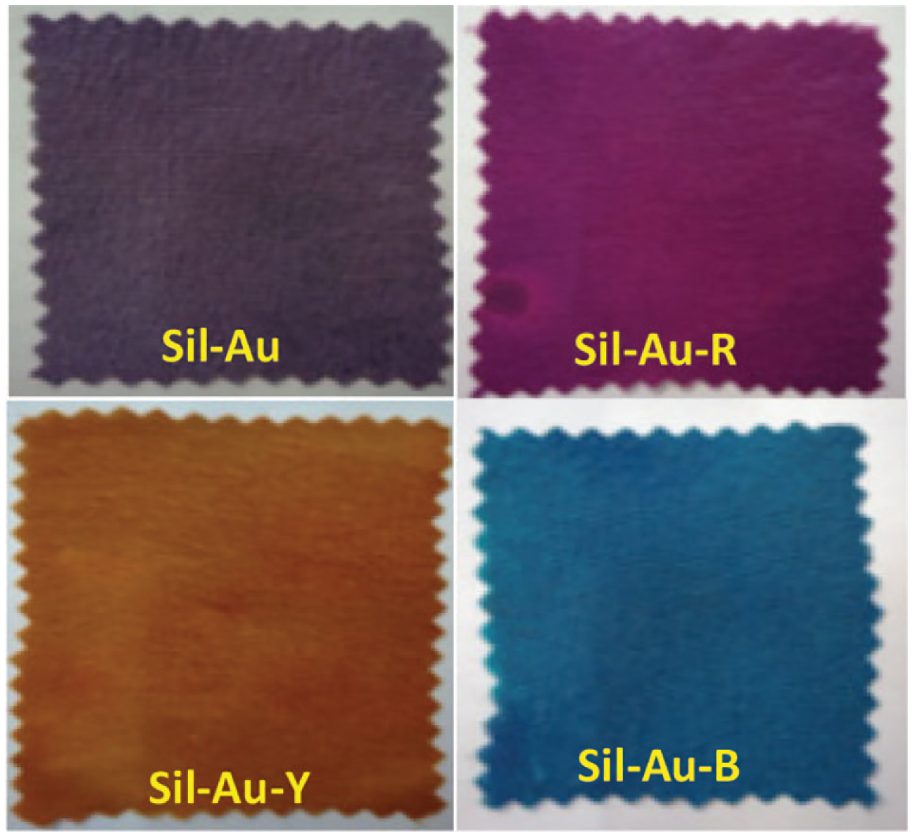
Photograph of silk fabrics colored with AuNPs and traditional dyes.

K/S curves of silk fabrics colored with AuNPs and traditional dyes: (a) Sil-Au, (b) Sil-Au-R, (c) Sil-Au-Y, and (d) Sil-Au-B.
UV-Vis diffuse absorption spectroscopy was employed to observe the optical properties of the silk fabrics dyed with AuNPs and dyes. The silk fabric colorated with AuNPs showed a main absorption band located at 563 nm (Figure 3(a)), which is attributed to the LSPR mode of AuNPs on silk fabrics. The data suggests that AuNPs were prepared in situ on silk fabrics by heat treatment. The silk fabric dyed with RY presented two UV-Vis absorption bands at 319 and 423 nm (Figure 3(b)). Two absorption bands at 301 and 440 nm appeared in the UV-Vis diffuse absorption spectrum of silk fabrics dyed with AuNPs and RY (Figure 3(c)). The Sil-Au-Y sample displayed the combined optical properties of AuNPs and traditional RY. The synergetic effect of AuNPs and traditional dyes could enrich the colors of silk fabrics. Moreover, the presence of AuNPs may render the functions of fabrics, such as the antibacterial activity.

UV-Vis diffuse absorption spectra of dyed silk fabrics: (a) Sil-Au, (b) Sil-Y, and (c) Sil-Au-Y.
Coloration and characterization of silk fabrics with AgNPs
In addition to AuNPs, AgNPs were used to colorate the silk fabrics by in situ synthesis method. The AgNP-treated silk fabrics showed yellow color (Figure 4), due to the LSPR effect of AgNPs on the surface of fibers. To extend the color range of silk fabrics, the three traditional dyes (RR, RY, and RB) were used to colorate the AgNP-treated silk fabrics. Bright colors were obtained on silk fabrics after dyeing with RR, RY, and RB (Figure 4). The colors of the silk fabrics exhibited the combined effects of AgNPs and traditional dyes. The K/S curve of the AgNP-treated silk fabric presented a peak at 370 nm, associated with the LSPR properties of AgNPs (Figure 5(a)). 17 The K/S values of the silk fabrics increased notably after the AgNP-treated silk fabrics were dyed with RR, RY, and RB, which is the same as the case of the AuNP-treated silk fabrics. The wavelengths corresponding to maximum K/S values were 460, 430, and 670 nm for Sil-Ag-R, Sil-Ag-Y, and Sil-Ag-B, respectively (Figure 5(b)–(d)).
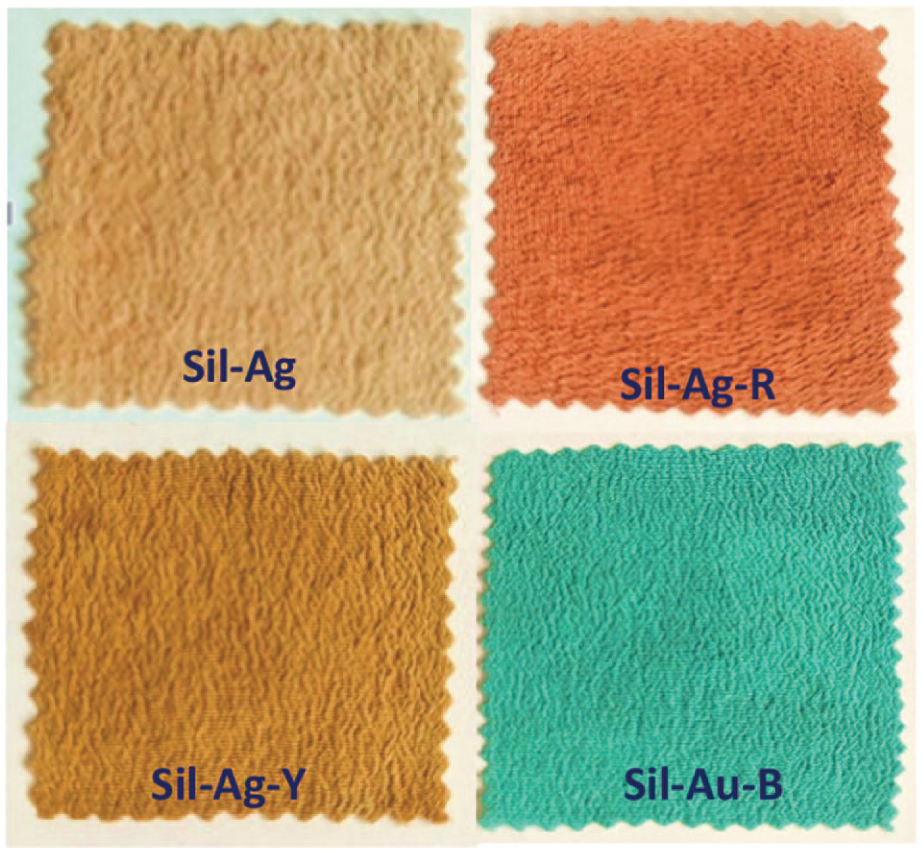
Photograph of silk fabrics colored with AgNPs and traditional dyes.

K/S curves of silk fabrics colored with AgNPs and traditional dyes: (a) Sil-Ag, (b) Sil-Ag-R, (c) Sil-Ag-Y, and (d) Sil-Ag-B.
UV-Vis diffuse absorption spectrum of the AgNP-treated silk fabrics displays a distinct absorption band at 432 nm (Figure 6(a)), ascribed to a characteristic LSPR mode of AgNPs, 27 which indicates that AgNPs were successfully in situ synthesized on the surface of silk fabrics. The optical properties of the silk fabrics with complex coloration from AgNPs and RB were analyzed to gain insights into the combined effect on colors of silk. The UV-Vis diffuse absorption spectrum of silk fabric dyed with RB shows two main bands at 349 and 677 nm, as well as a 614 nm shoulder band (Figure 6(b)). The absorption bands of silk fabrics after complex coloration with AgNPs and RB did not change observably in comparison with Sil-B (Figure 6(c)). However, the intensity in the range of 400–550 nm elevated, which is from the optical effect of AgNPs.
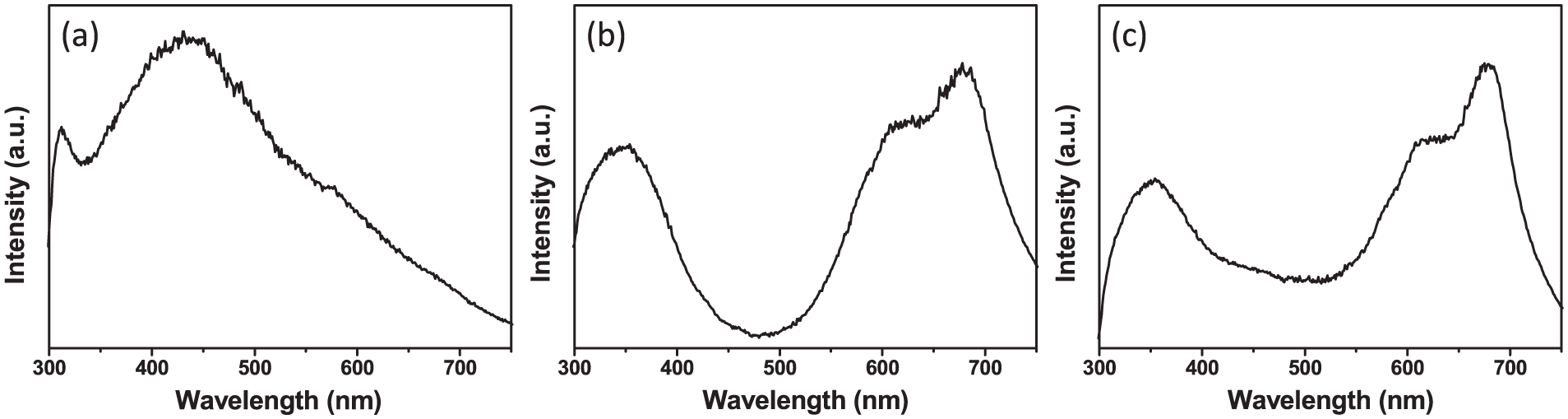
UV-Vis diffuse absorption spectra of dyed silk fabrics: (a) Sil-Ag, (b) Sil-B, and (c) Sil-Ag-B.
Morphological characterization
SEM characterization was performed to observe the morphologies of silk fabrics before and after coloration with noble metal nanoparticles and traditional dyes. The surface of pristine silk fibers was smooth without any impurities before coloration (Figure 7(a)). The surface of silk fibers was still neat after the silk fabrics were dyed with RR, indicating that dyeing process involving traditional dyes did not change the surface morphology of silk fiber though the dye molecules were bonded to silk fibers. Figure 7(c) displays the SEM image of Sil-Au. Some spherical and plate-like nanoparticles can be seen on the surface of silk fiber, demonstrating that AuNPs were synthesized on the silk fabrics. The existence of plate-like nanoparticles led to color change from red to purple when the concentration of Au ions increased to a certain range. 23 It should be noted that AuNPs were synthesized in situ on silk under acid condition. Base condition was adverse to in situ synthesis of AuNPs in the presence of silk. The SEM image of Sil-Au-R is shown in Figure 7(d). Numerous nanoparticles were distributed on the fiber surface, implying that the coloration of traditional dyes affected slightly the AuNPs on silk, which facilitates the complex coloration of silk based on AuNPs and traditional dyes. Figure 7(e) and (f) presents the SEM images of Sil-Ag and Sil-Ag-R, respectively. Many spherical nanoparticles were observed on fiber surface, indicating the AgNPs obtained on the silk fabrics. Different from in situ synthesis of AuNPs, base condition is favorable of the synthesis of AgNPs on silk, which is similar to the case of in situ synthesis of AgNPs on cotton. 17 Although the stability of AgNPs is weaker than that of AuNPs, the dyeing with RR did not influence the morphology of AgNPs on silk fibers (Figure 7(f)). These results demonstrate that the coloring process of traditional dyes showed slight impact on the noble metal nanoparticles on silk fabrics, resulting in the achievement of complex coloration of silk fabrics.

SEM images of different silk fabrics: (a) pristine silk, (b) Sil-R, (c) Sil-Au, (d) Sil-Au-R, (e) Sil-Ag, and (f) Sil-Ag-R.
Evaluation of antibacterial activity
Antibacterial properties of the silk fabrics colorated with AuNPs and dye were assessed against E. coli. Figure 8 shows the photographs of colonies of E. coli corresponding to different silk fabric samples. The agar plate for pristine silk is full of bacterial colonies, suggesting that the pristine silk has no antibacterial activity. The silk fabric dyed with traditional dye (RR) exhibited the similar result as the pristine silk. A large amount of colonies were seen on the agar plate for Sil-R, which reveals that the traditional dye did not possess any antibacterial effect. Compared with the plates for pristine and RR-dyed silk fabrics, no colonies were found on the plates for the silk fabrics after complex coloration (Sil-Ag-R and Sil-Au-R), which proves that the silk fabrics with AuNPs and AgNPs have a significant antibacterial activity. The CFU values of 99.96% for Sil-Au-R and Sil-Ag-R were close to be 100%. The combination of traditional dyes onto silk fabrics did not hinder the antibacterial effect of AuNPs and AgNPs.

Evaluation of antibacterial activity of different silk fabrics: (a) pristine silk, (b) Sil-R, (c) Sil-Au-R, and (d) Sil-Ag-R.
Conclusion
Complex coloration of silk fabrics was accomplished using noble metal nanoparticles and traditional dyes by heat treatment. AuNPs and AgNPs were synthesized in situ on silk fabrics by controlling pH values. The range of colors of silk fabrics with AuNPs and AgNPs were extended by coloration with three traditional dyes. The silk fabrics showed the synergetic optical effect of noble metal nanoparticles and dyes. The color strength (K/S) was improved through the complex coloration process. UV-Vis diffuse absorption spectroscopy demonstrated the LSPR optical properties of AuNPs and AgNPs on silk fabrics. Spherical and plate-like AuNPs were obtained during the complex coloration. The shape of all the AgNPs on silk fibers was sphere. The dyeing process involving traditional dyes did not affect the morphologies of AuNPs and AgNPs, facilitating the inheritance of LSPR features. Importantly, the silk fabrics after complex coloration exhibited a strong antibacterial activity. The treatment based on AuNPs and AgNPs not only endows silk fabrics with vivid colors, but also renders special functions to silk fabrics.
Footnotes
Declaration of conflicting interests
The author(s) declared no potential conflicts of interest with respect to the research, authorship, and/or publication of this article.
Funding
The author(s) disclosed receipt of the following financial support for the research, authorship, and/or publication of this article: This research was financially supported by the Doctoral Promotion Program of Zhuhai College of Jilin University and Cultivation Project for Innovation of Zhuhai College of Jilin University (2018XJCQ023). We would also like to acknowledge the research support from the National Natural Science Foundation of Guangdong Province (2016A030313830), National College Students’ Innovation and Entrepreneurship Training Project (201813684009), and University Innovation & Enhancement Project of the Education Department of Guangdong Province (2018KTSCX305).
