



Abstract
Coatings were prepared by using NdFeB flake-like microparticles with aqueous polyurethane polyol dispersions and were coated onto the surface of textile fabrics in order to obtain textile fabrics with good magnetic properties. X-ray diffraction and energy dispersive spectroscopy analysis showed that there was no significant oxidation and magnetic decline in the samples after 6 months. The surface morphologies of the textiles were characterized using scanning electron microscopy and optical microscopy. The results showed that the crack density (the number of cracks per unit area) increased with increasing magnetic microparticle content, which can be attributed to two reasons: on one hand, the stress concentration at areas of high powder concentrations fractured more easily; on the other hand, the expansion coefficients of magnetic microparticles and polymer materials are different. Three kinds of textile fabrics with different microparticle concentrations were magnetized by means of a magnetizing machine. It was found that the cotton knitted fabrics had the highest average surface magnetic induction intensity, reaching 19 mT when the content of magnetic microparticle was 50 wt%. It was considered that this was related to the magnetic field distribution, due to the surface friction coefficient of the textile fabrics and the positions/angles of the flake-like microparticles. The hysteresis loops were measured using a vibrating sample magnetometer, and the results showed that the higher the concentration of magnetic microparticles, the higher the magnetization of the fabric. In short, this method can be used to prepare fabrics with high magnetization required under special conditions.
Introduction
In recent years, significant progress in the development of new products has been made in all fields. In the field of textiles, smart fabrics are one of the most exciting innovations.1,2 It can be predicted that smart fabrics will greatly change our lives because of their stimuli-responsive reactions, which can be electrical, mechanical, magnetic, or from other sources. Magnetic textiles play an important role because they have great potential applications in the fields of medical treatment, smart clothing, electronic textiles, biomedicine, sportswear, protective clothing, and space exploration activities.
Magnetic textiles can be divided into one-dimensional fiber material, two-dimensional single-layer plane fabric, two-dimensional multilayer plane composite fabric, and three-dimensional solid structure fabric according to their morphological structures. The study of magnetic textiles mainly focuses on the preparation process, magnetic properties, and applications.
When considering the preparation methods of magnetic textiles, there are four main methods: conductive polymer coating, metal fiber or metallized fiber blending, metal coating, and in situ injection spinning. Traditional magnetic fibers are permalloy (Fe–Ni alloy) fibers with high magnetic permeability. The polymer-based magnetic fibers are typically prepared by adding magnetic powder into a spinning solution; this enables magnetic coils with a textile core to be built with magnetic fibers that consist of a cellulose matrix with a powdered magnetic modifier. 3 In addition, in situ sonosynthesis methods and co-precipitation techniques can also be used to prepare magnetic fabrics with magnetic nanoparticles.4,5
Magnetic textiles have a wide range of applications. These include providing conductive or antistatic properties, electromagnetic shielding, and radar-absorbing capabilities, in addition to being used for antennas, soft keyboards, and so on.6–10 Accordingly, the research focuses on the performances of magnetic textiles, when considering their wave absorbing and electromagnetic shielding properties.
Magnetic textiles can be used to exploit their electromagnetic characteristics for smart clothes. Furthermore, the unique strong magnetic properties of magnetic textiles can be combined with other microsensors that are being currently developed rapidly, which may be used in many potential applications. Most of the current studies focus on the weak magnetic properties of the textiles, which cannot meet the demand of strong magnetic textiles. The application of magnetic textiles is limited because of the weak magnetism, which hinders the innovation of the combination of magnetic fabric and microsensors.
Nd–Fe–B magnets have obtained considerable attention for their excellent magnetic properties of high maximum energy product and coercivity.11–13 Many kinds of the composites were prepared with bonded Nd–Fe–B magnets for improving thermal stability, mechanical strength, and so on, which provides clues for improving the magnetism of textiles.14,15 In this article, magnetic textiles were prepared with Nd–Fe–B for the first time by a coating method to obtain high magnetization. The effects of concentration and substrate fabric on the magnetic properties were studied.
Materials and methods
Raw materials
NdFeB flake-like microparticles were produced by the General Research Institute for Nonferrous Metals (GRINM). The mesh number of the powder was 200 meshes, and the particle size was approximately 75 μm.
Three common fabrics, plain woven cotton, knitted cotton, and plain woven polyester, were selected as substrate materials for the magnetic fabrics. As shown in Figure 1, the plain woven cotton fabric (a) and knitted cotton fabric (b) are examples of the same material but with different textures. The plain woven cotton fabric (a) and plain woven polyester fabric (c) both had a similar texture, but were composed of different materials and had a different fabric compactness and thread count. All the fabrics were manufactured in Arville Textiles Limited, UK, and were not treated before the research. The mass density and yarn density of the fabrics a, b, and c are (97 g/m2, 200 threads/10 cm), (232 g/m2, 200 threads/10 cm), and (141 g/m2, 400 threads/10 cm), respectively.

Optical microscope photographs of selected textile substrates: (a) plain woven cotton, (b) knitted cotton, (c) plain woven polyester, and the diagrams of: (d) a typical knitted structure and (e) a typical woven structure.
The composition and structure of the polyol dispersion played an important role in the performance of the coating, as the dispersion acted as the main solvent of polyurethane coating. As the polyurethane polyol comprises an ideal two-component polyurethane hydroxyl system, it had the ability to flexibly adjust the properties of the coating film. Accordingly, the aqueous polyurethane polyol dispersion TEGO VARIPLUS DS50 was used.
Sample preparation
After weighing the magnetic powder and dispersant at different concentrations (as shown in Table 1), the mixture was stirred for 5 min. The magnetic coating was applied onto the substrate fabric, and the thickness of the coating was controlled by using the K-bar (RK PrintCoat Instruments Ltd., Litlington, Royston Hertfordshire, UK) K-hand coater. Three concentrations of samples (10%, 33%, and 50%) were prepared to study the effect of magnetic particle concentration on the properties of textile fabrics. In particular, for plain woven fabric, higher concentrations (70%) of samples were also selected because of the need for a medical testing device being studied. Usually, this structure of the fabric is used in the testing.
Details of the sample preparation.

Measuring methods
X-ray diffraction (XRD) analysis was carried out using a RIGAKU diffractometer with a Cu Kα radiation source. The microstructure and morphology of the samples were visualized and analyzed using a VHX digital microscope (Keyence VHX-2000, VH-Z250R lens) and a Nova nanoSEM 450 type scanning electron microscope (SEM).
The intrinsic magnetic properties of the samples were measured using a vibrating sample magnetometer (VSM, Lakeshore 7400 series). The surface magnetic induction strength was measured using a tesla meter (TM-801 EXP; Kanetec, Bensenville, IL, USA) after the magnetic textile samples were magnetized using the pulse magnetizing apparatus (CKME-PC2000). The Tesla probe was clung to the surface of the sample to ensure the consistency of the measurement distance. A plastic film was covered on the surface of the sample, to prevent the contact between the probe and the surface from affecting the measurement results. In order to reduce the influence of uneven composition, the surface magnetic induction intensity was measured at nine uniform points in the area of 1 cm2. The averages were then calculated.
Results and discussion
Figure 2 shows the XRD patterns of both the NdFeB powder and the magnetic textile sample 3. It can be observed that the powder structure was characterized as a tetragonal Nd2Fe14B phase according to the characteristic diffraction peaks (004) at 27°, (105) at 37°, (006) at 44°, and (008) at 61°. The structure did not change after the powder was mixed with the aqueous polyurethane polyol dispersion and solidified. This indicated that the magnetic particles were protected by dispersant, which hindered the oxidation of the particles. NdFeB particles were rarely used in previous studies of magnetic fabrics for two reasons: on one hand, the alloy is expensive; on the other hand, it is easy to oxidize in the preparation process. XRD results show that the method is reliable in preventing oxidation in this work.

XRD patterns of NdFeB powder and sample 3.
As shown in Figure 3(a), it can be clearly observed that the magnetic powder in the coating is densely covered over the surface of the textile under the microscope light. A clearer surface morphology of the coating can be observed by SEM in Figure 3(b). However, it is difficult to identify the metal powder because the samples were coated with yttrium for the SEM analysis. In order to determine the exact position of the magnetic powder, a rectangular region was selected in the SEM image for energy dispersive spectroscopy (EDS) analysis, and the EDS mapping was obtained as shown in Figure 3(c). Considering the content of B in Nd2Fe14B powder is low, the position of the powder was indicated only by detecting content of Nd and Fe. It was found that a low concentration of powder was embedded in the textile fibers; however, there were areas of higher powder concentration in the indentations between fibers.

(a) Optical microscope photograph, (b) SEM image, and (c) EDS mapping of sample 3.
Figure 4 shows the SEM images of samples 1, 2, and 3. The first three images and the last one are the results of surface observation and side view, respectively. It can be seen that the dry film thickness of sample 3 is about 46.76 μm. It is easy to observe a large number of cracks on the coating surface of the sample. Further comparison shows that the crack density of sample 1 is the smallest and the crack density of sample 3 is the largest. The results show that the crack density increases with increasing magnetic powder content. The results are attributed to the following two reasons: first, the stress concentration at the intersection of the powder and the polyurethane is highly concentrated, meaning that fracture occurs easily. Second, the change in the volume of the coating causes fracture because the thermal expansion coefficients of the metal powder and the polyurethane are different. In addition, the composition of the adhesive is an important factor. In this work, the main concern is the functionality of textile fabric, that is, the key goal is to obtain high magnetic induction intensity, so only using the aqueous polyurethane polyol dispersion as adhesive will inevitably lead to cracks, even at low magnetic powder concentration. Next, on the basis of obtaining excellent magnetic properties, the formulation of adhesive will be optimized, which is very important to the fabric.
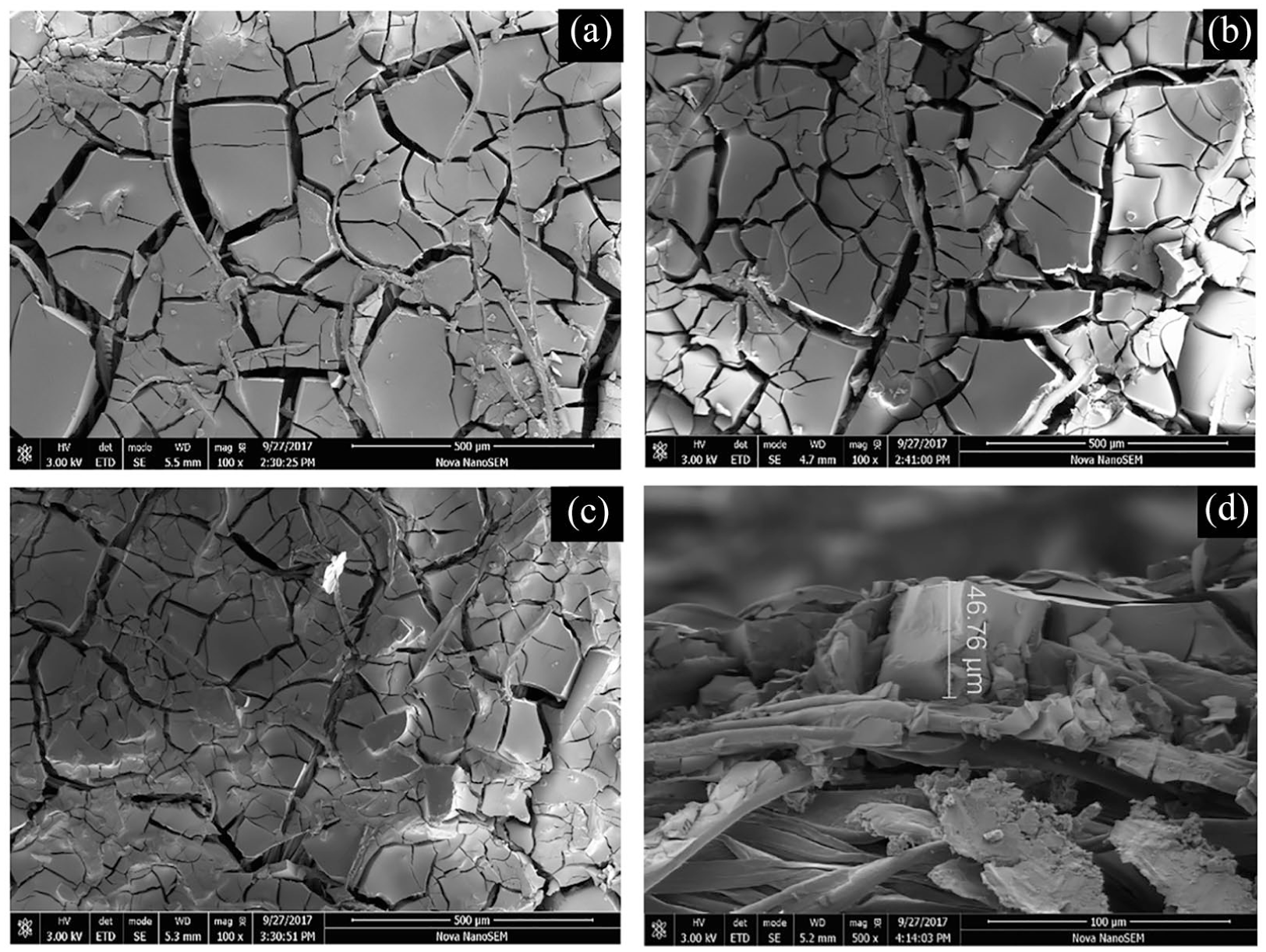
SEM images: surface observation for (a) sample 1, (b) sample 2, (c) sample 3, and side view for (d) Sample 3.
The intensity and direction of the magnetic fields of magnetic materials are usually characterized by the magnetic induction intensity. The magnetic induction intensity of the magnetic fabric originates from the magnetic particles in the coating. The surface magnetic induction intensity of the fabric is not uniform because the magnetic particles are distributed unevenly in the fabric. Therefore, the average value is used to denote the surface magnetic induction intensity of the whole fabric.
As shown in the diagram of the measurement method in Figure 5, the fabric was cut into a square with a side length of 1 cm, covered with a thin plastic film with nine uniform lattices, measured three times in each lattice with a Tesla meter, and averaged. Finally, the magnetic induction intensity of the sample was obtained by averaging the measured values of nine lattices.

The diagram on the right shows the method for measuring surface magnetic induction strength with a photograph of sample 3. The three curves on the left show the dependence of magnetic induction intensity on the content of magnetic powder on three different substrates. The error bars in the diagram show the standard deviation of the measured value of magnetic induction intensity.
The results showed that the magnetic induction intensity of the sample based on knitted cotton fabric was the highest, followed by the plain woven cotton fabric. The sample based on plain woven polyester fabric had the lowest magnetic induction intensity among the three kinds of fabrics selected for these experiments.
The analysis showed that cotton is rougher and softer than polyester, so it had the ability to retain magnetic microparticles more easily when using the K-bar to apply the magnetic coating. In addition, due to the larger contact angle value for polyester compared to the cotton, 16 the number of particles and polymer species that flowed into the pores of the polyester was less than that of the cotton; the amount of NdFeB particles present within the fabrics was shown to be the crucial factor in determining the magnetic induction intensity. That is why the magnetic induction intensity of the cotton was higher than that of the polyester.
It was revealed that the fabric weave design had a significant effect on fabric wetting time and water spreading speed. 17 It is shown in Figure 1(d) and (e) that the knitted fabric had a larger number of voids than the woven fabric within a square unit area, due to their fabric structures. Therefore, the knitted fabric had a higher surface energy and more effective wetting properties than the woven fabric, which resulted in a greater number of particle affinities to the knitted fabric. Hence, the knitted cotton fabric had a higher magnetic induction intensity than the woven cotton fabric. In addition, for the fabrics comprising the same material but with different textures, the knitted fabric substrates had a higher friction coefficient than the plain fabric substrates. This helped the fabrics to retain more magnetic powder and show higher magnetic induction intensities under the same conditions.
In addition, the magnetic induction intensity on the surface of the textile fabric is related to the shape anisotropy of the flake powder. On one hand, the magnetic induction intensity of flake powder is different in different directions, that is, it has vertical anisotropy or plane anisotropy. Therefore, the direction of the single flake powder and its angle with the substrate have an effect on the surface magnetic induction intensity. On the other hand, the relationship between the position and angle of the powder also affects the surface magnetic induction intensity. Different substrates lead to different preferential occupation of magnetic powder, so the surface magnetic induction intensity is significantly different.
It can be seen that the magnetic textiles with knitted cotton fabrics (red curve) had the best magnetic properties of the three substrate fabrics, and the average surface magnetic induction intensity reached 19 mT when the content of the magnetic microparticles was 50 wt%. The black curve showed that the surface magnetic induction intensity of the plain woven cotton samples was as high as 27 mT when the content of magnetic powder was 70 wt%. This was 10 times higher than the properties of the magnetic textiles prepared by other methods.18–21 However, each of the different magnetic textile substrates had a similar performance; that is, the surface magnetic induction intensity of the fabric increased approximately linearly with the increasing content of magnetic particles in the fabric.
Figure 6(a) shows the hysteresis loops of coatings with different concentrations of magnetic powder on plain cotton textile fabric. It can be seen that the magnetic powder on the fabric is not saturated, so the coercivity (≈12,000Oe ≈ 960 kA/m) has not reached the maximum, but it is still higher than the value (≈125 kA/m) in the reference. 19 It can also be observed that the coercivity of this series of samples did not change much, which indicates that the concentration of magnetic powder was not sensitive to the coercivity of the magnetic textiles. However, the maximum magnetization and remanence showed significant changes. It can be seen from Figure 6(b) that the maximum magnetization and remanence increased with the increase in the concentration of magnetic powder. The dependence of the maximum magnetization on the concentration of magnetic powder was highly consistent with that of the plain woven cotton series in Figure 5, which suggests that the content of magnetic powder was the key factor affecting the magnetic properties of magnetic fabrics. Similar to the magnetic loops of magnetizing barium ferrite (hard magnetic) and fibers including 50 wt% of barium ferrite, the coercivity is mainly determined by the type of magnetic powder, and the magnetic induction intensity is strongly dependent on the concentration of the magnetic powder. 19

(a) Hysteresis loops of coatings with different concentrations of magnetic powder on plain cotton textile fabric, and (b) the dependence of the maximum magnetization and remanence on the magnetic powder concentration.
Figures 5 and 6 show that the fibers with excellent magnetic properties can be prepared by this method. Unlike most of the current studies, which focus on the weak magnetic health effect or magnetic shielding effect, the high magnetic textile made of giant magnetic powder will open up new applications because of its noncontact force.
Conclusion
The coatings were prepared by using NdFeB flake-like microparticles with aqueous polyurethane polyol dispersions and were coated onto the surface of the textile fabrics. The magnetic properties of magnetic textiles and their important influencing factors were studied. The results showed that the surface magnetic induction intensity of plain woven cotton-based fabrics was up to 27 mT when the content of magnetic powder was 70 wt%. This indicates that magnetic textile fabrics with good magnetic properties can be prepared using this method.
The study found that the material substrate had a significant effect on the magnetic properties of the magnetic fabric. The magnetic induction intensity of the samples based on the knitted cotton fabric was the highest, followed by the plain woven cotton fabric. The sample based on plain woven polyester fabric had the lowest magnetic intensity among the three kinds of fabrics selected in the experiment.
It was also found that the maximum magnetization and remanence increased with the increase in the concentration of magnetic powder. Analysis suggested that the magnetic powder concentration was the key factor in influencing the magnetic properties of magnetic fabrics.
Furthermore, there are many factors such as the material, position, angle, and direction of magnetization of magnetic powder, which need to be researched further to improve the magnetic properties of magnetic textiles.
Footnotes
Declaration of conflicting interests
The author(s) declared no potential conflicts of interest with respect to the research, authorship, and/or publication of this article.
Funding
The author(s) disclosed receipt of the following financial support for the research, authorship, and/or publication of this article: This project was supported by the Natural Science Foundation of Tianjin (18JCYBJC87100).
