



Abstract
A computer-controlled electronic universal testing machine was used to test the mechanical properties of polypropylene macro fiber, including tensile strength, breaking elongation, and elastic modulus. The mechanical properties were compared with fibers soaked in an alkali solution and heat treated. The dispersion, corrosion resistance, and toughness of the polypropylene macro fiber in concrete were also analyzed via a fiber concrete test. The polypropylene macro fiber has a high tensile strength, large elastic modulus, and good ductility. The polypropylene macro fiber has heat resistance and alkali resistance. After heat treatment, the maximum breaking force, tensile strength, elastic modulus, and elongation at breaking are more than 92.0% of baseline. After alkali solution treatment, the maximum breaking force, tensile strength, elastic modulus, and elongation at breaking reach more than 88.0% of baseline. The surface of the polypropylene macro fiber is concave and convex; the cross section is X type, and the bite force is powerful between the concrete and the fiber. Compared to steel fiber, the polypropylene macro fiber is light and small. At the same volume content, the input number of the polypropylene macro fiber per volume concrete is more than that of steel fiber, and it is easy to evenly disperse the material. It has corrosion resistance and high toughness when the polypropylene macro fiber is mixed in the concrete.
Keywords
Introduction
Concrete is widely used in civil engineering, transportation, and water conservancy projects due to its low price, easy availability of raw materials, easy molding, and good durability. However, it also has some inherent defects such as brittleness, easy cracking, low tensile strength, poor toughness, poor impact resistance, low energy, and other shortcomings. These defects limit its wider applications in engineering.1–3 Fiber-reinforced concrete is a new type of concrete composite material with significantly improved tensile and impact resistance. This approach increases the toughness of the concrete and controls cracking. It has been widely used in tunnels, subways, roads, and airports as well as water conservancy projects, bridges, and other public engineering.4–9
Fiber-reinforced concrete is a composite material composed of fiber and the concrete matrix. Current examples include steel-fiber concrete, fiberglass concrete, and polypropylene (PP)-fiber concrete. The latter is still at the research and development stage. Steel fiber–reinforced concrete technology is relatively mature, and the steel fiber is easily agglomerated when mixed. It is poorly dispersed, difficult to construct, and causes problems with rust in tandem with sulfide or chloride ions. This seriously affects the life of concrete. If road projects use steel-fiber concrete, then the steel fibers in the pavement can puncture vehicle tires, causing traffic accidents. Glass-fiber reinforced concrete has decreased strength and toughness after exposure to the atmosphere. The alkali resistance of glass fibers is poor, and these problems hamper their practical applications.
Carbon fibers are also an ideal tool for reinforced concrete, but they are limited by cost and difficulty of fabrication. PP fibers are a high-strength special fiber mainly made of PP combined with additives. This new polymeric building material has high strength, good chemical stability, low density, no water absorption, and low price. However, the strength of normal PP fibers is low, and the diameter of the monofilament is generally 15–45 μm. The improved mechanical properties are not obvious. 10 In this experiment, we describe novel concave–convex PP macro fibers, including their mechanical properties and alkali, heat, and corrosion resistance. The results provide the basis for concave–convex PP macro fibers in concrete engineering.
Mechanical properties test
Material parameters
The concave–convex PP macro fiber has a density of 0.91 mg/mm3, a unit length weight of 3300 dtex, an equivalent diameter of monofilament of 0.68 mm, and a cross-sectional area of 0.363 mm2. The test fibers are shown in Figure 1.

The tested PP fiber.
Test method
The tensile strength of PP macro fiber is determined via a protocol developed for carbon fiber multifilaments GB/T 3362-2005. 11 The specific test procedure is as follows:
Put the PP macro fiber into the universal testing machine with a measurement range of 10 kN (Figure 2); ensure the effective length of the fiber tensile testing area is 200 ± 5 mm.
The test parameters are established through the computer control program; the tensile rate is 300 mm/min.
During the test, ensure that the temperature is 23 ± 2°C and the relative humidity is 50% ± 10%.
The maximum tensile force and elongation are recorded after tensile failure of the specimens; save the corresponding data in the computer.
The heat resistance treatment method of the fiber involved baking at 120°C for 48 h, cooling to room temperature, and measuring its tensile mechanical properties according to the above process.
The alkali resistance treatment involved setting the temperature to 23 ± 2°C with a relative humidity of 50% + 10%. This was then soaked in a pH 12.5 solution for 7 days. It was then dried, and the tensile mechanical properties were measured as above.
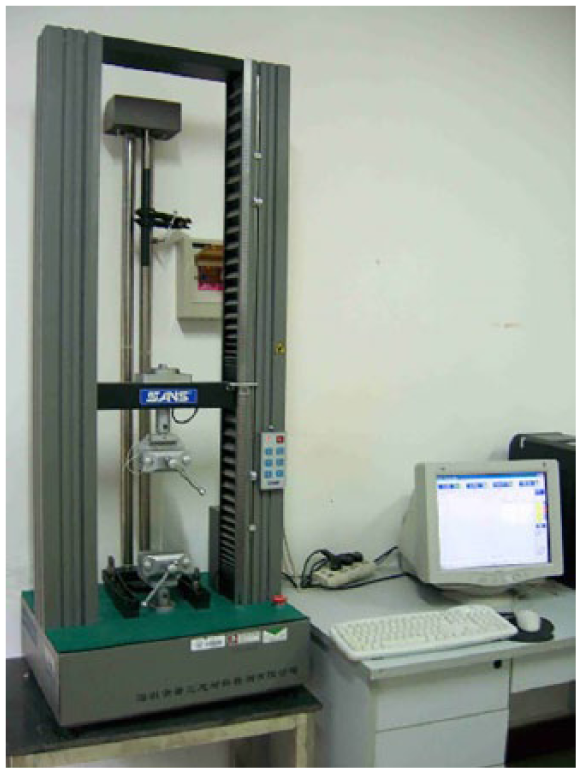
Computer-controlled electronic universal testing machine.
Test calculation
Tensile strength
Fiber tensile strength calculation formula is

where σt is the tensile strength of the fiber (MPa), P is the maximum load of fiber tensile failure (N), ρ is the fiber density (kg/m3), and t is the fiber linear density (kg/m).
The fiber tensile strength is calculated by the arithmetic mean of 10 samples’ measured values with accuracy of 0.1 MPa. If the sample’s maximum and the minimum measured value are greater than or less than 15% of the mean value, then this sample’s value is discarded. The arithmetic mean of the remaining values is taken as the tensile strength of the fiber. The calculation method of the tensile elastic modulus and the elongation at breakage are similarly treated.
Tensile elastic modulus
Fiber tensile elastic modulus calculation formula is

where Et is tensile elastic modulus (GPa), ΔP is the stress–strain curve straight-line-segment-intercepted load increment value (N), L is fiber’s effective tensile length (mm), and ΔL is the ΔP’s length deformation increment (mm), other symbols have the same meaning as above.
Elongation at breakage
Fiber elongation at break calculation formula is

where, εt is the elongation at break, %; ΔLb is the effective tensile length’s elongation at breakage, mm.
Test result analysis
In the test, 10 samples of the first group were under normal test conditions, 10 samples of the second group were heat treated in a 120°C oven for 48 h, and 10 samples of the third group were soaked in a pH 12.5 solution for 7 days. The maximum breaking force, tensile strength, modulus of elasticity, and elongation at break of three group samples were measured as shown in Table 1.
Mechanical parameters of the polypropylene macro fibers in different test conditions.
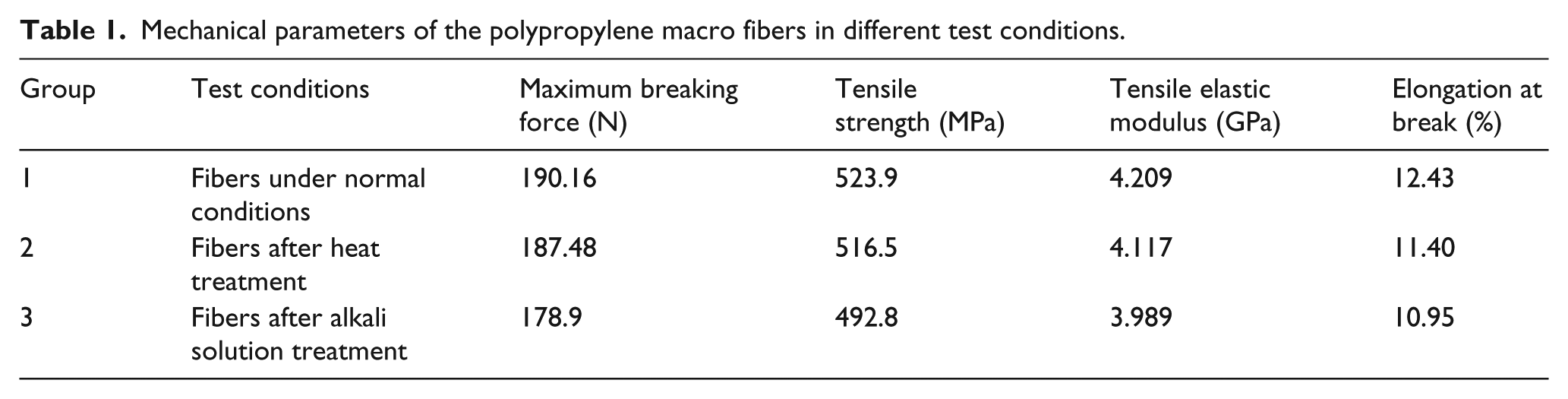
From Table 1, after heat treatment of the PP macro fibers, the maximum breaking force, tensile strength, elastic modulus, and elongation at break of the fiber are 98.6%, 98.6%, 97.8%, and 91.7% of baseline (Group 1), respectively. After alkali solution treatment, these values are 94.1%, 94.1%, 94.8%, and 88.1% of baseline (Group 1), respectively.
Characteristics analysis
Shape feature
The new PP macro fiber cross section is a unique X type. It processed through a concave and convex form with an irregular shape over four meridian surfaces. The surface area increased with excellent bite force. Figure 3(a) is the concave–convex PP macro fiber’s surface photo. Figure 3(b) is an idealized and amplified X-shaped section. Figure 3(c) is obtained according to fiber-reinforced concrete test specimen cut in cross section.

Concave-convex PP macro fiber’s photos: (a) concave–convex PP macro fiber’s surface photo, (b) PP’s idealized section shape, and (c) PP’s section shape in concrete.
Density and size effect
The PP macro fiber has a density of 0.91 mg/mm3 and an equivalent diameter of monofilament of 0.68 mm, which is 15–45 times that of normal PP fiber (an equivalent diameter of monofilament is 15–45 μm). The length of the PP fibers mixed in the concrete is 40 mm. The size and shape of the fibers are similar to steel fibers; the PP macro fiber is shown in Figure 4(b). The tested steel fiber, which is the wave mark type, has a density of 7.85 mg/mm3, an equivalent diameter of 0.8 mm, an aspect ratio of 38, and a tensile strength of 685 MPa. The length of the tested steel fiber is 30 mm; it is shown in Figure 4(c). Compared to the steel fiber, the PP macro fiber is lighter with more fibers per cubic meter of concrete. Table 2 shows sample metrics when the fiber volume content is 0.1%, 0.3%, 0.5%, and 1.0%. The cross-sectional fiber of the specimen with 1.0% volume content is shown in Figure 5.

Comparison of different PP fiber shapes: (a) normal PP fiber, (b) concavo-convex PP macro fiber, and (c) steel fiber.
Comparison of the polypropylene macro fiber and steel fiber on the cross section of concrete sample.
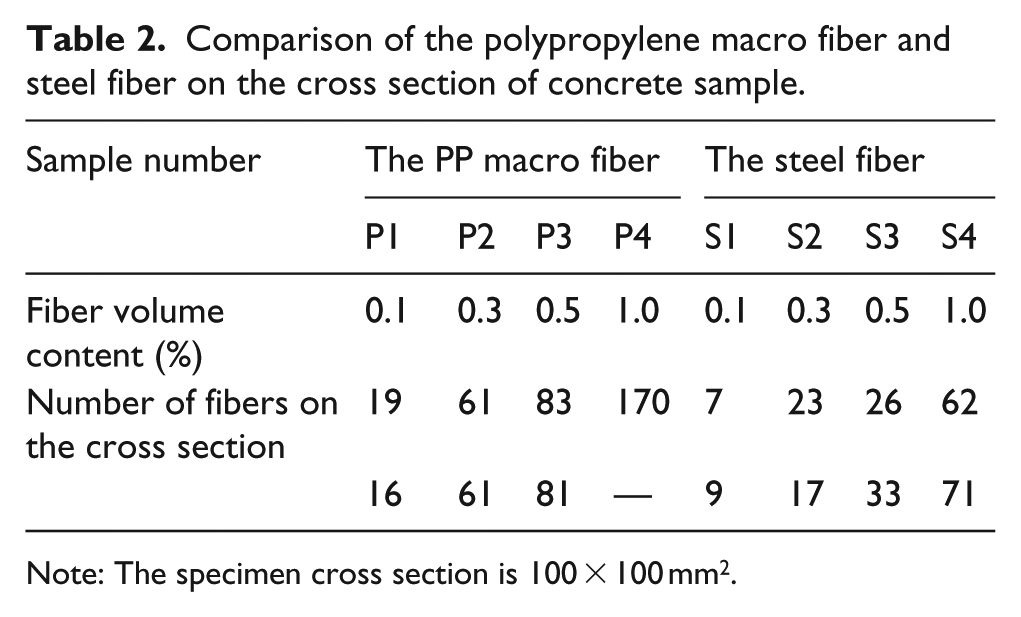
Note: The specimen cross section is 100 × 100 mm2.

Comparison of the fiber number on cross section of different specimen with 1.0% fiber volume content: (a) steel-fiber concrete and (b) PP macro fiber concrete.
Table 2 and Figure 5 show that the PP macro fiber number is about two or three times more than that of steel fiber on the concrete specimen’s cross section at the same volume content. Furthermore, with the increase of the fiber volume content, the number of the input PP macro fiber in per volume of concrete is larger, and the number of fibers on each section is also increased.
Dispersion in concrete
The fiber distribution in an impact failure test of the concrete slab is shown in Figure 6. The fiber volume content of specimens are 0.3% PP macro fiber and 0.3% steel fiber, respectively. The PP macro fibers are evenly distributed in the concrete slab (Figure 6). After impact loading, the central part of the flat plate cracks, but the concrete does not completely fall off due to the pulling effects of the PP fiber. The distribution of the steel fibers in the concrete slab is uneven, and the parts without steel fibers fall off completely under impact loading. This is because of the condensation caused by steel fibers. A hydrophilic treatment significantly improves the PP fiber dispersion in the concrete. Compared with steel fiber, the concave–convex PP macro fiber avoids defects for easy clumping, poor dispersion uniformity, and difficult construction when stirred.

Fiber distribution in concrete slab impact test: (a) steel-fiber concrete slab and (b) concave–convex PP macro fiber concrete slab.
Corrosion resistance
The concave–convex PP macro fiber concrete and steel-fiber concrete specimens were cured in a conservation room with temperature of 20°C and humidity more than 95% for 28 days. Surface corrosion photos are shown in Figure 7. The concrete specimens with steel fibers are completely corroded with steel fibers on the surface. The concrete specimens with PP macro fibers have no rust phenomenon. This is because of the concave–convex PP macro fiber is an organic fiber with permanent rust-free properties.

Corrosion comparison of steel fiber and PP macro fiber in fiber concrete specimens: (a) specimens with steel fibers and (b) specimens with the PP macro fibers.
High toughness in concrete
The concave–convex PP macro fiber is added in C30 concrete at 0.3% and 0.5% volume content, respectively. The steel fiber is added in C30 concrete at the same volume content, too. According to the flexural toughness test (Figure 8), the load-deflection curve of different fiber-reinforced concrete is shown in Figure 9. The toughness coefficients of concrete with 0.3% and 0.5% PP macro fibers are 1.432 MPa and 2.452 MPa, respectively. The toughness coefficients of concrete with 0.3% and 0.5% steel fiber are 1.291 MPa and 1.973 MPa, respectively. The toughness coefficient of concrete without fiber is only 0.513 MPa. The load-deflection curve shows that the concrete with the PP macro fiber still has a greater bearing capacity after the initial cracking of the concrete. This is due to the fibers’ large elongation at breaking and the larger tensile strength during the later period of initial cracking. When the concrete has a large deformation, damage occurs and the bearing capacity decreases. The steel-fiber concrete’s bearing capacity decreases sharply after the initial cracking of the concrete and finally disappears completely. For concrete without fiber, the bearing capacity drops sharply after the initial cracking of the concrete and the bearing capacity disappears immediately after the damage occurs. It shows that the toughness increases greatly when the concrete is mixed with concave–convex PP macro fibers.

Concrete flexural toughness test.

Comparison of flexural toughness test curves of different fiber concrete: (a) PP macro fiber concrete, (b) steel-fiber concrete, and (c) concrete without fiber.
Conclusion
The concave–convex PP macro fiber has high tensile strength, large elastic modulus, and good ductility. The maximum breaking force, tensile strength, elastic modulus, and elongation at breaking are 190.16 N, 523.9 MPa, 4.209 GPa, and 12.43%, respectively. The concave–convex PP macro fiber has high heat and alkali resistance. After heat treatment, the strength and deformation loss are 2% and 7%, respectively. After alkali solution treatment, the strength and deformation loss are 6% and 10%, respectively.
The concave–convex PP macro fiber is light and small. Under the same volume content, the PP macro fiber number input per volume of concrete is more than that of steel fiber. The PP macro fiber is easily dispersed in concrete and avoids the bad effects that come from steel fiber (poor dispersion and knotting during construction).
The concave–convex PP macro fiber is organic and is rust-free unlike steel fibers. This rust can affect the durability of the fiber concrete. The PP fiber–reinforced concrete has high toughness and good bearing capacity.
Footnotes
Declaration of conflicting interests
The author(s) declared no potential conflicts of interest with respect to the research, authorship, and/or publication of this article.
Funding
The author(s) received no financial support for the research, authorship, and/or publication of this article.