



Abstract
In this article, porosity and air permeability of denim fabric produced from filament core-spun yarns with different filament fineness and yarn linear density were demonstrated. For this purpose, 110 dtex drawn textured polyester filaments with conventional, fine, and micro finenesses were used as core part, and combed cotton fiber was used as sheath part to obtain core-spun yarns with four different yarn linear density on a modified ring spinning system with the same spinning parameters. Besides the production of core-spun yarns, 100% cotton ring-spun yarns were produced as control group at the same conditions for each yarn linear density, as well. To evaluate the effect of filament fineness and yarn linear density on air permeability and total porosity, denim fabrics were obtained by using 24 yarn samples as weft at the same cover factor with four determined weft densities. Results showed that filament fineness and yarn linear density have a significant effect on total porosity and air permeability at a significance level of 0.05. In addition, high correlation (79.4%) between air permeability and total porosity of denim fabric samples was observed at a significance level of 0.01.
Introduction
In determination of the appropriate comfort properties of fabrics, air permeability has great influence on transportation of the moisture from body to environment, apparel comfort, thermal insulation properties, the rate of liquid penetration during wet processing, and liquid removal during drying of fabrics.1–4 Air permeability of woven fabric is mainly dependent on the fabric structural property that is related to fiber density, linear density of warp and weft yarns, type of yarn, weave construction, warp and weft density etc.4–6 All these parameters have strong effects on porosity of fabric which can be expressed as the ratio of air space to the total volume of the fabric expressed as percentage.1–3,7–10 The total porosity of woven fabrics comprises two types of pores: pores between warp and weft yarns (inter-yarn porosity or macro porosity) and void space contained between the fibers in the yarn (intra-yarn porosity or micro porosity).3,6,7 Total porosity of fabrics made from monofilament yarns in both warp and weft equals the macro porosity. Macro porosity is important factor to evaluate air permeability, ultraviolet (UV) rays transmission, besides; micro porosity will affect absorption of humidity and capillary characteristic. Meanwhile, moisture management properties of fabrics are affected by both micro and macro porosity as well. 2 The estimation of the air permeability is theoretically based on the calculation of the porosity of the fabric. 10
There are various studies about the evaluation of the woven fabric porosity in terms of geometrical methods, liquid intrusion methods, liquid extrusion methods and liquid through method.1,11–27 The relationship between the fabric structural parameters which determine the pore volume within the fabric and air permeability is very complicated and this situation makes the assessing of pores more difficult in connection with weave construction, warp and weft interlacement, yarn type etc. that influence the porosity. Nevertheless, it is stated that comparing porosity parameters between two fabrics in relation to their permeability properties is better the porosity on its own. 2
Total porosity can be calculated in accordance with equations (1) and (2) as shown below


where
In the porosity estimation of the woven fabric made of blended yarns,

where
Total fiber density within woven fabric structure, when different weft and warp yarn types, density etc. are taken into consideration can be determined with equation (4)

where
It is generally easier to determine the macro porosity of woven fabrics from easily calculated fabric density and fiber density, whereas the number of pores can be subtracted from the number of interlacing points given by warp and weft density. Nevertheless, as a construction parameter, the fabric used certainly influences the shape and dimension of the pores. 2 The prediction of the permeability of fabrics made of filament core-spun yarn has rarely been reported, although open literature reveals the majority of fabric permeability.
In the present study, the effect of filament fineness, yarn linear density on woven denim fabrics macro porosity was calculated. The influence of the micro porosity was eliminated. Total porosity of woven denim fabrics made from core-spun and staple (100% Cotton) ring spun yarn as weft were calculated. Cotton covered core-spun yarns with different filament fineness (conventional, fine and micro) and yarn linear density were produced and used as weft in the production of the denim fabric. The effects of filament fineness and yarn linear density on total porosity and air permeability were evaluated. To understand the significance of filament fineness and yarn linear density on air permeability and total porosity, statistical analysis of variance (ANOVA) and Duncan’s multiple range tests for the determination of the effect of subgroups were performed at the significance level of 0.05 with SPSS-18 package program. Also, the Pearson correlation analysis was achieved to put forward the relationship between total porosity and air permeability of the denim fabrics.
Material and methods
For the purpose of this study, 110 dtex drawn textured polyester (PET DTY) filaments with different filament fineness i.e. 110dtex f36, 110dtex f96, 110dtex f144, 110dtex f192 and 110dtex f333 were used as core part to manufacture combed cotton covered filament yarns at four different yarn linear densities (37 tex, 30 tex, 25 tex and 21 tex). All production parameters were kept constant with the value of twist factor (αe) 3.9 and 8000 rpm spindle speed on modified ring spinning system which is illustrated in Figure 1. 31 Cotton (100% CO) ring-spun yarns were also produced as a control group to compare and analyze the differences between core-spun yarns for each yarn linear density at the same spinning conditions.

Principle of core-spun yarn production by adding filament core by means of V-grooved roller (it may not be reproduced without permission): (a) modified ring spinning frame, (b) combination of materials, and (c) simulated longitudinal and cross-sectional view of core-spun yarn containing filaments. 30
The linear density 37 tex, 30 tex, 25 tex, and 21 tex combed cotton covered core-spun yarns, combed 100% CO ring-spun yarns were used as weft yarn, and 30 tex combed 100% CO ring-spun yarn was used as warp yarn to obtain 3/1 twill weave denim fabrics. The preparation of warp yarns included mercerization with caustic soda ash and then prewashing process, dyeing at slasher indigo dyeing machine, final washing, and sizing/slashing process. All denim fabrics were produced on a Picanol GamMax rapier weaving machine and production parameters were kept constant (525 r/min machine speed, 190 cm reed width, 90 dents/4 warps reed number), only weft yarn density was determined in accordance with the same cover factor for each yarn linear density which was calculated using equation (5)2,6,32

where
In this study, diameter of warp and weft yarns were estimated for staple yarns with equation (6) given below 29

where
The properties of core-spun yarns and 100% combed CO ring spun yarns. 33

CO: cotton: TPI: twists per inch.
Fabric thickness, fabric weight, warp and weft density, cover factor, total porosity, and air permeability of denim fabrics were determined after singeing, desizing, finishing processes, and thermal fixation.
Denim fabrics were conditioned in a standard atmosphere at 20°C ± 2°C temperature and 65% ± 4% relative humidity for 24 h. Air permeability tests were carried out according to the ISO 9237: 1995—Textiles—Determination of the permeability of fabrics to air. A total of 20 tests were achieved for each denim fabric samples on SDL Atlas air permeability tester at 100 Pa test pressure on an area of 20 cm2.
To determine the weight fraction for each yarn linear density of core-spun yarn combining textured filament, core/sheath ratio (%) of each yarn linear density was taken into consideration. In addition, for 37 tex yarn linear density, core/sheath ratio (%) is 30/70; for 30 tex yarn linear density, core/sheath ratio (%) is 37/63; for 25 tex yarn linear density, core/sheath ratio (%) is 45/55; and finally, for 21 tex yarn linear density, core/sheath ratio (%) was 52/48. Density of cotton and polyester fiber was taken as 1.52 and 1.38 g/cm3, respectively. 28 The average density of weft yarn samples were determined with equation (3), and fiber density of the denim fabric samples were calculated with equation (4). Finally, total porosity of denim fabric samples were also determined by using fiber density, fabric weight, and fabric thickness with equation (2).
Results and discussions
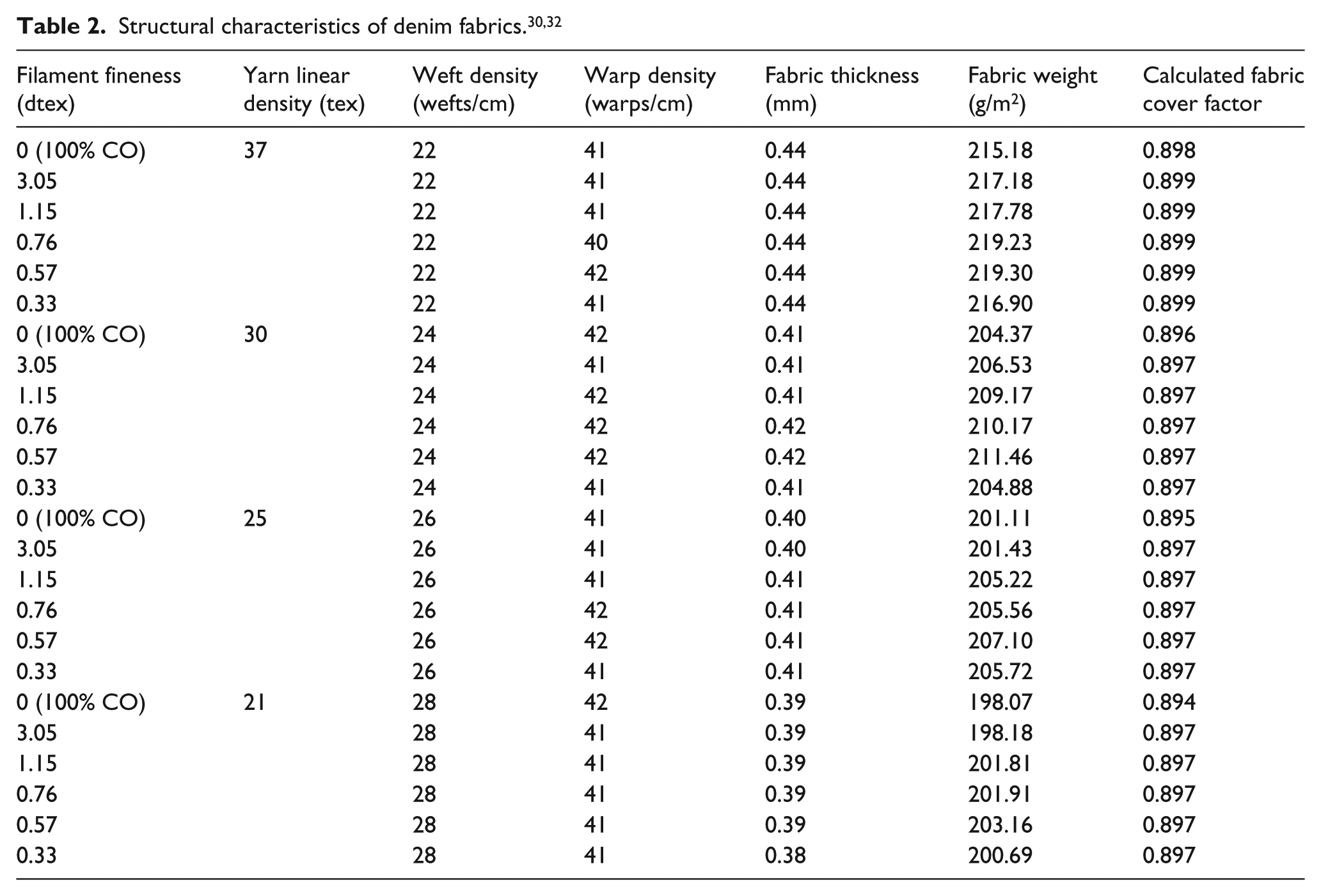
The structural characteristics of denim fabrics are demonstrated in Table 2. The correlation between theoretical and measured diameter yarn samples was evaluated by means of Pearson correlation analysis. Results are shown in Table 3.
Pearson correlation between calculated and measured yarn diameter.
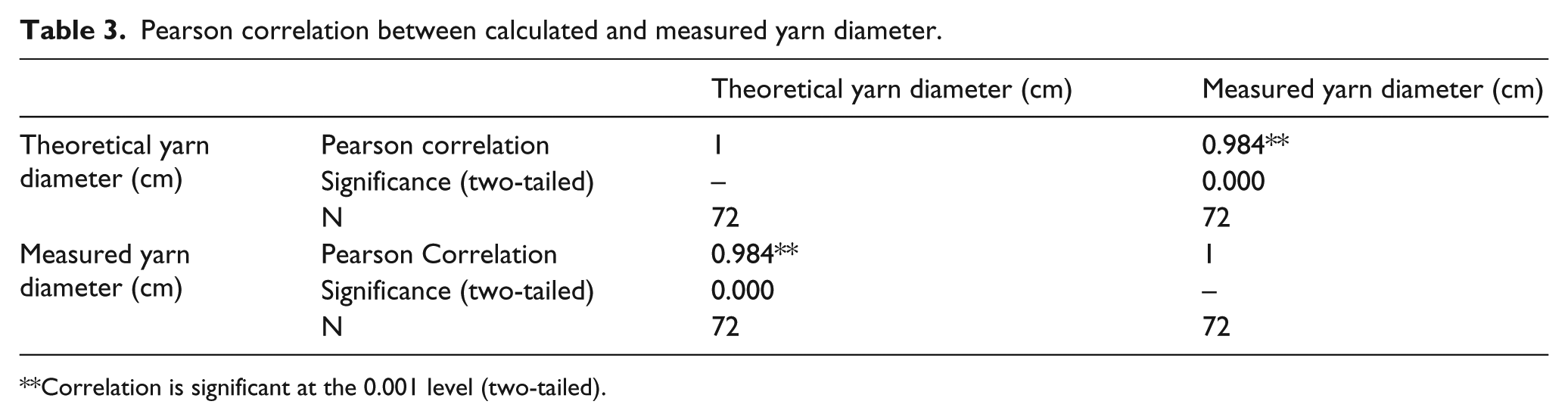
Correlation is significant at the 0.001 level (two-tailed).
It is clearly seen in table that Pearson correlation coefficients between theoretical yarn diameter (cm) and measured yarn diameter were found to be statistically significant with the value of 0.984 at a significance level of 0.001.
The line diagrams of air permeability of denim fabrics and total porosity are illustrated in Figure 2. Total porosity was calculated from equation (2) using fabric thickness, fabric weight, and fiber density.

Total porosity of denim fabrics at different levels of filament fineness and yarn linear density (✸:air permeability and I:total porosity).
It is obviously seen in Figure 2 that denim fabrics produced from combed 100% CO ring-spun weft yarns as control group of this study show higher air permeability with respect to core-spun weft yarns in all cases. Combed 100% CO ring-spun yarns have higher twists per inch yarn and lower diameter than core-spun that makes fabrics higher permeable. With decrease in yarn linear density, air permeability decreases. When it is thought to be similar cover factor of fabric by changing weft density in cm, finer yarn samples show lower permeability properties to air.
When constant fabric cover factor is taken into consideration, the number of weft yarns per unit length of the fabric (constant warp density for all fabrics) will increase when yarns become finer thus passing of air voids between fibers will become difficult and the barrier property of fabric will increase. There are similar results at previous studies in literature.3,8,12 In earlier studies, it is seen that the increase in filament fineness from conventional to micro has a great influence on air permeability whether weft yarn comprises 100% filament yarns or staple fiber covered filament yarns.33–35 Air permeability of a fabric determines its resistance to wind penetration in cold weather, and the extent of wind penetration affects the thermal insulation provided by the clothing in cold weather.36,37 The decrease in air permeability of denim fabrics made of core-spun yarns containing textured filaments in each yarn linear density exhibits the increase in the number of filament in yarn cross-section from 36 filaments to 333 filaments. In this situation, it can be concluded that yarn types with microfilament core part within the fabric structure contribute barrier effect against weather condition, especially for winter use. When denim fabric is considered to be preferred in all seasons, this appears to be an advantageous situation.
Total porosity that is emphasized in literature is a proportion of void space in a porous medium which is commonly calculated using equation (1). This equation includes the inter-fiber porosity as well as the inter-yarn porosity of the fabric. 1 In Figure 2, total porosity illustrated as line diagram was calculated with equation (2) which was derived from equation (1). There is a strong relationship between air permeability and porosity of fabric. Ideally, it is expected that fabric with higher total porosity will show higher air permeability behavior. In addition, higher void space leads to lower volume of yarns. Consequently, in general, calculated total porosity from equation (2) has similar trend, and 100% CO fabrics have the highest total porosity similar to air permeability trend.
In statistical analysis, to determine the effect of subgroups (filament fineness and yarn linear density individually) on air permeability, Duncan’s multiple range test was performed. The results for filament fineness and yarn linear density are summarized using Duncan’s multiple range tests in Tables 4 and 5, respectively.
Duncan’s multiple range test (p = 0.05) for air permeability of denim fabrics versus filament fineness.

Duncan’s multiple range test (p = 0.05) for air permeability of denim fabrics versus yarn linear density.
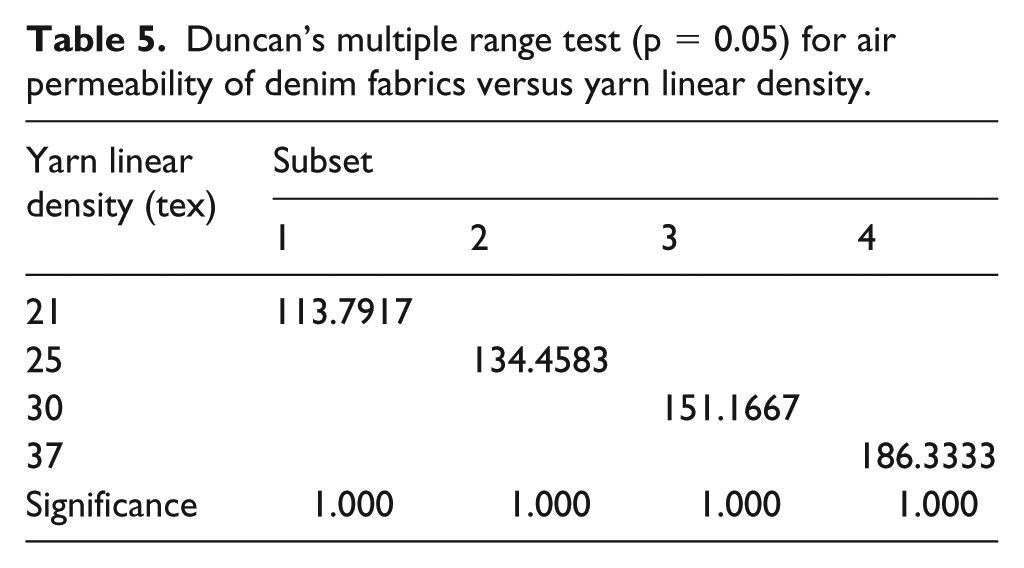
According to Duncan’s multiple range test, denim fabrics with microfilament core cotton-covered core-spun yarns’ air permeability was found to be lower values than both conventional and fine filament fineness cotton-covered core-spun weft yarns. The lowest air permeability are recorded at 0.33 dtex filament fineness followed by 0.76 dtex and 0.57 dtex, which means that permeability decreases as PET DTY filament becomes having micro fineness as core part of core-spun yarns. It can be said that the filaments with micro fineness differ from filaments with fine and conventional fineness and 100% CO ring-spun yarn when taking Duncan’s multiple range test of air permeability into account. This may be explained as microfilament with higher number of filament core part of core-spun yarns resulting in a higher resistance to air passage.
The total porosity results calculated from equation (2) for filament fineness and yarn linear density are summarized using Duncan’s multiple range tests in Tables 6 and 7, respectively. In Table 6, the individual means by Duncan’s multiple range test demonstrates that the total porosity of denim fabrics made from PET DTY yarn with micro and fine fineness cotton-covered core-spun yarns do not differ significantly at p = 0.05. On the other hand, denim fabrics made from 3.05 dtex core-spun yarns and 100% CO ring spun yarns as weft have the highest total porosity with the value of 66.65% and 66.95%, respectively.
Duncan’s multiple range test (p = 0.05) for total porosity of denim fabrics versus filament fineness.
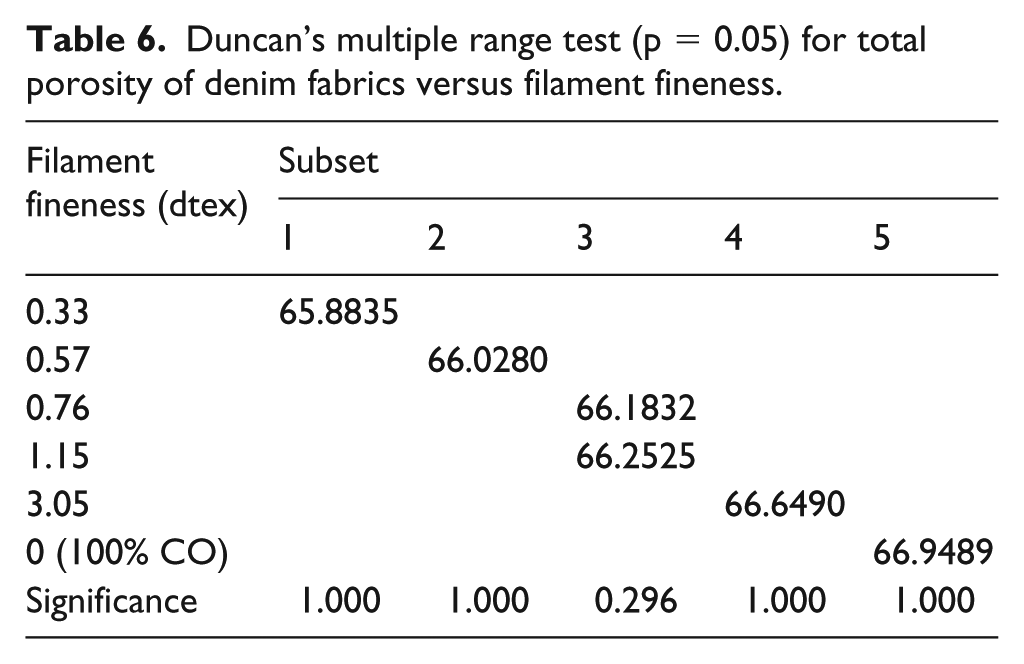
Duncan’s multiple range test (p = 0.05) for total porosity of denim fabrics versus yarn linear density.

It is clearly seen that Table 7 indicates total porosity of denim fabrics increase when yarn becomes coarse. All values differ significantly from each other. It can be said that yarns with coarser and lower weft density enable the flow of air through fabric. We can summarize that weft density and yarn linear density have statistically significant influence on total porosity of denim fabrics according to Duncan’s multiple range test.
An analysis of variance (ANOVA) was performed to determine the statistically significant influence of filament fineness and yarn linear density on the air permeability and total porosity of denim fabrics as shown in Table 8. The ANOVA results clarify that both filament fineness and yarn linear density have great significance effect on air permeability and total porosity of denim fabrics. It is clear that the effect of filament fineness and yarn linear density have a statistical significance at a level of 0.05 on total porosity and air permeability of denim fabric.
Multivariate analysis of variance, tests of between-subjects effects for the air permeability and total porosity of denim fabrics.
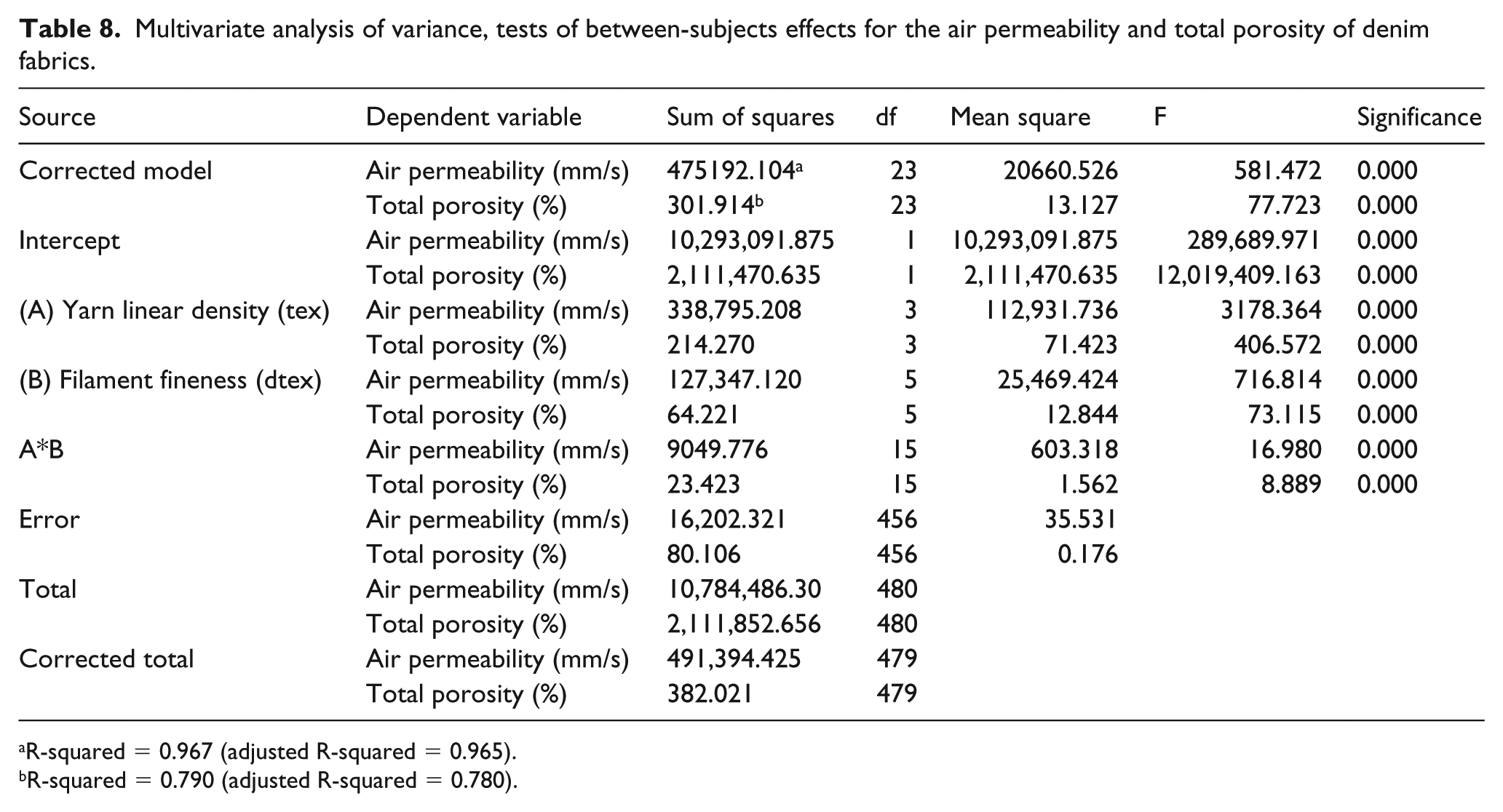
R-squared = 0.967 (adjusted R-squared = 0.965).
R-squared = 0.790 (adjusted R-squared = 0.780).
Furthermore, R-square with the value of 96.7% for air permeability shows that the influences of filament fineness and yarn linear density are highly statistically significant. When the effect of these parameters on total porosity of denim fabrics is examined, R-square is found to be the value of 79%. To exhibit the relationship between air permeability and total porosity of denim fabrics, Pearson correlation analysis result is illustrated in Table 9. As seen from table, Pearson correlation coefficients between air permeability (mm/s) and total porosity (%) were found to be statistically significant with the value of 0.794. It means that Pearson correlation coefficient for these variables represents the strong relationship for 0.001 significance level.
Pearson correlation between air permeability and total porosity.

Correlation is significant at the 0.001 level (two-tailed).
Conclusion
The air permeability of a fabric is one of the very important properties of fabrics, which depends on the structural parameters of fabrics such as fiber density, yarn type, yarn linear density, fabric density, and weave construction. In addition, these parameters have strong effects on porosity. In this study, the effects of filament fineness and yarn linear density on air permeability and total porosity of denim fabrics were examined. Denim fabrics from microfilament cotton-covered core yarn have the lowest values of air permeability and total porosity that enables a better thermal insulation for winter use. The multivariate analysis leads to the conclusion that the influence of filament fineness and yarn linear density is statistically significant on air permeability and total porosity of denim fabrics. A correlation relationship was achieved between the total porosity and air permeability of denim fabrics, considering the filament fineness and yarn linear density parameters. The positive and strong relation with the value of 0.794 between air permeability and total porosity of denim fabrics made of core-spun yarns with different filament finenesses and 100% CO ring-spun weft yarns was detected performing with Pearson correlation analysis at a significance level of 0.001.
Footnotes
Acknowledgements
Authors would like to thank Korteks, Karacasu and BOSSA companies for their contribution to this work. And also thank to Gama Recyle Company for their contribution to measure yarn samples diameter.
Declaration of conflicting interests
The author(s) declared no potential conflicts of interest with respect to the research, authorship, and/or publication of this article.
Funding
The author(s) disclosed receipt of the following financial support for the research, authorship, and/or publication of this article: This research had been granted by Çukurova University Scientific Research Program, Project ID: MMF2013D13.