




Abstract
University is a crucial period for developing lasting physical activity (PA) behaviors. The purpose of this study was to (a) explore differences in the strength and direction of the relationship between personal and environmental factors with one's use of a campus recreational facility (CRF) and the seven zones within it, and (b) test whether these relationships were influenced by gender. To test this, 648 university students provided responses to an online survey including CRF use, personal factors, and environmental factors. Eight path analyses were run with use of the CRF and the seven zones assigned as the eight dependent variables (one DV/analysis), gender as the moderator, and personal and environmental factors as the independent variables. An individuals’ task self-efficacy was the strongest factor (β = .16–.43; p < .05) related to use within each corresponding zone. Additionally, gender moderated several relationships between personal and environmental factors with use of the CRF and the distinct zones.
Introduction
University is a critical time in life for physical activity (PA) behavior (Nelson et al., 2008). While PA behavior during postsecondary school is a strong indicator for PA behavior following university, many students abandon an active lifestyle and adopt a more sedentary one while attending university (Gómez-López et al., 2011; Nelson et al., 2008). For instance, Busque et al. (2017) surveyed just under 2,000 university students and found that over half (55.2%) of students failed to meet the current Canadian PA guidelines of 150 min of moderate to vigorous PA per week. Given the low PA rates among university students, and the link between PA behaviors during and following postsecondary school, identifying factors that facilitate or hinder PA behaviors among postsecondary students is essential.
Social cognitive theory (SCT; Bandura, 1986) has been a prevalent theory used to guide research investigating PA behaviors (Beauchamp et al., 2019; Oyibo et al., 2018; Wallace et al., 2000). Within the SCT framework, Bandura (1986) states that a constant interplay between behavioral, personal, and environmental factors exists that influences individuals’ thoughts, feelings, and behaviors. Behavioral factors pertain to the patterns of action in which an individual performs (e.g., use of the gym and different zones within the gym), while personal factors include the psychological, emotional, and biological aspects of oneself (e.g., self-efficacy [SE], age, gender), and environmental factors consider the imposed, chosen, and built environment (e.g., mirrors, open spaces, presence of other people; Bandura, 1986). In this study, university students’ use of their institution's campus recreational facility (CRF) was explored and relationships between behavioral, personal, and environmental factors were considered.
CRFs are exercise spaces within a postsecondary institutional environment that serve a prominent role in student PA behavior (Alshuwaikhat & Abubakar, 2008). With that, CRFs are often the primary location for university students to engage in PA because they often mitigate barriers such as transportation, accessibility, and financial restrictions since students are typically on campus and CRF access is usually included within their tuition. Such a space can be divided into separate zones based on the layout of the exercise equipment where exercises can be performed (e.g., free weights and cardio machines). It is important to note that multiple distinct zones within the same CRF may house similar equipment (i.e., chest press machine, pull-up bars). Therefore, the factors that play a role in an individual's choice to use certain zones and refrain from exercising in others will be of interest in the present study.
From a behavioral perspective, researchers have examined engagement in different types of exercise (e.g., aerobic, cardio, strength/resistance). More specifically, quantitative studies have often used descriptive statistics to describe the frequency of engagement or comfort performing those exercises, or to demonstrate comparison between groups (e.g., men vs. women). It has also been qualitatively reported that individuals may choose to use certain areas within a gym and avoid others based on the presence of other individuals sharing the space (Rapport et al., 2018; Turnock, 2021). To the author's knowledge, specifically analyzing what distinct gym zones are used by certain individuals and not others has only been qualitatively assessed and not quantified. Additionally, gender/sex differences have been identified to impact use of the different equipment or type of exercise performed. Specifically, men report significantly greater use of free weight and machine weights and more frequent bouts of strength training in comparison to women (Rapport et al., 2018; Wilson et al., 2020). In contrast, women reported significantly greater use of aerobic equipment and higher frequency of cardio exercise in comparison to men (Rapport et al., 2018; Turnock, 2021; Wilson et al., 2020). Together, these studies highlight that gender differences should be considered when evaluating exercise behaviors and CRF use. Moreover, they suggest that such differences in exercise behavior are related to one's choice of equipment used and the presence of others around them. However, we have yet to understand what specific personal and environmental factors play a role in such differences in university students’ exercise behavior. One way we can analyze these differences is by separating a CRF into distinct zones based on the layout and type of equipment offered.
Limited research exists on personal factors within the CRF context, although some studies have explored factors such as comfort and confidence (Rapport et al., 2018; Watson et al., 2006; Wilson et al., 2020). Notably, these studies explored experiences of comfort using aerobic equipment, free weights, and machine weights (Rapport et al., 2018), feelings of comfortability in the space (Rapport et al., 2018; Watson et al., 2006), differences in participant confidence for using CRF equipment (Wilson et al., 2020), differences in reasons for discomfort (Wilson et al., 2020), and did not test how they were related to exercise behaviors. However, personal factors have been studied in the broader PA context, with SE being identified as one of the most influential factors impacting behavior (Young et al., 2014). Bandura (2006) defined SE as an individual's belief in their ability to perform actions that are required for a successful outcome.
Importantly, Bandura (2006) emphasized that many subcategories of SE exist, and domain specific measures of SE are more relevant since beliefs in one's abilities and knowledge are linked to each distinct domain. Within the literature, one of the most investigated types of SE is self-regulatory SE, which is defined as the level of confidence in one's ability to exercise regularly for a range of conditions (Everett et al., 2009). Researchers have demonstrated that self-regulatory SE is positively associated with PA behavior in a postsecondary student population, and that females had significantly lower self-regulatory SE than males (e.g., Joseph et al., 2014).
Another relevant form of SE is task SE, which refers to a participants’ confidence in their ability to properly exercise. Surprisingly, few studies have examined the relationship between task SE and exercise behavior. However, a study conducted by Selzler et al. (2019), demonstrated that task SE positively predicted exercise class attendance for up to 6 months. It is also likely that gender differences exist for task SE in exercise behavior. For instance, using a one-item measure of “participants confidence in strength/resistance/weight training” (p. 2), Wilson et al. (2020) reported that women had significantly lower confidence than men for engaging in strength, resistance, and weight training PA. Although confidence (general belief one holds in their ability to be successful, Vealy, 1986) is not synonymous with SE, the commonalities are undeniable. These studies (Selzler et al., 2019; Wilson et al., 2020) support the assumption that SE to self-regulate exercise and task SE will be positively associated with CRF use. Moreover, they reaffirm the importance of taking gender/sex into consideration when testing exercise behavior.
Another salient personal variable identified in the exercise behavior literature is social physique anxiety. Hart et al. (1989) defined social physique anxiety as experiencing symptoms of anxiety due to a result of one's own body or physique being evaluated by others. Social physique anxiety has been reported as a barrier for university students PA behavior when other patrons are present (Bowden et al., 2005; Kowalski et al., 2001). This was especially notable for women when sharing the space with men (Rapport et al., 2018; Turnock, 2021). Considering campus recreational facilities contain a space where a user's physique is typically on display (Crawford & Eklund, 1994), we deemed it important to test the potential relationship between SPA, the CRF environment, and students’ use of a CRF.
In addition to considered perceptions of one's own body, it is also valuable to understand perceptions of others present in the environment when evaluating exercise behavior. It has been reported that individuals engaging in exercise behavior often compare self-perceptions of their own body with someone who is perceived to be of superior physique and physical ability (Pila et al., 2016). While it is important to note that perceptions of body-related superiority are subjective in nature, when individuals make these comparisons, an increase in exercise behavior has been reported (Pila et al., 2016). However, a more nuanced study revealed that this positive relationship was gender-specific, with perception of body-related superiority resulting in increased exercise behavior in men and decreased behavior in women (Pila et al., 2016). Similarly, others have demonstrated that women feel more anxious and uncomfortable about their body being on display than men and report lower comfort in the gym in general as well as the machine weight, free weight, and indoor track zones (Rapport et al., 2018; Wilson et al., 2020). Therefore, a measure of body related self-perceptions was included in this study to further explore CRF use.
From an environmental perspective, researchers have identified facilitative or debilitative factors for an individuals’ CRF use or exercise engagement. On the facilitative side, improving the physical (e.g., more equipment, separate rooms) or social (e.g., workout partner) environment can optimize the psychological experience of gym users (Wilson et al., 2020). Other environmental factors have been reported as deterrents to CRF use such “crowdedness” and “boys with big muscles” (Wilson et al., 2020, p. 3). Similarly, Coulter (2021) found sharing the gym space with intimidating individuals negatively impacted gym use. While Coulter (2021) identified that intimidating individuals influenced gym use, a more detailed examination of the characteristics of those individuals is essential to determine which factors are “intimidating” and thus negatively influence use.
Other environmental factors can have a more complicated role in one's psychological experience within the exercise context (e.g., Sabiston et al., 2014; Rapport et al., 2018). For instance, in Sabiston et al.'s (2014) review of the literature surrounding user experiences in PA settings, they found several studies highlighting that the presence of mirrors intensified social physique anxiety indices when exercising, whereas others found mirrors decreased social physique anxiety experiences. Taken together, these studies suggest the social (e.g., presence of others) and physical environment (e.g., mirrors) must be considered when attempting to understand one's use of a CRF.
Similar to behavioral and personal factors, gender also impacts how environmental factors are interpreted within a CRF or gym context. Notably, spaces used to engage in PA (e.g., fitness centers) have consistently been perceived as “male dominated” (Kowalski et al., 2001; Miller et al. 2008; Rapport et al., 2018) which can be a barrier to women's participation (Turnock, 2021). Turnock (2021) conducted qualitative interviews with 18 women, revealing instances of intimidation and discomfort associated with the presence of men within the gym. For example, one participant reported that they felt as though they were “in their (men's) area,” while another mentioned being stared at and feeling uncomfortable. This has led to the exploration of women-only gyms as a solution to removing the intimidating presence of men (Craig & Liberti, 2007). However, researchers suggest that this segregation may not be a long-term solution to overcoming barriers such as intimidation (Lenneis et al., 2022; Oztürk & Koca, 2017). Instead, authors suggest that creating a more inclusive and welcoming gym environment by altering the physical layout, messaging strategies, and policy is a more favorable approach (Coen et al., 2018; Turnock, 2021). Although researchers have consistently declared that men and women encounter different experiences within a gym environment, most of the research has been qualitative in nature and has not tested how gender impacts the relationship between environment and use.
The purpose of the current study was to explore the personal and environmental factors that are either positively, or negatively related to university student's exercise behavior within the CRF. These considerations are crucial when attempting to understand why individuals decide to use or not use a CRF despite reduced barriers related to transportation, accessibility, and financial cost. Considering the malleability of PA behavior in university aged individuals (Gómez-López et al., 2011; Nelson et al., 2008) and the interconnected nature of behavioral, environmental, and personal factors (Bandura, 1986; Beauchamp et al., 2019; Oyibo et al., 2018; Wallace et al., 2000), we sought to answer the following research question (RQ1) How are personal and environmental factors related to CRF use as a whole and use of specific zones within the CRF (behavioral factors)? It was hypothesized that (1a) social physique anxiety would be a negatively associated with CRF use, (1b) task SE would be positively related to use of the corresponding zones, and (1c) self-regulatory SE to exercise would be positively related to CRF use in general.
Given the prevalent gender differences surrounding use of fitness facilities, and its relationship to key personal psychological factors such as SE, social physique anxiety, and perception of others within the environment (Kowalski et al., 2001; Miller et al., 2008; Rapport et al., 2018; Turnock, 2021; Wilson et al., 2020), the second research question (RQ2) was does the strength or direction of the relationships between personal and environmental factors and CRF use (behavior) differ between men and women? It is clear within the literature that women typically report greater social physique anxiety indices (Bowden et al., 2005), lower confidence in engaging with strength, resistance and weight training PA (Wilson et al., 2020), and more negative body related self-perceptions (Pila et al., 2016) compared to men. While we can hypothesize that men and women will differ on these factors at a mean level (SPA, task SE, self-perceived fat mass), we cannot hypothesize how gender will moderate the relationships between these factors and CRF use based on the current literature. Additionally, there are mixed findings on how positive physical self-perceptions (e.g., greater muscle mass) may impact exercise engagement in a gym setting such as a CRF; therefore, no hypothesis was made regarding self-perceived muscle mass. Finally, it is also important to address that no hypotheses were made in relation to the environmental factors addressed within the present study due to the exploratory nature of each factor.
Method
Procedure
University students were recruited from a variety of departments at a Western Canadian university during the 2022–2023 academic year following ethics approval (Pro00125189). Participants were recruited to complete an online cross-sectional survey hosted by Qualtrics using several modalities including class presentations, physical posters, campus wide email, word of mouth, online survey platform for students specific to the host university, and social media. Following the informed consent on the first page, the survey was presented to participants which took approximately 10–15 min to complete.
Participants
The final sample included 648 university students aged 17 to 52 years of age (M = 21.27; SD = 3.77). The majority self-identified as women (n = 499, 77%), and the remaining 23% self-identified as men (n = 149). The sample included 171 freshmen, 133 sophomores, 141 juniors, 188 seniors, 12 masters’ students, and three PhD candidates. Participants varied in body mass index, program designation, and whether or not they played competitive sport prior to attending university (see Table 1).
Descriptive Statistics for Personal Independent Factors.
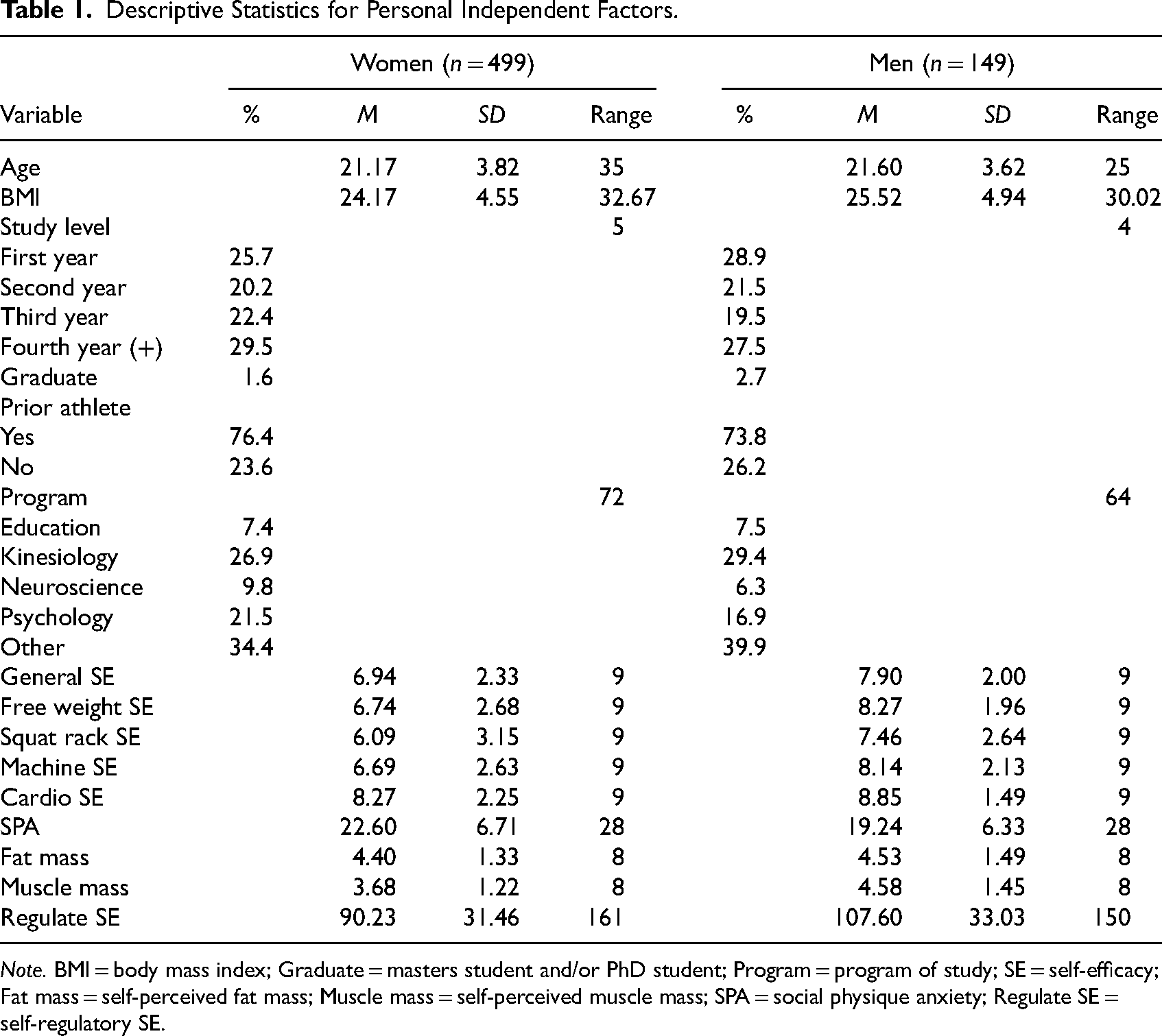
Note. BMI = body mass index; Graduate = masters student and/or PhD student; Program = program of study; SE = self-efficacy; Fat mass = self-perceived fat mass; Muscle mass = self-perceived muscle mass; SPA = social physique anxiety; Regulate SE = self-regulatory SE.
Measures
Demographics
Participants self-reported age, height, weight, current level of study (undergraduate first–fourth year+, Masters, PhD), program designation (e.g., kinesiology, education, psychology, etc.), gender identity, and whether they were an athlete (club athlete, high school athlete, other) prior to attending university or not (Table 1 for results).
CRF use
General use of the CRF was assessed by asking how frequently participants visited the CRF in a typical week on an 8-point scale (0 = never, to 7 = 7 days per week; adapted from Wilson et al., 2020). Participants also answered seven items that asked how often they used each of the different zones within the CRF (free weights, squat rack, main machine weights, private machine weights, cardio machines, indoor running track, and indoor running track weights) during a typical week. Participants responded using a 5-point Likert scale; 1 = never, 2 = rarely, 3 = sometimes, 4 = often, 5 = always; which was adapted from Wilson et al. (2020).
Task SE
To assess task SE, participants were asked how confident they felt when engaging with different elements of a fitness center environment (CRF and/or off campus facility) using seven items (confidence in using free weights, squat racks, machine weights, cardio equipment, one's knowledge to do exercises in general, to perform exercises properly in general, having the ability to create an effective workout program). Responses were collected using a Likert scale that ranged from 1 (no confidence) to 10 (completely confident). Raw scores were used for the first four task SE items related to each specific zone (confidence using free weights, squat racks, machine weights, and cardio equipment), while a composite score was calculated from the final three items of this measure (confidence in one's knowledge to do general exercises, in performing exercises properly in general, in one's ability to create an effective workout program) to obtain a single value for one's general task SE within a gym environment (Cronbach α = .93). This scale was modified from Wilson et al.’s study (2020) to account for the specific CRF environment zones under investigation in the current study.
Social Physique Anxiety
The researchers used the seven-item Social Physique Anxiety Scale (SPAS-7) to assess participants’ feelings of anxiety experienced when their physique is observed or evaluated by others (Motl & Conroy, 2001). Hart's original social physique anxiety scale, which included 12 items (Hart et al., 1989), was modified to this seven-item unidimensional scale wherein evidence of “tight” cross-validity and factorial invariance across genders was achieved (Motl & Conroy, 2001, p. 92). This seven-item version of the social physique anxiety scale has been suggested for use when measuring social physique anxiety in young adults (Motl & Conroy, 2001). Respondents were asked to read each item carefully and indicate how characteristic each statement was of them on a 5-point Likert scale (1 = not at all, 2 = slightly, 3 = moderately, 4 = very, 5 = extremely). Two example items from the SPAS-7 are “I am comfortable with how fit my body appears to others,” and “I usually feel relaxed when it's obvious that others are looking at my physique or figure.” Consistent with previous literature (Motl & Conroy, 2001), item eight (from the original 12-item SPAS) was reverse scored as it was the only positively worded item remaining from the original 12 items. This scale has evidence of good internal consistency reliability in previous research (Cronbach's α = .85; Sáenz-Alvarez et al., 2013) and in the current study (Cronbach's α = .87).
Body Image Perceptual Dimension
To assess participants perception of their body composition (beyond simply calculated BMI), participants reported their perception of their own body figure. All participants were presented with the Female Body Scale (FBS; Ralph-Nearman & Filik, 2020), the Female Fit Body Scale (FFITBS; Ralph-Nearman & Filik, 2020), the Male Body Scale (MBS; Ralph-Nearman & Filik, 2018), and the Male FBS (MFBS; Ralph-Nearman & Filik, 2018) and asked to select the body figure that best represented themselves. The FBS consists of nine silhouettes of female body figures and the MBS consisted of nine silhouettes of male body figures, both ranging from extremely low body fat (1 for female, 10 for male) to high body fat (9 for female, 18 for male). Participants were asked to indicate the silhouette that matched their current level of body fat, while ignoring any muscle they may have on their own body. The FFITBS consisted of nine silhouettes of female body figures and the MFBS consisted of nine silhouettes of male body figures, both ranging from extremely low muscle mass (1 for female, 10 for male) to extremely muscular (9 for female, 18 for male). Participants were asked to indicate the silhouette that matched their current level of muscle while, ignoring any fat they may have on their own body.
The FBS, FFITBS, MBS, and MFBS were all developed in the same fashion by utilizing skills of a professional artist/graphic designer to use real body figures of models resembling anorexic, obese, and muscle-lifting individuals which were scanned into Adobe Photoshop to confirm that the size increase between figures was uniform. These scales have demonstrated evidence of test–retest reliability for males (Ralph-Nearman & Filik, 2018) and females (Ralph-Nearman & Filik, 2020). Further evidence for the construct validity of each scale was supported based on the correspondence between participants subjective scores from the FBS, FFITBS, MBS, and MFBS with objective scores related to actual body measures, drive for muscularity, and the eating disorder symptomatology level (EDE-Q 6.0).
Self-Regulatory SE
The researchers used an 18-item exercise SE (ESE) scale to assess participants’ confidence in their ability to exercise regularly (Bandura, 2006). The original scale, developed by Bandura (2006), was modified to the same specifications seen in the study conducted by Everett et al. (2009). Respondents were asked to rate the degree of confidence in their ability to perform exercise regularly for a range of situations on a scale from 1 (no confidence) to 10 (extremely confident). Two example items from the ESE are “when I am feeling tired,” and “when there are other interesting things to do.” This scale has evidence of good internal consistency reliability in previous research (Cronbach's α = .89; Joseph et al., 2014) and in the current study (Cronbach's α = .94).
Environmental Factors
Participants answered 33 items that asked about how factors within a fitness center environment (including the CRF or other fitness centers) influenced their use of the fitness center. Items were generated for this study using a triangulation approach (literature review, consulting students, professors, and CRF staff), accounting for potential salient physical and social environmental factors within a gym environment, to establish face validity of the items. To determine if an individuals’ comparison of other CRF's characteristics in relation to their own were important, root items (e.g., the presence of others that are very fit) as well as modified items (e.g., the presence of others who are more fit than me) were generated for the study. Participants responded to the items using a 5-point Likert scale; −2 = completely negative influence, −1 = some negative influence, 0 = neither positive or negative influence, 1 = some positive influence, 2 = completely positive influence. See Supplemental Table S1 for a full list of the environmental factors included in the present study.
Data Analysis Procedure
Data analysis was conducted in several steps. First, data was screened for nonhuman entities (“bots”; via Qualtrics reCHAPTCHA). Next a missing data analysis was conducted using IBM SPSS statistical data editor (SPSS) and missing values were filled in using estimated means. Next, data was screened for normality using descriptive statistics via SPSS and was deemed to be normally distributed (all skewness and kurtosis values = ± 3.29; Field, 2009); see Supplemental Table S2. Next, further descriptive statistics (Supplemental Table S2) and bivariate correlation (Supplemental Table S1) scores were calculated for all factors using SPSS, while internal consistency reliability scores (Cronbach α) were also computed for all previously validated scales (i.e., SPSA and ESE). Finally, eight moderation analyses were conducted to test the relationship between personal demographic and psychological factors with general CRF use, as well as the use of the seven identified CRF zones (see Table 2).
Results for Moderation Analyses.
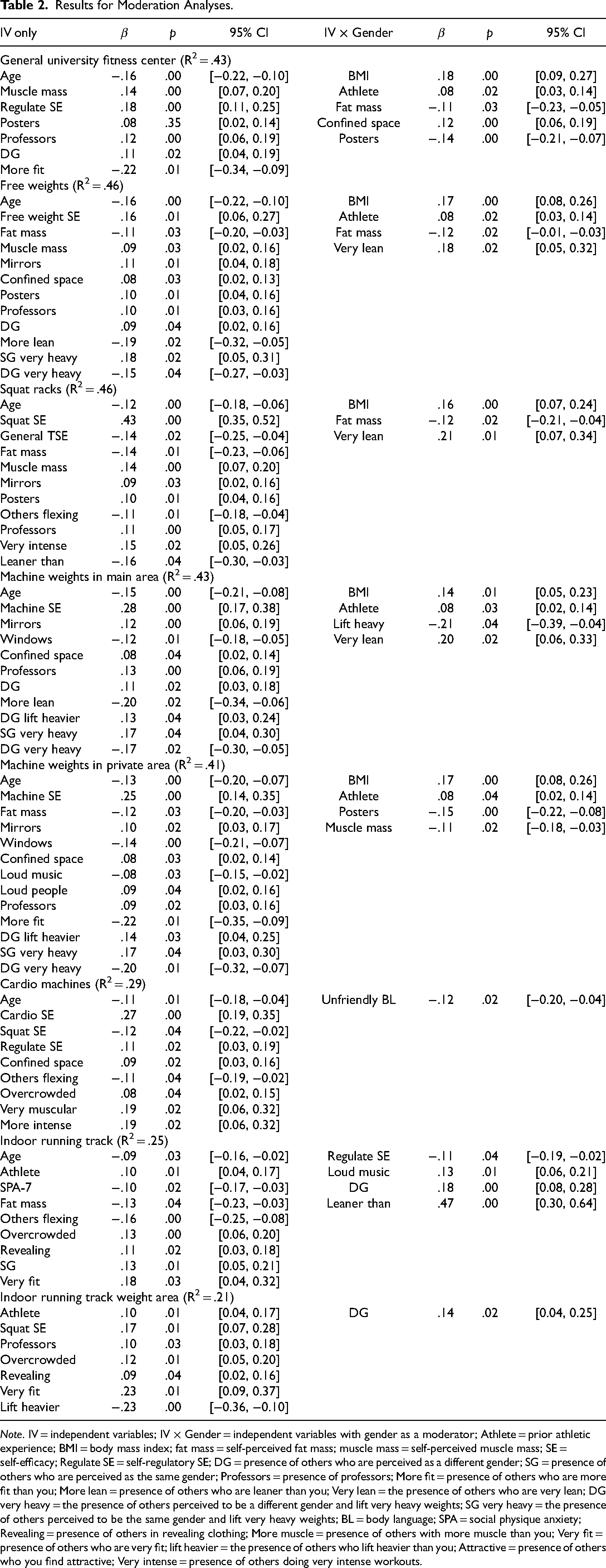
Note. IV = independent variables; IV × Gender = independent variables with gender as a moderator; Athlete = prior athletic experience; BMI = body mass index; fat mass = self-perceived fat mass; muscle mass = self-perceived muscle mass; SE = self-efficacy; Regulate SE = self-regulatory SE; DG = presence of others who are perceived as a different gender; SG = presence of others who are perceived as the same gender; Professors = presence of professors; More fit = presence of others who are more fit than you; More lean = presence of others who are leaner than you; Very lean = the presence of others who are very lean; DG very heavy = the presence of others perceived to be a different gender and lift very heavy weights; SG very heavy = the presence of others perceived to be the same gender and lift very heavy weights; BL = body language; SPA = social physique anxiety; Revealing = presence of others in revealing clothing; More muscle = presence of others with more muscle than you; Very fit = presence of others who are very fit; lift heavier = the presence of others who lift heavier than you; Attractive = presence of others who you find attractive; Very intense = presence of others doing very intense workouts.
Data screening commenced with the removal of responses flagged as nonhuman entities (n = 568) or nonsubmitted responses (n = 34). The responses flagged as nonhuman entities were removed as they were suspected bots with IP addresses outside of Canada and North America based on data provided by Qualtrics. The removal of these responses was necessary because these responses did not have access to the institutions CRF which was essential for this study. Of the 746 responses that remained, 55 were removed because they indicated on the survey that they had “never” exercised at the host institutions CRF (therefore it was inappropriate to examine personal or environmental factors associated with their CRF use given that they had no frame of referenced for use in that space), five did not meet inclusions criteria (e.g., did not identify as a student at the host institutions) resulting in a sample of 654. Additionally, during the screening process, responses from six of the participants were removed to allow for gender-based analysis, leaving a final sample of 648 participants. Although we as researchers recognize the importance of representing all gender identities, we did not have a large enough sample from genders other than women and men to perform statistical analysis.
For the moderation analyses, Mplus version 8.9 was used. For the analyses, personal and environmental factors served as the independent variables, behavioral factors (i.e., CRF use) were set as the dependent variables, and gender (0 = man, 1 = woman) was the moderating variable. All variables (independent; all personal and environmental variables, dependent; use of the CRF in general as well as use of the seven distinct zones within the CRF, and moderator; gender) were treated as observed variables in the path analyses. For variables associated with scales (i.e., social physique anxiety and task SE), scores were calculated by summing the items for a total score (social physique anxiety) and by averaging the items (task SE).
Results
Descriptive Statistics
On average, students reported using the CRF 3.16 days per week (SD = 2.09). Over half of the sample (n = 409, 63%) reported attending the CRF for PA purposes at least one day per week, 37% (n = 239) did not attend the CRF regularly (0 days per week), whereas 19% (n = 120) of participants indicated attending the CRF a minimum of 5 days per week to engage in PA. Notably, all participants indicated having used the CRF for exercise purposes before. Thus, the 37% of participants who did not use the CRF regularly were important, as various personal and environmental factors may have played a role in their lack of regular CRF use. Within the specific zones, students reported using the free weight zone the most (M = 2.73; SD = 1.69) and the track weight zone the least (M = 1.59; SD = 1.05).
Correlation Analyses
All personal demographic factors, aside from BMI and level of study, were related to at least one of the dependent variables (p ≤ .05). Additionally, all personal psychological factors (Task SE, SPA, self-regulatory SE, self-assessed body fat and muscle mass) were associated with at least one dependent variable (p ≤ .05). Finally, all 33 environmental factors were related to at least one of the dependent variables (p ≤ .05). See Supplemental Table S1 for all Pearson correlation coefficients.
Moderation Analyses
Use of the CRF in General
Poster messages, the presence of professors, presence of individuals of perceived different gender, self-regulatory SE, and perceived muscle mass were positively associated with general use of the CRF. Age and the presence of individuals that are more fit were negatively associated with use of the CRF in general. Gender significantly moderated the relationships between the following independent factors and general use of the CRF; BMI (men, β = .03, p = .53; women, β = .20, p = .01), prior athletic experience (men, β = .03, p = .33; women, β = .12, p = .02), self-perceived body fat mass (men, β = −.08, p = .15; women, β = −.18, p = .02), confined space (men, β = −.00, p = .97; women, β = .12, p = .01), and poster messages (men, β = .08 p = .04; women, β = −.06, p = .26). See Table 2 for all significant relationships with CRF use in general and the use of the seven distinct zones.
Use of the Free Weight Zone
One's perceived muscle mass, free weight SE, as well as the presence of mirrors, posters, confined space, professors, individuals that are perceived to be a different gender, and individuals that are perceived to be the same gender lifting very heavy weights were positively associated with free weight zone use. Age, an individuals’ perceived fat mass, the presence of people that are leaner than oneself, and the presence of individuals that are perceived to be a different gender lifting very heavy weights were negatively associated with free weight zone use. Gender moderated the relationship between BMI (men, β = .06, p = .20; women, β = .23, p = .00), prior athletic experience (men, β = .04, p = .19; women, β = .12, p = .01), self-perceived fat mass (men, β = −.11, p = .03; women, β = −.23, p = .00), and the presence of very lean individuals (men, β = .06, p = .41; women, β = .23, p = .04) and use of the free weight zone.
Use of the Squat Rack Zone
One's perceived muscle mass, squat SE, as well as the presence of mirrors, posters, professors, and others doing very intense workouts were positively related to squat rack use. Age, self-perceived fat mass, general task SE, the presence of others flexing, and the presence of people that are leaner than oneself were negatively related to squat rack use. Gender significantly moderated the relationship between BMI (men, β = .07, p = .17; women, β = .22, p = .01), self-perceived fat mass (men, β = −.14, p = .01; women, β = −.26, p = .00), and the presence of very lean individuals (men, β = .09, p = .24; women, β = .23, p = .00) and use of the squat rack zone.
Use of the main machine weight zone
Perceived machine SE, confined spaces, as well as the presence of mirrors, professors, others perceived as a different gender, other perceived as a different gender lifting heavier weights, and same gender that lifts very heavy were positively related to main machine weight zone use. Age, windows, the presence of people who are leaner than oneself, and individuals perceived as a different gender that are lifting very heavy weight were negatively related. Gender moderated the relationship from BMI (men, β = .05, p = .36; women, β = .18, p = .01), prior athletic experience (men, β = .01, p = .81; women, β = .09, p = .07), the presence of others lifting very heavy weight (men, β = .08, p = .31; women, β = −.11, p = .29), and very lean individuals (men, β = .10, p = .23; women, β = .27, p = .02) to use of the main machine weight zone. While results indicated prior athletic experience and the presence of others lifting very heavy weights was significantly moderated by gender, further inspection of the gender specific beta weights showed the relationships between these variables and main machine weight zone use were not meaningful for either gender.
Use of the private machine weight zone
Positive relationships were found between perceived machine SE, confined spaces, the presence of mirrors, loud people, professors, others perceived to be a different gender that lift heavier, and perceived same gender that lifts very heavy with use of the private machine weight zone. Age, self-perceived fat mass, windows, loud music, the presence of people who are more fit, and individuals perceived as a different gender that are lifting very heavy weight were negatively associated with use of the private machine weight zone. The relationship between BMI (men, β = .05, p = .37; women, β = .21, p = .00), prior athletic experience (men, β = .03, p = .34; women, β = .11, p = .03), poster messages (men, β = .07, p = .05; women, β = −.08, p = .15), and self-perceived muscle mass (men, β = .08, p = .05; women, β = −.01, p = .84) and use of the private machine weight zone were all moderated by gender. However, self-perceived muscle mass was not related to private machine weight zone use for men or women.
Use of the cardio machines zone
Cardio SE, and self-regulatory SE, confined space, overcrowdedness, the presence of very muscular individuals, and others doing more intense workouts than oneself were positively associated with use of the cardio machine zone. The age of the participant, the presence of people flexing, and squat SE were negatively associated with use of this area. Gender moderated the relationship between unfriendly body language (men, β = −.03, p = .47; women, β = −.16, p = .01) and use of the area.
Use of the indoor running track
Previous athletic experience, overcrowdedness, the presence of others wearing revealing clothing, the presence of others perceived to be the same gender, and very fit individuals were positively associated with use of the indoor running track. Age, the presence of people flexing, social physique anxiety, and self-perceived fat mass were negatively associated with this zone. Gender moderated the association between self-regulatory SE (men, β = .04, p = .37; women, β = −.06, p = .39), loud music in the gym (men, β = −.03, p = .47; women, β = .10, p = .12), the presence of other individuals of a perceived different gender (men, β = .09, p = .08; women, β = .27, p = .00), and who were more lean than oneself (men, β = −.07, p = .48; women, β = .35, p = .01) and use of the indoor running track. Upon further inspection, the relationship between self-regulatory SE and use of this zone was not noteworthy for either gender.
Use of the Indoor Running Track Weights
Prior athletic experience, one's squat SE, overcrowdedness, the presence of professors, others wearing revealing clothing, and fit people were significantly positively associated with use of the indoor running track weight zone. The presence of others that lift heavier was negatively associated with use of this peripheral zone. Gender moderated the relationship between the presence of others they perceived to be a different gender (men, β = .02, p = .69; women, β = .16, p = .03) and the use of this zone.
Discussion
Guided by SCT (Bandura, 1986), the purpose of the present study was to examine relationships between various personal and environmental factors with the behavioral factors of one's use of a CRF, and the distinct zones within it. The personal and environmental factors accounted for a large amount of variance in CRF use in general (R2 = .43). Concerning the specific zones, the greatest amount of variance was explained by our models in the dominant strength training zones (free weight, R2 = .46; squat rack, R2 = .46; machine weights in main area, R2 = .43), followed by cardio and peripheral zones within the CRF (machine weights in private zone, R2 = .41; cardio machines, R2 = .29; indoor running track, R2 = .25; indoor running track weight area, R2 = .21). This demonstrates that personal and environmental factors are meaningfully related to why postsecondary students choose to use their CRF and especially important for the decisions regarding use of strength training zones.
In general, use of the different zones within the CRF (behavior) were associated with seven to 13 personal and environmental factors, which suggests that a holistic approach must be taken that considers numerous personal and environmental factors to enhance CRF use. Participants’ age was the only significant personal factor associated with use of the CRF in general and all zones but one (track weight zone). As participants increased in age, they were less likely to use the gym in general as well as the zones within it, which mirrors PA trends in ageing (Gómez-López et al., 2011; Nelson et al., 2008). Future studies should longitudinally seek to understand if creating healthy exercise habits during early adulthood can help individuals better cope with detrimental physical impacts of aging.
One notable finding was that BMI was not related to CRF use and the zones within it when gender was not considered. However, our results showed that paradoxically, as women (but not men) reported higher BMIs, they also reported greater use of the strength training zones. Importantly, BMI has been criticized as a measure because it does not differentiate between muscle mass and fat mass (Borga et al., 2018). When examining perceived muscle mass in this study, we found it was positively associated with gym use in general as well as the use of free weight, and squat rack zones for men and women. Conversely, when women (not men) reported higher perceived fat mass, they were less likely to use the gym in general, as well as in the free weight zone, and the squat rack zone. Therefore, it is likely that the positive relationship between BMI and strength training zones for women was associated with increased muscle mass. Taken together, we advocate that including other measures of body composition (i.e., self-perceived fat and muscle mass) beyond BMI is important because they provide a more in-depth understanding of exercise behavior. Our results also confirm that women with more negative self-perceptions (e.g., higher self-perceived fat mass) are less likely to engage in exercise in social settings (Pila et al., 2016), including their CRF. Thus, our findings also highlight the importance of considering gender when evaluating relationships between measures of body composition and exercise behavior.
One personal factor that was particularly relevant to use of the various zones was SE. Interestingly, the type of SE explored was differentially associated with individuals’ use of the specific zones and use of the CRF in general. For instance, task SE explained the most variance related to use of each zone. This means that an individuals’ specific task SE for each zone was the strongest determinant as to how likely they were to exercise in the corresponding zone. Whereas self-regulatory SE was more important to general use than the use of specific zones. Our findings confirm the central role that SE plays in SCT (Bandura, 1986) and add to the literature by demonstrating its importance for use of the CRF and various zones within it. This is promising given that SE factors are malleable through behavior change intervention (e.g., increasing knowledge by watching exercise videos; Bandura, 2006). Together, our results suggest that college recreational facility staff should consider integrating strategies for increasing self-regulatory SE to get people to attend the CRF but focus on strategies targeting task SE to increase usage of specific areas within the gym (e.g., increasing signage of how to use various machines or cues to perform various exercise).
In addition to beliefs about our own capacity to perform behaviors, it is also important to consider comparisons we make with others when understanding exercise behavior. For instance, we found the ability of others performing the behaviors was important. Specifically, we noticed a trend regarding the gender of individuals lifting very heavy weights. The presence of others of the same gender lifting very heavy weights was positively associated with use of the free weight, main machine weight, and private machine weight zones. Conversely, the presence of others perceived to be a different gender and lifting very heavy weights was negatively related to use for both men and women. Pila et al. (2016) reported that humans innately choose to compare similarities and differences between themselves and others in a social setting. Our results add to Pila et al.’s (2016) findings by demonstrating that body related upward social comparisons (i.e., comparing one's physical self with a superior individual) can have a positive impact on exercise engagement, but only when done with the same gender.
Within a gym environment, how others look also has an impact on exercise behavior. When considering the composition of others, the participants in this study were not threatened by muscularity (no relationship with presence of more muscular individuals and CRF use). When evaluating leanness, the results were more mixed depending on if the respondent was considering the presence of people leaner than themselves, or the presence of very lean individuals in general. For instance, there was a negative relationship between the presence of people leaner than oneself and use of the squat racks for both men and women. However, when the comparison to oneself was removed from the equation (i.e., responding to questions about very lean people in general and not questions about the presence of people leaner than oneself), women reported using the free weight zone, squat rack zone, and main machine weight zone more often. One explanation for these findings resides in the results from Pila et al. (2016), which found that women with more negative evaluations of their own appearance (e.g., perceived high fat mass) engage in less exercise when they make more body upward social comparisons (e.g., in the presence of individuals leaner than themselves). While Pila et al.'s (2016) results do support ours, it is worthy to note that on average our sample of men and women perceived themselves as having low-moderate fat mass which differs from the body image evaluations used in the Pila et al. (2016) study. Moreover, it is possible that some individuals may consider low-moderate fat mass a negative evaluation, while others may not. Therefore, the direction of upward versus downward comparisons in our study is speculative. With these considerations, further research is required to better understand differences between women with negative or positive appearance self-perceptions, when comparing themselves with other women, men, and other gender identifications. Considering the subjectivity of what different individuals consider to be a positive or negative appearance evaluation, we suggest future research also include an indication of physical body ideals as a benchmark for what individuals desire their ideal appearance to be.
How others behave also appears to impact exercise behavior. In the past, authors have noted how intimidating factors within a gym environment can thwart exercise duration, exertion, frequency, and adherence (Coulter, 2021; Turnock, 2021). In this study, most of the potentially intimidating factors such as the presence of loud people, people wearing revealing clothing, attractive people, people who lift heavy, people who exercise very intensely, were either nonsignificant or positively associated with use of one or more zones. In fact, only the presence of others flexing was associated with lower use of various zones within a gym. The inconsistencies between our results and the limited literature (Coulter, 2021; Turnock, 2021) shed light on the need to investigate the specific factors that play a role in creating an intimidating gym environment, and the identification of characteristics of individuals that may make them more susceptible to intimidating others (e.g., negative body image). Based on these findings, we recommend CRF employees/owners consider implementing policies or recommendations around flexing within the gym environment. For example, gym owners could provide a specific space in which flexing/posing is allowed, which may be important for specific patrons (e.g., body builders, fitness competitors, influencers).
Who is in one's vicinity and what roles they occupy may also impact exercise behavior. For instance, one novel finding in this study was the positive relationship between the presence of professors and use of almost all gym zones (excluding cardio and indoor running track areas). This offered interesting findings pertaining to a social environmental factor that, to the author's knowledge, has never been considered within an exercise context. As professors serve as an authoritative figure within postsecondary institutions, one explanation may be that student behaviors were positively influenced by vicarious learning associated with positive role models (Van Dinther et al., 2011). However, since we did not assess whether professors were viewed as role models or ask comparative items about professors (e.g., professors who lift more or professors who are more lean), we can only speculate at this time.
When considering the relationship between environment and behavior factors, the physical layout of the environment itself was important to CRF use. For instance, we found a positive association between mirrors and use of the primary weightlifting and strength training zones (i.e., free weights, squat racks, and main and private machine weight areas). These findings contrast prior research that suggests mirrors are problematic (Haelyon & Levy, 2012). Notably, one advantage of our study was that we tested specific zones and found positive relationships between the presence of mirrors and use of the several strength training zones within the CRF. Our results are likely due to the visual performance feedback that mirrors provide for individuals in these specific zones (Sabiston et al., 2014). Our contrasting results may also be attributed to the fact that individuals with higher task SE and higher self-perceived muscle mass were more likely to use these zones. Based on these reports we suggest that, when possible, gym owners and managers should consider organizing workout spaces so that mirrors reside within the primary weightlifting zones such as free weight, squat rack, and machine weight areas.
Limitations and Future Directions
It is important to note that this study included several scales (task SE and environmental factors) where the psychometric properties have not been previously assessed. With that, our analyses included a large number of variables entered into multiple models, therein potentially increasing type one error rates. However, these measures addressed limitations within the measurement literature including the lack of a comprehensive measure of environmental factors and measures specific to the CRF under investigation (e.g., use of CRF scale and task SE within specific zones).
Another limitation was that we only tested the independent effects of our personal and environmental factors. However, it is important to recognize that patrons within the gym environment can personify several influencing factors at the same time (Turnock, 2021). For instance, a person could be lean, a different gender, and flexing in the mirror, and that the interaction between these different factors could result in unique effects on CRF use. Thus, future studies should test the various profiles of social agents and interaction with the environment to determine how social agents influence other CRF users’ gym use.
An additional limitation we would like to acknowledge is that we did not test every possible personal factor that may contribute to an individual's CRF use. For example, within the literature, connections have been made between exercise behavior such as frequency of use and personal factors such as motivation (Markland & Ingledew, 1997; Snelgrove et al., 2022; Teixeira et al., 2012). However, such measures include over 50 items (i.e., EMI-2; Markland & Ingledew, 1997) and we decided to not include such measures to decrease the chance of participant burden. Considering the small to moderate amount of variance that the variables we did include accounted for and the literature surrounding exercise motivation, we would advise future researchers to include a measure for exercise motivation along with the personal and environmental factors when examining exercise behavior and CRF use.
Application to Practice
Taken together, the results of this study demonstrate that personal characteristics, physical facility characteristics, and characteristics of other gym patrons’ impact CRF use and the use of different zones. Moreover, our results suggest scholars and gym owners should consider these zones or groupings of zones (e.g., primary weightlifting and strength training zones) as distinct and unique areas when promoting or evaluating use. Gym administration and staff should make similar considerations when evaluating the layout of the zones within their facilities. When attempting to enhance use, our results suggest that measures should be taken to enhance individual's task SE for each specific CRF zone as task SE had the greatest relationship with use of each zone. For example, gym owners might consider creating and promoting accessible “how to” videos for using gym equipment so users may gain the appropriate knowledge to properly utilize the various zones in a CRF. Another suggestion to support users with low task SE is to ensure that campus recreational facilities have peripheral zones that contain a variety of equipment (e.g., free weights, machine weights, cardio machines) so such individuals have a secluded space to increase their confidence before moving into gym spaces with others who may have a debilitating presence. In addition to these potential strategies, educators are encouraged to teach students the literacy needed to complete a workout within campus recreational facilities to increase their SE in such an environment. Additionally, our results show that gender needs to be considered when examining relationships between personal and environmental factors and CRF use or designing intervention to promote CRF use in general or use of the different zones. The final practical recommendations gym administrators and staff are encouraged to follow are (a) to clearly advertise using digital or physical messaging that gym staff are readily available to show people how to set up machines and perform exercises and (b) when hiring gym staff, ensure they are knowledgeable, outgoing, and friendly people who are inclusive and approachable when users wish to interact with them (e.g., smiling, not hiding in the back room on their phones, engaging with all gym users and not just their friends).
Supplemental Material
sj-docx-1-rsj-10.1177_15588661241313337 - Supplemental material for Exploring Gender Differences in the Relationship Between Personal and Environmental Factors With the Use of a Campus Fitness Center
Supplemental material, sj-docx-1-rsj-10.1177_15588661241313337 for Exploring Gender Differences in the Relationship Between Personal and Environmental Factors With the Use of a Campus Fitness Center by Alex Reese Engel, Scott Rathwell and Jacquelyn Paige Pope in Recreational Sports Journal
Supplemental Material
sj-docx-2-rsj-10.1177_15588661241313337 - Supplemental material for Exploring Gender Differences in the Relationship Between Personal and Environmental Factors With the Use of a Campus Fitness Center
Supplemental material, sj-docx-2-rsj-10.1177_15588661241313337 for Exploring Gender Differences in the Relationship Between Personal and Environmental Factors With the Use of a Campus Fitness Center by Alex Reese Engel, Scott Rathwell and Jacquelyn Paige Pope in Recreational Sports Journal
Footnotes
Declaration of Conflicting Interests
The authors declared no potential conflicts of interest with respect to the research, authorship, and/or publication of this article.
Funding
The authors disclosed receipt of the following financial support for the research, authorship, and/or publication of this article: This work was supported by the University of Lethbridge (Grant No. 4252).

Supplemental Material
Supplemental material for this article is available online.
References
Supplementary Material
Please find the following supplemental material available below.
For Open Access articles published under a Creative Commons License, all supplemental material carries the same license as the article it is associated with.
For non-Open Access articles published, all supplemental material carries a non-exclusive license, and permission requests for re-use of supplemental material or any part of supplemental material shall be sent directly to the copyright owner as specified in the copyright notice associated with the article.
