



Abstract
Athletes’ history of concussions is an important indicator of risk potential in organized sports. The purpose of this project was to explore differences by sport classification (contact vs. noncontact) and sex on concussion history among university club sports participants. This was a cross-sectional quality improvement study (n = 593). The outcomes were self-reported answers to: (1) How many times have you been diagnosed with a concussion? and (2) How many times have you had your “bell rung”/“dinged”? Multivariable logistic regression models examined the association of contact club sport participation and sex on the history of concussion and prior experience of having their bell rung. Models were adjusted for age, race, participation in multiple sports, and years of participation in sports, and years in college. When compared to those in non-contact club sports, the adjusted odds of reporting ever having a concussion were 2.29 times higher for those participating in contact club sports (OR = 2.29; 95% CI: 1.49, 3.53). In the model for having a bell rung, those participating in a contact sport had 1.90 times greater odds of reporting having their bell rung in the past compared to those in noncontact sports (OR = 1.90; 95% CI: 1.25, 2.88). Whereas males and females did not differ in their self-reported concussion history, females had significantly lower odds of reporting having their bell rung in the past than males (OR = 0.46; 95% CI: 0.30, 0.69). Female athletes have a higher reporting of concussion incidence than that of male athletes. The use of terminology and variance in slang versus medical terms has the potential to affect reporting outcomes. Reporting of concussion incidents has the potential to be influenced by the nature of sport culture and sport participation in contact versus noncontact sports. Club sport athletes could benefit from tailored education related to concussions based on these results.
Keywords
Introduction
Injury during sport participation is a persistent but variable risk. The amount of risk is dependent on many factors inherent to the sport, the style of play, the equipment, and the participants (Abrahams et al., 2014; Arriaza et al., 2017; Zuckerman et al., 2015). Concussion has risen as one of the chief concerns for sports participants, particularly for those athletes in contact sports and for athletes who have had multiple sub-concussive and concussive injuries (Alsalaheen et al., 2017; Walter et al., 2017). According to a recent meta-analysis, for athletes who sustain a concussion, their risk of a subsequent concussion is nearly 4.5 times greater than athletes who do not have a history of a concussion (Reneker et al., 2019). Knowing athletes’ history of concussions has become an important indicator of risk potential in organized sports (Brooks et al., 2016; Fino et al., 2017).
Interestingly, obtaining a legitimate and accurate concussion history from an athlete is not an easy endeavor (Cunningham et al., 2021; Post et al., 2021; Wojtowicz et al., 2017). Athletes tend to under-report concussion, both at the time of the injury and when being queried about personal history (Cunningham et al., 2021; Williamson & Goodman, 2006). There may be various reasons for this, but one factor that has been shown to influence reporting rates is the question that was asked. Simply asking, “Have you ever suffered a concussion?” does not elicit accurate historical reports. Other variants of this question have been shown to have a higher sensitivity for detecting an accurate self-reported personal history of concussion (Valovich McLeod et al., 2008).
In club sports, concussion history is important because resources are limited, and safety is a priority. Unlike scholarship athletes, access to sports medicine and athletic trainers for club sport athletes is typically not as readily available (Beidler et al., 2018). Given that collegiate club sports are often viewed as an attractive outlet for former high school athletes to extend their athletic careers and remain physically active (Beidler et al., 2018), head impact exposures, subconcussive events, and concussions are likely, (Jang et al., 2019; Saghafi et al., 2018; Urban et al., 2013), which may impart increased risk of subsequent injury (Reneker et al., 2019). In addition, sports with a demonstrated higher rate of concussion occurrence and a preponderance of participants with a concussion history likely impart the greatest risk to the participants and the university for producing concussions during play. It is therefore important for universities, the athletes themselves, and the staff involved in club sports to be aware of the risk profiles for contact versus noncontact club sports and to take measures to mitigate risk, to the degree possible.
Resources supportive of concussion prevention, identification, and management for concussions in club sports may be most appropriately focused on sports where the risk is the highest. To do this, having a better idea about the risk profiles of the athletes in the different club sports is a necessary first step. Therefore, the purpose of this project was to explore concussion reporting history among university club sports participants and to determine if there are differences by sport and by sex. This project was completed to inform the development of a risk management program for club sports at the university where it was completed.
Methods
Study Design and Setting
This is a cross-sectional quality improvement study, describing questionnaire results as reported by students prior to the start of the club sports season. This report was written according to the STROBE statement for cross-sectional studies (von Elm et al., 2007). Participants were from one large public university in the south. This project was overseen by the university's Institutional Review Board.
Participants
As part of a departmental initiative to improve on standard operating procedures for Campus Recreation and club sport participation, all students participating in the Sport Clubs program starting with the 2021–2022 academic year were required to complete mandatory baseline neurocognitive testing (ImPACT testing). In addition to this, active club-sport athletes, over 18 years of age, from each of the 26 active club sports at the participating university were asked to complete a preseason concussion history questionnaire.
Variables and Data Sources
Data were collected using the preparticipation questionnaire via Qualtrics. The variables included demographic information and sport participation data as well as queried about concussion history.
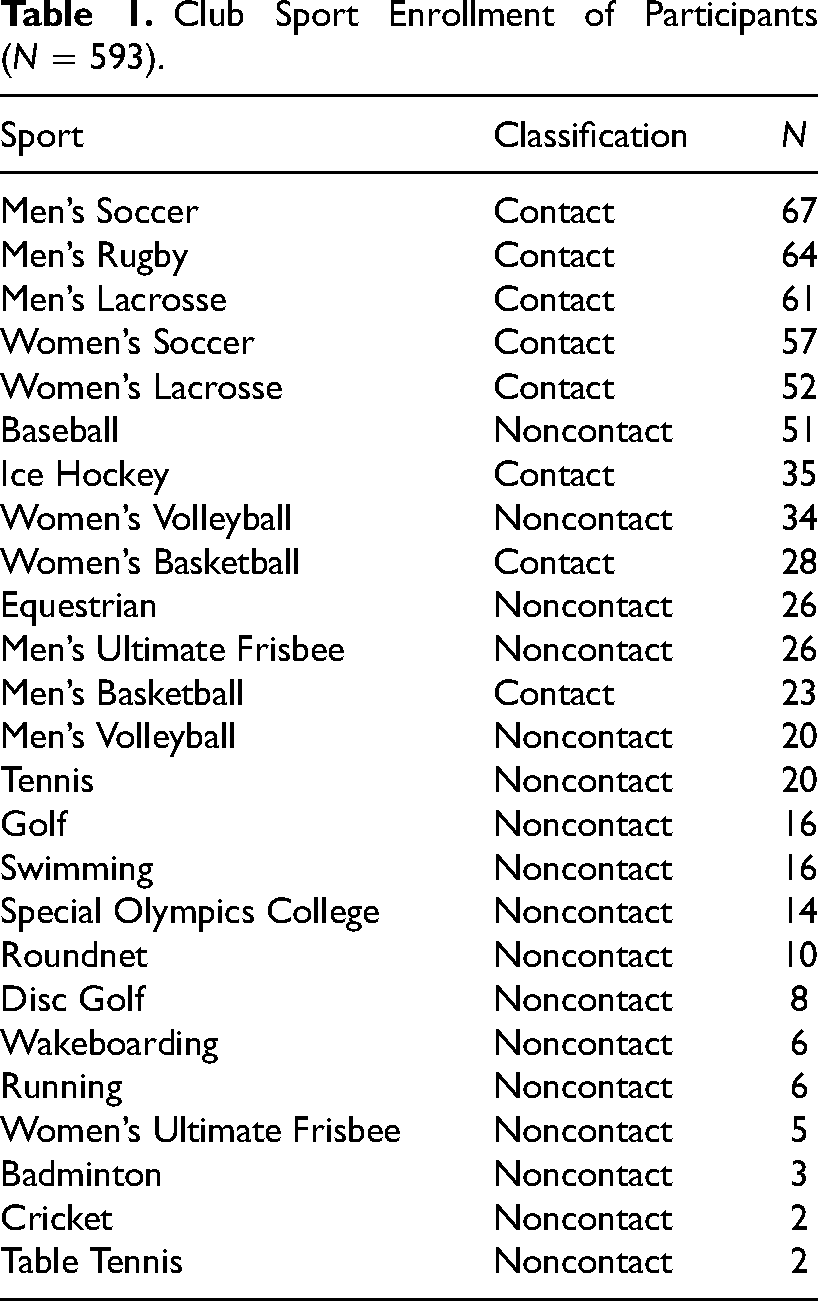
Primary exposure: Each student was classified into one of two contact-level groups (contact vs. noncontact) based on the type of club sport(s) in which they were currently participating (Table 1). Contact sports included basketball, ice hockey, lacrosse, rugby, and soccer. Noncontact sports include badminton, baseball, cricket, disc golf, equestrian, golf, round net, running, swimming, table tennis, tennis, ultimate Frisbee, volleyball, wakeboarding, and Special Olympics College. Because students could participate in multiple club sports, those participating in one or more contact sports were classified as contact sports.
Club Sport Enrollment of Participants (N = 593).
Primary outcome: The history of concussion was identified by using different evidence-based manners (Valovich McLeod et al., 2008). This included asking the following questions,
How many times have you been diagnosed with a concussion? How many times have you had your “bell rung”/“dinged”?
These two concussion history questions were answered with the response choices 0, 1, 2, 3, or more, or unsure and were recoded for the analysis to “no history” or “history of one or more.” No additional instructions regarding timeframe (e.g., “past five years”) were provided and participants were not instructed to limit their reporting to sports-related concussions only.
Covariates: Demographic variables including age, race, and year in school were included in the adjusted model. Years of sport experience and participation in multiple sports were added to determine whether increased exposures (historic or current) modified the primary association of interest.
Statistical Methods
Stata/SE 18 was used for statistical analyses. Descriptive statistics were used for the entire sample of students participating in club sports. Pearson χ2 was used to compare the prevalence of concussion (history of one or more concussions) and prior experience of having one's bell rung by contact-sport participation and sex. Individuals who answered “unsure” to one or both outcome questions were treated as missing. Multivariable logistic regression models were used to examine the impact of contact club sport participation and sex on the history of one or more concussions and prior experience of having their bell rung. Models were adjusted for age, race, participation in multiple sports, years of participation in organized sports, and years in college. Missing data were handled using listwise deletion. The final analytic sample included 593 participants.
Results
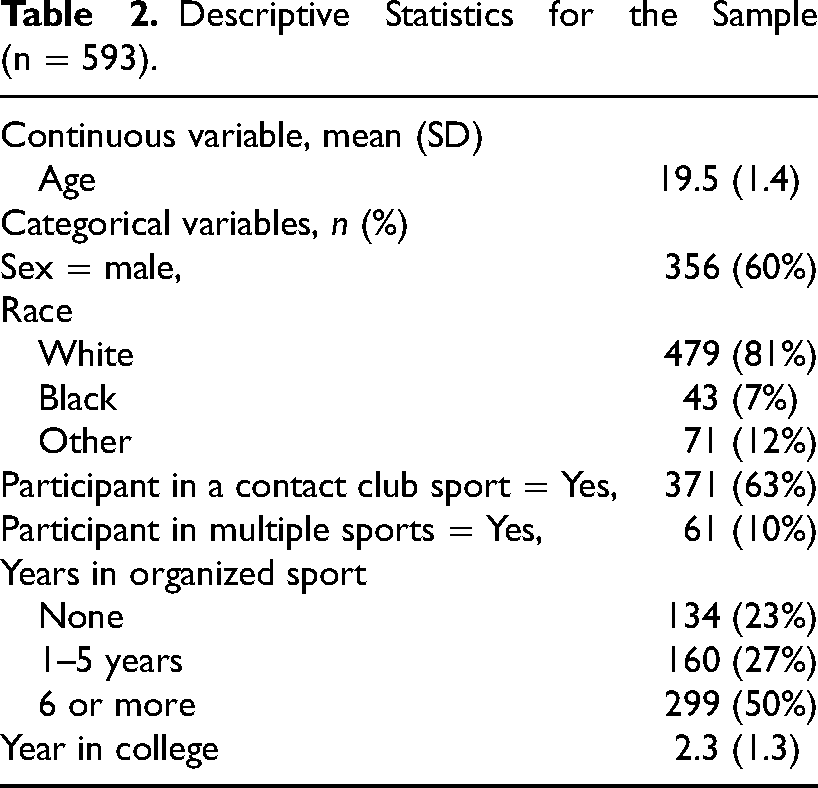
Descriptive statistics of students participating in club sports are shown in Table 2. The average age of participants was 19.5 years with an average of 2.3 years of college experience. A majority of participants were White (81%), participating in a single club sport (90%), and had at least one year of previous experience participating in sports (77%). For our primary exposure variables, the majority of participants were male (60.0%) and participated in a contact club sport (63%).
Descriptive Statistics for the Sample (n = 593).
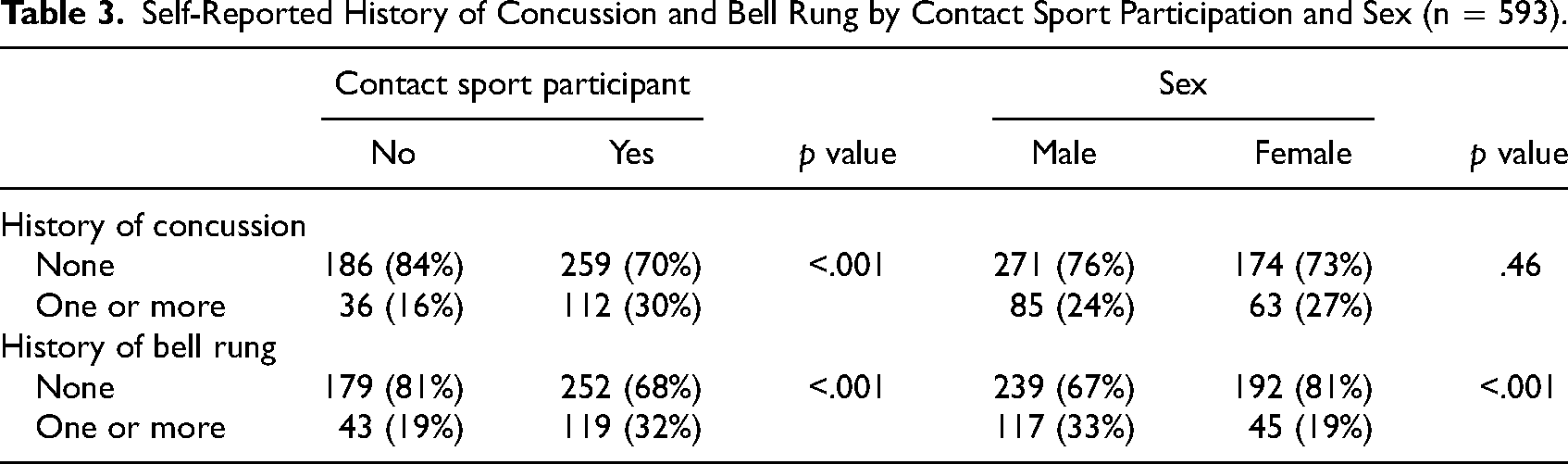
The percentage of participants who reported ever experiencing one or more concussions was 25% (Table 3). Those currently participating in contact sports were significantly more likely to report having experienced a concussion compared to those who were in non-contact sports (30% vs. 16%, p < .001). Males and females had a similar prevalence of self-reported concussion (24% vs. 27%, p = .456). The percentage of participants who reported ever having had their bell rung one or more times was 27.3%. This was significantly higher for those participating in contact sports compared to non-contact sports (32% vs. 19%, p < .001) and males compared to females (33% vs. 19%).
Self-Reported History of Concussion and Bell Rung by Contact Sport Participation and Sex (n = 593).
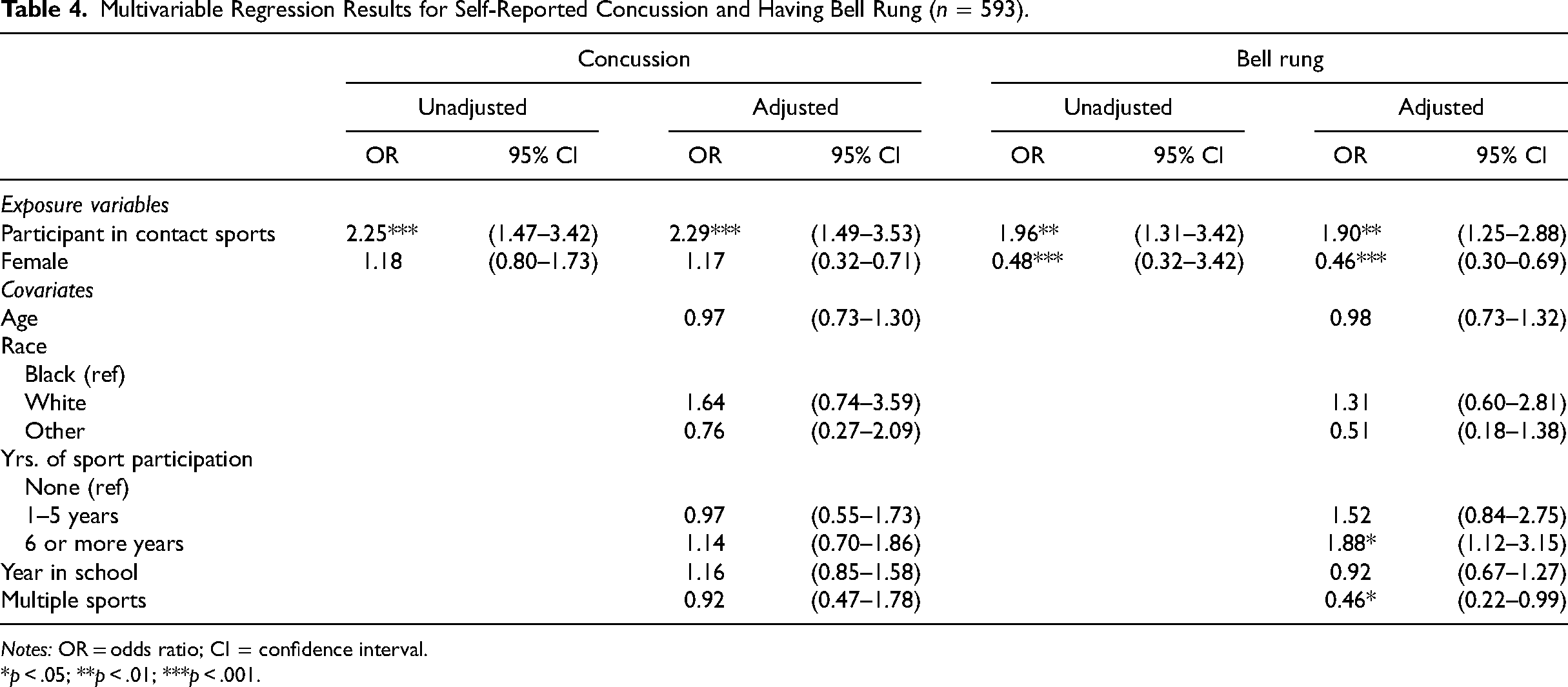
The results of the logistic regression models predicting reported concussions and having one's bell rung as a function of contact sport participation and gender, adjusted for covariates are presented in Table 4. When compared to those in noncontact club sports, the adjusted odds of reporting ever having sustained a concussion were 2.29 times higher for those participating in contact club sports (OR = 2.29; 95% CI: 1.49, 3.53). Males and females did not significantly differ in the odds of reporting a previous concussion. In the model for having one's bell rung, those participating in a contact sport had 1.90 times greater odds of reporting having their bell rung in the past compared to those in noncontact sports (OR = 1.90; 95% CI: 1.25, 2.88). Whereas males and females did not differ in their self-reported concussion history, females had significantly lower odds of reporting having their bell rung in the past than males (OR = 0.46; 95% CI: 0.30, 0.69). In addition, participating in sports for six or more years demonstrated 1.88 times greater odds for reporting having their bell rung (OR = 1.88; 95% CI: 1.12, 3.15) than having no prior participation in sports.
Multivariable Regression Results for Self-Reported Concussion and Having Bell Rung (n = 593).
Notes: OR = odds ratio; CI = confidence interval.
*p < .05; **p < .01; ***p < .001.
A low positive correlation (r = .44) was found between self-reported history of concussion and having their bell rung. Similar findings were demonstrated for male (r = .48) and female (r = .41) athletes. Overall, of the 162 athletes who affirmed having their bell rung, 47% of males and 36% of females (total n = 71) did not also regard this as a concussion. Similarly, of the 148 who affirmed having a concussion, 27% of males and 54% of females (total n = 57) did not also perceive this as having their bell rung.
Discussion
The results of this study on a large sample of club sports participants at one university have demonstrated three interesting findings. First, there are differences in concussion reporting behaviors by sex based on the question asked. Male athletes had a significantly greater probability of reporting a history of having their bell rung than females, while there was no difference in the probability of self-reporting a history of concussion between males (24%) and females (27%). These findings were evident in the univariate and multivariate analyses. Published research has reported that male athletes were less likely than female athletes to report concussions (Cheng et al., 2019; Wallace et al., 2017b). A common reason argued for underreporting has been downplaying of the severity of the injury based on the athlete not believing the injury to be severe enough to require medical attention (McCrea et al., 2004). Another possible reason is that athletes felt an obligation to continue to play to avoid upsetting their coach or feeling as though they had let their teammates down (Lininger et al., 2017; Wallace et al., 2017b). We propose that cultural utilization of the term “bell rung” versus concussion reflects an understatement of the injury, warranting the response of continued play in some of high-risk sports as a result of their perceived obligation. Similarly, it is possible that athletes who participate in more predominantly male high-risk contact and collision sports such as football, where toughness and other masculine norms are seen as indicators of success, are more likely to downplay their injury and continue to play when symptomatic (Clark & Stanfill, 2019; Kroshus et al., 2017; Wallace et al., 2017a). This could also explain the variance in terminology, which presented opposing findings in this study suggesting that the slang “bell rung” may be more commonly used as an alternative by male athletes or the sport of football in an effort to downplay the injury.
Secondarily, across the athletes surveyed, those who participated in a contact sport reported a significantly higher history of concussion and of having their bell rung than those athletes participating in non-contact sports. These findings were present in the univariate analyses and in multivariate analyses. In the multivariate analysis, participation in a sport for more than six years also increased the odds of reporting having their bell rung by participants. This finding is not surprising, given that contact sports are where a majority of sports-related concussions occur (Prien et al., 2018; Tommasone & Valovich McLeod, 2006). The rates of concussion in these sports have been well documented (Kerr et al., 2017, 2019; Koh et al., 2003; Pfister et al., 2016). It is interesting that more than six years of participation in sport is positively associated with reporting having your bell rung, demonstrating possible historic effects and exposure to the term “having your bell rung” by athletes who have been in the sport longer. As concussion education has emphasized that having your bell rung is synonymous with a concussion (Valovich McLeod et al., 2008), it is possible that athletes with less historic exposure to this term are less likely to use it, whereas, those with a greater time in sport may continue to carry this slang statement indicative of their perception of an event which is less serious than an actual concussion.
A third finding is that there is a low positive correlation (r = .44) between an individual affirming a history of one or more concussions and also reporting one or more incidences of having their bell rung. This is an interesting finding which needs to be explored further as there are multiple possible reasons for this. Similar to the reported findings, the variance in reporting based on the question asked is likely due to a lack of understanding of the athlete and failure to realize the nature of the injury (Miyashita et al., 2014, 2016). Because these two questions were asked at the same time, it is possible that the athletes are reporting the same historical event as a “yes” answer to both questions (i.e., they had a concussion and they regard it as having their bell rung). On the other hand, some athletes who affirmed both questions may be reporting two separate events, once when they had a concussion and another when they had their bell rung. From this present study, we do not know how both questions being affirmed should be interpreted. More interesting here are the athletes who affirm one yes but not the other. Overall, the correlation results demonstrate for nearly half of the athletes, a concussion and having your bell rung are two different things. This is important as it continues to demonstrate that language is important when talking about concussions with athletes (Miyashita et al., 2014, 2016). This includes how concussions are described through educational materials and when taking a medical history (Kroshus et al., 2015; Miyashita et al., 2016).
It should be noted that responses to these questions can be biased based on the athlete's inability to recall all incidents that occurred in the past. We do not know how these questions were interpreted by the athletes and whether they classified one incident as either having their “bell rung” or having sustained a concussion, versus regarding one event as the same (i.e., resulting in “yes” answers to both questions). Clarification of the terminology used could be found helpful in determining more accurate reporting. Having a better understanding of where the term “bell rung” originated and how it is being utilized in certain sports could aid in a better understanding of reporting behaviors. Similarly, because the timeframe and circumstance of injury (sports vs. other mechanism) were not included in the questions asked, it is possible participants answered the questions based on nonsports or within a certain timeframe. Future considerations should be given towards a pre/postmeasurement and education intervention to increase knowledge, attitudes, and behaviors around concussion in this population.
Conclusion
This study expands upon what is already known about concussion-reporting behaviors, including differences in reporting based on the question asked. Specifically, female athletes have a higher reporting of concussion incidence than that of male athletes. The use of terminology and variance in slang versus medical terms has the potential to effect reporting outcomes. Reporting of concussion incidents has the potential to be influenced by the nature of sport culture and sport participation in contact versus noncontact sports.
Application to Practice
Overall, these findings suggest that the club sport athlete population could benefit from additional education related to concussions based on the differences seen here in reporting of the injury and terminology used. Similarly, one could infer that there could be a greater realization of concussion following education for this population as that has been found in other populations (Van Pelt et al., 2021). Based on these results, we suggest that resources be devoted to tailored education for sport club athletes participating in and staff associated with sports at greatest risk. Consideration towards annual in-person, hybrid, or remote delivery of education modules on concussion by certified and licensed healthcare professionals is suggested. Inclusion of evidence-based facts on signs and symptoms of concussion, as well as instruction on when to seek medical care, discontinue activity, return to learn, and return to play, should be provided. In addition, this education should include clarification of terminology and language used by the subgroups of athletes to aid in understanding and more accurate reporting of injury. Annual review of reported injuries and follow-up surveys to determine the effectiveness of education modules are recommended.
Footnotes
Declaration of Conflicting Interests
The author(s) declared no potential conflicts of interest with respect to the research, authorship, and/or publication of this article.
Funding
The author(s) disclosed receipt of the following financial support for the research, authorship, and/or publication of this article: This work was supported by the University of Mississippi Community Wellbeing Constellation.
