



Abstract
The purpose of this study was to examine the physical activity behaviors and campus recreation use of students enrolled in a summer transition (high school to university) program. The physical activity behaviors and socio-demographic characteristics of summer transition program students from a large Northeastern United States university were collected via an online survey. Descriptive statistics were computed, and disparities between genders were examined using independent samples t-tests. Women participated in less aerobic and muscle-strengthening activity compared to men (p < .05); and, among those who used the primary campus recreation facility, women reported lower use of both weights and informal sports areas, and higher use of group exercise compared to men (p < .05). Cardio area and indoor running track use did not differ between men and women. In summary, there appears to be an opportunity for university summer transitional programs to address disparities in physical activity by expanding coverage to address a currently unmet need for physical activity promotion.
Introduction
Participation in physical activity declines significantly during the transition from secondary to post-secondary (i.e., tertiary) education (e.g., Deforche et al., 2015; Ullrich-French et al., 2013), with many students participating in insufficient levels of both aerobic and muscle-strengthening activities (Wilson et al., 2021c). The physical environment is among one of the various interconnected factors that influence participation in physical activity (Sallis et al., 2008). The availability/accessibility of recreational facilities is one component of the physical environment associated with physical activity (Heinrich et al., 2017; Reed & Phillips, 2005). Compared to other communities throughout the United States (US), universities/colleges are often able to provide a unique physical environment to promote healthy behaviors due to many students living on campus or in the surrounding community.
Although universities may provide substantial facilities to promote healthy behaviors, disparities in campus recreation facilities use have been seen within various demographic populations (e.g., race, religion, gender identity, etc.), and may have implications in overall physical activity participation and associated physical and mental health outcomes (Bull et al., 2020). For example, previous research has established that women use campus recreation facilities at a lower frequency than men (Miller et al., 2008; Milton & Patton, 2011; Shaikh et al., 2018; Wilson et al., 2022a), as well as specific spaces within facilities (Wilson et al., 2022b). However, whether disparities in campus recreation facility use exist from the moment students set foot on campus or develop over time is unclear. Summer transition (bridging) programs are intended to ease the transition from high school to post-secondary education by boosting academic and social readiness (Wachen et al., 2016). Such programs are becoming increasingly common at US post-secondary institutions with some attempting to promote physical activity during this important transition (Wilson et al., 2022c). The purpose of this study was to examine differences in the physical activity behaviors and campus recreation facility use among summer transition program students.
Methods
Participants and Procedures
Design. This cross-sectional cohort study was conducted at a large university located in the northeast US using an online survey in the Summers of 2018 and 2019 (Qualtrics, Provo, UT). The Pennsylvania State University Institutional Review Board approved the study.
Recruitment. Recruitment was conducted using an anonymous open-link survey distributed to students involved in a summer transition program with the assistance of the program director, program instructors, and program mentors. Participants were sent one reminder message following the initial message. Participation was voluntary and did not impact students’ grades. The summer transition program group that achieved the greatest response rate, determined with the assistance of the program director, was awarded a pizza party. Data were password protected, and only accessible to research team members. An informed consent statement was presented to students upon opening the survey link. Cookies were used to prevent multiple submissions.
Measures
Survey questions were aggregated from previously validated measures. Each measure is described below.
Socio-demographic characteristics. Participants self-reported their: age; gender identity (man, woman, and various non-binary identities); race, sexual orientation, and parent education level.
Physical activity behaviors. The Global Physical Activity Questionnaire (GPAQ), a reliable and valid measure (Bull et al., 2009; Herrmann et al., 2013), assessed minutes per week of moderate and vigorous leisure time physical activity (Armstrong & Bull, 2006). Muscle-strengthening activity was measured in a similar manner to the GPAQ using items, with participants asked their weekly frequency and duration of participation in moderate or high intensity muscle-strengthening activities lasting at least 10 min continuously in a typical week. Those who participated in 75 min of vigorous physical activity or 150 min of moderate physical activity were considered to meet aerobic physical activity recommendations. Those who participated in muscle-strengthening activities at least two days/week were considered to meet muscle-strengthening activity recommendations. Those who met both aerobic and muscle-strengthening recommendations were considered to meet physical activity recommendations (2018 Physical Activity Guidelines Advisory Committee, 2018).
Campus recreation facility use. Participants reported whether they had used each of the three campus recreational facilities. Those who had used the respective facilities were asked to report the frequency (days/week) that they used areas/spaces within the given facilities (e.g., weights, cardio equipment, informal sports, group exercise, indoor running track).
Statistical Analyses
Descriptive statistics were computed, and gender disparities in physical activity and campus recreation facility use were examined using independent samples t-tests. Differences in the proportion of men and women meeting physical activity recommendations were examined using chi-square tests for independence. Differences based on other socio-demographic characteristics were not examined due to an insufficient sample size to examine disparities without condensing underreported groups. All analyses were run using SPSS 28.0 (IBM, Armonk, NY), with an alpha-significance level set at p < .05. Eta squared η2 values were calculated for t-tests to report the magnitude of any differences.
Results
Participant Characteristics
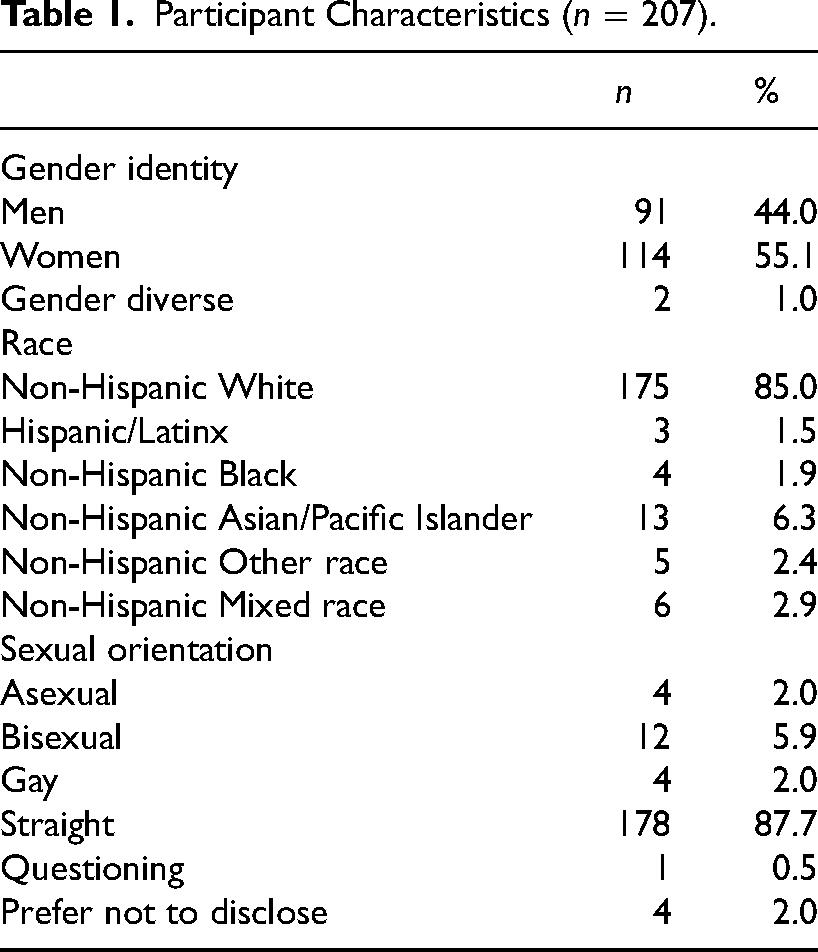
A total of 207 students participated in the study. The mean age of participants was 18.07 ± 0.27 years. The majority were women, non-Hispanic White, and heterosexual (Table 1). Most (n = 139, 67.1%) met aerobic activity recommendations, less than half (n = 86, 41.5%) met muscle-strengthening recommendations, and just over a third (n = 72, 34.8%) met both aerobic and muscle-strengthening recommendations.
Participant Characteristics (n = 207).
Gender Disparities
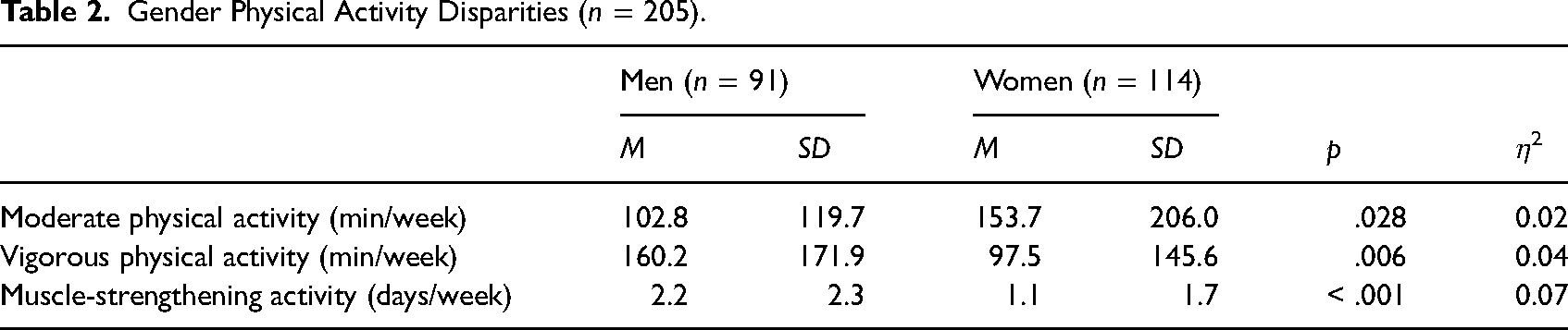
Women reported significantly lower minutes/week of both moderate and vigorous physical activity, as well as significantly fewer days/week of participation in muscle-strengthening activities compared to men (Table 2). The proportion of men (71.4%) and women (63.2%) meeting aerobic activity recommendations did not differ significantly (p = .211), with 66.8% meeting recommendations overall. A significantly (p < .001) larger proportion of men (53.8%) met muscle-strengthening recommendations compared to women (30.7%), with 40.1% meeting recommendations overall. Similarly, a significantly (p = .002) larger proportion of men (47.3%) met muscle-strengthening recommendations compared to women (23.7%), with 34.1% meeting recommendations overall.
Gender Physical Activity Disparities (n = 205).
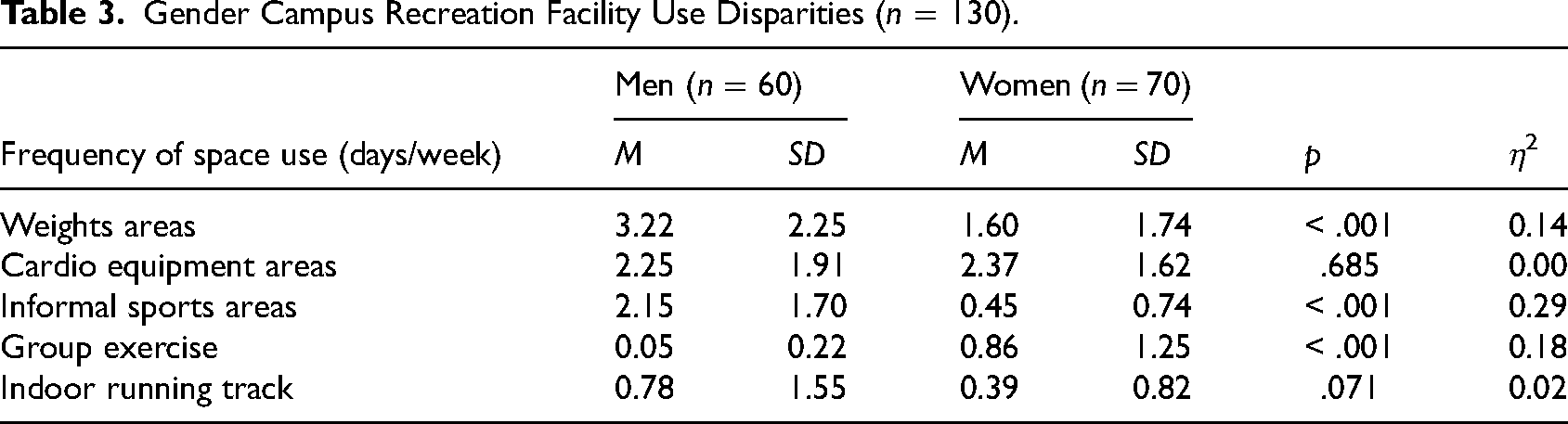
Among those who reported using the primary campus recreation facility (n = 130), women reported lower use of both weights and informal sports areas, and higher use of group exercise compared to men. Use of cardio areas and the indoor running track did not differ between genders (Table 3).
Gender Campus Recreation Facility Use Disparities (n = 130).
Conclusions
A smaller proportion of women met physical activity recommendations compared to men. This difference was largely attributable to the disparity in muscle-strengthening physical activity participation, which is consistent with previous findings regarding inequities in muscle-strengthening participation (Wilson et al., 2021b) and reports that women use weights areas within campus recreation facilities less frequently than men (Wilson et al., 2022b).
Our findings suggest that certain disparities pertaining to the use of campus recreation facilities exist from the moment students arrive on campus. Though there are many and diverse opportunities to participate in physical activity outside of campus recreation facilities, facilitating greater use of weights within campus recreation facilities by women would help to address well-established disparities in muscle-strengthening activity. Despite differences in intensity preferences, a similar proportion of male and female college students prefer to participate in some form strength training (Reading & LaRose, 2020). Prior research suggests that increasing women's comfort in recreational facilities (Peters et al., 2019; Stankowski et al., 2017; Wilson et al., 2021a; Wilson et al., 2022b) facilitating the development of skills, knowledge, and competence (Peters et al., 2019; Wilson et al., 2021a; Wilson et al., 2022b) and more appropriate equipment and more considered design (Wilson et al., 2021a) encourage more women to use campus recreation facilities as well as specific areas within facilities.
One of the core principles of the life-course perspective is timing (Li et al., 2009). Summer transition programs afford a unique timing opportunity to disrupt the negative observed in the physical activity behaviors of post-secondary students. Along similar lines, summer transition programs also represent an opportunity to address the inequities evident in the current study and the wider literature. Such programs align with the theory of expanded, extended, and enhanced opportunities for youth physical activity promotion (Beets et al., 2016). However, before such programs are widely offered, additional research into their efficacy in achieving not only physical activity goals, but also other institutional priorities, such as student retention and sense of belonging (Murphy et al., 2020), is warranted.
The main limitations of this study are the reliance on a self-selected sample from a single institution, and the use of self-reported measures. Future researchers may want to consider recruiting larger samples, or samples that comprise students from multiple institutions. Researchers could also measure physical activity using accelerometers (Slootmaker et al., 2009) and campus recreation facility use via swipe card data (Zegre et al., 2022). Longitudinal research, that continues into and beyond students’ first year of post-secondary education is also worth considering. In addition, longitudinal between-groups comparisons of changes in the physical activity behaviors, as well as associated health behaviors and outcomes, between students who do and do not participate in summer transition programs with a physical activity component could also be considered.
In summary, there appears to be a good opportunity to develop, implement, and evaluate intentional programming targeting transition/bridge students prior to their full matriculation that expands, extends, and enhances opportunities for youth to participate in physical activity as they transition through early adulthood. However, mere programming is unlikely to address the disparities given they mirror those observed in the wider student population. The environment, both social and built, likely needs to change to alleviate persistent disparities. For example, facility design and equipment design/variety are aspects of the built environment that could be changed, while there is a clear need for policies that alter the social environment and enhance comfort.
Footnotes
Acknowledgments
The authors would like to acknowledge Office for Summer Session Director Kelly Griffith and Learning Edge Academic Program (LEAP) instructors and mentors for facilitating participant recruitment.
Declaration of Conflicting Interests
The author(s) declared no potential conflicts of interest with respect to the research, authorship, and/or publication of this article.
Funding
The author(s) received no financial support for the research, authorship, and/or publication of this article.
