



Abstract
In this study of North American campus recreation staff, we examined staff perceptions of transgender and nonbinary student inclusivity, and explored differences in perceived inclusivity based on institutional characteristics, policies, amenities, and staff characteristics. Staff were recruited to participate in an online survey that assessed: institutional characteristics, amenities, and policies; personal characteristics; and, their perception of their campus recreation facilities’ inclusivity of transgender and nonbinary students. Perceived inclusivity was greater at nonreligiously affiliated institutions, and at institutions that had antidiscrimination/antiharassment policies and/or all-gender locker/restrooms within the campus recreation department. Men and heterosexual staff reported greater perceived inclusivity than women and sexual minority staff. In summary, antidiscrimination and antiharassment policies and all-gender locker/rest rooms appear to contribute to creating the perception of a more inclusive campus recreation environment. Continued work on staff awareness/knowledge relating to inclusion of transgender and nonbinary students appears to be necessary, and application of policies that support inclusivity should be a priority.
Introduction
Many college (i.e., postsecondary) students from both the United States and around the world do not meet aerobic or muscle-strengthening activity recommendations, with inequities in participation often poorly examined (Wilson et al., 2021b). However, evidence suggests that physical activity participation among college students in the United States varies based on several sociodemographic characteristics, including gender identity and sexual orientation (Wilson et al., 2021a). Campus recreation departments play an important role in student physical activity promotion, with activity inequities often mirroring inequities in the use of campus recreation facilities (Stankowski et al., 2017; Wilson, Colinear, et al., 2022). Physical activity is associated with a variety of physical and mental health benefits (Bull et al., 2020), and insight into how campus recreation policies and practices influence student physical activity participation via the built and social environment of recreation facilities is of great interest.
A smaller proportion of transgender and nonbinary students meet aerobic and muscle-strengthening activity recommendations compared to their peers (Wilson et al., 2021a). Evidence, albeit limited, indicates that few transgender and nonbinary students use campus recreation facilities, and that some avoid using such facilities due to discomfort associated, in part, with their gender identity (Petterson, 2021). Previous research has highlighted the importance of gender-inclusive restrooms in relation to members of the lesbian, gay, bisexual, transgender, queer or questioning (LGBTQ) community using campus recreation facilities (Daly et al., 2015; Petterson, 2021). Such amenities provide students with a comfortable and safe space, as opposed to using the restroom matching their sex assigned at birth as required by legislation in some states within the United States (Couillard & Higbee, 2018). Gender-inclusive bathrooms and changing rooms have become increasingly common in campus recreation facilities, with reportedly around half of institutions having gender-inclusive bathrooms and/or changing rooms within recreation facilities (Patchett & Foster, 2015). Though gender-inclusive spaces are recognized as important by campus recreation professionals, recognition does not necessarily translate into staff raising student awareness of such amenities and accompanying policies (Anderson et al., 2020). Safe and comfortable places to engage in physical activity are important (Pecoraro & Pitts, 2020), and evidence suggests that the existence and enforcement of other policies that influence the social environment of campus recreation facilities (e.g., antidiscrimination/harassment policies) may also play a role in creating an inclusive environment for members of the LGBTQ community (Daly et al., 2015).
Though recognition of the importance of such policies and amenities is promising, many institutions do not yet endorse such policies or provide such amenities. In doing so, institutions are potentially constraining participation of students who may stand to benefit from such amenities, such as transgender and nonbinary students, from using facilities. This is concerning for various reasons, including that it potentially prevents all students from realizing the benefits of physical activity participation, and because in most instances students are paying for such facilities as part of mandatory student fees (Wilson et al., 2020; Wilson, Powers et al., 2022). The purpose of this study was to examine whether the campus recreation staff member's perceptions of inclusiveness of their campus recreation facilities for/of transgender and nonbinary students differed based on institutional characteristics (e.g., religiously affiliated or minority-serving institution), staff characteristics, or the existence of antidiscrimination policies, and/or antiharassment policies and all gender locker rooms. Though the focus of our article is on perceived gender inequities, given the exploratory nature of our study and that gender and sexual minorities are often grouped together as a part of the LGBTQ + community we examined differences in perceptions based on staff member gender and sexual orientation.
Methods
Participants and Procedures
Data for this cross-sectional mixed-methods study were collected using an open-link, Qualtrics (Provo, UT) survey distributed via email by National Intramural-Recreational Sports Association (NIRSA) on 11/10/20 to campus recreation department staff who were NIRSA members (n = 2,563; 2,556 emails delivered). Follow-up reminders were sent on 11/12 and 11/18. Though data covered a range of topics this study focusses exclusively on the perceived inclusivity of transgender and nonbinary students. Findings pertaining to wider policies and practices and the response of campus recreation departments to the pandemic are reported elsewhere (Wilson, Powers et al., 2022). All equity-related questions were framed to participants such that they answered questions as they would have prior to the pandemic, as opposed to in the midst of the pandemic. Two hundred and five participants responded to the main question examined in this article—perceived inclusivity of campus recreation for transgender and nonbinary students. Though some participants were missing responses for certain questions pertaining to institution and personal characteristics, these participants were retained to maximize sample size for different analyses.
The [Pennsylvania State University] institutional review board approved this study. Informed and voluntary consent was implied through a forced response question following the presentation of the participant information sheet detailing how participant confidentiality and anonymity would be maintained.
Measures
Institutional characteristics
Participants reported status as a minority-serving institution and religious affiliation.
Policies/amenities
Participants reported whether their campus recreation department had: an antiharassment policy, an antidiscrimination policy, and all gender locker rooms/restrooms. Options were created based on a previous review of campus recreation policies (Wilson et al., 2020).
Staff member characteristics
Participants reported their age, gender identity, and sexual orientation.
Transgender and nonbinary inclusivity
Participants were asked to indicate, using a 0 (strongly disagree) to 100 (strongly agree) point sliding scale the extent to which they agreed or disagreed that their campus recreation facilities are inclusive of transgender and nonbinary students.
Statistical Analyzes
Quantitative analyzes were conducted using IBM SPSS Statistics Version 28.0 (IBM, Armonk, NY). Descriptive statistics were computed to describe the sample. Independent samples t-tests were used to examine differences in perceived inclusiveness of transgender and nonbinary students based on institutional characteristics (minority-serving, religiously affiliated), institutional policies/amenities, and participant (staff) characteristics (gender, sexual orientation). Participants affiliated with minority-serving institutions were collapsed into a single minority-serving institution category. The participant identifying as nonbinary was excluded from analyzes comparing differences between men and women. Sexual minority participants were also collapsed into a category to compare with heterosexual participants.
Results
Institutional Characteristics
Among all participants, one worked at a historically black college or university, 31 worked at Hispanic Serving Institutions, five worked at a tribal college or university, 12 worked at another minority-serving institution, and 22 worked at religiously affiliated institutions.
Participant Characteristics
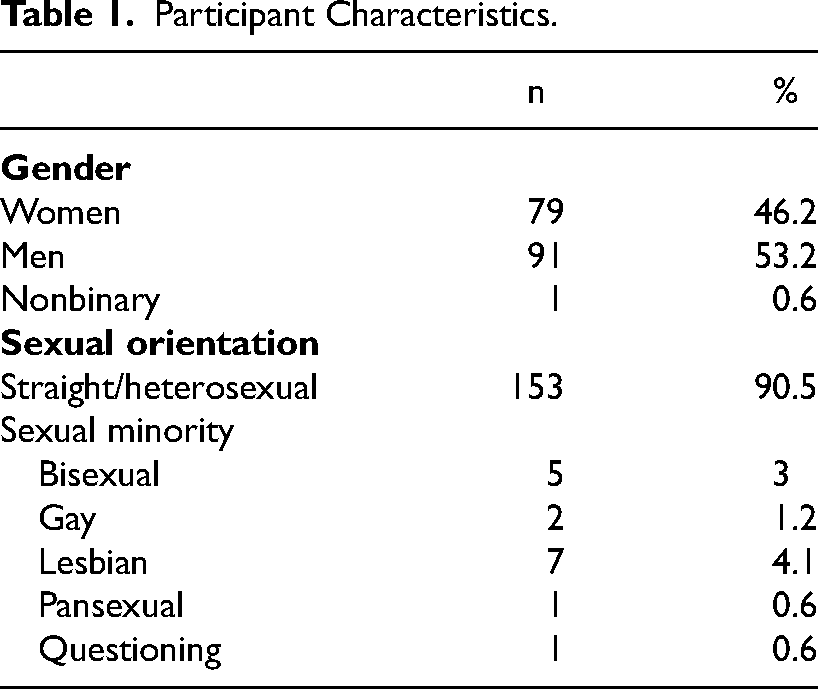
The average age of staff was 45.5 ± 11.8 years. There was a relatively even gender split, whereas most participants identified as heterosexual (Table 1).
Participant Characteristics.
Perceived Transgender and Nonbinary Campus Recreation Inclusivity
Institutional characteristics
No differences (p = 0.370) in perceived inclusivity were found between participants working at minority-serving institutions (M = 66.4, SD = 25.1) and nonminority-serving institutions (M = 61.9, SD = 28.3; p = .370). However, participants working at nonreligiously affiliated institutions (M = 64.3, SD = 27.5) reported significantly greater agreement (p = .034, η2 = 0.02) in relation to inclusivity compared to staff working at religiously affiliated institutions (M = 51.0, SD = 26.9).
Campus recreation policies/amenities
Participants at institutions that had antidiscrimination and/or antiharassment policies, all-gender locker/rest rooms reported significantly greater agreement that their campus recreation facilities were inclusive to transgender and nonbinary individuals than institutions that did not have such policies or amenities (Table 2).
Differences in Inclusivity of Transgender and Nonbinary Students Based on Institutional Policies/Amenities.
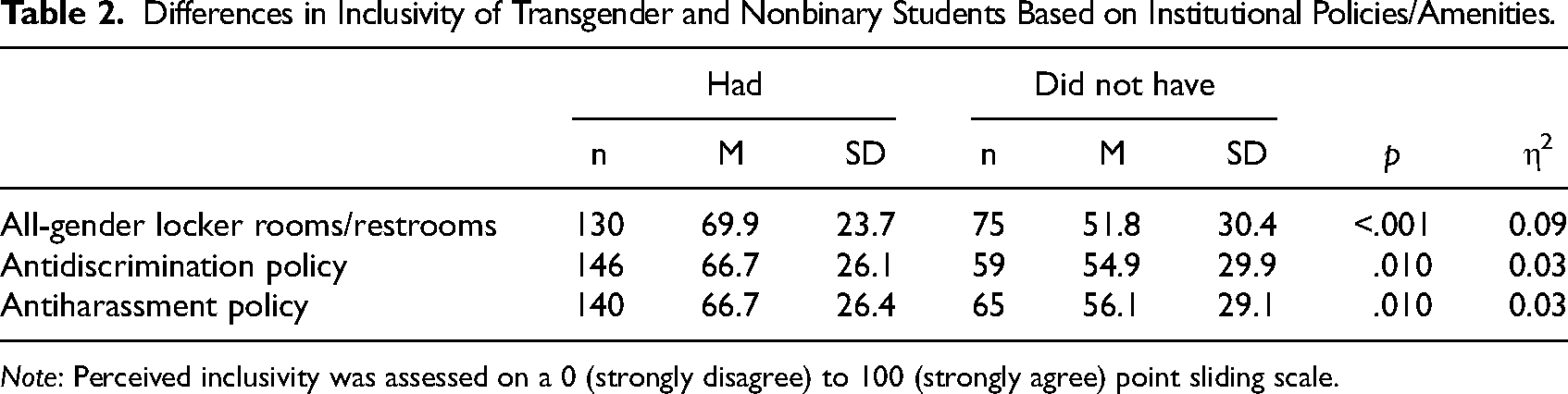
Note: Perceived inclusivity was assessed on a 0 (strongly disagree) to 100 (strongly agree) point sliding scale.
Staff characteristics
Men (M = 73.6, SD = 24.4) reported significantly greater agreement (p < .001, η2 = 0.13) in relation to inclusivity compared to women (M = 53.0, SD = 27.9). Heterosexual participants (M = 65.6, SD = 27.7) reported significantly greater agreement (p = .018, n2 = 0.03) in relation to inclusivity compared to sexual minority participants (M = 48.3, SD = 27.4).
Discussion
Our study revealed that perceived inclusiveness of campus recreation facilities to transgender and nonbinary students varied based on certain institutional characteristics, policies, amenities, and staff characteristics. Though the associations between the existence of policies and amenities and inclusiveness of transgender and nonbinary students were not examined explicitly, findings suggest that the perceived inclusivity of transgender and nonbinary students was greater at nonreligiously affiliated institutions, and at institutions that had antidiscrimination/antiharassment policies and an all-gender locker/rest room within the campus recreation department. Differences were also found based on staff characteristics, with men and heterosexual staff reporting greater perceived inclusivity than women and sexual minority peers.
Our findings add to the growing body of evidence demonstrating the importance of offering all-gender locker/rest rooms to facilitate the use of campus recreation facilities by all members of the student community. Consistent with previous research (Patchett & Foster, 2015), we found that most campus recreation departments had an all gender locker/rest room. Providing such amenities merely addresses a physical barrier to facility use; however, raising awareness of such amenities (Anderson et al., 2020), and adopting policies that prevent harassment of transgender and nonbinary students are also crucial (Daly et al., 2015). Including transgender and nonbinary students in the development and revision of campus recreation policies and services would help to increase the likelihood of them being as inclusive as possible (Pecoraro & Pitts, 2020).
Previous research has demonstrated that religiously affiliated institutions tend to lag behind in their inclusivity of transgender and nonbinary students (Goldberg et al., 2019) and do not always foster an inclusive, welcoming, of safe environment for transgender and nonbinary students (Boskey & Ganor, 2020; Craig et al., 2017; Evans et al., 2017). Our findings, based on staff perceptions alone, align with the wider body of literature regarding the inclusivity of transgender and nonbinary students at religiously affiliated institutions, and demonstrate that inclusivity is an issue in relation to campus recreation too. This is not to say that nonreligiously affiliated institutions do not have work to do too, but rather findings suggest that more barriers to engaging in campus recreation activities may exist for transgender and nonbinary students enrolled at religiously affiliated institutions.
Finally, when considering staff characteristics, it is interesting that staff who have traditionally been more socially privileged (i.e., men, and those identifying as heterosexual) perceived greater inclusivity. The magnitude of this difference in relation to staff member gender is particularly noteworthy, and collection of perceptions of more sexual minority staff members would help to establish the magnitude of differences based on sexual orientation. Why these differences in perceptions exist is beyond the scope of our study, but they may be attributable to ignorance of the social environment within which they work. Our findings suggest that staff characteristics warrant consideration by institutions committed to establishing and maintaining an inclusive environment, as perceptions may extend beyond those pertaining to gender and include other aspects of student identities.
Our study is not without limitations. Findings were derived from a relatively small convenience sample of staff members that included only one nonbinary participant. In addition, the small sample size and attrition in response to some items regrettably required us to consolidate sexual minorities into a single group to examine differences based on sexual orientation. Furthermore, findings are based on staff perceptions, and student perceptions are equally, if not more, important to understand how to ensure campus recreation facilities are inclusive for all.
In summary, evidence suggests that antidiscrimination and antiharassment policies along with all-gender locker/rest rooms contribute to creating a more inclusive campus recreation environment. However, continued improvements in other policies and practices, for example, the awareness and knowledge of certain staff members, appears to be necessary to ensure that transgender and nonbinary students are provided with equitable opportunities to participate in physical activities. In future work, perceptions of students, in particular students who identify as transgender and/or nonbinary, should be sought with respect to both research and practice.
Footnotes
Acknowledgments
The authors would like to thank the participants who took the time to respond offer candid responses to the survey, as well as NIRSA for supporting this research with a NIRSA Research Grant.
Authors Note
Sammie L. Powers is also affiliated at School of Sport, Recreation, and Tourism Management, George Mason University, Athens, Georgia.
Ginny M. Frederick is also affiliated at Department of Kinesiology, University of Georgia, GA, USA.
Declaration of Conflicting Interests
The author(s) declared no potential conflicts of interest with respect to the research, authorship, and/or publication of this article.
Funding
The author(s) disclosed receipt of the following financial support for the research, authorship, and/or publication of this article: This work was supported by a NIRSA Research Grant.
