



Abstract
The purpose of this study was to explore how students’ knowledge of campus recreation opportunities and their general physical activity (PA) motivations were associated with participation or non-participation in intramural sports, drop-in sports, and the fitness center. Data were collected using a questionnaire from undergraduate students (N = 348) at a large university in Ontario, Canada. Data were analyzed using logistic regression. Knowledge of opportunities was positively associated with participation in all three campus recreation activities. A desire to enhance the university experience was positively associated with intramurals and drop-in sports. Additionally, a desire to be fit through PA was negatively associated with drop-in sports. In addition to increasing students’ knowledge of opportunities, recreation professionals are encouraged to identify and promote the unique aspects of the campus recreation experience, such as its ability to enhance the university experience, in order to stimulate participation through differentiation from off-campus recreation experiences.
The benefits of physical activity (PA) for university students are well documented, including building friendships, physical fitness, mastery, stress reduction, and improved academic performance (Henchy, 2013; Schaefer et al., 2011). There are a number of recreation settings, both on campus and off campus, available to students who wish to obtain these benefits, both on campus and off campus. Therefore, an understanding of the factors that influence participation in campus recreation over other settings is important for professionals who wish to design programs and promotions in a way that highlights a university's unique offerings and maximizes facility usage.
Previous theorizing and supporting research suggests that consumers must first be aware of an activity and the opportunities to participate prior to becoming interested in the activity or facility (Funk et al., 2011). Awareness of opportunities on campus has been identified in previous research as a constraint associated with non-participation (Reed, 2007). Relatedly, simply being aware of what exists may not be enough to start students” participation pathway, as students also report not knowing how to get involved (Selvaratnam et al., 2021). Therefore, knowledge of opportunities must follow awareness. As such, this line of research typically recommends that recreation professionals increase students” awareness of what is available and knowledge of how to become involved in campus recreation (Bayne & Cianfrone, 2013; Selvaratnam et al., 2021).
The mere knowledge of opportunities is, of course, not enough to explain participation in PA as individuals must also be attracted to the opportunity (Funk et al., 2011). A major reason for an individual being attracted to one PA opportunity (organized or non-organized) over another is that it better fulfills the specific motivations held by an individual (Molanorouzi et al., 2015). Furthermore, the content of the programs and promotions need to appeal to students” motivations for selecting campus recreation over other settings. As such, the design of campaigns and programs need to be informed by an identification of how campus recreation experience fulfills PA motivations held by students (Beggs et al., 2014).
Significance and Purpose of the Study
To date, research on campus recreation has primarily focused on specific motivations to participate and less often considered students” general PA motivations and how they might be associated with participation or non-participation in different types of campus recreation. The present study advances research in campus recreation participation by offering more nuanced understandings of the extent to which certain motivational factors, salient to students, influence participation in different types of on campus PA opportunities. Our study underscores the idea that students” PA motivations may vary greatly (and have disproportional influence on participation) depending on the activity context. Knowledge of these differences may help campus recreation organizations design programs and experiences that better meet the unique needs of student participants; and develop more targeted promotional efforts for different types of opportunities. Furthermore, there is a need to account for the effects of knowledge of opportunities, the first condition of participation, when examining the associations between PA motivations and participation. Indeed, relatively few investigations have considered the simultaneous influence of both knowledge and PA motivation on participation in campus recreation opportunities.
Therefore, the purpose of this study was to explore the extent to which knowledge of campus recreation opportunities and PA motivations were differently associated with participation/non-participation in intramurals (i.e., organized sports over the course of a semester), drop-in sports (i.e., unorganized sports open to anyone during specified times), and the fitness center (i.e., weights and cardo equipment, but not fitness classes) for a sample of undergraduate students at one large university in Ontario, Canada. More specifically, the following research questions were explored:
To what degree does knowledge of campus recreation opportunities distinguish participants and non-participants in intramurals, drop-in sports, and fitness center on campus? Which motivations for PA in general, if any, distinguish participants and non-participants in intramurals, drop-in sports, and fitness center on campus?
Motivations for Physical Activity
Motivation is a multi-faceted concept that refers to goal directed voluntary actions that involve the psychological processes of arousal, direction, intensity, and persistence (Parks & Guay, 2009). In other words, motivation “relates to what we choose to pursue (arousal and direction) and how we pursue it (intensity and persistence)” (Parks & Guay, p. 679). The vast majority of PA motivation research focuses on the arousal aspect (see Molanorouzi et al., 2014), which will be the approach taken in this study. Arousal refers to the “motivational process of being interested in a given goal (such as a student being interested in earning good grades)” (Parks & Guay, p. 679). Therefore, the focus of this study is on the aspects of PA that are important or valuable to students. Some of the most commonly cited PA motivations held by adults are physical fitness, socialization, mastery, and stress reduction (Allender et al., 2006; Beggs et al., 2014; Molanorouzi et al., 2014). There are also PA motivations that can be unique to the context under study. In particular, research on campus recreation has often cited improvements to grades and an enhancement of the university experience as motivations that may be unique to university students.
Method
A cross-sectional survey was employed to understand the associations among knowledge of opportunities, PA motivations, and participation/non-participation in campus recreation.
Data Collection
During the fall of 2018 and winter of 2019, data were collected from undergraduate students from six different courses spread across three different disciplines (i.e., Arts, Health, Science) at one large university in Ontario, Canada. As part of a larger study, students were asked to respond to a series of questions on a paper and pencil survey and return the completed survey to a research assistant. Participation was completely voluntary and no incentives were offered. A response rate of 85% was obtained.
Survey Measures
This article draws on two types of variables, namely knowledge of opportunities (Research Question 1) and PA motivations (Research Question 2). Knowledge of opportunities was measured on a four-point scale (1 = “I know nothing”, 2 = “I know a little”, 3 = “I know some”, 4 = “I know a lot”) using the question lead “Please rate your knowledge of opportunities provided by [X]Athletics & Recreation” (Wright-Nunes et al., 2012).
The motivations that participants hold toward physical activity were measured using a Likert-type scale ranging from 1 (“strongly disagree”) to 5 (“strongly agree”). The specific measures were based on previous research on physical activity (Molanorouzi et al., 2014), and campus recreation specifically (Beggs et al., 2014). The motivations were physical fitness, socialization, mastery, stress reduction, academic success, and university experience. The measure of participation for each recreation activity (i.e., intramurals, drop-in sports, fitness center) was coded as yes (1) or no (0) based on whether the respondent indicated participation in the past term. The gender of respondents was also collected through the open-ended question “What gender do you identify with?”
Data Analysis
Descriptive statistics were calculated to assess the means and standard deviations of measures. Skewness (value < 3.0) and kurtosis (value < 3.0) were calculated to determine if the variables were normally distributed. A correlation matrix was produced to determine multi-collinearity among the independent variables, and the widely used cut-off of .500 was employed (Vatcheva et al., 2016). Logistic regression analysis was used to identify the associations among the independent and dependent variables. A Bonferroni adjustment was made to the alpha level (.05/3 = .017) to account for the same independent variables being used in three different logistic regressions. Therefore, a more stringent alpha level was required for the relationships being examined to reach statistical significance.
Results
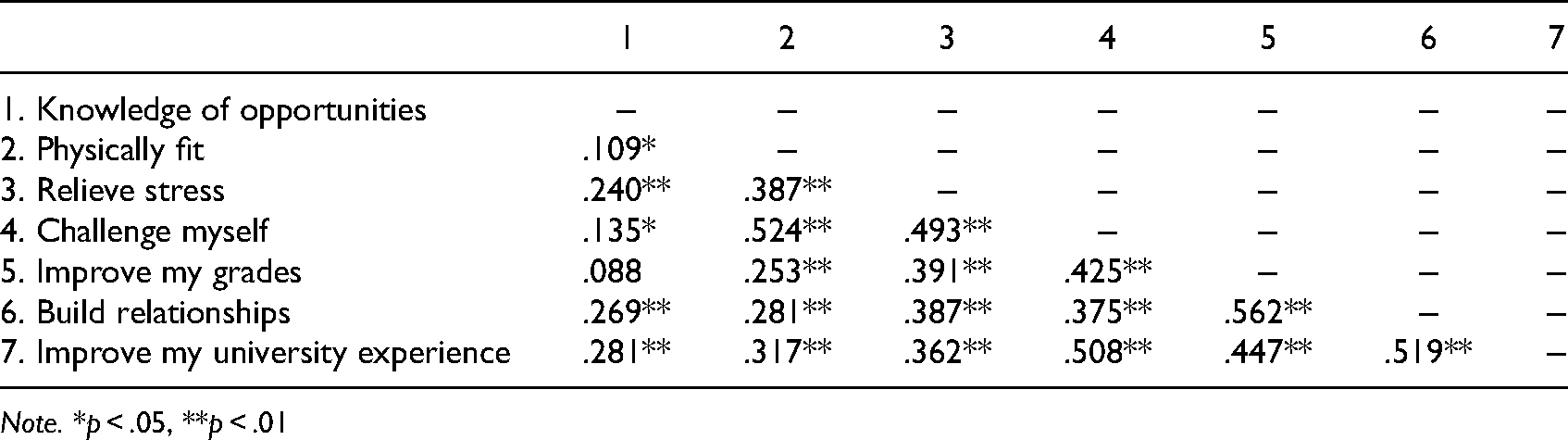
The sample of undergraduate students (n = 348) who completed the questionnaire consisted of 33% women and 67% men. All variables were normally distributed as skewness and kurtosis were below acceptable thresholds. A correlation matrix was conducted to determine if multi-collinearity was an issue among the independent variables (see Table 1). No issues were found as all correlation coefficients were well below the threshold of .800 (Vatcheva et al., 2016).
Correlation Matrix among Knowledge of Opportunities and PA Motivations.
Note. *p < .05, **p < .01
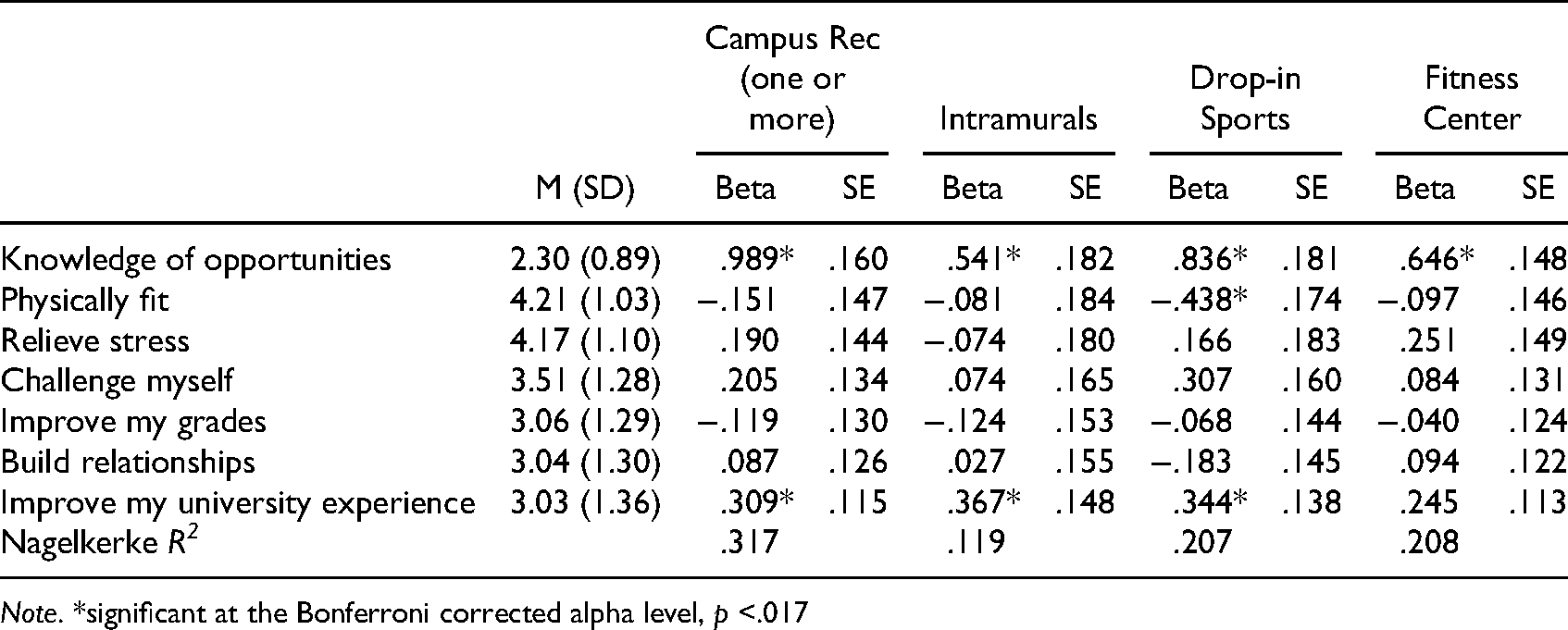
The means and standard deviations for the independent variables are presented in Table 2. The mean score for knowledge of opportunities (M = 2.30) indicates that respondents, on average, reported having “some” knowledge about campus recreation opportunities. All motivations for participation in PA were neutral or positive in agreement, with physical fitness and stress relief being the most valued parts of participating in PA.
Unstandardized Regression Coefficients for Logistic Regression Models Examining the Association among Knowledge, PA Motivations, and Campus Recreation Participation
Note. *significant at the Bonferroni corrected alpha level, p <.017
Next, a series of logistic regression analyses were conducted (see Table 2) to determine if knowledge of opportunities (Research Question 1) and motivations for PA (Research Question 2) were associated with participation in three different types of campus recreation opportunities (i.e., intramurals, drop-in sports, and fitness center). As for Research Question 1, results indicated that knowledge of opportunities was positively associated with participation in intramurals (β = .541, p = .003), drop-in sports (β = .836, p < .001), and fitness center (β = .646, p < .001). In terms of Research Question 2, results indicated that a desire to enhance the university experience through PA was positively associated with intramurals (β = .367, p = .013), and drop-in sports (β = .344, p = .013), but not the fitness center (β = .245, p = .030). Additionally, a desire to be fit through PA was negatively associated with drop-in sports (β = –.438, p = .012), but not associated with intramurals (β = –.081, p = .658) or fitness center (β = –.097, p = .506). Stress reduction, mastery, improve grades, and build relationships were not associated with participation in any of the activities (p >.017).
Discussion
The purpose of this study was to determine the degree to which knowledge of campus recreation opportunities and PA motivations were associated with participation or non-participation in intramurals, drop-in sports, and the fitness center. Study results confirm that knowing about recreation opportunities on campus is an important distinguisher between participation and non-participation in all three types of activities. Furthermore, although study participants reported having various PA motivations in general, only some of those motivations were associated with participation or non-participation in recreation on campus. This section describes these findings in greater detail.
Results that addressed Research Question 1 were consistent with previous research and indicated that knowledge of opportunities was positively associated with participation in campus recreation (Reed, 2007; Selvaratnam et al., 2021). Furthermore, knowledge of opportunities was a key distinguisher between participants and non-participants regardless of the nature of the activity, which included both organized and non-organized opportunities. As intramurals, drop-in sports, and fitness center differ significantly in the timing of their availability and level of involvement with other people, different communication strategies need to be employed by campus recreation professionals. For example, communication about opportunities for intramurals may occur during the weeks leading up to registration and rely on word-of-mouth from prospective teammates, whereas communication should be ongoing for activities, such as drop-in sports and fitness center, that can be started at any point in time and do not require registration (Selvaratnam et al., 2021).
Research Question 2 sought to determine the extent to which different PA motivations were associated with participation in intramurals, drop-in sports, and fitness center. The results identified two influential PA motivations that were associated with participation or non-participation in campus recreation. Perhaps most notably, the university experience was positively associated with intramurals and drop-in sports, but not fitness center. Two implications can be derived from this result. First, intramurals and drop-in sports feature participation with other students, and therefore include a social component, whereas fitness center participation can be undertaken on a solo basis. Therefore, it may not be surprising that a desire to enhance a university experience, which is co-created (Buultjens & Robinson, 2011; Ng & Forbes, 2009), is associated with social recreational activities on campus. Second, the results call attention to the importance of the unique elements of a recreational opportunity to help distinguish participants from non-participants. More specifically, intramurals and drop-in sports are recreational activities that are more readily found on a university campus than in the community, especially involving university peers, and fitness center participation on a solo basis can be easily undertaken at any type of gym in the community.
The other PA motivation that was associated with participation was a desire to be fit. Specifically, a desire to be fit through PA was negatively associated with drop-in sports, meaning that students who valued this aspect of PA in general were likely to avoid drop-in sports on campus. This result indicates that students are comparing the nature of the activities on campus to their own PA motivations to see if there is a match. It seems likely that respondents did not view drop-in sports as being intense enough to provide physical fitness benefits, whereas that was not the case with intramurals or fitness center. This result is consistent with the research that shows intensity of activity being important for improving physical fitness (Tremblay, et al., 2011). The result that this general PA motivation was not associated with intramurals or fitness center participation or non-participation, highlights the need to examine the influence of motivations on specific activities instead of campus recreation in general.
Although the mean scores were neutral to positive for the other PA motivations – stress reduction, challenge, build relationships, and improve grades – they did not help distinguish participants from non-participants in any of the three campus recreation activities. These results could mean that respondents were fulfilling their motivations in other recreational settings or were inactive due to one or more constraints. Future research would benefit from identifying how students develop conceptions of different campus recreation activities as well as how they evaluate each opportunity relative to their PA motivations.
Limitations and Future Research
Although this study pointed to a number of important associations that distinguish participants and non-participants, there are some limitations that should be recognized. These limitations also create opportunities for future research. First, it remains unclear how to better increase knowledge of opportunities and whether different promotional approaches are needed based on the type of campus recreation opportunity. Future scholarly collaborations that partner researchers with campus recreation departments to test different approaches would be beneficial (e.g., Bayne & Cianfrone, 2013). These field experiments would also benefit from examining the inclusion of different messaging content focusing on the PA motivations of university students. Second, this study did not collect data about participation in off-campus recreation or constraints to campus recreation, which limited our ability to assess whether non-participants were fulfilling their motivations off-campus or did not participate on-campus due to constraints (Wood & Danylchuk, 2015). Third, this study's use of a cross-sectional design means the relationships found are not necessarily causal as temporal precedence was not established. Future research that builds upon this study could use experimental or longitudinal designs to meet the temporal precedence condition of establishing causality.
Practical Implications
In addition to increasing students” knowledge of opportunities, recreation professionals are encouraged to identify and promote the unique aspects of the campus recreation experience, such as its ability to enhance the university experience, in order to stimulate participation. To that end, recreation professionals should consider partnering with interested researchers to conduct lab and field experiments that test the efficacy of different messaging and promotional tools. Furthermore, recreational professionals may wish to assess how different recreation programming can be re-designed or enhanced to provide a university feel. Although the motivation to improve the university experience through PA was not associated with participation in the fitness center, other programs should also be evaluated for their ability to fulfill this motivation. Our study demonstrates that students” PA motivations may differ in relation to activity type. Campus recreation professionals should be mindful of these nuances and use evidence of knowledge of opportunities and PA motivations to continually improve program promotion and delivery efforts.
Footnotes
Declaration of Conflicting Interests
The author(s) declared no potential conflicts of interest with respect to the research, authorship, and/or publication of this article.
Funding
The author(s) received no financial support for the research, authorship, and/or publication of this article
