




Abstract
The purpose of this study was to explore the differential effects of constraints on participation in three different types of campus recreation (i.e., intramural sports, drop-in sports, fitness center), and how constraints differ based on gender and citizenship. Data were collected from undergraduate students (n = 344) using a questionnaire at a large university in Ontario, Canada and analyzed using logistic regression and Mann–Whitney U. Non-participation in intramurals was associated with not knowing how to get involved, drop-in sports with not knowing enough people to participate, and fitness center with feeling uncomfortable exercising in public. Women and men did not differ in the ten constraints measured in the study. International students were more constrained than domestic students by feeling as though the recreation facilities were inaccessible. Implications for practice are discussed.
Campus recreation is an opportunity for students to have fun, connect with their university, build friendships, and be physically active. The physical activity (PA) component of campus recreation is especially important given that most students are not meeting established PA recommendations (Colley et al., 2018). Students should stay physically active for a myriad of reasons, including the link between vigorous PA and lower levels of anxiety, depression, stress and negative mood, heart disease, and developing illnesses (Bray & Born, 2004). Furthermore, participation in campus recreation has been associated with academic success (Vasold et al., 2019). Thus, through the provision of campus recreation programs (e.g., intramural sport, drop-in sport, fitness) universities play an important role in the promotion of health and active living.
This undertaking cannot be accomplished effectively without obtaining an understanding of specific constraints that affect campus recreation participation. Such understandings can inform the creation of programs and marketing strategies aimed at increasing participation (Alexandris & Carroll, 1999). However, previous research has neglected to identify how constraints vary based on activity type, despite arguments that constraints vary based on context and population groups (Masmanidis et al., 2009). The purpose of this study was to explore how constraints affect participation in different types of campus recreation and how constraints differ based on major groups of students. Specifically, this study explored the following research questions: (1) Is participation in intramural sport, drop-in sport, and fitness center programs affected by the same constraints? (2) How do constraints differ based on gender and citizenship status?
Leisure Constraints
This study employs leisure constraints theory to further understandings of participation and non-participation in campus recreation. Leisure constraints can be categorized as intrapersonal, interpersonal, and structural (Crawford & Godbey, 1987). Intrapersonal constraints include factors that exist within the individual, such as body image, perceived reference group attitudes, and perceived skills (Jun & Kyle, 2011). Interpersonal constraints are factors that discourage leisure participation due to social interactions with others, such as family commitments or lack of leisure partners (e.g. Wood & Danylchuk, 2015). Last, structural constraints are identified as societal or organizational level factors, such as a lack of time, transportation, and a poor match between personal and program schedules (Jun & Kyle, 2011; Wood & Danylchuk, 2015). These three types of constraints have also been found within the literature on campus recreation, primarily in the context of intramural sport (Stankowski et al., 2017; Shifman et al., 2012; Wood & Danylchuk, 2015). However, what remains less clear is how leisure constraints are related to different forms of campus recreation.
There is also a need to understand how constraints differ based on groups of students (Cho & Price, 2016; Masmanidis et al., 2009). For example, research has shown that women and international students can be more constrained than men and domestic students, respectively (Cho & Price, 2018; Hoang et al., 2016; Shifman et al., 2012; Stankowski et al., 2017). The limited amount of research examining international students’ participation in campus recreation has identified that this group is more prone to experience constraints compared to domestic students (Cho & Price, 2018; Li & Stodolska, 2006; Shifman et al., 2012). Explanations for differences center on cultural differences, limited social networks, and a lack of language competency. Thus, international students have unique challenges to overcome in order to participate in campus recreation (Shifman et al., 2012). Whereas some of this research has tended to analyze differences in constraints at the aggregate (i.e., intrapersonal, interpersonal, structural), we investigate differences at the item level (e.g., do not know enough people).
Similarly, women more often face a number of constraints to leisure compared to men, particularly those related to gender norms (e.g., family caregivers, body image, perceived lack of skills; Craig & Brown, 2016; Fendt & Wilson, 2012; Wood & Danylchuk, 2012). In a campus recreation context specifically, research has found that women were more likely to be constrained by not knowing how to use fitness equipment, a lack of time, and an unwelcoming facility environment (Hoang et al., 2016; Stankowski et al., 2017). However, more research is needed to understand how gender is related to constraints in other university settings (Stankowski et al., 2017).
Leisure constraints have the potential to negatively influence participation in two ways. First, constraints can reduce the frequency of participation in an activity. For example, an individual may participate only two times instead of four due to one or more constraints. Second, constraints can be the difference between non-participation and participation. For example, not feeling comfortable exercising in public prevents individuals from doing so rather than reducing their participation to two times per week. In this study, we focus on the latter phenomenon by exploring how constraints are associated with non-participation versus participation in three different campus recreation activities.
Method
A cross-sectional survey methodology was employed mid-way through the Spring 2018 and Fall 2018 terms to collect data at a large university in Ontario, Canada. The university has two major athletics and recreation facilities which offer recreation programs such as intramurals (i.e., sports organized over a semester involving competition among teams), drop-in sports (i.e., unorganized sports during allotted times for anyone who arrives at the facility), and fitness center (i.e., weights and cardo equipment). Data were collected from undergraduate students in two courses (one lower and one upper year) in each of the following faculties: Arts, Health, and Science.
Survey Measures
This study was part of a larger project on campus recreation and campus engagement. This study draws on three types of variables measured on the questionnaire including demographics, constraints, and campus recreation participation. Demographic information utilized in this study included gender and citizenship status. Gender was measured by asking the open-ended question “What gender do you identify with”? Respondents only provided answers that were indicative of identifying as a man or woman. Citizenship status was measured by asking the closed-ended question “Are you an international student” with a yes or no response option.
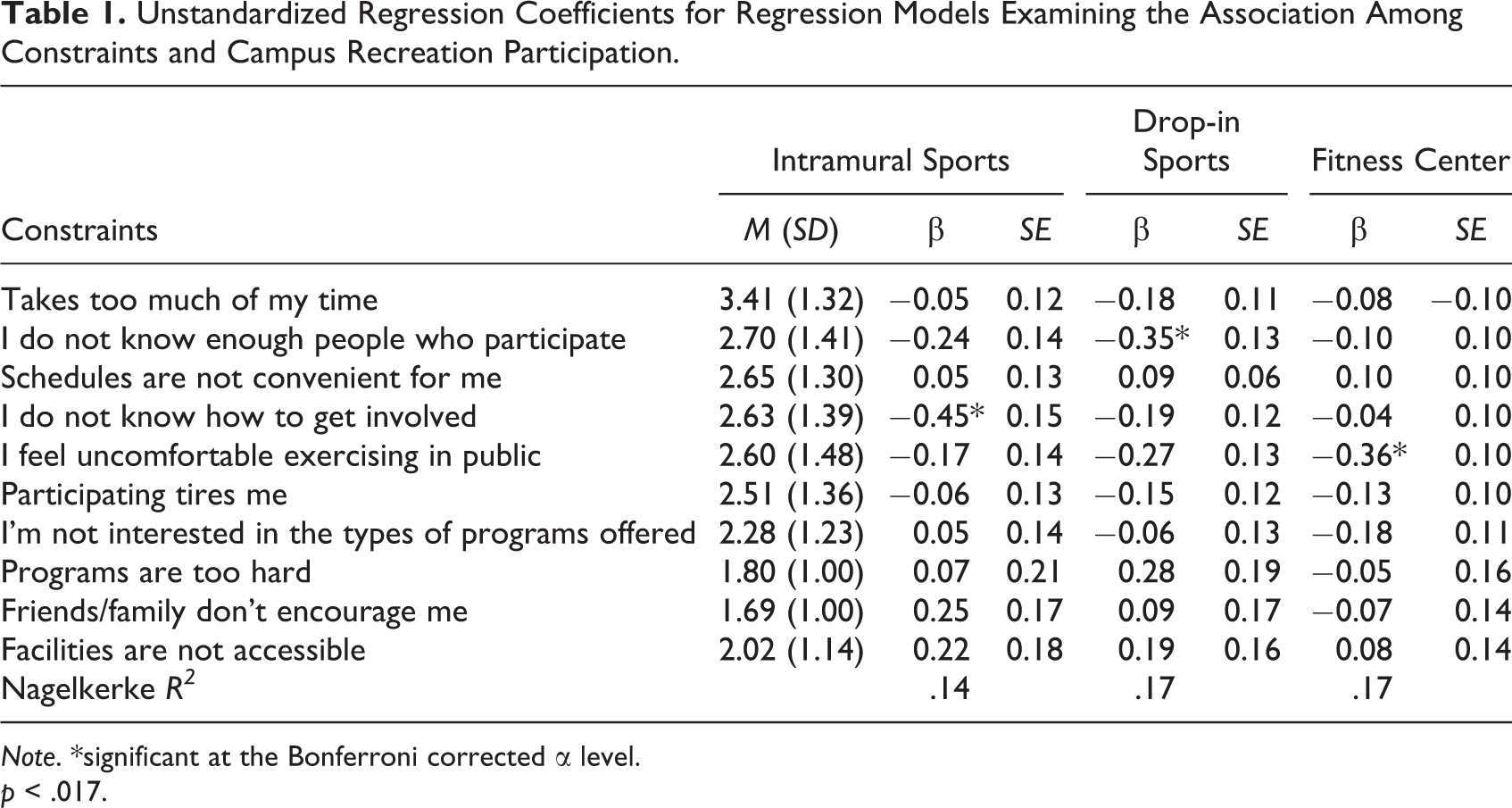
Specific measures of constraints were based on previous research (Hubbard & Mannell, 2001; Stankowski et al., 2017; Wood & Danylchuk, 2015). Respondents were asked to rate their level of agreement with a series of statements (“The following get in the way of me being active on campus”) using a 5-point Likert-type scale ranging from 1 (strongly disagree) to 5 (strongly agree). See Table 1 for a full list of the items. Participation in different types of campus recreation activities was measured by asking students to indicate the average number of times per week they had participated in (1) intramurals, (2) drop-in sports, and (3) the fitness center over the past term. These figures were then re-coded into a dichotomous variable with 1 representing participation and 0 representing non-participation.
Data Analysis
Descriptive statistics were calculated and reported for each of the study variables. Correlation analysis was used to determine if multicollinearity among the independent variables (i.e., constraints) was an issue before proceeding. Acceptable cut-off levels vary in the literature with most scholars using .800 and above as a cut-off whereas some scholars advocate for a more stringent approach such as .500 cut-off (Vatcheva et al., 2016). We have taken a stringent approach and used .500 as a cut-off.
Logistic regression was conducted to analyze the relationships among constraints and non-participation or participation in the three forms of campus recreation. All independent variables were entered into a single logistic regression model. Mann–Whitney U tests were used to assess differences in constraints based on gender and citizenship status. To account for the error associated with conducting tests of multiple dependent variables with the same independent variable, a Bonferroni correction to the αlevel was utilized (.05/number of dependent variables being tested with the same independent variables). Specifically, the corrected alpha for the logistic regressions was .017 (.05/3) and the corrected alpha for the Mann–Whitney test was .005 (.05/10).
Results
The sample in this study (n = 344) consisted of 33% men and 67% women, 9% international students and 91% domestic students. In comparison to the university in which data was collected, the sample is over-sampled from women and slightly under-sampled from international students. In terms of participation, 17% reported participating in intramurals in the previous term, 22% in drop-in sports, and 40% in the fitness center. An inspection of the correlation matrix resulted in the removal of one variable due to potential issues of multi-collinearity (Vatcheva et al., 2016). Specifically, the item “I do not know how to properly use the equipment” was removed because it had a high correlation with another variable (r = .613). Furthermore, the specific removal of this item is also justified because properly using equipment is specific to one type of campus recreation activity (i.e., fitness center) which is not ideal for cross-activity comparisons.
The mean scores for constraints to campus recreation can be seen in Table 1. Results of the logistic regressions indicate that different constraints were associated with non-participation in different forms of campus recreation (see Table 1). Specifically, the likelihood of non-participation in intramurals was associated with not knowing how to get involved (β = −0.45, p < .017). Non-participation in drop-in sports was associated with not knowing enough people to participate (β = −0.35, p < .017). Finally, fitness center non-participation was associated with feeling uncomfortable exercising in public (β = −0.36, p < .017).
Unstandardized Regression Coefficients for Regression Models Examining the Association Among Constraints and Campus Recreation Participation.
Note. *significant at the Bonferroni corrected α level.
p < .017.
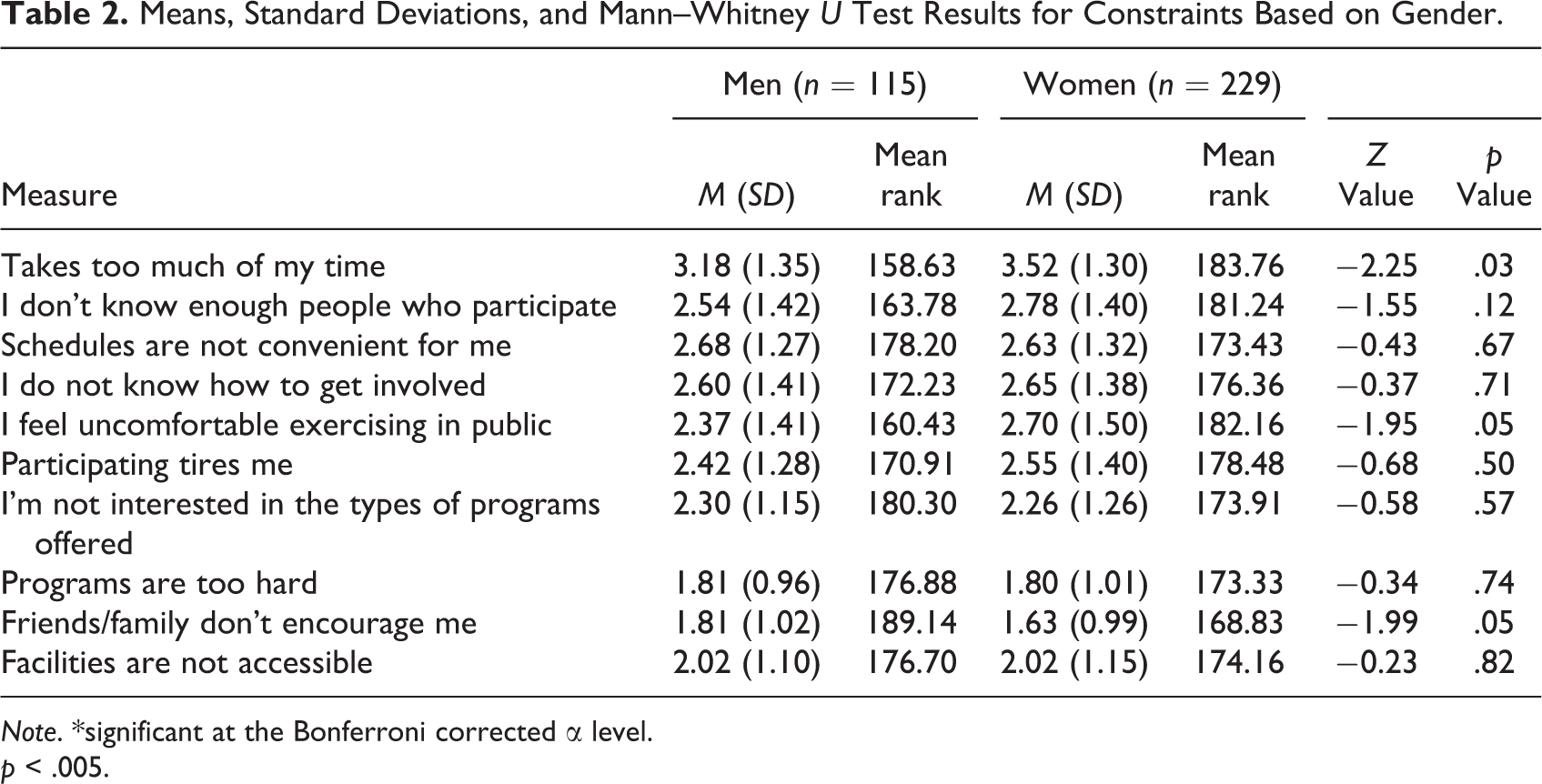
Results of the Mann–Whitney test indicated that no constraints were experienced differently based on gender (see Table 2). Although some mean scores for constraints were higher for women compared to men and statistically significant at an α level of .05, these differences were no longer statistically significant when considering a Bonferroni corrected α level of .005.
Means, Standard Deviations, and Mann–Whitney U Test Results for Constraints Based on Gender.
Note. *significant at the Bonferroni corrected α level.
p < .005.
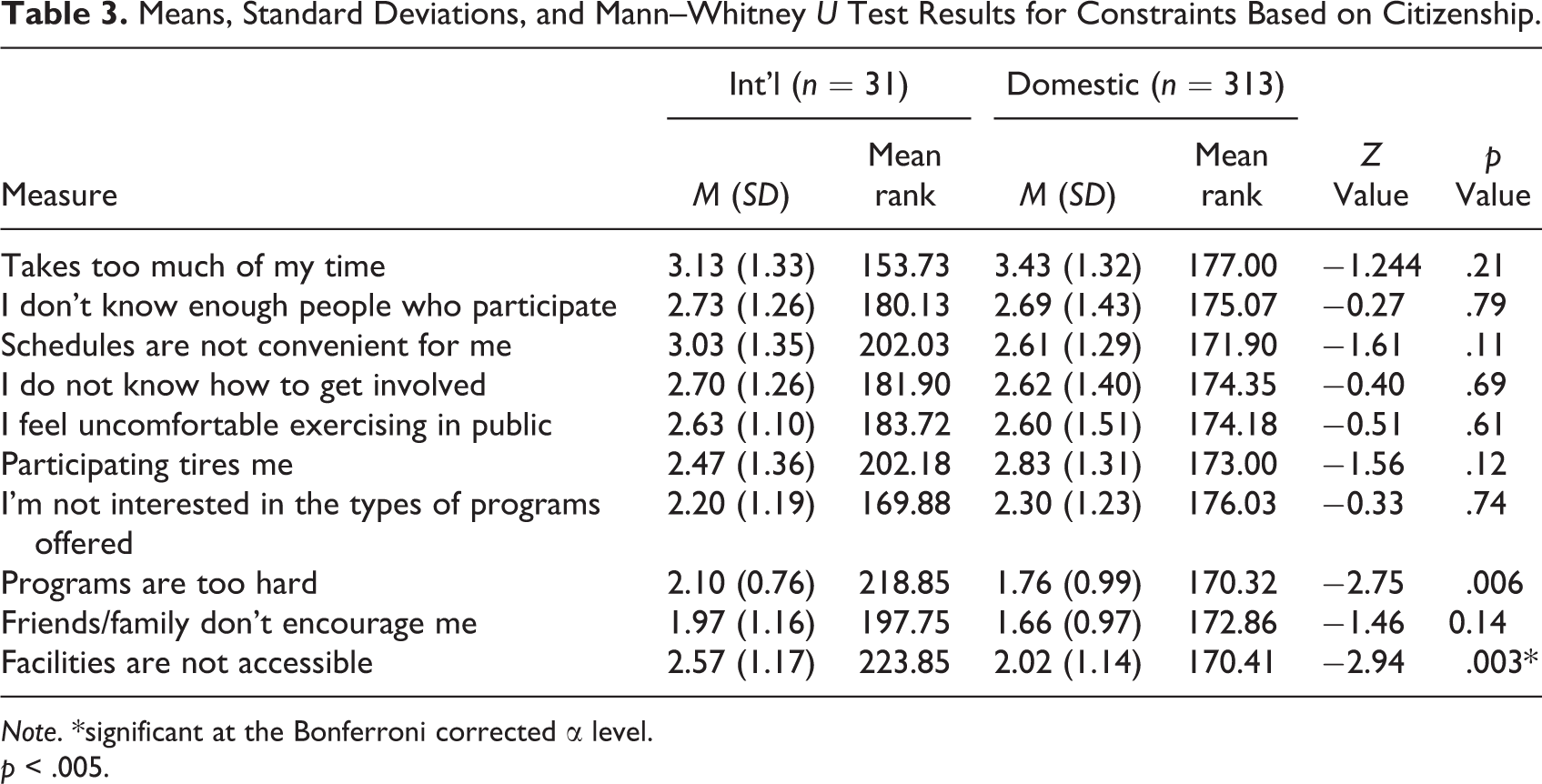
A comparison of international and domestic students based on constraints was also conducted using a Mann-Whitney test. Results, as shown in Table 3, indicate that international students, on average, were more likely to believe that campus recreation programs were too hard as compared to domestic students (Z = −2.75, p < .005). No other differences were statistically significant at an alpha level of .05 or the corrected level of .005.
Means, Standard Deviations, and Mann–Whitney U Test Results for Constraints Based on Citizenship.
Note. *significant at the Bonferroni corrected α level.
p < .005.
Discussion
The purpose of this study was to explore which constraints were associated with different types of campus recreation, as well as how constraints differed based on gender and citizenship. Overall, study results indicate that although individuals may feel constrained in particular ways about campus recreation, there were unique constraints associated with non-participation in each type of campus recreation (intramural sports, drop-in sports, fitness center). Previous research has provided limited insight into this phenomenon because it has focused primarily on one activity specifically (e.g., Wood & Danylchuk, 2015) or campus recreation participation rates in general (e.g., Stankowski et al., 2017).
Non-participation in intramural sport was associated with not knowing how to get involved. This finding is consistent with literature that identifies the importance of awareness in the initiation phase of sport participation (Beaton et al., 2009). Specifically related to the context of campus recreation, intramural sport was the only formally organized activity in this study as compared to drop-in sports and the fitness center which have no registration process.
A lack of participation in drop-in sports was only associated with not knowing enough people to participate. The influence of this constraint is consistent with leisure research identifying the importance of leisure partners for many individuals (Wood & Kulczycki, 2018). For some students, building new friendships in university can be difficult because many are abandoning former social networks. However, the lack of association of not knowing enough people to participate with intramural sport and fitness center participation requires explanation. We speculate that whereas intramural sports require a negotiation of this challenge one time when teams are formed, drop-in sports can require individuals to revisit this constraint each time. Similarly, fitness center participation can be approached individually making this constraint less influential in this context.
Non-participation in the fitness center was associated with feeling uncomfortable exercising in public. This finding is also consistent with previous research which has found that feeling uncomfortable with one’s body reduces participation and longitudinal research shows that efforts to create inclusive spaces are effective at increasing participation (Cunningham & Pickett, 2020). Most notably, however, is that this constraint was not associated with intramural sports or drop-in sports. These results could be explained by the nature of the different activities. More specifically, while working out in the fitness center there is time to observe others during pauses in the “action” and there are mirrors all around that stimulate observations of oneself and awareness of physical appearances. Conversely, during sports, competitors are typically focused on the play and have less time to evaluate an individual’s appearance and facilities do not have mirrors. Furthermore, there are few spectators during drop-in and intramural sports who typically engage in the evaluation of physical appearances (Madrigal, 2006; Potwarka et al., 2018).
That only one constraint was associated with each recreation activity suggests that these constraints are particularly challenging to negotiate compared to other constraints. In terms of classifying constraints, an intrapersonal constraint was associated with fitness center participation, interpersonal with drop-in sports, and structural with intramural sports. Therefore, where possible campus recreation managers should tailor strategies aimed at reducing constraints by activity type. For example, although initiatives to increase awareness of opportunities are likely to be effective in stimulating all types of campus recreation, messaging related to intramural sport should also include specific steps about how to get involved. For some students, these steps may include a detailed activity plan that describes how they may undertake steps to enrol and attend games (Carrao & Gaudreau, 2013).
Results did not identify any differences in constraints to campus recreation based on gender. This finding is somewhat surprising given that past research has identified that women face certain constraints more than men (Craig & Brown, 2016; Stankowski et al., 2017). However, the literature varies in the specific identification of constraints that differ based on gender. Therefore, rather than offering conclusive identification of how constraints differ by gender, this study along with previous work, serve to highlight the importance of the context in which data were collected (i.e., universities may have different facilities or social environments) that can influence results. Such an identification of how local environments influence differences in constraints based on gender represents an important avenue for future research as a way of identifying mechanisms that shape gendered experiences.
Results showed that international students were more likely than domestic students to believe facilities were not accessible. As such, norms that may be taken for granted by recreation staff members can limit or prevent engagement by international students. Explanations for why international students felt as though facilities were inaccessible are not clear, but seem to mirror the leisure experiences of newcomers to a country (e.g., Campbell et al., 2016). For example, Campbell et al. found that many youth new to Canada spent more time in spaces familiar to them unless recruited by others to join unfamiliar leisure spaces. Thus, actively welcoming international students to various campus recreation facilities, such as the use of culturally-based theming in facilities, may serve to increase participation.
Addressing the constraint of perceived accessibility to campus recreation is particularly important because recreation is a way that newcomers to a country integrate into a community (Quirke, 2015). One important step to addressing this constraint is to engage international students in the process to further understand their perceptions and partner with them to reduce this constraint instead of expecting them to fit into existing programs and spaces (Forde et al., 2015). Furthermore, international students come from various cultures, each of which can have unique constraints. Therefore, treating international students as a homogeneous group may not be beneficial for nuanced understandings of constraints. Future research may play a role in developing such understandings further, as well as practitioner led inquiries.
A strength of this study is the identification of influential constraints related to non-participation in different contexts. However, this study has a few limitations. One, it could not provide an understanding of how students experience each of the impactful constraints identified in this study. Two, it failed to explain why other constraints were not associated with non-participation. Last, the timing of the survey administered to university students provides ambiguity in outcomes because it is not known if associations among constraints and participation relate to particular semesters. Future research investigating constraints to campus recreation would benefit from using qualitative methods to fill these gaps in knowledge. Furthermore, given there was a large amount of variance unexplained by constraints alone, future research on campus recreation would benefit from a multi-dimensional approach that integrates a number of interrelated constructs (e.g., Alexandris et al., 2007, 2017; Hubbard & Mannell, 2001).
Footnotes
Declaration of Conflicting Interests
The author(s) declared no potential conflicts of interest with respect to the research, authorship, and/or publication of this article.
Funding
The author(s) disclosed receipt of the following financial support for the research, authorship, and/or publication of this article: University of Waterloo (grant id: Campus Athletics Research Network).
