



Abstract
This study investigates whether the benefits of participation in, and perceived service quality of, an intramural sport program contribute to student retention and overall program satisfaction. Health and wellness outcomes, student learning outcomes, service quality, program satisfaction, and student retention in intramural programming were assessed at one Canadian university. The results reveal that participants experience physical, emotional, social and academic outcomes as a result of participation in intramural programming. The results also reveal that benefits of participation (physical health and wellness, emotional wellness, academic learning outcomes, social learning outcomes) and service quality are associated with greater student retention and program satisfaction. The results highlight the unique association between physical health and wellness benefits and student retention. The results also highlight the association between service quality, social and emotional wellness and program satisfaction among participants. Implications for practice and future research are presented.
Keywords
Introduction
Calls for postsecondary institutions to take an active role in addressing the wellness needs of students have increased in recent years (Eisenberg et al., 2012; Hunt & Eisenberg, 2010). As a result, many institutions have developed campus-wide wellness programs to improve student health and student retention (Strand et al., 2010). At the same time, campus recreation departments are well-positioned to further influence student wellness through their programs and services (Hartman et al., 2018). Intramural sport programming is a common campus recreation service, with ∼11.7% of undergraduate students in Canada participating in some form of intramural sport programming (American College Health Association, 2019). The contribution of intramural programming to quality postsecondary education is well documented (e.g., Forrester et al., 2018; McElveen & Ibele, 2019; Moffit, 2010; Phipps et al., 2015; Sturts & Ross, 2013). Notably, previous research suggests that participation in intramurals contributes to improved health and physical fitness, greater self-confidence, and improved stress management among students (e.g., Artinger et al., 2006; Forrester, 2015; Huesman et al., 2009). Participation in intramurals has also been linked to increased student satisfaction (e.g., Miller, 2011) retention (e.g., Forrester et al., 2018; McElveen & Rossow, 2014), and grade point average (e.g., Vasold et al., 2021; Zegre et al., 2020).
As public institutions, universities require, and are continually seeking, justification for dedicating resources to intramural programming and to determine whether programs support the university's mission (Forrester et al., 2018). Further, postsecondary institutions in Canada are facing a decline in student enrollment (Robertson, 2014) and, so, a greater understanding of the factors that contribute to student retention is warranted. Forrester et al. (2018) examined the retention rate of students who participated in intramural sports by comparing aggregate data extracted from the campus recreation registration database with student records from the Office of the Registrar. The authors found that 98% of students who participated in intramural programming during their first, second, or third year of studies returned to school the following year, whereas 65%–85% of the general student population returned to school the following year depending on the year of study (Forrester et al., 2018). However, little research has explored what factors of intramural sport participation might contribute to student retention and program satisfaction. As such, the purpose of this study is to investigate whether the benefits of participation and service quality of intramural sports relate to student retention and program satisfaction.
Literature Review
Recreational Sport Service Quality
Service quality has been defined as “the customer's overall impression about the service performances, service delivery systems, and overall consumption experiences” (Ko & Pastore, 2004, p. 162) and has been viewed as a key factor in evaluating recreational sport programs such as intramural sports (Weese, 1997). Ko and Pastore (2005) found that the quality of programs, social interactions, and the physical environment were all indicative of overall service quality for recreational sport programs. Scholars have focused largely on aspects of the physical environment as key factors influencing perceptions of service quality, including characteristics of sport facilities such as proximity (Deelen et al., 2016; Wicker et al., 2013), aesthetics (Gallardo et al., 2009), and availability of fitness equipment (Makubuya et al., 2020). Further, previous research has pointed to programmatic factors that have influenced perceptions of service quality, including the types of programs offered (Hallmann et al., 2012) and opportunities to socialize (Mokoena & Dhurup, 2017). Evidently, participants in recreational sports, including intramural sport, have broad expectations and perceptions of service quality that relate to facility infrastructure, programming decisions, and the interpersonal nature of recreational sports.
Benefits of Intramural Sport Participation
Scholars have also found many benefits associated with participation in intramural sports. Notably, Cooper et al. (2012) found that students engage in intramural programming with the expectation that they will enjoy their experience, improve competence in the activity, and enhance their physical appearance and fitness levels. Previous research reveals that those expectations are often met as a result of participation in intramural sport. Scholars have also noted that participation in campus recreation can improve physical fitness (Lower et al., 2013), self-confidence (Artinger et al., 2006; Hall, 2006; Huesman et al., 2009), stress management (Kimball & Freysinger, 2003), emotional health and overall energy levels (Ellis et al., 2002), happiness (Sturts & Ross, 2013) and self-esteem and physical self-description (Simmons & Childers, 2013).
Previous research has also revealed that participants experience greater personal development and student learning as a result of participation in intramural sport (Forrester, 2015; Huesman et al., 2009; Makubuya et al., 2020). Scholars suggest that participants are likely to experience social outcomes as evidenced by improved communication skills, respectful behavior, and expanding social networks (Cooper et al., 2012; Phipps et al., 2015; Sturts & Ross, 2013). Participation in intramural sport has also been associated with intellectual benefits (Lower et al., 2013), increased grade point averages (Vasold et al., 2021), and improved soft skills (e.g., critical thinking, cooperation) (Sturts & Ross, 2013; Williams et al., 2018). Together, existing research points to the various health and wellness, and learning outcomes that have been attributed to participation in intramural sport, while highlighting the importance of intramural programming across postsecondary contexts.
Campus Recreation Program Satisfaction and Student Retention
The overall impact of intramural sport participation on students and campus communities more broadly has often been framed around program satisfaction and student retention. Specifically, effectiveness has largely been understood based on measures of program satisfaction (Tsigilis et al., 2009; Weese, 1997), with a particular focus on factors that lead to higher levels of satisfaction among intramural participants. Scholars have found that organizational effectiveness and program satisfaction are related, and that evaluating program satisfaction is important in understanding the organization's actual performance in relation to its objectives (Tsigilis et al., 2009; Weese, 1997). Meanwhile, social identification has been found to moderate the relationship between high levels of program quality and program satisfaction highlighting the social importance of campus recreation programs (Shonk et al., 2010). Further, Osman et al. (2006) found that greater perceptions of service quality were associated with increased program satisfaction and greater intention to use the sport facilities in the future.
Student retention has been a major concern for postsecondary institutions attracting attention from educators, policy makers, and academics (Aljohani, 2016). Scholars have found that participation in intramural sport contributes to academic success, student persistence, and retention in postsecondary institutions (Forrester, 2015; Kampf & Teske, 2013; Mayers et al., 2017; Zegre et al., 2020). For example, Kulp et al. (2019) found that first year students who participate in extracurricular activities (e.g., intramural sport) experience greater academic success and higher retention rates. Further, Forrester et al. (2018) found that participation in intramural sport resulted in greater student retention when compared to the broader undergraduate student population (see also Vasold et al., 2021). Many scholars attribute this to Astin’s (1984) theory of student involvement suggesting involvement in extracurricular activities (such as campus recreation) contributes to continued persistence in postsecondary education (Elkins et al., 2011; Forrester, 2015; Henchy, 2013).
Much of the research in this area has examined participant benefits, service quality, program satisfaction, and student retention in isolation, rather than examining the potential interactions that may be at play in the intramural context. Therefore, the purpose of this study is to investigate the association between participant benefits and intramural service quality, and both student retention and program satisfaction. To address the purpose of this study, the following research questions were advanced:
What is the relative strength of participant benefits and service quality among intramural sport participants? Are health and wellness outcomes, student learning outcomes, and service quality associated with program satisfaction of intramural sport participants? Are health and wellness outcomes, student learning outcomes, and service quality associated with student retention among intramural sport participants?
Methods
Participants and Procedures
A purposive sampling approach was used in order to recruit current participants, over the age of 18 years, across several different intramural sports at one Canadian university (Patton, 2015). To address the research questions, an online questionnaire was developed and administered through Qualtrics. Intramural participants were sent an email with a link to the questionnaire and others were approached at the campus recreation center prior to or following their intramural sport. Data collection occurred in the two weeks preceding playoffs in order to reduce emotional responses associated with the result of the season. For those who completed the survey in person at the campus recreation center, touch screen tablets with the survey preloaded were provided. Business cards with a link to the survey were also distributed so that participants could complete the survey on their own web-enabled devices at their convenience. It took participants ∼10 min to complete to survey.
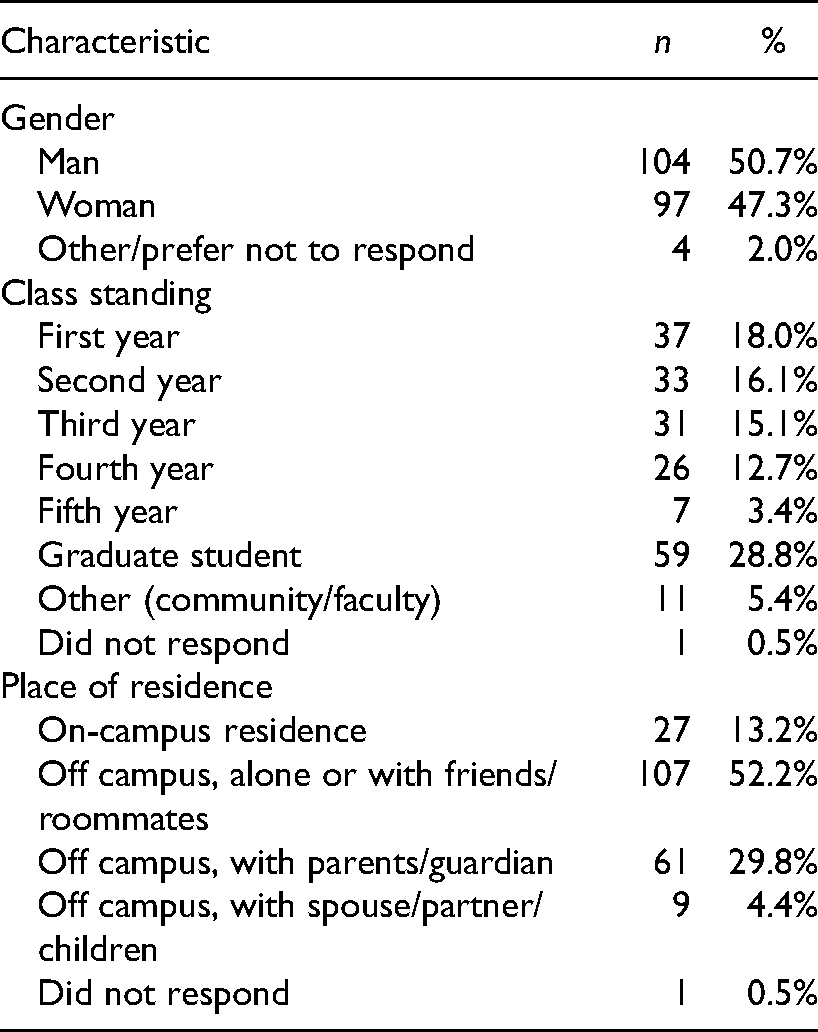
Participants were 205 intramural sport participants across multiple sports, including ice hockey, basketball, volleyball, soccer, spikeball, cricket, ultimate frisbee, flag football, and dodgeball. Of the ∼16,000 students enrolled at the university, the intramural sports program had 1,604 unique participants during the 2019–2020 school year. Therefore, the sample represents 12.8% of intramural participants. Participant ages ranged from 18 to 38 years with an average age of 21.78 years (SD = 31.16), with more than 85% of participants living off campus. The self-identified gender of the sample included 104 males, 97 females, and four who did not disclose their gender. See Table 1 for descriptive statistics.
Sample Demographics.
Survey Instrument
The survey consisted of three sections that asked students to respond according to their overall intramural experience. In the first section, participants were asked to provide demographic information (e.g., age, gender) and participation history in the intramural program (e.g., sports played, number of years of intramural participation). The second section of the survey contained questions pertaining to health and wellness and student learning outcomes (10 items each, adopted from the National Intramural-Recreational Sports Association/National Association of Student Personnel Administrators (NIRSA/NASPA) Recreation and Wellness Benchmark Instrument; Forrester, 2015) and the service quality of the intramural programs (10 items, adapted from the Scale of Service Quality in Recreational Sports; Ko & Pastore, 2005). For health and wellness and student learning outcomes, participants were asked to consider whether their participation in intramural sports at the university increased/improved their health and wellness and student learning based on each item (e.g., overall health, fitness level, academic performance, time management skills; see Table 2). Similarly, for the measures pertaining to service quality, participants were asked to indicate their level of satisfaction with each item (e.g., diversity of sport offerings, officiating fairness, quality of equipment used; see Table 2). In the third section of the survey, participants responded to two outcome factor questions regarding retention (“when deciding to continue at this institution, how important are intramural sports?”; adopted from Forrester, 2015) and overall satisfaction with the intramural program (“overall, how satisfied are you with your intramural sports experience”). Prior to distribution, the survey was circulated to a panel of experts (e.g., campus recreation manager, intramural coordinator, faculty members) in order to review the readability and validity of the survey items (DeVellis, 2015). The final survey was composed of 32 items, measured on 5-point Likert scales.
Pattern Matrix Representing Factor Loadings for Intramural Benefits and Service Quality.
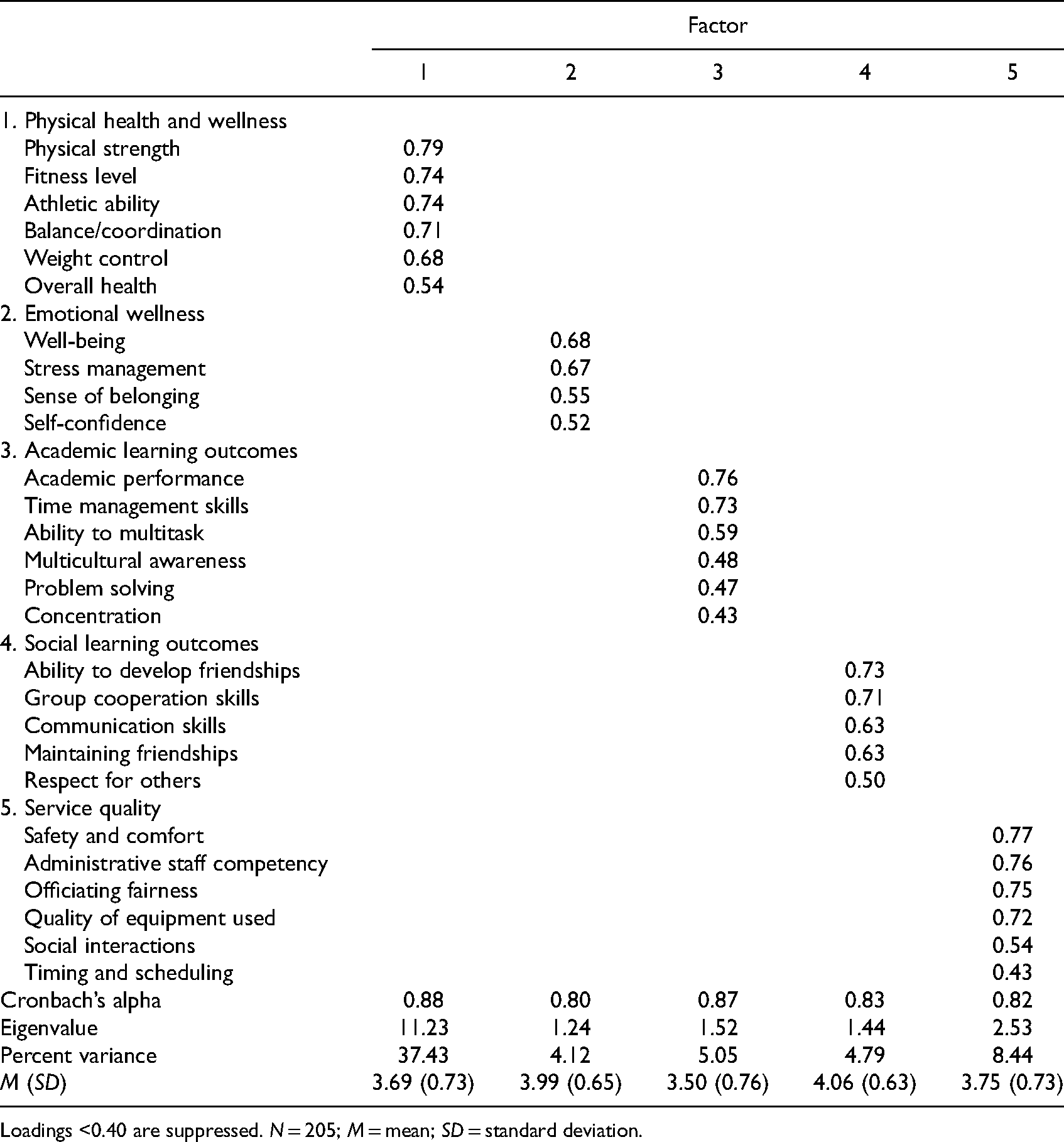
Loadings <0.40 are suppressed. N = 205; M = mean; SD = standard deviation.
Data Analysis
The data was input into SPSS for statistical analysis. With regard to the participant benefits and service quality scale measures, a minimal amount of missing data was indicated (<1%) and was addressed using a series mean substitution imputation method (Tabachnick & Fidell, 2012). Factor structures for the participant benefit and service quality measures were developed through exploratory factor analysis using principal component analysis with varimax rotation (Tabachnick & Fidell, 2012). Cronbach’s alpha reliability analyses and scale intercorrelations were performed to test the psychometric properties of the scales. Descriptive statistics and multivariate analysis were used to examine the relative strength of the participant benefit and service quality variables. Linear regression analyses were conducted to test the relationships between participant benefits and service quality and program satisfaction and student retention.
Results
Psychometric Properties of Participant Benefits and Service Quality
Measures of sampling adequacy confirmed that the factor analysis procedure was appropriate for the participant benefits and service quality scale (Kaiser-Meyer-Olkin (KMO) = 0.92, X2 = 3092.97, p < .001). Principal component analysis yielded five possible factors with eigenvalues greater than 1.0. Inspection of the rotated component matrix revealed that three items correlated within 0.10 of another factor and so were removed. In total, 27 of the original 30 items representing participant benefits and service quality remained, resulting in a five-factor structure: (1) physical health and wellness (n = 6), (2) emotional wellness (n = 4), (3) academic learning outcomes (n = 6), (4) social learning outcomes (n = 5), and (5) service quality (n = 6). All five factors demonstrated acceptable levels of internal consistency (α > 0.80; Lance et al., 2006) and accounted for 60% of the explained variance. Notably, the 10 health and wellness items adopted from Forrester (2015) loaded on two separate factors, physical health and wellness, and emotional wellness. The factor loadings, eigenvalues, percent variance, and internal consistency coefficients for each factor are presented in Table 2. Table 3 presents the intercorrelations among the five factors (physical health and wellness, emotional wellness, academic learning outcomes, social learning outcomes, and service quality) and the two outcome factors (program satisfaction, student retention).
Bivariate Correlations Among Benefits, Service Quality, and Program Satisfaction and Student Retention.
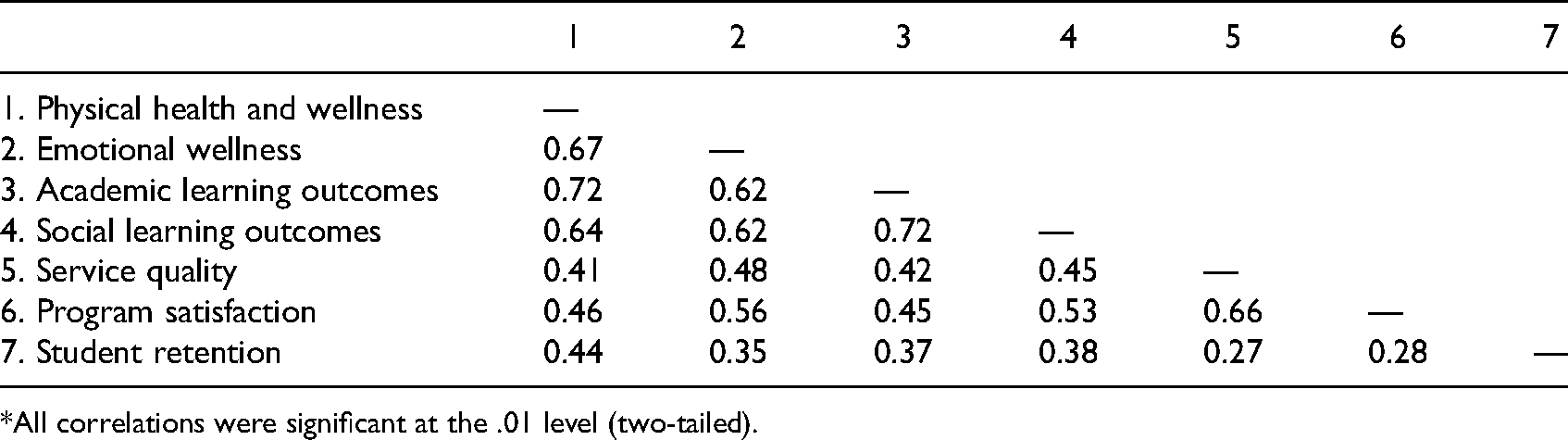
*All correlations were significant at the .01 level (two-tailed).
Participant Benefits and Service Quality
T-test and analysis of variance (ANOVA) analyses were conducted to determine whether any significant differences existed based on gender, age, class standing, and place of residence. No significant differences were found. A repeated-measures ANOVA was conducted to determine the relative strength of the participant benefits and service quality factors. The results revealed a significant difference among the five factors (F[3.28, 665.40] = 49.48, p < .001). Post-hoc Bonferroni analyses demonstrated that both physical health and wellness (M = 3.69, SD = 0.73) and service quality (M = 3.75, SD = 0.73) were significantly greater than academic learning outcomes (M = 3.50, SD = 0.76, p = .000), and that social learning outcomes (M = 4.06, SD = 0.63) and emotional wellness (M = 3.99, SD = 0.65, p < .001) were significantly greater than physical health and wellness, academic learning outcomes, and service quality. A summary of the descriptive statistics for the participant benefits and service quality factors are presented in Table 2. Descriptive statistics for program satisfaction (M = 4.12, SD = 0.74) and student retention (M = 2.64, SD = 1.46) were also conducted.
Regression Analyses
Program satisfaction was regressed on the participant benefits and service quality factors using standard linear regression (see Table 4). The full model accounted for 53% of the variance in program satisfaction (R2 = .53, F[5, 197] = 45.15, p < .001), indicating that greater participant benefits and service quality was predictive of greater program satisfaction. The results also revealed that emotional wellness (β = 0.23, t = 3.15, p < .01), social learning outcomes (β = 0.19, t = 2.57, p < .05), and service quality (β = 0.48, t = 8.33, p < .01) were unique significant contributors to the prediction of program satisfaction, demonstrating unique variance over and above the contribution of the other two factors.
Regression Analysis for Benefits and Service Quality Variables Predicting Program Satisfaction and Student Retention.
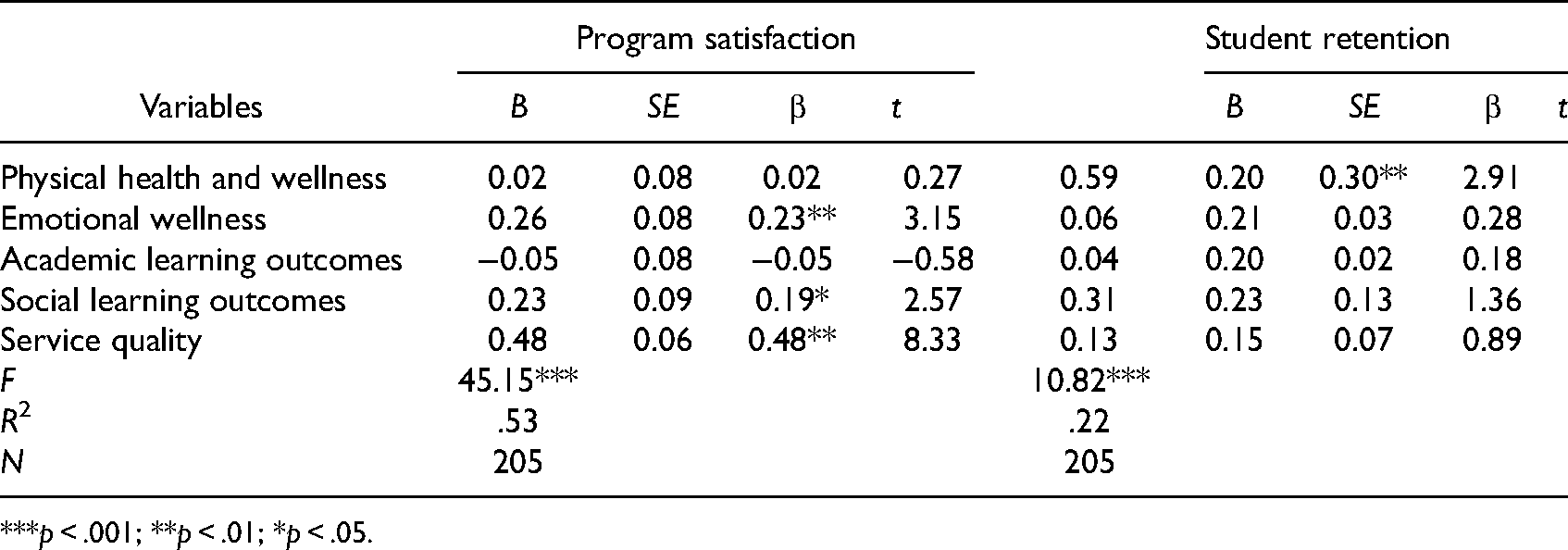
***p < .001; **p < .01; *p < .05.
Student retention was regressed on the participant benefits and service quality factors using standard linear regression (see Table 4). The full model accounted for 22% of the variance in student retention (R2 = .22, F[5, 197] = 10.82, p < .001), indicating that greater participant benefits and service quality was predictive of greater student retention. The results also revealed that physical health and wellness (β = 0.30, t = 2.91, p < .01) was the only unique significant contributor to the prediction of student retention, demonstrating unique variance over and above the contribution of the other four factors.
Discussion
The current study investigated whether the benefits of participating in intramural sport and perceptions of service quality are related to student retention and program satisfaction among intramural sport participants. The results reveal a perhaps unique understanding of program benefits in the context of intramural sport, while highlighting how they are associated with student retention and program satisfaction. Specifically, the results highlight the unique association between fostering physical health and wellness outcomes among participants and student retention. The results also highlight a unique association between high-quality service, the social environment, and emotional wellness outcomes with program satisfaction.
The factor structure uncovered in this study highlights important considerations regarding the nature of program benefits fostered through participation in intramural sport. Specifically, the fact that physical health and wellness and emotional wellness, and academic and social learning outcomes, emerged as distinct factors suggests that intramural sport participation contributes to overall student wellness in a number of unique ways. The results support a more holistic view of wellness in order to understand the scope of benefits that intramural sport provides to a university community; one that acknowledges the physical, emotional, social, and intellectual dimensions of wellness (Roscoe, 2009). Notably, the results reveal that participants experienced significantly greater social and emotional wellness outcomes than they did academic and physical ones, respectively. Despite previous scholars pointing to the academic and physical health benefits of intramural sport participation (e.g., Forrester, 2015; Lower et al., 2013; Simmons & Childers, 2013; Sturts & Ross, 2013; Williams et al., 2018), these results suggest that academic outcomes may in fact be secondary to social outcomes, and that physical health benefits may be secondary to the emotional benefits experienced by participants. Evidently, the distinction between these factors warrants further investigation in order to understand the nature and nuances of student wellness as it relates to intramural sport participation.
The results also indicate that the benefits experienced as a result of participation in intramural sport may vary. Notably, participants experienced significantly greater social learning and emotional wellness benefits than they did physical health and wellness benefits. This is particularly notable as students often engage in intramural programming with the expectation of improved physical competency, physical appearance, and fitness levels (Cooper et al., 2012); and those expectations are often met (Forrester, 2015). However, as witnessed in the current study, participants are experiencing significant social and emotional benefits above and beyond the physical benefits that serve as a key focus in program design (Cooper et al., 2012). Further, while much of the existing literature examines learning outcomes as a combination of academic and social factors, the results presented here suggest that the interpersonal aspects of student learning (e.g., communication skills, cooperation, building friendships) are of greater benefit to participants. This may be attributable to the format and structure of the intramural programming at this specific university, one that emphasizes fair play, comradery, and the social (and health) benefits of sport participation. The significantly lower degree of academic learning outcomes may be a result of the types of sports that participants were engaged with or the nature of their participation experience that may have simply not challenged them intellectually.
The results of this study also reveal that participant benefits and service quality explained 53% of the variance in program satisfaction and 22% of the variance in student retention, with social learning outcomes, service quality, and emotional wellness serving as unique predictors in the former, and physical health and wellness serving as the only unique predictor in the latter. With regards to the particular impact of social learning outcomes and service quality on program satisfaction, the results appear to align with previous research that points to the importance of well-designed programming (e.g., Gallardo et al., 2009; Ko & Pastore, 2005), the social aspects of campus recreation (e.g., Lower-Hoppe et al., 2020; Mokoena & Dhurup, 2017), and contributions to student emotional wellness (Lewis et al., 2002) in determining one's satisfaction with their participation experience. Providing satisfactory experiences for intramural sport participants has been found to influence future participation (Brady & Robertson, 2001; Osman et al., 2006). As such, developing quality participation opportunities for students that promote social interactions and positive emotional outcomes are perhaps critical in creating satisfied program users that return year-to-year or semester-to-semester in the context of campus recreation programming.
With regards to the relationship between physical health and wellness outcomes and student retention, the results demonstrate the importance of providing sport participation opportunities that develop physical fitness and overall indicators of personal health. The results suggest that intramural sport participation may help combat the decline in student physical health during early adulthood and aid the transition to postsecondary education (Kwan et al., 2012; Zick et al., 2007). Further, these results also speak to the relationship between physical health and wellness and indicators of student success (Larson et al., 2016). Notably, these results support previous research that posits that the more involved students are in campus-wide activities (including intramural sport), the more likely they are to continue their studies to degree completion (Elkins et al., 2011; Forrester et al., 2018). Together, the results of this study suggest that campus recreation departments, and intramural programming specifically, are well positioned to contribute to overall student wellness and success (Hartman et al., 2018). This may be particularly insightful for postsecondary institutions as they operate within an increasingly resource-constrained environment (Haines, 2010).
Concluding Comments
This study provided added insight into the factors that influence program satisfaction and student retention among intramural sport participants. Of particular interest is the distinct, and more holistic, nature of the participant benefits that emerged in this study. Further, the particular role of service quality, social learning, and emotional wellness in predicting program satisfaction, and of physical health and wellness in predicting student retention advanced a more nuanced depiction of the relationships between these factors. Together, the results of this study offer a more holistic understanding of the wellness benefits, and their impacts, experienced by intramural participants.
There are several limitations of the study, which present opportunities for future research. For instance, data was collected at a single institution and, so, the results may reflect unique factors, values, and characteristics of that particular institution. Additionally, the results reflect an aggregate data set across a number of different sports (i.e., team vs. individual sport). As such, future research should investigate participant benefits, service quality, program satisfaction, and student retention across multiple institutions, sport types, and number of sports that each student participants in (i.e., dosage) to explore whether similar results are witnessed. Further, data collection occurred at a single point in time (e.g., near the end of the regular season) and so, it is possible that at this point in the season, participants were experiencing higher (or lower) levels of specific benefits and had ingrained perceptions of the quality of programming. Future research might adopt a qualitative approach to delve into the nuances of participant benefits and perceptions of service quality or might adopt a longitudinal approach to analyze whether perceptions change throughout the course of a season. Future research may explore the nature of various wellness dimensions (e.g., academic, social, physical, emotional, spiritual, etc.; Roscoe, 2009) in order to gain a deeper, nuanced understanding of those particular participant benefits (e.g., How does intramural sport participation influence academic performance? How does intramural sport participation contribute to student development of social network?). Future research may also explore whether program or departmental values (e.g., fair play, safety) influence the benefits experienced by participants.
The study uncovered important implications for practitioners involved in campus recreation and postsecondary administration. The results provide evidence that intramural sport programming provides important benefits to participants and contributes to student retention. Postsecondary administrators may use these results to support resource allocation decisions and in future student retention efforts. Relatedly, campus recreation departments can use the results for marketing purposes; highlighting the benefits experienced by participants is likely to attract new participants and increase the number of students engaging in intramural sport. Campus recreation departments should also note the important role of service quality in predicting program satisfaction. By developing and offering high-quality participation opportunities to students, they are likely to be more satisfied with their experience and, therefore, continue participation from one season to the next.
Footnotes
Declaration of Conflicting Interests
The authors declared no potential conflicts of interest with respect to the research, authorship, and/or publication of this article.
Funding
The authors received no financial support for the research, authorship, and/or publication of this article.
