



Abstract
This theoretical paper advances participatory and justice-oriented mixed methods research by integrating qualitatively driven mixed methods research with mixed methods action research within Mertens’ transformative paradigm, specifically in the context of disability studies. We critique post-positivist disability research for positioning people with disabilities as passive subjects and propose an alternative that centers lived experience and co-creation of knowledge. We position qualitatively driven mixed methods research as providing an ethical and epistemological foundation for these aims by privileging qualitative inquiry to shape the research design, while selectively incorporating quantitative tools to extend and contextualize findings without displacing the primacy of qualitative approaches. With mixed methods, action research contributes iterative, participatory cycles that translate insights into meaningful action. Together, this integration offers a coherent and ethically robust framework for addressing entrenched inequities and the “wicked problems” faced by disability communities. Philosophical synthesis of the transformative paradigm and critical realism underpins this approach, enabling both the recognition of systemic power and the explanation of its generative mechanisms. The proposed integrated, qualitatively driven mixed methods research, employing a mixed methods action research model, responds to calls for reflexive, equity-driven, and action-oriented mixed methods designs. This approach bridges conceptual innovation with practical guidance for designing rigorous, participatory, and socially impactful studies in health and social science research.
Keywords
The historical marginalization of people with disabilities within societal institutions and academic research has resulted in an increasing demand for paradigms and research approaches that emphasize inclusivity, ethical accountability, and actionable outcomes (Brinkman et al., 2023; Walsh et al., 2024). Traditional disability research has historically been criticized for its post-positivist foundations, in which people with disabilities were studied as subjects rather than engaged as active participants in research, and were objectified as data points instead of being involved as co-constructors of knowledge (Goodley & Moore, 2000; Stone & Priestley, 1996). This has perpetuated stereotypical and pathologizing narratives of disability and has undermined the legitimacy of lived experience as a critical source of insight and transformation (Ife et al., 2022; Oliver, 2018). At this pivotal juncture of research inclusion and support for equity-deserving populations, there is a contemporary and ethical imperative for health and social scientists to embrace methodologies that align with the principled and epistemological tenets of social justice, collaborative engagement, and health equity (Archibald, 2021).
In this context, mixed methods research has emerged as a flexible paradigm that addresses complex social problems by integrating the contextual richness of qualitative inquiry with the generalizability of quantitative analysis (Creswell & Plano Clark, 2018). However, despite its inclusive potential, many mixed methods designs in disability research continue to privilege quantitative logics, thereby perpetuating epistemic power imbalances and limiting the transformative potential of research (Boda, 2023; Hernández-Johnson & Bendixen, 2024; Hunt & Blease, 2024). In response, scholars have called for transformative mixed methods approaches that center equity, community voice, and actionable outcomes in their inquiries (Mertens, 2007; Poth & Shannon-Baker, 2022).
Recent literature signals an evolution in mixed methods research toward more reflexive, justice-oriented, and generative designs. For instance, Poth et al. (2022) highlight methodological advancements in integration, meta-inference, and pluralistic design strategies. Similarly, Poth and Shannon-Baker (2022) advocate for explicit articulation of qualitative primacy in design and reporting. Hernández-Johnson and Bendixen (2024) envision critical mixed methods research as inherently reflexive, while Contreras-Villalobos et al. (2024) demonstrate how transformative paradigms can drive systemic change. To strengthen rigor and accountability in equity-focused research, Leko et al. (2022) outline quality indicators specific to mixed methods research in special education and disability studies. Complementing this, applied frameworks, such as those by Skamagki et al. (2024), offer practical guidance for the multi-level integration of qualitative and quantitative components. Together, these contributions affirm the merit of qualitatively oriented mixed methods designs, emphasizing that they must be conceptually ambitious, reflexively grounded, and socially impactful.
Given the growth of mixed methods research across the health and social sciences and the merits of the transformative paradigm in addressing social justice objectives, we aim to advance the discourse on social justice by promoting equity and societal accessibility among individuals and communities with disabilities, thereby fostering positive social change. In this context, we propose an integrated framework that unites qualitatively driven mixed methods research (QDMMR) with mixed methods action research (MMAR), anchored in Mertens’ transformative paradigm and informed by critical realism. QDMMR refers to mixed methods designs in which qualitative inquiry provides the primary epistemological and methodological foundation. Here, sampling and initial data collection are grounded in interpretive, critical, or transformative paradigms that privilege lived experience, meaning-making, and sociocultural context; and where the quantitative components are intentionally integrated in a supportive, secondary role to extend, test, or amplify qualitative insights without displacing their primacy (Hesse-Biber, 2017; Johnson et al., 2007; Poth & Shannon-Baker, 2022). Mixed methods action research, in turn, provides iterative and participatory cycles that translate research into meaningful action (Ivankova & Wingo, 2018). This integration is not merely technical, but it reflects a philosophical commitment to valuing lived experience as foundational knowledge while pursuing deeper explanations of structural inequity. Our framework provides a methodologically coherent and ethically robust approach to addressing the entrenched, systemic inequities associated with disability, which constitute a “wicked problem” and necessitate context-sensitive, community-led solutions (Rittel & Webber, 1973, p. 161). By synthesizing QDMMR and MMAR, we contribute a model for conducting participatory, justice-oriented, and action-focused research in disability contexts, extending recent calls for reflexive, QDMMR (Poth et al., 2022; Poth & Shannon-Baker, 2022; Hernández-Johnson & Bendixen, 2024).
To begin, we outline the historical marginalization of people with disabilities in academic research, providing context for the ethical and epistemological need for more inclusive inquiry. Next, we introduce Mertens’ transformative paradigm (Mertens, 1999) as the moral and philosophical foundation for equity-oriented mixed methods inquiry. We then trace the evolution of mixed methods in disability research, highlighting the emergence of QDMMR. Building on this, we present and justify the integration of QDMMR with MMAR, an approach that combines qualitative primacy with participatory, iterative action. Finally, we offer a conceptual and practical model for implementing this QDMMR-MMAR framework in health and social science contexts, aiming to equip researchers with a rigorous, justice-oriented pathway to address systemic inequities in disability research.
Defining Disability Research and Its Relevance to Paradigmatic Clarity
The term disability research is used here as an inclusive designation encompassing several related yet distinct academic fields. Clarifying this landscape is essential because the term is often misapplied, at times conflating traditional biomedical, deficit-oriented approaches with critical, participatory, and justice-focused inquiry (Goodley & Moore, 2000; Oliver, 2018). Clarity in definition supports conceptual precision, reflecting an ethical commitment to respecting people with disabilities as knowledge holders rather than passive subjects in research (Ife et al., 2022; Stone & Priestley, 1996). Within this landscape, disability studies examine the social, cultural, and political construction of disability, interrogating ableist assumptions and advocating for agency and self-determination (Oliver, 1992, 2018; Shakespeare, 2015). Critical disability studies extend this by foregrounding intersectionality, exploring how disability interrelates with race, gender, coloniality, and other systems of oppression (Goodley et al., 2017; Meekosha & Shuttleworth, 2009). Special and inclusive education research focuses on inclusive pedagogies, curriculum design, and policy to promote fairness and equitable learning (Florian & Black-Hawkins, 2011; Slee, 2018). Public and population health research investigates disparities in health outcomes and social participation (Iezzoni et al., 2021; Krahn et al., 2015). Finally, clinical and rehabilitation sciences emphasize therapeutic interventions, assistive technologies, and inclusive care models (Hammel et al., 2015; Symeonidou & Loizou, 2018). This typology highlights paradigmatic tensions across fields. Disability and critical disability studies align closely with participatory, justice-oriented inquiry, while rehabilitation sciences have often remained within post-positivist, deficit-oriented frameworks (Hammel et al., 2015; Oliver, 2018). Public health increasingly embraces participatory approaches but can still default to epidemiological objectification unless it is critically reflexive (Iezzoni et al., 2021; Krahn et al., 2015). Recognizing this landscape enables researchers to position themselves within it, providing more opportunities to make deliberate paradigm and method choices that align with their ethical and social justice commitments (Morse & Cheek, 2014; Poth & Shannon-Baker, 2022).
A Brief Overview of the Transformative Paradigm
The transformative paradigm emerged in the 1980s, shaped by critical theorists, participatory action researchers, Marxists, and feminists who challenged post-positivist assumptions that imposed universal laws while ignoring power and social justice (Creswell & Plano Clark, 2018). Within mixed methods research, Mertens (1999) introduced the transformative paradigm as an explicitly equity-oriented stance promoting emancipation, participation, and the inclusion of marginalized populations. Unlike post-positivism, which assumes objective truth through scientific inquiry, or constructivism, which privileges multiple subjective realities, the transformative paradigm situates knowledge within the contexts of politics, culture, and economics to expose and challenge structural inequities. Central to this approach is meaningful community involvement in all stages of research, ensuring relevance and avoiding exploitation (Mertens, 2007).
Building on Lincoln and Guba’s (2005) work, Mertens underscores that axiological values, including ethics, aesthetics, spirituality, dignity, and equity, are integral rather than peripheral to inquiry. By making these values explicit, researchers move beyond procedural ethics toward a justice-based ethic that demands reflexivity about their own cultural perspectives and commitments (Mertens, 2012). This orientation aligns closely with disability studies’ insistence on centering lived experience and dismantling oppressive systems, providing a strong moral and methodological foundation for inclusive research.
Addressing Philosophical Tensions Between the Transformative Paradigm and Critical Realism
Although disability research is often grounded in the transformative paradigm, it can be enriched by critical realism, which offers a deep analytic reach (Mertens, 2007, 2009), although there is an accompanying appearance of incompatibility. Ontologically, the transformative paradigm views reality as socially constructed and mediated by culture and power (Mertens, 2007, 2009), while critical realism, rooted in Bhaskar (1979) and elaborated by Archer et al. (2016) and Maxwell (2022, 2023), posits a stratified, mind-independent reality composed of enduring causal mechanisms. From a critical realist perspective, there is a single, highly complex reality; however, our understanding of that reality is inherently partial and fallible, and different viewpoints can capture distinct aspects of it (Maxwell, 2022, 2023). This recognition is crucial for disability research: while ableism and structural barriers exist as real phenomena with material consequences, our knowledge of these systems remains provisional and benefits from multiple perspectives, particularly the lived experiences of people with disabilities.
However, these views can be integrated. Social systems, such as ableism and policy regimes, can be understood as materially real and causally efficacious. At the same time, recognition of their historical and cultural mediation keeps inquiry attuned to justice and lived experiences. Maxwell’s (2022, 2023) critical realist stance emphasizes that challenging unjust prioritization of specific viewpoints requires arguing that such viewpoints are unfair while addressing the evidence that they are inaccurate or incomplete in ways that lead to injustice. This dual commitment to ethical accountability and accurate understanding is essential for transformative research that seeks to dismantle oppressive structures effectively.
Epistemologically, the transformative paradigm advances participatory, value-driven knowledge creation aimed at redressing injustice (Mertens, 2007, 2012). Critical realism adopts a fallibilist stance, seeking increasingly accurate yet always provisional explanations of generative mechanisms (Bhaskar, 1979; Maxwell, 2022, 2023). This fallibilism does not undermine transformative goals; rather, it strengthens them by acknowledging that our current understanding may be incomplete and that rigorous inquiry, including validation of findings against reality, better serves justice than ideologically driven but empirically weak claims. Lived experience becomes essential for revealing these mechanisms; for example, narratives of workplace ableism expose the structures that reproduce inequity. Different viewpoints, such as those of nurses with learning disabilities, their colleagues, administrators, and policymakers, each capture distinct aspects of the complex reality of workplace ableism. Integrating these perspectives produces a more complete and accurate understanding (Maxwell, 2023). Quantitative tools then examine the reach and systemic embedding of these mechanisms without overshadowing qualitative meaning (Hesse-Biber, 2017; Johnson et al., 2007; Poth & Shannon-Baker, 2022).
Bringing the transformative paradigm into conversation with critical realism provides more than philosophical depth and can yield concrete design guidance (Maxwell, 2023; Shannon-Baker, 2015). Sampling can intentionally combine maximum variation to surface diverse lived experiences, using critical case selection to interrogate how structural forces, such as ableism, operate across contexts (Morse & Cheek, 2014; Patton, 2015). By deliberately seeking multiple viewpoints, each revealing different facets of a complex reality, researchers build more comprehensive and accurate explanations of systemic inequity. Inference proceeds inductively and abductively, while qualitative exploration reveals participants’ priorities and uncovers the causal mechanisms of inequity. Meanwhile, quantitative approaches extend and test the scope and policy relevance of these mechanisms without altering their meaning (Hesse-Biber, 2017; Johnson et al., 2007; Poth & Shannon-Baker, 2022).
Legitimation is strengthened through a dual strategy, with participatory validation (member checking, collaborative analysis, and stakeholder workshops) ensuring findings remain grounded in community perspectives (Lincoln & Guba, 2005; Poth & Shannon-Baker, 2022), while realist triangulation links narratives to organizational or policy data to deepen explanatory power (Archer et al., 2016; Bhaskar, 1979; Maxwell, 2023). This dual approach acknowledges that a valid understanding of the complex realities of disability and structural inequity is crucial for effective, justice-oriented action; an incorrect or incomplete understanding may inadvertently hinder researchers’ efforts to combat injustice (Maxwell, 2023). This practical alignment enables researchers to design mixed methods studies that are philosophically sound and methodologically rigorous, justice-oriented, and action-capable (Ivankova & Wingo, 2018; Mertens, 2007, 2012). Thus, by uniting transformative values with critical realist explanatory depth, this approach moves beyond abstract philosophy toward actionable, justice-oriented mixed methods practice—one that honors lived experience, theorizes systemic mechanisms, and produces findings with both community and policy relevance.
Reframing Disability Research Through Mixed Methods Research
As previously noted, disability research has long been shaped by biomedical and post-positivist orientations that positioned researchers as experts and people with disabilities as passive subjects. While these critiques have fueled a shift toward more participatory and justice-oriented paradigms, methodological barriers to equitable inclusion persist. Recruitment and sampling remain challenging because individuals with disabilities may be hard to identify, difficult to reach, or reluctant to engage in research due to prior negative experiences and ongoing stigma (O'Brien et al., 2022; Shariq et al., 2023). Researchers must also ensure that participants have safe and meaningful experiences, particularly when disability disclosure may increase vulnerability or risk of harm. These barriers are both methodological (e.g., identifying appropriate research designs and engagement strategies) and sociocultural (e.g., mistrust of researchers’ intentions rooted in historic exploitation) (O'Brien et al., 2022).
Growing awareness of institutional knowledge hierarchies and power differentials has prompted a deliberate turn toward methodologies that redistribute power and recognize community expertise (Anderson & McLachlan, 2016; Chilisa, 2019; Held, 2019). This shift supports meaningful partnerships, culturally responsive engagement, and co-governance in research processes. Transformative mixed methods designs, particularly those that are qualitatively driven and action-oriented, offer practical tools for enacting this change (Mertens, 2012, 2021; Morse & Cheek, 2014; Sweetman et al., 2010). By foregrounding these methodological challenges and power analyses rather than repeating historical critiques, this section positions the field to advance beyond critique toward concrete, justice-centered design solutions.
Mixed Methods Research Practices in the Context of Disability
Over 20 years ago, Johnson and Onwuegbuzie (2004) declared mixed methods research as “a research paradigm whose time has come” (p. 14). We ask: has the time come for all, including underserved/equity-seeking communities, who could benefit from mixed methods research? Many in the disability research community are disillusioned with the status quo because it fails to adequately address practical issues or tap into the knowledge of those most affected (Saia et al., 2023). As a result, disability scholars have argued for more comprehensive approaches that consider various perspectives, including those of people living with disability (Mertens, 2015). Critics of current disability research, hailing from anti-positivist and feminist backgrounds, have favored qualitative over quantitative evidence (Danieli & Woodhams, 2005; Shakespeare, 2015). A critical eye on the research methods that have attempted to integrate, through mixed methods, social justice in the disability field’s current push toward these objectives helps to inform where further methodological pivots or expansions are needed.
Mixed methods research draws from diverse philosophical traditions, including critical realism and the transformational paradigm, making it well-suited to address the inequities historically present in disability research (Creswell & Plano Clark, 2018; Mertens, 2015). Rather than simply combining qualitative and quantitative approaches, transformative mixed methods research calls researchers to design studies that not only generate knowledge but also advance social justice goals (Fàbregues et al., 2021; Mertens, 2015). A key consideration is axiology (i.e., how researchers’ values shape their interactions with participants and the interpretation of findings). Axiology is especially salient in cultural contexts that prioritize relationality and collectivism, where dominant quantitative logics may inadvertently reproduce inequities. For example, Mohatt and Thomas (2006) described how random sampling conflicted with Alaska Native communities’ values of inclusion and protection from harm: Random sampling procedures violate a fundamental principle of every Indigenous group with whom I have worked. It assumes that a statistical or mathematical rationale should determine whom we talk to. . . not all members of the community would be included, and there would be no evidence of co-membership on the part of the researchers and, therefore, no sense of protection from harm (Mohatt & Thomas, 2006, pp. 110-111).
Such axiological tensions underscore why quantitatively driven, post-positivist methods can unintentionally perpetuate oppression when applied uncritically. Transformative mixed methods designs mitigate these risks by enabling underrepresented groups to express their perspectives in culturally resonant ways, ensuring that research priorities, measures, and outcomes remain grounded in lived experience (Biddle & Schafft, 2015; Shannon-Baker, 2015). Recent work also advances frameworks for participatory legitimation within qualitatively driven mixed methods. Poth and Shannon-Baker (2022) describe how community members actively shape validity claims through member checking, reflexive dialogue, and shared decision-making. Poth and Shannon-Baker (2022) show that qualitative primacy can guide quantitative adaptation without subordinating community knowledge. These approaches strengthen both ethical accountability and explanatory depth, offering a justice-centered pathway for mixed methods in disability research.
A Case for Qualitatively Driven Mixed Methods Research in the Context of Disability
QDMMR begins with deep qualitative exploration to shape supportive quantitative tools or applications that extend and contextualize participants’ insights. With qualitative inquiry as its epistemic core, QDMMR designs are particularly suited to the “wicked problems” of disability—complex, systemic inequities that defy simple solutions and demand context-sensitive, justice-oriented inquiry (Mertens, 2015, 2024; Rittel & Webber, 1973). QDMMR enables researchers to leverage the interpretive depth and cultural sensitivity of qualitative methods while producing policy-relevant evidence through carefully selected quantitative measures. For an example using the most straightforward and commonly used qualitative and quantitative data collection methods, qualitative interviews with nurses who have learning disabilities may reveal nuanced barriers to workplace disclosure and accommodation; follow-up surveys can then assess the prevalence and impact of these barriers on job satisfaction and retention. This sequencing resists the marginalization of qualitative insight, advances epistemic justice, and builds findings that are both deeply contextual and broadly relevant (Hernández-Johnson & Bendixen, 2024; Morse & Cheek, 2014). Certainly, more advanced applications of methodological integration may be appropriate.
Beyond methodological strength, qualitatively driven mixed methods aligns with disability rights and justice movements by promoting research with, rather than about, people with disabilities (Charlton, 1998). Its participatory and dialogic orientation affirms experiential knowledge and invites co-construction of meaning and action (Poth & Shannon-Baker, 2022). Recent scholarship further refines this integration, describing participatory legitimation (Poth & Shannon-Baker, 2022) and justice-oriented adaptation of quantitative tools (Ambuehl et al., 2025; Poth & Shannon-Baker, 2022). These innovations help ensure that mixed methods research remains accountable to communities while meeting broader expectations for rigor and policy relevance.
Conceptual Intersections
To prevent conceptual overlap and to clarify the connections between key approaches, Figure 1 maps the intersections among QDMMR, MMAR, CBPAR, and transformative mixed methods research. This visual shows how our proposed QDMMR-MMAR framework synthesizes the qualitative primacy of QDMMR, the participatory ethos of community-based participatory action research, and the iterative action cycles of MMAR, while remaining grounded in the transformative paradigm. Conceptual Intersections. Adapted From Hesse-Biber (2010), Ivankova (2015), Ivankova and Wingo (2022) and Mertens (2010)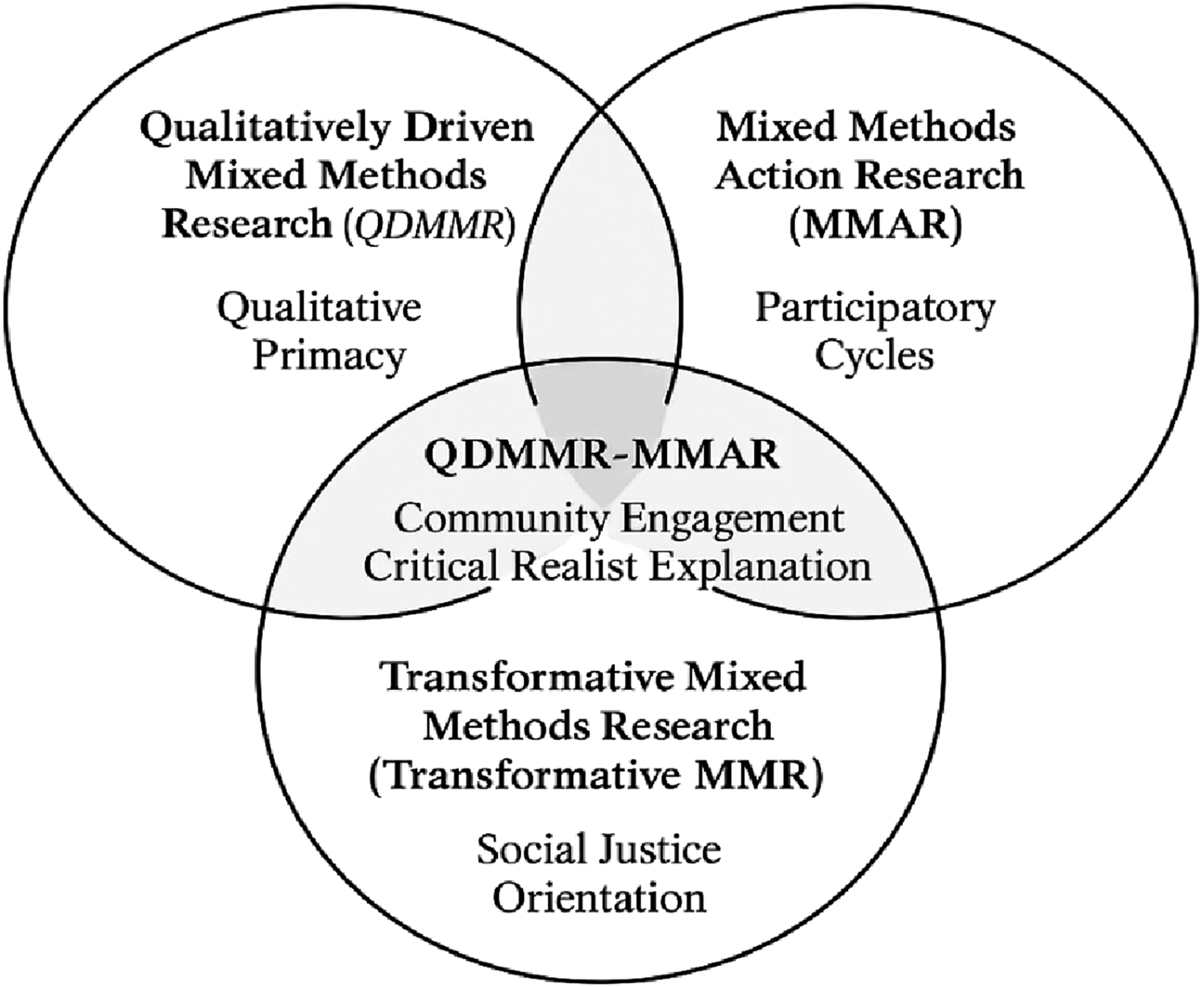
Building on this mapping, the following section explains how QDMMR and community-based participatory MMAR share deeply compatible epistemological and ethical foundations and how their integration strengthens the design and impact of mixed methods research in disability contexts.
Integrating Qualitatively Driven Mixed Methods Research and Community-Based Participatory Action Research
Qualitatively driven MMAR and community-based participatory action research share deeply compatible epistemological and ethical foundations. Both reject post-positivist traditions that have historically positioned people with disabilities as passive subjects, instead centering on lived experience, the co-construction of knowledge, and social justice (Hesse-Biber, 2010; Mason, 2006; Morse & Cheek, 2014). With qualitative inquiry at its core, community meaning-making drives research questions, instrument development, and interpretation. Community-based participatory action research provides the participatory infrastructure for this qualitative primacy to thrive, engaging community members as collaborators or even partners across the research cycle, from defining priorities and co-designing studies to interpreting and mobilizing findings (Ambuehl et al., 2025; Ivankova & Wingo, 2022).
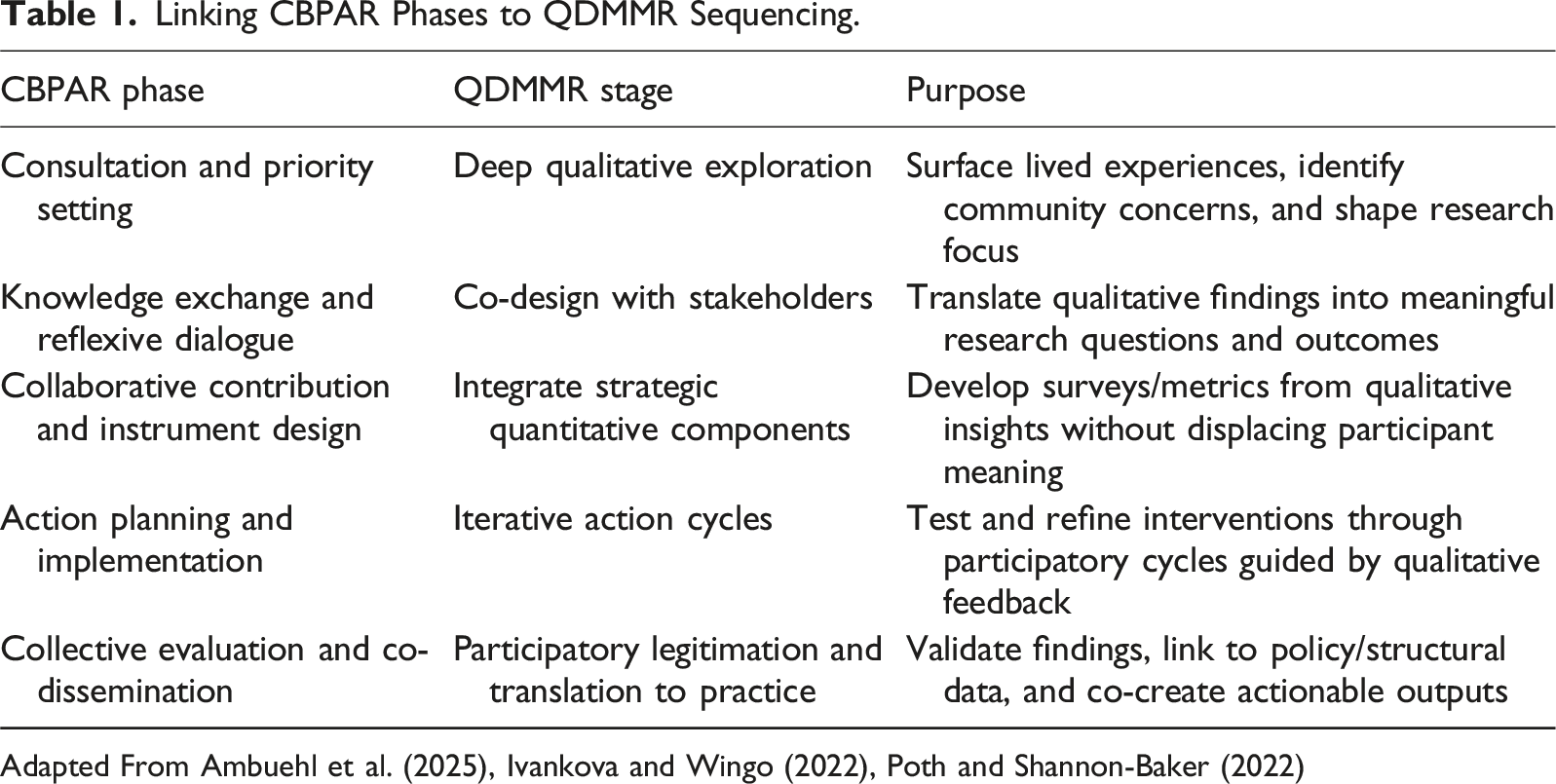
Community-based participatory action research typically unfolds through iterative phases, including consultation, knowledge exchange, co-identification of goals, collaborative contribution, collective evaluation, and co-dissemination (Ambuehl et al., 2025; Ivankova & Wingo, 2022). Each stage relies on in-depth qualitative engagement (e.g., narrative interviews, focus groups, participatory observation, and reflexive dialogue) to generate insights that can later inform strategic quantitative components (e.g., surveys measuring the prevalence of barriers or outcome metrics for evaluating the impact of the action cycle) (Poth & Shannon-Baker, 2022). Quantitative strands remain subordinate and accountable to the qualitative core, extending rather than displacing lived knowledge (Johnson et al., 2007; Mason, 2006). This integration addresses long-standing challenges in disability research by producing evidence that is both contextually grounded and policy-relevant (Ivankova & Wingo, 2022; Poth & Shannon-Baker, 2022). Ethically, the synergy of QDMMR and community-based participatory MMAR redistributes power by honoring experiential expertise and resisting extractive practices (Bailey-Rodriguez, 2021; Kroll, 2011). Together, they create voice-centered, action-oriented, and methodologically pluralistic designs capable of tackling entrenched inequities with context-sensitive, community-endorsed solutions (Mertens, 2015, 2024; Rittel & Webber, 1973).
Linking Community-Based Participatory Action Research Phases to Qualitatively Driven Mixed Methods Research Sequencing
Linking CBPAR Phases to QDMMR Sequencing.
Applying Community-Based Participatory Action Research to Advance Social Justice
Community-based participatory action research is a qualitatively driven yet methodologically pluralistic approach that centers community knowledge and co-governance. By privileging voice, context, and lived experience, community-based participatory action research challenges traditional, extractive research hierarchies and creates shared ownership of inquiry and outcomes (Ambuehl et al., 2025; Kroll, 2011; Poth & Shannon-Baker, 2022). Although primarily grounded in qualitative methods such as focus groups, narrative interviews, and participatory observation, community-based participatory action research also incorporates quantitative tools to enhance reach, explanatory breadth, or policy relevance (Ivankova, 2015). Positioning community-based participatory action research within a qualitatively driven mixed methods research-mixed methods action research (QDMMR-MMAR) design extends its participatory cycles into sustained action planning, implementation, and evaluation. Here, qualitative inquiry informs the research agenda and can be threaded or positioned throughout inquiry. Specifically, it can inform the selection of quantitative tools, their interpretation, and spur further investigations while continuing to center participant meaning. Notably, such decisions should be made collaboratively, and may include co-design approaches as consistent with the participatory ethos of this method. This integration strengthens the methodological rigor and policy relevance of the study, ensuring that emancipatory knowledge translates into tangible improvements in accessibility, equity, and inclusion. Ivankova (2015) notes that when CBPAR integrates mixed methods within a qualitative-driven framework, it enhances stakeholders’ ability to interpret and act upon data, bridging the gap between knowledge generation and practical application.
Beyond methodological coherence, community-based participatory action research within a QDMMR-MMAR model fosters capacity building and encourages sustainable change, since research grounded in community needs and conducted with rather than on participants enhances trust, supports local ownership of findings, and bridges the gap between knowledge production and real-world application. These features make the approach particularly valuable for disability research, where long-term, context-sensitive solutions are essential. Of note, CBPAR has been represented within mixed methods research, including in four articles published in the Journal of Mixed Methods Research and captured in a virtual special issue on collaborative practices in mixed methods research (Archibald, 2023). However, it has not been well represented in disability research, despite its high potential to generate context-specific, community-validated solutions.
Advancing Social Justice Through Engaged Mixed Methods Research
Although academia has traditionally prioritized knowledge production over social impact, there is a growing recognition that research must also generate practical, justice-oriented change (Barton & Merolli, 2019; Dwivedi et al., 2023). Mixed methods designs can help close this gap by combining rigorous, theory-informed inquiry with actionable insights that inform practice and policy (Grimshaw et al., 2012; Kieser et al., 2015). Transformative mixed methods researchers respond to this challenge by engaging participants as co-creators throughout the study and by translating findings into accessible outputs for decision-makers (Aguinis et al., 2009). Qualitative strands, particularly those rich in “thick description,” can powerfully convey injustice and mobilize action when presented through compelling narrative, arts-based dissemination, or creative formats such as storytelling and visual media (Lyons et al., 2013; Mertens, 2007; Ojeda et al., 2011). Indeed, such creative modalities can challenge the status quo through re-presenting phenomena and re-conceptualizing alternative futures for marginalized groups (Archibald, 2021). When integrated with carefully chosen quantitative evidence, such approaches yield findings that are both emotionally resonant and policy-relevant, meeting academic standards of rigor while galvanizing social change.
By prioritizing participatory engagement, cultural responsiveness, and application, QDMMR bridges the long-standing divide between research and practice, offering a model of inquiry that is both methodologically robust and socially impactful, based in part by the legacy of community capacity building. To extend impact beyond a single study, researchers can invest in long-term community partnerships and advisory boards that persist after formal project completion, ensuring continuity of advocacy and shared decision-making (Ambuehl et al., 2025; Mertens, 2015). Establishing policy advocacy networks and coalitions with community stakeholders, professional associations, and decision-makers further facilitates structural change (Grimshaw et al., 2012; Ivankova & Wingo, 2018). Embedding these networks within the research process helps bridge the gap between episodic projects and sustained, equity-oriented transformation.
Operationalizing Qualitatively Driven Mixed Methods Research-Mixed Methods Action Research (QDMMR-MMAR) in Disability Research
There is a strong conceptual rationale for combining QDMMR with MMAR. However, applied researchers require guidance on translating these principles into practice. We propose the following seven steps, conveyed within a simplified framing of transition-to-practice experiences of newly graduated nurses with learning disabilities, to support implementing a QDMMR-MMAR design in a disability studies context.
Principle: Identify and establish relationships with networks and key knowledge holders to develop deep understanding of context and assist in problem formation, reflexively.
Example: Engage early with newly graduated nurses who self-identify as having learning disabilities, along with nurse educators and leaders, to surface priorities and historical concerns about research exploitation. Reflexively examine team positionality and articulate social justice aims to establish trust (Mertens, 2007).
Principle: Lead with inductive, exploratory qualitative investigations to further crystalize the nature of the problem.
Example: Use narrative interviews, focus groups, and participatory mapping to document disclosure decisions, accommodation requests, and workplace ableism. Use these qualitative data to define community needs such as safer disclosure pathways and inclusive mentorship (Morse & Cheek, 2014).
Principle: Ensure collective attention to emerging research question(s) and collaborative engagement with foundational qualitative findings. These can be used to re-visit the nature of the problem of interest, explore approaches to quantitative investigation and consider continued qualitative investigation and/or integration.
Example: Present emerging themes in participatory workshops to refine research questions and select meaningful outcomes (e.g., psychological safety, job satisfaction, and retention), ensuring measures remain culturally and contextually responsive (Ivankova & Wingo, 2022).
Principle: Thoughtful development with consultation, co-development, or selection of quantitative tools in alignment with qualitative components or findings.
Example: Develop surveys from qualitative findings to examine the prevalence and impact of identified challenges (e.g., unsafe disclosure and denial of accommodations), considering co-development and co-design approaches. For example, early interviews with nurses may reveal that perceptions of psychological safety and informal peer support often shape disclosure decisions. These themes directly inform survey items assessing perceived organizational support, trust in supervisors, and prior disclosure outcomes, ensuring that quantitative instruments are grounded in lived experience rather than imposed constructs (Hesse-Biber, 2017; Poth & Shannon-Baker, 2022).
Principle: Cyclical revisiting of emerging data, further reflection and inquiry, leading into action and continued adaptation, informed by mixed methods to inform and evaluation actions.
Example: Co-design and pilot interventions such as inclusive mentorship programs or revised orientation models. Use mixed evaluation: quantitative metrics track reach and impact, while qualitative feedback captures empowerment and contextual fit (Lewin, 1948; Mertens, 2015).
Principle: Multifaceted consideration of trustworthiness, rigor, and legitimation, centering core participatory elements such as democratic validity in alignment or in tension with representation of the mechanisms, contexts, and outcomes underpinning casual process.
Example: Use member checking, collaborative analysis, and stakeholder workshops to validate findings. Realist triangulation can link narratives to policy or organizational data to strengthen causal explanations. In this case, the team used qualitative narratives about denied accommodations to guide the selection of organizational human resource records and policy metrics for triangulation, while stakeholders co-interpreted discrepancies between narrative accounts and documented policies. This ensured that the explanatory model remained faithful to participant meaning while achieving system-level policy relevance (Poth and Shannon-Baker, 2022; Ivankova & Wingo, 2018).
Principle: Intentionally designing research to extend beyond knowledge generation toward real-world application, including within program components like capacity building, and findings oriented applications informing concrete actions (e.g., change in service delivery).
Example: In addition to the translational impacts made possible through the co-design and integrated model, leverage co-authored policy briefs, visual models, and practice guidelines with stakeholders to influence hiring, orientation, and accommodation policies. Disseminate findings through accessible formats such as infographics, narrative reports, and professional workshops, tailored accordingly depending on specific user-group needs and preferences (Barton & Merolli, 2019; Ojeda et al., 2011).
This sequence illustrates the cyclical, reflective, and integrative ways in which qualitative discovery informs the research agenda, participatory collaboration sustains engagement, and strategic quantitative tools enhance breadth and policy relevance. The result is an ethically grounded pathway that links transformative commitments to socially impactful mixed methods practice.
Contribution to the Field of Mixed Methods Research Methodology
This theoretical manuscript provides a timely contribution to the evolving field of mixed methods research by advocating for a shift toward more inclusive, participatory, and justice-oriented approaches in disability research. It illuminates the potential of QDMMR, particularly when combined with MMAR, to advance this agenda. Its central contribution lies in the conceptual and practical integration of QDMMR and MMAR, both of which are guided by the transformative paradigm and enriched by critical realist explanatory depth. While each framework has been independently recognized for their capacity to address complex social challenges, few studies have explicitly examined their synergy, particularly in the context of disability research (Archibald, 2023). This manuscript addresses that gap by demonstrating how shared foundational principles, community engagement, epistemological pluralism, and social justice orientation can converge to produce research that is both methodologically rigorous and ethically grounded. It positions QDMMR, specifically MMAR, as a mechanism for rectifying historical inequities in research involving disabled communities, encouraging scholars to engage with marginalized voices not merely as data sources but as co-creators of knowledge.
Methodologically, the manuscript provides guidance on implementing QDMMR, specifically MMAR designs. It illustrates how researchers may begin with deep qualitative engagement to capture lived realities and subsequently deploy quantitative tools strategically to amplify those insights and broaden their societal and policy relevance, often circling back to qualitative interpretations and further inquiries based on critical and reflective understanding. This approach preserves a qualitative epistemological foundation while using mixed methods as a versatile toolkit for advocacy, policy influence, and systemic transformation. Reflexivity, cultural responsiveness, and collaborative knowledge co-construction are emphasized as essential mechanisms of quality and legitimacy. Together, these features provide a roadmap for socially engaged scholars seeking to conduct academically rigorous yet practically transformative inquiry.
In the context of health and social sciences, including disability research, such integration is particularly salient. Here, enduring challenges such as health disparities, ableism, and structural inequities demand nuanced, context-sensitive methodologies that can capture both individual experience and systemic causation. The proposed QDMMR-MMAR framework equips researchers with a robust methodological lens for addressing “wicked problems” (Rittel & Webber, 1973), while philosophically advancing a novel integration of the transformative paradigm and critical realism traditions that have historically evolved in parallel. This hybrid stance allows researchers to recognize, explain, and challenge inequitable social structures while maintaining the primacy of lived experience and community voice. Building on this foundation, the manuscript presents the first explicit model that unites QDMMR with MMAR. Whereas participatory action research and qualitatively driven designs have often proceeded along separate paths, this integration demonstrates how qualitative discovery can drive participatory co-design, inform the targeted use of quantitative tools for explanatory breadth, and sustain iterative action cycles all without compromising qualitative epistemic primacy. Moving beyond conceptual advocacy, the manuscript provides operational clarity through a seven-step QDMMR-MMAR process, including an example illustration of the transition-to-practice experiences of new graduate nurses with learning disabilities, a context that exposes the systemic ableism and structural inequities the framework seeks to confront.
Conclusion
As the number of global citizens affected by oppression continues to rise, well-designed QDMMR studies that are social justice-oriented have the potential to illuminate disparities and create action toward complex issues, paving the way for more extensive application of transformative principles in mixed methods research studies. Ivankova (2015) echoes this assertion, indicating that researchers can enhance the translation of evidence-informed practice results and achieve substantial change by combining action research approaches, such as community-based participatory action research, with mixed methods research typologies. This integrated approach supports a paradigmatic shift that redefines the role of research in serving communities, shaping policy, and fostering systemic change. It further emphasizes the importance of involving people with disabilities as co-researchers, affirming the mantra “nothing about us without us” (Charlton, 1998, p. 3). It moves away from methods criticized as exploitative and alienating, opening space for marginalized communities and facilitating a strong ethical foundation for research. By advocating for QDMMR that prioritizes the qualitative strand within the transformative paradigm, we highlight the potential for social justice and community empowerment in disability research. With the increasing demand for socially engaged scholarship to address health inequities and structural exclusion, QDMMR integrated with MMAR has strong potential for creating social impact (DeJonckheere et al., 2019). This integration represents a meaningful step toward fostering inclusivity and advancing social change in disability research. Future scholarship would benefit from embracing such mergers to ensure that research not only reflects but actively empowers the communities it seeks to serve.
Footnotes

Funding
The authors received no financial support for the research, authorship, and/or publication of this article.
Declaration of Conflicting Interests
The authors declared no potential conflicts of interest with respect to the research, authorship, and/or publication of this article.