



Abstract
Mixed methods studies in social sciences are predominantly employed to explore broad, complex, and multifaceted issues and to evaluate policies and interventions. The integration of qualitative and quantitative methods in social sciences most often follows the Peircean pragmatic approach—abductive hypothesis formation followed by deductive and inductive testing/confirmation—with limited theorizing properties. This paper contributes to the field of mixed methods research in social sciences by explicating a two-way interaction process between mixed methods data and [social] theory in a pluralistic inferencing approach espoused by critical realism—retroductive theorizing. The paper further illustrates how through retroductive theorizing, critical realism offers a more epistemologically and ontologically grounded alternative for integrating qualitative and quantitative methods compared to pragmatism.
Introduction
The integration of qualitative and quantitative research methods, the hallmark of mixed methods research—MMR (Guetterman et al., 2020), is predominantly employed to explore broad, complex, and multifaceted issues and to evaluate policies and interventions. Methods integration is understood to provide a better understanding of the phenomenon under consideration compared to when only a single approach is used (Timans et al., 2019). In most social science MMR, qualitative approaches are used to explain quantitative findings (Ozawa & Pongpirul, 2014). Nevertheless, accounting for complexity in open systems, where social events are the products of a range of complex interactions, requires rich theorizing.
While some social scientists have successfully integrated qualitative and quantitative methods for theorizing, most often, the theories obtained lack explanatory depth—moving beyond the immediately postulated level of events (Downward & Mearman, 2007)—to capture complex causal mechanisms that produced the events. Kislov et al. (2019) proposed that for more nuanced theorizing, theoretical traditions, theory-driven approaches, and methods should be adopted to approach empirical data in an informative way.
The integration of qualitative and quantitative methods within a research inquiry in social sciences is predominantly informed by Peircean’s pragmatism, whereby, abductive hypothesis formation is followed by deductive and inductive testing/confirmation. Although most research activities are implicitly or explicitly embedded within a philosophical stance, pragmatism is less concerned with remaining faithful to epistemological and ontological principles (Kaushik & Walsh, 2019). Conversely, methods integration in critical realist-informed research warrants the selection and application of methods enshrined in the philosophical assumptions of critical realism (Allana & Clark, 2018).
MMR is currently receiving support for having its own scholarly associations and scientific journals in scholarship especially in social sciences (Timans et al., 2019). Nevertheless, MMR informed by critical realism has received little attention. Although some principles guiding the use of qualitative and quantitative methods in critical realist research have been highlighted (Wynn & Williams, 2012; Zachariadis et al., 2013), their integration has not been elucidated through retroductive theorizing—inference to theorize and test hidden mechanisms (Jagosh, 2020). Through retroductive theorizing, we illustrate how critical realism offers an adequately useful theorizing framework and a robust platform for integrating qualitative and quantitative methods as an alternative to pragmatism.
In this paper, the ontological assumptions of critical realism are presented followed by the epistemological perspectives that emanate from the ontology to situate the roles of quantitative and qualitative methods in the critical realist paradigm. Following the epistemological perspectives, how causality is understood in the critical realist paradigm is explained. The critical realist research cycle is then presented to inform how methods integration is achieved in a research project. Then, retroductive theorizing as the overarching approach to critical realist theorizing is discussed in-depth and how methods integration in retroductive theorizing can be achieved.
Ontological Assumptions of Critical Realism
Critical realism assumes that there is a “real social world” that can be observed objectively—using our senses—while the observation is at the same time shaped by personal, social, historical, and cultural frames. Critical realism, therefore, offers an understanding of the social world, whereby both social structure (organized set of social institutions and patterns of institutionalized relationships) and agency (thoughts and actions taken by people) find a place (Bhaskar, 1975). Thus, critical realism accepts the existence of independent structures that influence the actions of actors in a particular setting while acknowledging the role of the subjective knowledge and reasoning of these actors (Sobh & Perry, 2006). In this way, critical realism leverages elements of both positivist and interpretivist paradigms to formulate a relatively new and alternative approach to knowledge development (Wynn & Williams, 2012).
Critical realism aligns with positivism in that “knowledge should be positively applied, but differs with positivism regarding the approach to doing this, arguing that causal explanations should not be based on empirical regularities but references to unobservable structures and mechanisms” (Cruickshank, 2012, p. 212). Contrarily, critical realism and interpretivism recognize the importance of ideas, experiences, narratives, and discourses in understanding the social phenomenon, however, critical realism employs these forms of expression to explore causal explanations (McEvoy & Richards, 2006). Critical realism distinguishes itself from positivism and interpretivism in recognizing that the world is an open system with a constellation of structures, mechanisms, and contexts (Kazi, 2003), which favors open systems theorizing.
Ontologically, critical realism, as opposed to positivism and interpretivism, proposes a stratified reality: the real, the actual, and the empirical (Bhaskar, 1975)—Figure 1. The “real” describes the existence of structures with generative powers (having the potential to produce something) and represents what happens when these existing powers are activated (Kazi, 2003). When these causal powers existing in the “real” are activated (mechanisms), events happen, unless countervailing mechanisms suppress them. The “actual” domain represents the portion(s) of those events that take place in the “real” that may or may not be experienced by the relevant actor (Schiller, 2016). The “actual” domain is, therefore, a subset of the real and includes actual events or nonevents. The third domain, the “empirical”, is a subset of the “actual” and relates to human perception and experiences of what happens. It contains information that becomes known to human beings through direct and indirect experiences associated with the “actual” domain. The relationship between these three domains is illustrated in Figure 1—Obtained from Mukumbang and van Wyk (2020, p. 3). Three ontological levels of reality.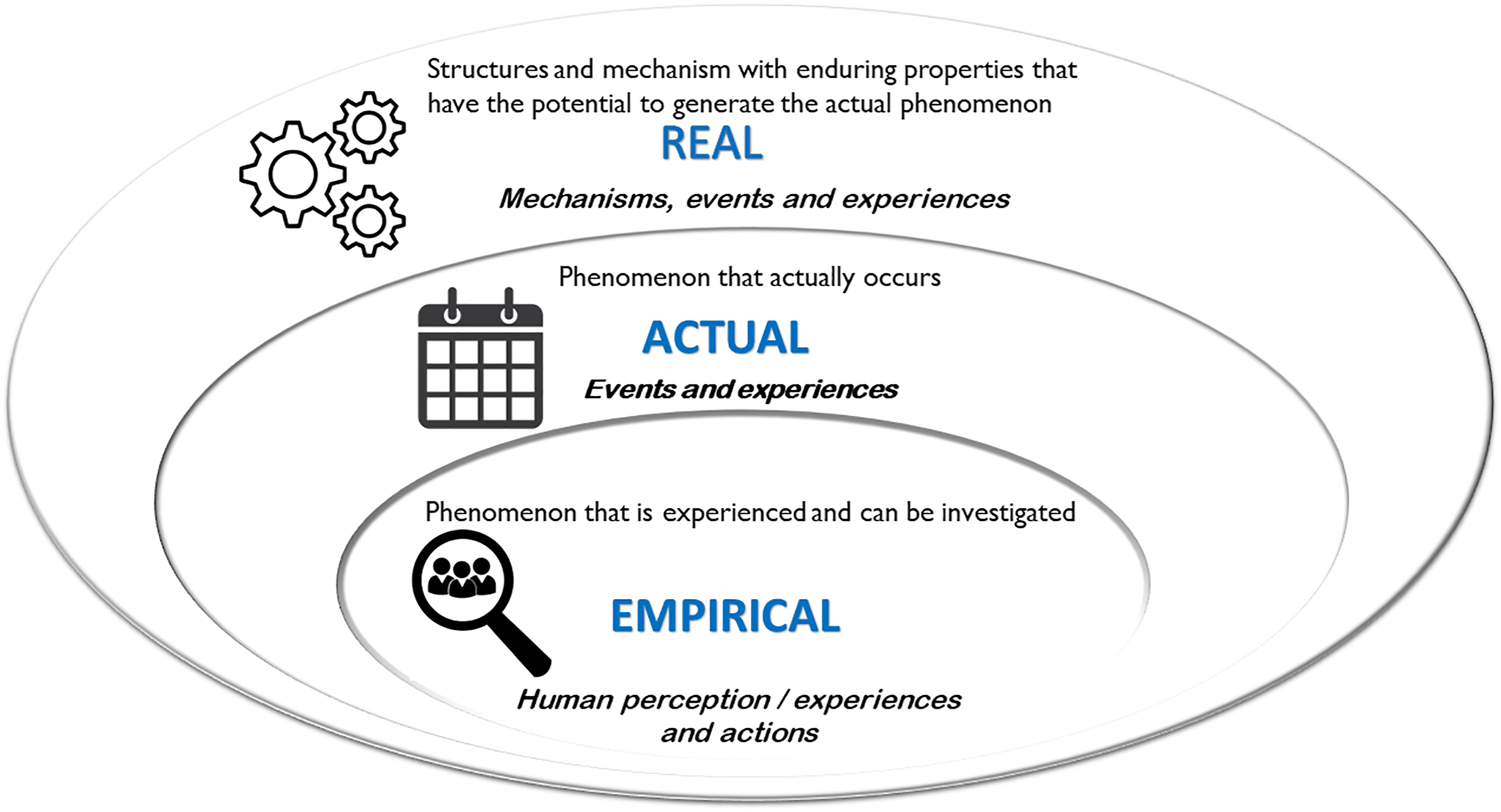
A second critical realist ontological dimension is that mechanisms (entities that are capable of causing an outcome) are stratified (Eastwood et al., 2021). The existence of a level’s specific mechanisms is what constitutes or defines that level or stratum with the stratification described as physical, chemical, biological, psychological, psychosocial, behavioral, social, cultural, and economic layers (Danermark et al., 2002; Sayer, 1992). Mechanisms at a lower level can create conditions for the unfolding of mechanisms at a higher level and this ability of mechanisms to combine to create something new is called emergence (Danermark et al., 2002). Sayer (2000, p. 13) illustrates this idea by highlighting that “social phenomena are emergent from biological phenomena, which are in turn emergent from chemical and physical strata”. While mechanisms may emerge from lower strata they are not reducible to those strata and therefore still usually need to be researched in the strata in which they operate to explain their operation.
Epistemological Perspectives of Critical Realism
Ontological and Epistemological Tenets of Critical Realism and Their Implications for Research.
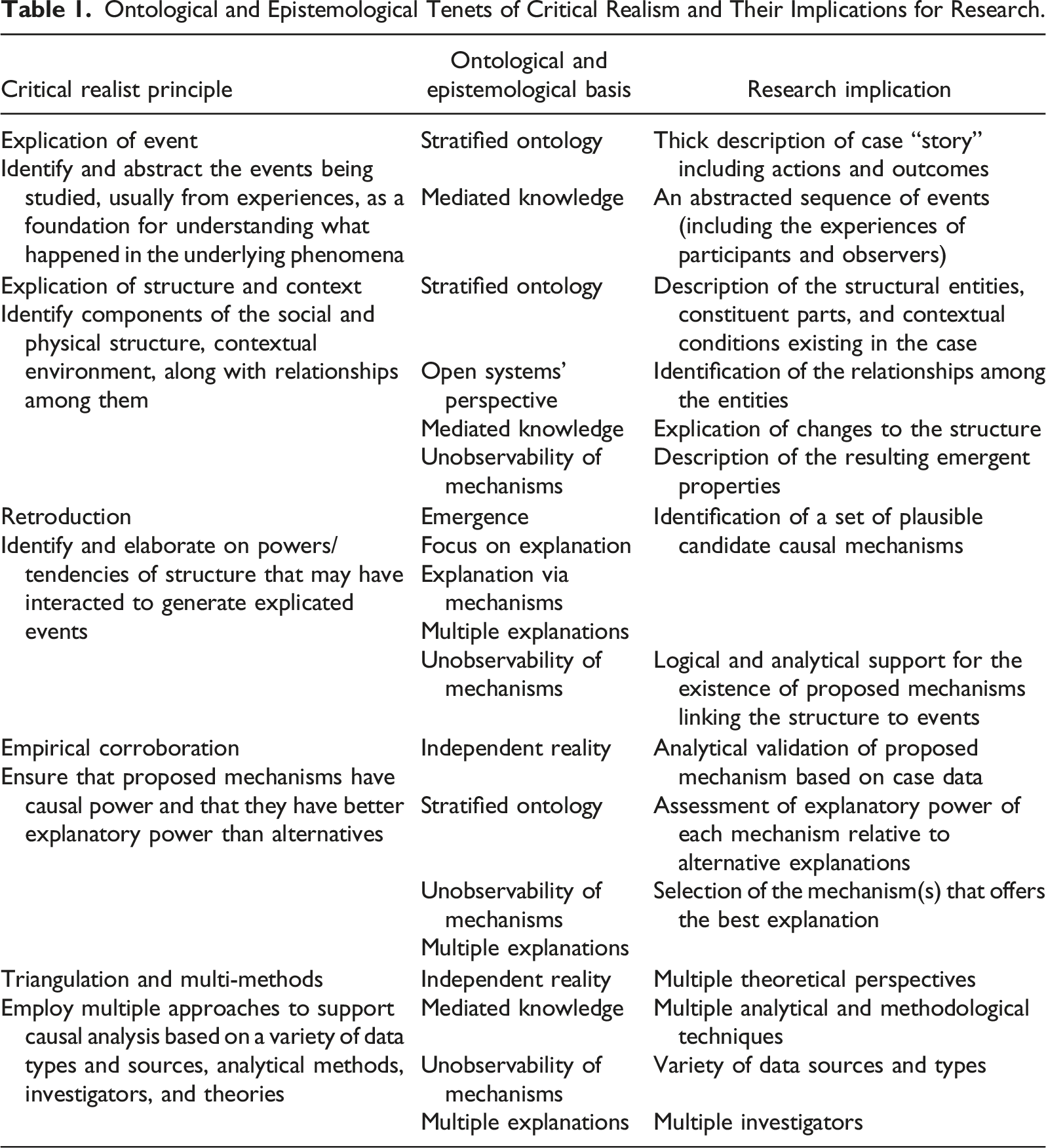
Epistemologically, critical realism holds that there is no such thing as “final” truth (Westhorp, 2014). Therefore, the researcher should be value-aware while adopting and integrating different methods to collect the experiences and perceptions of social agents (Sobh & Perry, 2006). Methods integration assumes a single reality (“real”) and the use of different sources is meant to create a “family of answers” that would foster the understanding of the complexities of reality.
According to Maxwell (2012), in the philosophy of science, research designs are viewed as real entities and not simply as research models. Therefore, realist researchers consider research methods as actual conceptualizations and practices employed in a specific study. Figure 2 illustrates how Sayer (1992, p. 237) conceptualizes the roles of various research and methods possible in critical realist research. The role of extensive and intensive research methods in critical realist methodology.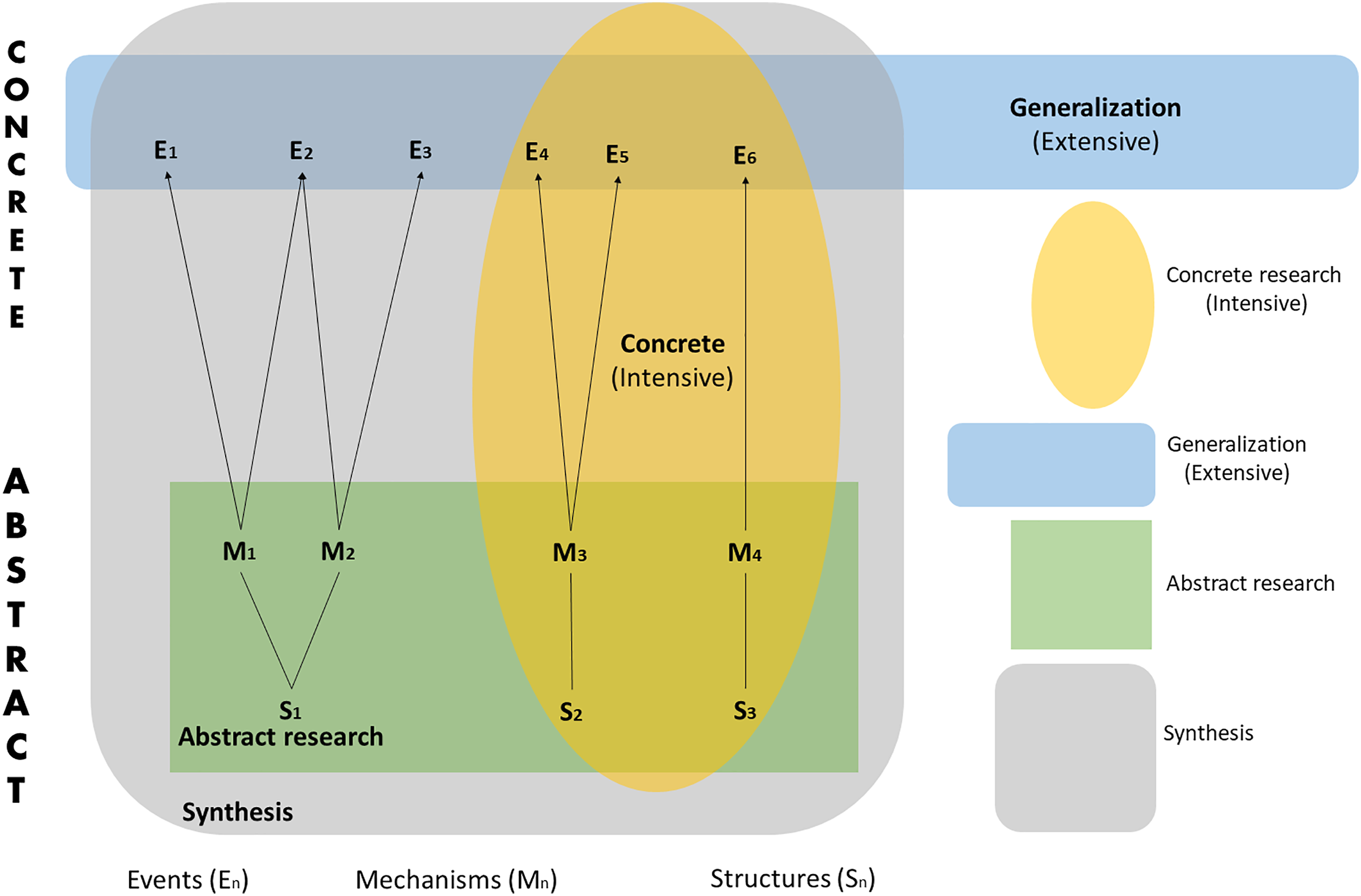
According to Sayer (1992), “abstract theoretical research deals with the constitution and possible ways of acting of social objects, and actual events are only dealt with as possible outcomes” (136). Based on Figure 2, some MMR can adopt both abstract and concrete research approaches to inform their retroductive theorizing process. Concrete research involves the use of intensive and extensive methods, and focuses on capturing elements of the observation (demi-regularities), mechanisms, and structures at the “empirical” level. Intensive methods entail substantial elements of data collecting and analyses of a qualitative kind while the extensive methods make use of representative samples for possible generalization (Danermark et al., 2019b). The abstract deals with causal mechanisms and underlying structures, which can or cannot be unveiled when synthesizing data toward the formulation of the explanatory theories. The integration of methods in critical realist-informed research is, therefore, meant to identify and provide a further understanding of these structures and mechanisms.
Causal Explanation in Critical Realism
Positivism requires the researcher to describe behaviors or occurrences as regularities because their measurements are mostly obtained under strict conditions and closed systems. Because strict regularities are less likely to occur in complex open systems, characterized by various prevailing and countervailing conditions, critical realism, on the other hand, gravitates toward the use of demi-regularities (Downward, 2003). Demi-regularities are usually consistent with expected habits and behaviors. Nevertheless, under countervailing conditions, other unintended or alternative behaviors could be observed—contrastives (Lawson, 2001).
Hausman (1967) explained that causality, as understood in the positivist paradigm, is mostly informed by Hume’s “secessionist” theory, which suggests that we cannot directly perceive causal relationships, only “constant conjunction” of events. According to Stroud (1978), two things are causally connected when they appear one after the other; the former is considered the “cause” and the latter the “effect.” This relationship is modeled in various mathematical forms in which the effect (dependent variable) is a function of the cause (independent variables):
In critical realist-informed research, identifying the agent–agent and agent–structure relations is important in explaining social behavior (Connelly, 2001). According to Archer (1995), agents in the past organized and constructed the various structures—social, economic, cultural, and political systems—that make up our society. Elder-Vass (2010) argues that these social structures are “causally effective in their own right, with generative powers that are distinct from those of individuals” (p. 6). As stated by Bhaskar (2009), the individual’s generative powers interact with those of the social structures to determine an individuals’ action. In the agential movement, an individual’s actions contribute to reproducing and/or transforming the structure(s) concerned—again interacting with other generative powers (Elder-Vass, 2008).
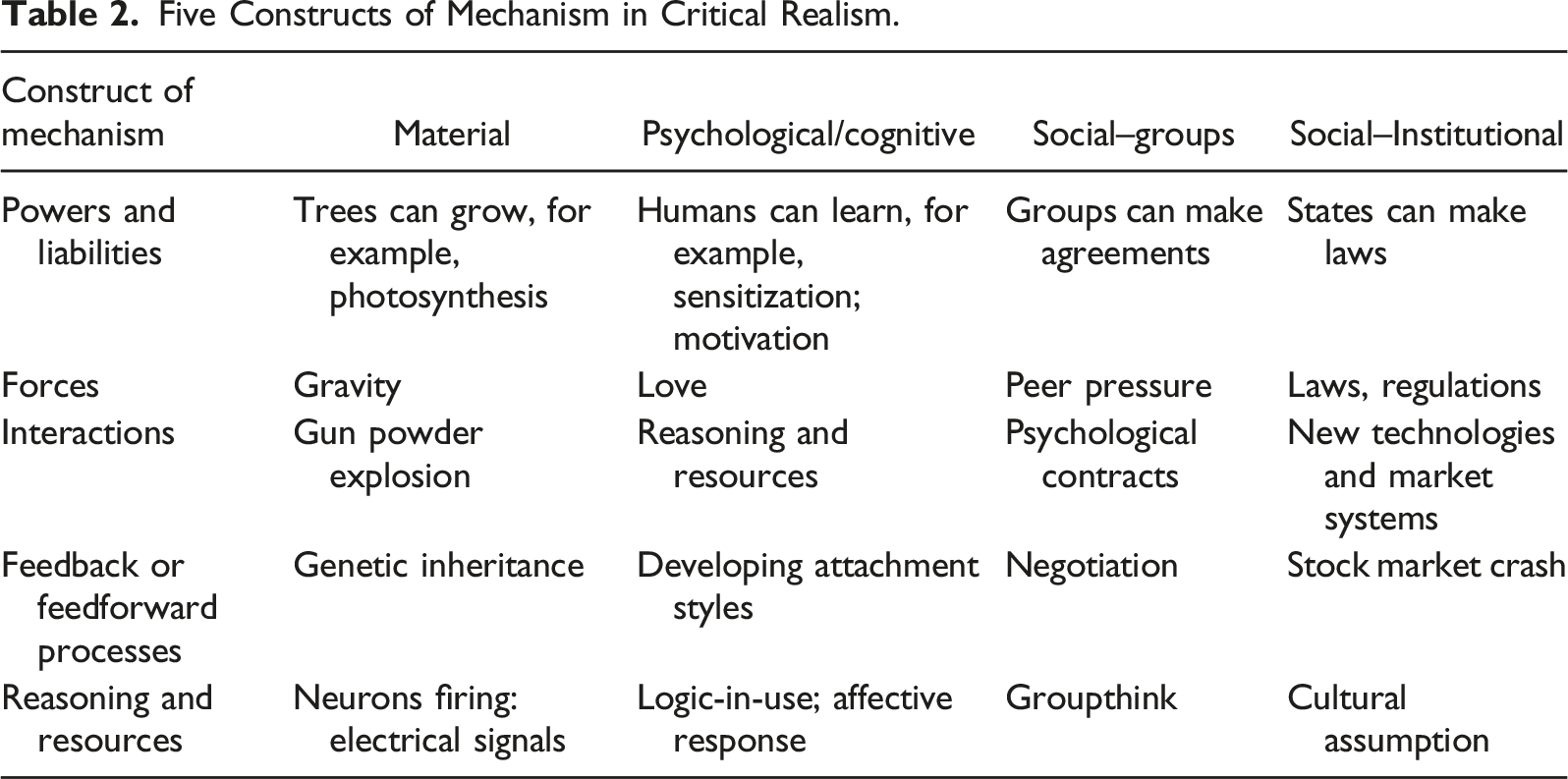
While structures and individuals possess generative powers, it is not in all circumstances that these powers are exercised. When these generative powers are triggered or activated, they become mechanisms, causing actual events. These mechanisms cannot be seen operating directly but they can be inferred through a combination of empirical investigations (McEvoy & Richards, 2006). Therefore, central to critical realist methodology is the identification and conceptualization of mechanisms considered as the causal elements of events (Bygstad et al., 2016).
Five Constructs of Mechanism in Critical Realism.
While the identification of mechanisms is a sine qua non in realist research, these mechanisms alone do not explain how observed events occurred. Critical realists emphasize that the effects of generative powers are contextual—dependent on other structures and conditions with generative powers. Therefore, context matters because it has the potential to change the outcome by (dis)activating the generative powers (Wong et al., 2013). This implies that a mechanism does not always produce the same outcome in different contexts, a notion described by Smith 2012 as contingent causality, which is a feature of open systems. To this end, critical realist explanations typically include structures and/or mechanisms, the effect or outcome that these mechanisms tend to produce, and the elements of context that trigger or inhibit the firing of these mechanisms—Figure 3 (Sayer, 2001; p. 15). A critical realist explanatory model.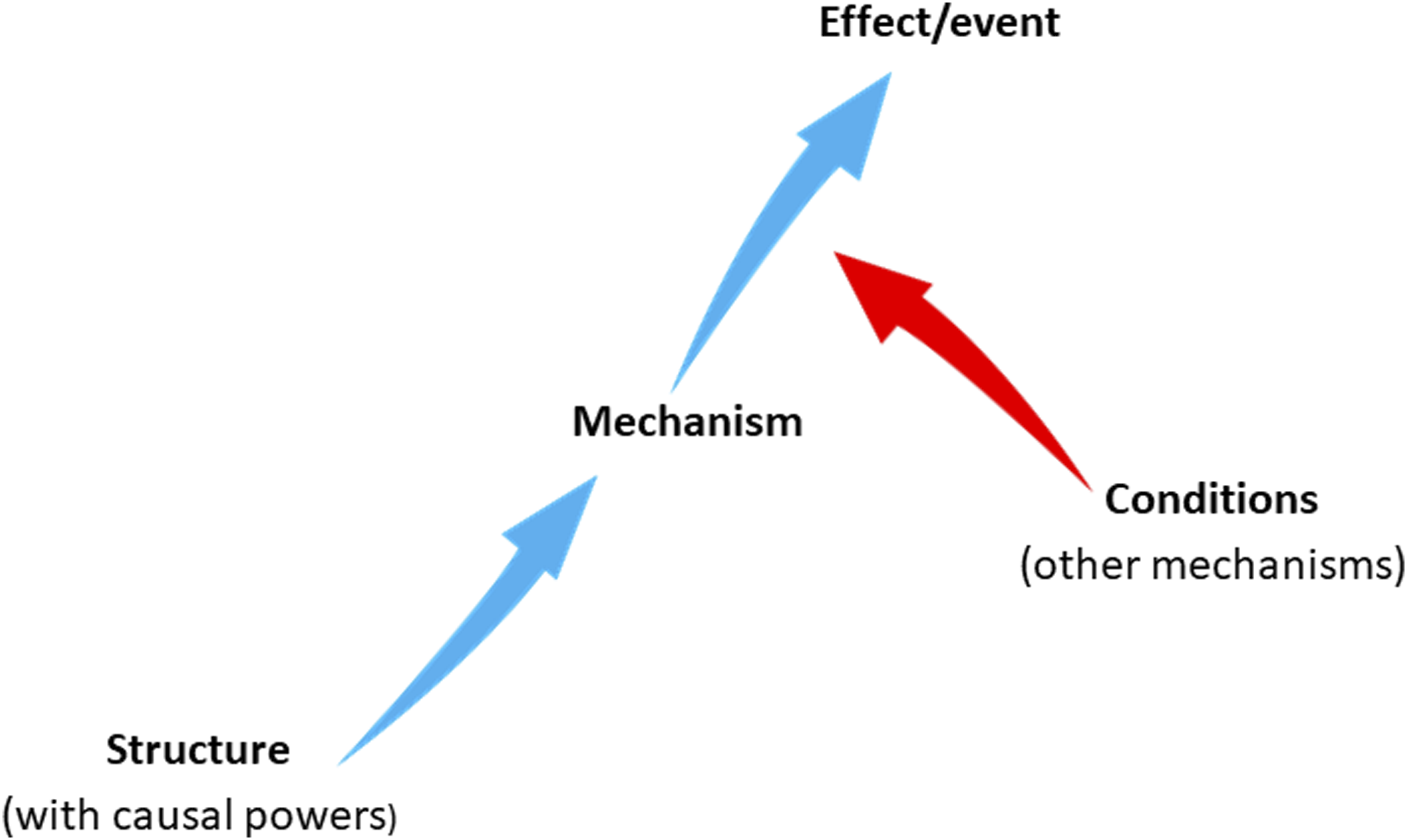
The Critical Realist Research Cycle
Critical realist research is based on a scientific approach to the construction of explanatory models and theories. Two types of theory-informative research approaches are prominent: Emergent—moving from empirical observation and inquiry toward the development of theoretical understanding, and Confirmatory—moving from a theoretical concept to empirical testing of hypotheses modes of theory.
The scientific process of emergent theory development offers freedom to explore theories that lack direct empirical correspondences for testing in a research process and has been described in three phases: the emergent, construction, and confirmatory phases (Eastwood et al., 2014). Similarly, the confirmatory approach has three phases; theory gleaning, theory refinement, and theory consolidation (Manzano, 2016). Nevertheless, it offers a more methodologically stringent approach focusing on retroductively constructing derived program theories and comparing such theories against the best available evidence. Realist evaluations (Pawson & Tilley, 1997) usually adopt the confirmatory approach. Figure 4 illustrates the phases of emergent and confirmation theory development in the realist research cycle (Mukumbang et al., 2016, p. 7). Describing the phases of theory development with the realist research cycle.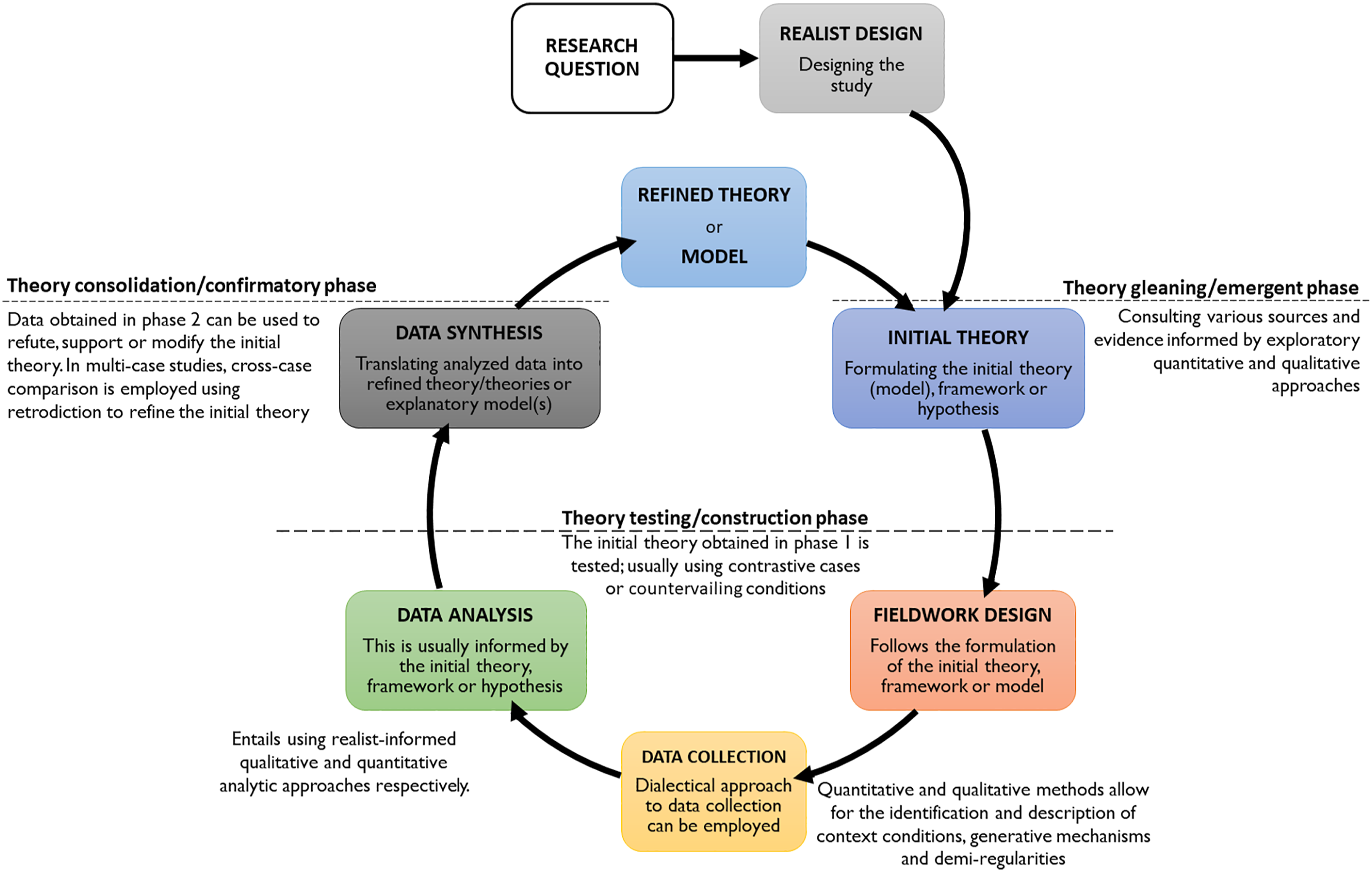
Emergent/Theory Gleaning Phase
The emergent/theory gleaning phase leads to the development of a tentative or initial theory. This phase aligns with Sobh and Perry’s (2006) suggestion of developing a preliminary theory or conceptual framework about the underlying mechanisms of the phenomenon. Extant information can also be harnessed through systematized reviews and document analysis to inform the initial theory or framework construction. Nevertheless, critical realist principles should guide the adoption of information from these sources.
Construction/Refining Phase
The construction phase as related to the explanatory theory-building approach requires forming a conceptual framework by integrating information from multiple methods. Explanatory theory-building usually includes case study research (single or multiple cases) involving formal data collection and analysis methods, aimed at supplementing and confirming (aspects of) the developing theory. This entails putting the initially developed framework as a foundation for constructing the emerging theory. Concerning the confirmatory theory testing approach, the theory refinement phase requires the use of case studies to “test” the initial theory (Koenig, 2009). The testing process entails adopting intensive and extensive research approaches to data collection and analysis to confirm or disprove and, above all, to refine the initial theory.
Confirmatory/Consolidation Phase
The confirmatory/consolidation phase involves second-level refining and fine-tuning of the initial theory. It might require doing a cross-case analysis, comparing and contrasting in-case theories from different selected cases toward obtaining a more refined theory (Danermark et al., 2002; Mukumbang et al., 2018). Cross-case analysis requires the application of retrodiction and abductive reasoning toward abstraction (analytical generalization).
Retroductive Theorizing
Retroduction is the logic of inference-making espoused by critical realism (Downward & Mearman, 2007). According to Sayer (1992), “retroduction is the mode of inference in which events are explained by postulating mechanisms which are capable of producing them” (p. 107). While induction, deduction, and abduction each refer to a distinct form of logical inference, retroduction describes an overarching logical method that incorporates abduction, deduction, and induction for its full performance (Chiasson, 2001). Therefore, retroduction does not offer a formalized logic of inference as a thought operation that moves between knowledge of one thing to another (Danermark et al., 2002). Rather, it is an empirical process of devising a theory and requires moving from an observation—an inference made by an observer in response to (or ideas about) an event—of concrete phenomena to reconstruct the basic conditions for a deeper causal understanding (Lawson, 1997; Meyer & Lunnay, 2013).
Inductive, deductive, and abductive forms of inferencing are often systematically applied in pluralistic theorizing. Inductive reasoning involves projecting from what we know to what we do not know; and it starts with a specific observation. While inductive reasoning seeks to make broad generalizations and predictions, in deductive reasoning, the researcher moves from the general (the theory) to the specific (the observations). Abduction, on the other end, typically begins with an incomplete set of observations and the researcher “suggests” the likeliest possible explanation for the set. By interpreting and re-contextualizing observed actions and events, the researcher suggests the “best explanation” of those observations (Downward & Mearman, 2007). Charles S Peirce (1839–1914) is credited with developing abduction as a mode of inference-making and used the following analogy to illustrate abduction based on pragmatism: Rule—All the beans in this bag are white. Result—These beans are white. Case—These beans are from the bag. (Peirce, 1902, p. 134)
Umberto Eco (1932–2016) conceptualized four types of abduction: over-coded, under-coded, creative, and meta-abduction (Dobson et al., 2012), which are useful at different stages in critical realist retroductive theorizing. Over-coded abduction consists of spontaneous interpretations, whereby the underlying hypothesis is seemingly obvious based on existing knowledge. Under-coded abduction relates to a situation of having more than one possible explanation and the researcher has to select the most plausible one in a specific case. The third type of abduction, creative abduction, is characterized by being unique and innovative and moving to a frame of alternative interpretations or which opposes conventional interpretations. Finally, meta-abduction refers to a series of mini abductions to explain observed happenings.
While theorizing in Peircean pragmatism and retroductive theorizing make use of induction, deduction, and abduction, their methods of inference-making are not necessarily the same (Lipscomb, 2011). For instance, the Peircean pragmatism approach to theorizing could take the form: abductive–deductive–inductive cycle; abductive hypothesis formation followed by deductive and inductive testing/confirmation (Kaushik & Walsh, 2019). In retroductive theorizing, abduction is that inventive thinking required to imagine the existence of mechanisms (Jagosh, 2020) with abductive conclusions underpinning retroductive inferences (Ritz, 2020). Therefore, retroductive theorizing is typically associated with the different forms of abductive reasoning applied as the researcher moves back and forth between deductively and inductively obtained data. In this way, retroduction is closely associated with abduction and they are considered to complement each other (Ritz, 2020). The retroductive theorizing approach is illustrated in Figure 5. Mixed methods retroductive theorizing.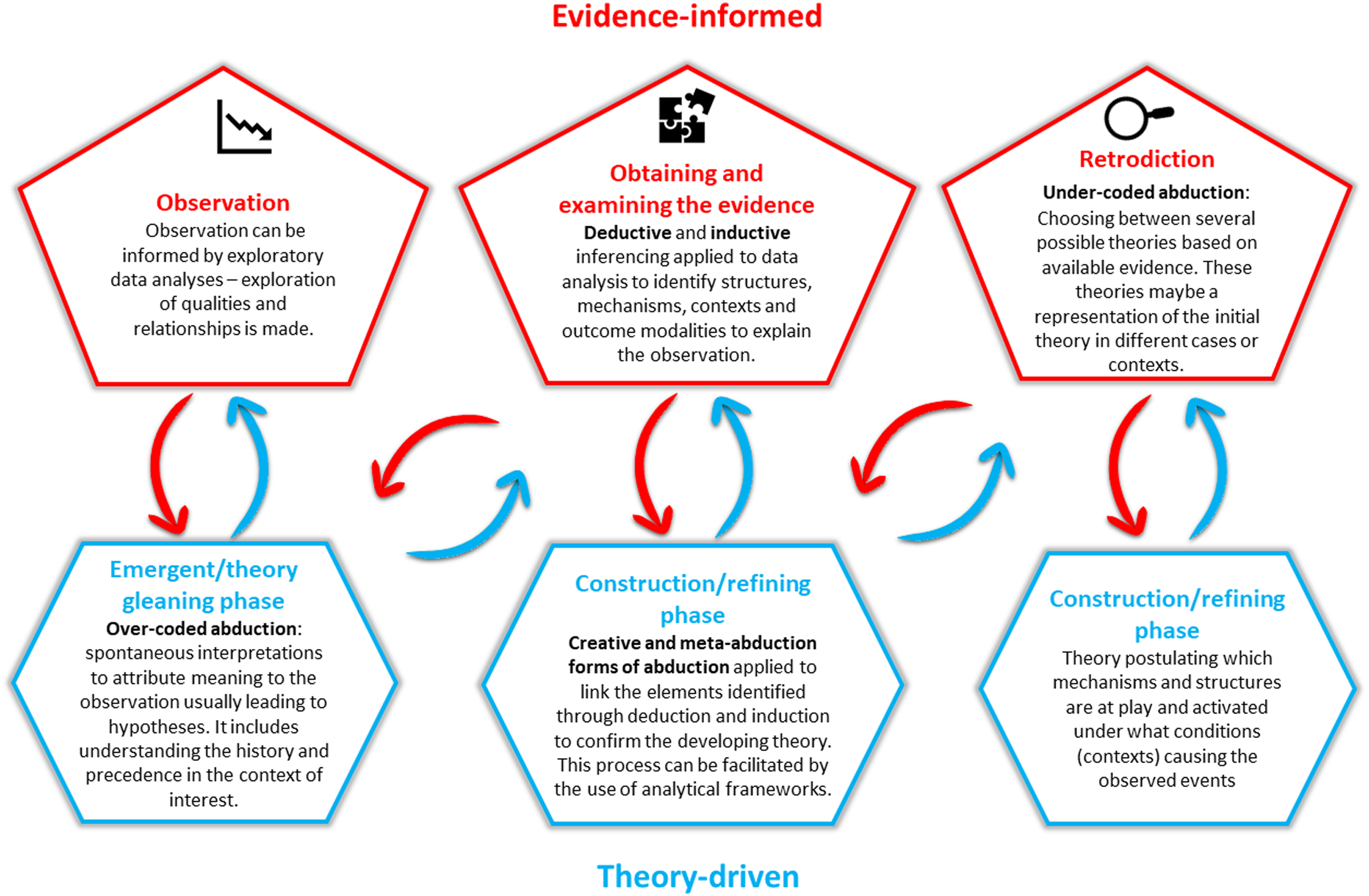
Stages of Retroductive Theorizing
According to Glynos and Howarth (2019), retroductive theorizing offers a useful approach to think about research strategy and methodology from a critical realist perspective. To this end, the process of retroductive theorizing is aligned with the critical realist research cycle to facilitate comprehension.
Emergent/Theory Gleaning Phase
Retroductive theorizing usually starts with an observation, which often occurs during an exploratory data analysis exercise. Exploratory data analysis uses charts, graphs, percentages, and other descriptive methods to summarize the main characteristics of a data set and highlight any patterns that may not be immediately obvious. Following the over-coded abduction, the researcher offers a “spontaneous” interpretation or an “educated guess” about possible underlying mechanisms and relevant structures and context conditions in play to cause the observed phenomenon. Then, the researcher sets out to test the conjectured initial theory.
Construction/Refining Phase
Central to critical realist research is the search for generative mechanisms. An approach for identifying mechanisms has been proposed by Bygstad et al. (2016) and summarized by Thapa and Omland (2018) into four steps: (1) describing the events in the situation studied; (2) identifying the entities and associations that characterize the phenomena being studied, and collecting data about these entities; (3) searching for different theoretical perspectives and different explanations (abduction); and (4) hypothesizing the mechanisms and conditions that might have activated the generation of the events (retroduction).
Quantitative Contributions
The legitimacy of quantitative methods within critical realist studies relies on the interpretation of statistics and how these findings inform the developing theory than any inherent quality of the methods themselves (Zachariadis et al., 2013). To describe the events in the situation studied, common quantitative-related data collection methods used in critical realist research include instrument measurements, surveys or questionnaires, and routine data records.
Regarding the identifying of entities and associations that characterize the phenomena being studied, inductive quantitative methods such as regression analyses are used to recognize and categorize contextual elements, postulate mechanisms, and classify outcomes (Ron, 2002; Westhorp, 2014). Regression analysis can be used to demonstrate the existence of a causal mechanism by controlling for other possible mechanisms that could have acted at that time (Ron, 2002). Ravn (2019) illustrated how simple statistical methods in the form of descriptive statistics and logistic regression can be used to test the influence of mechanisms in generating outcomes, especially when evaluating a large-N program. Deductive quantitative methods such as structural equation modeling can also be used to explicate and demonstrate aspects of that initial theory (Brown et al., 2020; Ford et al., 2018).
The strength of quantitative approaches in realist research lies in their ability to produce “reliable” descriptions and provide “accurate” comparisons (McEvoy & Richards, 2006); two elements that are useful in identifying demi-regularities and contrastives. The categorical or standardized nature of quantitative measures suggests that quantitative methods can be useful in identifying patterns and associations that could be hidden and that uncovering these masked associations could be useful in identifying new and unexpected mechanisms (McEvoy & Richards, 2006). This thinking synchronizes with Kazi’s (2011) assertion that inferential statistics can be used to identify potential causal mechanisms and the use of statistical significance and other measures can suggest relationships between mechanisms and outcomes. In addition to investigating mechanisms, quantitative analyses have also been used to examine contextual contingencies—effect moderation (Jamal et al., 2015).
Qualitative Contributions
While applying qualitative methods to describe events, it is advised that cases should be studied in their natural contexts, as the context of each illustrates its particular signification. Regarding the identification of entities and associations that characterize the phenomena being studied, deduction, especially applied to qualitative methods is used to make meaning of the initial theory clearer by operationalizing the demi-regularities and the underlying structures and mechanisms (Gregory & Muntermann, 2011). Also, the theorist strongly builds upon existing conceptualizations and theories when elaborating on the tentative theory where possible and necessary. Inductively, qualitative methods are also used to elicit information relevant to the social phenomenon, relevant context conditions, and mechanisms, and the emergent outcomes and provides evidence to link these elements (Mukumbang et al., 2020).
Intensive methods provide critical realist researchers the opportunity to mine rich, detailed insights. In-depth interviews and focus group discussions are predominantly used to elicit information from study participants. Brönnimann (2021) proposes that realist interviewers should start by phrasing questions about events and social entities related to the phenomenon directly. Narrative interviews, which predominantly focuses on capturing stories (Allen, 2017) can especially provide an opportunity for the participants to narrate their experiences and thus capture events (outcomes) from the participants’ perspectives. During critical realist interviews and focus group discussions, the interviewer interacts with the respondents to generate a set of responses which formulate perspectives, observations, experiences and evaluations, which the interviewer uses to interrogate their theories and understanding (Smith & Elger, 2014, p. 14). Realist interviews, a theory-driven approach to interviewing, could be a privileged method for identifying and linking the mechanisms at work in the specific context being studied (Mukumbang et al., 2020).
During focus group discussions, in particular, the interviewer should explore the beliefs and shared meanings, which constitute the discourse of the social groups under investigation. This could be achieved by exploring the shared material practices and their shared understandings associated with these practices. Participant and non-participant observations can also be used for collecting information relevant to the structures or the context of the social agents. (Handley et al., 2020). Participatory approaches such as Photovoice methods are also valuable as the images participants provide illustrate metaphors for their life situations, experiences, and/or emotions (Woodgate et al., 2017). The verbal interpretations of the images are particularly important for understanding the meaning(s) participants attach to the photos, especially when the images are deeply symbolic (Mukumbang & van Wyk, 2020).
Qualitative content and thematic analysis are predominantly applied to qualitative data. Qualitative content analysis, which entails qualifying and quantifying data through the application of various levels of interpretation (Vaismoradi & Snelgrove, 2019) can be used to establish demi-regularities. Thematic analysis, on the other hand, is used to uncover mechanisms and contextual elements as the approach requires a higher level of interpretation and considers both latent and manifest content to obtain abstract themes (Vaismoradi & Snelgrove, 2019). Both approaches are based on reflectively creating labels (codes) to develop data into meaningful categories to be analyzed and interpreted (Blair, 2015). Wiltshire and Ronkainen (2021) propose the use of experiential, inferential and dispositional themes with corresponding validity indicators, empirical adequacy, ontological plausibility and explanatory power, during qualitative realist analysis.
Codes are identified as the first stage of reducing qualitative data. The coding process should aim at obtaining both topic-based codes and prior theory-based codes (Maxwell, 2012). Fletcher (2017) and Hoddy (2019) also advocate for the use of axial coding techniques (linking open codes to each other) for identifying and postulating causal mechanisms and demi-regularities. Elements related to structures, context, mechanisms, and observation, which are useful for establishing mechanism-based causality should be identified (Peter & Park, 2018).
In addition to identifying construct elements, Jackson and Kolla (2012) suggest that axial data coding in realist studies can include identifying linked dyads (mechanism-observation, context-mechanisms, context-observation) and triads (context-mechanism-observation). Having a priori program theory usually guides axial coding. The initial theory is usually a preliminary conceptual framework about the underlying structures, contextual elements, and mechanisms developed from the literature and/or from people with experience of the phenomenon (Sobh & Perry, 2006).
Integrating Quantitative and Qualitative Contributions
Data synthesis in mixed methods retroductive theorizing entails integrating information obtained from extensive and intensive sources. Abductive theorizing at this level involves adjusting accounts and abstractions of theoretical concepts and relations to increase the practical adequacy of conceptual 'maps'. Eastwood et al. (2014) caution the possibility of losing some details regarding the complexity of the processes under study and suggest going back to check. The data synthesis is broken down into 3 steps to open the black box. Figure 6 illustrates a realist-informed convergent mixed methods design. Realist-informed convergent mixed methods design.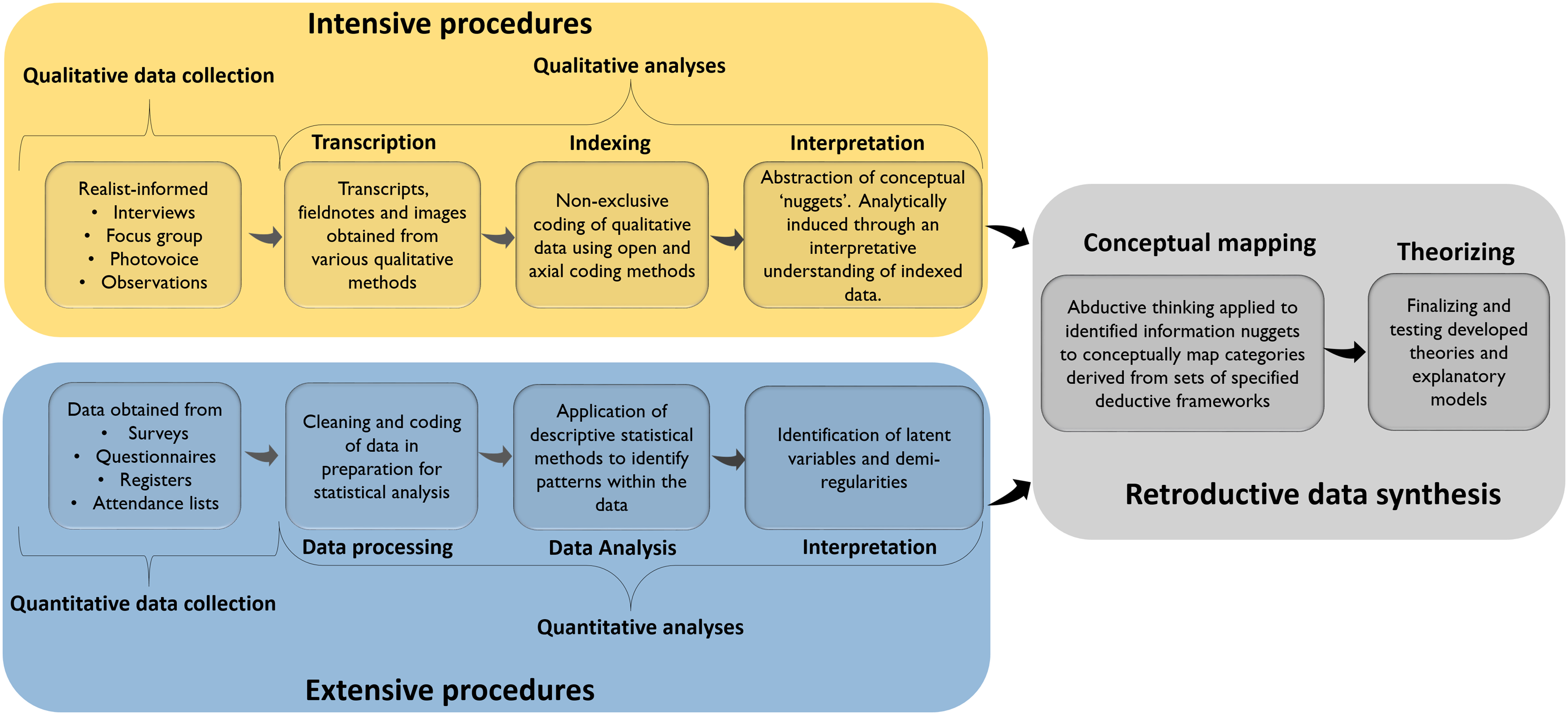
Step 1: Identifying a Suitable Analytic Framework
Not all realist-informed work employs an analytic framework. Most realist analytic frameworks have elements of “Interventions,” which may influence institutional and social structures, structures (S) possessing potential generative powers—mechanisms (M), or the reasoning (mechanism—M) of targeted actors (A), observed outcome(s) (O) and context (C) elements. Bhaskar (2016) proposed the use of Context-Structure-Mechanism-Outcome—CSMO in emergent theory development while Pawson and Tilley (1997) proposed the use of the context-mechanism-outcome (CMO) configurations, as applied to realist evaluation. While Bhaskar (2016) separates structures from mechanism, Pawson and Tilley (1997)’s approach seem to conflate structures and agency in their notion of “mechanism” (Porter, 2015). Intervention-Context-Actor-Mechanism-Outcome—ICAMO (Mukumbang et al., 2018); or Context-Intervention-Mechanism-Outcome—CIMO (Eastwood et al., 2019) configurations have also been used in critical realist evaluation studies. These realist analytic frameworks should be used on a fit-for-purpose basis. These heuristic tools are “ugly circumlocution” with the parts dependent on the whole. Therefore, while applying these models to analyze social situations or programs, researchers should consider their true value because models by their nature, distort the reality they seek to describe. To this end, researchers should provide a rationale for choosing and applying a particular heuristic tool (De Weger et al., 2020).
Step 2: Accentuating Candidate Mechanisms
There is no specific method or logic for conjecturing mechanisms (Bygstad et al., 2016). Their hidden nature makes them challenging to identify, therefore, their description is bound to contain concepts that do not occur in empirical data. Practically, in synthesizing realist data, for each broad observation (demi-regularity or contrastive), specific mechanisms or groups of mechanisms are studied (Byng et al., 2005; Fletcher, 2017). Identifying different mechanisms responsible for different scenarios is very useful. For instance, looking for positive and negative cases. According to Mingers (2006), the interplay between positive or counteracting mechanisms determines whether events occur or not. By identifying the association of the alternative observations with “missing mechanisms” and “negative contexts”, the realist researcher can confirm the value of the particular mechanism(s). Hedstrom and Swedberg (1998) advocate for the use of abstraction and analytical accentuation (grouping linked mechanisms) to make the general mechanisms visible.
Step 3: Linking of Key Components
Typically, the identified analytic framework in step 1 guides the process of linking the key components for formulating causal pathways. To this end, in addition to identifying and verifying causal mechanisms, realist researchers “identify the necessary contextual conditions for a particular causal mechanism to take effect and to result in the empirical trends observed” (Fletcher, 2017, p. 189). The aim of linking the key components to formulate the generative theory is not to provide an exhaustive account of all details relevant to the observation but the researcher seeks to distill the crucial elements of the process by abstracting away the irrelevant details–properties or activities that do not make any difference to the effect to be explained (Hedström et al., 2010).
The process of linking key components can be approached by constructing causal configurations around each relevant observation and is achieved through creative and meta-abduction forms of abduction (Mukumbang, Kabongo and Eastwood, 2021). Applying the configurational mapping approach (Pawson & Tilley, 2004) such as causal loop diagrams can be useful especially when more than one mechanism is associated with the observation of interest. Abduction also involves the application of counterfactual thinking (creating possible alternatives to events) to identify positive and negative outcomes (Roese, 1997). While constructing the causal configurations, the researchers should link each active mechanism identified as being associated with a positive or negative outcome (M-O links), then search for the underlying structures and/or context in which the mechanism is contingent. Through creative and meta-abduction forms, sub-theories could be developed, which are used to challenge or confirm the tentative theory. Applying creative abduction, new ideas can emerge from the newly added concepts some of which may be useful after further testing or turn out to be less valuable.
Construction/Refining Phase
Abduction offers the possibility for multiple potential explanations (Wynn & Williams, 2012) with rival theories sharing some features. The researcher is, therefore, required to and can adjudicate between rival theories. Bhaskar (2009) proposes evaluating the different hypotheses as being better or worse, judgmental rationality. Judgmental rationality is applied to evaluate and compare the explanatory power of different theoretical explanations and to select theories which most accurately represent the domain of “real” abductively—under-coded abduction (Hu, 2018). This means that the selection of one theory over another should be based on the “greater explanatory power” potential (Bhaskar, 2009). Greater explanatory power requires “having greater (but not final) epistemic credibility … and a greater ability to integrate knowledge” (Isaksen, 2016, p. 245).
The criteria of greater explanatory power combine the notion of immanent critique—valid grounds for knowledge and values (Isaksen, 2018)—and under-coded abduction to determine whether a theory has greater explanatory power than its rivals. Bhaskar (2009) propositions that “a theory Tc is preferable to a theory Td, even if they are [incommensurable], provided that Tc can explain under its descriptions, almost all the phenomena that Td can explain under its descriptions, plus some significant phenomena that Td cannot explain” (p. 73). Secondly, the selected theory should be able to explain a deeper level of reality (“the real”) or achieve a greater order of epistemic integration (Bhaskar, 2009).
Retrodiction
Retrodiction is the systematic comparison of explanations obtained from different cases toward a more refined theory. In multi-case studies, especially when demi-regularities and contrastives are explored for their causative mechanisms, a cross-case analysis should be done. First, the researcher should elaborate on the within-case theories extensively to enhance critical comparison. Placing the different within-case theories in a juxtaposition allows for the differences and similarities to become clear (McAvoy & Butler, 2018). Retrodiction is used to examine the similarities and differences between the various cases (Danermark et al., 2019a; McAvoy & Butler, 2018).
During retrodiction, the researcher searches for the variations in the context(s) accounting for the differences (if any) between them and aims to “generalize” across cases by looking at how the important outcomes may be achieved. The contrastive can be used to adjust (confirm) certain links to refine the developing theory or theories (Byng et al., 2005). Retrodiction should be focused on synchronizing the mechanisms that account for the emergence of the phenomena operating at the “real” domain, based on best explanation obtained from the different contexts within the individual case studies (Yeung, 1997).
Yeung (1997) explains that realist researchers should continue to apply this iterative process until theoretical saturation is reached. He describes theoretical saturation as a point when “further abstraction brings no significant additional theoretical rigor to the mechanism and when empirical evidence is strong enough to support the practical adequacy of the postulated mechanism in explaining a concrete phenomenon” (Yeung, 1997, p. 59).
Discussion
The epistemological assumptions of critical realism are anchored on (1) the recognition that reality is independent of human perceptions; (2) mechanism-based causality and explanations; and (3) methodological eclecticism—being method neutral (Clark et al., 2008). This epistemological foundation allows researchers to integrate data from various sources in a complementary fashion to promote theorizing (Porter et al., 2017). According to Downward and Mearman (2007), retroductive theorizing can best be achieved through the integration of qualitative and quantitative methods. The method neutral epistemology of critical realism offers researchers the freedom to choose suitable investigative techniques based on their study objective and appropriateness to the hypotheses generated (Lipscomb, 2011).
Although other mixed methods designs could be successfully employed in critical realist mixed methods studies, the convergent mixed methods design (Creswell, 2015) aligns to a greater extent with our proposed retroductive theorizing framework (Figure 6). The convergent mixed methods design allows the researcher to concurrently conduct the quantitative and qualitative elements in the same phase (phase 2) of the research process, weigh the methods (depending on the nature of the work), analyze the two components independently, and interpret the results together (Creswell & Plano Clark, 2017; Fetters & Freshwater, 2015). Irrespective of the approach adopted, the critical realist researcher should be mindful that retroductive theorizing is not formulaic, rather it is an iterative and dynamic process whereby the researcher can move back and forth between the data collection and analysis and the developing theory as the need arises.
Researchers who conduct MMR within the critical realist paradigm should be cognizant of the potential difficulties that they may encounter particularly around methods identity (Lipscomb, 2011). Integrating elements of interpretivism and positivism methodologically engenders issues around disentangling these methods from the strict interpretation of their epistemological context (Timans et al., 2019) and re-integrating and re-configuring them to align with the critical realist philosophy of science. For instance, in adopting quantitative methods such as inferential statistics, critical realists argue that structures found in the “real” or event descriptions in the “actual” can be identified by their effects, but strict empiricists do not share this assumption. Therefore, Danermark et al. (2002) advise that when integrating qualitative and quantitative methods in critical realist-informed research, the researchers should detach the methods from their meta-theoretical base.
Regarding qualitative methods, traditional interviews, for instance, are based on the principle that “if one puts a straight question, then most of the time one gets a straight answer,” an understanding inadvertently shared between the researcher and the respondent (Pawson & Tilley, 1997, p. 165). This principle is mostly shared in positivist, survey research. Interpretivists, on the other hand, do not always accept interview responses at face value and would apply interpretive heuristics to uncover meanings. Applying interviews in critical realism by necessity focuses on the search for underlying mechanisms or a theoretical expression of meaning (Mukumbang et al., 2020). To this end, Pawson (1996) proposed the theorizing of the interview process to focus on clarifying and/or debunking the researcher’s abductive hypothesis by shedding light on mechanisms at work in the specific context.
McEvoy and Richards (2006) reported that the integration of qualitative and quantitative methods in critical realist-informed research serves three purposes: completeness, abductive inspiration, and confirmation. While extensive approaches could help establish demi-regularities, latent variables, and characteristics of the agents (Eastwood et al., 2014), intensive approaches provide the tools for probing what realist researchers may require to produce in-depth knowledge of the contingent conditions under which the generative powers are activated. Indeed, it may be argued that intensive methods are not only a useful complement to extensive methods, but constitute a necessary vehicle for enhancing the validity of research explanations, given their superior capacity to engender inter-subjective understandings of how generative powers are activated (Modell, 2007).
Contributions to the Field of Mixed Methods Research
With more social scientists arguing that metatheory should be a central feature of social science research activities (Allana & Clark, 2018; Danermark et al., 2002), this paper illustrates how critical realism underpins the essential methodological characteristics of both qualitative and quantitative research methods and facilitates the communication and cooperation between the two for easy integration of methods to enhance retroductive theorizing. This paper contributes to the field of MMR by illustrating how through retroductive theorizing, critical realism offers an adequately useful theorizing framework and a robust platform for integrating qualitative and quantitative methods as an alternative to pragmatism. In other words, this paper illustrates how applied critical realist methodology offers explanatory value through the interplay of multiple empirical aspects.
The pluralistic retroductive theorizing approach presented in this paper illustrates a two-way interaction between information (evidence) obtained from the integration of qualitative and quantitative methods using various approaches of inferencing and the developing [social] theory. Illustrating the application of mixed methods through retroductive theorizing also contributes to MMR by illustrating a scientific method highlighting the different forms of inferencing approaches vis-à-vis the integration of qualitative and quantitative methods and offers a useful way to think about research strategy and methodology from a critical realist point of view.
We illustrated in this paper how qualitative and quantitative approaches can also be integrated, particularly concerning describing the demi-regularities and identifying context conditions and mechanisms. Also, quantitative and qualitative methods facilitate a thorough exploration of the links between the context, mechanism, and observation under investigation.
Finally, this paper contributes to illustrating how abduction and retroduction can be used to stitch together evidence obtained from integrating qualitative and quantitative methods toward retroductive theorizing.
Limitations to Mixed Methods Retroductive Theorizing
According to Isaksen (2016), the task of judgmental rationality should be performed by a team that understands the nature of the competing theories, a notion known as multitheoretic-linguality. In some instances, this process requires an interdisciplinary research team working as experts of a different area of knowledge, which will involve the conscious avoidance of epistemic fallacy. Gathering such expertise might be challenging.
There is a general atmosphere in social sciences to be able to predict especially predictions on how society will develop, how people will act in a certain situation, etc. Methods integration within retroductive theorizing does not respond to the quest of prediction. However, retroductive theorizing (through the integration of methods) claim that knowledge about structures, mechanisms, and tendencies is highly beneficial (Danermark et al., 2019b).
Integrating methods during retroductive theorizing is a highly discursive and iterative process. While the process enhances theory creativity, utility, and validity, the lack of prescriptive steps on how to integrate methods during realist theorizing can be challenging for researchers who are less familiar with retroductive theorizing.
Conclusion
In this paper, we illustrated how through retroductive theorizing, critical realism offers an adequately useful theorizing framework and a robust platform for integrating qualitative and quantitative methods as an alternative to pragmatism. The paper also outlines how critical realism offers a nuanced theorizing approach to empirical data obtained using quantitative and qualitative methods in an informative way while establishing a dynamic relationship between structures and agency through mechanism-based explanations.
Footnotes
Acknowledgments
The author will like to acknowledge Dr. Amber Fletcher and Dr. John Eastwood who read the first draft of this manuscript providing valuable comments. Many thanks to the anonymous reviewers who provided very valuable comments to improve the quality of the manuscript.
Declaration of Conflicting Interests
The author(s) declared no potential conflicts of interest with respect to the research, authorship, and/or publication of this article.
Funding
The author(s) received no financial support for the research, authorship, and/or publication of this article.
