



Abstract
Recreational soccer (RS) and recreational team handball (RTH) have gained recognition for its positive effects on health indices among untrained participants. We aimed to evaluate and compare the effects of regular RS and RTH on selective attention and physical fitness among untrained adolescents. Participants were randomly assigned to participate in a 3-month RS or RTH training program [2 sessions/week, RS group (n = 10; Age: 17.11 ± 0.60 years), RTH (n = 10; Age: 16.85 ± 0.62 years)] and 8 served as a control group [regular Physical Education classes, control group (n = 8; Age: 16.57 ± 0.38 years)]. Before and after the intervention period, the participants were tested for a range of physical fitness variables (explosive strength, horizontal and vertical jump performance, sprint, and aerobic performance) and for selective attentional performance. After the intervention, RTH (20.6%, d = 0.6) and RS (22.4%, d = 0.7) groups showed a significant and moderate improvement in concentration performance compared with the control group (−1.4%, d = 0.14), which decreased its performance. No significant effects were observed on the total number of concentration errors in the intervention groups (Ftime × groups =0.02). A significant improvement was found for CMJ performance in the RS group with no changes in the control group (Ftime = 17.41, small improvement). The RTH and RS groups showed a non-significant but moderate improvement in 10-m sprinting and aerobic performance (YYIR) (Cohen’s d > 0.5). In conclusion, RS and RTH training showed a small to moderate improvement in jump and sprint performance with a significant positive effect on concentration performance within a sample of untrained male adolescents.
Introduction
Adolescence is a critical period characterized by significant physiological and psychological changes (Alberga et al., 2012; Romeo, 2013; Sisk & Gee, 2022). During this phase, adolescents undergo physical, cognitive, and emotional transformations that shape their overall development and set the stage for future health outcomes (Alberga et al., 2012; Trejos-Castillo & Vazsonyi, 2011). However, this stage of life is also associated with challenges that can have long-term implications for health (Sisk & Gee, 2022). One major concern is the rising prevalence of obesity among adolescents (Alberga et al., 2012). Unhealthy lifestyle behaviors, such as sedentary behavior, poor dietary choices, and a lack of physical activity, contribute to the development of obesity during adolescence (Hwalla et al., 2005). Psychologically, adolescence is a time of self-discovery, identity formation, and emotional turmoil (McLean & Breen, 2009). These neurodevelopmental processes contribute to the development of cognitive abilities, self-awareness, and social skills. Addressing the physiological and psychological challenges faced by adolescents is crucial for promoting their overall well-being (Hwalla et al., 2005). Recognizing the importance of regular physical activity for children and adolescents, the World Health Organization recommends a minimum of 60 minutes per day of moderate-to-vigorous intensity physical activity to promote optimal health, and on at least 3 days per week, vigorous-intensity aerobic activities, as well as those that strengthen muscle and bones (Bull et al., 2020). Encouraging adolescents to adopt and maintain an active lifestyle requires engaging them in physical activities that are enjoyable, socially engaging, and motivating (Hammami et al., 2016).
For the last two decades, several studies have highlighted the role of recreational soccer (RS) and recreational team handball, both forms of multicomponent training, in improving the health of untrained populations (Lind et al., 2019; Hammami et al., 2016; Pereira et al., 2023; Póvoas et al., 2018). These sports combine aerobic and anaerobic demands during diverse actions and movements, such as running, jumping, accelerating, decelerating, stopping, and directional changes, which together provide a wide-ranging workout. The high-intensity nature of these activities has been linked to significant enhancements in cardiovascular fitness, muscular strength, and overall metabolic health (Krustrup et al., 2013; Póvoas et al., 2018; Uth et al., 2016). Importantly, the engaging and social aspects of these sports make them accessible and enjoyable for untrained individuals, encouraging consistent participation and thereby amplifying their health benefits (Castagna et al., 2018).
RS and RTH not only offer a fun and engaging experience, but also incorporate various physical fitness components, such as endurance, speed, strength and balance (Pereira et al., 2023; Póvoas et al., 2018). By participating in RS, adolescents have the opportunity to improve their physical performance while enjoying the social and competitive aspects of the sport (Hammami et al., 2017a). The fast-paced nature of the game demands rapid changes of direction, quick accelerations, and decelerations, which enhance participants’ speed and agility (Hammami et al., 2017b; Krustrup et al., 2009). Engaging in team-based sports promotes social interaction, teamwork, and cooperation, which contributes to the development of interpersonal skills and positive social relationships (Clemente et al., 2021; Randers et al., 2010). Furthermore, the cognitive demands of the game, such as decision-making, tactical awareness, and spatial perception, may enhance participants’ cognitive function and executive control (Clemente et al., 2021; Hammami et al., 2018).
On the other hand, recent findings have demonstrated that RTH is a high-intensity, intermittent exercise with significant aerobic and anaerobic demands, comparable to the competitive version (Póvoas et al., 2018). In addition, for participants with no previous experience with the sport, RTH provides relevant cardiovascular and musculoskeletal stimulus (Hammami et al., 2023). During 11% to 35% of the total match time (approximately 40 to 60 min of RTH), players’ HR exceeded 90%HRmax, with average values ranging from 76 to 85%HRmax. This level of cardiovascular strain has proven to be effective in inducing significant improvements in cardiorespiratory fitness, systolic blood pressure, and glucose tolerance, contributing to an enhanced overall health profile (Pereira et al., 2023; Póvoas et al., 2018). The intense nature of RTH is attributed to the frequent jumps, throws, stops, changes in direction, one-on-one situations, and unconventional movements that occur throughout the matches (Póvoas et al., 2018).
Despite the growing interest in both RS and RTH-based training programs, limited research has specifically examined their effects on the physical and cognitive performance of the adolescent population. Also, there is no study comparing these two training regimes and their effects on physical fitness. Therefore, the primary purpose of this study was to investigate and compare the effects of a 12-week RS and RTH-based training program on physical and cognitive performance of male adolescents. By shedding light on the potential benefits of engaging in enjoyable and socially appealing physical activities, this research aimed to contribute to expanding the body of knowledge focused on promoting healthier lifestyles through sport practice among adolescents.
Materials and Methods
Study Design
This was a randomized parallel controlled trial [3 groups: control, RS, and RTH × 2 times of measurements (i.e., pre- and post-intervention)]. The study was performed during the academic year 2023 to 2024 (from January to April) in the north of Tunisia.
All participants agreed verbally to participate in the study, and their parents or guardians signed informed consent. The protocol of the study conformed to the Declaration of Helsinki for human research, and the ethical approval for the study was obtained from the local Ethical Committee.
Participants
Participants were recruited from a public school through a school announcement to be part in the study. To be included, all participants had to be healthy, not suffering from any kind of acute or chronic disease and not receiving medical treatment. Furthermore, it was required that they had abstained from engaging in regular physical activity, except for their physical education program, for a minimum of 2 years. Participation in a regular sports club outside of the school was applied and non-attendance of the post-testing sessions or having more than 20% rate of absence during training sessions were applied as exclusion criteria. All participants were fully informed of the risks and discomforts associated with the experimental procedures.
After baseline testing [i.e., physical fitness tests and d2 test of attention (d2)], participants were randomly allocated (simple randomization) to either an RS group [small-sided soccer training + Physical Education (PE) sessions], an RTH group (small-sided team handball training + PE sessions), or a control group (PE sessions only).
Procedure
Training Intervention
All participants in both groups adhered to their regular PE sessions, which consisted of two 45-minute sessions per week. The PE program during the intervention encompassed athletics activities and gymnastics, and it was administered by the same teacher, who conducted identical activities for both groups.
The RS group participated in two sessions of outdoor regular small-sided soccer per week in addition to their PE program over 12 weeks. Training usually took place on Wednesday and Friday afternoons. Each session began with a brief dynamic warm-up followed by 30–45 min of small-sided soccer drills (4 vs. 4 to 7 vs. 7). The small-sided games were played with varying rules and with goalkeepers on an outdoor field, and pitch sizes were adjusted according to the number of players (from 20 × 15 m to 30 × 20 m for 4 vs. 4, and from 45 × 20 to 60 × 30 m for 7 v 7) (Hammami et al., 2017b). Participants were asked to maintain high exercise intensity during each training session and to avoid intensive or forceful contacts and movements to avoid injuries.
The RTH group participated in an RTH-based exercise program twice a week for 12 weeks, ensuring at least 48 h of rest between sessions. Each 60-min session included a standardized warm-up featuring running, coordination, strength, flexibility, and balance exercises, followed by two 20-min periods of small-sided team handball matches (4 vs. 4, 5 vs. 5, or 6 vs. 6). The training took place on an outdoor handball court (40 × 20 m), with playing areas adjusted to provide 34–36 m² per player. Modifications to official rules were implemented, including no exclusions or substitutions, goalkeepers and outfield players rotating positions, and immediate restarts from the goal area by the goalkeeper after a goal. To minimize injury risk, physical contact was prohibited. All sessions were overseen by a PE teacher with a strong understanding of the sports’ rules.
Measurements and Testing
Measurements During Training
At the end of each session, the participants’ activity perceived effort was assessed with rating of perceived exertion (RPE) scale. The RPE scale ranged from 0 [i.e., no perceived effort (rest)] to 10 [i.e., maximal perceived effort (the most stressful exercise ever performed)] (Foster et al., 2001).
Maturity Assessment
Body mass (kg) and height (m) measurements were taken under standard conditions, with participants wearing minimal clothing. Body mass index was calculated (kg/m2). Age at peak height velocity (PHV) was used as an indicator of maturity, representing the period of rapid growth during adolescence. PHV is defined as the period of maximum growth rate during adolescence when an individual experiences a rapid increase in height (Mirwald et al., 2002). Years to and from PHV (Y-PHV, years) were calculated using sex-specific equations based on anthropometric measures such as body mass, height, leg length, and sitting height (Mirwald et al., 2002).
Physical Performance Testing
Physical fitness represents a useful health marker in childhood and adolescence, reinforcing the need to include physical performance testing in health monitoring systems (Ortega et al., 2008). All participants were familiar with the test protocols. All physical tests were performed in the same conditions and time of day, using a random order after a brief dynamic warm-up and included the evaluation of aerobic, sprint, jump, and balance performance.
Aerobic performance was assessed by the Yo–Yo Intermittent Recovery level 1 Test (YYIR1, m) (Krustrup et al., 2003). Repeated 20-m runs were made back and forth between two markers at progressively increasing speeds prompted by an audio signal. A 10 s recovery period was allowed between 40-m bouts in a 10-m area, where the participants walked, and the test was considered completed when the participant twice failed to reach the starting point on the time set by the test audio or reached voluntary exhaustion.
Sprint performance (s) was evaluated with 20-m sprints. The participants performed two maximal 20-m sprints using electronic timing gates (Brower Timing Systems, Salt Lake City, UT, USA; accuracy of 0.01 s).
Explosive strength was estimated using the backward medicine ball throwing test (m) (Mayhew et al., 2005). The latter test is a valid and reliable test for assessing explosive power for an analogous total-body movement pattern and general athletic ability (Mayhew et al., 2005), and the test–retest reliability was 0.993 (P < .01). The medicine ball throwing test started with the feet shoulder-width apart, heels on the zero-measurement line, and the medicine ball held with arms straight out front at shoulder height. At the end of the throw, the participant’s feet were allowed to leave the ground, as would happen with a jumping motion, to minimize any deceleration component of the vertical ground reaction forces. Two repetitions were allowed, and the best distance value was recorded.
Jump performance was evaluated using two different jumps. Countermovement jump (CMJ, cm) was used to assess vertical jump height using an Optojump (Microgate, Bolzano, Italy). Participants were instructed to jump as high as possible while keeping their hands on their hips. Visual inspection was used to ensure that each landing was without any leg flexion. Horizontal jump was assessed with the bilateral standing long jump (SLJ, m) using a metal tape measure (Chamari et al., 2008). Participants were instructed to jump as far as possible horizontally with two legs. Two repetitions were allowed for each jump, and the best value was used for analysis.
Postural balance (s) was assessed using the stork balance test (Bouteraa et al., 2020). Participants stood with their hands on their hips and the opposite foot against the inside of the supporting knee. Participants were instructed to raise the heel from the floor on command and to maintain their balance for as long as possible, as timed by a stopwatch. The trial ended if the heel touched the floor, the ball of the dominant foot moved from its original position, or the participant moved his hands from his hips. Two trials were performed twice, and the longest time was recorded.
Selective Attention and Concentration Assessment
The revised d2-test of selective attention (Brickenkamp, 2002) was used to measure attention. In this task, participants were required to search each row of letters for the letter “d” with two dashes either above it or below it and cross them out. Participants were instructed to refrain from responding to seductively similar stimuli (e.g., a “d” with three dashes or a “p” with two dashes). Each row consisted of 57 items, and participants had a time limit of 20 s per row. Participants were instructed to work as fast and accurately as possible (Altermann & Gröpel, 2023). The d2-test assessed concentration performance, calculated as the number of correctly crossed-out d2 symbols minus the number of incorrectly crossed-out symbols. The total number of errors was determined by summing the errors made in identifying d2 symbols and incorrectly crossing out non-d2 symbols. The reliability of the d2 test ranges from 0.95 to 0.98, with a validity coefficient of 0.47 (Zillmer & Kennedy, 1999).
Statistical Analysis
The normality of quantitative data’ distribution was verified by carrying out the Shapiro–Wilk test, which was preferred over other statistical tests, given the “apparently” small sample size utilized in this study. Descriptive statistical analyses were conducted by calculating the means and SDs for each quantitative data. Paired Student’s t-tests and analysis of variance (ANOVA) or their non-parametric versions, based on the normality of data, were conducted to identify differences, if any, (a) between the pre- and post-tests, and (b) among the various interventions. An ES based on the partial eta squared was computed to quantitatively evaluate the main and interaction effects. The magnitude of the ES was deemed small if < 0.06, and large if > 0.14 (ref). All statistical analyses were performed by means of the commercial software “Statistical Package for Social Sciences” (SPSS version 24.0, IBM, Armonk, NY, USA). Only those results with P-values < .05 were considered statistically significant.
Results
An initial sample of 31 participants was initially recruited (12 in the RS group, 11 in the RH group, and 8 in the control group). Three months after the intervention, data from 28 participants (8 in the control group, 10 in RS, and 10 in RH) were included in the final analysis.
The descriptive statistics and anthropometrics data of the participants are presented in Table 1. No statistically significant differences were found between the three groups for any baseline characteristic, mainly age and year from PHV. The mean post-session RPE evaluated for the RS and RH groups sessions were 2.90 and 3.28, respectively.
Anthropometric Characteristics of the Participants of the Two Groups.

The effects of the two training regimes on physical performance are presented in Table 2. A significant improvement was found for CMJ performance for the RS group compared with the control group (Ftime = 17.41, small improvement). The RH and RS showed a non-significant but moderate improvement in sprinting (10 m) and aerobic performance (YYIR1) (Cohen’s d > 0.5).
Physical Performance Pre- and Post-Intervention for the 3 Groups.
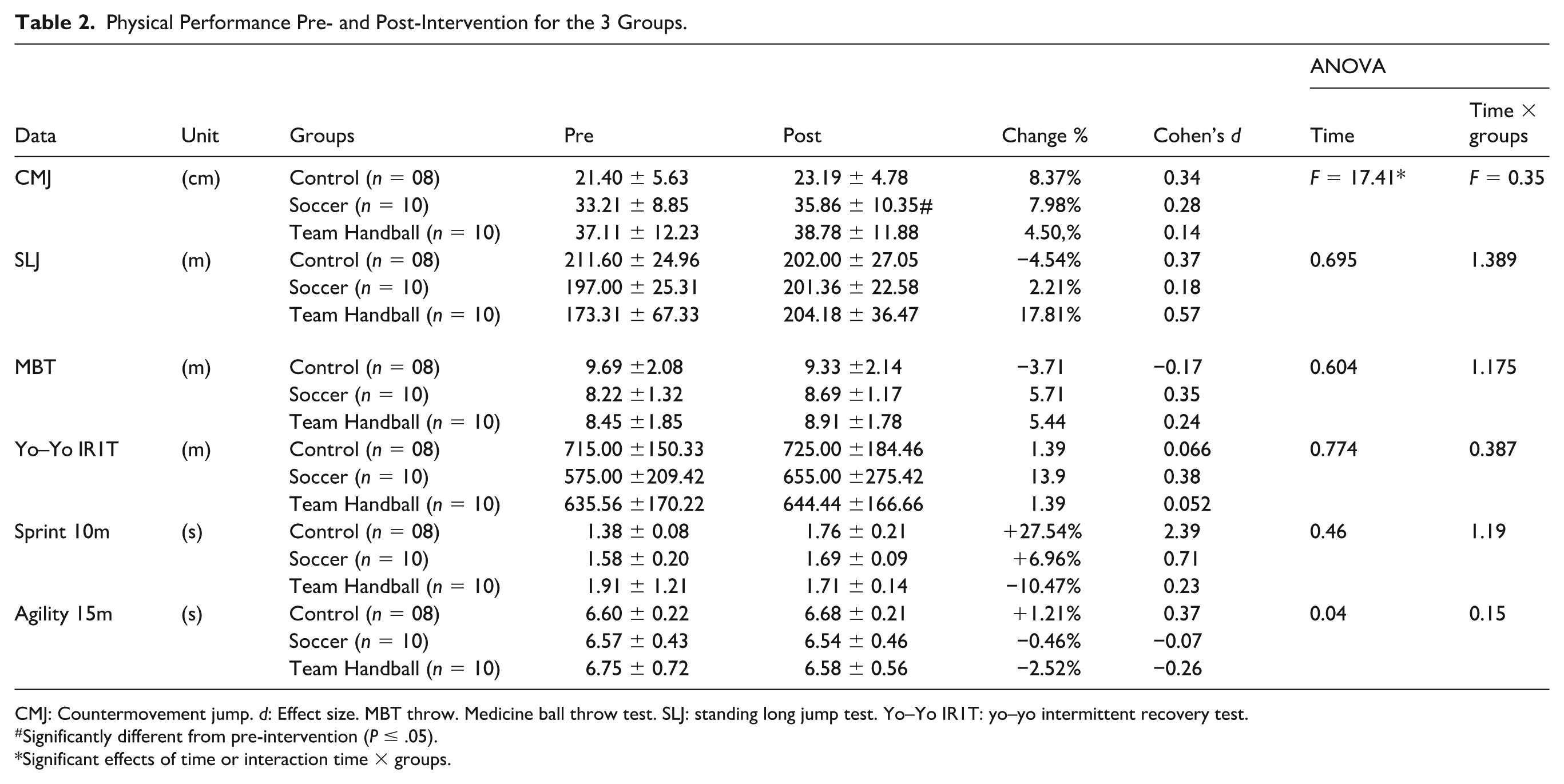
CMJ: Countermovement jump. d: Effect size. MBT throw. Medicine ball throw test. SLJ: standing long jump test. Yo–Yo IR1T: yo–yo intermittent recovery test.
Significantly different from pre-intervention (P ≤ .05).
Significant effects of time or interaction time × groups.
Effects on Selective Attention
The effects of the two training regimes on selective attention are presented in Table 3. For concentration performance, the ANOVA revealed a moderate and significant increase in RTH (+20.6%, d = 0.6) and RS (+22.4%, 0.7) groups compared with the control group (−1.4%, d = 0.14), with a non-significant change in the total number of concentrations’ errors in both groups (Ftime × groups =0.02).
Attention Performance pre- and Post-Each Intervention for the Two Groups.
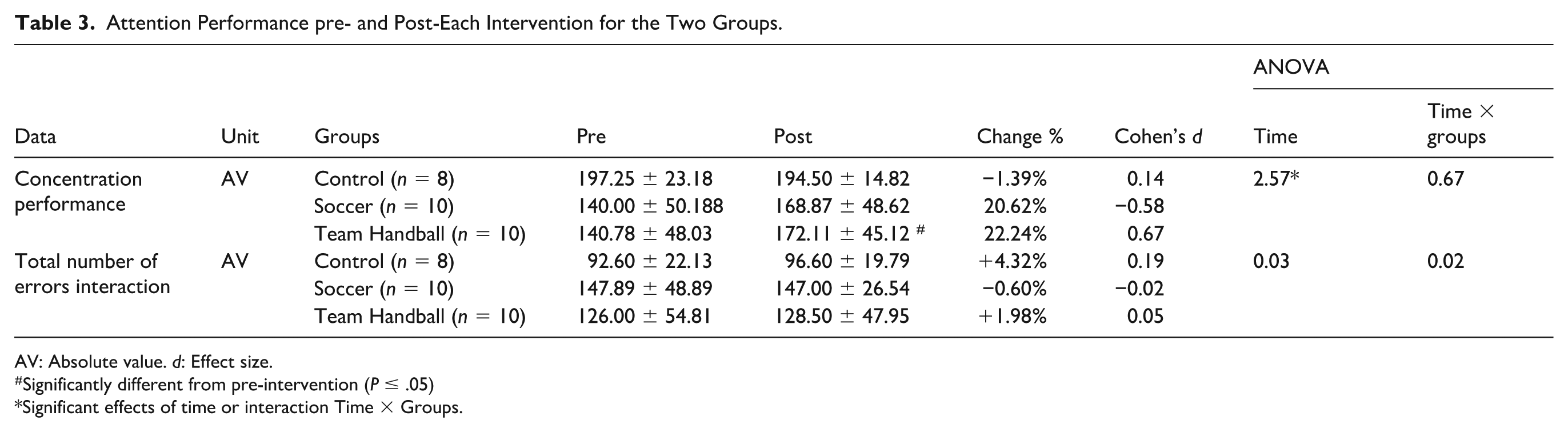
AV: Absolute value. d: Effect size.
Significantly different from pre-intervention (P ≤ .05)
Significant effects of time or interaction Time × Groups.
Discussion
The aim of this study was to compare the effects of RS and RTH on physical fitness and selective attention in untrained adolescents over a 3-month period. Both sports are dynamic, requiring a combination of endurance, high-intensity interval running, strength, speed, balance, agility, and quick decision-making. Given the increasing prevalence of sedentary lifestyles among adolescents, we sought to determine which sport may offer greater benefits in improving physical fitness parameters and cognitive functions like selective attention, which plays a crucial role on learning and daily activities. In terms of the main findings, this study revealed that RS training had a significant positive impact on vertical jump performance, with notable improvements compared to the control group. While both the RTH and RS groups demonstrated moderate enhancements in sprinting speed and aerobic performance, these improvements did not reach statistical significance. Interestingly, no significant effects were observed in the reduction of concentration errors across any of the groups. However, when it came to overall concentration performance, both RS and RTH led to moderate improvements compared to the control group, indicating their potential cognitive benefits for adolescents.
Given that physical fitness is a key indicator of health, it is essential to include fitness testing in health monitoring systems and provide effective training strategies to enhance physical performance in adolescents (Hammami et al., 2017b). Our findings align with recent studies that have demonstrated that regular soccer and handball training can lead to substantial improvements in aerobic performance, balance, and jumping ability in previously untrained individuals (Lind et al., 2019; Pereira et al., 2023; Póvoas et al., 2018). For team handball training, no studies have specifically focused on the effects of RTH on adolescents’ health. Existing research, which has primarily targeted adults and older adults, has shown significant improvements in various aspects of physical fitness, including jumping ability, and intermittent endurance across different populations, such as young adults, women, and middle-aged to elderly individuals (Lind et al., 2019; Póvoas et al., 2018). In addition, previous studies have reported significant gains in jump performance among overweight boys and healthy untrained men following periods of RS training (Bartlett et al., 2011; Vasconcellos et al., 2021). Nevertheless, Hammami et al. (2018) discovered that there were only minor effects on jump performance in untrained adolescents after an 8-week soccer training program. One potential reason for this inconsistency might lie in the varying durations of the training periods observed in different studies, as well as the differences in characteristics among the participants. In addition, the utilization of different protocols to evaluate vertical jump ability could have played a significant role in the aforementioned inconsistency. Recently, it has been shown that explosive leg power was improved by 4.3% (large ES) after 8 months of recreational, small-sided soccer training (Trajković et al., 2020).
It has been reported that RTH training involves high-intensity intermittent actions, such as sprinting, jumping, and rapid changes of direction, which have the potential to enhance cardiorespiratory fitness, muscular strength, agility, and coordination. The continuous engagement of both upper and lower body muscles also can contribute to improved overall body composition and muscular endurance. In addition, team handball stop-and-go movements may help to improve anaerobic capacity, which is essential for repeated high-intensity efforts (Hornstrup et al., 2019). In our study, both RTH and RS showed a small to moderate improvement in most of the physical fitness variables tested. The lack of significant between-group differences in some physical tests may be linked to both the sample size and the short period of training. It has been reported that the positive effects of RS and RTH can be explained by the high exercise intensity achieved during training. In addition, the relatively low training sessions’ ratings of perceived exertion compared to the positive outcomes further support the high level of interest and motivation experienced by participants throughout the intervention. Consequently, RS and RTH have the potential to address the issue of low motivation, which is a significant component of physical inactivity, especially among adolescents.
To October 2024, there have been relatively few studies that have investigated the effects of exercise on cognitive performance, particularly attention. For instance, a study by Hillman et al. (2009) showed that children who participated in an after-school physical activity program demonstrated significant improvements in attention and cognitive control compared to a control group. Moreover, a meta-analysis conducted by Verburgh et al. (2014) revealed that exercise interventions had a significant positive effect on attention, with improvements observed in tasks assessing selective attention and inhibitory control in children and adolescents. Our results showed that RS and RTH exhibited a large increase in CP compared with the control group, without significant differences between them. The significantly larger positive effects on concentration performance seen in both training regimes compared to regular PE sessions can be attributed to the nature of the training. Soccer and team handball games involve exercises that focus on coordination, decision-making tactics, and various skills, all of which have the potential to enhance concentration and attention (Clemente et al., 2021). The dynamic and strategic aspects of soccer and team handball require players to stay focused and make quick decisions, contributing to improved cognitive abilities (Clemente et al., 2021).
Furthermore, the social and interactive nature of soccer games can foster a sense of engagement and motivation among participants, which may further enhance their attention during the activities (Hammami et al., 2018). The combination of physical exercise, mental engagement, and social interaction creates a stimulating environment that boosts cognitive functions, leading to the observed positive effects on concentration performance. It is worth noting that the findings of this study are in line with previous research that has highlighted the cognitive benefits of sports and physical activities. For example, Chaddock-Heyman et al. (2013) reported that a 9-month physical activity intervention in preadolescent children led to improved attentional performance and changes in brain activation patterns compared to the control group. The positive impacts of sports on concentration and attention have been well-documented, showing the potential for these activities to not only improve physical fitness but also enhance various cognitive abilities, ultimately promoting overall well-being and academic performance in adolescents (Hillman et al., 2009; Verburgh et al., 2014). As such, integrating RS and RTH and similar sports-based activities into educational settings could be a valuable approach to support students’ cognitive development and academic success.
Future research should employ longer training durations and larger sample sizes to provide more robust and generalizable findings. To gain deeper insights, future research should compare the impact of RS and RTH with other, more conventional training programs. In the present study, attention was evaluated using only one test. While the d2 test is considered a valid and reliable assessment tool, it is crucial to supplement it with additional cognitive tests.
Conclusion
Taken together, our study showed that the implementation of RS and TH into regular PE classes seems to provide an appropriate stimulus for improving some measures of both physical fitness and attention compared with normal PE classes, making them an effective training strategy for improving health-related fitness measures in untrained adolescents. Gaining insights into the cognitive advantages associated with physical training, such as improved fitness and attention, as highlighted in the present study, can assist in developing focused interventions aimed at enhancing academic performance.
Footnotes

Funding
The authors received no financial support for the research, authorship, and/or publication of this article.
Declaration of Conflicting Interests
The authors declared no potential conflicts of interest with respect to the research, authorship, and/or publication of this article.