



Abstract
Strenuous sports are associated with an enlarged prostate. However, the genetic causality of this association remains unclear. In this study, Mendelian randomization (MR) was used to explore the potential causal relationship between strenuous sports and prostatic hypertrophy. The study utilizes single nucleotide polymorphisms (SNPs) associated with strenuous sports obtained from published genome-wide association studies (GWAS), alongside summarized genetic data related to benign prostatic hyperplasia (BPH) from published GWAS. The primary analytical method used is the Inverse Variance-Weighted (IVW) approach for two-sample MR analysis. Heterogeneity of the results is assessed using Cochran’s Q-statistic, while horizontal pleiotropy is evaluated using MR-Egger. Sensitivity analyses include “leave-one-out” tests. The findings indicate a protective causal effect of strenuous sports on BPH (OR = 0.927, 95% CI: [0.870, 0.988]; p = .020). Results from the Weighted Median (WM) method (OR = 0.904, 95% CI: [0.837, 0.978]; p = .011) support this discovery. Using Mendelian randomization, the study provides reliable causal evidence linking high-intensity exercise to a reduced risk of BPH, overcoming biases seen in traditional observational studies. The study demonstrates a causal protective effect of strenuous sports on BPH, suggesting exercise as a preventive strategy for prostate health.
Introduction
Benign prostatic hyperplasia (BPH) is a common disease among middle-aged and elderly men, affecting the quality of life of over 500 million men worldwide. As age increases, the incidence of BPH significantly rises, with studies showing that over 50% of men exhibit clinical symptoms of BPH by the age of 60, and this proportion increases to nearly 90% by the age of 80 (Jia et al., 2024; Sarma & Wei, 2012; Wang et al., 2020). The pathophysiology of BPH primarily involves the proliferation of prostatic epithelial and stromal cells, which may compress the urethra, thereby triggering a range of lower urinary tract symptoms (LUTS) such as increased urinary frequency, urgency, nocturia, and weakened urine flow (Langan, 2019; Lerner et al., 2021; Sandhu et al., 2023). These symptoms not only reduce the quality of life but may lead to serious complications such as urinary tract infections and kidney damage.
Although the exact causes of BPH are not fully understood, increasing evidence suggests that, in addition to age and genetic factors, various lifestyle factors are closely associated with the development of BPH (Nagakura et al., 2022). Physical activity, as a modifiable lifestyle factor, has been proven to have significant impacts on various health conditions. Epidemiological studies suggest that moderate physical activity can reduce the risk of BPH through multiple mechanisms, such as reducing inflammation, regulating hormone levels, and improving blood circulation (Lacey et al., 2001; Park et al., 2022). However, studies on how high-intensity exercise affects prostate health are relatively scarce, and the results are inconsistent. Some studies suggest that high-intensity exercise may increase prostate volume, while other studies have found no significant association (Loprinzi & Kohli, 2013, 2014).
Mendelian randomization (MR) is a method that uses genetic variants as instrumental variables (IVs) to estimate the causal effects of exposures on outcomes. This method takes advantage of the fact that genetic variants are randomly assigned before birth, effectively controlling for confounding factors and offering a new perspective on the etiology of disease (Birney, 2022). This study utilizes MR to explore whether high-intensity exercise has a causal impact on the risk of BPH, using genetic variants associated with high-intensity exercise as IVs.
Materials and Methods
Study Design
This study employed a two-sample MR approach, utilizing single nucleotide polymorphisms (SNPs) obtained from Genome-wide association studies (GWAS) summary data. We selected strenuous sports as the exposure variable and benign prostatic hyperplasia (BPH) as the study outcome. The fundamental assumptions of MR include (a) a significant association exists between genetic variants and the exposure factor; (b) the IVs are not associated with any confounders; and (c) the genetic variants influence the outcome solely through the exposure factor (Bowden & Holmes, 2019) (Figure 1).

An Overview of the Study Design
Data Sources
Summary single nucleotide polymorphism (SNP)-phenotype association data were obtained from Genome-Wide Association Studies (GWAS) of various phenotypes. The data set for strenuous sports was sourced from published data in the UK Biobank, comprising data on 460,376 individuals and 9,851,867 SNPs. The GWAS data set for BPH was obtained from the UK Biobank, including data on 337,159 individuals and 10,894,596 SNPs. The data in the article have the following exclusion criteria: (a) exclude individuals with previous or current malignant diseases; (b) exclude patients with severe comorbidities; and (c) exclude other diseases affecting urinary tract symptoms. All data are available at https://gwas.mrcieu.ac.uk/. Since this article does not include any identifiable patient information, ethical approval was not required.
Selection of Genetic IVs
To identify IVs that satisfy the three core assumptions of MR, a rigorous selection process was undertaken (Sanderson et al., 2022). Initially, independent single nucleotide polymorphisms (SNPs) closely associated with strenuous sports and having a significance level below 5×10⁻⁸ were selected. Subsequently, we employed PLINK software’s clumping method to exclude SNPs in linkage disequilibrium (LD) (r2 < 0.001, kb = 10,000). In cases where target SNPs were not identified in the GWAS results, we further sought alternative SNPs with high linkage disequilibrium (R2 > 0.8). Finally, SNPs with ambiguous allele frequencies and moderate allele frequencies were excluded through the harmonization of exposure and outcome data sets.
MR and Statistical Analysis
In this study, various complementary methods were utilized to validate the reliability of the experimental results. These methods included Inverse Variance-Weighted (IVW), MR-Egger regression, Weighted Median, Simple Mode, and Weighted Mode. The IVW method was extensively used as the primary analytical tool (Zuber et al., 2020). We employed the Weighted Median and MR-Egger methods as supplementary analyses to explore biases potentially caused by invalid IVs and pleiotropic effects (Burgess et al., 2019). To better interpret the analytical results, beta values from the experiments were converted to odds ratios (OR), and 95% confidence intervals (CI) were calculated (Kerr et al., 2023).
Sensitivity Analysis
Multiple sensitivity analyses were conducted to verify the robustness and consistency of the study results. First, MR-Egger regression was used to assess horizontal pleiotropy, with the intercept term of MR-Egger regression indicating the average pleiotropic effect (Bowden et al., 2016). Next, Cochran’s Q-statistic was utilized to evaluate the heterogeneity of the study outcomes (Langan, 2022). If heterogeneity was present, the analysis would proceed with an IVW method incorporating random effects. Finally, a Leave-one-out Analysis was applied to check the robustness and consistency of the results (Guan et al., 2022). All analyses were carried out using the “TwoSampleMR” package in R software.
Results
Causal Effect of High-Intensity Exercise on Benign Prostatic Hyperplasia
The causal effect of high-intensity exercise on BPH was initially assessed (Figure 2). The evaluation using the IVW method indicated a positive causal effect of high-intensity exercise on BPH (OR = 0.927, 95% CI: [0.870, 0.988]; p = .020). The results from the Weighted Median (WM) method (OR = 0.904, 95% CI: [0.837, 0.978]; p = .011) supported this finding. In addition, the outcomes from other supplementary analysis methods were consistent with the main analysis, further strengthening the credibility of our findings regarding the causal relationship (Figure 3).

MR Results for Association of Strenuous Sports and BPH
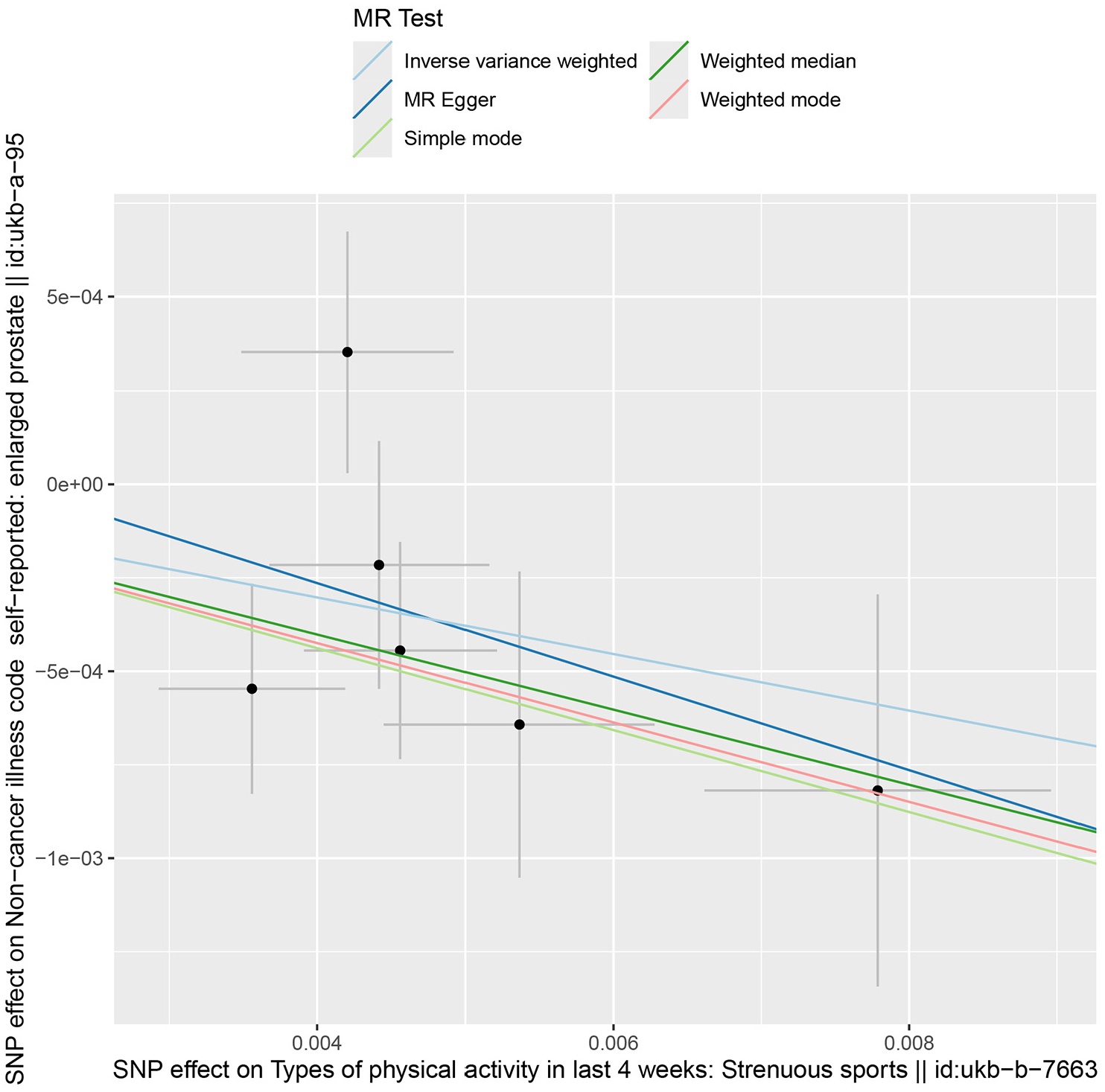
Scatter Plot of the Association Between Strenuous Sports and BPH
Sensitivity Analysis
The results of the sensitivity analysis showed that the effect sizes of the included IVs were very close to the overall effect size (see Supplementary Figure 1). Further tests for heterogeneity and pleiotropy, both with p-values greater than .05, did not significantly impact our results, thus confirming that our analysis was not affected by heterogeneity or pleiotropy. This further substantiates the reliability of our analytical study (Supplementary Table 1). Leave-one-out analysis confirmed the stability of our MR estimates, showing that the results remained stable even when any single SNP was removed (Supplementary Figure 2). The intercept term of MR-Egger regression is increasingly used to detect the presence of pleiotropy among IVs. If the linear regression intercept Egger-intercept of the MR-Egger model is close to 0 (p > .05), it suggests that there is no pleiotropy affecting the IVs. In contrast, a significant intercept indicates genetic pleiotropy, thereby invalidating the exclusion restriction hypothesis. Subsequently, we evaluated heterogeneity using Cochran’s Q-statistic. This statistically quantifies the degree of variance between the variables of the instrument. In this case, a p-value of less than .05 indicates significant heterogeneity, implying significant variation that may affect the validity of the MR analysis results. All analyses were conducted using the “TwoSampleMR” and “MRPRESSO” packages in R (version 4.1.3), which are specifically designed for performing sophisticated MR studies and provide tools for addressing pleiotropy and other potential biases in genetic association data.
Discussion
This study applied MR analysis to explore the potential causal relationship between strenuous sports and the risk of BPH. Our results indicate that genetic variants associated with strenuous sports are significantly correlated with a reduced risk of BPH (OR = 0.927, p = .02), suggesting that strenuous sports may be a protective factor against BPH.
The findings of this study suggest that strenuous sports may be a protective factor against BPH, consistent with some previous epidemiological research results. For example, a meta-analysis showed that men who regularly participate in physical activity have a significantly reduced risk of BPH, especially those who engage in intense physical activity for extended periods (Parsons & Kashefi, 2008). Similarly, another study supported the notion that physical activity is associated with a reduced risk of prostate enlargement, finding that high-intensity exercise is related to a reduction in prostate volume (Raheem & Parsons, 2014). In addition, some studies have noted that different types of physical activity might have varying impacts on prostate health. For instance, a population-based analysis found that moderate exercise might be more beneficial for prostate health compared with vigorous exercise (Parsons, 2011). This could be due to the complex relationship between hormone level changes induced by high-intensity exercise and prostate cell proliferation, which is not always directly inversely correlated.
Strenuous sports may exert protective effects on prostate health through several biological mechanisms. First, high-intensity exercise has been shown to influence hormone levels in the body, particularly those closely related to prostate health, such as testosterone and estrogen. Exercise can lower levels of free testosterone in circulation while increasing levels of sex hormone-binding globulin (SHBG), which reduces the amount of bioavailable testosterone, potentially slowing the proliferation of prostate cells (Bremmer et al., 2018; Cadegiani et al., 2019; Mendes et al., 2018). Furthermore, vigorous activity may also modulate estrogen metabolism, reducing prostate exposure to estrogen, thus lowering the risk of BPH (Miao et al., 2019). Second, inflammation plays a key role in the development of BPH. High-intensity exercise can initiate anti-inflammatory pathways in the body, such as increasing the production of anti-inflammatory cytokines and reducing pro-inflammatory cytokines (such as tumor necrosis factor alpha and interleukin-6) (Monico-Neto et al., 2015). This systemic anti-inflammatory response may help reduce the state of chronic inflammation in the prostate, thereby slowing the progression of BPH. Third, high-intensity exercise by improving blood circulation and increasing oxygen supply to tissues, may reduce hypoxic conditions and oxidative stress in the prostate area (Bunevicius et al., 2019; Gavanda et al., 2020). Oxidative stress is considered a significant factor in the development of BPH because it can promote DNA damage, activate the proliferation of prostate cells, and promote inflammatory responses. Therefore, the improved local and systemic oxidative stress conditions through vigorous activity may protect against excessive proliferation of the prostate. Finally, physical activity may function through its impact on the balance of the autonomic nervous system. High-intensity exercise can enhance parasympathetic nerve activity and reduce the overactivation of the sympathetic nervous system (Alemasi et al., 2019; Jeong et al., 2023). Since sympathetic nerve activity is associated with the tension and growth of prostate smooth muscle, this neural regulation may help alleviate symptoms of BPH and prevent its further progression.
Advantages of MR: (a) Reduce confounding bias. In MR, genetic variants are “randomly” assigned and are not related to environmental and lifestyle factors. Therefore, using genetic variants as IVs can effectively reduce the impact of confounding bias. (b) Avoid reverse causality. MR avoids the interference of reverse causality by using genetic variants as IVs. Genes are fixed at birth and are not affected by acquired factors, so they cannot be the result of disease or outcome influence. Although this study provides new insights into the relationship between strenuous sports and the risk of BPH, there are some limitations. First, MR analysis relies on the validity of the chosen IVs; if the IVs are related to potential confounders, this may introduce bias. Although we endeavored to select genetic variants directly related to high-intensity exercise as IVs, we cannot completely exclude all potential genetic confounding factors. Second, due to data source limitations, this study mainly targets populations of European descent, and its results may not be applicable to other ethnic or geographic populations.
Conclusion
These findings offer significant insights into public health. First, underscore the potential importance of regularly engaging in strenuous sports in preventing the development of BPH. In addition, these results provide a scientific basis for designing preventive strategies against BPH, suggesting that increasing the intensity of physical activities might help reduce the incidence of BPH and associated LUTS. Overall, this study enhances our understanding of the role of high-intensity exercise in maintaining prostate health and may facilitate the development of more effective preventive measures to improve the quality of life for middle-aged and elderly men worldwide.
Supplemental Material
sj-docx-1-jmh-10.1177_15579883241311209 – Supplemental material for Beyond the Comfort Zone: Strenuous Sports as a Preventive Tactic Against Benign Prostatic Hyperplasia
Supplemental material, sj-docx-1-jmh-10.1177_15579883241311209 for Beyond the Comfort Zone: Strenuous Sports as a Preventive Tactic Against Benign Prostatic Hyperplasia by Wei Zhang, Gang Li, Chengya Hao and Aijun Cheng in American Journal of Men's Health
Footnotes
Acknowledgements
We thank all the researchers who contributed to this MR study. We also thank all the institutions and researchers who provided data for this MR study.
Author Contributions
WZ: present idea, perform MR analysis, and manuscript writing. AC: evaluate the quality of MR and manuscript writing. GL: search of the database and quality assessment. CH: figure and table drawing. WZ and AC: study supervision and final approvement. All authors contributed to the article and approved the submitted version.
Declaration of Conflicting Interests
The author(s) declared no potential conflicts of interest with respect to the research, authorship, and/or publication of this article.
Funding
The author(s) received no financial support for the research, authorship, and/or publication of this article.
Ethical Statement
Ethical approval was not provided for this study on human participants because we used the publicly available GWAS catalog to conduct a two-sample MR study. No additional ethical approval was required due to the re-analysis of previously summary-level data. The patients/participants provided their written informed consent to participate in this study.

Date Availability Statement
The original contributions presented in the study are included in the article/Supplementary Material. Further inquiries can be directed to the corresponding authors.
Supplemental Material
Supplemental material for this article is available online.
References
Supplementary Material
Please find the following supplemental material available below.
For Open Access articles published under a Creative Commons License, all supplemental material carries the same license as the article it is associated with.
For non-Open Access articles published, all supplemental material carries a non-exclusive license, and permission requests for re-use of supplemental material or any part of supplemental material shall be sent directly to the copyright owner as specified in the copyright notice associated with the article.
