



Abstract
Despite the global effort to end the human immunodeficiency virus (HIV) and acquired immunodeficiency syndrome (AIDS) epidemic as a global threat by 2030, the rate of new HIV infections worldwide remains unacceptably high among men who have sex with men, hence the need to use pre-exposure prophylaxis (PrEP) to reduce the risk of HIV infection. This population has an increased risk of getting HIV; thus, it is imperative to assess the uptake and acceptability of PrEP. This study investigated the willingness, availability, accessibility, and knowledge and identified barriers and facilitators to using PrEP among this population. A scoping literature review search was conducted on research papers published in English and focused on men who have sex with men and their use of PrEP. These were independently screened and coded. Of about 1,202 literature sources, 55 were included in the study. Findings reported that the uptake and acceptability of PrEP were influenced by knowledge and perception of being high-risk. Generally, PrEP uptake and understanding were high in North America, Latin America, and Europe and low in Asia and Africa. Low uptake and acceptability have been largely attributed to fear of side effects, societal stigma, cost, and perception of not being at risk. Noted facilitators to PrEP use include education, availability of free pills, support groups, and friendly health care facilities. Health intervention programs to increase the use of PrEP must be backed by appropriate legal and regulatory frameworks.
Background
Since there is no viable treatment for HIV and AIDS, it has been a global threat for the past 40 years (Centers for Disease Control and Prevention, 2022). However, HIV can be effectively managed with appropriate and high-quality medical care. HIV-positive individuals can transmit HIV to another person through sharing needles and syringes or other drug injection supplies and anal or vaginal intercourse (Centers for Disease Control and Prevention, 2022). According to the World Health Organization (2022), as of 2021, HIV has killed around 36.3 million people, and approximately 37.7 million people globally are infected with HIV and AIDS. A combined preventive approach has been used over the years to manage HIV and AIDS, and these include sexual and reproductive health education, voluntary medical male circumcision (VMMC), condom programs, and utilization of pre-exposure prophylaxis (PrEP) (UNAIDS, 2016a, 2016b). Although there has been significant success in the prevention of new HIV infections, UNAIDS (2016a) notes that HIV management among men who have sex with men (MSM) remains a problem (UNAIDS, 2016a, 2016b). According to Pérez-Figueroa et al. (2015), most self-interventions for HIV-positive people have mostly targeted heterosexuals (Pérez-Figueroa et al., 2015). As a result, there is a substantial shortage of programmatic intervention research to address the management of HIV and AIDS among MSM.
Despite the global effort to end the HIV and AIDS epidemic as a global threat by 2030, significant transmission remains among MSM (UNAIDS, 2016a, 2016b). Reducing the burden of HIV disease among MSM is an important part of ending the HIV epidemic. It is why the World Health Organization quickly recommended PrEP use among MSM due to their significant risk of HIV infection. PrEP was targeted at MSM due to its effectiveness, especially in adherent MSM (Peng et al., 2018). Oral PrEP includes prophylactic use of daily or event-based antiretroviral therapy (ART) to reduce the risk of acquiring HIV upon exposure, with a proven effectiveness of 99% (Centers for Disease Control and Prevention, 2022). Given the proven record of its efficacy, PrEP is considered an integral HIV intervention tool, hence complimenting the combined HIV prevention program, which includes 100% condom use, VMMC, and HIV testing and counseling services (Nugroho et al., 2017).
According to UNAIDS (2019), 23% of global new infections of HIV in 2019 were among gay men and MSM. Therefore, effective HIV and AIDS management strategies should target this population due to their highest risk of acquiring HIV, which was noted to be 26 times higher as compared to other adult male populations (UNAIDS, 2019). Based on UNAIDS’s (2016a, 2016b) Key Performance Indicators, many countries fail to meet the global targets in HIV and AIDS management among MSM. Despite using other strategies to manage HIV and AIDS, PrEP holds the most promise in meeting global targets. PrEP is an integral golden standard to achieve the global target of ending the HIV and AIDS epidemic by 2030; therefore, it is empirical to know the uptake and acceptability of PrEP.
It should also be noted that punitive legislation may make it more difficult to obtain health care services, including accessing PrEP (Khozah & Nunu, 2023). For instance, criminalizing same-sex relationships in some Sub-Saharan African nations can make it difficult for MSM to obtain PrEP (Khozah & Nunu, 2023; Munyimani & Nunu, 2022). These restrictions have been noted to increase prejudice and stigma, which may discourage MSM from obtaining medical care, including accessing PrEP when needed (Khozah & Nunu, 2023; Munyimani & Nunu, 2022).
While a systematic literature review has been done on PrEP and MSM, it has not addressed how willingness, accessibility, knowledge, perceptions, barriers, and facilitators influence PrEP uptake and acceptability and how these elements are interrelated (Sundararajan et al., 2022). Due to this, a scoping review on PrEP was conducted to establish what is known about PrEP, focusing on the context of PrEP uptake and acceptability among MSM and how the elements mentioned above interrelate and influence PrEP uptake and acceptability. This study aimed to access and review available global literature on the subject matter. The following specific objectives guided this enquiry:
Describing the willingness to use PrEP among MSM as presented in the literature
Describing the availability and accessibility of PrEP among MSM
Determining the knowledge and perceptions of MSM on PrEP
Identification of the barriers that influence PrEP uptake among MSM
Identification of the potential facilitators to influence PrEP uptake and acceptability
Methodology
Literature Sources
Keywords were applied in search engines such as Google Scholar, Scopus, AJOL, PubMed, and Cochrane Library. Electronic databases were searched using the date ranges from January 1, 2012, to January 2023 because PrEP was approved in 2012 by the Food and Drug Administration (FDA) (Centers for Disease Control and Prevention, 2019). The most recent search was executed in February 2023. The following search string “PrEP uptake and acceptability among men who have sex with men” NEAR “PrEP usage and knowledge among men who have sex with men” OR “PrEP accessibility and availability among men who have sex with men” AND “barriers and facilitators on PrEP use among men who have sex with men” were used to search for the literature sources in the listed databases. Literature from the reference lists of the retrieved articles was also used and included in the study. The snow bowling technique was used to search relevant articles and websites. The review searched and focused on studies investigating the uptake and acceptability of PrEP among MSM. Those studies included cross-sectional studies, cohort studies, randomized controlled trials, and other quantification studies or qualification studies. The search, however, was only limited to articles published in English. The review included studies focusing on bisexual men, gay men, transgender women, and other MSM. Again, studies examining sexual and gender minority groups were included if only MSM were part of the study population and the associated information with MSM was recorded.
Inclusion Criteria and Exclusion Criteria
Using the population, intervention, comparison and outcome (PICOs) concept, a scoping literature review was conducted by looking for relevant studies using keywords. This scoping review had only studies that followed the PICOs framework, where the problem is HIV and AIDS, and interest is PrEP uptake and acceptability in the context of MSM. Studies were included if they reported PrEP uptake and acceptability among MSM for reasons related to willingness to use PrEP, perceptions on PrEP use, awareness, knowledge, attitudes barriers, and facilitators on PrEP uptake. The researchers excluded those studies with full articles unavailable. The researchers excluded studies that did not include the sections in the preferred reporting items in the PRISMA-ScR checklist. Literature sources from other languages besides English were excluded. Studies were also excluded if they focused only on PrEP use among different population groups that are not MSM, such as sex workers and women. Studies that reported combined use of PrEP and other HIV management, such as VMMC and condoms, were excluded if the data on the uptake and acceptability could not be separated. The study also excluded unpublished research papers, conference abstracts, and presentations.
Study Selection
Two authors independently screened the titles and abstracts to exclude unrelated studies and assessed full-text papers for eligibility. The two authors discussed and ironed out discrepancies in the included literature and the extracted and interpreted data.
Data Extraction and Synthesis
DistillerSR, a web-based software, was used for screening, management, and data extraction in the review process (Cowie et al., 2022). A descriptive literature analysis was done to extract data that answers review objectives. Quantitative data synthesis involved extracting information from similar studies and comparing them according to the context in which they were performed. Data from qualitative studies were classified and coded, and a coding framework was developed for this study. The resulting codes and their units of meaning were analyzed by topic to obtain salient themes. Analysis was done using tables and themes that emerged from different literature. All relevant findings were then summarized in tabular form by issues that arose.
Quality Assessment
This review assessed the quality using a purposive rating tool adapted from Preferred Reporting Items for Systematic Reviews and Meta-Analyses Extension for Scoping Reviews (PRISMA-ScR) (Tricco et al., 2018). The primary purpose of this rating tool was to evaluate the scientific quality and rigor of the scoping review. See Table 1 for the completed PRISMA-ScR checklist.
PRISMA-ScR Checklist

Note. PRISMA-ScR = Preferred Reporting Items for Systematic Reviews and Meta-Analyses Extension for Scoping Reviews.
Findings
A total of 1,202 literature sources from electronic databases were obtained. After excluding 1,060 duplicates, 142 papers were left, and 11 articles were further excluded. One hundred thirty-one articles were retained for full-text reading, and 12 sources were removed after the abstract screening. One hundred nineteen articles were reviewed, and a total of 64 articles were excluded for the following reasons; not MSM (22), not written in English (2), duplicates (13), did not address PrEP issues (17) and study design not related (10). Fifty-five sources were eligible and included in the review process, as presented in Figure 1. This section will categorize themes that emerged from the literature sources used in the scoping literature review. The most notable themes guided by the objectives were willingness to use PrEP, availability and accessibility of PrEP, perceptions toward PrEP, knowledge of PrEP, facilitators, and barriers to PrEP use.

Document Review Process
Theme 1—The Willingness to Use PrEP
The effectiveness of PrEP varied in different geographic locations; however, its success depended on the willingness to adopt it for those who need it (Auemaneekul et al., 2020; Ding et al., 2016; Han et al., 2019; Wang et al., 2018). The willingness to use PrEP by MSM was influenced by factors such as education and knowledge/awareness; refer to Table 1. The literature has also revealed that knowledge/awareness of PrEP is an important factor influencing willingness to use PrEP in different contexts. Being knowledgeable and aware of PrEP does not always imply a desire to use PrEP; refer to Table 2.
Influences of Willingness

Theme 2—PrEP Availability and Accessibility
Availability was quoted as a state where PrEP can be accessible by MSM at any given time (Diabaté et al., 2021) and to know where to get it (Kota et al., 2021). The availability of PrEP can be affected by many issues, such as limited resources and overstretched health systems, especially in the Sub-Saharan context (Bigna et al., 2016). PrEP is an effective HIV intervention tool to existing interventions (Allende & Acuña, 2017); however, the issue of availability has always come in the way of ensuring its success (Wanga et al., 2021). Availability of PrEP was mentioned in eleven (11) articles in different contexts as; a potential facilitator to the willingness to use PrEP (Ahouada et al., 2020; Frankis et al., 2016) and as the factor that influences PrEP uptake (Ahouada et al., 2020; Chakrapani et al., 2015; Dean et al., 2023; Diabaté et al., 2021; Galea et al., 2011; Kimani et al., 2022; Pelletier et al., 2019); refer to Table 3 Availability of PrEP does not always imply improved uptake and acceptability of PrEP, hence the need to ensure accessibility of the available PrEP to MSM. PrEP accessibility compliments PrEP availability in providing high uptake and acceptability of PrEP among this population. PrEP accessibility was mentioned in thirteen (13) articles in different contexts that affect PrEP use, as presented in Table 3.
Subthemes on Availability and Accessibility of PrEP

Note. PrEP = Pre-exposure Prophylaxis; MSM = men who have sex with men; IEC = Information, Education and Communication.
Theme 3—Knowledge and Perceptions of PrEP Among MSM
Knowledge/awareness of PrEP among MSM was identified in different continents, and different levels of knowledge/awareness were recorded; see Table 4. Different subthemes of knowledge emerged and showed that knowledge/awareness levels impact PrEP uptake, acceptability, adherence, and willingness; see Table 5.
Global Levels of Knowledge and Awareness on Pre-exposure Prophylaxis

Subthemes on Knowledge/Awareness of PrEP

Note. PrEP = Pre-exposure Prophylaxis; MSM = men who have sex with men.
Research studies in the review reported mixed perceptions toward PrEP use among MSM. A total of 17 articles reviewed focused on the perceptions of MSM on PrEP; perceptions toward PrEP were noted to influence the willingness, adherence, uptake, and acceptability. About 40% (7) of the 17 research articles that focused on the perceptions of MSM toward PrEP reported a positive attitude toward PrEP. Positive attitudes toward PrEP among MSM were mainly attributed to self-awareness of being at risk (Harawa et al., 2016; Hoagland et al., 2017; Liu et al., 2017; Wang et al., 2018) and perceived benefits of PrEP (Gredig et al., 2016; Holloway et al., 2017). Perception of being at low risk by MSM was identified in eleven (11) and was linked to reduced acceptability of PrEP (Chakrapani et al., 2015; Kota et al., 2021), low uptake of PrEP (Cox et al., 2021; Han et al., 2019; Harawa et al., 2016; Liu et al., 2017; Patrick et al., 2019; Pingel et al., 2017), nonwillingness to PrEP use (Holloway et al., 2017; Voglino et al., 2021) and nonadherence to PrEP (Blair et al., 2022; Graham et al., 2023; Kota et al., 2021).
Theme 4—Barriers to PrEP Uptake and Acceptability
Thirty-one (31) studies discussed the barriers to PrEP uptake and acceptability among MSM in different geographic locations. Barriers to PrEP uptake and acceptability were categorized into major themes: information; health care system; stigma and discrimination; pills; effectiveness, safety and side effects; risk perception; social support; privacy and disclosure; and preference to other preventive methods; refer to Table 6.
Potential Barriers Influencing PrEP Uptake and Acceptability
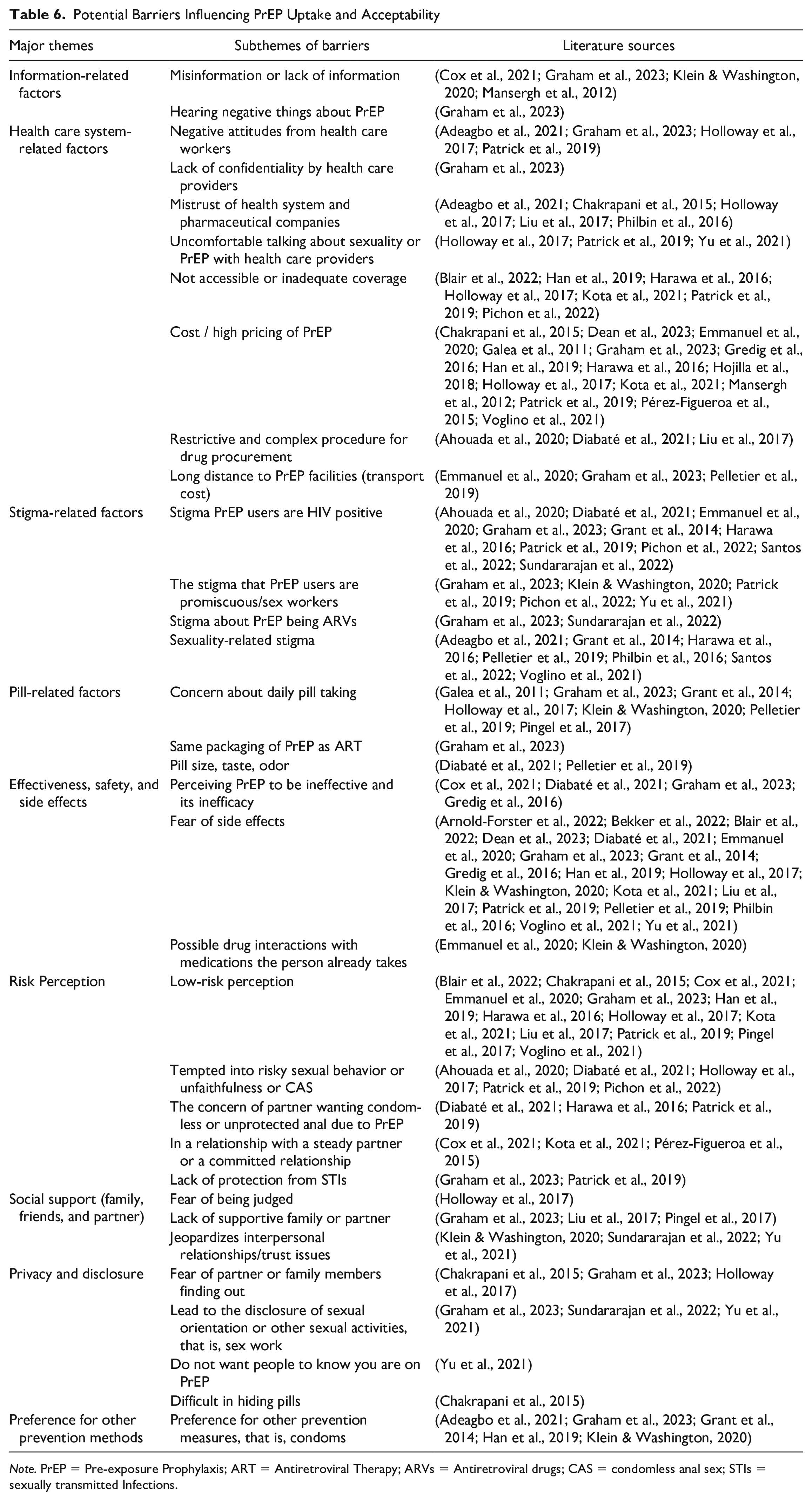
Note. PrEP = Pre-exposure Prophylaxis; ART = Antiretroviral Therapy; ARVs = Antiretroviral drugs; CAS = condomless anal sex; STIs = sexually transmitted Infections.
Theme 5—Facilitators to PrEP Uptake and Acceptability
Sixteen (16) research studies discussed the facilitators of PrEP uptake and acceptability among MSM. These facilitators have been classified into major themes: information; the health care system; stigma; drugs; social support; privacy and disclosure; and desire, motivation, and risk perception; refer to Table 7.
Potential Facilitators Influencing PrEP Uptake and Acceptability

Note. PrEP = Pre-exposure Prophylaxis; MSM = men who have sex with men; IEC = Information, Education and Communication.
Discussion
Despite its high effectiveness, uptake and acceptance of PrEP vary widely across geography, culture, ethnic group, and even MSM subpopulations. For example, two studies in the USA reported different levels of acceptability; one reported that MSM in New York was hesitant to use PrEP despite being knowledgeable (Pérez-Figueroa et al., 2015), and the other identified high uptake and willingness to use PrEP among MSM in California (Holloway et al., 2017). There are numerous hurdles to PrEP programming for MSM. Reasons for accepting or nonwillingness to use PrEP may be related to individual perceptions of risk, interactions with health care professionals, societal stigma, fear of side effects, cost, and lack of information. All these factors have been noted to differ from one nation to another due to economic status, punitive laws toward homosexuals, culture, ethnicity, and many other variables, particularly in Sub-Saharan African (SSA) Countries where countries like Zimbabwe, Malawi, Zambia, Uganda, and Ghana have come out in the open against same-sex marriages. At the same time, South Africa has ensured their policies include the key populations in its health strategies, with most of the SSA countries’ laws silent about key populations and their access to sexual health services (Khozah & Nunu, 2023). Literature has identified that a majority of MSM do not take PrEP due to fear of unforeseen side effects of PrEP, which might be long-term (Gredig et al., 2016). The cost of PrEP was mostly cited in many non-African countries as a barrier to influencing PrEP use; however, the cost of PrEP in Africa was not cited more often as a barrier due to the fact PrEP programs are funded by different organizations such as The US President’s Emergency Plan for AIDS Relief (PEPFAR), The Global Fund, UNAIDS and many others hence MSM access PrEP for free (Bigna et al., 2016; Kerzner et al., 2022).
This review reported an overall low uptake and acceptability of PrEP in different countries, especially in low and middle-income countries such as Thailand (Auemaneekul et al., 2020), Peru (Galea et al., 2011), Ghana (Ogunbajo et al., 2020), Swaziland (Sithole, 2017), Côte d’Ivoire (Pelletier et al., 2019), and China (Wang et al., 2018). Increased PrEP uptake and acceptability ascertain the effectiveness of PrEP as an HIV prevention strategy. To improve the uptake and acceptability of PrEP, it is imperative to ensure the availability and accessibility of PrEP among MSM. These two factors are essential in ensuring that PrEP is available anytime and in MSM-friendly health care facilities. However, the availability of PrEP on its own does not serve any purpose in MSM. In Zimbabwe, Population Service International provides oral PrEP for free to key populations in their clinics (National AIDS Council, 2019), yet the coverage remains below due to poor health systems, which infringe on MSM’s rights to access sexual and reproductive health services. Accessibility to PrEP provides clear guidance for potential government intervention to improve willingness to use PrEP by ensuring easy access to these pills even in remote neighborhoods (Pelletier et al., 2019). It is, therefore, important for different governments to subsidize PrEP programming to make PrEP accessible even to the most remote areas so that no MSM is left behind.
The study identified some facilitators that improve PrEP use among MSM, thus providing policymakers with information they could use to make informed decisions about ensuring the effectiveness of the PrEP programs. In general, MSM preferred free PrEP, and it was associated with higher acceptance of PrEP (Diabaté et al., 2021). However, it can be noted that even if PrEP is free of charge, it does not necessarily imply higher acceptance of PrEP as many other factors, such as societal stigma, fear of side effects and perception of being not at risk, play a significant role in reducing uptake and willingness. Multiple forms of stigma that emerged include the stigma that PrEP users are promiscuous and PrEP users are HIV positive, sexuality-related stigma on being gay or bisexual and stigma on PrEP being ARVs. It is, therefore, essential to provide accurate and detailed knowledge about PrEP to all stakeholders, and MSM is key to reducing the associated stigma from the community and health care professionals. In addition, health care professionals require standard training in professional skills and ethical practices.
A review reported that awareness of PrEP among MSM was associated with STI history (Ogunbajo et al., 2019). This is strong evidence that increased condom-less anal sex could be a negative effect of introducing PrEP (Hanum et al., 2020), undermining the potential benefit of PrEP in HIV prevention. Again, PrEP use was associated with increased sexual risk behavior, such as increased sexual partners (Ahouada et al., 2020). As PrEP is a golden standard in reducing the prevalence of HIV among MSM, it might result in increased STIs among this population due to the promotion of unprotected anal sex (Diabaté et al., 2021). At the same time, managing the increasing prevalence of STIs following the introduction of PrEP will require other innovative interventions, which might eventually result in a financial burden.
Limitation
The limitation of this review is that comparisons on the uptake and acceptability of PrEP among MSM were made on research papers published in different years. On the assessment of global knowledge levels, people become knowledgeable with time, and the figures identified might not truly portray the current levels of knowledge of PrEP among this population. Another limitation of the review is that the analysis is not in-depth; it provides the baseline of issues under study.
Conclusions
PrEP is an additional HIV prevention strategy that has been proven to lower the prevalence of HIV among MSM. This scoping review revealed multiple facets of PrEP uptake and acceptability, such as willingness, accessibility, availability, knowledge, perspectives, barriers, and facilitators of PrEP in the existing literature. Over the years, the number of research on MSM and PrEP has drastically increased. This shows PrEP policies are being implemented in different countries to meet global targets of ending HIV as a global threat by 2030. Despite these efforts, some countries still have punitive laws that criminalize same-sex relations; hence, this has proven to negatively cause low uptake of PrEP among MSM, together with societal stigma and exclusion of MSM in sexual and reproductive health services in these countries. Health intervention programs aimed to introduce or increase the use of PrEP must be backed by appropriate legal and regulatory framework contexts and based on context-specific evidence, such as prospective demand and user preferences. This review adds to the body of knowledge by showing different elements that influence PrEP uptake and acceptability among MSM and certain strategies that can be employed to improve uptake and acceptability among this population.
Footnotes
Author Contributions
P.L.M. conceptualized the research idea and drafted the manuscript, W.N.N. co-ordinated the manuscript writing process, guided the manuscript writing process, and revised the draft manuscript. Both authors read and approved the manuscript.
Authors Information
P.L.M. is a BSc Environmental Science and Health holder at the National University of Science and Technology in Zimbabwe. The author is also a Master’s student in the same institution. This paper was part of the partial research project, fulfillment of the Master’s Degree in Environmental Health. W.N.N. is a PhD in Public Health holder and an Executive Dean in the Faculty of Environmental Science. The author is the supervisor to the student and provided guidance and mentorship in the conceptualization and writing of this manuscript.
Declaration of Conflicting Interests
The author(s) declared no potential conflicts of interest with respect to the research, authorship, and/or publication of this article.
Funding
The author(s) received no financial support for the research, authorship, and/or publication of this article.
Ethics Approval and Consent to Participate
A research protocol covering this scoping review and a mixed method study to probe issues further was lodged with the Institutional Review Board at the National University of Science and Technology in Bulawayo, Zimbabwe. This committee granted ethics clearance (Ethics Clearance Number: NUST/IRB/2023/52).
