



Abstract
Although studies show that masculine discrepancy stress (i.e., the intrapsychic strain associated with failing to meet internalized masculine ideals) is associated with intimate partner violence (IPV) perpetration, little is known about the processes underlying this association. There may be other social psychological constructs at play that explain this relationship further. The present study uses recently collected data from a national survey of men living in the United States (n = 711) to formally test whether the effects of discrepancy stress on three different forms of IPV perpetration are mediated by anger, self-esteem, and perceived powerlessness. We find that discrepancy stress is directly associated with higher levels of anger, lower levels self-esteem, a sense of powerlessness, and a greater odds of perpetrating any physical IPV and severe physical IPV resulting in injuries, but not sexual IPV perpetration in our sample of men. Our mediation analyses confirms that masculine discrepancy stress is indirectly associated with perpetrating all three forms of IPV through the mechanism of anger. Self-esteem and perceived powerlessness are not supported as mediators. These findings add to our understanding of the link between masculinity and violence perpetration and can inform IPV reduction interventions. Gender transformative interventions that reduce discrepancy stress among men by shifting men’s adherence to traditional masculine norms, and that integrate anger management strategies, should be explored in future research.
Introduction
Intimate partner violence (IPV), including physical violence, sexual violence, stalking, and psychological harm, is a major social problem. In the United States (U.S.), nearly one in five men report that they have perpetrated IPV in their lifetime (Singh et al., 2014). IPV is devastating to the health and wellness of women. For example, studies report that IPV increases the risk of post-traumatic stress disorder, depression, anxiety, severe injuries, chronic pain, and gastrointestinal disorders (Bacchus et al., 2018; Coker et al., 2000; Dillon et al., 2013; Lagdon et al., 2014). The average lifetime health care costs associated with IPV are estimated at US$103,767 (Centers for Disease Control and Prevention [CDC], 2021). According to the the National Center for Injury and Prevention Control (2003), nearly 1,300 women are killed annually by an intimate partner, and 2 million suffer IPV-related injuries in the U.S. The rate of mortality for victims of severe lifetime IPV is two times higher than those who have not experienced IPV in their lifetime (Closson et al., 2020; Stockman et al., 2014).
A large body of literature has established a broad range of risk factors for the perpetration of IPV among men, including, for example, youth, low socioeconomic status, childhood victimization, anger, and various other relational (e.g., poor communication, jealousy, high partner dependence) or situational factors (e.g., environmental irritant, aggression cues, alcohol) (Finkel, 2007). In this study, we focus on masculine norms, the culturally grounded expectations for men’s roles, behaviors, and relationships (Courtenay, 2000a, 2000b). From a social constructionist perspective, violence is a display of masculinity that reinforces the broader social structure of gender and power (Courtenay, 2000a, 2000b). The theory is that men are socialized to be strong and dominant over others, and masculine displays of dominance like IPV perpetration function to reinforce a patriarchal power structure. Studies report that men who adhere to traditional masculine norms are more likely to engage in violence against intimate partners (Baugher & Gazmararian, 2015; Speizer, 2009; Truman et al., 1996). The association between masculinity and IPV perpetration has been observed across aggregate masculinity scales (Eisler & Skidmore, 1987; Mahalik et al., 2003; Thompson & Pleck, 1995) and specific indicators like “toughness” and “power” (Brody, 1999; Fowler & Geers, 2017; Mshweshwe, 2020; Próspero, 2008).
The concept of discrepancy stress is one aspect of masculinity that links gender role conformity with IPV perpetration. Pleck (1995) describes discrepancy stress as a form of intrapsychic strain that results when men perceive that they have failed to meet the masculine ideals they have internalized through years of gender socialization. Eisler and Skidmore (1987) explain that discrepancy stress arises when men who subscribe to traditional gender roles are unable to “cope with the imperatives of the male role” (p. 125). Reidy, Berke, et al. (2016) developed a measure of discrepancy stress to directly assess the degree to which men perceive that others see them as less masculine than their internalized standards. Research suggests that men who experience greater masculine discrepancy stress are more likely to perpetrate IPV (Pleck, 1981, 1995; Reidy et al., 2014, 2015; Vandello & Bosson, 2013). Examples from the literature include IPV perpetration by men who fail to conform to masculine gender roles and the perpetration of sexual violence among adolescent boys (Reidy et al., 2015; Vandello & Bosson, 2013).
One theoretical explanation linking discrepancy stress with IPV and other unhealthy behaviors is that men experiencing discrepancy stress engage in hyper-masculine behaviors as a way of compensating for feelings of inadequacy. According to Vandello and Bosson (2013), such acts of “public proof” can take the form of driving a truck or, on the extreme end, physical aggression (p. 4). Several studies have linked gender role strain with hyper-masculine behaviors like risky sexual behavior and alcohol abuse (Copenhaver et al., 2000; Gottert et al., 2018; Reidy et al., 2014; Reidy, Berke, et al., 2016). Reidy, Brookmeyer, et al. (2016) found that men who experience gender role discrepancy stress are more likely to engage in casual, unprotected sex and to be diagnosed with sexually transmitted infections than other men. Levant (1996) and Berke et al. (2016) highlight the toxic combination of discrepancy stress and violent behavior, including IPV. Consistent with this theory, researchers studying discrepancy stress and violence frame the perpetration of physical and sexual violence among men as a tactic or means of “increasing” or restoring masculine status (Pleck, 1981, 1995; Reidy et al., 2014, 2015; Vandello & Bosson, 2013).
As emphasized in the preceding literature, masculine stress may directly relate to IPV as a way of compensating for gender role discrepancies. Discrepancy stress may also contribute to the perpetration of IPV through various indirect mechanisms. For example, failing to meet internalized norms of masculinity could undermine self-esteem and elicit feelings of anger (Yang et al., 2018), which could then increase the risk IPV perpetration (Berke et al., 2016; Norlander & Eckhardt, 2005; Papadakaki et al., 2008; Walker & Bright, 2009; Yang et al., 2018). Discrepancy stress may challenge healthy self-conceptions and contribute to feelings of frustration and anger through processes related to a deep sense of inadequacy and a perceived loss of social status (Shields, 2002). When men are consciously disconnected from masculine identities (Am I man enough?), they are also alienated from the masculine role (i.e., the behavioral expressions of masculinity). Under these conditions, men begin to question their abilities to exercise power and control over their own lives. We note that this sense of powerlessness is only reinforced by the loss of self-esteem and social status. Violence perpetration, including IPV, then becomes a way for men who struggle with their masculine identities to reclaim their manhood by dominating another person (Gage & Lease, 2018; Peralta & Tuttle, 2013; Pornari et al., 2013; Próspero, 2008).
Although previous research is suggestive, we could find only one mediation study that is relevant to our work. In their study of 405 U.S. men recruited through Amazon’s Mechanical Turk (MTurk) website, Berke et al. (2016) found that difficulties with emotional regulation (e.g., feeling out of control when upset) fully mediated the relationship between masculine discrepancy stress and the perpetration of physical IPV and partially mediated the association between discrepancy stress and sexual IPV. Aside from this seminal study, we were unable to find any additional research concerning the pathways linking masculine discrepancy stress and IPV perpetration.
Building on previous work, the present study uses recently collected data from a national survey of men living in the U.S. to formally test whether anger, self-esteem, and perceived powerlessness mediate the effects of discrepancy stress on three different forms of IPV perpetration (any physical IPV, severe physical IPV resulting in injuries, and sexual IPV). In accordance with prior theory and research, our proposed mediation model (Figure 1) suggests that discrepancy stress will increase the risk of IPV perpetration by contributing to feelings of anger and conceptions of the self as worthless and powerless. By adding to our understanding of how masculine discrepancy stress might contribute to the perpetration of IPV, our analyses could have potentially important implications for public health intervention.

A Conceptual Model of the Hypothesized Parallel Multiple Mediation Model of the Relationship Between Masculine Discrepancy Stress and Intimate Partner Violence (IPV) Perpetration of Any Physical IPV, Severe Physical IPV Resulting in Injuries, and Sexual IPV.
Method
In this study, we use cross-sectional data from the 2021 Crime, Health, and Politics Survey (CHAPS). CHAPS measures the social causes and consequences of various health and well-being indicators among a national probability sample of 1,771 community-dwelling adults (844 men) aged 18 and over living the U.S. The omnibus survey, developed by the study authors (TDH, KMS) and a larger team of investigators, includes measures of psychosocial characteristics, religious beliefs and experiences, political views and behaviors, neighborhood conditions, experiences with crime and police, stressful life events, health behavior and health lifestyles, mental health, physical health, sexual and reproductive health, and sociodemographic characteristics.
Respondents were sampled from the National Opinion Research Center’s (NORC) AmeriSpeak© panel, which is representative of households from all 50 states and the District of Columbia (NORC at the University of Chicago, 2022). Between May 10, 2021 and June 1, 2021, participants were sampled and invited to complete an online survey in English. The data collection process yielded a survey completion rate of 30.7% and a weighted cumulative response rate of 4.4%. The multistage probability sample resulted in a margin of error of ±3.23% and an average design effect of 1.92. The self-administered web-based survey lasted approximately 25 minutes. All respondents were offered the cash equivalent of US $8.00 for completing the survey. The survey was reviewed and approved by the institutional review boards at NORC (21-05-279) and the University of Texas at San Antonio (FY20-21-29). Written informed consent was obtained from all participants.
Measures
Intimate Partner Violence
To measure the outcome of IPV, we used items from the Revised Conflict Tactics Scale Short Form (CTS2S Short Form) (Straus et al., 1996). The scale includes questions that measure the experience and perpetration of different forms of IPV. The question that precedes the scale first asks “Have you ever been in a relationship with a romantic or intimate partner?” Those who have are then asked about their experience and perpetration of different forms of violence from a partner. Physical IPV perpetration was operationalized as a dichotomous variable, with a positive response to any of the following being score as having perpetrated physical violence: “Have you ever pushed, shoved, or slapped a partner?” “Have you ever punched or kicked or beat-up a partner?” “Has a partner ever had a sprain, bruise, small cut, or felt pain the next day because of a fight with you?” “Has a partner ever needed professional medical treatment because of a fight with you?” The two latter questions were used to operationalize having perpetrated any severe physical IPV perpetration resulting in injuries (vs. having never perpetrated severe physical violence). Finally, two items were used to operationalize the perpetration of sexual IPV, including rape and coercive sex without a condom: “Have you ever used force (like hitting, holding down, or using a weapon) to make my partner have sex?” “Have you ever insisted on having sex with a partner without a condom?” A positive response to either question was scored as having perpetrated sexual violence (vs. having never perpetrated).
Masculine Discrepancy Stress
We used a modified version of a scale developed by Reidy et al. (2014) to measure masculine discrepancy stress. Six items were included to measure discrepancy stress, or the strain men feel about perceiving themselves to be less masculine than their internalized ideals, including: “I wish I was interested in things that other guys find interesting” “I wish I was more “manly” “Sometimes I worry about my masculinity” “I worry that people judge me because I am not like the typical man” “I worry that other find me less attractive because I am not as “manly” as other guys” and “It is important for me to be seen as a typical “manly guy” (Cronbach’s α = 0.87). Two items in the original masculine discrepancy stress subscale were not asked as part of the survey for conciseness: “Compared to my guy friends, I am not very masculine” and “Most women I know would say that I am not as masculine as my friends.” Response options ranged from 1 ‘‘strongly disagree to 7 ‘‘strongly agree.” For analysis, we calculated the mean score, with higher scores indicating greater masculine discrepancy stress.
Anger
The mean of three items drawn from the How I Feel Instrument was used to measure anger (Petersen & Kellam, 1977). The items asked participants how often in the past 30 days did they: (1) feel angry, (2) lose their temper, and (3) yell at people. Response options range from 1 “never” to 5 “always” (Cronbach’s α = 0.86).
Self-Esteem
Three items were drawn from the Single-Item Self-Esteem Scale (Robins et al., 2001) and the Rosenberg Self-Esteem Scale (Rosenberg, 1965) to measure self-esteem. Respondents were asked to indicate the extent to which they agree with the following statements: “I can do things as well as most people” “I am a person of worth, at least on equal terms with others” and “I have high self-esteem.” Response options ranged from 1 “strongly disagree” to 5 “strongly agree.” The mean of the three items was calculated for the total score, with greater scores indicating greater self-esteem. A reliability analysis suggested adequate internal consistency for three items (Cronbach’s α = 0.70).
Perceived Powerlessness
To measure men’s sense of control in their life, we use three items from the Perceived Stress scale that focus on control (Cohen & Williamson, 1988). These items include the following: “In the past 30 days, how often have you felt difficulties were piling up so high that you could not overcome them?” “In the past 30 days, how often have you felt confident about your ability to handle your personal problems?” “In the past 30 days, how often have you felt that you were unable to control the important things in your life?” Response options ranged from 1 “always” to 5 “never” (Cronbach’s α = 0.86). The first item was reverse scored, and a mean score was calculated, with greater scores indicating a lower sense of control or greater sense of powerlessness.
Demographics
All subsequent regression analyses control for the following sociodemographic correlates of the focal variables in our proposed mediation model: Age was a continuous variable. Race/ethnicity included the categories: “White, non-Hispanic,” “Black, non-Hispanic,” “Hispanic,” “Other, non-Hispanic,” “2+, non-Hispanic,” and “Asian, non-Hispanic.” Sexual orientation included the categories: “straight,” “lesbian/gay,” “bisexual,” and “other/don’t know.” Due to low prevalence in some cells, race/ethnicity and sexual orientation, used as covariates, were dichotomized for analysis into 0 “White” versus 1 “Racial/ethnic minority” and 0 “Heterosexual” versus 1 “Non-Heterosexual.” Finally, income measured annual income, recategorized into four categories for analysis based on distribution: “less than US$30,000,” “US$30,000-$59,000,” “US$60,000-$99,999,” and “US$100,000 or more.”
Data Analysis Approach
Our hypothesized conceptual model (see Figure 1) includes the independent variable (masculine discrepancy stress), the dependent variables (IPV outcomes), and three proposed mediators (anger, self-esteem, and perceived powerlessness). A mediation test of this model requires the assessment of multiple pathways. The a path includes the assessment of the effect of the independent variable (masculine discrepancy stress) on the mediators. The b path consists of analyzing the effect of each mediator variable on the dependent variables (IPV outcomes tested in separate models), controlling for the independent variable and all mediator variables. For the c’ path, IPV is regressed on discrepancy stress.
Post-stratification weights were used to assess sampling error and non-response bias. NORC developed post-stratification weights for CHAPS via iterative proportional fitting or raking to general population parameters derived from the Current Population Survey (https://www.census.gov/programs-surveys/cps/data.html). These parameters included age, sex, race/ethnicity, education, and several interactions (Age × Sex, Age × Race, and Sex × Race). In supplemental analyses (not shown), we replicated our focal regression estimates with these post-stratification weights. Because the weighted and unweighted analyses were substantively identical, we present our original unweighted analyses.
We tested each of these pathways using multivariate linear regression models for continuous outcomes and binary logistic regression for dichotomous outcomes in SPSS version 26. Age, sexual orientation, race/ethnicity, and income were included as potential covariates, following prior work on discrepancy stress (Reidy, Brookmeyer, et al., 2016). We tested our mediation model using the PROCESS module developed by Hayes (2013). We used the bias-corrected bootstrap confidence intervals (CI) to formally test our proposed indirect effects. These CIs offer greater statistical power compared with other mediation approaches because they do not assume the normality of the sampling distribution of indirect effects (Hayes, 2013). Following Preacher and Hayes (2008), we estimated 95% CIs from 10,000 bootstrap samples.
Results
Table 1 displays sociodemographic characteristics of the sample. In their lifetime, approximately 17% (n = 123) of the sample had ever perpetrated physical violence against an intimate partner (exluding sexual IPV), and about 7% (n = 47) of the sample reported perpetrating severe violence that resulted in injuries for their partner. Twenty-four percent (n = 171) of the sample had ever committed sexual IPV against an intimate partner, including rape or coercion of sex without a condom. Discrepancy stress (mean [M] = 2.10, standard deviation [SD] = 0.77) and the mean scores for anger and perceived powerlessness fell toward the lower/middle of each scale (anger: 2.14, SD = 0.80, powerlessness: M = 2.71, SD = 0.47), while self-esteem’s mean score fell in the upper/middle end of the scale (M = 3.95, SD = 0.66). The majority of men identified as straight (92%, n = 654) and White, non-Hispanic (70%, n = 494); Hispanic (15%, n = 109) and Black, non-Hispanic (8%, n = 60) were the second and third-most represented racial/ethnic groups. Most men were partnered (married: 60%, n = 428; living with a partner: 6%, n = 43), compared with those not in relationship.
Descriptive Statistics, U.S. Sample of Men, 2021 (n = 711).
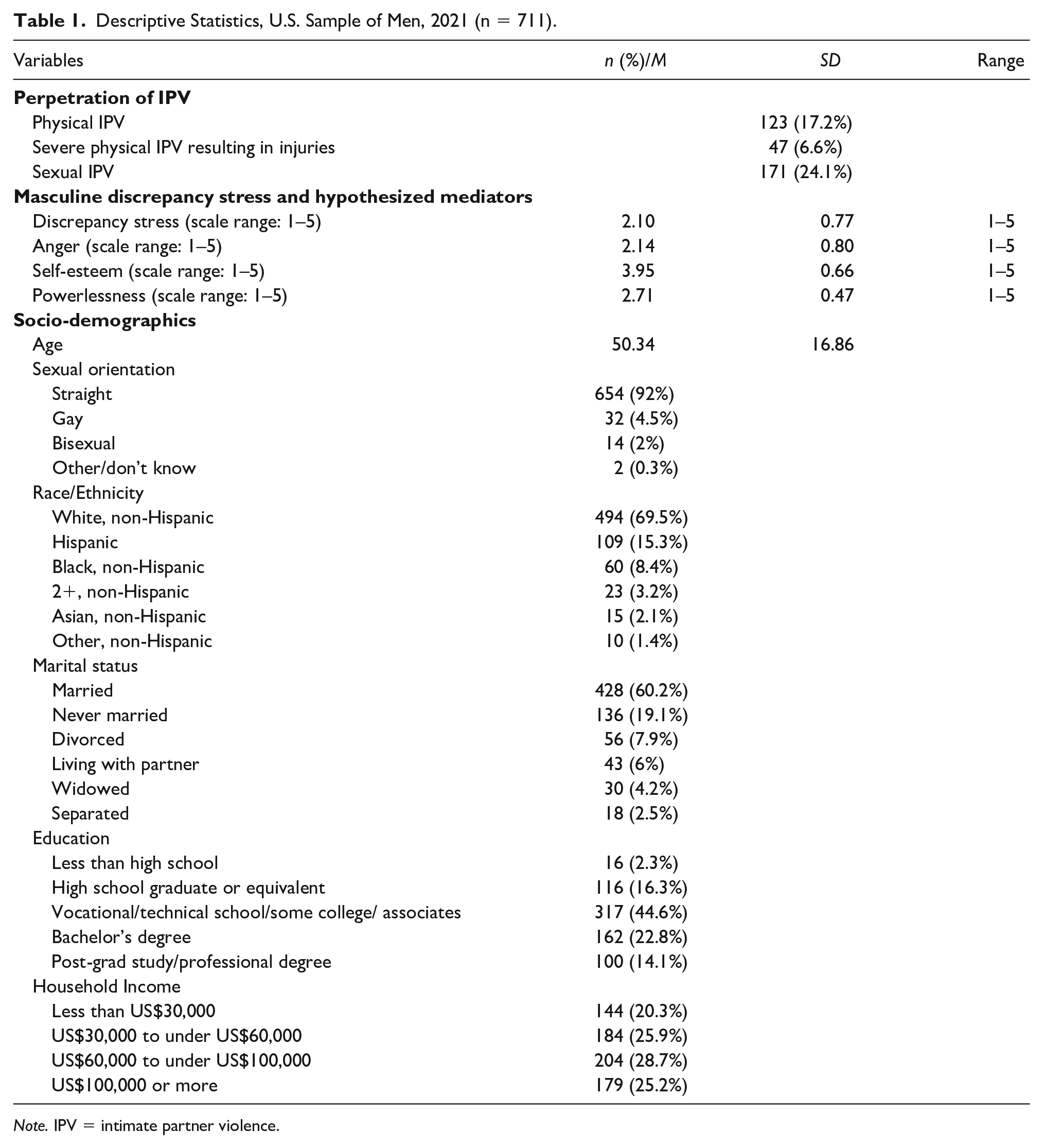
Note. IPV = intimate partner violence.
Table 2 displays the results of the multivariate linear regression models testing discrepancy stress’s association with anger, self-esteem, and perceived powerlessness, controlling for sociodemographic covariates. These three models demonstrate support for path a in our conceptual model for each hypothesized mediator at the p < .05 level. Controlling for background variables, discrepancy stress was positively associated with anger (unstandardized beta [b] = 0.26, standard error [SE]= 0.04, p < .001) and perceived powerlessness (b = 0.07, SE = 0.02, p = .004), and negatively associated with self-esteem (b = − 0.22, SE = 0.03, p < .001).
Multivariate Linear Regression of Anger, Self-Esteem, and Perceived Powerlessness on Masculine Discrepancy Stress (path a), U.S. Sample of Men, 2021 (n = 711).

Note. Bold indicates p<.05. b = unstandardized beta; SE = standard error.
Table 3 first reports the results of the multivariate logistic regression models testing the c’ path of the conceptual model (i.e., the associations between masculine discrepancy stress and each IPV perpetration outcome controlling for sociodemographic variables). The results show support for the c’ path for any physical and severe physical IPV perpetration, but not sexual IPV perpetration (adjusted odds ratio [AOR] = 1.05, 95% CI = [0.84, 1.32], p = .65). For each unit increase in the discrepancy stress scale, the odds of physical IPV perpetration increases by 54% (95% CI = [1.19, 1.99], p < .001) and the odds of severe physical IPV perpetration increases by 85% (95% CI = [1.28, 2.66], p = .001).
Multivariate Logistic Regression of IPV Outcomes on Masculine Discrepancy Stress (path c’) and Mediators (path b), U.S. Sample of Men, 2021 (n = 711).
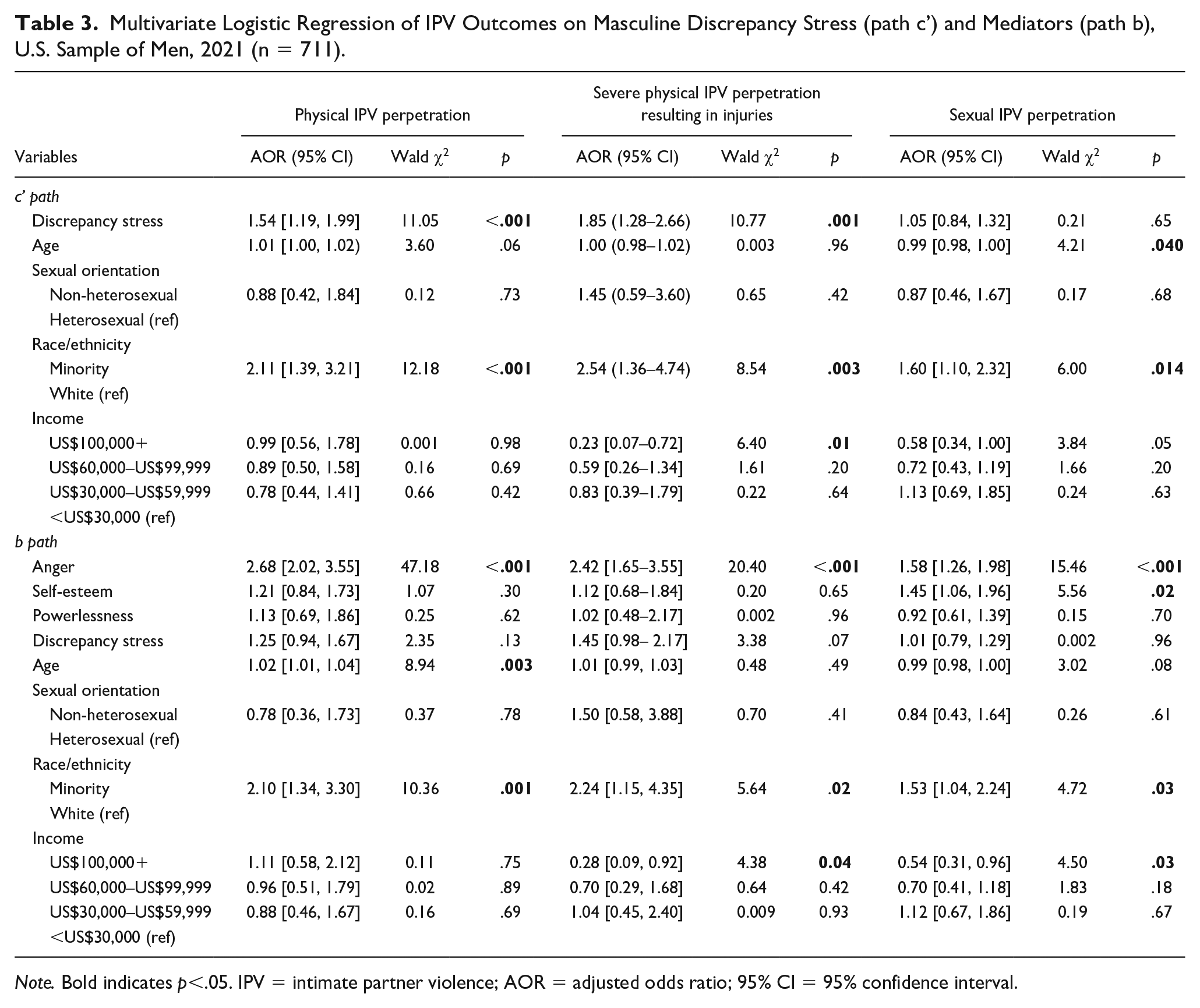
Note. Bold indicates p<.05. IPV = intimate partner violence; AOR = adjusted odds ratio; 95% CI = 95% confidence interval.
The second part of Table 3 reports the findings in support of the b path, the associations between the proposed mediators and IPV perpetration outcomes, controlling for all other variables and covariates in the conceptual model. The path between anger and each outcome was supported (physical IPV: AOR = 2.68, 95% CI = [2.02, 3.55], p < .001; severe physical IPV: AOR = 2.42, 95% CI = [1.65, 3.55], p < .001; sexual IPV: AOR = 1.58, 95% CI = [1.26, 1.98], p < .001). Greater self-esteem was associated with greater odds of sexual IPV perpetration (AOR = 1.45, 95% CI = [1.06, 1.96], p = .02), but not any physical (AOR =1.21, 95% CI = [0.84, 1.73], p = 0.30) or severe physical IPV perpetration (AOR = 1.12, 95% CI = [0.68, 1.84], p = 0.65). Finally, we failed to detect any associations between perceived powerlessness and any of the three outcomes: (physical IPV: AOR = 1.13, 95% CI = [0.69, 1.86], p = 0.62; severe physical IPV: AOR = 1.02, 95% CI = [0.48, 2.17], p = 0.96; sexual IPV: AOR = 0.92, 95% CI = [0.61, 1.39], p = 0.70).
After ruling out the possibility of indirect effects through self-esteem and perceived powerlessness because these mediators were either unrelated to IPV outcomes (a statistical precondition) or unexpectedly associated with specific IPV outcomes (a theoretical precondition), we observed (in Table 4) statistically significant indirect effects of masculine discrepancy stress through anger for any physical IPV (indirect effect [I.E.] = 0.23, CI = [0.12, 0.36]), severe physical IPV (I.E. = 0.21, CI = [0.10, 0.38]), and sexual IPV perpetration (I.E. = 0.11, CI = [0.05, 0.18]).
Indirect Effects of Masculine Discrepancy Stress, U.S. Sample of Men, 2021 (n = 711).
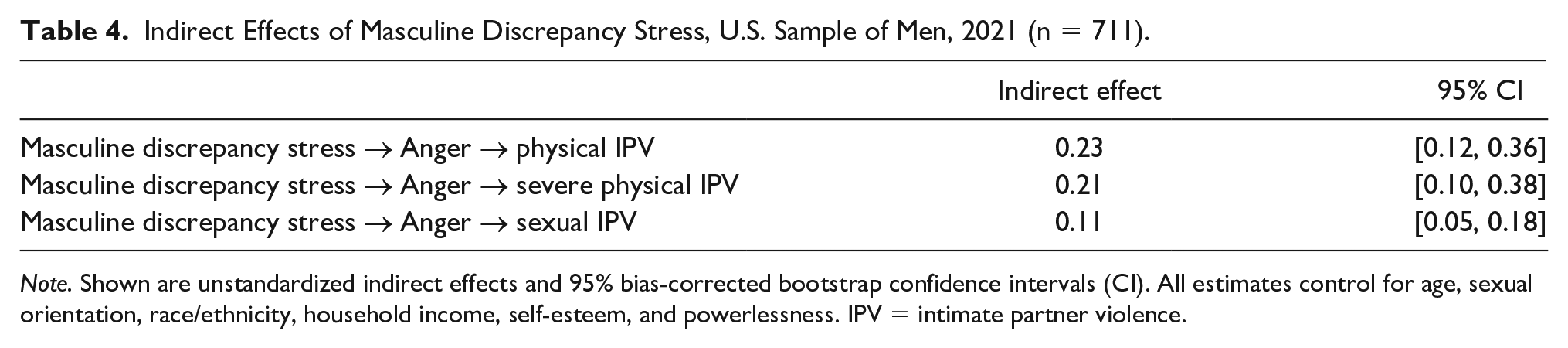
Note. Shown are unstandardized indirect effects and 95% bias-corrected bootstrap confidence intervals (CI). All estimates control for age, sexual orientation, race/ethnicity, household income, self-esteem, and powerlessness. IPV = intimate partner violence.
Discussion
This study aims to add to our understanding of the role of masculine discrepancy stress in men’s perpetration of IPV by examining potential mediators of this relationship in a sample of U.S. adult men. While studies have previously linked constructs measuring men’s stress about meeting societal gender role expectations with the perpetration of violence, few studies have explored psychological mechanisms that might explain this relationship further. Hypothesizing that discrepancy stress may lead to anger, low self-esteem, and/or a perceived powerlessness in one’s life, we tested these constructs as mediators of the masculine stress-IPV perpetration relationship. We observed statistically significant indirect effects of masculine discrepancy stress on all three forms of IPV through anger. We failed to detect any indirect effects through self-esteem or perceived powerlessness.
The reported lifetime perpetration of IPV was high in the present sample, with approximately 17% of respondents reporting any physical IPV perpetration. These findings are similar to a recent study of a nationally representative sample of U.S. men aged 18 to 35 that reported 19% of the sample had perpetrated physical IPV in their most recent relationship (Walsh et al., 2020). In the present study, 24% of respondents reported perpetrating any sexual IPV, including coercion of sex without a condom (23.6%) and rape (1.3%). These findings align with estimates from prior research on the prevalence of forced sex without a condom among U.S. men (Raj et al., 2006), but the low prevalence of rape perpetration may be due in part to social desirability bias. The most recent national surveillance report estimates the lifetime prevalence of rape by an intimate partner for women is 8.8% (Breiding et al., 2014).
Our findings highlight the important role anger plays in the relationship between masculine discrepancy stress and IPV perpetration. The link between anger and violence is well researched (Birkley & Eckhardt, 2015; Mahalik et al., 2003; Pollack, 1998), with violence perpetration generally accepted as a manifestation of the emotion of anger (Gardner & Moore, 2008). Scarpa and Raine (2000) posit that impulsive anger arises when a person feels unsafe, threatened, provoked, or insulted, occurring suddenly in response to stimuli (Berkowitz, 1993). Our study extends the understanding of the link between anger and IPV within the context of threatened masculinity. It is theorized that the expression of anger can serve as a mechanism to seek power and appear strong. This display of masculinity reinforces patriarchal structures of gender and power. It also results in the social construction of emotional expression as feminine, with the exception of anger, which is accepted as masculine (Brody, 1999; Courtenay, 2000a, 2000b; Shields, 2002).
Other research confirms that men who feel they are failing to fulfill gender expectations of themselves experience negative psychological outcomes (i.e., anger, anxiety, lack of emotional control, psychological maladjustment) (Berke et al., 2016, 2017; Eisler et al., 1988), which may result in violence. Violence perpetration among men experiencing anger in response to discrepancy stress may also be a way for men to display masculinity to regain masculine status when not meeting other societal standards of manliness (Brooks & Silverstein, 1995; O’Neil, 2015; Vandello & Bosson, 2013). While our study did not find support for low self-esteem or powerlessness as mediators between masculine stress and IPV, these constructs did relate to masculine discrepancy stress and self-esteem related to sexual IPV perpetration in multivariate analyses. Contrary to our hypothesis, the main effect between self-esteem and sexual IPV was positive in our study (i.e., men with greater self-esteem reported greater sexual violence perpetration). Prior researchers have posited that self-esteem or egotism is associated with violence, with inflated, unstable, or tentative beliefs in one’s self most prone to encountering threats and causing violence (Baumeister, 1997; Baumeister et al., 1996). While others report evidence for a negative association between self-esteem and violence (Walker & Bright, 2009), this may be an area for future inquiry within the context of discrepancy stress. One other study on masculine gender discrepancy and IPV identified a psychological mediator of this relationship—emotion-regulation difficulties (Berke et al., 2016). Thus, future research should continue to explore anger, self-esteem, powerlessness, and related psychological constructs like emotional regulation and anxiety that might further explain the ways in which masculine stress may result in violence.
This study has important implications for violence reduction interventions. First, by adding support for a link between discrepancy stress and IPV perpetration, our findings highlight for the need for gender transformative interventions to reduce IPV perpetration in the U.S. An intervention is considered gender transformative if it attempts to “shift norms of masculinity to be more gender equitable” (Dworkin et al., 2013). These interventions challenge mainstream subscription to rigid gender roles, most commonly through community mobilization, social media campaigns, and group discussion, built on the notion that masculinity is a learned social construct, and thus, can be changed (Dworkin et al., 2013). Most gender transformative violence reduction interventions have been in the context of HIV prevention and in sub-Saharan African settings, with evidence for their effectiveness at reducing women’s experience of violence; however, more work is needed to improve their effectiveness in reducing men’s perpetration of violence against an intimate partner and on the cultural adaption and test of this approach for U.S. settings (Abramsky et al., 2016; Christofides et al., 2020; Dworkin et al., 2013; Wagman et al., 2015). Our findings specifically point to the potential to reduce violence perpetration by reducing masculine discrepancy stress among men, which might be achieved by lessening men’s adherence to traditional masculine norms or reconstructing healthy masculine identities. This approach could be developed for men with a history of partner violence and should be tailored to the local cultural contexts of specific sub-populations in the U.S.
The second implication our study has for violence reduction interventions is the potential importance of integrating anger management strategies into gender transformative interventions for men to prevent IPV perpetration, since high masculine discrepancy stress may result in anger, which increases the risk of IPV perpetration. Anger management interventions targeting IPV perpetrators most commonly center on cognitive behavioral therapy (CBT), couples-based therapy, and coping strategies, but the evidence on effectiveness of such interventions is mixed (Finkel et al., 2009; Gilchrist et al., 2015; Stover et al., 2009). The effectiveness of interventions to reduce IPV perpetration may vary based on the root cause of IPV, which is specific to the perpetrator (Chester & DeWall, 2018). Our study points to discrepancy stress as one root cause of IPV perpetration; thus, gender transformative strategies that address masculine discrepancy stress may be a tailored approach to anger reduction for some men.
One strength of this study is its use of data from a national probability-based sample of U.S. men. Despite a large sample size, the low prevalence of lifetime perpetration of rape and the construction of its measure with few items might have contributed to the some of the null direct pathways specific to this outcome. Social desirability and recall bias may have also contributed to underreporting of the outcomes measured. However, the use of self-administered surveys may have reduced the effect of social desirability in this study. Future research should continue to examine discrepancy stress against different forms of IPV with larger samples and a more detailed assessment of our violence outcomes. The assessment of our independent variables also has limitations. A global measure of self-esteem does not capture different domains of self-esteem. We also modified the masculine discrepancy stress measure to reduce redundancy within the scale with the goal of reducing the overall time burden on participants. This limits the ability to compare the scores on our measure with other studies using the measure.
Another limitation of this study is the use of cross-sectional data for mediation analysis, which limits the ability to infer temporality or causation between the variables measured. While we test a theoretical model that implies causation, future studies are needed to replicate and expand on our findings with longitudinal data. Finally, while we control for socio-demographics in our analyses, such as age, race/ethnicity, and sexual orientation, we did not have the power to examine how these factors might moderate the relationships examined in this study. More research is needed that examines masculine discrepancy stress through an intersectional lens, teasing apart potential differential effects by race/ethnicity, sexuality, and other identities. These groups are underrepresented in the literature and it may be possible that men in marginalized or underrepresented groups are more affected by masculine stress given greater structural barriers to traditional markers of male success (e.g., status/power, money, etc.).
Conclusion
This study highlights the need for public health intervention that reduces the perpetration of violence in intimate relationships, with high rates of any physical (17%) or sexual IPV (forced unprotected sex or rape) perpetration (24%) reported in this nationally representative sample of U.S. men. This study of U.S. adult men found anger fully mediated the relationships between discrepancy stress and the perpetration of any physical violence, severe physical violence, and sexual violence against an intimate partner. By examining the psychological mechanisms that link men’s threatened masculinity with IPV perpetration, this study adds to our understanding on ways we might intervene to reduce IPV perpetration; gender transformative interventions that reduce masculine discrepancy stress among men by shifting men’s adherence to traditional masculine norms with anger management strategies should be explored in future research. More research is needed to replicate our findings and translate them into intervention approaches that are culturally tailored to specific populations. Future research should continue to explore other psychological mechanisms potentially at play, while examining how the masculine stress-IPV perpetration relationship may differ among specific populations, such as by race/ethnicity or sexual orientation.
Footnotes
Declaration of Conflicting Interests
The author(s) declared no potential conflicts of interest with respect to the research, authorship, and/or publication of this article.
Funding
The author(s) disclosed receipt of the following financial support for the research, authorship, and/or publication of this article: Katelyn M. Sileo was supported by a Mentored Research Scientist Career Development Award from the National Institute of Mental Health of the National Institutes of Health [K01MH121663]. The content is solely the responsibility of the authors and does not necessarily represent the official views of the National Institutes of Health.
