



Abstract
Men’s intimate partner relationship services have focused on correcting the behaviors of male perpetrators of intimate partner (IPV) and/or domestic violence (DV). There is a need to advance IPV and DV prevention efforts by better equipping men with relationship skills. This study explores service providers’ and stakeholders’ perspectives about the challenges and strategies for assisting men to build better intimate partner relationships. Interviews were conducted with participants (n = 30) from Canada and Australia who worked in the men’s intimate partner relationships sector. Three themes were inductively derived: (a) crisis management (barriers to engagement), (b) owning deficits and leveraging strengths (engaging though accountability and action), and (c) me then we (self-work as requisite for relationship success). Using a gender relations lens, we examined the influence of masculinities on men’s intimate partner relationships and engagement with services. Participants described crisis management challenges for men accessing services including shame, threats to masculine identity, and mental health challenges. Owning deficits and leveraging strengths hinged on men’s accountability and action, rather than assigning blame for problematic behaviors in accessing services. Related to this, the me then we theme highlighted men’s strength-based approaches in focussing on self-work to develop tangible skills and awareness needed to build healthy relationships. Overall, the findings indicate men’s healthy relationships hinged on working with masculine identities to inform their perspectives and behaviors. Men’s intimate partner relationship work likely requires labor at multiple levels (e.g., individual, partners, and systems) to secure the strong potential for reframing masculine identities as asset-building for men’s relationships.
Introduction
The influence of masculine norms and stereotypes have been implicated as contributing to intimate partner violence (IPV) and domestic violence (DV) risk. Traditional patriarchal archetypes for men’s intimate partner relationships depict them as household heads, economic providers, entitled to sex, and dominant over women. Herein, power and superiority can contribute to negatively impact men’s intimate partner relationships (Connell & Messerschmidt, 2005; Kilmartin & McDermott, 2016). Masculine norms (e.g., stoicism, self-reliance) may conflict with familial roles (e.g., being an affectionate and caring father) (Lee & Lee, 2018), and greater adherence to these characteristics can manifest IPV and DV (Petts et al., 2018). In the modern paradigm of disciplinary and corrective relationship programs, contemporary services have been delivered using a reductionist, static, and pathological view of masculinities with limited attention to upstream programs that might prevent IPV and DV (Oliffe et al., 2021). It is imperative to reimagine approaches to men’s relationship services that proactively equip men to build better intimate partner relationships.
Men’s relationship programs are delivered by diverse service providers and stakeholders with a range of training, experiences, and perspectives, yet most tend to be corrective with a focus on anger management (Oliffe, Kelly, Gonzalez Montaner, Seidler, et al., 2021). A recent scoping review identified that the majority men attending fathering and relationship programs were court-mandated as a result of IPV or DV (Oliffe et al., 2021). The effectiveness of court-mandated interventions for IPV and DV offenders is mixed with modest to no benefit reported in studies with experimental design and quasi-experimental studies indicating a small but potentially harmful effect (Feder & Wilson, 2005). While the paradigm of corrective relationship services makes sense, service providers have noted resistance, denial, recidivism, and high dropout rates among male attendees (Englar-Carlson & Kiselica, 2013). With a focus on accountability in IPV and DV treatment, service provision can be inherently confrontational (Pence et al., 1993) and men’s reticence may also stem from feeling victimized. A focus on corrective programming means that there is little support and training for men who are not in crisis, but who would deeply benefit from developing relationship skills related to confrontation and communication as their relationship struggles may manifest in other unhealthy behaviors (e.g., substance use).
Key to evaluating the feasibility and potential specificities of strength-based and asset-building programs are the perspectives of service providers and stakeholders who work in the men’s relationships space. The additional burden on service providers working with cases of IPV and/or DV has been associated with vicarious trauma, fatigue, and burnout (van Wormer & Bednar, 2002). For marriage and family therapy counseling, service providers report a lack of confidence and/or experience when dealing with issues of violence (Karakurt et al., 2013). In addition, service providers report conflict between the moral and legal obligation of addressing the violent behavior itself and treating violence as an indicator of larger systemic issues, which may have more sustained treatment outcomes (Karakurt et al., 2013). While traditional perspectives of men and masculinities have espoused men as resistant to change and typically ill-equipped for therapy, a focus on strength-based masculinities shows promise for increasing men and boys connection, motivation, and authenticity (e.g., van Wormer & Bednar, 2002; Wilson et al., 2022). Largely absent from the literature have been the perspectives and experiences of service providers working with men to understand how their approaches translate to clinical practice and men’s relationship services (Seidler et al., 2021).
The aim of this study was to explore service providers’ and stakeholders’ perspectives about the challenges and strategies for assisting men to build intimate partner relationships. We were specifically interested in identifying gender-related barriers and facilitators to men’s engagement with relationships services to make recommendations for efforts to equip boys and men to build better relationships.
Method
The study employed a qualitative semistructured interview design using thematic analysis and a masculinities framework to guide interpretations of the data. Ethics approval was provided by the University of British Columbia (H20-1868).
Participants and Recruitment
Thirty participants were recruited online via Twitter and Facebook ads and emails targeting Australia- and Canada-based service providers (e.g., counselor and social worker) and stakeholders (e.g., organizational lead, researcher) working in the men’s intimate partner relationships space. Participants in Canada and Australia were purposefully recruited as the two countries have similar publicly funded health care systems and social values. Participants were screened for eligibility and sent a link to provide consent and complete a brief descriptive questionnaire (e.g., age and gender) prior to scheduling an individual Zoom interview (Oliffe, Kelly, Gonzalez Montaner, & Yu Ko, 2021). The semistructured interviews lasted approximately 60 minutes and were conducted by four researchers based in Canada. Participants were sent a $100 e-gift card to acknowledge their time and contribution to the study. Participant demographics are provided in Table 1.
Characteristics of Service Providers (N = 30).

Data Collection
An interview guide comprising open-ended questions was used to explore participants’ experiences and perspectives of delivering relationship programs for men, the barriers and facilitators to men’s engagement with relationship services, and recommendations for how programs might equip boys and men to build better intimate partner relationships (Supplemental Appendix A). Interview questions included, “When and how do men typically find their way to relationship services?,” “What is key to the success of these services for men?” and “What works especially well for many men?,” and follow-up prompts were used to elicit detailed accounts of the participants’ experiences. The digitally recorded Zoom interviews were transcribed verbatim and checked for accuracy. Pseudonyms were assigned by the researchers to protect the identity of participants.
Data Analysis
Participant interviews were uploaded and coded in NVivo 13. Braun and Clarke’s (2006) six step approach was used to guide the thematic analysis. This included reading and re-reading the interview transcripts to build familiarity with the data, noting preliminary interpretations relevant to the research question, what are service provider’s and stakeholder’s perspectives about the challenges and strategies for assisting men with their intimate partner relationships? A coding schedule was developed to fracture the data using 10 descriptive labels including, “how men access services,” “advocacy issues,” “barriers to access,” “masculinities,” “program characteristics,” and “skills men need.” Data segments were assigned to these codes, and the data in each code were read and compared to distill patterns and account for variations. Through this process, we recognized participants’ use of social constructivist and relational approaches to the delivery of services. As such, Connell’s (2005) masculinities framework was used to further conceptualize and theorize the findings. Connell’s (2005) masculinities comprises a plurality of gendered identities, roles, and relations to make available diversity for how men think and act within socially constructed norms for what it is to be a man (Connell, 2005). Examining participants’ interviews with this framework allowed us to examine their perceptions of power, social structures, and agency in men’s intimate partner relationships, and what that means for tailored services. In completing these analyses for each code, we subsumed codes (e.g., “advocacy issues” and “barriers to access”) to differentiate and inductively derive three thematic findings.
Findings
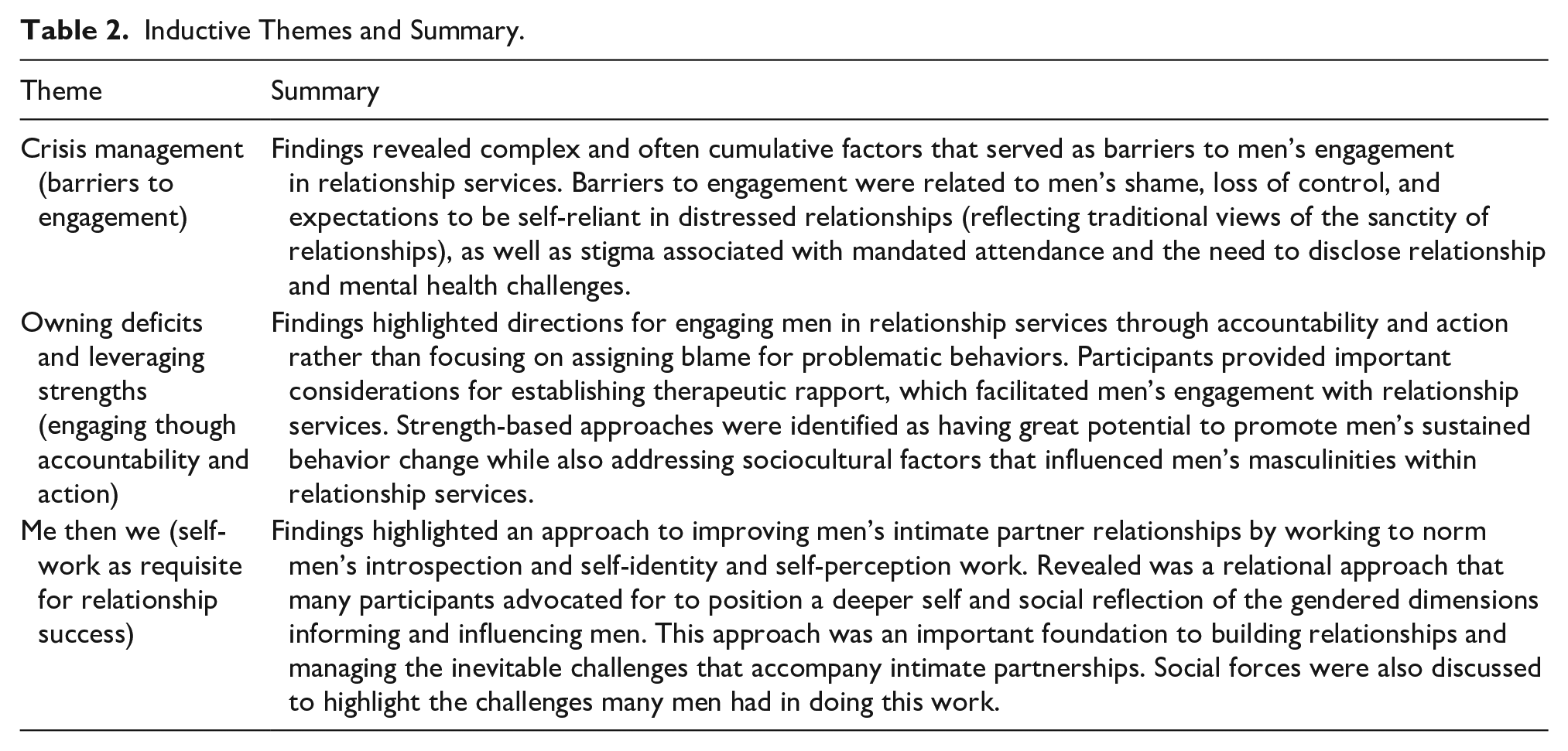
Three themes: (a) crisis management (barriers to engagement), (b) owning deficits and leveraging strengths (engaging though accountability and action), and (c) me then we (self-work as requisite for relationship success) were inductively derived. A summary of each theme is presented in Table 2.
Inductive Themes and Summary.
Crisis Management (Barriers to Engagement)
Participants described an array of factors and circumstances constituting crisis management in sharing how most men found their way to intimate partner relationship services. Although crisis was positioned as the catalyst for accessing services—it was also a barrier for many men’s engagement with that help. Crisis signaled men’s loss of control, and the often-mandated processes for men needing to access relationship services carried significant stigma and shame. Participants explained that although some men self-referred, most were recommended or mandated to attend by someone else. Specifically, men’s participation in relationship programs was often at the request (or ultimatum) of their partner, legal counsel, or mandated by the courts. Travis, a 30-year-old clinical counselor with 11 years’ experience working with men, explained: A lot of the partners are phoning in to say, ‘my husband is starting to fall apart. He’s anxious, he’s depressed, he’s drinking a lot.’ And especially with COVID, we’ve noticed that, and so it’s not even that the men are taking initiative to do it. Often when it’s a relational issue, it’s the woman doing it on behalf of the man. And so they’ve got to a point where they’re starting to destroy their relationship with their own mental health concerns. And even at that point, many men aren’t reaching out unless they’re encouraged to do so, forced to do so or the wife themselves phones instead.
Travis noted and normed men’s reticence for help-seeking, and their reliance on partners for directly providing care and/or connecting them with professional services. In line with Seidler et al.’s (2016) review, also evident was how men’s alignments to masculine norms (e.g., self-reliance) can inhibit help-seeking and fuel maladaptive behavior. Paradoxically, reflected in men’s poor mental health literacy is the overburdening of their intimate partner to bridge their partner’s social, mental, and physical well-being. Participants suggested men’s mental illness recursively flowed to and from distressed intimate partner relationships, wherein the partnership might be the nexus of the issue, and/or an arena where other issues negatively took hold. Herein, the result was that crisis and ultimatum drove many men to services at a time when their trauma was severe and the work of recovery (and redemption) especially demanding. As Oliffe et al. (2022) reported, while men’s relationships can be protective of their mental health, crises in and around the partnership can heighten the potential for anxiety and depression.
Participants suggested that the entry point to relationship services for most men was when their partnership was severely distressed and/or in jeopardy. Karl, a 68-year-old director of counseling with 25 years’ experience working with men, joked: This is probably another societal imposition that [men] don’t ask for directions, we don’t ask for help. One thing is that men don’t know
Herein, Karl referred to men’s normative ineffectual self-reliance and disorientation for navigating outside help for their relationship. There was also reference to men needing to be ready to receive help, which, in the context of intimate partner relationships was especially challenging for many men. This might be explained by the privacy in intimate partner relationships and men’s expectations that issues arising could (and should) be addressed “in house.” This underscores the need for service providers to work with men’s health literacy and expectations by providing education and orientation that actions men’s contributions to their own care (Seidler et al., 2018). Joel, a 36-year-old psychologist with 1.5 years of experience working with men, explained: Usually when they reach out, they’re well into the process of relationship breakdown or they’ve already separated and they’re looking to do some work, you know, on the potential of salvaging the relationship and rebuilding it or potentially bringing a better version of themselves to their next relationship.
Joel suggested the nature of the help, by virtue of men acting on a crisis, was by and large about making sense of their injurious behaviors to themselves, their partner, and their relationship. In essence, much of the men’s work was related to grief and loss, with shame, anger, and regret ever-present emotions. In addition to acting late, participants suggested that most men did not continue to garner help beyond the crisis. Participants lamented the limits of such acute help, and the likelihood that repeated patterns of behaviors brought troubled men back to services to address recurrent crises. In this sense, working with men required service providers to triage men’s immediate concerns and distress, rather than addressing underlying causes or skills needed to prevent future crises. These candid insights to the shortfalls of downstream services reflect work by Bowen et al. (2019), who wryly suggested little is changed by tending to men’s dire outcomes rather than the underpinning issues driving those consequences.
Another barrier preventing men from engaging with relationship services was the shame associated with not being able to self-manage or maintain an amicable relationship or end to the partnership. Andrew, a 54-year-old counselor with 15 years’ experience working with men, said: For a lot of the men, although they may be, for want of a better term. . .the perpetrator of the violence, generally speaking, there’s a lot of shame that they’re sitting with. And so that presents itself in various forms often in resistance, but also too in low self-esteem. . .a real self-denigrating sort of attitude that is masked by this bravado that they try to put on and that they don’t need help and they don’t talk and ‘I’ll manage it, I don’t need to talk about my problems, how does talking about my problems solve my problems?’
Men’s shame-based reluctance may be understood as an unwillingness to reveal weakness or vulnerability that may further threaten their masculine status (Vogel et al., 2007). Andrew went on to describe men’s “bravado” as a demonstration of normative masculinities related to self-reliance and independence. This stubbornness has been explained by Gough (2013) as a mechanism for protecting masculine capital by demonstrating dominant masculinities when masculinity is challenged. Similarly, social pressure that threatens masculine identities have been reported to predict aggressive cognition, particularly for younger men (Stanaland & Gaither, 2021). Here, Andrew also described men’s resistance to engaging with group therapy focussed on relationships. In this context, men’s behaviors, mistakes, and masculinities expressed in private are understood as being exposed, examined, and publicly scrutinized, a process that parallels the experience of going through legal proceedings.
Owning Deficits and Leveraging Strengths (Engaging Through Accountability and Action)
Participants described approaches to engaging men in relationship services through attendee’s owning deficits and leveraging strengths. Tensions were inherent to delivering relationship services from a deficit perspective, which focuses on correcting maladaptive masculine behaviors. The blend with using strength-based approaches that capitalize on men’s qualities and virtues to improve their lives and relationships provided an important balance and lever for men to make positive changes and actively engage in their own care and self-betterment. To this end, participants consistently outlined gendered approaches that worked with masculinities to positively frame accountability and action toward building relationship skills.
Participants suggested the critical need to strike a balance between condemning and correcting men’s behaviors and creating opportunities for change, particularly in situations involving DV. This approach aligns with strength-based approaches to counseling men discussed by Englar-Carlson and Kiselica (2013) that suggest the early stages of counseling should be focused on identifying, affirming, and promoting male strengths to make men feel valued and reduce defensiveness. Participants emphasized the importance of rapidly establishing this rapport and moving toward action and practical solutions. Richard, a 63-year-old social worker and counselor with over 35 years’ experience working with men, described men’s relationship services as requiring collegiality and teamwork: I think it’s about how to join with men and how to be of service to men. Any kind of one-to-one work or group program offering has to have a face validity, be plain speaking, and not start from a deficit standing. Start from ‘Hey, you’re probably doing the best you can with the resources you’ve been given. How can we support you and assist you to refine those resources?’
In addition to encouraging accountability, Richard discussed the need to use a nonhierarchical, collegiate health equity approach with men, focused on skill building to maximize impact and effect feasible change. Taking ownership and doing the work of skill building can align to normative masculinities, and as Richard further suggested, that emphasis needs to be made early, alluding to the importance of offering resources as actionable skills and tools. Implicit here, and in many participants’ narratives, was the need to position men as decision-makers with the autonomy to choose and action their personalized approach. In supporting men to become active agents in their intimate partner relationships, participants suggested that the role of the service provider was not to police men or their behavior. Rather, service providers must steer and guide men to be accountable in being active agents in their relationship. Andrew, a 54-year-old counselor with 15 years’ experience working with men, described his role as a facilitator with men: You’re directing things from an orchestra point of view, but they’re actually doing a lot of the challenging to each other, but particularly to themselves where they’ll actually pull themselves up. We might drop a little seed and then they’ll identify, ‘yeah, that’s what I’ve been doing’ and then as soon as somebody has the courage and the vulnerability to be able to share that little experience, something else happens and somebody else owns another one and then it just develops . . . That sort of environment is really powerful because they’re feeding off each other and it becomes really instrumental in the development of change.
Here, Andrew referred to the value of group work to establish a subaltern masculine culture in driving sustained authenticity, change, and accountability. This process of internalizing and normalizing men’s reflection on actions helped to establish a collective value system among men in a group. At this point, men’s specific behaviors and beliefs could be examined and challenged by service providers as well as peers without eliciting defensive responses as disclosures are normed practices in personal and the groups development. As outlined by Babcock et al. (2006), group formats can provide opportunities for social intervening as well as positive peer influence; however, facilitators must be cautious of unwanted consequences such as normalizing masculine stereotypes (e.g., aggressive behavior) (Murphy & Meis, 2008). In this regard, many participants scrutinized long-standing approaches to delivering relationship services for alienating men and having limited effectiveness. For example, Karl, a 68-year-old director of counseling with 25 years’ experience working with men, criticized deficit approaches that focused on placing accountability for abuse on the offender: That’s just the best part of the typecasting of men that needs to be gotten rid of that can be improved by men having a lot of emotions and learning to live with them and learning to work with them . . . We need to find something better because that’s not meeting the needs, this guilting and shaming stuff. And remind them it really is okay to choose our integrity ahead of the shame.
Karl referenced the need for programs to focus on working with and understanding men’s emotions for sustainable behavior change and long-term solutions for men’s relationship challenges. Implicit in many participants’ narratives was a more holistic approach to understanding and addressing broader sociocultural influences and practices impacting men’s relationships (e.g., social pressures to be self-reliant and emotionally restrictive). Similarly, participants discussed framing the processing of emotions as an introspective process, whereby men were coached to redirect their energy toward self-improvement and understanding rather than trying to supress or deny what they felt. Tony, a 69-year-old men’s program director with over 20 years of experience explained how he worked with clients to understand what they were feeling and redirect their expression and energy in more productive pursuits toward self-improvement: It’s not about supressing your anger, it’s about using it as an energy source that is constructive . . . It’s about recognising what the source of that is, and so where does that come from. That can be sort of a deep, internal psychological curiosity. ‘Where did you pick this trigger up? What happened in your life that now triggers you so that you’re pissed off’?
Tony recognized and called upon broader social influences as the root of men’s emotional expressions. Using strength-based approaches, participants positioned men’s emotions including anger as a valid energy that needed to be deconstructed and redirected to drive personal and interpersonal development. Also referenced were the socialized origins of men’s anger and cultural factors related to men’s expressions of anger. Consistent with dominant masculine discourses, many participants considered and incorporated broader socio-cultural influences as important aspects to address in men’s relationship services. Garry, a 50-year-old coach and speaker with 25 years’ experience working with men, discussed how recognizing and understanding these factors provided opportunities for engaging men in important conversations about gender roles and relations: I think one of the things if it’s a father is this whole concept of a provider. You and I were probably raised that a provider was the breadwinner. We have to realize in the times that we live in, a provider doesn’t have to be a breadwinner, provider can be a provider of support, a provider of encouragement. There’s so many different areas of provision that can be out there and I think a lot of fathers and a lot of their partners have to realize that.
Reflected in Garry’s statement, and in those of many participants, were contextual understandings of social constructivist perspectives of gender. In recognizing that gender and identity were shaped by history, environment, experiences, and exposures, participants promoted work by men to recognize their own privilege and power, and how that might harm or benefit their relationships. Here, men’s relationships operated within social structures that assigned masculine capital that could muster both health dividends and taxes. That is, the rigidity of some masculine roles shackled and drained some men’s embodiment of what could have been available through more diversely operationalized gendered frames.
Me Then We (Self-Work as Requisite for Relationship Success)
Participants described their method of delivering relationship services as being contingent on a me then we approach, wherein the focus was on engaging men in self-work as a requisite for being successful in their intimate partner relationships. Participants identified self-work with men as a necessary process and bedrock for behavior change. Within this process, participants discussed the importance of working with men’s masculine identities, values, and sense of self to develop capacities to reflect on their emotions and behaviors. In understanding themselves better, men could develop healthier interpersonal relationships and better manage future challenges. Participants suggested this work should begin early with boys and young men, as it had the potential for a significant knock on effect to other aspects of men’s lives. Some participants cautioned that broader sociocultural shifts must also occur to impact gender relations and support men to build better relationships.
Although many men began relationship services with a desire to learn strategies that would help them with their relationship, participants described the importance of working with men to build capacity and solidify a sense of self-identity and positive values as a requisite to work focused on interpersonal and couple dynamics. Jeff, a 63-year-old clinical counselor with 7 years’ experience working with men, explained: When people call into our program asking for support, a very, very common expression is, “yeah, I was told I need an anger management course.” It’s as if they’re going to learn how to change a tyre or how to learn geometry or something. It’s part of the education process, okay, anger management is part of what we do, but we do more than just kind of give you anger management techniques. It’s much more than that.
Jeff outlined how men often approached relationship services from a utilitarian perspective to learn the skills that may address their immediate concerns and challenges. While these approaches align well with masculine preferences for skill-building (Oliffe, Rossnagel, et al., 2019), Jeff alluded to the complexities of supporting men to be introspective in making sustainable changes to improve their relationships. Richard, a 63-year-old social worker and counselor with over 35 years’ experience working with men, explained how lacking these base skills jeopardized their participation in couples counseling: Men often have such a poorly developed intrinsic sense of self that they can’t show up as an equal in the relationship counselling room because they haven’t yet learned their skill set and they haven’t got a solid enough sense of self defined and hold their voice in the relationship in constructive ways.
Richard signaled the need for men to develop self-awareness of their embodied identity and expressions to wholesomely participate in their relationship and by extension couples’ services. The way men think (or do not think) about their values, beliefs, and purpose had important implications for their self-reflection, regulation, and management work. Seidler et al. (2021) explain how a lack of emotional regulation and self-knowledge in male clients contributes to rigid and two-dimensional roles through a general lack of consideration—which may help to explain the fragility in men’s self-identity, and dismay when faced with a relationship breakdown. Furthermore, men often define themselves by their familial role (e.g., father, breadwinner) (Connell, 2005), and participants discussed how these archetypes were ruptured in relationship break-ups. Participants believed that men who had established an abiding sense of self were better equipped to address these challenges, feel and articulate their emotions, and by extension manage a relationship break-up.
Opportunities for developing self-identity were identified and participants suggested that work with boys and men should begin early, as the potential benefits extended into other aspects of men’s lives and future relationships. Jamie, a 32-year-old executive director with 5 years’ experience working with young men, described the process of how working with men’s self-identity might translate to better relationships: So we start with that pillar of self and then “self” breaks down into self-awareness, self-esteem, self-respect, and self-love because if you don’t have that strong sense of self and that fortitude, it’s easier to push you into things, right. So we start with that first relationship and that relationship is with yourself . . . Then finally towards the end once you’re taken care of, we move towards others . . . we talk about consent and we talk about healthy relationships, but it is really like with anyone . . . If they can’t have healthy relationships with other boys, how do we have this expectation all of a sudden that they’ll have healthy relationships with girls.
Jamie described the importance of requisite self-work with young men and delineated the tenants of personal development that his programs sought to sequentially address. Having well-established self-identity was understood to involve a value system nourishing resilience to withstand adversity. Young men’s relationships with each other were also identified as forging and reflecting masculine values transferrable to supporting healthy intimate partner relationships. Jamie continued by explaining the intended outcome of this work with young men: A young man who is self-aware, who can name that he was having a bad day and he was feeling emotions, that is someone who can reach out to ask for help or share an emotion, and it is someone who can check in and has some of that resilience.
Here, the value of young men and boys showing up authentically in the everyday is garnered in the hope that it will carry forward to their relationships. These are men whose values affirm and lever them to critically evaluate an array of situations in formulating appropriate responses and actions. As a growing body of work looks at intervening with young men to recognize (and address) gender inequities (King et al., 2021), any self-work must ultimately be applied and negotiated in the context of men’s intimate partner relationships. Jamie also referred to the need for resilience, as offering one’s authentic self to one’s significant other requires a degree of vulnerability that men often protect themselves against. Highlighted here and by many participants was the need for men’s self-work to be understood and operationalized as a dynamic and ongoing process.
While many participants were hopeful that a “me then we” approach would help men to establish a foundation for successful intimate partner relationships, others cautioned against focusing on men and expecting broader social changes. Acknowledging the relational aspects of gender roles, Mark, a 50-year-old CEO with 23 years’ experience working with men, noted: There is always this assumption that men individually can be responsible for changing gender norms, which of course we can take some responsibility, but we have to live within communities and cultures that enforce the gender norms, and we don’t place nearly enough emphasis on that, and so we’re surrounded by . . . assumptions that, you know, ‘she’ll be right’ and ‘men aren’t hurt,’ it’s very difficult for men to actually navigate a conscious pathway.
Mark pointed to the influence of social structures and systems that shape and police gender roles and relations. Traditional cultural perspectives norming dominant masculinities are ever-present in this context influencing how men show up in their relationships. Chandler (2021) similarly suggests it is naïve to expect men’s disclosures of vulnerabilities will trump the silencing powers of dominant masculinities. Men’s identities and experiences shape but are also shaped through such dominant discourses, as well as interactions with peers and partners.
Discussion
This study’s aim was to explore service providers’ and stakeholders’ perspectives about the challenges and strategies for assisting men with their intimate partner relationships. Our findings reveal participants as operationalizing masculinity frameworks to explain barriers and facilitators for garnering men’s behavior change and advancement of relationship skills. Although much is written about and lobbied for addressing IPV and DV, it seems entirely reasonable that the findings in this study might offer prevention and health promotion strategies by adapting similar services upstream toward boys and men. In what follows, we discuss three key points from the study findings in suggesting that there is great potential for transitioning this study toward tailored programs that equip boys and men to build better relationships.
First, where women are typically more likely to seek help for relationship problems (Stewart et al., 2016), there is a normative frame and perhaps expectation that men monitor distress rather than act to prevent or minimize such issues. The net effects of acting late on relationship distress is that men’s capacity to address the issues are diminished—perhaps because they are feeling shamed and fatigued and likely engaged in the rising conflicts—rather than being proactive in remedying unhelpful emergent communication patterns and negative relational dynamics. These findings in and of themselves affirm the need for upstream services tailored for men. That said, significant challenges linger for creating the drivers for men to engage in relationship work as an up-skilling project ahead of having significant problems, including the demand for correcting their behaviors. This is not to suggest upstream relationship skill building would avoid partnership challenges, rather the IPV and DV prevention aspects of upstream relationship programs for men should include skills and strategies for reducing the risk of conflict escalation and violence. There might also be value in educating men to identify distressed relationships by coaching about the need to quickly communicate and effectively repair underpinning issues. While reticence for help-seeking and crisis management has consistently been linked to masculine self-reliance (Addis & Mahalik, 2003), the normed sanctity of intimate partnerships might by extension presume (and police) conflicts be handled “in house.” In this regard, there should be some rethinking of how gender relations might be negotiated, inclusive of pathways for dealing with distressed relationships. Research suggests that men who have well-developed emotional competencies are better able to perceive and consider their partner’s feelings, as well as understand, name, and adequately express their own emotional states (Takšić et al., 2009). Various avenues for formal and informal relationship help-seeking exist, such as counseling, online self-help, or talking to friends and family (Stewart et al., 2016), which may present unique opportunities for prevention, early intervention, and the re-framing of gender roles and relations.
Second, there has been much written about the need for tailoring strength-based asset-building programs to men and these findings sit within a broader shift in the field of men’s health, whereby emphasis is placed on the adaptive characteristics, values, and emotions of men that promote well-being and resilience in themselves and others (Englar-Carlson & Kiselica, 2013). This study findings affirm these principles as potent drivers for reducing barriers that can be imposed by guilt and shame when men’s vulnerabilities come to the fore. Actions for betterment of self (identity) and other (protector, provider) will likely engage men, wherein upstream efforts might offer more general skills amid inserting intimate partner relationships as one of many contexts in which specific strategies will yield significant benefits. Hearn (1998) has long spoken about the discord between men’s public and private masculinities—and there may be some benefit in seaming strength-based skills and values to guide wide-ranging interactions and life principles. For example, reformulating some masculine ideals offers men flexibility in negotiating healthy masculinities that may be akin to greater social connectedness and support, healthy lifestyle behaviors (Oliffe, Rice, et al., 2019) and help-seeking for mental health challenges (Seidler et al., 2016).
Third, while Robertson (2007) spoke to hedonistic masculinities as action-based and somewhat self-indulgent, this study findings delineate men’s self-work as introspective with a view to knowing oneself and values. This seems entirely reasonable as a requisite for successfully engaging a relationship, and might aptly address Oliffe, Kelly, Gonzalez Montaner, Seidler, et al.’s (2021) caution that intimate partner relationships often happen to men—rather than summoning their authentic agency. This self-work seems imperative, and while boys and young men are priority targets for such upstream efforts, there are undoubtedly wider applications including distressed relationships and partnership break-ups where such work is critical. While these circumstances may be catalytic to engaging men in self-work, the implied suggestion that this is cross-sectional needs addressing to operationalize self-work as a lifelong process. As masculinities shift and change across the life course through aging, life events and history self-work must be ongoing and communicated within the relationship.
The benefits of supporting men to develop and maintain healthy relationships may be far reaching, and these study findings have important implications for clinical practice. Critical to developing relationship services targeted at prevention and early intervention will be identifying strategies to foster men’s interest and engagement. Health promoting activities and education must be delivered within these services in ways that align with men’s values and interests and effectively sell the empowerment benefits of self-work (see van Wormer & Bednar, 2002; Wilson, 2022). Similarly, opportunities for upskilling service providers to consider the role of masculinities and employ strength-based approaches would also be valuable. Accordingly, prevention and early intervention in this space may take many forms. Given many men’s affinity for self-reliance, particularly when it comes to their intimate partner relationships, online and self-guided resources may serve useful for early intervention of distressed relationships. Among the growing number of programs for new fathers, a potentially receptive population to health relationship services, incorporation of self-work and capacity building to sustain healthy relationships may be beneficial given the added relationship pressures that a new father may experience. More broadly, efforts are needed in workplaces, community-based settings, or as an adjunct to clinical practice (e.g., mental health counseling) to challenge masculine stereotypes and norms. For example, a 12-week sports-based health promotion program for men incorporated DV prevention content and reported that it led to ongoing conversations with partners and children about mental health and respectful relationships (George et al., 2021).
This study includes limitations that should be considered. First, while this study is strengthened by the multinational sample of service providers and stakeholders with diverse backgrounds and experiences, participants predominantly worked with male perpetrators of IPV and/or DV. Accordingly, caution is needed in terms of what can be extrapolated from these findings for men’s relationship building programs. Second, that nearly all participants were men is somewhat surprising and promising. While a limitation for not being representative of a help-giving sector largely comprised of women, we believe that this demonstrates interest and potential for shifting the deficits narrative that is so prevalent within existing men’s relationship services. Finally, as assumptions of heteronormative relationships are implicit in many participant narratives, these findings likely do not reflect relationship diversities in genders or sexual orientations.
Conclusion
This study explored the perspectives and experiences of service providers and stakeholders working in the men’s intimate partner relationships space to inform upstream efforts that might equip boys and men to develop healthy relationships. Our findings point to the urgent need for further research and work with men on the prevention and early intervention of IPV and DV. Among developing relationship skills in ways that aligns with masculine values, broader work is needed to reframe gender roles and relations that are inclusive of building healthy relationships. In this regard, engaging men in self-work and capacity building related to their masculine identities may be critical to establishing the skills needed to maintain healthy intimate partner and, more broadly, interpersonal relationships across the life course.
Supplemental Material
sj-docx-1-jmh-10.1177_15579883231161023 – Supplemental material for Engaging Men in Intimate Partner Relationship Programs: Service Provider and Stakeholder Perspectives
Supplemental material, sj-docx-1-jmh-10.1177_15579883231161023 for Engaging Men in Intimate Partner Relationship Programs: Service Provider and Stakeholder Perspectives by Paul Sharp, Adina Coroiu, Simon M. Rice, Zac E. Seidler, David Kealy, John S. Ogrodniczuk and John L. Oliffe in American Journal of Men's Health
Footnotes
Declaration of Conflicting Interests
The author(s) declared no potential conflicts of interest with respect to the research, authorship, and/or publication of this article.
Funding
The author(s) disclosed receipt of the following financial support for the research, authorship, and/or publication of this article: This research was made possible with funding by Movember (grant no. 017801). P.S. is supported by a Canadian Institutes of Health Research (CIHR) Fellowship and Michael Smith Health Research BC Research Trainee Award. A.C. is supported by postdoctoral fellowships from the Canadian Institutes of Health Research and the Fonds de Recherche du Quebec-Santé. Z.E.S. is supported by an Investigator Grant Fellowship from the National Health and Medical Research Council of Australia (grant no. 2008170). S.M.R. is supported by a Career Development Fellowship from the National Health and Medical Research Council of Australia (grant no. 1158881), and the Dame Kate Campbell Fellowship from the Faculty of Medicine, Dentistry and Health Sciences at The University of Melbourne. D.K. is supported by a Michael Smith Health Research BC Scholar Award. J. L. O. is supported by a Tier 1 Canada Research Char in Men’s Health Promotion.

Supplemental Material
Supplemental material for this article is available online.
References
Supplementary Material
Please find the following supplemental material available below.
For Open Access articles published under a Creative Commons License, all supplemental material carries the same license as the article it is associated with.
For non-Open Access articles published, all supplemental material carries a non-exclusive license, and permission requests for re-use of supplemental material or any part of supplemental material shall be sent directly to the copyright owner as specified in the copyright notice associated with the article.
