



Abstract
Research suggests that adherence to traditional and hegemonic masculinities can be detrimental to men’s mental health. In particular, anxiety can result from the incongruence between idealised and lived experiences. Emerging research suggests that holding spiritual beliefs may protect against such anxiety. This Australian study investigated whether two aspects of spiritualism (Spiritual Openness and Spiritual Support) could moderate the relationship between four stereotypical masculine behaviours (Success Dedication, Restrictive Emotionality, Inhibited Affection and Exaggerated Self-Reliance and Control) and anxiety. A cross-sectional, correlational design, with a heterogeneous, Western community sample included 331 male participants aged 18–67 (M = 24.57, SD = 10.37). In partial support of the hypotheses, two significant moderation models were found. Both Spiritual Support and Spiritual Openness moderated the relationship between Exaggerated Self-Reliance and Control and anxiety. There were no significant moderations for Success Dedication, Restrictive Emotionality, and Inhibited Affection. Masculinity and spiritualism did not have significant direct effects on anxiety. These findings suggest that when working with men and their mental health, it may be important to consider the congruence between their behaviors and belief systems, as spirituality was only protective against anxiety where these beliefs were congruent with masculine self-reliance and control. It appears that the potential benefit of spirituality in reducing masculine anxiety is dependent on the man being more open to external supports, and having a lower need for control.
Over the last two decades, there has been an increase in the attention of researchers, policy makers and health professionals to the disparities in mental health outcomes between men and women (Salzman & Wender 2006; White & Holmes 2006; Wilson, & Cordier, 2013). Researchers have posed a range of reasons to explain these disparities, with prominent themes focusing on the difference between how men and women express their gender roles, and in the case of men, particular psychosocial issues relating to the expression of masculinity (Gill at al., 2014).
Masculinity theory has evolved over the years from predisposing biological underpinnings to a modern constructionist-based theory of ‘gender role’ expression and power structures (Mirkovic et al., 2005; Wilson, & Cordier, 2013). Masculinity is further delineated into different subcultures and communities depending on context-specific responses (e.g., hegemonic (dominant), ethnic and western/white masculinity, alpha/beta males, fathers, homosexual masculinity). As such, masculinity is learned and created as part of identity and intersects with other identity components such as ethnicity, spirituality, and sexuality (Christensen & Jensen, 2014). Regardless of how masculinity is conceptualized, hyper, hegemonic, and stereotypical masculinities are often associated with poor mental health and well-being outcomes for men (Clark et al., 2020; Seidler et al., 2016). Recently, there has been an increase in recognition that the relationship between masculinity and mental health might be more nuanced and might depend on how “masculinity” is understood (Wong et al., 2017). For example, while some aspects of masculinity may relate to restricted emotionality and reduced help seeking, others may have protective qualities (Hammer & Good, 2010; Levant et al., 2011; 2015).
Masculinity and Anxiety
Paradoxically, it appears that men are both privileged and imprisoned by the expectations of hegemonic masculinity. Connell (2005) described hegemonic masculinity as being at the top of the masculine hierarchy. Other less powerful forms are complicit, marginalized, and subordinate masculinity. Historically, cultures privilege hegemonic masculinity over other forms as well as femininity, and as such bestow men greater freedoms solely based on their gender (Mankowski & Maton, 2010). Conversely, these powers also confine men to enacting socially accepted stereotypical masculine roles and characteristics such as stoicism, repression of emotions and heterosexuality (Mansfield, 2013). This paradox confounds the often-simplistic analysis of men and masculinity as being either positive or negative. Masculinity can be both an advantage and a disadvantage depending on how it is endorsed or expressed (Mankowski & Maton, 2010). The concept of Gender Role Stress, which is the tension men feel when failing to perform within their cultural expectations, encompasses this paradox well (Gallagher & Parrott, 2011). Grounded in the psychology of social norms, men have a societal expectation to meet what constitutes masculinity. These expectations and conceptualizations are known as Gender Role Norms (Mahalik et al., 2003; Wong et al., 2017). Men who hold stereotypical gender role beliefs are likely to experience strain and anxiety in situations where that role is challenged (Eisler et al., 2000; Franchina et al., 2001). Specifically, men can experience psychological effects (e.g., poor emotional control, anxiety, low self-esteem and insecurity) and physiological effects (e.g., cardiovascular and nervous system changes), when trying to meet their gender role norms (Gallagher & Parrott, 2011; Mahalik et al., 1998).
Research demonstrates that men who adhere to stereotypical masculine ideologies, particularly the norm that men should be stoic and restrict emotionality, report an increased fear of emotions, both positive and negative (Jakupcak et al., 2003). This can be applied to an experiential aspect of masculinity, as stereotypical men have to contend with vulnerable emotions (e.g., shame, anxiety) from their perceived deficiencies in masculinity, as mentioned above. This is a positive feedback loop where men feel anxiety over not living up to masculine stereotypes and are then confronted with intense emotions that are not part of “being a man.” This can lead to an increase in gender role strain and further anxiety. This cycle may also become a conditioned response that is no longer perpetuated by any negative social feedback (Jakupcak et al., 2003).
Laboratory experiments demonstrate that perceived threats to men’s masculinity (e.g., engaging in stereotypical feminine activities) can lead to increased anxiety in men (Berke et al., 2018; Vandello et al., 2010). Men who have demonstrated stress related to gender role strain may employ emotional coping strategies (e.g., denial or suppression; Berke et al., 2017), or behavioral coping strategies (e.g., violent and risky sexual behavior or substance use; Berke et al., 2018) that help bring their emotional expression and internal experience back in line with gender role norms (Berke et al., 2017; Bosson et al., 2009). This can result in negative long-term consequences for mental health and wellbeing.
Spiritualism
The paradox of masculinity and mental health described above positions men to aspire to hegemonic masculinity for the social benefits it bestows yet creates unrealistic and unliveable expectations in relation to men’s emotional lives. Men must create alternate masculinities or identity intersections to adapt, while avoiding subordination and discrimination. The difficulty in successfully negotiating this paradox may partly explain why hegemonic masculinity has been resistant to change over the decades. We suggest that spirituality as a broadly socially accepted identity characteristic may offer men an important identity intersection to help address this paradox. Spiritualism is considered a connection to something bigger than oneself (Snider & McPhedran, 2014). One of the most consistent findings in religiousness and spirituality literature is that men tend to be less religious and spiritual than women (Argyle & Beit-Hallahmi, 1975; Francis & Wilcox, 1996; Jurkovic, & Walker, 2005). Men, compared to women, participate less often in spiritual rituals, identify less with ‘being religious’, and espouse different spiritual motivations (Francis & Wilcox, 1996; Thompson & Remmes, 2002). Research suggests that the personality profiles of people who are more religious and spiritual are more feminine, and this was seen historically in clergymen who often possessed a feminine personality profile (Ekhardt & Goldsmith 1984). Spiritualism researchers have questioned whether these gendered differences are due to the socialization differences between the genders (Jurkovic & Walker, 2005; Thompson, 1991).
Regardless, spiritualism is inversely correlated with negative outcomes that are commonly associated with hegemonic masculinity. For example, spiritualism is often associated with lower levels of depression, suicidality, and substance abuse in men (Koenig, 2009; Saunders et al., 2014). Further, men who associate with some level of spirituality feel free to avoid adhering to (and capable of challenging) strict social constructs of hegemonic masculinity, and also express less gender role conflict in their daily lives (Heth 2017; Longwood et al., 2011). Spiritualism can also provide men with an alternative and specific masculine identity, helping them move away from the rigid social norms associated with traditional masculinity. Spiritualism can allow men the freedom to express emotions, differentiating them from their peers and societal expectations without shame (Heth, 2017). Additionally, having a spiritual identity can provide a coping strategy and a support system that helps individuals deal with the anxiety caused by uncertainty (Solaimanizadeh et al., 2020). Spiritual coping includes positive ways of reframing negative life events (“The universe has a way of working things out”), and offers a frame of support (“God will help me through this”).
The Current Study
In summary, previous literature has posited some aspects of traditional masculinity such as stoicism and emotional restriction as problematic to mens emotional wellbeing. These characteristics when conflicting with men’s lived experiences can create gnder role strain and result in anxiety. As such research is needed to identify other identity characteristics that might weaken the link between masculinity and anxiety. As spirituality has been shown to protect against anxiety in some contexts, we aim to assess any potential protective benefits in the context of masculine anxiety in men from Western cultures. This interaction effect has not been previously examined, and can provide important information on ways to manage masculinity-related anxiety. The current study explores the link between conforming to stereotypical masculine behaviors and anxiety, and the potential protective role of spiritualism.
It was hypothesized that the subscales of the masculine behavior scale (Success Dedication, Restrictive Emotionality, Inhibited Affection, and Exaggerated Self-Reliance and Control) would positively relate to anxiety, and that spiritual openness and spiritual support would negatively relate to anxiety.
It was also hypothesized that greater spiritual openness and greater spiritual support will moderate and reduce the strength of the positive relationship between masculinity behaviors and anxiety.
Method
Participants
A G*Power analysis (Faul et al., 2014), using an effect size of .15, an alpha of .05, a standard power level of .80, and 24 predictors revealed a requirement of 169 participants. Recruitment involved convenience and snowball sampling from the researcher’s personal social media accounts in Australia (approximately half) as well as targeted participant recruitment from an international cohort via Prolific. Prolific is a UK-based online paid participant recruitment platform. This platform allowed us to expand our recruitment to U.S., Canadanian, and UK men. The eligibility criteria was that participants had to be at least 18 years old, self-identify as male, live in a predominantly Western culture, and be proficient in the English language.
Participants were 331 males, aged between 18 and 67 (M = 24.57, SD = 10.37). The participants’ country of birth was predominantly Australia (41%), followed by the UK (22%), United States (19%), and Canada (3%). The remaining 15% consisted of other countries with a contribution of less than 3%. The ethnicities of participants were predominantly white (30%) and Asian (20%), with a small percentage being Hispanic (5%) and black/African (3%). The majority of participants did not have a partner with most being single (50%) and a smaller percentage being divorced/separated (4%).
Design
This study employed a cross-sectional, correlational design to investigate spiritualism as a moderator of the relationship between stereotypical masculine behaviors and anxiety in a series of hierarchical regression analyses, that is, one analysis per criterion variable (Tabachnick & Fidell, 2007). The study involved six predictor variables (Spiritual Openness [SO], Spiritual Support [SS], MBS-SD, MBS-Restrictive Emotionality [RE], MBS-Inhibited Affection [AI], MBS-Exaggerated Self-Reliance and Control [SCR] subscale) against one criterion variable (anxiety) (see Figure 1). Moderation was tested using the Baron and Kenny (1986) model. In this analysis, an interaction term is created by mean centering each variable and multiplying it by each other. A moderation effect is proven when the interaction term is significant in the regression model.

Model of Moderation Analysis.
Measures
Demographics (Locally Developed)
Participants were asked to provide basic demographic information including age, relationship status, ethinicity, and location.
The Masculine Behavior Scale (MBS; Snell 1989)
The MBS is a 20-item scale designed to measure stereotypical masculine behavior over four subscales: Success Dedication (e.g.,
Spiritual Experience Index—Revised (SEI-R; Genia, 1997)
The SEI-R is a 23-item self-reported measure designed to be ideologically neutral and to measure spiritual maturity in people with diverse religious and spiritual beliefs. The SEI-R consists of two subscales—the 13-item Spiritual Support (SS) scale and the 10-item Spiritual Openness (SO) scale. The SS measures the tendency for one’s spiritual journey to be an interpersonal experience and a source of sustenance and support (e.g., “My faith gives my life meaning and purpose”). While the SO scale measures openness to divergent beliefs (e.g., “Ideas from faiths different from my own may increase my understanding of spiritual truth”). Each item is rated on a six-point Likert-type scale ranging from 1 (strongly disagree) to 6 (strongly agree). Some items on the SO are reverse scored (i.e., 1, 3, 7, and 10). Each subscale is scored separately with a total score for SS ranging from 13 to 78 and SO from 10 to 60. Higher scores indicate higher levels of that subscale. Both have internal reliability with the SS (Cronbach alpha = .95) subscale being more a more valid subscale compared to the SO scale (Cronbach alpha = .79; Eyer et al., 2018; Sharde’N et al., 2012).
The Beck Anxiety Inventory (BAI; Beck & Steer, 1993)
The BAI is 21-item self-reported measure used to assess a participant’s anxiety symptoms over the last month. Questions assess the severity of commonly experienced somatic (e.g., heart pounding) and cognitive (e.g., fear of losing control) symptoms associated with anxiety. Each question is rated on a four-Likert-scale questionnaire and ranges from 0 (not at all) to 3 (severely). Scores range from 0 to 63 with higher scores indicating higher levels of anxiety. Scores range from low (0–21), moderate (22–35) and potentially concerning levels of anxiety (36+). The BAI has both high integral consistency (Cronbach alpha = 0.71–.92), cross-cultural consistency (Evans et al., 2008) and a 1-week test-retest reliability (Cronbach alpha = 0.75; Beck et al., 1988; McCaul, 2017).
Procedure
Upon obtaining university committee ethics approval, an online survey consisting of the above measures was self-administered by participants via a computer or smartphone at a time and location of their choosing. Participants were directed to the study via an advertisement containing a hyperlink to a Qualtrics survey on the Prolific recruitment system or the researcher’s social media platform. Participants were briefed about the nature and purpose of the study, their rights and interests regarding participation and informed consent, and how their data would be stored ensuring their anonymity. Data were collected over a 12-week period in early 2020.
Results
The questionnaire data was exported and analyzed using Statistical Package for Social Sciences (SPSS) version 25. Sixty cases were removed due to substantial missing data (>30%; Tabachnick & Fidell, 2013) and 49 more were excluded due to not identifying as male, leaving 331 cases for analysis. Further data screening revealed 21 missing completely at random data values which were handled using Estimated Mean Substitution for correction (Tabachnick & Fidell, 2013). Assumptions of normality, linearity, and homoscedasticity were met.
Descriptive Statistics
Descriptive statistics for the study variables are displayed in Table 1. Spiritual Support and Restrictive Emotionality scores were slightly higher and Spiritual Openness scores were slightly lower than the mid-point on average. Success Dedication, Inhibited Affection and Exaggerated Self-Reliance and Control were also close to the midpoint on average. Participants fell within the high end of the “mild” category for anxiety levels on average (Beck & Steer, 1993).
Survey Characteristics.

Note. Abbreviations are as follows: SEIR-SO = Spiritual Experience Index—Revised Spiritual Openness subscale, SEIR-SS = Spiritual Experience Index—Revised Spiritual Support subscale, MBS-SD, The Masculine Behavior Scale Success Dedication subscale, MBS-RE = The Masculine Behavior Scale Restrictive Emotionality subscale, MBS = IA, The Masculine Behavior Scale Inhibited Affection, MBS- SRC = The Masculine Behavior Scale Exaggerated Self-Reliance and Control subscale.
As represented in Table 2, Spiritual Support had a weak, negative correlation with age and a strong and positive correlation with the other spiritual subscale of Spiritual Openness. Inhibited Affection correlated moderately and positively with Restrictive Emotionality, the other stereotypical masculine behavior subscale relating to feelings. Inhibited Affection also had a weak to moderate correlation with Exaggerated Self-reliance and Control. Spiritual Support, Success Dedication, Restrictive Emotionality and Inhibited Affection correlated negatively and weakly with age. As age and other demographic variables had either weak to moderate (< .30) non-significant correlations with anxiety, they were therefore not controlled in further regression analyses (Tabachnick & Fidell, 2013).
Inter-Correlations Among Key Variables.
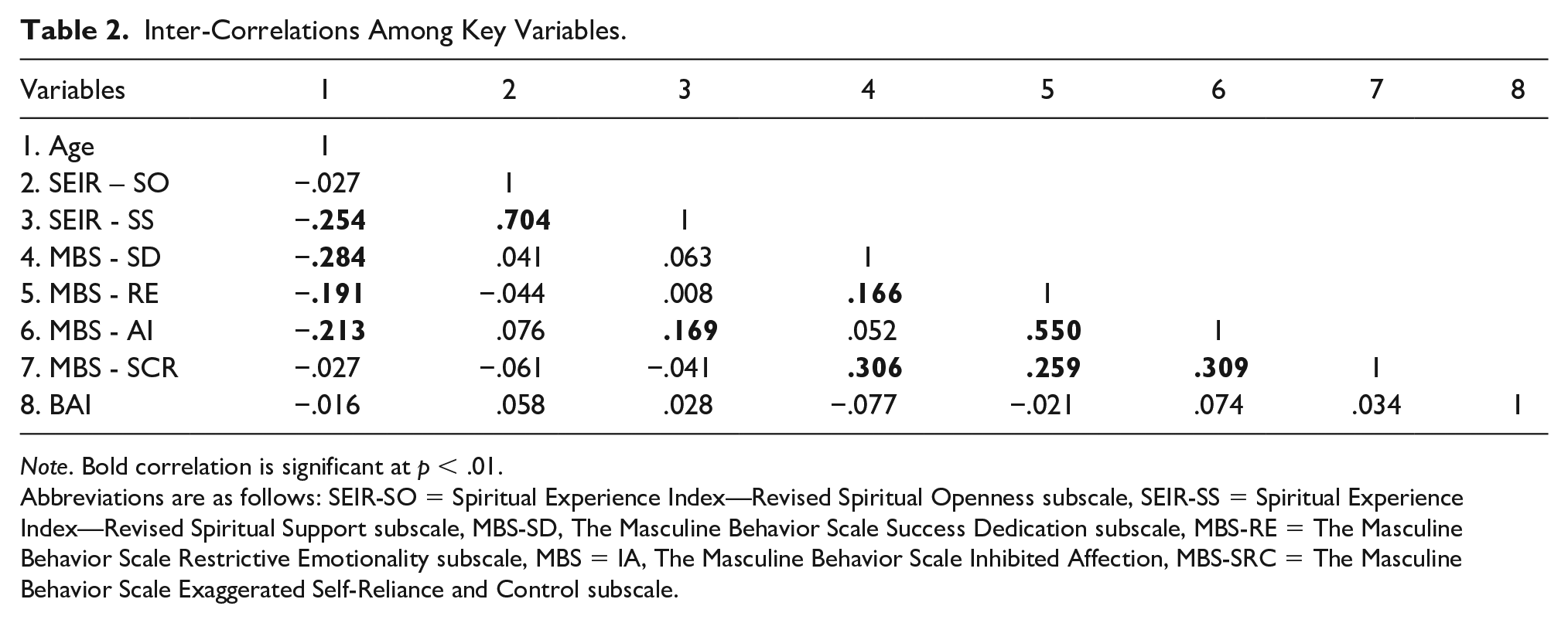
Note. Bold correlation is significant at p < .01.
Abbreviations are as follows: SEIR-SO = Spiritual Experience Index—Revised Spiritual Openness subscale, SEIR-SS = Spiritual Experience Index—Revised Spiritual Support subscale, MBS-SD, The Masculine Behavior Scale Success Dedication subscale, MBS-RE = The Masculine Behavior Scale Restrictive Emotionality subscale, MBS = IA, The Masculine Behavior Scale Inhibited Affection, MBS-SRC = The Masculine Behavior Scale Exaggerated Self-Reliance and Control subscale.
Moderation Analysis
Overview
The interactive effects of spiritualism (openness and support) and four stereotypical masculine behavior subscales in predicting anxiety were examined using eight separate hierarchical regressions. The hypothesis was examined using the four subscales of stereotypical masculine behavior against the two subscales of spiritualism. To avoid multi-collinearity, Spiritual Support, Spiritual Openness, Success Dedication, Restrictive Emotionality, Inhibited Affection, and Exaggerated Self-Reliance and Control were mean-cantered and multiplied to complete the interaction term (Tabachnick & Fidell, 2013). The main effect of (mean-centered) Spiritual Openness and one of the four subscales of Masculine Behavior Scale were entered for step one. This was followed by their interaction term at step two. This method was then repeated for Spiritual Support.
No significant effect of the interaction between either Spiritual Openness or Spiritual Support and the stereotypical masculine behaviors of Success Dedication, Restrictive Emotionality and Inhibited Affection were found on anxiety and were not further reported.
Table 3 displays R2, R2 change and adjusted R2 at each step for the hierarchical regression of Spiritual Support as a moderator of the relationship between Exaggerated Self-Reliance and Control and anxiety. The regression equation at step one with the entry of the two variables (Spiritual Service and Exaggerated Self-Reliance and Control) is R2 = .002, F (2, 328) = .33, p > .05, suggests the two variables did not significantly contribute to the variance in anxiety. When the interaction term was added at the final step of the regression equation R2 = .02, F (1, 327) = 5.93, p < .05, it indicated the interactive effect of Spiritual Support and Exaggerated Self-Reliance and Control on anxiety added to the variance. The interaction term explained 14% (p < .05) of the variance in anxiety. With all the variables accounted for in the model, the accumulative proportion of variance explained in anxiety was 20% (adjusted R2 Squared = .11).
Hierarchical Regression for SEIR-SS and MBS-SRC.

Note. SEIR-SSxMBS-SRC = Interaction Term.
p < .05.
Figure 2 presents the simple slopes for the significant moderation effect between Spiritual Support and Exaggerated Self-Reliance and Control in predicting anxiety. For men who were high in Spiritual Support, the relationship between Exaggerated Self-Reliance and Control and anxiety was positive. For men who were low in Spiritual Support, the relationship between Exaggerated Self-Reliance and Control and anxiety was negative. For men high in Spiritual Support, high Self-Reliance predicts high anxiety and low Self-Reliance predicts low anxiety. For low Spiritual Support men, low Self-Reliance predicts mean anxiety levels while high Self-Reliance predicts low anxiety levels.

Interaction between Spiritual Support and Exaggerated Self-Reliance and Control in predicting anxiety.
Table 4 displays R2, R2 change, and adjusted R2 at each step for the hierarchical regression of Spiritual Openness as a moderator of the relationship between Exaggerated Self-Reliance and Control and anxiety. The regression equation at step one with the entry of the two variables (Spiritual Openness and Exaggerated Self-Reliance and Control) is R2 = .01, F (2, 328) = .78, p = .46, suggesting the two variables did not significantly contribute to the variance in anxiety. When the interaction term was added at final step of the regression equation, R2 = .04, F (1, 327) = 101.58, p < .001, indicated the interactive effect of Spiritual Openness and Exaggerated Self-Reliance and Control on anxiety added to the variance. The interaction term explained 17% (p < .001) of the variance in anxiety. With all the variables accounted for in the model, the accumulative proportion of variance explained in anxiety was 36% (adjusted to 27%).
Hierarchical Regression for SEIR-SO and MBS-SRC.

Note. SEIR-SOxMBS-SRC = Interaction Term.
p < .01.
Figure 3 presents the simple slopes for the significant moderation effect between Spiritual Openness and Exaggerated Self-Reliance and Control in predicting anxiety. For men who were high in Spiritual Support, the relationship between Exaggerated Self-Reliance and Control and anxiety was positive. For men who were low in Spiritual Openness, the relationship between Exaggerated Self-Reliance and Control and anxiety was negative. For high Spiritual Support men, high Self-Reliance predicted high anxiety and low Self-Reliance predicted low anxiety. For low Spiritually Open men, low Self-Reliance predicts low anxiety levels while high Self-Reliance predicts low anxiety levels.
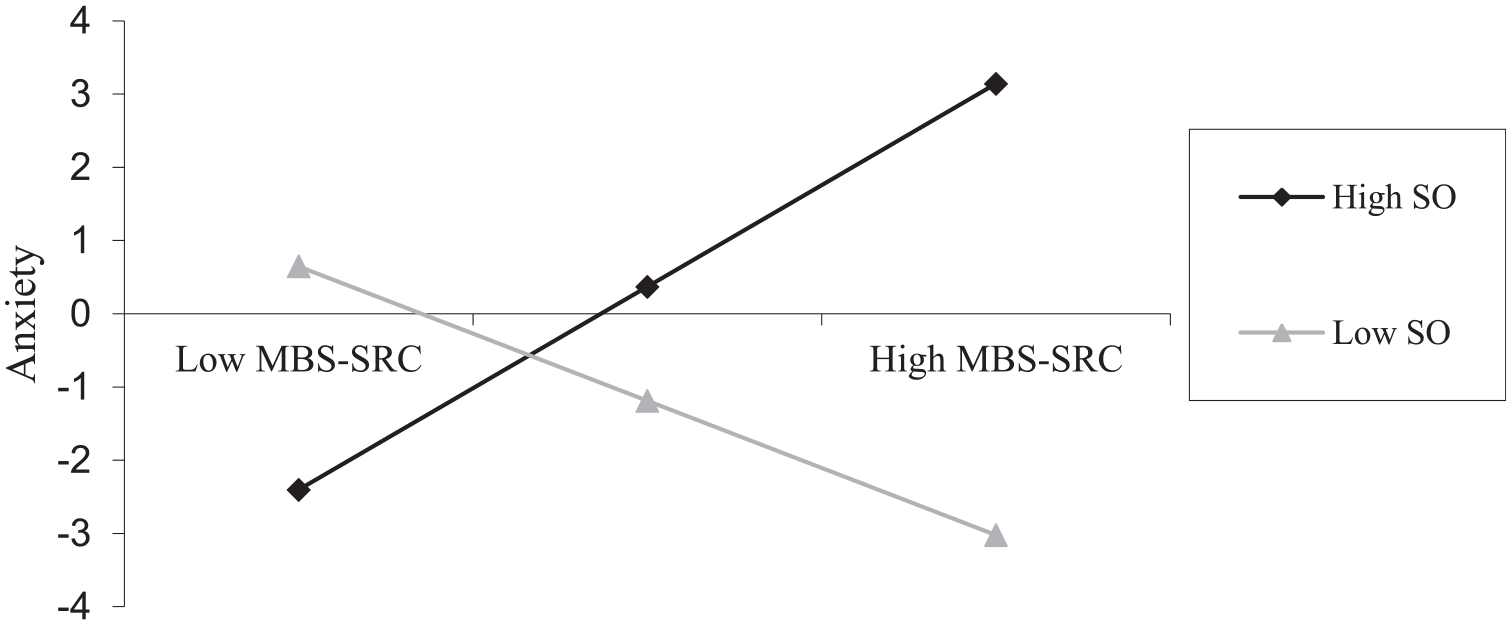
Interaction between Spiritual Openness and Exaggerated Self-Reliance and Control in predicting anxiety.
In sum, the study’s hypothesis was partially supported as Spiritual Support was able to moderate anxiety when Spiritual Support was high and Exaggerated Self-Reliance and Control was low, and also when Spiritual Support was low and Exaggerated Self-Reliance and Control was high. Furthermore, low levels of Spiritual Openness moderate anxiety at high and low levels of Exaggerated Self-Reliance and Control. Low levels of Spiritual Support were able to moderate anxiety at high Exaggerated Self-Reliance and Control.
Discussion
This study aimed to investigate whether two aspects of spiritualism (Spiritual Openness and Spiritual Support), and masculinity variables (Success Dedication, Restrictive Emotionality, Inhibited Affection, and Exaggerated Self-Reliance and Control) were related to anxiety. Additionally, the study investigated whether spirituality moderated the relationships between masculinity and anxiety. Contrary to hypothesis one, neither masculinity nor spirituality were significantly related to anxiety. In partial support of hypothesis two, two significant moderation models were found where Spiritual Support and Spiritual Openness both interacted with Masculine Exaggerated Self-Reliance and Control to predict anxiety.
In contrast to previous research, none of the masculinity subscales (Berke et al., 2018; Vandello et al., 2010), nor spiritual openness or support (Koenig, 2009; Saunders et al., 2014) were related to anxiety. This suggests that high levels of the more hegemonic masculinity traits and behaviors as measured by the MBS do not relate to increased anxiety. It also suggests that higher spiritual openness and spiritual support do not relate to lower anxiety. These unexpected findings are particularly interesting in light of the moderation effects found, where some combinations of masculinity and spiritualism combined to effect anxiety in the absence of any effects of the variables independently.
Spiritual Support and Exaggerated Self-Reliance and Control
In partial support of the hypothesis, there was an interaction effect between Spiritual Support and Exaggerated Self-Reliance and Control on anxiety. Unexpectedly, the interactions were complex and could not simply be explained as high spiritualism buffering masculinity’s effects on anxiety. For men who were high in Spiritual Support, the relationship between Exaggerated Self-Reliance and Control and anxiety was positive. For men who were low in Spiritual Support, the relationship between Exaggerated Self-Reliance and Control and anxiety was negative. The interaction effect appeared to present four profiles for predicting anxiety; (1) Highest Anxiety; highly spiritually supported men who had high Exaggerated Self-Reliance and Control beliefs, (2) Low Anxiety; highly spiritually supported men who had low Exaggerated Self-Reliance and Control beliefs, (3) Low Anxiety; low spiritually supported men who had high Exaggerated Self-Reliance and Control beliefs, and (4) Mean Anxiety; low spiritually supported men who had low Exaggerated Self-Reliance and Control beliefs. Each profile is discussed below.
Being high in both Spiritual Support and Exaggerated Self-Reliance and Control appeared to predict very high anxiety. This profile appears to be the most problematic. These men identified strongly with their faith and felt emotionally supported by it. They were also high in the need to be self-reliant and in control of their environments. As such they were spiritually open to support but in terms of their masculinity, they were closed off and self-reliant. It appeared that the interaction between these two potentially incongruent belief systems resulted in anxiety (Haslam et al., 2004; 2005). These two beliefs may cause stress and anxiety in situations and contexts where they are incompatible. The pressure to maintain a self-sufficient, masculine and spiritually present façade could in fact lead to greater gender role strain, and consequently the anxiety in the face of spiritual support (Snell, 1989). It appears that high levels of both Spiritual Support and Exaggerated Self-Reliance and Control are conflicting in terms of locus of control. It may be the lack of congruence in aspects of personality and belief systems that predicts anxiety rather than the aspects themselves. It might also be that these men seek out spirituality in an unsuccessful attempt to alleviate the stress caused by trying to live up to unrealistic masculine ideals of self-reliance and control.
Men with both high Spiritual Support and low Exaggerated Self-Reliance and Control had low anxiety levels. It appears that these sets of beliefs and behaviors are more congruent and result in low anxiety. These men feel supported by their faith and are also more open to and behave in ways to receive help based on their masculine ideals and behaviors. As identity characteristics intersect to influence anxiety and wellbeing in general, it appears that this intersection is functional and supports mental health (Christensen & Jensen, 2014). Spiritually supported men who do not adhere to stereotypically masculine behaviors of self-reliance and control may feel more comfortable placing their faith in Externalized LOC and relinquishing some control (Galvin et al., 2018; Limajatini et al., 2019; Lowe, 2019). Knowing an outcome is part of a bigger force may reduce their personal responsibility for that outcome, thereby reducing anxiety (Merluzzi & Philip, 2017). Having trust in this external being while simultaneously benefitting from not having to adhere to a concept of masculinity that requires them to be in control all the time, may generally reduce anxiety in these men.
Men who strongly adhere to stereotypical masculine behaviors of Exaggerated Self-Reliance and Control but have low levels of Spiritual Support also had low levels of anxiety. It appears that not feeling supported by faith and believing that men do not need or should not need support are congruent and result in low anxiety. Interestingly, and based on previous research, the combination of high levels of this hegemonic masculine trait along with low levels of perceived spiritual support should be predictive of poor mental health and higher anxiety. It may be that the congruence of these identity intersections is more important than the beliefs themselves. It may also be that while high spirituality can be supportive, low spirituality can represent a lack of investment in that sphere rather than a deficit. Further research is needed to see if this result is consistent in relation to measures of wellbeing other than anxiety.
Men who were not spiritually sustained and supported, and who had low Exaggerated Self-Reliance and Control, exhibited a mean level of anxiety. These men may be open to and benefit from increased spiritual support as it would be congruent with their lower masculine need to be independent and in control.
Spiritual Openness and Exaggerated Self-Reliance and Control
This significant interaction effect was very similar to the spiritual support result and produced four anxiety profiles. Men who were high in both Spiritual Openness and Exaggerated Self-Reliance and Control behaviours were high in anxiety. These men believe that faith is not a narrow singular spirituality but rather there are multiple perspectives. These men are less judgmental of opposing or different spiritual outlooks. This appeared to conflict with a masculine belief in self-reliance and self-control, causing anxiety. These men may experience identity strain from having two conflicting belief systems; a dogmatic, rigid belief system and behaviors associated with masculinity, and an open belief system associated with being spiritually open, and consequently experience high anxiety. Research also suggests that dogmatism has been linked to discomfort when one’s beliefs are challenged (Carlucci et al., 2020).
Men who had congruent Spiritual Openness and masculine Self-Reliance behavior levels (i.e., high/low and low/high levels) had low anxiety levels. Similar to the study’s evaluation of Spiritual Support, being more open in one’s spirituality is anxiety lowering for men who are also open to external support and have less need for control. Where this masculinity trait is high, a more closed and narrow spirituality results in lower anxiety.
Spiritual Openness may also protect against Exaggerated Self-Reliance and Control at low levels due to its negative correlation with dogmatic thinking (Genia, 1997). Again, as there is only one strong identity, spiritualism could be a protective influence because it creates a less stereotypical masculine identity with less pressure to conform (Jurkovic & Walker, 2005). Further, Spiritual Openness concerns one’s openness to divergent beliefs, specifically the belief that ideas from faiths different than one’s own may increase one’s understanding of spiritual truth. Individuals who are high in the openness trait are generally associated with having less anxiety (Kaplan et al., 2015).
Men who were both low in Spiritual Openness and Exaggerated Self-Reliance and Control had a mean level of anxiety which again yielded a number of different possible explanations. Men without a protective faith system (or openness about the existence of multiple faith systems) who do not strongly adhere to masculine stereotypes could lack a strong sense of identity, and therefore benefit from gaining spiritual openness.
There was no significant interactions between the other three masculine behaviors traits measured. In addition, there appeared to be no direct effects of masculinity or spirituality on anxiety. In contrast to past research, these results suggest masculine behaviors and spirituality of themselves do not predict anxiety. Instead, it appears incongruence or conflict between belief systems and between beliefs and behaviors causes dissonance and high anxiety. For example, the negative effects of having Success-Dedication or ambition might not be moderated by being more spiritual due to these men still having a strong sense of personal responsibility to succeed. Believing in a God does not mean a man should be passive in their success (Park, 2005), therefore there is no conflict between belief systems. Similarly, the lack of an interaction effect for Restrictive Emotionality and Inhibited Affection could be due to the similar internal expression styles associated with both concepts.
Implications
When working with men, it may be important to consider the congruence between their behaviors and belief systems. Spirituality may buffer masculine anxiety in some cases but not others. The efficacy of increased spiritual support and openness as a protective factor for masculine anxiety may be dependent on the man’s particular masculine beliefs around self-reliance and control. When addressing spiritualism, it appears that this aspect of masculinity must also be considered. In particular, it appears that men who are more open to support from others in general are also more open to and more likely to benefit from higher levels of spirituality. Those wanting to promote better mental health through promoting spirituality need to consider men’s masculine needs and behaviors relating to control and accepting external support.
Limitations
There are several limitations of this study. Firstly, reporting on phenomena such as masculinity is hard to conceptualize, as this term has multiple diverse definitions and interpretations. This divergence may not have been sufficiently captured in self-reports. Further, given the lack of significant associations between some stereotypical masculine behaviors and anxiety, it is that possible heterogeneous males may be increasingly questioning traditional gender roles (Kaya et al., 2019). Further research is required to understand emerging changes in traditional masculine identity and its relationship to anxiety.
Additionally, the cohort used in this study is not representative of a heterogeneous population sample. This is a serious limitation given the intersectionality of race, ethnicity, culture, gender, sexuality, and mental health. Further research should involve participants varying in location, ethnicity, cultural background, sexuality, and mental health levels.
Conclusion
This study was the first examine spirituality as a moderating factor in the relationship between adherence to masculinity and anxiety. One’s spiritual practice appeared to interact with the self-reliance and control facet of masculinity to effect anxiety. Of themselves, spirituality and masculinity had little effect on anxiety. It appeared that instead, an incongruence between masculinity and spiritual belief systems may predict high anxiety. It appears that the potential benefit of spirituality in reducing masculine anxiety is dependent on the man being more open to external supports, and having a lower need for control.
Footnotes
Acknowledgements
No
Author’s Note
This study obtained informed consent from participants and ethics approval from Victoria University Human Research Ethics Approval: HRE19-051
Declaration of Conflicting Interests
The author(s) declared no potential conflicts of interest with respect to the research, authorship, and/or publication of this article.
Funding
The author(s) received no financial support for the research, authorship, and/or publication of this article.
