




Abstract
This study aimed at examining social appearance anxiety levels of male nursing students and their coping attitudes and identifying the relationship between them. A cross-sectional research approach was adopted in a study population of 180; the sample comprised 129 students. Data were collected using a socio-demographic information form, the Social Appearance Anxiety Scale (SAAS), and the Assessment of Coping Attitudes Inventory (COPE). The average age of students was 20.54 ± 1.49 years. The male students’ average score obtained from the SAAS measure was 32.64 ± 13.07, while that of the COPE Inventory was 138.11 ± 14.47. Significant correlations were detected between students’ SAAS scores and COPE scale scores. There were negative relationships between social anxiety scores and COPE subscales of positive reinterpretation and growth (p < .05), use of instrumental social support (p < .05), active coping (p ≤ .01), and planning (p ≤ .01). In contrast, there were positive relationships between social anxiety scores and COPE subscales of mental disengagement (p ≤ .01), denial (p ≤ .01), behavioral disengagement (p ≤ .01), restraint (p ≤ .01), use of emotional social support (p < .05), substance use (p ≤ .01), and acceptance (p < .05). The conclusion was that male students who do not perceive themselves as having an ideal body image face high social appearance anxiety. There is a prejudice that social appearance anxiety has negative effects on these students’ self-confidence. In this context, this research revealed concrete results about how male nursing students have battled the prejudices that they have faced throughout their student life.
Social appearance anxiety is a type of social anxiety where stress or anxiety experienced when one’s physical appearance is evaluated by his or her social circle (Erdemir, Bağcı, Inan, Turan, & Erdemir, 2013; Hagger & Stevenson, 2010; Hart, Leary, & Rejeski, 1989). Social appearance anxiety is defined as “the fear that one will be negatively evaluated because of one’s appearance” (Levinson et al., 2013, p. 126). It is a concept that supersedes general physical appearance features, such as height, weight, and muscle structure, including more specific features such as shape of the face, distance between the eyes, and smile (Doğan, 2010, p. 151). Therefore, it encompasses a more detailed and holistic phenomenon rather than a general physical appearance. Social physique anxiety is mostly associated with perceived physical features. Individuals who have negative emotions and thoughts about body sensation and who are anxious about their appearance can often be seen dealing with too much of their daytime defects and constantly controlling themselves on reflected surfaces or comparing themselves with others. Thus, social appearance anxiety in young adults might have negative and serious effects on their future life (Argon, 2014; Çelik & Turan, 2014; Doğan, 2010; Yaman, 2017). Physical appearance is one factor of any person that influences the environment very easily. A physical appearance is the description of the physical properties of an object (Amil & Bozgeyikli, 2015; Dilger, Lütkenhöner, & Müller, 2015; Hernandez-Julian & Peters, 2017; Şahin, Barut, Ersanlı, & Kumcağız, 2014).
Both historically and currently, traits that include a beautiful or handsome appearance, in addition to being slim, healthy, well-built, and muscular, have been crucial considerations for individuals seeking to create a positive impact on others (Çelik & Turan, 2014; Doğan, 2010). Humans have an innate desire to be liked by other people and to belong to a group (self-presentational drive). When this does not occur, it leads to lack of self-esteem, poor body image, and social appearance anxiety. Ideal body presentation of the influence and thinness in media is improving social appearance anxiety. Social appearance anxiety has been found to be affected by the way the media portrays the ideal thin body type, resulting in negative self-evaluations (Doğan, 2010). Through television, newspapers, or magazines, the perfect face and body are constantly exposed. However, there is no single ideal body shape as this tends to differ by gender and culture (Doğan, 2011; Harper & Tiggeman, 2008; Trekels & Eggermont, 2017). The influence of mass media contributes to this as well and changes the adolescence’ feelings and eventually leading to social appearance anxiety (Doğan, 2010; Yaşartürk, Çalık, Kul, Türkmen, & Akyüz, 2014). However, it is believed that adolescence is when young people become more aware of the self as an independent person and are better able to evaluate body image (Brausch & Decker, 2014; Iannaccone, D’Olimpio, Cella, & Cotrufo, 2016).
An individual’s feelings, opinions, and perceptions about his or her body are described as “body image” (Doğan, 2011, p. 13). Body image is a complex, multidimensional phenomenon consisting of one’s attitudes, body-related cognitions, perception, affect, and behavior to one’s own physical appearance (Cash, Santos, & Williams, 2005, p. 191; Sabiston & Chandler, 2010, p. 165). If negative body image was low, positive body image would be high, and vice versa (Tylka & Wood-Barcalow, 2015). Negative body image describes the negative feelings, opinions, and perceptions about one’s body in general or in any proportion of body features, resulting in various perceptions, such as considering oneself much less attractive than others, feeling uncomfortable about one’s body, and being ashamed of one’s body (Doğan, 2010, p. 151; Goodbey & Courage, 1994, p. 190). On the other hand, positive body image describes the satisfaction and content an individual feels about his or her body (Doğan, 2010; Goodbey & Courage, 1994). Positive body image is a multidimensional construct that involves much more than body satisfaction or appearance evaluation (Tylka & Wood-Narcalow, 2015, p. 118). Positive body image is not a multidimensional construct that can be comprehensively assessed via a measure of body satisfaction or gauged by the extent individuals favorably view their appearance. If body image therapies reduce symptoms of negative body image, but do not enhance aspects of positive body image, they may promote a neutral body image at best (Tylka & Wood-Narcalow, 2015, p. 118).
Body image is important because it directly affects an individual’s self-esteem. Positive body image is associated with high self-esteem, while negative body image is associated with low self-esteem. Social appearance is considered a concern to be the result of an individual’s negative body image regarding his or her body and appearance (Doğan, 2010; Kaya, Öztürk, & Sarı, 2005; Oktan & Şahin, 2010).
The stage of youth, which generally spans the age group of 18–25 years, during which a person faces physical, cognitive, and social developmental issues, is one of the most turbulent and changeable stages of one’s life (Altunay & Öz, 2006; Özgüven, 1992). While negative body image has an influence on the quality of life and mental health in every stage of life, it occurs primarily in the youth stage (Nayir et al., 2016). This situation, which can be described as the individual’s interaction with his or her own body in a developmental stage, may evolve to be positive or negative as well. Especially for many men, the muscular ideal—one that can be described as being lean and tall, having broad shoulders, large pectorals and biceps, and well-defined abdominals—is associated with social benefits such as being perceived as strong, powerful, confident, and attractive. The internalization of this male ideal can lead many men to judge their own bodies against them often coming up short, as the male ideal is impossible for the majority of men to achieve, which may lead to the development of an unhealthy drive for muscularity (Edwards, Tod, & Molnar, 2014; Lamarche, Ozimok, Gammage, & Muir, 2017; Tiggemann, 2011). In addition to the characteristics inherent in the youthful stage, being a university student further increases the problems that youth experience. University life is generally viewed as having environmental characteristics that cause stress and anxiety in Turkey and other countries (Kılıç & Karakuş, 2016; Monteiro, Torres, Morgadinho, & Pereira, 2013; Özgüven, 1992; Turner & McCarthy, 2017). In this period, while individuals try to cope with the changes and developments occurring in their bodies, they simultaneously feel obliged to respond to the expectations of society and to accommodate themselves to social roles and norms (Aktaş, 1997; Argon, 2014).
As university students move to a larger, more impersonal education structure, interaction with peers from diverse geographical and ethnic backgrounds brings with it many challenges At the same time, in this process, body image is a complex and a multidimensional phenomenon that comprises attitudes, perceptions, and experiences, which a person undergoes with reference to his or her physical appearance (Dhurup & Nolan, 2014). Transition of students from a school environment to a university environment could cause psychological, academic, and social shock for many students. In this process, the subjects of body image and perceptions of fatness and slenderness have become central to western culture and values. Body image is culturally determined, and levels of body dissatisfaction differ between subcultures and ethnicity, since sociocultural factors play an important role (Dhurup & Nolan, 2014). These challenges pave the way for the development of coping attitudes for many young people. Having or using several coping attitudes to minimize the negative impacts of anxiety, stress-causing occurrences, or related influential factors or to eliminate these situations entirely is a universal attitude (Lawrence, Ashford, & Dent, 2006) in the development and prevalence of body dissatisfaction (Dhurup & Nolan, 2014).
“Coping” is a survival mechanism conceptualized as the sum of all cognitive, emotional, and behavioral reactions that an individual displays to resist the occurrences or factors that cause stress for himself or herself and to withstand these situations (Ağargün, Beşiroğlu, Kıran, Özer, & Kara, 2005; Cash et al., 2005). In any anxious situation, there is more than one option for coping strategies (Cash et al., 2005). Coping strategies refer to specific behavioral and psychological efforts used to cope with the negative consequences of stressful life events (Ağargün et al., 2005). These strategies are maintained through negative reinforcement to the extent that they provide temporary relief through escape and avoidance, thus minimizing discomfort (Cash et al., 2005; Lawrence et al., 2006). Coping attitudes that are not aimed at harmony/adjustment can make the solution of students’ problems much more difficult and complicated (Kaya & Kaya, 2009; Kılıç & Karakuş, 2016). In their youth, nursing students, in particular, encounter conflicts as university students, and they face several other problems caused by both the school and hospital environments (Ayyıldız et al., 2014). In high schools or nursing faculties, the majority of students are female; therefore, being a male student makes this ongoing process much more demanding and requires that they develop more effective coping attitudes (Kaya, Turan, & Öztürk, 2011; Turan, Öztürk, Kaya, & Aştı, 2011).
Nursing students experience high levels of anxiety. The clinical part of nursing education causes more anxiety than the theoretical part. In the hospital environment, nursing students have prolonged interactions with patients and their family as well as intensive practice cause an increase in their anxiety. Among university students, male students the nursing division constitute a special group. Turkish men entering the nursing profession encounter barriers that limit their choice of specialty and they risk being labeled and stereotyped. This is because Turkish society attributes different roles and responsibilities to males, especially in terms of gender, body image, and social roles. Traditionally, nursing care has been identified as profession for women. Therefore, nursing has been influenced by gender-related prejudices (Çınar & Olgun, 2013).
In the socialization process, impressions formed of male individuals, who are nursing professional candidates, about one another are also significant. An individual’s developmental task and possible sources of anxiety might disrupt his body image development and increase his social appearance anxiety. In this process, male students should develop attitudes to cope with the problems they are experiencing. As the coping style of male nursing students develops, the social appearance anxiety experienced due to body image will decrease (Yuceant &Unlu, 2017). In Turkey, the number of studies that are particularly aimed at determining male nursing students’ social appearance anxiety and coping attitudes is very scarce. To resolve this research gap, male nursing students’ social appearance anxiety and their coping attitudes were identified in the current study.
The specific aims of this study were to evaluate:
Students’ social appearance anxiety levels.
Students’ coping attitudes.
The relationship between students’ social appearance anxiety and coping attitudes.
Research Questions
What are the individual characteristics of students?
What are the students’ social appearance anxiety levels and their coping attitudes?
Is there a correlation between students’ social appearance anxiety and their coping attitudes?
Are the students’ social appearance anxiety levels different in terms of individual traits?
Do the students’ coping attitudes differ depending on their individual traits?
The Study
Aim
Social appearance anxiety is a potential factor that could affect a male student’s performance, health, attitude, and role satisfaction as a nurse. Understanding male students in nursing education, in the context of their coping strategies and their social appearance anxiety, is very important for any kind of planning in this field. The aim of this study was to determine male nursing students’ social appearance anxiety and their coping attitudes.
Design
The design was a one-group, observational correlational design with no control groups or interventions. Cross-sectional study design is a type of observational study design that examines any event within a certain period of time (Akgul, 2005; Erdoğan, Nahcivan, & Esin, 2014). In a cross-sectional study, the investigator measures the outcome and exposures in the study participants at the same time (Setia, 2016). This design type was chosen because the research questions and the research process were appropriate for observational correlational design.
Methods
The population was comprised of a total of 180 male nursing students registered at the Istanbul University Cerrahpasa, Florence Nightingale Nursing Faculty in the academic year 2014–2015. A stratified random sampling method was employed. Student registration numbers were used as assigned numbers. The investigators used a table of random numbers to select these assigned numbers to obtain potential participants. The sample population included 129 male nursing students who volunteered to participate in the study. We calculated the sample size of our research based on the study cited as “The study of the relationships between social appearance anxiety, self-esteem and loneliness level among university students” (Kılıç & Karakuş, 2015). Calculation was performed with 95% confidence interval and 80% power according to “Social Appearance Anxiety Scale (SAAS)” mean scores t test and SD, and sample size predicted 129. G Power 3.1.92 was used for the sample size calculation. The inclusion criteria for male students was voluntary participation in the survey.
Measures
Data were collected using the socio-demographic information form intended for male nursing students, the SAAS, and the COPE inventory.
Socio-Demographic Information Form: It involves questions about age, gender, height, weight, family type, work status, income status, place of residence, and smoking/alcohol consumption.
Social Appearance Anxiety Scale: The SAAS was created by Hart et al. (2008) to assess one’s social appearance anxiety, and its Turkish reliability and validity studies were performed by Doğan (2010). The scale contains 16 questions in total. The reliability of the SAAS was calculated by methods of internal consistency, including Cronbach’s α, split-half test, and test–retest. The internal consistency coefficient of the scale was .93, while the reliability coefficient calculated through split-half test was .88. To examine test–retest reliability, the scale was applied to the group of 86 students with a 2-week interval (Doğan, 2010).The correlation coefficient between the two applications was .85. Cronbach’s α coefficient for the scale was .909. The SAAS is measured on a 5-point Likert-type scale, with answers ranging from (1) not at all to (5) extremely. Reverse coding was applied to the first item of the scale. The higher scores obtained from the SAAS that unidimensionally examines social appearance anxiety demonstrated a high level of social appearance anxiety. The lowest and highest scores of the scale were 16 and 80, respectively (Doğan, 2010). In this study, Cronbach’s α coefficient was .909.
Assessment of Coping Attitudes Inventory (COPE): It was developed by Carver, Scheier, and Weintraub in 1989 and its Turkish validity and reliability study was conducted by Ağargün, Beşiroğlu, Kıran, Özer, and Kara in 2005. Cronbach’s α for the original subscales ranged from 0.45 (mental disengagement) to 0.92 (religious coping; Carver, Scheier, & Weintraub, 1989). It is a self-report scale including 60 items. Coping subscales are as follows: (a) positive reinterpretation and growth, (b) mental disengagement, (c) focusing on and venting of emotions, (d) use of instrumental social support, (e) active coping, (f) denial, (g) religious coping, (h) humor, (i) behavioral disengagement, (j) restraint, (k) use of emotional social support, (l) substance use, (m) acceptance, (n) suppression of competing activities, and (o) planning. There are four options to choose from in each item. The answers are as follows: (1) I never do this at all; (2) I do this a little bit; (3) I do this moderately; and (4) I often do this. Each subscale of the COPE provides information about a different coping attitude. The level of scores obtained from the subscales makes it possible to interpret the type of coping attitude that is employed by the individual. Active coping, planning, suppression of competing activities, restraint, and the use of instrumental social support are problem-oriented coping attitudes. Use of emotional social support, positive reinterpretation and growth, acceptance, denial and religious coping are emotion-oriented coping strategies. The strategies of focusing on the problem and venting of emotions, behavioral disengagement, humor and mental disengagement are less effective coping strategies. Cronbach’s α coefficient for the scale was .79 (Ağargün et al., 2005; Carver et al., 1989; Kaya & Kaya, 2009). In this study, Cronbach’s α coefficient was .787.
Ethical Considerations
Confirmation of approval was obtained from the Ethical Committee of Cerrahpasa Faculty of Medicine was obtained (Date: 18/02/2015 Issue: 41292). Participants who comprised the sample were informed about the aim and benefits of the study and their consent was obtained. No conflict of interest regarding this issue was identified. Students were informed that they had the right to leave at any stage of the study even though they had consented to participate. In addition, students were not exposed to any punishment or sanction and would not lose their right to education.
Analysis Strategy
IBM SPSS Statistics 22 (IBM SPSS, Turkey) was utilized for statistical analysis of the study’s findings. In the analysis, the compatibility of the parameters with the normal distribution was conducted using the Shapiro–Wilks test. Student’s t test was used for descriptive statistical methods (average, standard deviation, frequency), as well as for the intergroup comparison of data. A unidirectional ANOVA test was used for data comparison of more than two groups, whereas Tukey’s HSD and Tamhane’s T2 post hoc tests were utilized to determine the discriminant group. Pearson correlation analysis was used to assess the correlation between scale scores. A significance level of p < .05 was applied.
Findings
Students’ Individual Characteristics
The mean age of the students was 20.54 ± 1.49 (Min .= 17, Max. = 25) and the majority were single. In terms of body mass index (BMI), 69% were at normal weight. Students comprised of 41.1% second year (sophomores), 51.9% could make both ends meet (financial status), 34.9% lived in a dormitory, and 82.2% did not have any job. Moreover, 20.9% of them were smokers while 16.3% consumed alcohol.
Scores and Correlations Distributions of Male Nursing Students’ SAAS and the COPE Inventory
The students’ average score obtained from the SAAS was 32.64 ± 13.07, while that of the COPE Inventory was 138.11 ± 14.47. Average scores for the COPE subscales were 11.52 ± 2.22 for positive reinterpretation and growth, 9.81 ± 2.46 for mental disengagement, 10.16 ± 2.25 for focus on problem and venting of emotions, 11.56 ± 2.71 for use of instrumental social support, 11.38 ± 2.34 for active coping, 7.56 ± 2.78 for denial, 11.58 ± 2.92 for religious coping, 9.47 ± 3.01 for humor, 9.41 ± 1.99 for behavioral disengagement, 7.93 ± 2.80 for restraint, 9.93 ± 2.32 for use of emotional social support, 6.92 ± 3.12 for substance use, 9.76 ± 2.27 for acceptance, 10.01 ± 1.89 for suppression of competing activities, and 11.26 ± 2.66 for planning (Table 1).
Scores and Correlations Distributions of Male Nursing Students’ SAAS and the COPE Inventory (N = 129).
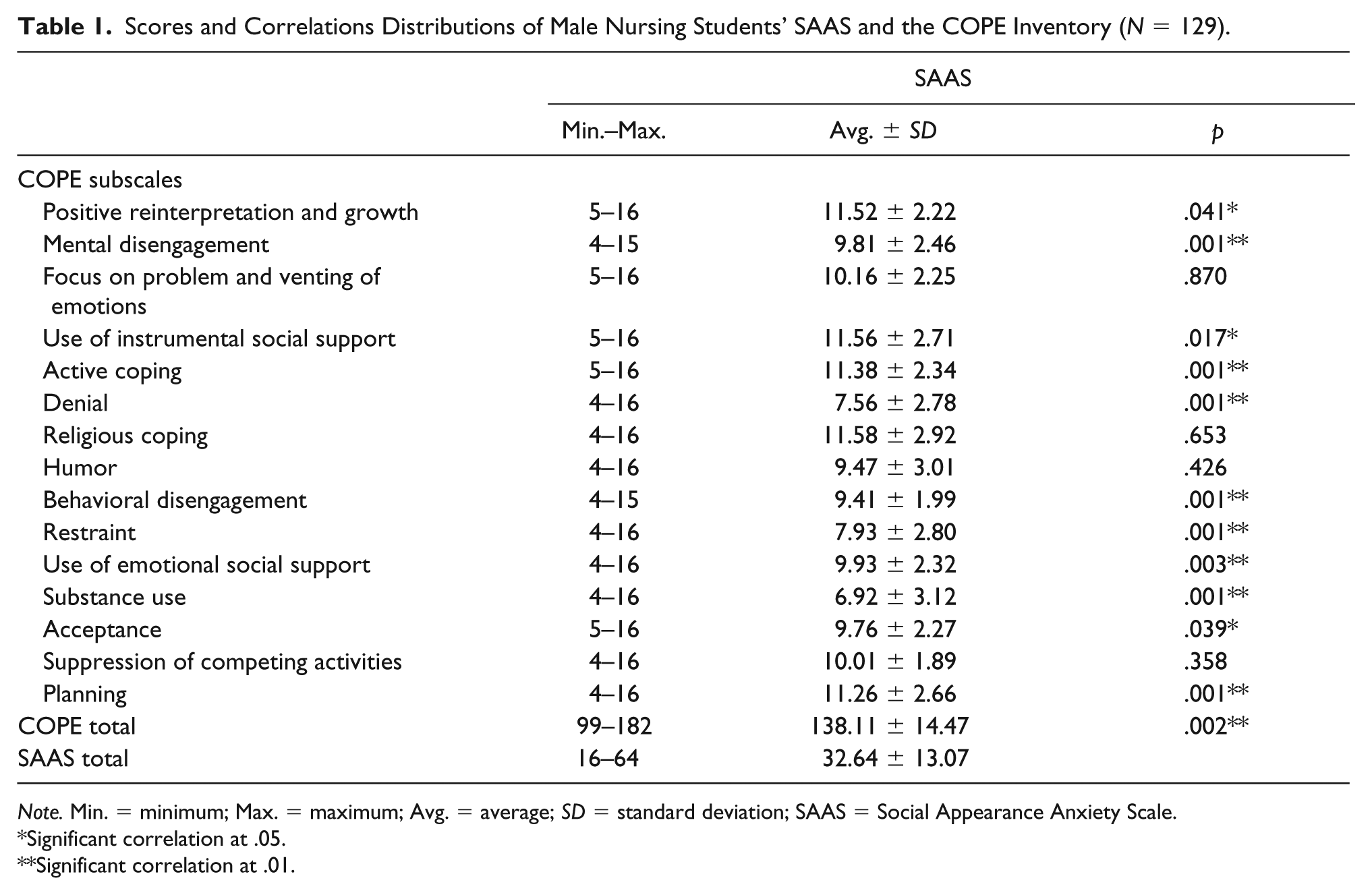
Note. Min. = minimum; Max. = maximum; Avg. = average; SD = standard deviation; SAAS = Social Appearance Anxiety Scale.
Significant correlation at .05.
Significant correlation at .01.
There were negative relationships between social anxiety scores and COPE subscales of positive reinterpretation and growth (r = −0.180, p < .05, weak); use of instrumental social support (r = −0.210, p < .05, weak); active coping (r = −0.329, p ≤ .01, medium); and planning (r = −0.364, p ≤ .01, medium). In contrast, there were positive relationships between social anxiety scores and COPE subscales of mental disengagement (r = 0.332, p ≤ .01, medium); denial (r = 0.542, p ≤ .01, strong); behavioral disengagement (r = 0.350, p ≤ .01, medium); restraint (r = 0.452, p ≤ .01, medium); use of emotional social support (r = 0.256, p < .05, weak); substance use (r = 0.381, p < .05; medium); and acceptance (r = 0.182, p < .05, weak [Table 1] Cohen, 1988).
Students’ Social Appearance Anxiety Levels and Coping Attitudes Based on Individual Characteristics
Male students aged 17–19 years were reported to have statistically higher average scores from COPE subscales of active coping and religious coping compared to 20- to 22-year-old students (p < .01). In contrast, their average scores of the denial subscale (p < .05) were statistically lower than those of the 20- to 22-year-olds (p < .01) and equal to and greater than those of the 23-year-olds (p < .05). Overweight/obese students’ total COPE and substance abuse subscale average scores were statistically higher than those of mildly obese/obese students (p < .05; p < .05).
The Grade 1’s COPE positive reinterpretation and growth average scores were statistically higher than those of Grade 2 (p < .05), while their average scores for the active coping subscale were high compared to second and Grade 3 (p < .01; Table 2). It was also reported that those who could not make both ends meet reported higher average scores from the COPE denial subscale compared to those who could do so (p < .05). Students living with their friends reported lower average scores in the COPE mental disengagement subscale (p < .05) compared to those living alone/with family (p < .05) and at the dormitory/with relatives (p < .05). Compared to the students living alone/with family (p < .05) and at the dormitory/with relatives (p < .05), those living with friends indicated statistically lower average scores from mental disengagement (p < .05; Table 2).
Comparison of SAAS and COPE Scores Based on Students’ Individual Characteristics (N = 129)

Note. Avg. = average; SD = standard deviation; BMI = body mass index.
Significant correlation at .05.
Significant correlation at .01.
Non-smokers’ average scores from positive reinterpretation and growth (p < .01), use of instrumental social support, and religious coping were statistically significantly higher compared to those who had such habits (p < .05). Male students with non-alcohol use reported statistically higher levels in religious coping average scores, unlike those who consumed alcohol (p < .01). Students in the 20- to 22-year-old group had statistically higher average scores in the COPE subscales of behavioral disengagement, restraint, and substance use compared to 17- to 19-year-old students (p < .01), whereas the latter reported statistically higher average scores in the planning subscale than 20- to 22-year-old students, 23-year-old students, and those above 23 years (p < .05, p < .01; Table 2).
Male students with overweight/obesity according to BMI standards were determined to have higher COPE total average scores and substance use subscale average scores at a statistically meaningful level, compared to weak/normal ones (p < .05). Students at the third-grade level were observed to have statistically higher scores in the COPE subscale of suppression of competing activities than the first and second graders (p < .05, p < .01). Students with smoking habits had reportedly higher average scores in the COPE subscale of restraint and substance use than non-smokers while alcohol users performed better in substance use average scores than those who did not drink alcohol (p < .01; Table 2).
Discussion
Social appearance anxiety is very important for male nursing students. This study reveals important results about the factors that affect social appearance anxiety and coping attitudes among male nursing students. Important findings that could guide education, research and practice have been obtained within the scope of this research.
Regarded as a type of social anxiety, social appearance anxiety is the anxiety and apprehension felt by individuals when their physical attributes are evaluated by other people. The current study demonstrated that students underwent social appearance anxiety. Male students experience social appearance anxiety because of their negative perceptions and evaluations regarding body image and appearance. Research documented that male college students are becoming more concerned about matters of physical appearance and are reporting a greater degree of negative body image than previous generations (Caraline, Howard, & Marc, 1993; Kılış & Karakuş, 2016). In a similar study conducted by Amil and Bozgeyikli (2015), university students reported low levels of social appearance anxiety and the findings resemble those of the current study. According this study, male students’ average score obtained from the SAAS was 32.03 ± 11.01, female students’ score was 31.48 ± 12.33. There was no significant difference between male and female students in terms of their social appearance anxiety levels. Şahin et al. (2014) reported that females’ SAAS score was 35.71
Coping attitudes include specific behavioral and psychological endeavors to combat the negative impacts of events or factors causing stress. These efforts and attitudes help individuals to sustain their mental harmony during the anxiety period (Ağargün et al., 2005). Students of the current study were seen to have coping attitudes at a medium level. This finding engendered the idea that students try to enhance their coping attitudes to be able to reduce their social appearance anxiety (Brosof & Levinson, 2017).
The higher the students’ social appearance anxiety levels, the lower the scores from positive reinterpretation and growth, use of instrumental social support, active coping, and planning. The literature shows that anxiety at mild levels increases attention level, courage, and enterprise, while at higher levels it reduces one’s perception and decision-making abilities (Çiftçi, Aydın, & Karataş, 2016). The findings of the current study are consistent with the literature in this respect, because they emphasize that students’ social appearance anxiety has negative impacts on their cognitive skills (Levinson & Rodebaugh, 2015).
Students in the 17- to 19-year age group reported higher scores for COPE subscales of active coping, denial, and religious coping compared to students aged 20–22 years. The stage of life that university students experience is of great importance for their body image. Rapid physical, social, and emotional changes that occur in adolescents may result in negatively affecting the establishment of a healthy body image. Adolescents that fail to develop a healthy body image are at risk of psychological disorders such as low self-esteem, depression, eating disorders, body dysmorphic disorder, and social phobia (Şahin, Barut, & Ersanlı, 2013).
Overweight/obese student groups reported higher scores for COPE total and substance abuse compared to students who were mildly obese/obese. Weight in early life is likely carried over into adulthood, since approximately one-third (26%–41%) of preschool obese children, half (42%–63%) of school-age obese children, and up to 70% of obese adolescents become obese adults. At the same time, the social anxiety of obesity entails prolonged exposure to related risk factors (Pirgon, Sandal, Gökçen, Bilgin, & Dündar, 2015). Then, substance abuse starts at this age, and teenagers are also extremely susceptible to psychosocial influences (Denoth, Siciliano, Lozzo, Fortunato, & Molinaro, 2011). This finding shows that substance use is one way of coping among overweight male students.
The study suggests that the higher the grade level is, the lower the positive reinterpretation levels become. Studies indicate a decline in social appearance anxiety along with ageing (Yıldırım et al., 2011; Wittchen & Fehm, 2003). In a study conducted by Wittchen and Fehm (2003) with university students, students studying at lower grades were observed to suffer from higher levels of social anxiety. Another study conducted by Yıldırım, Çırak, and Konan (2011) shows that freshman teacher candidates reported meaningfully high levels of social anxiety compared to senior students (the Grade 4). This study’s findings support such literature.
Social support is very crucial for individuals to maintain their health in case of physical and psychological illnesses. The literature indicates that natural support systems play a great role in facilitating the solutions of psychological problems or in making social support more demanding (Atik, Atik, Asaf, & Cinar, 2015). Participant students of the current study who live with their friends were identified to have lower average scores in the COPE subscale of mental disengagement than the other students, a finding that shows that students’ social relationships affect their anxiety level.
It is claimed that tobacco and alcohol addicts, in terms of psychodynamics, tend to have orality properties such as dependence, insecurity, inability, powerlessness, and passivity emotions. They also have oedipal properties, exhibiting timidity, shyness, guilt, and sinfulness (Gülseren, 2004). This study shows that non-smoker students had higher scores in the COPE subscales of positive reinterpretation and growth, use of instrumental social support, and religious coping than those who smoke. Furthermore, the students who did not consume alcohol obtained better average scores for religious coping. A similar study notes the effects of smoking and alcohol abuse on social appearance anxiety (Atasoy, Karabulut, & Yalçinkaya, 2010).
Students aged 20–22 years had higher scores in behavioral disengagement, restraint, and substance use than those aged 17–19 years. Özarslan, Fıstıkçı, Keyvan, Uğurad, and Saygılı (2013) observed that these three attitudes were found more among depressive patients. This finding demonstrates that male students, especially in the youth stage, experience regression in their skills of planning, acting, and seeking solutions because of social appearance anxiety and loss of motivation, and this leads to behaviors of disengagement, restraint, and substance use. The average scores of the planning subscale that 17- to 19-year-old students achieved were higher than those of the 20–22 and 23 and over age groups. Likewise, Mıstık, Unalan, Kaya, Karaduman, and Tokgöz (2016) determined a negative correlation between age and the COPE subscale of planning.
Overweight/obese students had higher COPE total average scores and substance use subscale scores compared to those with weak/normal weight. It is more demanding for students with high BMI to control their consumption, determine adequate portions, and maintain healthy body weight. Nutrition is often used as a way to cope with problems when faced with negative emotional states, especially sorrow (Abraham, Noriega, & Shin, 2018). In addition to appearance anxiety, it causes problematic behaviors, such as overeating, binge eating with high calories, night eating, and substance use (Collins & Bents, 2009; Gülseren, 2004).
Compared to the first and second graders, students at the third-grade level were determined to have higher average scores in the COPE subscale of suppression of competing activities. This finding bolsters the premise that progression through education levels increases individual and professional knowledge and thereby enables students to discover themselves, to be aware of their emotions and professional capabilities, and to better cope with their anxiety (Tavlı & Ünsal, 2016).
Students who smoke were reported to have higher average scores in the COPE subscales of restraint and substance use, while those consuming alcohol reported higher average scores only from substance use compared to non-users. The literature suggests that substance and alcohol use are shown to help cope with stress (Witkiewitz et al., 2012). Additionally, coping attitudes and tendency for substance use are significantly correlated (Chelf & Ellis, 2002). This finding is consistent with the literature.
Implications of the Study to Policy, Research, and Education
Male nursing students are getting increasingly involved in the nursing profession, but the majority of nurses are female. In our country, the number of men who prefer entering the nursing profession is quite small. In addition, it is not considered to be usual and profession in nursing. For this reason, there is a prejudice against male nurses in both social and educational environments. These prejudices create negative effects on the male nurses’ self-confidence. In this context, our research has revealed concrete results about how male nursing students have battled these prejudices they have faced throughout their student life. In particular, no studies have been found in the literature related to this subject. They might have many practical benefits for nurse educators, guidance and psychological counseling services. In this respect, it will be ensured from directors of faculty that the education programs were restructured, the coping attitudes were strengthened, and the relevant students were directed to the university’s psychosocial guidance department. In addition, the study will contribute to an increase of knowledge in the literature on male nursing students, and sharing of the results of this research will contribute to an increase in awareness on this issue.
Study Limitations
This study explored the social anxiety levels and coping attitudes of male nursing students studying in a nursing faculty and the relationship between them. The study has revealed concrete results about how male nursing students have battled with prejudices they have faced throughout their education life. This study is a non-experimental design. In a cross-sectional study, research measurements are obtained during a single data collection. The participants are monitored for a very short time. Most of these researches are descriptive. Therefore, they do not show the cause-effect relationship sufficiently (Akgul, 2005; Erdoğan et al., 2014). The main limitation to our study is that it was conducted in only one faculty whose male nursing students were our study’s participants. The results of the study are specific to one faculty of nursing.
Conclusion
There are many reasons why male students may identified to experience such as their negative perceptions and evaluations regarding body image and appearance. Male students try to cope with body image threats or challenges. As a result, male students who do not perceive themselves as having an ideal body image face high social appearance anxiety and consequently a decrease in their self-esteem. The current findings add significantly to the literature on male gender differences in body image issues, and provide evidence for examining contingent self-esteem as contributing to social appearance anxiety in male nurses. At the same time, this study also demonstrated that male nurses adopted different coping attitudes. Because of these factors, the findings could be of considerable relevance to intervention practitioners. In line with these findings:
Male nursing students should be addressed and evaluated across all dimensions (biophysical, sociocultural, environmental, and politico-economic);
Studies of this kind should be conducted in the psychological counseling centers of the universities; and
If necessary, guidance and counseling programs should be established.
Footnotes
Authors’ Contributions
All authors were involved in the conception and design of the study and the acquisition, analysis, and interpretation of data. They approved the final version of the manuscript for submission.
Declaration of Conflicting Interests
The author(s) declared no potential conflicts of interest with respect to the research, authorship, and/or publication of this article.
Funding
The author(s) received no financial support for the research, authorship, and/or publication of this article.
