



Abstract
In Hong Kong, males constituted only about 10.2% of the nursing workforce in 2010. The learning experiences of male nursing students in Hong Kong during their clinical practicum have rarely been explored. If these students cannot maintain their psychological well-being and psychological health in formal education and clinical placements, then their physical health will also suffer. This ethnographic qualitative study gave male nursing students in Hong Kong a chance to voice their experiences during their clinical practicum. Selected through snowball sampling, 18 male nursing students from a local university participated in individual face-to-face semistructured interviews. The data were processed with content analysis. The findings indicated that male students not only received more support and understanding from male rather than female members of staff but endured a certain amount of oppression while working in female wards. According to the students’ comments on nursing culture, the work climate of male nursing students could be improved by reorganizing the clinical placements and providing extra support to male nursing students.
Due to the comparatively low proportion of males admitted to the profession in many countries, nursing is inevitably categorized as a female-dominated career. Taking the United Kingdom and the United States as examples, males made up only 10.69% and 6.6% of those joining the profession in 2008 (Nursing & Midwifery Council, 2008; U.S. Department of Health and Human Services, 2010). This is similar to the situation in Hong Kong, where males constituted only about 10.2% of the nurses in the workforce in 2010 (Hong Kong Department of Health, 2010).
Some nursing students stated that the mass media had an obvious impact on the societal perception of nursing as a female occupation (O’Brien, Mooney, & Glacken, 2008). Culture is another key factor that should not be neglected. Indeed, gender roles are constructed by culture (Allen, 1996). Using Hong Kong as an example, people living in this patriarchal society have insisted that nursing should be performed by females because they view nursing as a female occupation (Westwood, Mehrain, & Cheung, 1995). In Australia, the view is similar (Inoue, Chapman, & Wynaden, 2006). With regard to historical perspective, the founder of modern nursing, Florence Nightingale, molded female characteristics into nursing (Evans, 2004). For the above reasons, the label of nursing as a female profession is deeply embedded in the public’s mind.
Although no official statistics are available to determine how the local Hong Kong community accepts male nurses, there is a great deal of evidence showing that a number of male nursing students have experienced various gender-related inequities in their clinical placements. Some worried that they were not welcomed by the staff (Keogh & O’Lynn, 2007), whereas some were treated unfairly by the clinical staff, for example, by being appointed to do certain kinds of work just because they are male nurses (O’Lynn, 2004). Furthermore, studies have drawn a link between cultural problems and the difficulties that male nurses have experienced in providing intimate care for female patients (Inoue et al., 2006; Kulakac, Ozkan, Sucu, & O’Lynn, 2009). Throughout the placement, male students had negative emotions because of stereotyping (Meadus & Twomey, 2011). Some of them even thought that the isolation that they experienced in clinical settings was a reason for quitting the nursing program (Stott, 2007). Different styles of supervision in clinical practice were reported to be favorable for different genders (Arvidsson, Baigi, & Skärsäter, 2008). The phenomenon appears to be a global one. According to a study conducted in Egypt, male students experienced various sources of stress during their maternal clinical practice, resulting in more than half of the male students preferring to care for patients of the same gender as themselves (Eswi & Sayed, 2011). Such a situation was also observed in Taiwan (Tzeng, Chen, Tu, & Tsai, 2009). One of the stressors highlighted in this study was the refusal of care from female patients. For example, a study conducted in Pakistan reported that male students encountered difficulties in communicating with and caring for female patients (Fooladi, 2008). An earlier study conducted in the United States also reported that male nursing students experienced interpersonal conflicts in the workplace (Pines et al., 2012). Unfortunately, the study did not explicitly provide possible reasons for that finding.
The above-mentioned Western and Asian studies showed that (a) nursing is a female-dominated career, (b) this phenomenon may be because of public perceptions as shaped by the mass media and culture, and (c) male nursing students experienced various kinds of stress in clinical placements because of gender inequities. To maintain the health of male nursing students, their physical, social, and psychological well-being should be considered. If they have low self-esteem or a negative self-image during their studies, they may experience mental distress and subsequently fall physically ill (Brewer, 2011; Janzen & Kelly, 2012). The aim of this study was to enhance the psychological well-being of male nursing students by giving voice to this minority group, so as to achieve the goal of holistic care for all.
Furthermore, although there have been several recent studies in the West exploring the clinical placement experiences of male nursing students (Fooladi, 2008; Kulakac, Ozkan, Sucu, & O’Lynn, 2009), to date similar studies are lacking in Hong Kong. Since there may be some specific elements of Hong Kong or Chinese culture that contribute to a unique clinical context, this study also aimed to explore the experiences of Hong Kong male nursing students in clinical settings and to determine how their experiences compared with those from other countries. With the help of the findings, it is hoped that ways can be found in this study to improve the work climate for male nursing students in clinical settings.
Method
Design
Ethnography, a qualitative research method, was employed in this study to explore the clinical practicum from the perspectives of male nursing students. Ethnography typically involves a wide range of data collection methods, such as participant observations, reviews of documents, and participant journals. Sometimes, interviews alone are used as an ethnographic method (Das, Das, & Das, 2012; Johnson, Goss, Beckerman, & Castro, 2012), and this study also adopted interviews to collect data. The aim in ethnography is to investigate the lives or lived experiences of a group of people in order to understand a certain culture (Chan & Chan, 2010; Lam & Chan, 2011; Saldaña, 2011). As mentioned above, the gender stereotypes in nursing could be influenced by the culture of nursing (Allen, 1996). Consequently, ethnography is a suitable approach for this research. This study was granted ethical approval from the authors’ affiliation. To ensure that all the topics were covered for all the participants and to facilitate the interview, an interview guide was drawn up. See Table 1 for a sample of the interview guide.
Sample of the Semistructured Interview Guide.

Participants
In spring 2012, 18 male full-time nursing students were invited to participate in a semistructured interview. To be eligible to participate in the study, the participant had to fulfill the following criteria: male, in the second to fourth year of nursing studies in a local university, and with at least 35 days of clinical placements. The participants were invited by researchers through snowball sampling without the use of any incentives, since this sampling method is suitable for use in inviting those from minority groups (Sadler, Lee, Lim, & Fullerton, 2010). We originally invited 24 students, but 6 of them declined to participate. We followed the ethical principle of voluntary participation and respected their right of autonomy. All (n = 18) the participants were of Hong Kong origin, spoke Cantonese as their primary language, and ranged in age from 21 to 28 years. Fourteen participants were in their third year of nursing studies. Three participants were in their final year. One participant was in his second year of studies. The average number of days of clinical placement was 88, and the participants were from multiple sites. See Table 2 for detailed information on the participants.
Characteristics of the Participants.

Procedure
The individual face-to-face interviews were conducted in different classrooms in a university. Before the interview, all the participants had read and signed the consent form for the study, including their agreement on the use of an audio recorder. With the use of an information sheet, two trained Chinese interviewers then explained the research objectives to the participants and subsequently conducted each interview using a guide to the semistructured interview. The interview began with basic and less sensitive questions, followed by more detailed and in-depth questions aimed at testing the appropriateness of the questions and encouraging the interviewees to open up about their experiences during their clinical practicum. If necessary, the interviewer asked follow-up questions and sought clarifications. The interviews lasted an average of approximately 1 hour. All the conversations were audiotaped for transcription.
Data Analysis
The audiotaped recordings were first transcribed verbatim by the interviewers. To ensure the credibility of the entire transcript, all the transcripts were checked for accuracy by two of the interviewers. The first author then translated the transcriptions verbatim from Cantonese, a dialect of Chinese, into English. This triangulation of researchers was conducted to peer check the accuracy of the transcription and translation.
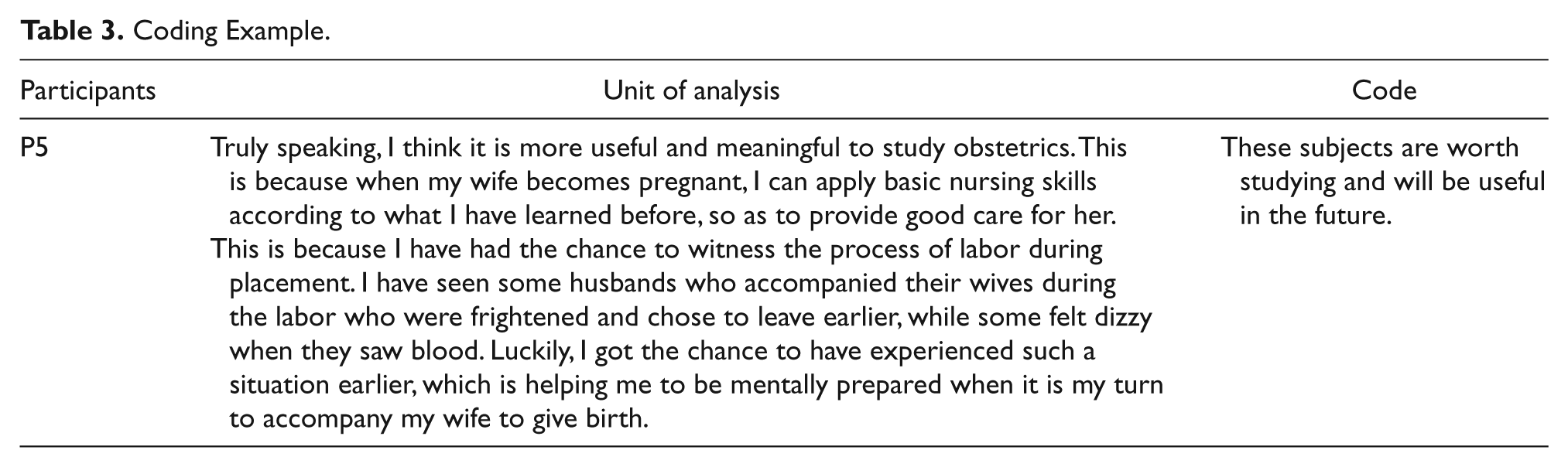
The verbatim translations were then analyzed using content analysis. The narratives were first coded by the five authors. During the coding stage, a consensus was considered to have been reached when three out of the five authors agreed on the coding. This was to ensure confirmability in interpreting the contents of the transcripts (Waltz, Strickland, & Lenz, 2005; Zhang & Wildemuth, 2009). After coding, the coded contents were grouped under various themes. The procedure of deciding which participants to analyze first depended on the sequence of the interviews conducted. Although no noteworthy differences in approach were used to analyze all the 18 participants, data saturation was reached by the end of 16 interviews, as no more new themes could be generated in the last two interviews. The salient themes were chosen after negotiations involving the whole team, with 70% agreement. That is, each theme received the agreement of at least four out of the six coauthors. We continued to hold biweekly meetings from January to October 2012, during which we discussed the themes until we came to a consensus. These procedures were designed to produce narratives that were logical and objective (George, 2009). In the end, all the contents were checked and reviewed by the whole research team. We also conducted member checking by inviting six of the participants to confirm that the themes actually captured their original meanings. The first author served as an auditor to examine the audit trail, consisting of the transcripts, the coding, and thematizing notes. The study then had confirmability, credibility, and dependability, thus maximizing the trustworthiness of this study (Lincoln & Guba, 1985). See Table 3 for a sample of the coding and thematizing process.
Coding Example.
Results
The participants shared different profound experiences associated with their clinical practicum. Three themes emerged from their disclosures: (a) the dynamics of working in a hospital, (b) working with female patients, and (c) gender perspectives on nursing culture. Details of these themes are given below.
Theme 1: Dynamics of Working in Hospitals
On the question of how the participants were interacting with others in the ward, three subthemes were discerned: (a) Interactions with staff, (b) Interactions between the participants and their mentors, and (c) The participants’ interaction with classmates.
Subtheme A: Interactions with staff
Four participants felt that the female staff liked male students and provided more support for them in their clinical placements than they did for female students. One of the participants described his experience with the ward staff:
[W]hen a group of males enters [the ward], the “ward man” [ward manager, a female, as he stated] may be nicer to you . . . which means that she always asks “Students, how is your work? Is it tough or not? Do you have any work to do? We saved some work for you”—something like that, which is a way of showing care. (Participant [P] 14)
Nevertheless, he clarified that this might be a special case, as that ward manager was too enthusiastic. Two participants tried to explain the reason for the above treatment:
[W]hen it comes to . . . staff, the ward staff, in fact they are rather . . . sometimes rather happy to see male classmates. . . . Both male and female staffs think that when a male student or male nurse becomes a member of staff in the ward, the atmosphere in the ward will improve. . . . I think that it may smooth the conflicts between female staff. Or when there is a male nurse lifting or carrying things, doing physical work, walking up or down, working around, this is ok, which means that they rather appreciate and rather like to teach our male students. (P4) Both of us [participant and staff member] are male. [Male staff] would teach you more things, teaching special skills and telling you more real life experiences. . . . Someone of the same gender will tell you more things. . . . In fact it is easy to get closer to a mentor of the same gender. . . . For staff, again, being of the same gender means that there are more things to chat about, and it is easier to communicate. . . . [I] really don’t know what to talk about with female staff. (P8)
In contrast to those encouraging experiences, some of the participants stated that they were perceived unfairly by the clinical staff. One participant recalled being scolded more rudely than female students whenever he did something wrong. He did not ask why he was being treated in this way but speculated that the staff might think that males were tougher than females and were therefore better able to withstand punishments or ridicule. These narratives reflected various dynamics, such as supportive, gendered, and antagonistic dynamics, which may yield a deeper analysis of the culture of nursing.
Subtheme B: Interactions between the participants and their mentors
In a clinical environment, mentors have an important role to play in educating students. In Hong Kong, each mentor is responsible for managing the learning conditions of students in a ward, usually more than one student. Similar to the interaction with clinical staff, participants reported receiving extra support from their mentors:
And about the mentors [female, as stated before], in fact . . . they rather protect male nurses. I am not sure if this is because there are not many male nurses . . . [Interviewer: male classmates or . . . ?] Male nursing classmates, which means male classmates . . . [We] need a new workforce of male nurses. In fact, they rather support and protect male classmates. [Interviewer: Any examples of such protection or extra protection?] It is not extra protection. But they simply support you. [For example, when asking] “Who would like to do such procedure?” In fact if there is a large amount [of work available], it [the work] would surely be distributed fairly. However, sometimes, maybe because a male classmate standing near . . . which means that the distance to the mentor is short, or for whatever reason . . . there is a rather high chance for boys to do [the procedure]. [Interviewer: Is this because [the mentor thought that] a male student may . . . have less chance to practice nursing care; therefore if the situation allows, the chance would be given to male students?] Maybe that is [the reason]. (P4)
Furthermore, when discussing how male students obtain a learning advantage over their female peers, one participant referred to the scene of dressing wounds as an example. The female mentor provided more assistance to him than to his female classmates while performing the dressing of wounds. When he was questioned on how he felt about this issue, he stated:
[S]ometimes, you . . . at first are not really familiar with that person [the female mentor] then [you] would feel pressure, . . . but after [you are] familiar [with her], [you] will feel safe. (P10)
When the interviewers asked the participant whether he thought that the assistance from the mentor was a kind of expression of mistrust, he said, “[N]ot really, in fact if you are left on your own to work, it is scarier, isn’t it?” In addition, some of the participants indicated that female mentors were ruder to female students than to male students and scolded them harder when they did something wrong. Yet, although a majority of the participants said that both male and female mentors and staff treated them well, some stated that male staff sometimes provided extra help than female staff, because the former had a better understanding of what male students need. For example, one participant said,
[M]aybe because a male tutor also experienced the stage of being a male student nurse like us, he understands more about us; therefore sometimes he would strive for [chances for us to provide care to] an old lady or a pregnant woman patient. (P5)
Not only were male mentors teaching more things to male students, but other participants noted that male mentors were also more logical and rational than female ones, which could help the participants learn something more easily. One participant, for example, remarked,
[T]hey [female mentors] gave me the feeling that females focus more on the emotional aspect while males think more logically. Although it is not always, not an absolute fact, in comparison . . . when being taught by some teachers, one can obviously feel that some of their logic is strange. . . . [You are] not certain to understand [a female mentor’s teaching]. (P3)
However, receiving better treatment from a male mentor does not mean that male students would prefer to have a male mentor. In fact, some would prefer to have female mentors. As one stated:
A male mentor may not lead us in doing some procedures for female patients. In contrast, a female mentor can do both male and female [procedures] . . . and the working range would be greater. (P4)
Another participant added that the ability of the mentor is the first thing to be considered. Nevertheless, the above excerpts suggested that multidimensional gendered interpretations of interactions reflected the “doing of gender” within the practicum setting.
Subtheme C: The participants’ interaction with classmates
The response from one student summed up the thoughts of most of the participants:
Between males, there can be no restrictions, which mean that you can talk about everything. . . . However, if [there are] males and females, maybe . . . males cannot talk to females in a rough manner. . . . However, if you use a laborious manner to talk [with females], maybe you have to take one more step to think [before you talk], which means that maybe in terms of cooperation, or in the working aspect, it would be laborious. (P14)
One participant recalled his attempt to further explain details of communication between classmates:
In fact, if you want to get help with learning, it is better to find some [classmates] who are of the same gender. Because we both are in the same situation, and we are both males . . . our views of how to handle the case may be the same. (P8)
However, even if it was easier to communicate with male classmates, it was also beneficial for males to talk to female classmates when handling cases or events in a clinical situation:
[I] can understand other ideas that they [female classmates] have . . . because I think that males are rational, while females are emotional/perceptual. (P8)
Another participant stated that some mentors, regardless of their gender, have higher expectations of male students with regard to knowledge. Yet, three participants did not experience gender inequalities from their clinical placement and did not experience any conflicts with others in the hospital. Generally, male students received satisfactory treatment and showed no reluctance to work with the staff and mentors.
Theme 2: Working With Female Patients
The male participants were interviewed on their feelings and experiences about their working environment, where there are female patients. They were asked whether they preferred to practice in female wards if permitted to do so. Two subthemes were proposed: (a) Working in female wards: The voices of males and (b) The gender of patients does matter.
Subtheme A: Working in female wards: The voices of males
Eight participants claimed that they had been excluded from observing women in the process of labor and were prohibited to provide intimate care to female patients, unlike female nurses and male doctors.
Female nurses can get behind the curtain to care and assess female patients, while male nurses can only stay outside the curtain. (P3) I feel little bit unhappy about excluded from the delivery process. And I feel bored when just waiting outside. (P7) Male nurses are prohibited to provide some kinds of intimate care to female patients, like perineal swabbing. (P10)
Four participants expressed the view that the unwillingness of female patients to receive care from male nurses may be because of the traditional Chinese culture, but that most of the male nurses understand this.
Because of the problem of culture, female classmates can touch or provide intimate care for female patients while we cannot. (P4) I understand that traditional Chinese women don’t want to expose their perineal parts to males. (P5) Traditional women think that their body parts should not be exposed to male staff. I understand why they have such a thought. (P9)
Although male nurses were excluded from providing some kinds of intimate care for female patients, some basic care could be still performed by male nurses. Two participants reported that they are willing to provide intimate care for female patients. Only one participant expressed the view that it would be better to avoid providing intimate care to female patients.
Nonetheless, two participants still felt very uncomfortable about giving care to female patients. Some thought that because of the issue of gender, male students would have fewer learning opportunities than female students. They thought that this was unfair, and made them feel useless.
Overall, most of the participants did not have strong views on the issue of caring for female patients; rather, they always made the concerns of female patients their first priority.
Subtheme B: The gender of patients does matter
The majority expressed concern about legal issues such as sexual harassment. Two of the participants agreed that males could take care of female patients, given that they followed the code of conduct of nurses.
I would feel very embarrassed if I worked in a female ward. . . . A male normally won’t see a female’s body. It is really distracting if you see a female body, even if you are a professional. I feel embarrassed, even if the patient does not. I think I cannot break through my psychological barrier to take care of a female. (P18) I think there will be dissenting voices from society if males can work in female wards because of gender differences. Also there is no CCTV in cubicles, so if a male nurse was being sued by a female patient the court may tend to trust the confession of the patient. I myself think that it’s OK to practice in female wards if all male nurses follow the code of conduct of nurses and principles of procedures. (P16)
The participants were also concerned about the impression that female patients have of males. They believed that females presumed that males were rather obscene and had a negative impression of the nursing care delivered by male nurses. To protect their male dignity, males preferred to take care of male patients even if females do not mind males taking care of them.
However, male staff will have a lighter workload in a mixed ward. Patients usually think that male staff have a tendency to sexually harass female patients, which leads to a lighter workload. I think male staff do not deserve such treatment. I wonder why male doctors, male physiotherapists, male staff in operating theaters, and some other healthcare professionals can handle female patients, but not male nurses. I think this constitutes discrimination. It deserves further thought. (P9)
To protect male nurses from being sued by female patients if they were working in female wards, two participants suggested that legislation was a suitable method of dealing with the issue. The willingness of female patients should also be taken into account.
I think it’s OK for male staff to take care of female patients, and we have the ability to do it. The main question is the willingness of female patients. If a female patient does allow a male nurse to take care of her, I hope some law could be passed to protect us and make it safer for us to do our duty. Otherwise, no male nurse will provide care for female patients even we actually can do it, as there is a “pitfall” for males. (P10)
Theme 3: Gender Perspective on Nursing Culture
In an attempt to reveal current nursing culture, most participants commented on a sensible increase in the admission of male students’ admission. When probing the claim that “nursing is no longer female-dominated,” it was noted that certain participants stated that a high salary and fulfillment in work are reasons for males to stay in nursing. Another concern is career prospects. In fact, the starting monthly salary of a registered nurse in Hong Kong is HK$23,530 (US$3,034), which is higher than the median monthly domestic household income of a family with three members, HK$20,500 (US$2,644; Hong Kong Census & Statistics Department, 2011; Hong Kong Social Welfare Department, 2012). The relatively higher promotion opportunities for males than females motivate males to choose to enter or stay in the field of nursing.
[I]f you only focus on career prospects, I don’t think males are at a disadvantage…. It is easy for males to get promotions. . . . [A]s you can see, many of the senior nursing staff are males. (P14) A job with high pay is my first priority, the next is satisfaction. . . . I think most males have same priorities in being a nurse. . . . If the pay were cut to half, I . . . think that no male or even nobody would be eager to become a nurse. (P17)
Although males showed interest in being admitted as nurses, in applying for jobs males still encountered refusals from certain specialties. Likewise, certain participants claimed that they also received unfair treatment during placement. The need in Chinese culture “to observe intersexual propriety” was the chief grievance of the male nurses. They were always excluded from taking care of female patients.
Male can carry out only a fraction of the care given to female patients; they are also rejected when applying to some wards or specialties . . . but why? Only male nurses are rejected, but not medical officers . . . it seems unfair to male nurses. (P12)
To avoid the embarrassment caused by gender differences, three participants suggested that nursing procedures involving “private areas,” that is, the genital area and the breasts of females should be allocated to the corresponding gender, whereas three participants believed that “it is necessary through propaganda to narrow the gap in professional image between male and female nurses, and between male nurses and male medical officers.” However, their opinions differed from those of the former three participants, in that they expected that males would be able to provide care to female patients in the future.
I think that a nursing procedure like the Foley insertion should be delivered by the corresponding gender. . . . It is less embarrassing [this way] . . . male by male, female by female. (P1) I expect male nurses to be able to enjoy the same privileges as male medical officers, especially in performing certain kinds of nursing procedures on female patients. (P5)
One of the participants identified the thinking of the older generation and the mistrust of nursing as profession, which came with the expansion of patients’ rights, as hindrances to male nurses in performing nursing procedures on female patients.
The notion that “nurses are humble servants” was firmly fixed in the minds of the preceding generation . . . and the progressive expansion of the rights and interests of patients seem to be barriers in the nursing profession. (P15)
Fortunately, several participants perceived that the public’s view of the admission of males to nursing has shifted from doubt to acceptance and believe that the admission of more male nurses would be a great benefit to nursing.
[I]t certainly . . . does not destroy the framework of nursing society, but improves the allocation of manpower. (P4) Before I entered this nursing course, I heard from others that the majority of the public did not really accept male nurses. They thought that male nurses were careless and not capable of working as nurses. . . . [E]ver since childhood, we were taught that nurses are females . . . nowadays, there are more males becoming nurses. The public has started to change their mind and don’t think that nursing is a job only for females anymore. (P8) [I]n fact, more and more males entering nursing is good news. . . . I think it can improve nursing services. (P9)
The majority of the participants mentioned that males outperform females in both the physical (e.g., masculine acts) and cognitive (logical and critical thinking) aspects. In particular, males can contribute a high level of work efficiency, good judgment, and less gossip to nursing society.
With regard to the working environment . . . the more males, the less gossip. . . . [The] thinking and the judgment of males are superior to those of females (P2) The physical strength of males is better than that of females. Sometimes we have to transfer patients and sometimes we have to override them. Males perform better in these aspects. (P6) I have mentioned before that . . . male nurses are rather industrious and have more stamina than females. (P9)
Furthermore, two participants stated that the presence of male nurse was essential for a harmonious working environment.
[T]he working environment can be coordinated by nurses of both genders. (P7) I guess, the presence of a male nurse instills happiness and comfort in the working environment. . . . I think patients can also taste it. . . . Yet it is better to have nursing staff of both genders (P13)
According to the above dialogues, most of the participants hoped that male and female nurses would be treated equally by patients of both genders and the public.
Discussion
This study revealed that male students were generally treated unfairly during their clinical placement, had uncomfortable feelings about working in female wards, and felt that some female-related specialties excluded male nurses. This suggests that policy makers of hospitals or nursing schools should adjust the support available to male nursing students by encouraging coordination by nurses of both genders. The cross-cultural similarities and differences in nursing contexts were identified with reference to some existing literature.
This examination of how the nursing students were treated by their mentors contrasts with the findings of past research. Bell-Scriber (2008) pointed out that both male and female students felt that male students were discriminated against by their nurse educators. However, in the findings, some male students felt that their female mentor liked them more than female students. Compared with female students, some of them were given more chances to work, while some of them were treated more kindly. Some of the participants were not treated unfairly or at least did not feel any discrimination from their mentor.
Regarding the similarities between the nursing cultures of the West and Hong Kong, it seems that male nursing students in different locations also felt that chatting with female staff and classmates was a somewhat laborious process. Although they knew that they might learn something new by working with the female staff and fellow classmates, the participants expressed the view that communicating with female classmates is not as easy as talking with males. These findings support that of a previous study in Australia, in which informants mentioned that they were afraid to speak in front of a group of females (Stott, 2007). Nevertheless, the reason behind the finding in this study is different. The male students in this study identified the difficulties of talking to female staff and students as stemming from a lack of shared interests, whereas the students in the Australian study were afraid of encountering trouble.
Moreover, this was a study that investigated the experience of male nursing students working in female wards, such as the obstetric and labor ward. Similar to recent research findings (Eswi & Sayed, 2011), male nursing students experienced rejection from female patients. The above study added that male students regard the rejection as a stressor. Nonetheless, in the findings, the informants easily accepted their exclusion and fully understood that it was a matter of culture. Several informants used a common Chinese idiom “To observe intersexual proprietary” to describe this aspect of the culture, which means that males should mind their manners and not act in an intimate manner toward females. The participants were uncomfortable about delivering care to females. This expression was consistent with that of a previous Australian study (Inoue et al., 2006). In general, it seemed that those students were in fact ready to give intimate care, while the only bias originated from the clients themselves. Further research may investigate the views of female patients on male nursing students or focus more on the idea of intersex propriety.
Another important theme highlighted in the study was the students’ opinion on nursing culture. In this section, most of them stated that male nurses had different strengths when working in the field. Meanwhile, some had an optimistic view of males in nursing, as they felt that the public had a positive change of view toward male nurses. It was not surprising to hear of such a change, because it is safe to say that a change in culture can take place (Weinstein, 2010). Further research is needed to confirm such a change.
Apart from those encouraging issues, some pointed out two unfair matters here. First, male doctors can work in specialties from which male nurses are excluded. In Hong Kong, there are in fact many doctors who are licensed to practice in obstetrics and gynecology, while there are no male registered midwives in Hong Kong (Hong Kong Medical Association, 2012; Midwives Council of Hong Kong, 2012). Such a phenomenon could be explored in a further study. Second, females can deliver intimate care to male patients. Interestingly, the participants viewed this in two distinct ways. Some supported the view that male nurses can expand their roles to care for female patients, whereas some insisted that male patients should be cared for by male nurses and females should be cared for by females. One informant used urinary catheterization as an example. However, as a matter of fact, past studies have shown that the situation is a controversial one. Although it seems to be a good idea, female nurses have negative emotions about tending to the male genital area (Zang, Chung, & Wong, 2009). Giuffre and Williams (2000) discovered that some male patients refused care from male nurses because they thought that male nurses are homosexual. However, this phenomenon may be influenced by culture. In a Chinese study, more than 70% of patients accepted male nurses providing intimate care for them and felt stress if a female provided such care (Xiang, Dong, & Liu, 2005). Some of the participants explained that the reason for males to enter the field of nursing is all about the salary. Since the starting monthly salary of a registered nurse is much higher than the median monthly domestic household income of a family in Hong Kong (Hong Kong Census & Statistics Department, 2011; Hong Kong Social Welfare Department, 2012), Hong Kong males were attracted to enter the field of nursing.
Limitations
Several limitations existed in this study. First of all, given the restrictions posed by the criteria for eligibility to participate in the study, all the informants were from the same university, and therefore the results cannot be assumed to be transferable to other locations. Since it is difficult and complicated to arrange for communities of assimilation for males in the nursing profession, it is recommended that the degree of male elegance across cultures be considered. With such a limit, the insights that can be acquired from the study would therefore also be limited, and the results cannot represent the situation of all nursing students in Hong Kong. A potential limitation of the study is that it did not extend the techniques of prolonged engagement and persistent observation, member checks, negative case analysis, and confirmability. However, because of the use of other methods of establishing credibility and of corroboration, we are confident that this would not have led to any changes to the themes or the findings. Moreover, all the views captured in this study came from only a one-time interview, and therefore the study does not reflect possible changes in the views of the participants from time to time. Thus, to further corroborate the findings, extra interviews may be needed to evaluate their comments.
Conclusion and Recommendations
This study showed the working conditions of male nursing students in their clinical practicum. The students in this sample expressed difficulties in working with females in wards. To further improve the experience of male students during their practicum, female nurses should consider asking male students whether there is anything that they need. In addition, the organizer of student clinical placements can arrange to have at least two male students participate in each practicum. Generally speaking, the data in this study provided evidence that Chinese culture has hindered the delivery of care by male nursing students to females. Efforts should be made to create a positive image of male nurses. One avenue for achieving such a change would be through the public media (Stanley, 2008). Staff or mentors in female wards, such as the obstetric ward, are also advised to give male students extra support during the time that they are caring for female patients.
Another interesting finding was that better treatment for males and females was experienced by several informants, who thought that the existence of a male in the ward would improve the atmosphere in the ward. This may be because of their humorous practices, tendency sometimes associated with masculinity (Evans, 2002). Given all the findings in the present study, further study is recommended on the question of whether other males in the workplace, especially male nurses or male nurse supervisors, have a beneficial effect on male students. It is hoped that by giving voices to male nursing students, this study could provide suitable suggestions to enhance their psychological well-being and positive self-image.
Footnotes
Declaration of Conflicting Interests
The authors declared no potential conflicts of interest with respect to the research, authorship, and/or publication of this article.
Funding
The authors received no financial support for the research, authorship, and/or publication of this article.