



Abstract
Previous research has highlighted the homonegative atmospheres of many religious communities in Western society and their harmful impact on Black sexual minority (SM) people’s mental and physical health. However, few studies have examined the relationship between sexual orientation disclosure to church members and exposure to homonegative religious messages in religious settings. This online quantitative study investigated this relationship among a sample of 320 Black SM men. The participants for this study were recruited nationally from across the United States and had a mean age of 34 years. Descriptive statistics and linear regression analyses were conducted. Findings indicated that sexual orientation disclosure to church members was significantly associated with exposure to homonegative religious messages, even when controlling for geographic region of residence and denominational affiliation. Black SM men who had higher levels of disclosure were exposed to fewer homonegative religious messages. The implications of these findings for health research and clinical work with Black SM men are discussed in detail.
Black Christian churches continue to be central institutions in Black American communities (Chatters et al., 2011; Mattis et al., 2017; Taylor, Chatters, & Levin, 2003). They are often comprehensive organizations offering a broad range of resources including and going beyond religious guidance. For example, these churches have helped shape Black Americans’ attitudes on a range of interpersonal and civic issues such as romantic partner selection (Collins & Perry, 2015) and political engagement (McDaniel, Dwidar, & Calderon, 2018). They have also been sites of health education on topics such as cancer (McNeill et al., 2018) and HIV (Bryant-Davis et al., 2016). In addition, many Black churches provide economic resources and supportive networks for their members who face poverty and racial oppression (Barnes, 2015; Butler-Barnes et al., 2018; Lincoln & Mamiya, 1990). These institutions are cornerstones in many Black Americans’ lives.
Statistical reports have indicated that Black Americans comprise the most religious group in the United States (Chatters, Taylor, & Lincoln, 1999; Taylor, Chatters, & Brown, 2014; Taylor, Chatters, Jayakody, & Levin, 1996). Their weekly religious service attendance rates (47%) have exceeded those of their Latinx (39%), White (34%), and Asian American counterparts (26%; Pew Research Center, 2014). In 2014, most Black Americans identified as Christian with 94% of them reporting affiliation with historically Black Protestant denominations (i.e., African Methodist Episcopal, African Methodist Episcopal Zion, Christian Methodist Episcopal, National Baptist Convention, USA, Inc., National Baptist Convention of America, Southern Baptist Convention, Progressive National Baptist Convention, and Church of God in Christ (as defined by Lincoln & Mamiya, 1990; Pew Research Center, 2014). This makes historically Black Protestant denominations the most endorsed denominational affiliation among Black Americans. Overall, Black Americans are heavily involved in their religious communities.
While Black Christian churches are bastions of hope and a respite from oppression for many Black Americans, they have also become sites of sex negativity (West, 1993) and homonegativity. 1 This may be due, partially, to the practice of literal religious scripture interpretation among some Black congregations. Sixty-two percent of Black Protestants believe that the Bible should be interpreted literally (Pew Research Center, 2014), which might account for the significant percentage (39%) of Black Protestants in historically Black congregations who also think that same-sex attractions, behaviors, and identity should be discouraged by society. These statistics suggest that Black American religious communities can be both places of uplift and degradation for sexual minority (SM) people.
Many Black SM men have relied on religious institutions and resources to help them navigate myriad negative stressors, including racism (Bowleg, Huang, Brooks, Black, & Burkholder, 2003; Brown, 2008; Foster, Arnold, Rebchook, & Kegeles, 2011; Jeffries, Sutton, & Eke, 2017; Miller, 2007) and physical ailments (e.g., HIV; Miller, 2005; Seegers, 2007; Wilson, Wittlin, Muñoz-Laboy, & Parker, 2011). Black churches also provide a space where some Black SM men can meet sexual partners (Jeffries, Dodge, & Sandfort, 2008). For many Black SM men, religion is an integral component of their lives. While fewer Black SM men have reported attending formal religious services on a weekly basis compared to their Black heterosexual counterparts (22.1% vs. 47%; Lassiter, 2016), religion is still viewed as an important phenomenon by this group (Lassiter et al., 2017; Pitt, 2010; Quinn & Dickson-Gomez, 2016; Quinn, Dickson-Gomez, & Kelly, 2016; Quinn, Dikson-Gomez, & Young, 2016; Taylor et al., 2003). Black SM men have reported being involved in the full range of church roles and activities including pulpit ministry, choir direction, and other ministerial duties (Garrett-Walker & Torres, 2017; Lassiter, 2014; Woodyard, Peterson, & Stokes, 2000). Black SM men are often important parts of their religious communities and receive essential fortifying benefits as a result of their religious participation.
However, churches can also expose Black SM men to homonegative religious messages. Homonegative religious messages are verbal and nonverbal modes of communication that disparage either directly or indirectly SM people’s sexual orientation (i.e., same-sex attraction, behaviors, and identities) on the basis of religious doctrine (Griffin, 2006; Jeffries et al., 2014; Nelson et al., 2017). These messages communicate that same-sex attractions, behaviors, and identities are incompatible with religious ideology and group membership. They suggest that SM people must give up same-sex attractions, behaviors, and identities before they can be accepted into religious communities. Furthermore, these messages may purport that SM people are either disconnected or at risk of being separated from the love and care of sacred beings (i.e., higher power, god, deity) due to their sexual orientation. Examples of verbal homonegative religious messages include “God hates gays,” “You should pray to God to make you straight,” and “God can change you when you’re ready.” Examples of nonverbal homonegative messages include being excluded from religious rituals or not being allowed to use religious resources for openly SM-centered events (e.g., refusal of clergy to officiate funerals or weddings of SM people).
Such homonegativity in religious institutions is associated with numerous negative and punitive consequences including loss of social and familial ties (Garrett-Walker & Torres, 2017; Quinn & Dickson-Gomez, 2016; Warren et al., 2008), rejection, social isolation, loneliness (Griffin 2006; Pingel & Bauermeister, 2017), and victimization (Quinn & Dickson-Gomez, 2016). Homonegative religious doctrine has been used to justify homonegative prejudice and discrimination beyond the walls of Black churches, extending to multiple settings and relationships (e.g., homes, schools, and communities; Wilson, et al., 2011). For example, some SM people are physically attacked by religious people who believe they are justified in their violence because of literal interpretations of religious text that disparage same-sex behaviors. Overall, homonegative religious messages may have several negative ramifications for Black SM men’s well-being and how they interact with heterosexual Black Americans who may know or assume that these men are part of a SM group.
Frequent exposure to homonegative religious messages may be one reason that some Black SM men do not readily disclose their sexual orientation to others (Nelson et al., 2017). Exposure to homonegative religious messages can contribute to an internal conflict between the religious and sexual identities of Black SM men that make it harder to share their sexual orientation with others (Appleby, 2001; Foster et al., 2011; Lassiter, 2014). In fact, some Black SM men who do not disclose their sexual orientation to their church members may avoid attending religious services (Lassiter, 2016). Sexual orientation disclosure among SM people has been described as a process where an individual weighs the potential benefits of a positive reaction (e.g., acceptance, deeper emotional bonds) against the potential costs of a negative reaction (e.g., rejection, denial of access to material resources) related to disclosure of one’s sexual orientation (Powell, Herbert, Ritchwood, & Latkin, 2016; Quinn & Dickson-Gomez, 2016; Schope, 2008). These benefits and costs vary according to whether the relationships (e.g., with family, friends, and church members) in a specific setting are more immediate and important or distant and inconsequential to the individual (Schope, 2008). Thus, Black SM men may avoid disclosure when they perceive the costs to outweigh the benefits in religious settings.
Sexual orientation disclosure among SM people, in general, has been associated with a variety of advantages and disadvantages related to sharing one’s sexual orientation with others. Some researchers have reported significant associations between sexual orientation disclosure and positive psychosocial outcomes including the elimination of the need to continuously conceal their sexual identities (Schope, 2008) and higher levels of self-rated well-being (Beal, Peplau, & Gable, 2009). Other researchers have identified that people who share their minority sexual orientation subsequently are better able to form homoaffirming 2 support networks (Manera & Frank, 2014). In addition, when SM patients share their sexual orientation with health-care providers, it improves staff’s ability to give more tailored recommendations for preventive health services (Arnold et al., 2017; Cahill et al., 2017). Conversely, concealing one’s sexual orientation has been reported to be associated with poor mental health outcomes such as experiencing higher levels of depressive and anxiety symptoms and lower levels of positive affect (Pachankis, Cochran, & Mays, 2015; Schrimshaw, Siegal, Downing, & Parsons, 2013). While these findings provide insight into the sexual orientation disclosure and health links for the general population of SM people in a range of settings, analysis focusing specifically on sexual orientation disclosure in religious organizations is limited.
The relationship between sexual orientation disclosure and exposure to homonegative religious messages among Black SM men is an important area for examination, given its implications for Black SM men’s well-being (Jeffries, et al., 2017; Nelson et al., 2017). Thus, the goal of this manuscript was to examine the association between sexual orientation disclosure and exposure to homonegative religious messages in a U.S. national sample of Black SM men. It should be noted that while the focus on the study is on sexual orientation disclosure’s influence on exposure to homonegative religious messages, the authors recognize that geographic region (i.e., living in the South; Barton, 2010; Herek, 2002) and denominational affiliation (i.e., attending traditional Black Protestant denominations; Pew Research Center, 2014) have been associated with higher levels of homonegative attitudes among heterosexuals. Thus, this study tested a model that also included those variables. The researchers hypothesized that Black SM men who disclosed their sexual orientation to church members would report significantly higher levels of exposure to homonegative messages in religious settings than men who had not disclosed, even when controlling for geographic region and denominational affiliation.
Method
Recruitment, Procedures, and Eligibility Criteria
These data were collected from 2011 to 2013 as part of the Sex, Drugs, and Church Survey. This project was a national online cross-sectional quantitative study that broadly examined the relationships between religion, spirituality, and health outcomes among a sample of 428 Black SM men. It was approved by the Institutional Review Board at California School of Professional Psychology, San Francisco-Alliant International University.
Participants were recruited nationally using three specific methods: (a) buying online ads on websites that had large Black SM male readerships (e.g., Muse Magazine, Adam4Adam); (b) posting hyperlinked banners on social media websites such as Facebook and Twitter on the first author’s personal profile pages as well as in virtual groups with large Black SM male memberships; and (c) sending e-mail messages to churches and other civic and health organizations that served a significant proportion of Black SM men. All recruitment ads, posts, and e-mails contained hyperlinks to the online survey hosted on the Qualtrics survey platform. Upon visiting the website, potential participants were presented with an informed consent document that outlined the purpose, procedures, and eligibility requirements of the study. The informed consent document also provided information about confidentiality of collected data and its limits, risks and benefits of participation, and the contact information of the first author and his home institution’s review board. After consenting to participation, respondents were presented with instructions to the study and then mental health referrals (which they were encouraged to print out before starting the survey) in the event they experienced psychological discomfort while completing the questionnaires. Finally, the questionnaires were presented to the participants. Participants were allowed to complete the survey in any environment of their choice. They were allowed to answer questions in one sitting or return to it at a later time. They also had the option to skip any questions that made them feel uncomfortable. As an incentive, participants who completed the survey were entered into a raffle to win a prize for an iPad.
Inclusion criteria for this study were being a Black cisgender man and having an equal or majority portion of one’s sexual attractions toward and sexual behaviors with other men. These criteria were chosen to ensure that all participants would have grown up in and currently reside in environments where they were perceived and socialized as males. The authors hoped that this requirement would increase the likelihood that participants had similar experiences of navigating the particular stressors and privileges of being a Black man in the United States who is also attracted to other men. All participants were required to be 18 years of age or older. Inclusion criteria were assessed with eligibility questions presented individually throughout the first half of the survey. If participants selected responses that were not consistent with inclusion criteria, skip logic was used to direct them to the end of the survey. Men who did not meet the inclusion criteria were presented a page that thanked them for their interest in the survey and informed them of their ineligibility but did not give a specific reason for their ineligibility. To prevent multiple responses from the same people, the data validation function of SPSS was used to identify and eliminate duplicate cases that shared the same Internet protocol address. Overall, 1,278 people clicked on the hyperlink for the survey and 33% met the inclusion criteria and provided enough data to be included in the study.
Measures
Sociodemographic characteristics
A self-report measure was used to assess age, ethnicity, education, income, and geographic region of residence among the sample. Participants endorsed their current affiliations with eight traditionally Black Protestant Christian denominations. These denominations were African Methodist Episcopal, African Methodist Episcopal Zion, Christian Methodist Episcopal, National Baptist Convention, USA, Inc., National Baptist Convention of America, Southern Baptist Convention, Progressive National Baptist Convention, and Church of God in Christ (as defined by Lincoln & Mamiya, 1990). Participants endorsed either being a member of one of the eight denominations or being a member of an “other” denomination or religion that was not part of the traditional eight.
Sexual orientation has been conceptualized as having several components including identity, attraction, and behavior (American Psychological Association, 2008). In an effort to be consistent with the majority of public health and psychological literature related to Black SM men and decrease participant burden, this study utilized one behaviorally focused question to assess sexual orientation disclosure. Participants were asked to respond to the question “How many of the church members that are most important to you know about your same-sex sexual behaviors?” They rated their level of disclosure of their sexual orientation to their fellow church members on a scale of 1 (none of them) to 5 (all of them).
Homonegative religious messages scale
Participants’ exposure to homonegative religious messages in their religious organizations was measured using a 9-item, 6-point Likert-type scale initially developed by the first author and later factor analyzed and initially validated by Lassiter and colleagues (2018). Specifically, this instrument examines the homonegative attitudes and behaviors of one’s church members and clergy. Examples of items are “People in this church believe God condemns people who are same gender loving,” “In this church, the leaders advise that same gender loving people should pray to become straight,” and “People in this church would say disapproving things to me about my sexual orientation if they knew about it.” Participants indicated their agreement or disagreement with the measure’s items on a scale of 1 (strongly disagree) to 6 (strongly agree). One of the items was reverse coded and then all items were summed. Higher scores indicated higher levels of exposure to homonegative religious messages in one’s church. The Homonegative Religious Messages Scale (HaRMS) includes subscales to measure exposure to religion-based homonegative messages as a child (i.e., before turning 18; HaRMS-C) and as an adult (i.e., after turning 18; HaRMS-A). Only the 5-item HaRMS-A was used in this study due to the present-time orientation of the research question. The researchers were interested in how current participant characteristics (i.e., geographic region of residence, denomination affiliation, sexual orientation disclosure) were associated with current levels of exposure to homonegative religious messages. The internal consistency of the subscale was calculated and yielded a Cronbach α coefficient of 0.94, which suggests good measure reliability.
Data Analysis
All data preparation and analyses were conducted with SPSS 25. The variables included in the analyses were first examined for missing data. All variables had at least some missing data with 25.23% of cases having at least one value missing. Little’s Missing Completely at Random Test was conducted to determine the pattern of missing data. It was nonsignificant (p = .109). This suggests that the missing data is random and not systematic. Thus, pairwise deletion was used to exclude missing data when conducting subsequent analyses. The overall sample for these analyses included 326 men who provided data that allowed for computation of the HaRMS-A subscale. However, after utilizing pairwise deletion, the resulting sample was comprised of 320 cases. This included only those men who provided data available for computation for all the variables included in the linear regression model. Power analyses using G*Power 3 software (Faul, Erdfelder, Lang, & Buchner, 2007) indicated that this sample size exceeded the minimum number of cases (N = 184) to detect a medium effect size of .15 for an F test at the .05 alpha level with 12 predictors. Thus, the study was sufficiently powered to find true significance and avoid a Type II error. All assumptions of linear regression, including normal distribution, were tested and deemed to be met.
Preparation of the data included collapsing categorical variables from several levels to smaller, more manageable, and easily interpretable levels. Geographic region was originally measured on a nominal scale, and for the purposes of analyses it was dummy coded with the reference group being the Southeastern region. This decision was based on previous research that reported that people residing in the Southeastern United States tend to hold more homonegative beliefs than people who do not reside in that region (Swank, Frost, & Fahs, 2012). Participants were able to select from eight traditionally Black American Protestant denominations and one option that was “other” (i.e., the participant did not attend any of the eight traditional denominations). Studies have reported that traditionally Black American Protestant denominations endorse more literal interpretations of the Bible and higher levels of homonegativity (Pew Research Center, 2014) in comparison to other denominations that are not traditional Black Protestant ones. Thus, denominational affiliation was dichotomized into two groups: “traditionally Black Protestant denomination” and “not traditionally Black Protestant denomination.” Finally, disclosure of sexual orientation to church members was originally measured on an ordinal scale. This scale was dummy coded to facilitate linear regression analyses. The reference group was “out to no church members.”
Next, descriptive analyses for sociodemographic characteristics and exposure to homonegative religious messages were conducted. Then, a multivariate linear regression where all variables were entered simultaneously was used to determine the associations between sexual orientation disclosure and exposure to homonegative religious messages, while statistically controlling for sociodemographic characteristics (i.e., geographic region and denominational affiliation).
Results
Descriptive Analyses
Table 1 presents the sociodemographic characteristics of the sample. The mean age of the participants was 34.77 years (range = 18–78). The majority of the sample identified as African American (85.5%; n = 284), while 7.4% (n = 24) reported being Caribbean (Black) American and 5.5% (n = 18) disclosed being an African (Black) immigrant currently residing in the United States. Approximately 72% (n = 237) of the sample reported having earned at least a 4-year college degree. The median income category endorsed was $20,000–$24,000. Most men resided in the Southeastern United States (n = 157; 48.2%), compared with 23.6% (n = 77) in the Northeastern region, 13.5% (n = 44) in the Midwest, and 10.7% (n = 35) in the Western region of the United States. Four percent (n = 13) did not report their geographic location of residence. The majority (67.5%) of men did not attend traditionally Black protestant denominations. More than half of the sample (52.6%; n = 172) had not disclosed their sexual orientation to any of their fellow church members. Participants reported that since becoming an adult (i.e., turning age 18 years), they had experienced moderate levels of exposure to homonegative religious messages in religious settings (M = 20.13; SD = 8.54; scale range = 5–30). See Table 1.
Sociodemographic Variables.
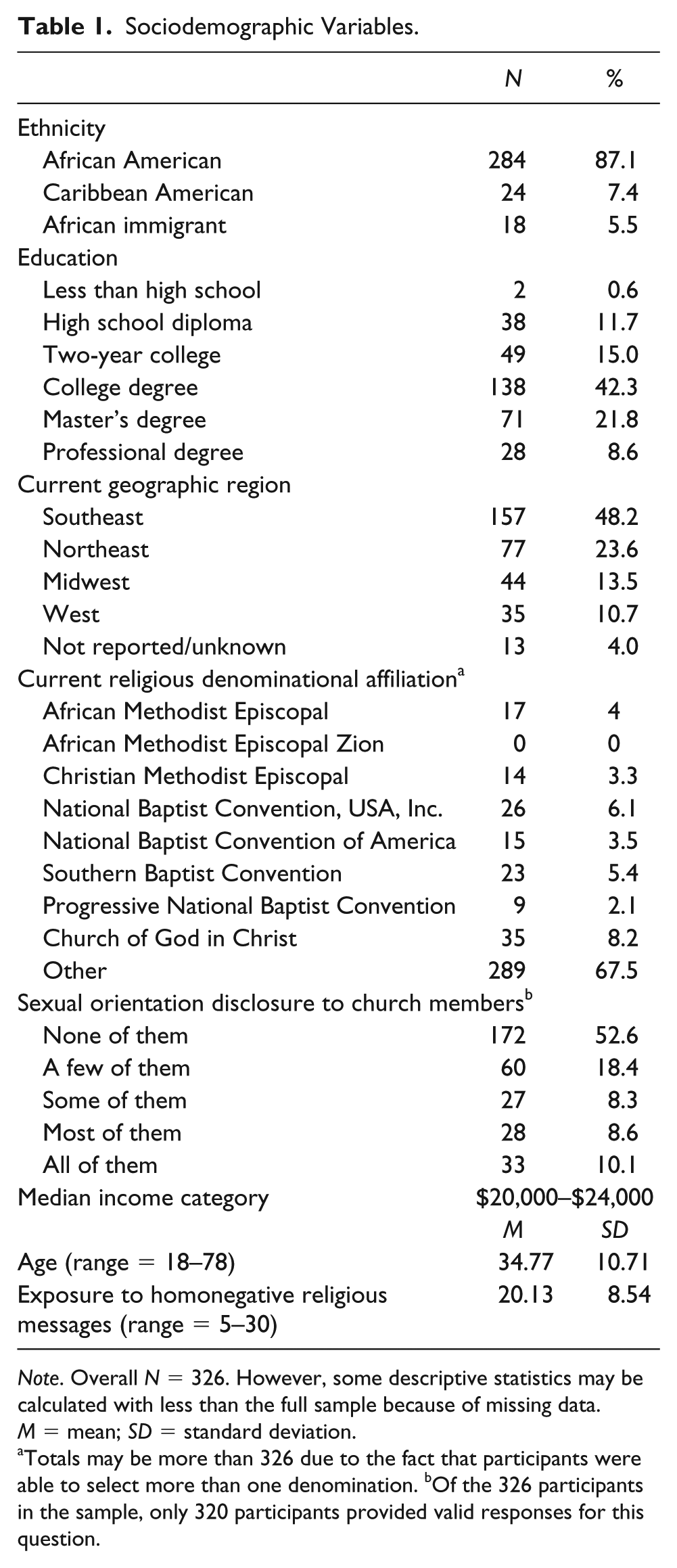
Note. Overall N = 326. However, some descriptive statistics may be calculated with less than the full sample because of missing data. M = mean; SD = standard deviation.
Totals may be more than 326 due to the fact that participants were able to select more than one denomination. bOf the 326 participants in the sample, only 320 participants provided valid responses for this question.
Multivariate Analyses
Geographic region, denominational affiliation, and sexual orientation disclosure significantly predicted exposure to homonegative religious messages in religious organizations. Specifically, living in the Midwestern region of the United States (B = 2.73, CI [.19, 5.27], p < .05) was associated with more exposure to homonegative religious messages compared to Black SM men who resided in the Southeastern region of the United States. Black SM men who reported not attending traditional Black Protestant churches at the time of the survey had lower levels of exposure to homonegative religious messages than men who were attending traditional Black Protestant churches at the time of the survey (B = −1.77, CI [−3.49, −.05], p < .05). Black SM men who disclosed their sexual orientation to a few (B = −3.80, CI [−5.97, −1.62], p < .01), some (B = −9.42, CI [−12.43, −6.40], p < .001), most (B = −7.34, CI [−10.48, −4.19], p < .001), or all (B = −12.65, CI [−15.32, −9.99], p < .001) of their fellow church members reported lower levels of exposure to homonegative religious messages in their religious organizations compared to men who had not disclosed to any of their church members. The overall model (F = 15.64, df = 9, 310, p < .001) accounted for 31% of the variance in exposure to homonegative religious messages. See Table 2 for details.
Multivariate Linear Regression Assessing the Associations Between Sociodemographic Correlates, Sexual Orientation Disclosure, and Exposure to Homonegative Religious Messages as an Adult.

Note. F = 15.64, df = 9, 310, p < .001. R2 = .31. N = 320. B = unstandardized regression coefficient; CI = confidence interval; Ref = reference group; SE = standard error of the coefficient.
p < .05. **p < .01. ***p < .001.
Discussion
This study identified a significant association between Black SM men’s sexual orientation disclosure and exposure to homonegative religious messages since becoming adults, even when controlling for geographic region and denominational affiliation. Contrary to the authors’ hypothesis, men who had disclosed their sexual orientation to at least a few other church members reported being exposed to fewer homonegative religious messages compared to men who had not disclosed their sexual orientation to any congregants. These findings may be interpreted bidirectionally, given the correlative nature of the analyses. Thus, the results suggest it may be the case that (a) Black SM men who attend churches where people often espouse homonegative religious messages are less likely to disclose their sexual orientation to other church members, and (b) Black SM men who disclose their sexual orientation to fellow congregants are subjected to less exposure to homonegative religious messages.
The first presumption is a logical one in that Black SM men might not share their sexual orientation with others in homonegative religious settings to avoid negative experiences (Garrett-Walker & Torres, 2017; Jeffries et al., 2017; Nelson et al., 2017). The Spiral of Silence theory purports that people are likely to remain silent about beliefs and behaviors that go against the status quo when they are afraid of isolation and other negative consequences (e.g., lack of social support and physical resources) from group members (Glynn, Hayes, & Shanahan, 1997). Black SM men’s reluctance to disclose their sexual orientation to church members is understandable, given that Black religious institutions are often places of not only spiritual guidance and support but also economic and social support (Lassiter, 2014). Such disclosure could have serious negative implications for their spiritual and physical well-being (Foster et al., 2011; Wilson et al., 2011), such as refusal of participation in sacred rituals or denial of access to food pantry services. One recent study among community stakeholders reported that the presence of stigma related to same-sex sexuality among clergy and the congregation enacted a predisposition toward social isolation for young Black SM men (Pingel & Bauermeister, 2017). Overall, Black SM men risk a lot when disclosing their sexual orientations in religious settings.
Conversely, an alternative interpretation of the study’s findings suggests that it may be advantageous for Black SM men to discuss their sexual orientation with others in their churches. This study found that Black SM men who disclose their sexual orientation to church members experience lower levels of exposure to homonegative religious messages. It is possible that disclosing one’s sexual orientation may be a catalyst toward decreasing (explicit) homonegative remarks in one’s religious setting (Jeffries et al., 2017). Cone (1975) asserts in his seminal work God of the Oppressed that Black people’s truths emerge directly from their lived experiences and that those experiences are sacred because they represent “the people’s attempt to shape and live [their lives] according to their dreams and aspirations” (p. 22). Aligned with this perspective, Black SM men’s honest sharing of their sexual orientation, especially at the risk of loss, is a sacred act. Disclosing their sexual orientation to others allows them to authentically shape their lives toward their dreams and aspirations and represents a form of self-acceptance. This is not to infer that men who do not disclose their sexual attractions to others lack self-acceptance (Schrimshaw, Downing, & Cohn, 2018). However, disclosure represents not only a move toward deeper self-acceptance but also an invitation, maybe even a demand, to others for tolerance and inclusion. In this way, Black SM men’s disclosure may be considered a Black liberation theological enactment that grants “identity and liberation to an oppressed and [oft] humiliated people” (Cone, 1975, p. 21). Black SM men who disclose their sexual orientation to other congregants push against the compulsory heterosexism in many religious settings that assumes heterosexuality among members (Sneed, 2010). These men imagine new ways of being that counter narratives that position same-sex attraction and religious identities in conflict.
Indeed, Black SM men have identified ways to transcend the binary of heterosexual Christian or nonheterosexual heathen through defining themselves for themselves and using their personal lived experiences with the sacred to shape their identities and behaviors in ways that are affirming and health inducing (Lassiter, 2015). Black SM men’s disclosure of their same-sex attraction requires that space be made for them and other SM people in religious communities. When Black SM men publically highlight their presence in Black religious settings, it is harder for others to ignore them and makes it more interpersonally difficult for heterosexual people to openly attack SM people whom they know personally (Smith, Axelton, & Saucier, 2009). Black SM men’s disclosure of their sexual orientation may also be beneficial to the larger Black community. As Black heterosexual people begin to grapple with homonegativity and forge racial and homoaffirming alliances with Black SM people, they can focus more of their efforts on mitigating cross-cutting oppression (i.e., racism, classism, ableism) that contributes to commonly shared health disparities (e.g., cardiovascular disease, police brutality and killings, HIV, cancer) that threaten all Black people’s health regardless of sexual orientation. Black SM men’s ability and courage to live authentically and openly makes it possible to keep “hate [of non-heterosexual people] and revenge [by Black SM people directed toward Black heterosexual people] from destroying the revolutionary struggle” (Cone, 1975, p. 139) against economic, social, and health challenges.
Black SM men’s disclosure or nondisclosure of sexual orientation to church members has implications for their mental and physical health. Nondisclosure to church members puts them at risk for higher levels of exposure to homonegative religious messages. In another study, exposure to homonegative religious messages in religious settings was linked to higher levels of internalized homonegativity (Lassiter, Smallwood, Green, & Carrico, 2018). Exposure to homonegative religious messages has also been reported as a contributing factor to Black SM men’s experience of cognitive dissonance related to internal conflict between their sexual attractions and religious beliefs (Lassiter, 2014). Nondisclosure within religious settings may also contribute to less engagement in HIV prevention strategies (Watson, Fish, Allen, & Eaton, 2017) housed within religious organizations. Furthermore, it is also plausible that nondisclosure of sexual orientation might contribute to a lack of involvement in sexual minority communities, which could potentially provide homoaffirming resources. The exact ways in which nondisclosure in religious settings is associated with nondisclosure in predominately sexual minority settings needs to be further explored.
Although geographic region and denominational affiliation were not the focus of the analyses described in this study, it is important to note that these were significant factors related to sexual orientation among the present sample. Black SM men who resided in the Midwestern region of the United States reported significantly higher levels of exposure to homonegative religious messages compared to men in the Southeastern region. This was contrary to previous research findings that suggest that the Southeastern region of the United States tends to be more homonegative than other parts of the country (Barton, 2010; Herek, 2002; Swank, Frost, & Fahs, 2012). More research needs to be done to confirm this finding in other samples of Black SM men. As expected, men who did not attend traditional Black Protestant denominations were exposed to less homonegative religious messages than those who did. Researchers and clinicians should be mindful of the influence of denominational affiliation on their Black SM male clients’ exposure to and possible internalization of homonegative religious messages as well as how this exposure might influence health behaviors and outcomes. Public health programs that work with traditional Black Protestant churches to address health disparities may find it advantageous to incorporate content that addresses issues of homonegativity among members.
While the current study has many areas of strength, it is not without its limitations. Most of the participants in the sample identified as Black American, so these results should be interpreted with caution when trying to make inferences about Caribbean American and African immigrant Black men. Black SM men with less than a high school education were also underrepresented in this sample, so caution should be taken when generalizing these findings to men with those characteristics. Although 428 men participated in the study, only 326 of them provided data that allowed computation of the HaRMS measure. Out of those, 320 were included in the linear regression analysis due to pairwise deletion of cases with missing data. Thus, while a power analysis revealed that the current study was sufficiently powered to detect a medium effect size, analyses with the full sample size may have revealed other statistically significant findings. Efforts to ensure complete data collection (i.e., minimizing missing data) should be explored in future studies. Finally, the study utilized a cross-sectional design, and thus statements about causality should be avoided.
Black SM men often play active roles in their religious communities. Unfortunately, some of these communities are detrimental as they malign these men’s sexual attractions through exposure to homonegative religious messages. Compared to disclosing Black SM men, exposure to homonegative religious messages are worse for Black SM men who do not disclose their sexual orientation to their fellow church members. Both Black SM men and their religious communities must work toward creating more homoaffirming environments where Black SM people can live their authentic lives and join in solidarity with Black heterosexual congregants to uplift each other.
Footnotes
Acknowledgements
The first author acknowledges Robert-Jay Green, Ph.D. and Brian Alex Mindlin for providing feedback on previous versions of this manuscript.
Declaration of Conflicting Interests
The author(s) declared no potential conflicts of interest with respect to the research, authorship, and/or publication of this article.
Funding
The author(s) disclosed receipt of the following financial support for the research, authorship, and/or publication of this article: The Sex, Drugs, and Church Survey was partially funded by a dissertation grant to Jonathan Mathias Lassiter from the California School of Professional Psychology at Alliant International University. Research reported in this publication was also supported by the National Institute of Child Health and Human Development of the National Institutes of Health under award number R25HD045810.
