




Abstract
Compared with previous generations in the United States, men today are starting families later in life and having fewer children. As a result birthrates in the United States have dropped sharply, and some men never make the transition into parenthood. Using data from the 2006-2010 National Survey of Family Growth, this study examines the characteristics of childless men in the United States between the ages of 15 and 44 (N = 6,168) and whether these men want to have a child sometime in the future. Our main finding is that the majority of childless men want a child someday; however, by the age of 45 more than 1 in 7 still remain childless.
Introduction
Since the 1960s, birth rates have dropped sharply in developed nations (Adsera, 2004, 2005; Hotz, Klerman, & Willis, 1997; Martin et al., 2011). Compared with previous generations in the United States, men today are starting families later in life and having fewer children (Fisch & Braun, 2005; Stewart & Kim, 2011). Even if a man wants to start a family, he may ultimately be childless because of medical or social constraints, such as infertility or because he cannot find a partner who wishes to have his baby. In this study, we examine whether men, 15 to 44 years old, want to start a family or prefer to remain childless.
For men, the burden of involuntary childlessness may best be measured by the extent of their expressed desire and the potential benefits of fatherhood (i.e., opportunity cost). Fatherhood can transform a man’s life in ways that are beneficial to him, as well as to society as a whole. For instance, Christiansen and Palkovitz (2001) reported that new fathers were more likely to increase their involvement in the labor force in order to fulfill the financial needs of their children. On average, men with children are more productive and have higher incomes than do men without children (Koslowski, 2010). Compared with childless men, fathers have better relationships with their own parents and siblings, are more likely to help others in their community, and participate in service-oriented activities more often (Dykstra & Keizer, 2009; Knoester & Eggebeen, 2006). Furthermore, men with children are less likely to engage in unhealthy behaviors, such as drinking alcohol or smoking, and are more likely to engage in healthy behaviors, such as dieting and exercise (Dykstra & Hagestad, 2007). However, it is unclear whether these are truly causal effects; if healthier men or socially adept men are more likely to become fathers then some of these perceived benefits of fatherhood could be driven by a selection bias (Bartlett, 2004; Goldman, 1993). Maximova and Quesnel-Vallée (2009) suggest that unintended childlessness could lead to depression or other types of psychological distress, indicating a causal relationship between unsuccessful family planning and adverse health events. Considering the potential costs of unintended childlessness and the potential benefits of fatherhood, involuntary childlessness is an important concern and men should be made more aware of this possible life-cycle outcome.
Miscalculation in the postponement of fatherhood is one of the most likely causes of involuntary childlessness among men. Men delay fatherhood until after they have developed a stable career and achieved an income level with which they feel they can financially support their desired family. As men delay fatherhood beyond their 30s, it may become increasingly difficult to find a mate or commit to a relationship (Carpenter, Nathanson, & Kim, 2006; McKinlay & Feldman, 1994). Although some researchers have found that men grow more attractive as they age because of increased maturity or increased income (England & McClintock, 2009; Fisman, Iyengar, Kamenica, & Simonson, 2006; South, 1991), the odds of infertility increase dramatically with age. Men can father children in their 50s or 60s, but this is far from the norm (Plas, Berger, Herman, & Pfluger, 2000). Sterility in the average male cohort is reported to increase substantially in the late 30s and continues to accelerate after age 40 (Dunson, Baird, & Colombo, 2004). In studies that control for the age of female partners, men older than 50 years are less likely to impregnate their partners and display an increased risk for subfecundity compared with men younger than 30 years (Brzechffa, Daneshmand, & Buyalos, 1998; Kidd, Eskenazi, & Wyrobek, 2001; Rolf, Behre, & Nieschlag, 1996). Men aged 45 years and older have reduced DNA integrity within their sperm increasing the likelihood of failed pregnancy and birth defects compared with younger men (Moskovtsev, Willis, & Mullen, 2006).
Current trends in involuntary childlessness among men may reflect trends in women’s preferences and the workplace. Seccombe (1991) and Koropeckyj-Cox and Pendell (2007) explain that men’s attitudes have generally remained pronatalistic throughout the past century; whereas women have chosen to delay childbirth in order to increase their roles in the labor force or further their education (Abma & Martinez, 2006; Heaton, Jacobson, & Holland, 1999; Kirmeyer & Hamilton, 2011; Lampic, Svanberg, Karlstrom, & Tyden, 2006). Once in the workplace, men may meet fewer potential mates interested in starting a family, may be disinclined to date coworkers, and may have reduced time to meet potential mates outside work (Gutek, Cohen, & Konrad, 1990; Levy, 1994; Padavic & Reskin, 2002; Salvaggio, Streich, Hopper, & Pierce, 2011). Economic trends reducing interaction with partners interested in starting a family may have contributed to the decline in birthrates among developed nations, and potentially may have prevented some men from having children, regardless of their preferences toward fatherhood.
Because of the nature of childbearing, a large body of research has focused on the perspectives of women and their attitudes regarding first-time pregnancies and parenthood (Doughty, 2011; Hayford & Morgan, 2008; Miller & Jones, 2009; Thomson, 1997; Wu & MacNeill, 2002). Studying women’s fertility intentions has improved our understanding of the characteristics associated with women’s reproductive preferences and has helped shape health policy among developed nations. However, previous research has indicated that men’s attitudes can have a strong effect on women’s preferences toward childbirth (Chalmers & Meyer, 1996; Dudgeon & Inhorn, 2004), yet very few studies have focused on the preferences of men. Analyzing men’s attitudes toward fatherhood can help provide a more comprehensive understanding of fertility behavior and reproductive decision making.
Using data from the 2006-2010 National Survey of Family Growth (NSFG), this study examines the characteristics of childless men between the ages of 15 and 44 and whether they want to have a child. Furthermore, we test for potential determinants of their desire for offspring.
Method
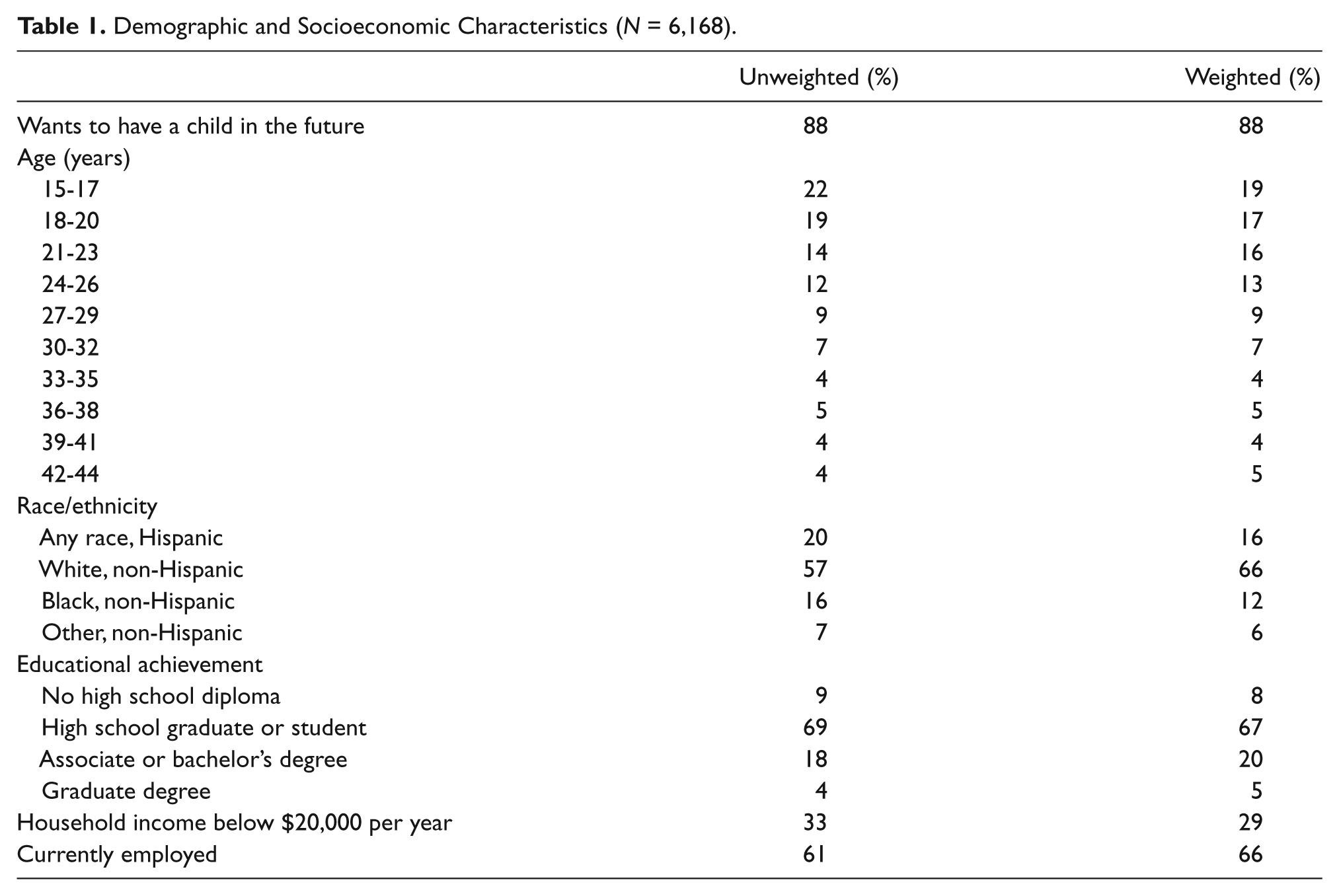
The NSFG is a cross-sectional survey of 10,403 men and 12,279 women, aged 15 to 44 years, which was conducted by the University of Michigan’s Institute of Social Research from June 2006 to June 2010, under contract with the National Center for Health Statistics (Groves, Mosher, Lepkowski, & Kirgis, 2009). The sample is nationally representative and includes an oversampling of Black, Hispanic, and teenage respondents; however, this oversampling did not have a large impact on the characteristics of the average respondent (Tables 1 and 2). In-person interviews were administered in both English and Spanish with a median duration of 60 minutes, covering a wide range of topics including health, sexual behavior, marriage, parenthood, and family planning (Lepkowski, Mosher, Davis, Groves, & Van Hoewyk, 2010).
Demographic and Socioeconomic Characteristics (N = 6,168).
Health, Household, and Religious Characteristics (N = 6,168).

For inclusion in this study, male respondents must meet the following criteria: (a) be 15 to 44 years of age, (b) have never biologically fathered a child, and (c) have no women pregnant with their child at the time of the interview. Among the 10,403 male respondents, 6,292 men met these 3 criteria, 3 refused to answer the paternal demand question, and 121 reported “Don’t know,” reducing the analytical sample by 1.97%.
During the interviews, male respondents were asked whether they were surgically sterile, specifically because of a vasectomy or some other surgical procedure. Men who did not report surgical sterility were asked the question, “Some men are not physically able to have children. As far as you know, is it physically possible for you, yourself, to biologically father a child in the future?” Respondents were then asked if they wanted to father a child in the future; however, the question was phrased differently depending on respondents’ self-reported health characteristics related to fertility. Nonsterile respondents were asked, “Looking to the future, do you, yourself, want to have a child at some time in the future?” Sterile respondents (both surgically sterile and naturally sterile) were asked, “If it were possible, would you, yourself, want to have a child at some time in the future?” In either case, the answer to this question represented respondents’ stated preference for a firstborn child (i.e., paternal demand).
The survey also included questions on respondents’ socioeconomic status (SES), demographics, health characteristics, current living arrangements, religion, military service, and childhood environment (Tables 1 and 2; NSFG, 2006). SES was measured by self-reported educational attainment level, household income higher than $20,000 per year (“Was it $20,000 or more per year?”), and current employment status.
Respondents were asked their date of birth, Hispanic ethnicity, and racial background. If race identification was refused, this portion was completed by the interviewer’s observation. For this analysis, age at interview was split into ten 3-year categories, and non-Hispanic respondents were categorized into the groups they believed best described their racial background: White, Black or African American, or another race (Asian; American Indian or Alaska Native; Native Hawaiian or Other Pacific Islander).
Apart from sterility, the only other health indicator in the NSFG is “In general, how is your health: excellent, very good, good, fair or poor?” which was recorded as a dichotomous variable indicating fair or poor health (self-reported).
Current living arrangement was measured by self-reported marital status (whether living with a spouse or partner) and the number of adopted children the respondent had, as well as whether the respondent had recently immigrated to the United States (within the past 5 years). Current religion was recoded into 4 groups: none, Catholic, Protestant, or other religions, and respondents were asked about their military service (“Have you ever been on active duty in the Armed Forces for a period of 6 months or more?”). Other religions included, but were not limited to, Jewish, Mormon, Jehovah’s Witness, Greek Orthodox, Muslim, Buddhist, and Hindu. Finally, childhood environment was captured using a binary variable, indicating whether his parents had divorced while he was a child.
Analysis
Descriptive statistics, with and without sampling weights, are reported in Tables 1 and 2. In addition, two statistical analyses are conducted. Figure 1 shows the weighted mean response to the paternal demand question by age as well as the weighted likelihood of fathering a child at some point in the future. The weighted likelihood is estimated using the age of the respondent and the age of the respondent’s first child at the time of the interview. Specifically, we estimate the proportion of men with no children by age (p age), controlling for censoring at the age of interview, and took the ratio of the proportion at age 45 and each younger age (p45/page), which represents the age-specific likelihood of never fathering a child by age 45. The age-specific proportion of who will father a child by age 45 is one minus this ratio (1 − [p45/page]). This likelihood estimator assumes survival until age 45 and depicts the attitudes toward fatherhood of a nationally representative sample of male cohorts in the United States, comparing the likelihood of wanting a firstborn child and the estimated likelihood of actually having a child by age.

Childless men in the United States by age.
In addition to the likelihood estimation, a set of logistic regressions on the odds of wanting a child were also conducted, each of which incorporated the complex sampling design of the NSFG in both the probability weights and stratified sampling (Siller & Tompkins, 2006). The regressions test the relationship between the respondent’s desire to start a family and his SES, demographics, health characteristics, living arrangement, religion, military service, and childhood environment. After the full sample estimation, the sample was stratified at age 30 years and reestimated for each subsample. For the older subsample, one stratum had to be combined with another stratum, because it contained only one sampling unit.
Results
Figure 1 depicts the age-specific proportions of childless men who wanted to start a family someday and the estimated proportions who will start a family by the age of 45. Regardless of age, the proportion of men who wanted a child someday was at least 15% higher than the estimated proportion of men who will actually start a family by the age of 45. Though both these proportions decreased with age, the difference increased with age, particularly after the age of 29. By the age of 33, less than half of the men who wanted a child will have one by the age of 45. At the age of 40, more than 50% of the men still wanted a child someday, but less than 10% will actually have one within 5 years.
Table 3 reports the logistic regression results, characterizing the relationship between respondent characteristics (listed in Tables 1 and 2) and the odds of wanting a child someday. Relative to teenagers, 15 to 17 years old, older men were less likely to want a child someday, with this association becoming statistically significant at the age of 24. Hispanic men were more likely to want a child compared with White, non-Hispanic men, and the odds of wanting a child were similar between White and Black, non-Hispanic men, and non-Hispanic men of other races.
Odds Ratios in Paternal Preference for a First Born Child by Age.

The null case is a White, non-Hispanic Catholic male, age 15 to 17 years, who is a high school student or graduate, whose parents were married while he was growing up (up to 18 years of age), is in good health and not sterile, was not in the military, is not living with a spouse or partner, is currently unemployed, has an annual household income higher than $20,000, and has resided in the United States for at least 5 years. For the last column, the null case changes to be age 30 to 32 years, but otherwise is the same.
p < .10.
p < .05.
Those with a college degree (associate or bachelor’s degree) were more likely to want a child than were men at any other education achievement level. Men with an annual household income less than $20,000 were less likely to want a child, whereas current employment status had a positive impact on paternal demand; though, neither variable was statistically significant.
Catholic men were more likely to want a child than were men with no religious affiliation, but less likely than those in the “other religion” category. Military service had no impact on the odds of wanting a child nor did immigration status. The odds of wanting a child were higher for the respondents whose parents had divorced while the respondent was a child, himself.
Living with a spouse or a partner had no effect on the likelihood of wanting a child, nor did the number of adopted children. The likelihood was much lower for men who were surgically sterile but was no different among men who were nonsurgically sterile or had reported fair or good health.
Splitting the sample at age 30, Table 3 shows that older Hispanic men and older Black men were more likely to want a child than older, non-Hispanic White men, but for the younger subsample, preferences were similar across all races.
In both subsamples, a similar relationship between educational attainment and paternal preferences was found, as those with a college degree had greater odds of wanting a child.
Interestingly, nonsurgical sterility increased the likelihood of wanting a child among older men, but decreased the likelihood among younger men. Additionally, the association between immigration and wanting a child increased dramatically among older men, as well as the association for older men of another religious affiliation.
Discussion
This study focuses on whether childless men, living in the United States want to have a child. Our study has several significant findings. First, a substantial proportion (at least 15%) of men who wish to start a family are unable to do so by the time they turn 45 years. These data are consistent with other population-based data regarding the prevalence of involuntary childlessness. Among couples of childbearing age, European population-based data indicated that 11% of nulliparous couples, aged 18 to 44 years, remained childless even after 2 years of unprotected intercourse (Slama et al., 2012).
With regard to racial differences and differences in ethnicity, we find an increased desire for offspring among Hispanic and Black men relative to White men, which is consistent with previous research. This is consistent with the relatively high birthrates among Hispanic and Black populations in the United States (Martin et al., 2011). Consistent with research on the importance of religious beliefs and fertility behavior, our findings suggest that men with no religious affiliations were less likely to want a child than were Catholic men or men from the other religion category (Hayford & Morgan, 2008; Heaton, Jacobson, & Fu, 1992; Lehrer, 1996). These results are consistent with the doctrines of the Catholic and Mormon churches, which encourage large family sizes and are against birth control and abortions (Zhang, 2008).
Interestingly, we find that men who grew up in a divorced home were more likely to want a child in the future. This is consistent with previous research suggesting that children of divorce will marry and become parents at a younger age (Aquilino, 1994; Gruber, 2004; Keith & Finlay, 1988; Thornton, 1991). Among older men (ages 30-44), being naturally sterile was associated with a greater desire for a biological child. We also find an increase in the desire for a child among older men who recently immigrated into the United States, perhaps indicating that these men would like to start a family in the United States.
With regard to SES, we find that a college education increases the desire for a child, whereas low household income decreases the desire for a child. This is likely related to the fact that most men believe that they should be financially secure before entering into fatherhood (Christiansen & Palkovitz, 2001; Jamieson, Milburn, Simpson, & Wasoff, 2010; O’Brien & Shemilt, 2003). Higher education may impose a delay in starting a family, which, if extensive, may preclude them from ever starting due to sterility or difficulty coupling, regardless of their desire for offspring.
Although we cannot ascertain the reasons that the men participating in the NSFG were unable to father children, male factors may be responsible for about half of the cases of infertility that reach medical attention, indicating that a biological cause may be implicated in a substantial proportion of these men (Nangia, Luke, Smith, Mak, & Stern, 2011; World Health Organanization, 1992). Several conditions can contribute to male factor infertility, including the presence of a varicocele, postinfectious complications or trauma affecting the genital tract, and treatments for genitourinary malignancies such as testicular cancer. Chemotherapy for other tumors or radiation therapy directed at the pelvis can also result in male infertility. The burden of involuntary childlessness described in these data may be lessened by attention to fertility-sparing options for patients with malignancies (such as sperm banking prior to treatment) or better access to urological care for men with a correctable source of infertility, such as varicocele.
This study does not examine involuntary childlessness among older men or changes in preference after prolonged childlessness. However, Heaton et al. (1999) showed that 13% of men who were childless and reported a desire for a child in the future, remained childless 6 years later and changed their intentions to no longer wanting to start a family. The concept of reproductive preferences being continually revised over the life course is supported by other studies (Hayford, 2009; Iacovou & Tavares, 2011; Matthews & Matthews, 1986; McAllister & Clarke, 1998).
The main conclusion drawn from this study is that men should be more aware of the potential risks associated with postponing fatherhood, including increased sterility and perhaps a greater difficulty in finding a mate. Our findings suggest that most men do, in fact, want to become a father someday, therefore, men should be better informed of these risks to help prevent a growing trend of involuntary childlessness.
Footnotes
Acknowledgements
The authors thank the staff at Lee H. Moffitt Cancer Center & Research Institute, Janel Phetteplace and Carol Templeton, for their contributions to the research and creation of this article.
Declaration of Conflicting Interests
The author(s) declared no potential conflicts of interest with respect to the research, authorship, and/or publication of this article.
Funding
The author(s) received no financial support for the research, authorship, and/or publication of this article.