




Abstract
This study investigated the relationship between fatigue and work safety behavior of fathers with new babies. A total of 241 fathers completed a questionnaire at 6 and 12 weeks postpartum with items on fatigue and safety behavior at work. Results revealed that fathers worked long hours, reported a moderate-to-high physical intensity of work, and experienced interrupted sleep averaging less than 6 hours. Fathers also reported moderate fatigue at both 6 and 12 weeks postbirth, which was inversely related to safety behavior. Both fatigue and sleep history made a small but statistically significant contribution to safety behavior results at 6 and 12 weeks postbirth. Findings suggest that working fathers with babies experience fatigue during early fatherhood and are unable to recover due to interrupted and poor sleep patterns. Managers should consider the potential for fatigue to compromise work safety and develop risk management strategies that target new fathers.
Introduction
Becoming a father is a major transition in men’s lives, yet few researchers have measured the fatigue men experience during early fatherhood (fathers with babies, whether first time or subsequent fathers) and nothing has been written on the effects of fatigue on their work safety.
The prevalence of fatigue in the work place has been difficult to measure and varies across many studies. In 1994, the prevalence rate for fatigue was reported to be 48.3% with 18.3% reporting substantial fatigue lasting 6 months or longer (Pawlikowska et al., 1994). Yet more recently, the prevalence of fatigue has been reported to be 21.9% with 12% reporting fatigue for 1 year (Kant, Bultmann, Schroer, & Beurskens, 2003), and another study revealed a prevalence rate for work fatigue of 37.9% (Ricci, Chee, Lorandeau, & Berger, 2007).
One reason for the varied prevalence rates might be that fatigue is hard to define and sometimes hard to disentangle from other concepts. Some authors have defined fatigue based on physical or mental impairment (Grandjean, 1979), whereas others have characterized fatigue as being task related (Hancock & Verway, 2001; Simonson, 1971). More recently, authors have seen fatigue as an inability to rest or recover (McQueen & Mander, 2003; Soames & Job-Delziel, 2001). Specifically, recovery from fatigue must take into account the rest needed to sufficiently address the nature, length, and intensity of effort expended during work (Gawron, French, & Funke, 2001).
Fatigue affects a person’s alertness, vigilance, and readiness for action (Grandjean, 1979), as well as creating a propensity to make impulsive and intuitive decisions (Sicard, 2001; Slovic, 1987; Slovic, Finucane, Peters, & MacGregor, 2004). Consequently, fatigue has been reported to be a major factor in workplace accidents (Swaen, Van Amelsvoort, Bultmann, & Kant, 2003) and it can result in catastrophic consequences. For example, fatigue was a significant contributing factor in the Chernobyl nuclear disaster and the 1986 Challenger shuttle disaster (Merril et al., 1988; Moore-Ede, 1993).
Fatigue has been reported to be prominent theme in the daily life of fathers with babies, because of their participation in infant care and family life (Anderson, 1996; Bielby & Bielby, 1988; Bittman, Hoffman, & Thompson, 2004; Daly, 1993; Dye, 1998; McVeigh & St. John, 2003; Newburn & MacMillan, 1998; Russell et al., 1999). According to the Australian Bureau of Statistics (2006), fathers reported doing 28 hours of direct child care per week. Therefore, working men during early fatherhood, engaging in infant care might create ongoing fatigue and extra pressure on their work safety.
Currently, 33% of working fathers in Australia worked more than 50 hours per week (Australian Bureau of Statistics, 2006). One reason for this may be the need to increase the financial support for their families (Eggebeen & Knoester, 2001; Tanaka & Waldfogel, 2007). The physical cost of long work hours has also been associated with fatigue (Sasaki, Iwaski, Mori, Hisanaga, & Shibata, 2007; Tanaka & Waldfogel, 2007); and moreover, the greater the work hours the greater the experience of fatigue and the inability to recover. For example, long work hours do not allow for fatigue recovery because of corresponding restrictions to obtain adequate sleep (Caruso, 2006; Park, Yangho, Chung, & Hisanaga, 2001). Research has identified that those working more than 70 hours per week only receive 6 hours of sleep, and at least 6 hours of sleep is needed to prevent sleepiness during the day (Dinges, Rogers, & Baynard 2005). During early fatherhood, sleep is a challenge because of the nocturnal care requirements of babies: For example, 16% of a parent’s time is allocated to holding their babies for sleeping or crying purposes, and this dropped to 13% at 13 weeks (Baildam et al., 2000). Moreover, a lack of sleep appears to be a prominent problem for fathers, lasting for several months after the baby is born (Elek, Hudson, & Fleck, 2002; Gay, Lee, & Lee, 2004).
The literature demonstrates that fatigue is prevalent in the workplace and can have an impact on alertness and decision making and thus, have consequences for work safety. Early fatherhood might be a time when men are particularly at risk of fatigue; however, no research has specifically investigated whether working fathers with babies (early fatherhood)—a time when men are expected to meet the expectations of work and engagement in infant care - might be susceptible to fatigue and risk workplace accidents or injury. Unfortunately, there is a lack of research on the health and safety of men during early fatherhood. Only 12 studies could be located that collectively investigated fathers in relation to sleep, fatigue, and work safety, and these studies only provided a descriptive snapshot (Mellor & St. John, 2010). Therefore, this study sought a clearer understanding of the workplace safety situation faced by Australian working men during early fatherhood, and consequently, the research question for this study was, “What is the relationship between fatigue and work safety behavior in men during early fatherhood?”
Method
This study was a component of a larger study that investigated working men during early fatherhood. Fathers were surveyed twice over the first 3 months of their baby’s life, at 6 weeks and 12 weeks.
Instrument
The questionnaire elicited demographic information and contained items measuring fatigue, safety behavior, work hours, physical intensity of work, and sleep history. Specific to fatigue and safety behavior, the questionnaire contained 10 items that measured fatigue, and 6 items that measured safety behavior at work. Two specific items measured work hours and the physical intensity of work, and 3 items measured sleep history.
Fatigue was measured using the Fatigue Assessment Scale consisting of 10 items with a 5-point scale. Participants reported their level of fatigue as follows: 1 = never, 2 = almost never, 3 = some of the time, 4 = almost always, and 5 = always. The score range was 0 to 50 and a score was achieved by summing all items, with higher scores representing higher levels of fatigue. The Fatigue Assessment Scale was developed by Michielsen, deVries, Van Heck, Van der Vijer, and Sijitsma (2004) and has demonstrated good validity and reliability with other fatigue scales as well as good unidimensional qualities in measuring fatigue as opposed to depression (de Vries, Michielsen, & Van Heck, 2003; de Vries, Van der Steeg, & Roukema, 2010). Work safety behavior was measured by the Safety Behavior at Work Scale developed by Griffin and Neal (2000). The scale comprises six items–three measured safety compliance, and three measure safety participation. All items are measured on a 5-point scale. Participants were asked whether they adhered to procedures to maintain a safe workplace (1 = strongly disagree, 2 = disagree, 3 = not sure, 4 = agree, and 5 = strongly agree). The score range was 0 to 15 for both compliance and participation subscales. Scores are achieved by summing all items in the subscales; with lower scores more indicative of unsafe behavior. The Safety Behavior at Work Scale has been used in several studies that have demonstrated high Chronbach alpha scores for the scale items (Machin, 2006; Neal & Griffin, 2006).
In relation to work, participants were asked to estimate how many hours they spent at work per week. The physical intensity of the participant’s work was measured using the CR10 Visual Analogue Scale (0 = nothing to 10 = highest possible) developed by Borg (1998). The CR10 has previously demonstrated concurrent validity and criterion-related validity (Capodaglio, 2001; Jackson, Borg, Zhang, Laughery, & Chen, 1997). Three items asked participants to report their sleep history. Participants were asked whether their sleep was interrupted, how many times this occurred per night, and to estimate the amount of sleep (minus the interruptions) they received.
Sampling and Recruitment
As there is limited research into this topic, a conservative approach was taken to determine sample size. The power analysis used in the study was based on a p value of .05, β value of .80, and an effect size of .30. The resultant sample size was 197, however, to overcome possible attrition a sample size of 240 was targeted.
A convenience sample was recruited from antenatal and postpartum services in the Gold Coast region of Queensland and Northern New South Wales, Australia. Information sheets and registration cards were given to health agency staff distribute to expectant and actual fathers. Postnatal wards and antenatal classes were visited to provide information about the study and to personally invite men to become participants. On the reply-post registration cards, men provided their contact details and the expected or actual date of their baby’s birth. Those men who returned their registration cards were sent a questionnaire at 6 and 12 weeks after the birth of their baby. Participants who failed to return their questionnaires within 1 week of posting were sent a reminder notice and another questionnaire.
Overall, 638 men were approached to register for the study and given registration cards. A total of 241 men returned the registration cards (37.7%; 241/638) and were subsequently sent the questionnaire at 6 weeks after the birth of their baby. Fifty-six reminder notices were sent and 47 participants replied–9 did not respond. Five of the returned questionnaires were deemed unusable, leaving 227 usable questionnaires and participants available for the 12-week phase of the study. Of the 227 questionnaires sent at 12 weeks, 51 reminder notices were sent and 48 participants replied. Three did not respond and three were deemed unusable. Therefore, at the end of the data collection, 221 questionnaires had been completed by participants at both the 6 and 12 week time periods (91.7%, 221/224).
The study followed the Australian National Health and Medical Research Council (NHMRC) guidelines on human experimentation. Approval for the study was gained from the University Human Research Ethics Committee and the relevant participating health agencies. Participants were informed that individuals would not be identifiable in any publication of results. A code number for each participant was placed on questionnaires. Once data analysis was complete, all reidentifiable data were deleted from the database and only code numbers remained on questionnaires.
Means, standard deviations, and frequency distributions were used to describe the sample profile, the frequency rates and mean scores for the scales, and to make gross comparisons between the data at 6 and 12 weeks. Paired t tests compared the mean sleep history, fatigue, and safety behavior scores over the two time periods. A correlation coefficient (Pearson’s r) was used to identify the direction, strength and statistical significance of relationships between work hours, physical intensity of work, sleep history, fatigue, and work safety behavior. A standard multiple regression analysis was used to explore whether fatigue, sleep history, work hours, and the physical intensity of work contributed to safety behavior at work.
Results
The demographic characteristics of the subjects are described in Table 1. Participants’ educational qualifications showed that the majority had completed high school or attained a trade certificate or university degree. Furthermore, 81.4% of participants earned a wage of $40,000 (AUD) or more, with 40% earning more than $60,000 (AUD). A sizable proportion of the participants were professionals or tradesman. Furthermore, 16.7% participants reported “other” a work type, and the most common reported were “self-employed” (11/36), followed by “subcontractor” (8/36), and “truck driver” (4/36).
Participant Characteristics

The vast majority of participants worked long hours per week (x̄ = 49, SD = 11.66). Moreover, 30% (64/214) of participants worked more than 50 hours per week. The Borg (1998) CR10 Visual Analogue Scale was used to assess the physical intensity at work, and revealed a sample mean reflecting moderate physical intensity (x̄ = 4.64, SD = 2.60), and the majority of participants (73.5%) reported a moderate to the highest possible physical intensity at work (see Table 2). Moreover, a Kruskal–Wallis analysis of variance indicated significant differences in the physical intensity at work between work types, with workers involved in trades, construction and manufacturing reporting the highest levels of physical intensity (H = 86.71, df = 9, N = 219, p = .001, Cohen’s f = 0.828; see Figure 1).
Work Hours and Physical Intensity at Work


Boxplot of the differences in physical intensity at work between work types
The vast majority of the participants (85.4%) indicated that they were experiencing interrupted sleep at 6 weeks with an average of 2.4 interruptions per night (SD = 1.18, 0-7). The mean hours of sleep was 5.5 hours (SD = 1.20, 1-8). At 12 weeks, participants reported less interrupted sleep (x̄ = 1.80, SD = 1.14, 1-6), and a corresponding increase in hours of sleep (x̄ = 5.9, SD = 1.18, 1-8). A paired-sample t test with α = .05 was used to compare the sleep interruption and mean hours of sleep scores for 6 and 12 weeks. There was a decrease in sleep interruption mean scores between 6 and 12 weeks, t(217) = 7.26, p < .000, and a corresponding increase in mean hours of sleep, t(210) = −4.65, p < .001.
In relation to the Fatigue Assessment Scale, 65% of fathers at 6 weeks scored greater than 3 (experiencing fatigue some of the time), and this percentage was higher at 12 weeks (76%). The fatigue mean score at week 6 was 28.18 (SD = 6.27, 11-44), with a higher mean score at 12 weeks (M = 31.52, SD = 6.53, 12-45). A paired-sample t test with α = .05 was used to compare fatigue scores, and the results demonstrated a significant increase between 6 and 12 weeks, t(220) = −10.38, p < .001).
In relation to the Safety Behavior at Work Scale, and in particular safety compliance, 92% of participants at 6 weeks scored greater than 3 (adhered to procedures to maintain a safe workplace “not sure”), and the percentage was similar at 12 weeks (91%). The safety compliance mean score at 6 weeks was 12.14 (SD = 2.21, 3-15); with a lower mean score at 12 weeks (M = 11.31, SD = 2.31, 3-15). A paired-sample t test with α = .05 was used to compare safety compliance scores. The test revealed a decrease in the safety compliance scores from 6 to 12 weeks, and the difference was statistically significant, t(220) = −10.38, p < .001.
In relation to safety participation, 81% of participants at 6 weeks scored greater than 3 (not sure) and the percentage dropped to 78% at 12 weeks. The safety participation mean score at 6 weeks was 10.93, (SD = 2.67, 3-15), with a lower mean score at 12 weeks (M = 9.66, SD = 2.58, 3-15). A paired-sample t test with α = .05 was used to compare safety participation scores. The mean score was lower at 12 weeks and the difference was statistically significant, t(220) = −7.09, p < .000).
A bivariate Pearson’s r correlation test was used to assess the size and direction of the correlation between work hours, physical intensity of work, sleep history, fatigue, and safety behavior. No significant correlation were found between work hours and the other variables. There was a positive correlation between physical intensity and fatigue at 6 weeks; but no statistically significant correlation at 12 weeks. An inverse correlation was found between fatigue and both safety compliance and safety participation at 6 and 12 weeks. In relation to sleep history, a positive correlation between interrupted sleep and fatigue at 12 weeks was found and a negative correlation between hours of sleep and fatigue at 6 weeks was found, and it was higher at 12 weeks. No correlation was found between interrupted sleep and safety behavior, however, there was a correlation between sleep hours and safety behavior at 12 weeks (see Tables 3 and 4).
The Relationship Between Work Hours, Physical Intensity of Work, Sleep History, Fatigue, and Safety Behavior at 6 weeks

The Relationship Between Work Hours, Physical Intensity of Work, Sleep History, Fatigue, and Safety Behavior at 12 weeks

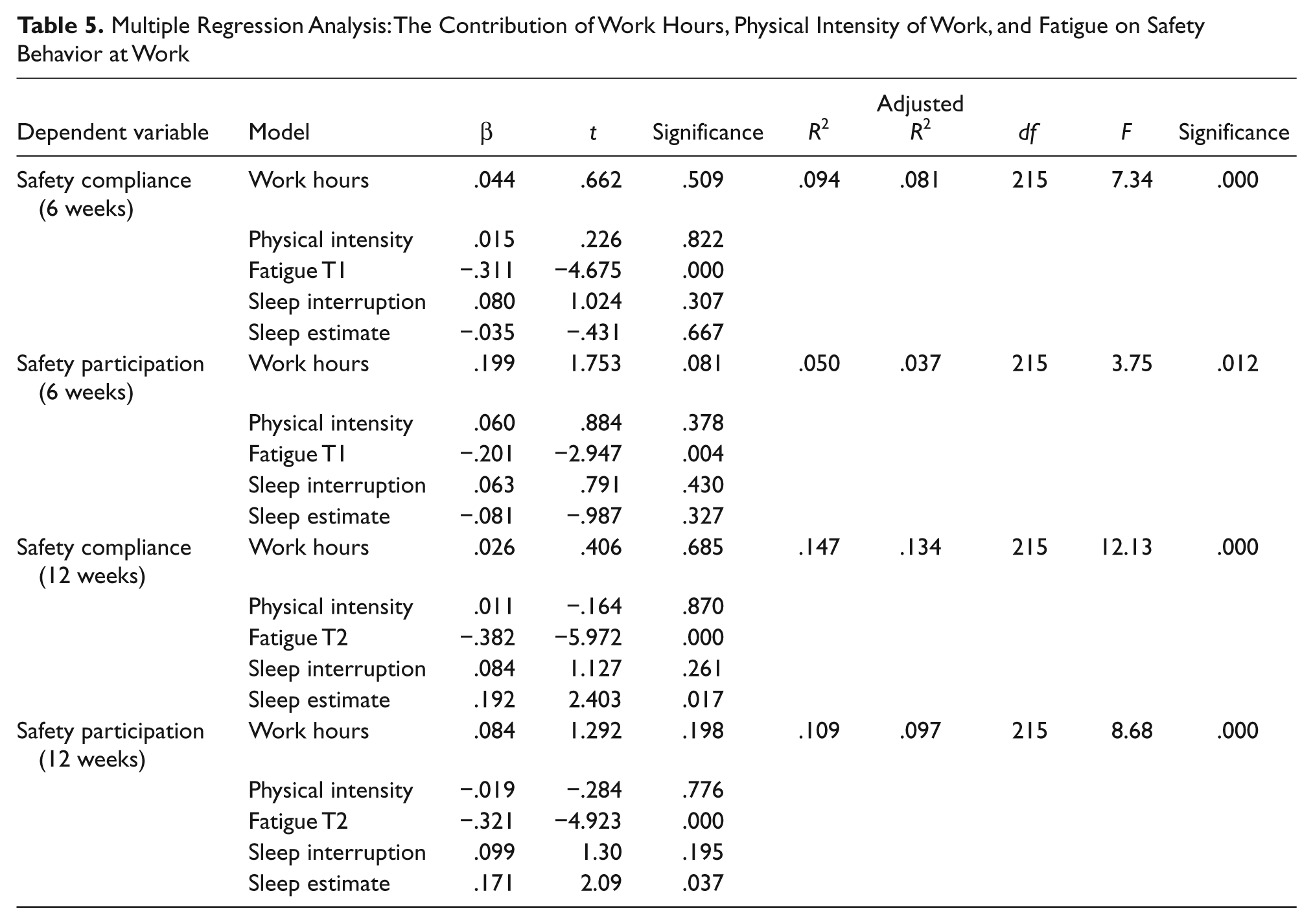
A standard multiple regression analysis was performed to examine which of the study variables best contributed to safety compliance and safety participation. As a percentage work hours, physical intensity at work, sleep history, and fatigue did not contribute substantially to either safety compliance or safety participation. However, of the four variables, fatigue made the largest and statistically significant contribution to safety compliance and safety participation at both 6 and 12 weeks, and sleep hours provided the second largest and significant contribution at 12 weeks (see Table 5).
Multiple Regression Analysis: The Contribution of Work Hours, Physical Intensity of Work, and Fatigue on Safety Behavior at Work
A Chronbach’s alpha coefficient examined the reliability of the items within each scale. In this study, Chronbach’s alpha coefficient scores for the fatigue and safety behavior scales at 6 and 12 weeks were greater than .70.
Discussion
The aim of the research question in this article was to examine the relationships between fatigue and the work safety of men during early fatherhood. The mean working hours of the fathers in our sample was 49 hours, which is higher than the national mean for Australian fathers at 43 hours per week (Australian Bureau of Statistics, 2006). The results support previous studies that have identified work is important for men during early fatherhood, presumably because of increased financial need to support their family (Eggebeen & Knoester, 2001; Tanaka & Waldfogel, 2007). Although no relationship between work hours and fatigue was noted, previous research has shown that long work hours can limit the amount of sleep (Caruso, 2006; Park et al., 2001).
The results also identified that a high proportion of fathers (73.5%) reported a physical intensity at their work of a moderate to the highest possible intensity. Moreover, physical intensity at work differed between work types, with tradesman, construction and manufacturing workers reporting higher levels of physical intensity. During the first 6 weeks postpartum there was a relationship between the physical intensity of work and fatigue. Therefore, workloads for fathers with babies might need to be reduced in the short term (e.g., by the use of mechanical aids), diluted (e.g., by using other workers), or staggered (through appropriate rest breaks).
Whereas no previous study has specifically measured fatigue in early fatherhood, our findings add to earlier research indicating that fatigue is a common experience for fathers with babies (Dye, 1998; McVeigh & St. John, 2003; Newburn & MacMillan, 1998). Fathers in this study reported a moderate degree of fatigue at 6 weeks, which increased at 12 weeks. The reason for this might be that they are not able to recover from fatigue. This proposition is supported by the interrupted and lack of sleep reported by fathers over the 12 weeks of the study (<6 hours), and the significant relationships between fatigue and sleep reported in the results. Frequency rates reported for fatigue in the general working population range between 20% and 30% (Kant et al., 2003; Pawlikowska, et al., 1994; Ricci et al., 2007), whereas in this study, the frequency of fathers reporting fatigue at least “some of the time” was dramatically higher, 65% at 6 weeks and 75% at 12 weeks. These results suggest that during the first 12 weeks of early fatherhood, men might be substantially more susceptible to fatigue than the rest of the working population.
In relation to the work safety, fathers in this study engaged in a high degree of safety behavior at work, both in safety compliance and safety participation. However, the safety behavior scores decreased from 6 to 12 weeks and were related to fatigue and sleep hours. Our results tentatively support and extend the work of previous studies that have shown that fatigue might affect performance, vigilance, and decision making (Grandjean, 1979; Sicard, 2001). For example, fathers might be either too fatigued to comply fully with safety procedures during their work (compliance) or too fatigued to participate in work safety programs (participation). In light of high levels of physical intensity at work reported by tradesman, construction workers and manufacturing workers, the ramifications are serious because poor safety behavior might place the general public at risk.
The results also revealed that fatigue and hours of sleep significantly contributed to work safety behavior; however, the overall contribution was small. Whereas previous studies have investigated other work factors that affect safety behavior, for example, factors such as organizational culture (Lee & Harrison, 2000), organizational climate (Neal & Griffin, 2002, 2006), safety motivation (Neal & Griffin, 2006), and safety culture (Rundmo, 2001; Rundmo, Hestad, & Ulleberg, 1998); the results of this study help identify and add other factors that affect work safety behavior, namely, fatigue and hours of sleep. Where fatigue and sleep fit into the picture of safety behavior is compelling and in need of further research. For example, fatigue and sleep might be a moderating factor in relation to safety motivation, climate, and culture.
Overall, the results reported a disturbing picture of fathers with babies undergoing worsening fatigue over the first 12 weeks of their baby’s life, unrelieved by poor and interrupted sleep, and with potential consequences to their work safety. The results support the view that poor sleep is an important consideration in relation to fatigue recovery, and suggest a need for employers to give serious attention to the fatigue experienced by men during early fatherhood. Although employers can do little to improve the sleep of workers at home, it is important that they consider whether other work factors, such as long work hours or physical intensity might exacerbate the problem. Thus, it is important for employers and fathers to negotiate and collaborate on a balance between the context of the operational needs of the workplace, the financial needs for employees to provide for their families, and the ability of the father to recover from fatigue.
Paid parental leave is a step in the right direction. However, taking all of their leave entitlement in one block during the early weeks of fatherhood might not be of benefit, because the results of this study have highlighted that fatigue was worse at 12 weeks. Therefore, fathers might need to organize their paid parental leave in a more flexible manner in order to ease their work and family commitments. For example, throughout the first 12 weeks, it might be more beneficial for fathers to work less days per week, have later start or earlier finish times for work and to utilize part of their paid leave to supplement the reduction in their corresponding work hours.
Caution is warranted when generalizing the findings to all working men with new babies. The findings reported in this article are not based on a randomized sample; the study was essentially self-selecting and drawn from within a distinct geographical region. Moreover, the demographic profile of the study reported a middle-to-high socioeconomic status and, therefore, an important demographic profile (low socioeconomic status) remains largely unreported. To fill these gaps in knowledge, there is a need to replicate this study with a larger sample of working men with babies and over a wider geographical area, and for comparative studies between subgroups of men prior to and during early fatherhood, such as expectant fathers, fathers with toddlers, children, and teenagers, men in general, and mothers. Regardless of the limitations, accessing information about men during early fatherhood remains difficult, and these results provide an important picture of the fatigue and safety practices of men with babies.
Transition to fatherhood is a significant life event for men, and the findings from this study identified that it is common for working men during early fatherhood to experience fatigue and a lack of quality sleep during the first 12 weeks of a baby’s life, and this may be further complicated by long work hours and the physical intensity at work. Consequently, fathers reported a decrease in their safety behavior at work. Thus, fathers may be unable to fully recover from fatigue, and this may have implications for their work safety.
Footnotes
The author(s) declared no potential conflicts of interests with respect to the authorship and/or publication of this article.
The author(s) received no financial support for the research and/or authorship of this article.