



Abstract
The aim of this study was to compare levels of psychological distress in employed single fathers relative to partnered fathers and to explore the role of psychosocial job quality, work–family conflict, and work–family facilitation as explanations for differences in distress. The data were collected from a cross-sectional telephone survey conducted in a Canadian city. Participants were 486 employed fathers with children living in the household. In addition to experiencing higher levels of psychological distress than partnered fathers (p = .057), single fathers reported greater work–family conflict, poorer work quality, and lower family-to-work facilitation. Adjusting for the strain-based work–family conflict variables in the regression analysis resulted in the largest reduction to the association between partner status and psychological distress. Future research employing a longitudinal design and subject to lower selection biases is required to tease out the interrelationship between these exposures and to point to the most appropriate policies to support employed single fathers.
Introduction
Research on the health of single fathers, though increasing in recent years, lags far behind that of single mothers. This is an important gap to address for several reasons. First, single father–headed households have become more prevalent in North America over the past several decades and are growing at a faster rate than that of single mother households (Statistics Canada, 2007; U.S. Census Bureau, 2007). In Canada, for example, male lone–parent families increased by nearly 15% between 2001 and 2006, compared with an increase of about 6% among female-headed families. The growth in single father households has been largely attributed to an increase in joint custody arrangements following the dissolution of a relationship compared with previous generations (Statistics Canada, 2007). Second, a growing body of research suggests that single fathers may be at greater risk of poorer mental and physical health than fathers in two-parent households. That is, compared with partnered fathers, recent studies have reported single fathers to have higher rates of poor self-rated health (Janzen, Green, & Muhajarine, 2006; Westin & Westerling, 2007), premature mortality (Ringback Weitoft, Burstrom, & Rosen, 2004), and affective disorder (Cooper et al., 2008;Tobias, Gerritsen, Kokaua, & Templeton, 2009).
Recent research has also sought to illuminate the mechanisms through which single fatherhood might produce these deleterious health effects. Some of this poorer health appears because of an association between single fathering and economic disadvantage (Cooper et al., 2008; Janzen et al., 2006). In Canada in 2008, the average household income of single father families was $60,400 compared with $100,200 among two-parent families with children (C. Williams, 2010). Single fathers are also less likely than their partnered counterparts to own their own home or have a postsecondary degree (Galarneu, 2005) and are more likely to have a high debt-to-asset ratio, indicating greater financial instability (Hurst, 2011; C. Williams, 2010). In addition to fewer economic resources, single fathers may have more limited access than partnered fathers to various health enhancing psychosocial resources, such as social support (Janzen et al., 2006; Tobias et al., 2009) and community social capital (Ravanera, 2007). For previously married single fathers, strains specifically associated with the ending of a relationship may further compromise mental health (Braver, Shapiro, & Goodman, 2006). Reverse causation is another potential explanation in that mental health problems may increase the probability of an individual becoming and remaining a single father (Ringback Weitoft et al., 2004).
A relatively ignored area of inquiry is the potential relationship between employment conditions and the mental health of single compared with partnered fathers. The vast majority of single fathers in Canada—87% in 2006—are employed (Beaupré, Dryburgh, & Wendt, 2010). Although a considerable body of research points to an overall positive association between employment and mental health (Murphy & Athanasou, 1999; Ross & Mirowsky, 1995), employment status per se does not take into account the fact that the psychological and social conditions of work vary greatly among the employed and in ways that may affect mental health (Stansfeld & Candy, 2008). According to Karasek’s demand—control model of job strain and negative mental and physical health outcomes result from work environments in which employees’ control over work is low and the psychological demands are high (Karasek et al., 1998). Lower paying jobs tend to be associated with poorer psychosocial work conditions, particularly low decision latitude (Rahkonen, Laaksonen, Martikainen, Roos, & Lahelma, 2006; Schrijvers, van de Mheen, Stronks, & Mackenbach, 1998). The fact that single fathers are, on average, more likely than partnered fathers to be employed in lower wage occupations (Beaupre et al., 2010, Chung, 2004) may increase single fathers’ exposure to poor psychosocial working conditions and, hence, their risk of psychological distress. To our knowledge, no research to date has systematically compared the psychosocial paid work environment of single and partnered fathers using Karasek’s job strain model (Karasek et al., 1998) nor examined to what extent such differences may assist in explaining family structure disparities in mental health.
Lower wage work is also associated with less access to employment practices and policies that may enhance employees’ ability to successfully negotiate work and family responsibilities (Swanberg, Pitt-Catsouphes, & Drescher-Burke, 2005). Employed single fathers may experience greater challenges than partnered fathers in balancing work and family life—a situation potentially exacerbated by the lack of a resident partner to offset the simultaneous demands of caregiving, household management, and employment. Work–family conflict is defined as “a type of inter-role conflict that occurs as a result of incompatible role pressures from the work and family domains” (Greenhaus & Beutell, 1985, p. 77). Work-to-family conflict occurs when attempts to meet the demands of the employee role interfere with the ability to fulfill the demands of the partner and/or parent roles (Carlson, Kacmar, & Williams, 2000). Conversely, family-to-work conflict occurs when family role obligations compromise the ability to successfully fulfill work-related responsibilities. In addition, different forms of work–family conflict have been described in the literature, the two most common being time-based and strain-based conflict. Significant associations between work–family conflict, particularly strain-based work-to-family conflict and stress-related health outcomes, have been consistently reported in the research literature, including psychological distress, anxiety, depression, somatic complaints, and alcohol abuse (Greenhaus, Allen, & Spector, 2006). However, the majority of studies examining work–family conflict have focused on dual-earner families (Casper, Eby, Bordeaux, Lockwood, & Lambert, 2007). Although attention to the experiences of employed single mothers has emerged recently (Baxter & Alexander, 2008; Dziak, Janzen, & Muhajarine, 2010), this consideration has not extended to employed single fathers. One notable exception is a study of public civil servants, which found that single fathers reported significantly greater work–family conflict than partnered fathers and that single fathers’ poorer mental health could be explained, in part, by this difference in work–family conflict, particularly their higher levels of family-to-work conflict (Chandola et al., 2004).
In contrast to a conflict perspective, which dominates the work–family literature, researchers have more recently begun to study how participation in one role can benefit functioning in another role. Work–family facilitation is “the extent to which individuals’ participation in one life domain (e.g., work) is made easier by the skills, experiences, and opportunities gained by their participating in another domain (e.g., family)” (Grzywacz & Butler, 2005, p. 97) and, like work–family conflict, is bidirection in nature. Also, research supports the notion that work–family conflict and work–family facilitation are relatively independent concepts rather than opposing points on a singular continuum. A growing body of evidence supports the health-enhancing properties of work–family facilitation, such as enhanced sleep (A. Williams, Franche, Ibrahim, Mustard, & Layton, 2006) and lower levels of stress (Hill, 2005), depression, and problem drinking (Grzywacz & Bass, 2003; Grzywacz & Marks, 2000). To our knowledge, no research to date has specifically examined differences in work–family facilitation according to partner status among employed fathers or its possible role in explaining disparities in mental health between single and partnered fathers.
The aim of this study was threefold. The first purpose was to compare levels of psychological distress in employed single fathers relative with those in partnered fathers. The second purpose of this study was to examine whether single and partnered fathers varied in their perceptions of work–family conflict, work–family facilitation, and psychosocial work quality. The third purpose was to explore the potential role of psychosocial job quality, work–family conflict, and work–family facilitation as explanations for any observed differences in psychological distress.
Method
Participants and Procedure
Data for the present study were obtained from a 2005 cross-sectional telephone survey conducted in a midsized Canadian city (see Dziak et al., 2010, for a more detailed methodological description). Participant eligibility requirements included being the following: (a) English speaking, (b) between 25 and 50 years of age, (c) employed, and (d) the parent of one or more children younger than 20 years currently living (at least part-time) in the household. In addition to these criteria, our goal was to include a sociodemographically diverse sample of employed parents; toward that end, a data collection grid was applied to ensure that similar proportions of participants were selected for the final sample with regard to gender, age-group (25-34 years, 35-50 years), and education (high school or less, some postsecondary, university/college degree). Trained interviewers randomly dialed the phone numbers; in households with more than one eligible person, and one person was randomly selected to be individually interviewed. A computer-assisted telephone interviewing system was used to conduct the interviews. The study was approved by the university’s behavioral research ethics board.
Of the 5,300 eligible people contacted, 1,160 agreed to participate in the study. Men comprised 42% of the sample, and half of the participants were younger than 35 years. The proportion of respondents was evenly distributed between the three educational categories. To further the goals of this study, we restricted our sample to 486 employed fathers (341 partnered and 145 single).
Instruments
A self-report measure, the Kessler-6, was used to assess nonspecific psychological distress. This scale requires respondents to estimate on a 5-point response scale (0 = none of the time to 4 = all of the time) how often in the previous month they had experienced various behavioral, emotional, and cognitive symptoms of psychological distress (Kessler et al., 2002). The measure comprised six questions, such as “How often in the past 30 days did you feel that everything was an effort?” “How often did you feel worthless?” and “How often did you feel restless or fidgety?” The scores of respondents were totaled across all items, with higher scores indicating higher levels of psychological distress. We calculated the interitem reliability for the scale by using Cronbach’s α, yielding a reliability estimate of .80. To improve concordance with the statistical assumptions of linear regression, the variable was square root transformed. The Kessler-6 has been used extensively in general population samples with strong evidence of validity and reliability reported. It has been shown to be a sensitive screen for the Diagnostic and Statistical Manual of Mental Disorders, 4th edition (American Psychiatric Association, 1994) disorders (Furukawa, Kessler, Slade, & Andrews, 2003; Kessler et al., 2003).
Partner status, the main independent variable, was a categorical variable based on current marital status. Men who indicated that they were married or living with a partner were considered “partnered,” and those who were separated/divorced, widowed, or never married were “unpartnered.” The different categories of unpartnered status were combined into a one group as a result of analyses indicating no statistically significant differences between groups on measures of psychological distress, psychosocial work quality, work–family facilitation, or work–family conflict.
Work–family conflict was measured by a 12-item scale in which participants are required to indicate their extent of agreement (1 = strongly disagree to 5 = strongly agree) with various statements related to work–family conflict (Carlson et al., 2000). We summed responses into four subscales of three items each: (a) time-based work-to-family conflict (e.g., “I have to miss family activities because of the amount of time I must spend on work responsibilities”), (b) time-based family-to-work conflict (e.g., “I have to miss work activities because of the amount of time I must spend on family responsibilities”), (c) strain-based work-to-family conflict (e.g., “I am often so emotionally drained when I get home from work that it prevents me from contributing to my family”), and (d) strain-based family-to-work conflict (e.g., “Because I am often stressed from family responsibilities, I have a hard time concentrating on my work”). Greater perceived work–family conflict is reflected in higher scores. Cronbach’s α for each work–family scale ranged between .75 and .88. Evidence of the scales’ discriminant validity and internal consistency has been reported in previous research (Carlson et al., 2000; Lapierre & Allen, 2006).
Work–family facilitation was assessed with a six-item scale requiring respondents to indicate how often (1 = never to 5 = all of the time) they had experienced positive spillover between work and family domains in the previous year (Grzywacz & Marks, 2000). Three items assessed work-to-family facilitation (e.g., “The things you do at work help you deal with personal and practical issues at home”), and three items assessed family-to-work (e.g., “Talking with someone at home helps you deal with problems at work”). Scores on each subscale are summed, with higher scores indicating greater positive work–family facilitation. Cronbach’s αs were .75 and .64 for work-to-family facilitation and family-to-work facilitation, respectively.
Karasek’s Job Content Questionnaire (JCQ) was used to assess psychosocial job quality (Karasek et al., 1998). Core job quality constructs measured by the JCQ include decision latitude, consisting of 9 items (e.g., “My job allows me to make a lot of decisions on my own), and psychological job demands, consisting of 10 items (e.g., “The demands that other people make of me often conflict”). The questionnaire items were coded from 1 (strongly agree) to 4 (strongly disagree), according to the degree to which respondents agreed with each statement. Scores were summed to derive subscale scores, with higher values indicating greater job demands and decision latitude. Cronbach’s αs for decision latitude and job demands were .79 and .65, respectively. To reflect Karasek’s conceptual framework of job strain, participants’ scores on the two subscales were categorized using median splits (Vermeulen & Mustard, 2000), resulting in four dimensions of psychosocial work quality: high strain (high job demands/low decision latitude), low strain (low job demands, high decision latitude), active (high job demands, high decision latitude), and passive (low job demands, low decision latitude). Evidence in support of the validity and reliability of the JCQ scales has been reported in numerous international studies (Karasek et al., 1998).
Several covariates were also assessed. Indicators of socioeconomic position included highest education level (high school graduate or less, some postsecondary training, or college/university graduate) and perceived income adequacy. Perceived income adequacy was measured with the statement “We have enough money to cover basic needs for food, housing and clothing” with which participants were asked to indicate their agreement on a scale from 1 (strongly disagree) to 5 (strongly agree). Higher scores indicated greater perceived income adequacy. Demographic characteristics included fathers’ age, number of children, work hours, and the presence of a preschool child (i.e., 5 years of age or younger) in the household.
Analysis
Initial analyses involved the calculation of Pearson product–moment correlation coefficients between the continuous scale study variables. Bivariate analyses were conducted to examine, according to partner status, differences in sociodemographic characteristics, psychosocial work quality, work–family conflict, work–family facilitation, and psychological distress. Differences between single fathers and partnered fathers were tested using chi-square tests for categorical variables and t tests for continuous measures.
The purpose of the next stage of the analysis was to try and account for any difference in psychological distress observed between single and partnered fathers. Using linear regression, Model 1 assessed the unadjusted association between partner status and psychological distress, with subsequent models evaluating the separate effect of each explanatory variable on this primary relationship of interest. A decision was made to adjust for each variable individually rather than blocks of variables, as the latter approach would have prevented understanding of which individual factors were most important in explaining single father status and psychological distress. To be selected for inclusion in the adjustment stage of the analysis, the variable had to meet the criteria for a potential confounder; that is, it had to be statistically significantly associated with both the primary exposure variable (i.e., partner status) and the dependent variable (i.e., psychological distress; Szklo & Nieto, 2007). The following variables met both these criteria: job strain, decision latitude, all of the work–family conflict subscales, and positive family-to-work facilitation. The independent variable that resulted in the largest percentage change in the standardized beta coefficient for partner status was determined to have the greatest confounding effect.
Results
Correlations among the continuous variables, displayed in Table 1, are generally low, indicating that in relation to each other these measures were adequately orthogonal. Table 2 displays the distribution of the key study variables for participants according to partner status. Compared with single fathers, partnered fathers were older, had more education, reported more hours of paid work, and were more likely to perceive an adequate household income. Single fathers reported having more children than partnered fathers, though partnered fathers were more likely to have at least one child living in their household on a full-time basis. Although there were no differences in job demands, single fathers reported significantly lower levels of decision latitude than partnered fathers, and a greater proportion were categorized as having a high-strain psychosocial work environment (i.e., high demands/low control). Compared with partnered fathers, single fathers scored significantly higher on all measures of work–family conflict (indicating greater conflict) and lower on family-to-work facilitation (indicating less facilitation). Finally, single fathers reported higher levels of psychological distress than partnered fathers (p = .057).
Correlations Between Continuous Study Variables
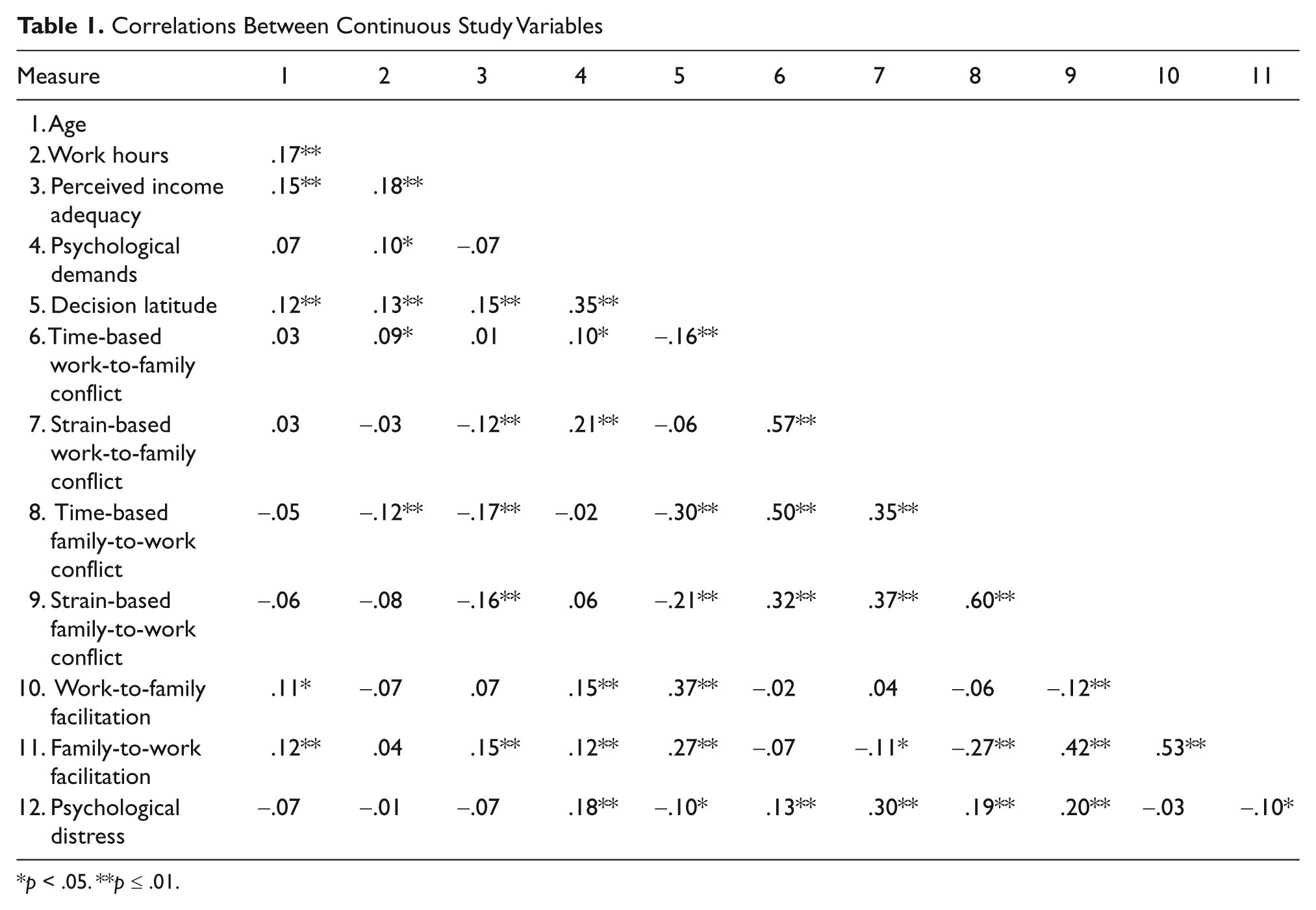
p < .05. **p ≤ .01.
Study Variables by Partner Status

Table 3 shows associations between partner status and psychological distress, adjusting for the explanatory factors individually (Models 2-8). The introduction of each variable into the regression resulted in a reduction in the association between partner status and psychological distress, with the largest independent attenuations occurring with the additions of strain-based work-to-family conflict (Model 5) and strain-based family-to-work conflict (Model 6).
Associations Between Partner Status and Psychological Distress, Adjusting for Individual Explanatory Factors

Discussion
We found that single fathers were more likely to report psychological distress than partnered fathers—a finding in line with the results of previous research in relation to a range of mental health outcomes (Cooper et al., 2008; Tobias et al., 2009). It is important to acknowledge, however, that the difference in psychological distress between single and partnered fathers in this study (p = .057) was not as pronounced as that reported in other studies. This may be because of the more stringent criteria we applied for admission as participants in our study. Participant eligibility criteria for our study included both employment and the presence of a child living in the household at least part-time. Although most research on the health of single fathers has not considered children’s living arrangement, the studies that have suggest that noncustodial fathers may be a particularly socially and economically disadvantaged subgroup of fathers and, in turn, more vulnerable to mental and physical health problems (Ringback Weitoft et al., 2004). Thus, our study selection criteria likely resulted in a relatively healthier group of single fathers, which may account for the “borderline” statistically significant difference between single and partnered fathers in psychological distress.
Single fathers in this study reported more difficulties than partnered fathers in successfully balancing the demands of work and family life. That is, similar to the results of Chandola et al. (2004), we found single fathers to experience higher levels of both family-to-work conflict and work-to-family conflict. This distinction is important given the growing body of research suggesting that the causes of work–family conflict, and therefore, likely the resolutions, vary according to direction; that is, on average, work-to-family conflict is more likely to originate from challenges within the work environment, whereas family-to-work conflict is more likely because of challenges within the family domain (Byron, 2005). Although single fathers reported higher levels of all types of work–family conflict, statistically adjusting for the strain-based work–family conflict variables in the regression analysis resulted in the largest reduction to the association between partner status and psychological distress (Table 3). Of all types of work–family conflict, strain-based, work-to-family has been found to be most strongly associated with a variety of negative health-, family-, and work-related outcomes (Greenhaus et al., 2006).
Why might single fathers experience greater work-to-family conflict than partnered fathers? We are not aware of any research specifically examining workplace demands among single compared with partnered fathers. However, the greater probability of single fathers being employed in lower wage occupations (Beaupré et al., 2010) may translate into less exposure among single fathers to workplace characteristics identified in the research literature as reducing strain-based, work-to-family conflict, such as job security, family-friendly policies and benefits, organizational cultures that are informally supportive of work–family balance, and job autonomy (Thompson & Prottas, 2005; Voydanoff, 2005b). Regarding the latter, single fathers in our study reported lower levels of workplace decision latitude, and a greater proportion of single than partnered fathers were in the high-strain quadrant of Karasek’s job strain typology (i.e., high job demands and low decision latitude; Karasek et al., 1998). Therefore, poor psychosocial work conditions, particularly low-job autonomy, may affect mental health negatively not only by eroding workers’ feelings of self-worth and sense of mastery (Cole, Ibrahim, Shannon, Scott, & Eyles, 2002) but also by increasing employees’ perceptions of work–family conflict.
Our results also suggested that family-to-work conflict, particularly strain based, played a role in explaining single fathers’ greater psychological distress. Single fathers in our study also reported lower levels of family-to-work facilitation than partnered fathers, but its contribution to explaining differences in psychological distress between these two groups of fathers was much more modest (Table 3). Demands originating in the family environment have been found to be the strongest predictors of family-to-work conflict in dual-earner couples, including marital disagreements, household management demands, parenting problems, and negative relationships with extended family members (Grzywacz & Marks, 2000; Voydanoff, 2005a). Conversely, resources in the family environment, such as emotional and instrumental social support and family cohesiveness, are most strongly associated with family-to-work facilitation (Stevens, Minnotte, Mannon, & Kiger, 2007; Voydanoff, 2005a). Given the lack of a partner to share family role responsibilities, it seems reasonable to speculate that employed single fathers might have more difficulty than partnered fathers in successfully fulfilling domestic roles because of greater demands and fewer resources. In addition, males generally are still not being socialized to be the main caregiver within families, perhaps creating additional stress for single fathers trying to fulfill such a role (DeGarmo, Patras, & Eap, 2008). Although evidence is limited, one study reported that compared with married fathers, divorced fathers experienced more stress associated with parenting, which in turn partly explained single fathers’ greater distress and alcohol use compared with married fathers (Umberson & Williams, 1993).
Study Limitations
All variables were based on self-reported measures; thus reporting biases cannot be ruled out. Also, access to potentially important information, such as custody arrangements and the duration of single parenthood, was not available in the present study. Among single fathers, there is variability in terms of the other parent’s level of involvement in their children’s lives that would likely affect on the father’s experience of single parenting. Also not addressed in the present study was the presence of other supportive people, such as friends and extended family, who may be available to assist single fathers in the daily demands of raising a family as a single parent.
In addition to the cross-sectional design, which impedes our understanding of the temporal relationship of study variables, the potential for response bias is an important concern. As already indicated, our eligibility criteria may have biased our sample toward a healthier group of single fathers participating in this study. The lower than desired response rate is perhaps not completely surprising given that our target population—employed men with children—may have found it difficult to find the time in their busy schedules to actually participate in a study. We cannot rule out the possibility that men who agreed to participate may have differed from nonparticipants in their perceptions of work, family, and well-being.
Conclusions
Although single fathers did experience higher levels of psychological distress than their partnered counterparts, differences between these groups of men in work–family conflict, and to a lesser extent, psychosocial work quality, were found to explain this relationship. These results, though preliminary, suggest that the mental health of single fathers could be enhanced through specific policies aimed at reducing work–family conflict (e.g., enhancing informal managerial support, flexible scheduling), as well changes to the nature of the job itself (e.g., degree of employee control; Lapierre & Allen, 2006; Stevens et al., 2007). Future research employing a longitudinal design and subject to lower selection biases is required to point to the most appropriate economic, work, and family policies to support employed single fathers.
Footnotes
The author(s) declared no potential conflicts of interest with respect to the research, authorship, and/or publication of this article.
The author(s) disclosed receipt of the following financial support for the research, authorship, and/or publication of this article:
This research was funded by the Canadian Institutes of Health Research, Grant No. 67129, awarded to the first author.