




Abstract
Objective:
Thoracic endovascular aortic repair (TEVAR) and transcatheter aortic valve replacement (TAVR) necessitate large-bore arterial access for stent/valve delivery. With improvement of device delivery technology, percutaneous access has become the standard. This may be associated with fewer complications, although the literature is conflicting. The purpose of this study was to compare the outcomes of open versus percutaneous large-bore arterial access at a single institution.
Methods:
A total of 1,018 patients who underwent TEVAR or TAVR between 2006 and 2022 were included. Only groins accessed for delivery sheath were included in the analysis, with sizes ranging from 12 to 28 Fr. Access complications included bleeding (hematoma, perforation, rupture, pseudoaneurysm), infection, seroma, dissection, and distal embolization.
Results:
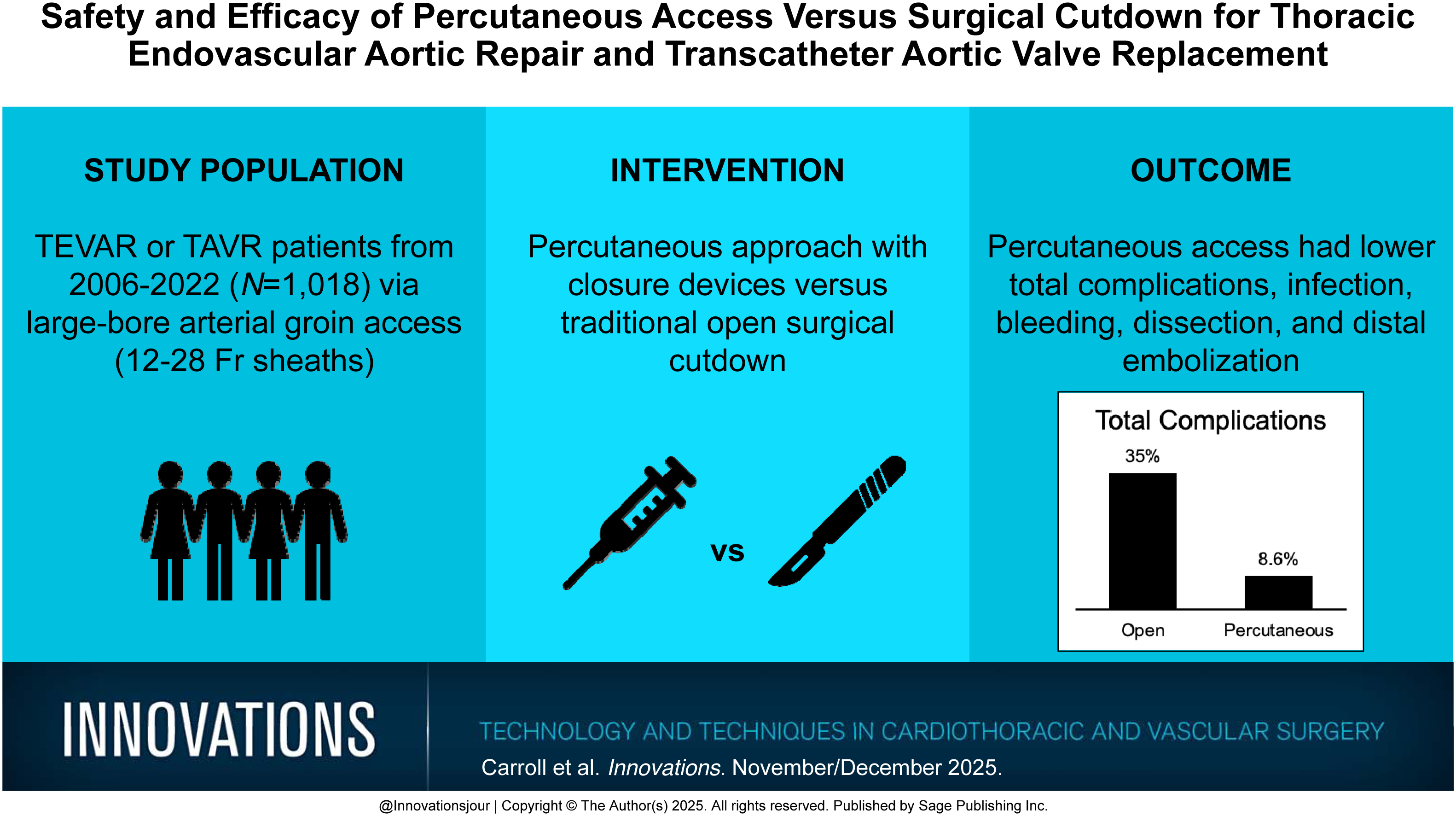
Delivery sites were successfully closed using a median of 2 percutaneous closure devices. Larger sheath diameter was associated with conversion to open (20 Fr vs 16 Fr, P = 0.004). There was a significantly higher rate of total complications (35.0% vs 8.6%, P < 0.001), infection, bleeding, seroma, dissection, and distal embolization in open compared with percutaneous cases. Multivariable analysis confirmed a significantly lower rate of complication with the percutaneous approach relative to the open approach (odds ratio = 0.17, P < 0.001).
Conclusions:
Percutaneous access is associated with significantly lower rates of total complications, infection, bleeding, dissection, and distal embolization when compared with surgical cutdown. Delivery sheath size was associated with conversion to open arteriotomy closure, but the overall incidence was low. Large-bore arterial access closure can be safely achieved using a percutaneous strategy, resulting in fewer complications than with the open approach.
Get full access to this article
View all access options for this article.
References
Supplementary Material
Please find the following supplemental material available below.
For Open Access articles published under a Creative Commons License, all supplemental material carries the same license as the article it is associated with.
For non-Open Access articles published, all supplemental material carries a non-exclusive license, and permission requests for re-use of supplemental material or any part of supplemental material shall be sent directly to the copyright owner as specified in the copyright notice associated with the article.
