




Abstract
This case study explores the challenges faced by incoming principals who encounter unexpected situations along with the impacts on multiple stakeholders of leadership transition on a middle school campus. Leadership shifts are felt throughout organizations in diverse ways and may even have a personal impact on individuals in a school community. Leadership transition, by its very nature, is a change. Change, especially at the top, presents organizations with myriad possibilities and similar stressors. Principal turnover has a direct impact on school achievement. The principal is key to sustainable school improvement, a process that may take 5 to 7 years after a new principal has been named. High-performing principals often leave campuses and move to central office positions because of their success with campus achievement. In the late 1990s and early 2000s in Texas, more than 30% of principals left their campuses within the first 2 years. Principals leave schools for varying reasons, such as promotions to other campuses, district-level roles, new opportunities in other districts, retirement, and positions out of the educational field. The reader should consider all perspectives in the narrative. This case study involves issues related to transition, change, instructional policies, decision-making, staff culture, and the impacts of COVID-19 on student achievement.
Keywords
Case Narrative
Rock River School District is a mid-sized, suburban district located in the Southern United States. It borders a large urban school district, the second largest in the state. Rock River services approximately 40,000 students in grades PK through 12 and consists of 36 schools: four comprehensive high schools, seven middle schools, and 25 elementary schools. Nearly, two-thirds of the schools in Rock River identify as Title I. One of those schools is Dwight D. Eisenhower Middle School (EMS).
The Recent History of Eisenhower Middle School
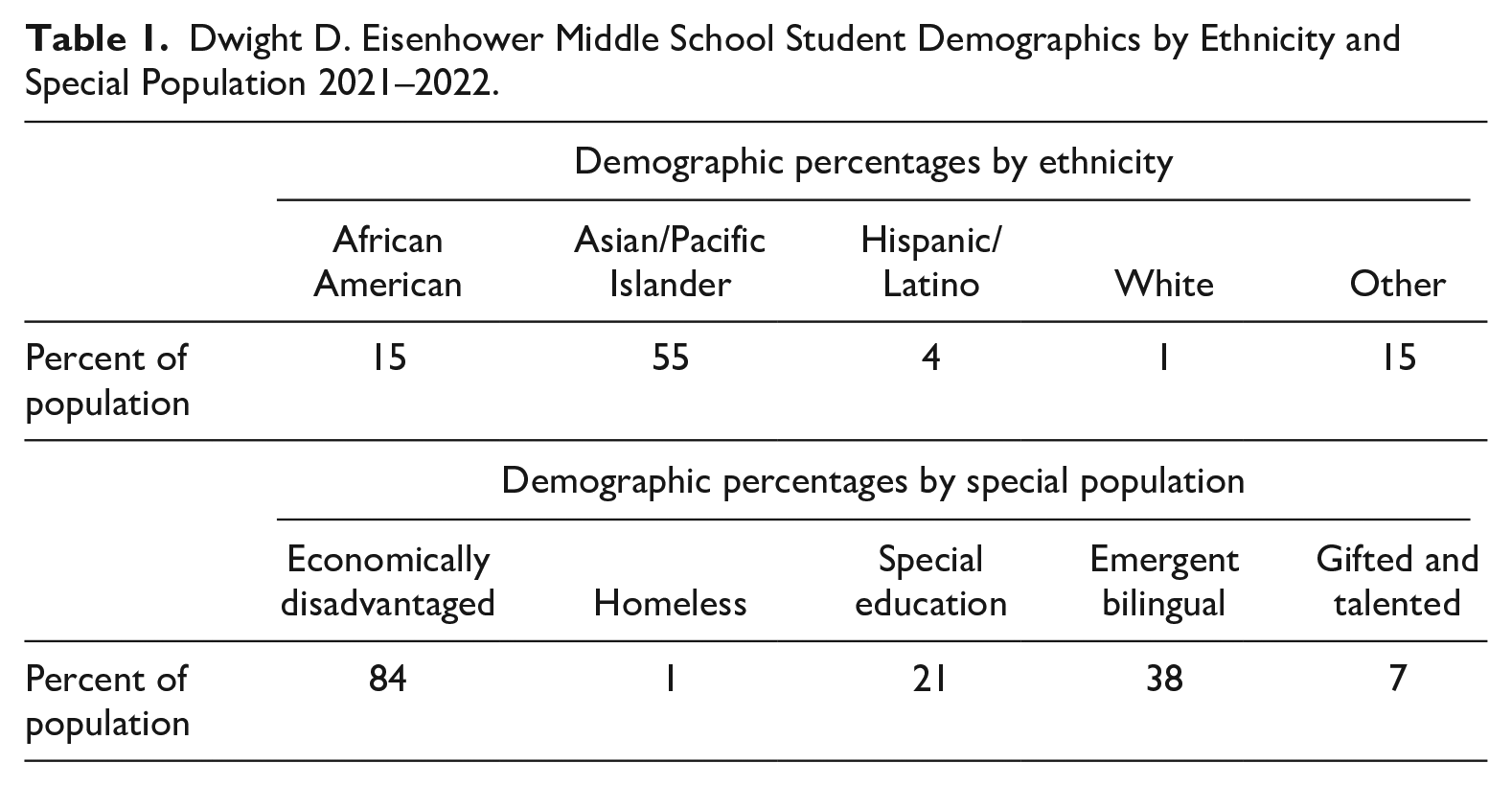
EMS serves approximately 900 students in Grades 6 through 8. The demographic breakdown at EMS has changed over the past two decades as the campus shifted from a majority white campus with a large African American subpopulation in the early 2000s to its current profile as a majority Hispanic campus with large African American and Asian subpopulations. Thirty-eight percent of students at EMS are labeled as Emergent Bilinguals (EBs), with a majority of beginner EBs speaking various East Asian and Middle Eastern languages at home. Eighty-four percent of the students at EMS receive free and reduced lunch benefits, and 21% of the student population receives special education services (Table 1).
Dwight D. Eisenhower Middle School Student Demographics by Ethnicity and Special Population 2021–2022.
In addition to demographic shifts, change in leadership has been a common occurrence at EMS. This fall, EMS will be welcoming its third principal in 5 years. Eisenhower’s past two principals, Dr Janice DeMarco, and Mr Peter Quigley were both promoted to district-level administration positions within Rock River School district after short tenures of 2 to 3 years. Dr DeMarco was brought to the Rock River central office after being lauded for her handling of the abrupt switch to virtual schooling in the beginning days of the COVID-19 pandemic. She served EMS for 3 years. Mr Quigley was promoted after overseeing a tremendous rebound in state test scores after the low mark of the first full year of pandemic schooling. He was the EMS principal for just 2 years.
While both principals left EMS on good terms, the lack of continuity in leadership is a concern. Neither Dr Demarco nor Mr Quigley worked long enough at EMS to establish a sustainable culture (Table 2). The lack of long-term impact from their leadership is underscored in state assessment data. While short-term gains in proficiency were seen under Mr Quigley’s leadership, the long-term trends of underachievement among academically advanced students continued. As part of the state accountability system, students are required to make a certain level of academic achievement and academic growth at the advanced (meets) level to display campus-wide success for academic achievement, determining overall ratings. In addition, EB students must meet a specific proficiency target determined by the state. Targets are determined based on prior year performance (Table 3).
EMS Reading and Math Proficiency and Advanced Achievement Trends.
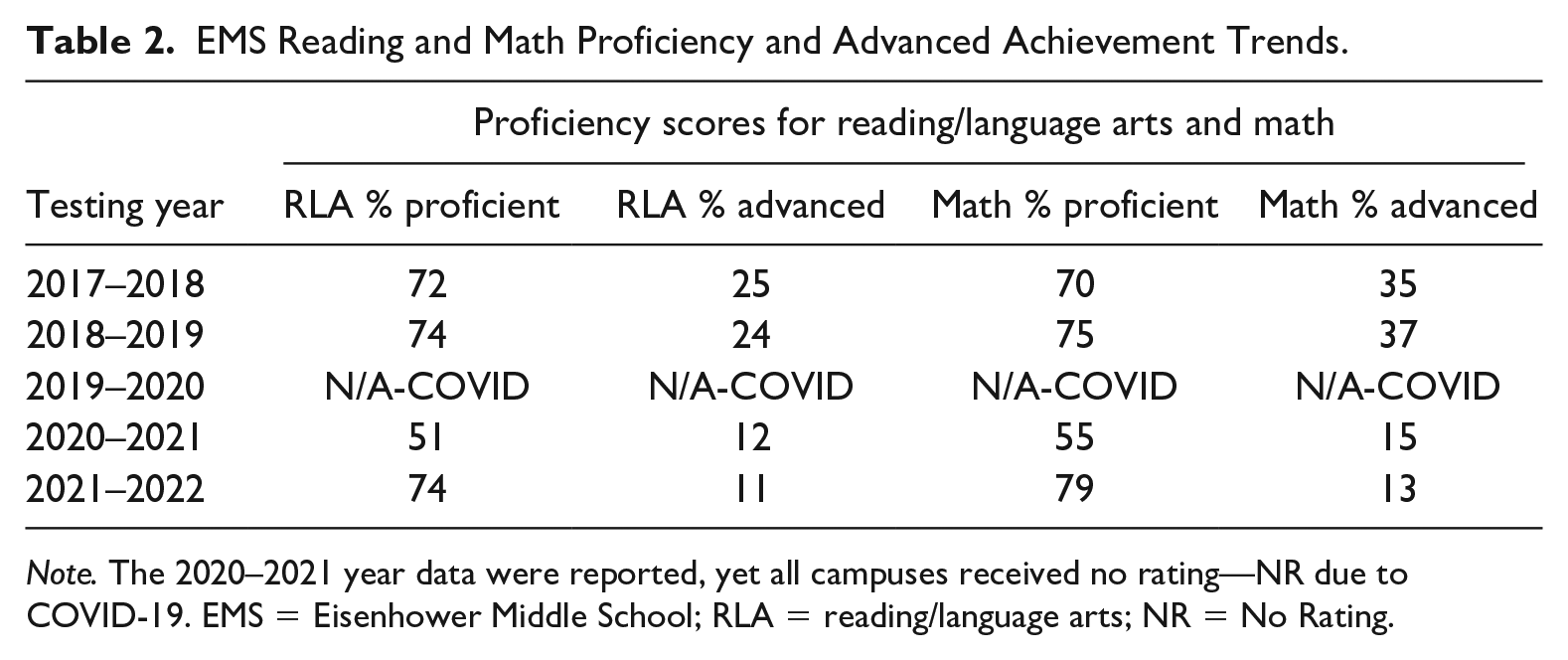
Note. The 2020–2021 year data were reported, yet all campuses received no rating—NR due to COVID-19. EMS = Eisenhower Middle School; RLA = reading/language arts; NR = No Rating.
EMS Overall Campus Advanced Achievement Trends.
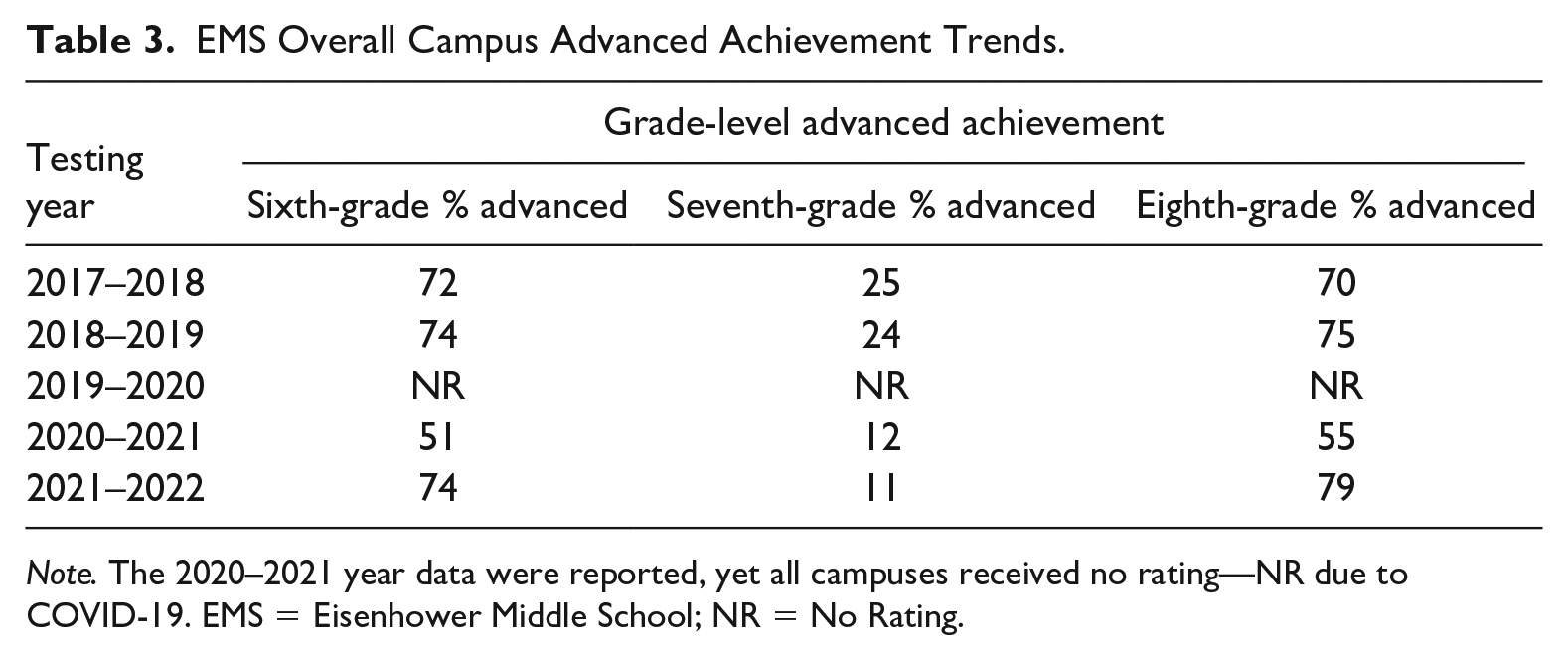
Note. The 2020–2021 year data were reported, yet all campuses received no rating—NR due to COVID-19. EMS = Eisenhower Middle School; NR = No Rating.
The Outgoing Principal—The Legend of Mr Quigley
Peter Quigley was bent on improving EMS culture immediately upon his arrival. While conventional wisdom called for a slow start to any change initiatives as a new campus leader, Mr Quigley leaned on his natural charisma and high energy level to instill a sense of urgency in the EMS staff to increase student achievement. From the beginning of the year, faculty meeting to every hallway conversation, he referred to his mission for EMS. By October, every member of the EMS team could name what had become the school’s new mission: “high levels of achievement for all students.”
In addition to refocusing the faculty on a common vision of high levels of student achievement, Mr Quigley prided himself on relationship building. He carved out 1 hour every day for the first month of his time on campus to have one-on-one meetings with each faculty member. By the end of his first semester as a campus administrator, Mr Quigley knew everyone on campus and had every adult on campus referring to him not as “Mr. Quigley,” but as “Peter.” This focus on relationships paid tremendous dividends when it came to staff morale. Every EMS staff member felt valued and heard.
Peter’s vision casting and focus on relationships were critical in facilitating his greatest accomplishment on campus, the implementation of a school-wide, targeted intervention system. The system began as an idea from Mr Nguyen, the Math department chair. Mr Nguyen had a proposal about targeted pullouts from non-core content classes. His plan involved identifying essential skills that held students back in Math classes and pulling them from elective classes, such as music, art, drama, and physical education (PE), to provide extra support on specific skills. He pitched this proposal to Peter, who helped to clarify the vision. Peter then assembled a team, including Mr Nguyen, to iron out the logistical details and to make the proposal a reality, not just for Math, but for Reading as well.
The positive reception of this plan was another marker of the staff’s trust in Peter Quigley. The intervention plan called for students to be pulled from their fine arts electives and PE classes to receive additional instruction in Math and Reading. Some of the athletic coaches and elective teachers voiced concern about losing out on their time with students for these interventions, but they were persuaded to support the initiative. “Eisenhower has a moral imperative,” Peter argued, “to help every student achieve elevated levels of learning. In addition to this, if more of our kids pass, then more will be able to participate in after-school sports and fine arts activities.”
Peter was able to get students on board with his new intervention initiative too. He was able to leverage his rapport with students to convince them about the benefits of interventions, even if most students remained unenthusiastic about losing out on elective time. The approach he took with students was similar to the approach he took with his staff; he led with the “why” of the interventions. Within 4 weeks of the roll out of the elective-pullout-intervention plan, students embraced the interventions. Students noticed that with progress, they stopped being pulled and were able to attend electives every day. With the targeted help students received during pullouts, learning gaps closed. As a result, morale among students in math and reading classes increased.
Peter had a gift for making his staff and students feel valued. He encouraged collaboration and embraced risk-taking if it benefited students. The successful transformation of a math teacher’s intervention idea into a campus-wide system with widespread buy-in was a hallmark of Peter Quigley’s leadership. He believed in his people. He built leaders. He encouraged and helped foster every idea that would help students succeed.
The high morale at EMS and the rise in student test scores served to mask a real problem in Mr Quigley’s leadership. He was involved in everything at EMS. Little to nothing was done without his blessing or direct involvement. Peter was driven by a motor, taking task after task on himself and rarely delegating any tasks to other faculty members. He wanted to protect their time for innovation and collaboration. Because he was directly involved in so many aspects of school operations, little to no systems or structures were written down. Rules and procedures were simply “understood.” When so much of EMS’s recent success hinged on the direct involvement of one man, what would happen if he left?
When the news broke that Peter Quigley was moving on from EMS for a district-level leadership position, the reaction from the staff was a mix of sadness and pride in his success. There was also tremendous concern about what the impending transition would mean for EMS and the magnificent work that had been done under Mr Quigley’s leadership.
The New Principal—Taking the Helm
Eisenhower’s new principal, Dr Jacqueline Kimble, was a veteran of Rock River School District. She worked as a teacher for 15 years, an assistant principal for 5 years, and most recently as the dean of instruction at Roosevelt High School for the past 6 years. To the longer tenured teachers at EMS, Kimble was a familiar name. She often led district-level professional development. Her name was often on the “CC” line of important district emails, and her name has previously mentioned about potential “next principals.”
Kimble earned a reputation for being rigid and focused on systems. In fact, her name was ascribed to a quote that has been circulating through the district for years: “If it is not written down, it does not exist.” This focus on systems and protocol served her well in her previous posts. The handbooks she created and the structures she was instrumental in codifying were credited with decreases in student discipline referrals and instructional systems, leading to evidenced student achievement. In addition, the clarity provided by Dr Kimble’s focus on structure was recognized by her previous two principals as a contributing factor to increases in teacher morale.
For all her successes, a hallmark of Dr Kimble’s tenure had been consistency. She had remained in every leadership post earned for at least 5 years. She also served exclusively under campus leaders who had held their posts for 4 or more years. Dr Kimble’s appointment was seen by many as a logical and safe move to bring stability to a campus that has become synonymous with leadership change.
The revolving door of administration at EMS, despite its association with positive promotions, took its toll on campus culture and morale. After having worked with a transformational leader who idealized influence, inspired with motivation, stimulated intellect, and considered individuals, like Mr Quigley for 2 years, the EMS staff was likely to be reticent about any new principal (Bass & Riggio, 2006). With Dr Kimble being billed as a systems-oriented leader, there was palpable tension among the EMS staff. “Systems,” one teacher remarked, “sounds like the opposite of Peter’s passion and vision. Get ready for four-page lesson plans.”
Old Meets New—The Principal Transition Meeting
Directly following her appointment as the new principal of EMS, Dr Kimble reached out to Mr Quigley in hopes that he could share some things about the school that only a principal truly knows. Having met Peter several times during leadership meetings, Jacqueline felt comfortable approaching him for a meeting. She hoped to get some feedback on the ins and outs of the school. Just as she had expected, Peter welcomed the meeting excitedly.
The two leaders met at EMS, where Peter could give her a tour before sitting down to talk business. Seeing how proudly he spoke of the school, and anyone they came across as they walked the campus, Jacqueline could tell that Peter was truly, personally invested in the success of every student and staff member at EMS. Following the tour, the two leaders sat down to discuss school matters and the programs within the school.
Dr Kimble opened with questions about school operations, including staffing and schedules. Peter obliged and answered with some insights into the ins and outs of the school but moved, more quickly than Jacqueline would have preferred, into his work on the campus climate and culture. He talked about his efforts to build relationships with everyone in the building, parents, and community members. Peter proudly spoke of the parent involvement initiatives and how successful they had been since he arrived. For middle school, this was not easy, and he wanted her to know the importance. When he started at the school, parent involvement was non-existent due to the impact of the COVID pandemic. He shared that there was still work to do in this regard, but that he was proud of the gains toward pre-COVID levels of parent involvement.
Understanding that Peter wanted to focus on climate and culture, Jacqueline asked him about some of Eisenhower’s extracurricular successes. He said EMS had great coaches and fine arts teachers, but their students typically did not place high in district events. When pressed on the issue, Peter revealed that the focus of the past few years had been on core academic gains. Improvements in extracurriculars would surely improve, he assured her, but a focus on academics had been critical for the past few years.
While on the topic of core academic gains, Peter mentioned his intervention plan. He showed her the data that noted the uptick in scores for the students involved in the fine arts and PE pullouts. He described how much time some students missed from their electives to accomplish these gains. At first, Dr Kimble thought she misunderstood what he was saying, but as he continued to elaborate, she knew she had heard him correctly. Peter Quigley’s district-lauded intervention system involved students losing minutes in state-mandated fine arts and PE classes.
As a staunch supporter of Whole Child Education, Jacqueline was confounded and slightly annoyed by this revelation. Not only was sacrificing elective time for remediation something that she was philosophically opposed, but she was certain that this program was a violation of state law. In her position as Dean of Instruction, part of her responsibility was understanding state education laws and regulations. She had worked behind the scenes for years to ensure that this sort of thing was not occurring on her campuses. As she listened throughout the rest of the meeting, she mentally took note that this intervention program could no longer stand and would be one of the first changes she would have to make as the incoming principal of this school.
District Leader Meeting—Dr Kimble Brings Concerns to the “White House” (District Office)
Shortly after meeting with Mr Quigley, Dr Kimble scheduled to meet with her Area Superintendent, Mrs Bedford, to discuss procedures for transition to the new campus. While she was no stranger to campus transitions, this was completely different as she now was the principal carrying 100% of the accountability for the success and failure of EMS. She was now in the captain’s chair, and along with that came the knowledge of how the campus was truly perceived and the plans for her focus moving forward.
Mrs Bedford shared with Dr Kimble that district administration was impressed with the growth that the students had shown under the intervention plan developed by Mr Quigley. Upon hearing this, Jacqueline had to speak up. She described the program as Mr Quigley had expressed it to her, then asked if district administrators were aware that students were pulled from their fine arts electives and PE, missing state-mandated minutes in these classes. Mrs Bedford looked surprised and said she did not know that was part of the process, as only results were presented. Mrs Bedford agreed with Dr Kimble about the importance of aligning all programs to comply with state law. However, she stressed that it could not be abandoned because the interventions were a success.
Following Jacqueline’s disclosure and a short conversation about the necessity of the intervention program, Dr Bedford shifted the conversation to the school’s state accountability rating. EMS students receiving intervention saw significant increases in state assessment scores. In addition to this, the overall percentage of students reaching the proficient achievement level on these assessments increased significantly. Despite these successes, Dr Medford disclosed that EMS would be entering Jacqueline’s inaugural school year on a state-mandated growth plan.
While EMS’s intervention plan produced great gains for struggling learners, the students at EMS who were not receiving interventions had not made similar progress (Figure 1). Approximately, 30% of EMS students made negative academic progress, according to the state’s accountability system. This backward trend in such a substantial portion of EMS’s population had earned the school a failing rating in the state’s academic achievement and growth measure. In addition, the campus EB population did not meet the required target.
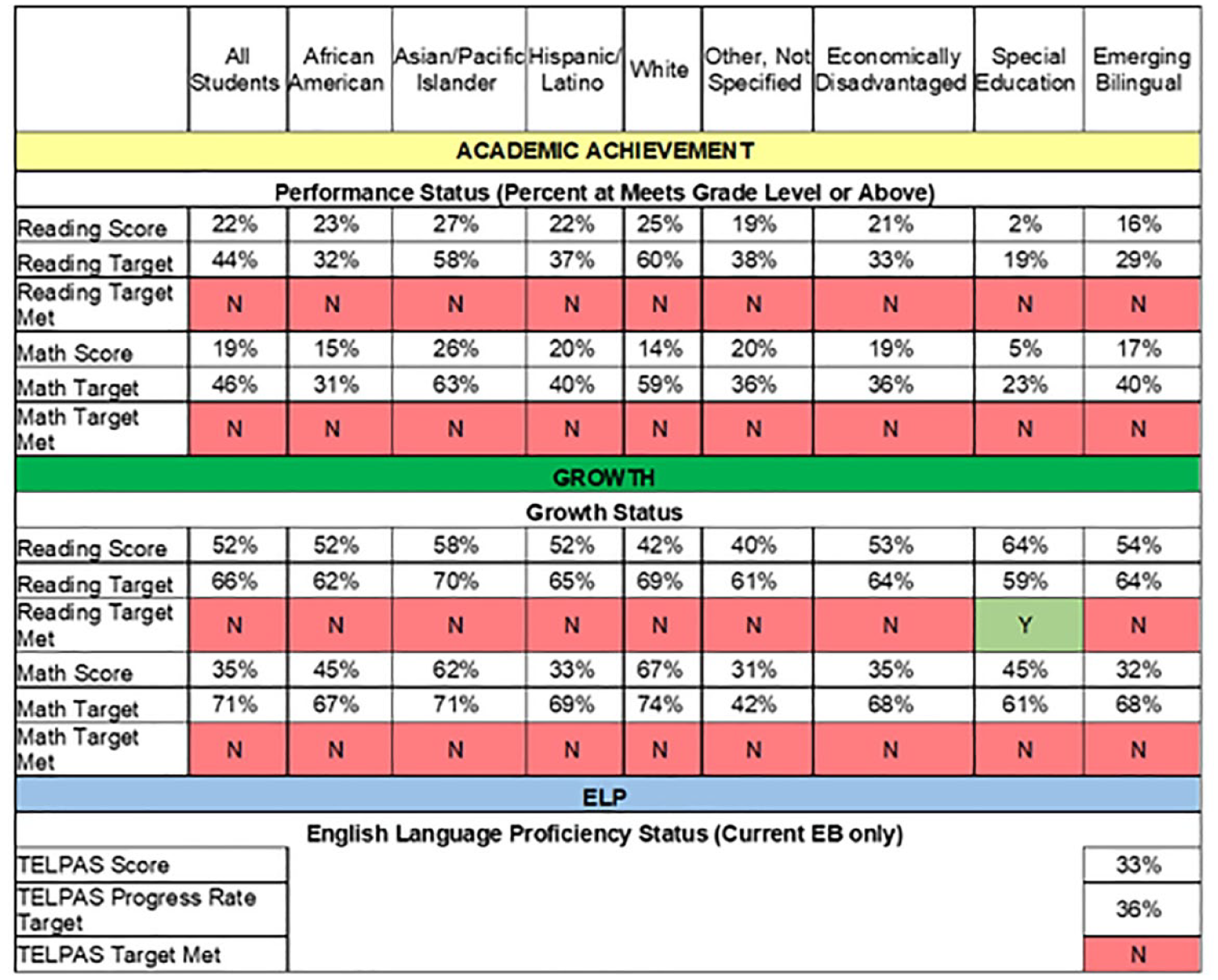
State Prepared Academic Achievement Report for Eisenhower Middle School.
Mrs Bedford recognized the shock in Dr Kimble’s face and offered some comforting words. She then reemphasized her confidence in Jacqueline and in her record of accomplishment as a stabilizing force and natural problem solver. While Jacqueline appreciated the vote of confidence, she was uneasy. She was advised by mentors and current, effective principals to not make drastic changes in her first year as principal. Year 1 was about building relationships and laying the foundations for positive change. Jacqueline’s year 1 was, by necessity, going to look vastly different.
Dr Kimble was charged with restructuring EMS’s intervention program to make sure it complied with state law. She was also going to have to fashion a way to increase engagement among EMS’s higher academic achievers and language learners to ensure that they saw similar growth to the students who had received targeted intervention in the previous school year. Jacqueline was sure she was going to get some pushback regarding any changes she made. As EMS’s principal, all repercussions of new implementation would directly impact on her relationships with staff and her instructional record of accomplishment of excellence.
After her meeting with Mrs Bedford, Jacqueline took an afternoon, first to worry then to process the information shared and how this news would inform her of her next move. The following day, she came to work ready to plan and problem solve. She would have to share the news of changes to the intervention plan and EMS placement on a state growth plan with her staff as quickly and as gently as possible. Her focus turned entirely to EMS’s welcome back faculty meeting.
Welcome Back Faculty Meeting—Breaking the News
Dr Kimble welcomed the staff back to school on the first day of the Fall semester with student cheerleaders celebrating their return, a catered breakfast, and a team-building activity. There were some necessary back-to-school forms that teachers needed to complete. To allow teachers time to fill out these forms, while also allowing for some bonding and competitive fun, Dr Kimble and her assistant principals organized a scavenger hunt. During this activity, teachers were placed on teams and competed to see who could gather all the necessary signatures and personal information needed for their paperwork. This part of the morning was met with an enthusiastic response with more than one teacher proclaiming that this “was a great idea!”
After a brief recess following the scavenger hunt, Dr Kimble took the time to formally introduce herself. Her presentation reflected her personality, efficient and to the point. She laid out her journey in education and expressed her excitement to continue the excellent work that had been underway at EMS. Dr Kimble also took time to speak a little about her philosophy as an educator and how she believed in whole-child education. She emphasized that schools employ fine arts and PE teachers in addition to core content teachers because non-core education, in her estimation, is just as valuable as core content education and in many cases brings joy to students. These fine arts electives and PE courses, she continued, provide necessary extension and enrichment to high-achieving learners, and may help keep them engaged and motivated in school.
After sharing her story, Dr Kimble shifted her focus to EMS’s state test scores and the positive and negative news related to those scores. Jacqueline started her presentation on test scores with positive news, praising the staff for the magnificent work that EMS had done to increase overall achievement on state tests and closing the gaps between demographic groups on those same tests. After sharing this genuine bit of good news, she shared that there were still areas in which EMS had work to do. While EMS had made strides in increasing overall student achievement, EMS’s high-achieving students did not show academic growth. A full 30% of EMS’s students, all of whom had reached the highest level of achievement on the previous year’s state tests, had regressed on the most recent exams. Due to the considerable number of students failing to meet what the state education agency termed “positive academic growth,” EMS was placed on a state-mandated growth plan.
This news was met with confusion and anxiety from the staff. Dr Kimble paused her presentation while disruptive side conversations broke out and several teachers began speaking over one another to try to shout questions at the new principal. Dr Kimble got the faculty’s attention and did her best to calm the room, explaining that she had no doubt that they would meet the needs of the growth plan together and that the strides EMS had made in student achievement showed the efficacy of Eisenhower’s teachers and the drive of Eisenhower’s students.
Once the faculty had quieted enough for Dr Kimble to move on, she moved quickly to the topic of the school’s intervention system. She shared that the current system, which called for students to be pulled from fine arts electives and PE for math and reading/language arts (RLA) interventions, would not be continued this school year. Dr Kimble explained that this decision was made because pulling students from fine arts and PE denied students access to critical learning opportunities and, in addition, was in violation of state mandates. Students were not only readers and mathematicians, she explained, but also musicians, performers, artists, and athletes. Sports and fine arts, Dr Kimble reasoned, were the only reason some students came to school. The very reason for Eisenhower’s growth plan was that high-achieving students were backsliding. She reasoned that this could be a symptom of poor investment in enrichment time on campus.
Dr Kimble’s defense of electives was not well received, however. In fact, it was barely received at all, as her voice was once again drowned out by the crowd. While there were some smiles and clapping in response to her support of the fine arts and PE courses, the core content teachers, particularly those in the Math and RLA departments, were visibly shaken, and multiple teachers were visibly angry as they spoke among themselves, clearly disengaged from Dr Kimble’s presentation.
With the help of her assistant principals, Dr Kimble got the noise level low enough to be heard. As she began speaking again, side conversations disrupted her speech once more. Understanding that no more information would help ease the current tension in the room, Dr Kimble abruptly ended the faculty meeting with these words: I understand that the news of losing your intervention system is difficult. We will follow state policy at Eisenhower and the current system is in violation of state policy. I will not allow any program that directly opposes state law to be run on this campus. I plan to meet with the campus leadership team to plan for an alternative intervention system and would love to brainstorm alternatives with any faculty members who may have ideas. For now, though, please go enjoy your lunch. The faculty meeting is over, and the afternoon is yours.
She closed her laptop, stepped down from the stage, and quickly made her way to her office.
Perspectives—All EMS Experiences Are “NOT” Created Equally
Ms. Young—New and Inspired
Ms Erin Young was hired by Mr Quigley 2 years ago, right out of an undergraduate teacher prep program. Her first and only 2 years of teaching experience were at EMS led by Mr Quigley. As an RLA teacher, Ms Young was involved in the planning for the school’s intervention program. She helped to determine which students needed support on which RLA standards. She and the rest of her RLA team paired students with degree-holding interventionists or retired teachers who had shown success with each intervention standard.
Though she was involved in the workings of the school to a degree that few second-year teachers were, Ms Young was still in the initial stages of her career and had never experienced a leadership change. She had heard from her more experienced colleagues that Dr Kimble was much more systems-oriented and less of a motivational figure than Mr Quigley. Regardless of this knowledge, Ms Young was not prepared for what she experienced at the beginning-of-the-year faculty meeting. Dr Kimble came across as competent and even pleasant early in the meeting, but Erin felt that by the end, after having shared the two big pieces of sad news, that two more appropriate descriptors of Dr Kimble may be panicked and rigid.
Ms Young felt invested in the students at EMS and, with only 2 years of experience, thought she was committed to sticking this year and certainly next year out before considering moving on. However, she no longer felt that the new principal was invested in the staff. Working directly with Dr Kimble was not something in which she had interest. The school year after the shutdown was so stressful in having to deal with her own and her students’ COVID-related social emotional trauma. So many gains were made last year even though things looked impossible. How could Dr Kimble just not consider what accomplished?
While she was involved in the process of placing students in intervention groups last year and was something of an expert in the workings of Eisenhower’s intervention plan, she decided shortly after the faculty meeting that she may have to move on from Eisenhower before students arrive. As a new effective teacher, other schools would be interested and were much closer to her home. If she was not able to find other work in education due to license sanction or lack of interest, she figured she was still young enough to switch careers. Erin decided she would submit her resignation letter that afternoon.
Mr Nguyen—The Man Behind the “Plan”
Mr John Nguyen taught at EMS for 15 years and was entering his eighth year as the Math Department chair. Mr Nguyen was one of just a few teachers on campus who had worked at EMS before “the revolving door of principals.” Prior to Mr Quigley’s arrival on campus, Mr Nguyen began to feel complacent. He had led the math department for 5 years but had seen little progress in student achievement scores and had noticed quite an uptick in student apathy. He found himself reinvigorated and excited about his work once again with the arrival of Mr Quigley. Mr Quigley inspired Mr Nguyen to speak his mind and to take risks.
While he would not take credit for the implementation of the school’s intervention plan, it did begin with his collaboration with the fine arts and PE teachers. Before sharing his idea with Mr Quigley, he worked with elective and PE teachers to pull kids from their classes for extra math help. Elective teachers were on board because this extra help allowed students to participate in after-school activities, which some students had been missing due to the state’s “no pass, no play” policy. Mr Quigley had heard about what Mr Nguyen was doing and met with him to hear about the rationale behind the move. Mr Quigley was impressed by Mr Nguyen’s initiative and quickly turned to him as a member of his leadership team and as a regular thinking partner. Mr Quigley’s leadership and trust in him had transformed Mr Nguyen’s complacency into a reinvigorated passion for his work.
When he heard that Mr Quigley was leaving, Mr Nguyen was devastated. He knew that leaders like Mr Quigley were rare, and he questioned whether anyone could effectively take his place. In addition to this, the word was that his successor, Dr Kimble, was focused on following district policy in every detail and that her focus was on systems, not people. To make matters worse, at Kimble’s initial faculty meeting, she effectively announced the end of the school’s intervention program. There was some explanation about state and district policy. However, all Mr Nguyen heard was that his passion project, something he had helped to create with a truly visionary leader, was being scrapped because of some bureaucratic technicality. The reason this intervention plan was critical was due to the loss of learning students experienced during COVID. They needed something different, and the program was an example of what was best for kids. Now, it seemed, Kimble was letting a misguided “law” get in the way of that.
Mr Nguyen was too invested in the students at EMS to walk away from his job so close to the beginning of the school year, but the first thing he did after the meeting was to find and update his resume. He could do anything, work anywhere for a year, but he knew he would not be back at EMS next August.
Mrs Hopkins—Music to Her Ears
Miriam Hopkins was beginning her 20th year in Rock River School District, and her 12th year at EMS as the choir director and had been the fine arts department chair for 6 years. Before coming to EMS, Mrs Hopkins served 8 years at Eisenhower’s feeder elementary school. In her first 4 years at EMS, she built the choral program from the ground up. When Miriam arrived, choir was considered an “Easy A” class because it was where students went who did not get into their first (sometimes second or third) choice elective.
The numbers (and talent, if she was honest) were incredibly low in her “top” choirs when she began. As time marched on, Miriam built relationships with students and used her connections with the elementary music teachers to recruit students into her program. In her fifth year, the numbers tripled in her select groups and quadrupled in her beginner groups. Mrs Hopkins consistently had superior marks at choral festivals around the city and state. This success continued to grow until Mr Peter Quigley became principal.
Sure, everyone loved Mr Quigley because he was very personable with a magnetic personality. However, when it came to his intervention initiative, he seemed to have a one-track mind. When Mr Nguyen first brought up the plan to pull students from their electives for some extra help, Miriam and her team were more than happy to oblige because it happened sporadically. In addition, it was a benefit to her, along with the rest of her department and PE, because it helped her students who were struggling to get on track so they could participate in their extracurricular activities. However, what started as a favor to Mr Nguyen and a few other teachers was not meant to turn into something so permanent.
The fine arts and PE departments saw a huge drop in classroom numbers. Indeed, the numbers on the roster stayed the same, but the physical bodies in the classroom dwindled. For Mrs Hopkins and her other fine arts teammates, this was detrimental to their rehearsals during class time. For example, her top audition show choir ensemble had only 16 students. When Mr Quigley started his intervention initiative, over half were consistently missing during her class. For the students who were there, it was difficult for them to rehearse with so many students absent from class. On top of that, according to the initiative, Miriam would have to rehearse with the missing students either after school or during her planning time. The students rarely got a chance to rehearse all together, and this caused them to lose their high marks in festivals and competitions. This took its toll on the whole department. It would take a significant amount of work to get them to where they were 3 years ago.
While others were visibly angry during the meeting with Dr Kimble, the fine arts and PE teachers could not help but show their relief. Their cheers were drowned out by the others’ jeers, but that did not matter. Mrs Hopkins and the elective team were confident that Dr Kimble would be true to word and that they could start to rebuild their programs. With any luck, Dr Kimble would last longer at EMS than her two predecessors.
Sophia—#1 Mr Quigley Fan
Sophia is a rising eighth grader at EMS. When she came to the campus, she was afraid, shy, and overwhelmed with the change from elementary school to middle school. Returning to school after virtual learning at home due to COVID was scary. When she arrived on the campus, Mr Quigley was the first person she saw who greeted her with a smile full of love and welcomed her to EMS. He could see that she was afraid, and he made it his business to reassure her that everything was going to be okay. Mr Quigley even made it a point to check in on her at the end of the day and every day for what seemed like her entire sixth-grade year. Sophia knew that had it not been for Mr Quigley she would not have blossomed into the proud confident eighth grader she was today.
At the staff meeting, she and the rest of the cheerleading team were asked to welcome teachers back to school. Sophia was the captain of the team and was sad that Mr Quigley was leaving. Still, she found a way to be incredibly happy for him as she knew that he deserved the promotion. Sophia knew her role as captain meant she would need to lead the charge in welcoming the new principal. Once the cheerleaders welcomed the new principal and staff, they were excused to return to the gym with a campus aide to meet their parents for pick-up. While preparing to leave, she realized she had forgotten her pom poms at the staff meeting. She ran back to get them. While re-entering the staff meeting, she overheard that the intervention program would no longer be in place. Her mouth dropped to the floor in disappointment. While she wanted to be positive, this news upset her because the intervention program helped her to do better in her classes and pass the state reading test for the first time in her academic career.
What was she going to do now? The feeling of fear and being overwhelmed returned as if she were in sixth grade all over again. Unfortunately, while many good things were being said about Dr Kimble, she did not have the same warmth that Mr Quigley had. Like her time during COVID at home, she felt once again, alone. Sophia could not wait to go home and tell her parents this news. She knew that they would not be happy about it either.
Dr Kimble—The New “Bad Guy”
Back in her office following the morning session, Dr Kimble took a deep breath and sat at her desk. She expected a reaction; however, she did not expect to have to shut down the meeting so abruptly. She had really enjoyed getting to know her fresh staff during the icebreakers. There was positive interaction all around and she could tell what Mrs Bedford meant when she said they had a great dynamic. The staff genuinely enjoyed each other’s company. When it came to breaking the news about the intervention initiative, Jacqueline had braced herself for some rebuttal, but she did not anticipate the chaos that ensued with people shouting out and talking over one another. She would address meeting norms in all meetings she had going forward.
Dr Kimble realized as she scanned the room that the reactions and emotions were across the spectrum. Several of the PE coaches and elective team seemed elated about this information, while most math and RLA teachers looked confused, shocked, or . . . Was that anger? Most started having impassioned conversations with one another, surely trying to figure out what it meant for them. Though she had told the staff she would give them more details in their smaller team meetings, she was not sure if anyone heard that part since there was so much commotion. One thing that did not surprise her was the reaction of the staff when she told them that the intervention initiative, as it stood, was in violation of state education laws. Jacqueline had seen that reaction in every person with whom she shared the intervention initiative. No one realized that what they were doing was a contravention of several policies. What did surprise her was that many staff members seemed unaware that they were still going to be on a growth plan due to the underperformance of the higher-level students. She was not the only one with whom Mr Quigley failed to share that bit of information. He knew all along and had not shared it with the people he cared for the most, teachers and parents.
As she had been setting herself up in the office and looking through the disorganization that was left, she could not find any reference to this intervention plan anywhere on paper. She had asked her assistant principals about it, and they said that they had never received any written documentation. It was just learned, and everyone knew their role. The upcoming week would be critical and foundational in establishing professional morale and providing meaningful support as she met with her leadership team and departments throughout the building to gain insight and ideas on a new intervention plan. One thing was certain, she would make the details of this new implementation clear and in writing. “If it isn’t in writing, it doesn’t exist,” she reminded herself.
After giving herself a pep talk and action planning on how she would be moving forward in planning meetings, an email notification startled her and made her skip a breath. The email read, “Erin Young has submitted a formal resignation form.” Dr Kimble immediately wondered how many more of these notifications would she be receiving prior to school beginning. Emergency hiring had not been something experienced in her prior roles. What was the first step in the process?
Teaching Notes
The recruitment and appointment of principals are among the most important activities of school and system leaders (Bush, 2022). School effectiveness and academic achievement depend heavily on the strength and stability of school leadership (Yucedag-Ozcan & Metcalfe, 2018). Leadership shifts occur often in schools across the nation and more frequently in diverse schools that have academic challenges (Bush, 2022). One overarching conclusion has been that the reactions of change recipients are an important determinant of success and failure in implementing change (Agote et al., 2016). School accountability has sparked an urgency and priority in school districts to staff schools with effective instructional leaders that can impact change (Peters-Hawkins et al., 2018).
The transition of new principals in schools has several ripple effects that can impact culture, climate, and academic performance (Yucedag-Ozcan & Metcalfe, 2018). In many cases, the outgoing principal does not have any input or is not part of the selection process of the incoming principal. This process is typically controlled and driven by the district executive leadership.
The process varies on how principal selection takes place depending on district policies, hiring procedures, and human resources climate and culture. Many of these processes include but are not limited to campus position advertisement, candidate application, candidate pool development, campus profile development, candidate profile development, series of interviews—screening, panel, final, then candidate selection (Palmer et al., 2019).
What many of these processes do not take into consideration is the personality, vision, and individual priorities of the candidates and how those will impact the transition of leadership. When outgoing and incoming principals have different visions and priorities, faculty, student academic achievement, and campus culture can be impacted significantly (Cruickshank, 2018). The principal has both a direct and indirect impact on student and student learning. Principals ensure effective teachers/staff are hired, set vision, establish expectations, create positive culture, ensure teacher professional learning is strong, and provide instructional and managerial leadership that impact systems in which children will learn (Snodgrass Rangel, 2018). The transition of leadership must be handled with more care and intentionality because the impacts are lasting and impact multiple stakeholders.
Case Study Class Activities
Based on the case study, draft 5–7 incoming principal interview questions that address the challenges faced by Dr Kimble at EMS. What questions would be helpful in confirming the incoming principal would be prepared to address these challenges?
Discuss with a partner what your 90-day plan would be as the incoming principal. Collaborate and draft a 90-day outline to address both culture and academic needs for EMS.
Write an additional perspective not indicated in this case study. Present to the class why you choose this specific perspective.
Discussion Questions
Think about a time you, as a campus stakeholder, experienced a shift in leadership. What were some of the feelings that resonated with you the most? What fears or anxieties did you experience if any? Was there a level of excitement for a fresh and new leadership? Why or why not? Which of the perspectives can you relate to the most and why?
Based on your 90-day plan, what three key actions do you feel a new incoming principal should prioritize when transitioning onto a new campus? Consider all stakeholders in your response.
As in the case of Dr Demarco and Mr Quigley, leaders who exhibit some levels of success are often promoted or seek better opportunities elsewhere, making a massive impact on the sustainability factor for a campus. What do you think district leaders should consider when promoting or hiring new principals? How can they involve all stakeholders in decision-making?
What are some of the implications for school climate (environment) and culture (morale) when there is a change in leadership? How stakeholders impacted differently?
Dr Kimble needed to make a change to the school’s intervention system. When she shared this news with her staff, it was not well received. How could she have better communicated this change? Why do you feel your suggested recommendation of communication is more effective?
In this case, Mr Quigly or “Peter” was extremely popular with the staff, students, and community. What aspects of his leadership were positive and where did Mr Quigly have opportunities for growth?
Review the diverse types of leadership styles with your classmates (e.g., instructional leadership, transactional leadership, transformational leadership, social justice, or transformative leadership, etc.). What are some special considerations you feel are important for a new incoming principal when succeeding a transformational leader? How could this be different than following a transactional leader?
In the case study after Dr Kimble had her staff meeting, she took some time to reflect on her next steps with the staff when she received a resignation notification. Often, a new teacher’s turnover can be immediate. What advice would you give Dr Kimble on her next steps for mitigating the vacancy and avoiding additional vacancies?
Mr Quigley and Mrs Bedford celebrated the proficiency growth of students and neither mentioned the impacts of not focusing on all student performance (advanced and EB). Now Dr Kimble is faced with a growth plan. Was the previous administration ethically responsible? What does an ethical response look like for Dr Kimble?
In the perspectives section, Mr Nguyen refers to doing what was “best for kids.” Do you agree with the statement, why or why not? Reflect on a time when you may have observed or experienced challenging decision-making that conflicted with stakeholders’ interest. Explain to your classmates how the decision was made and its implications for said stakeholders.
Footnotes
Declaration of Conflicting Interests
The author(s) declared no potential conflicts of interest with respect to the research, authorship, and/or publication of this article.
Funding
The author(s) received no financial support for the research, authorship, and/or publication of this article.
