



Abstract
In the Republic of Ireland, school leadership policy adopts a distributed leadership model nationally. Given that this is a relatively recent policy development, research conducted on distributed leadership to date has highlighted that there are particular challenges for school leaders in enacting this model in practice and, more significantly, that principals have signalled their need for further leadership development in its enactment. In this study, we contribute to the growing national research on this leadership model. We chart the development of this policy and, drawing on primary school principals’ perspectives, also explore opportunities and challenges in this context at school and system levels, illustrated richly through two participant vignettes and more generally in the discussion. We argue that constructive-developmental theory, a theory that acknowledges developmental diversity and richly theorises professional growth and development, offers school and system leaders a nuanced, differentiated, and transformative approach through which leadership development activities are led at school and system levels can support principals to enact distributed leadership in practice. We conclude by describing developmental supports for leaders and considerations for system leaders and policymakers, which are also likely to be of interest beyond the Irish context given the rise of distributed leadership internationally.
Keywords
Introduction
Over the past decade, there has been a sustained national approach to the evolution of the educational leadership policy and practice contexts in the Republic of Ireland. One of the most significant policy context reforms has been the introduction of standards through a framework-process-model approach to leading schools at primary and post-primary/secondary levels (Murphy, 2019a). The Republic of Ireland's educational leadership framework, titled ‘Looking at Our Schools’ (Department of Education and Skills, 2016a, 2016b), explicates through two dimensions – (i) Teaching and Learning and (ii) Leadership and Management – a series of leadership standards (Berkovich and Bogler, 2020; Fitzpatrick Associates Economic Consultants, 2018) associated with statements of ‘effective’ and ‘highly effective’ school leadership practices. Importantly, the policy intention – albeit that the reality in practice is often different (Skerritt et al., 2021) – is that schools enact the framework through the process of school self-evaluation (SSE), adopting a distributed leadership (DL) model. In this paper, we explore how principals grow, and are themselves supported to grow, DL practice in their school contexts by drawing on constructive developmental theory.
In the Republic of Ireland, there are challenges for leaders on the ground when enacting the aforementioned framework-process-model approach in leading schools (Murphy, 2020; Sugrue, 2015). Notably, in historical reviews of the Irish context (Flood, 2011), the collaboration typically associated with the enactment of the DL model has been observed to be lacking and problematic (Lárusdóttir and O’Connor, 2017; Moynihan and O’Donovan, 2021; O’Donovan, 2015). Further compounding these, in broad stroke terms, ‘legacy issues’, are politically-mandated cuts to middle leadership structures and associated experiential leadership development for a period of almost 10 years owed largely to a deep economic recession which immediately preceded the implementation of the most recent educational leadership policy reforms aforementioned and elaborated on further below (Murphy, 2020). Finally, the discourse of the framework and the process associated with the DL model implemented in the Irish policy context is also worth mentioning. A range of scholars have recently pointed out that improvement, and more especially, both accountability and economic imperatives imbue the development and enactment of this contemporary policy and practice context (McNamara et al., 2021; Quinn, 2021; Skerrit et al., 2021), while others point to the OECD-influence of a ‘discourse of quality assurance’ (Moynihan and O’Donovan, 2021). Holloway (2021: 133) also sees the global policy-making pattern pertaining to DL as influenced by the OECD and aligned to ‘accountability-related’ and ‘utilitarian’ matters, but at the same time asserts the benefits of and for teachers’ participation in decision-making processes, particularly for a professional agency. Similarly, we believe that despite challenges connected to the architecture of the current policy landscape in Ireland, and thus their influence on practice, we still maintain that DL is worth pursuing and evolving through theoretical approaches such as that adopted in this paper given its association with enhanced broad outcomes for students and the multiple benefits of collaboration for teachers and principals as educationalists in its own rite (Hargreaves and O’Connor, 2017).
Although challenges such as those mentioned and, indeed, misconceptions exist related to the understanding, implementation and collaborative enactment of DL in the Republic of Ireland – issues common in many jurisdictions (Harris and DeFlaminis, 2016; Spillane et al., 2015) – it remains under-researched. Most of the limited research to date has also been carried out in post-primary school contexts and, therefore, this paper also contributes to the literature given the empirical data reflect primary school principals’ perspectives. It is also of note that the data were collected during the first wave of COVID-19 in March 2020, which also imbues participants’ views of collaborative leadership and, thus, offers a particularly rich, contemporary set of perspectives.
Recent sectoral research commissioned by the Centre for School Leadership (CSL), for example, demonstrated that principals have particular developmental needs associated with the implementation of a DL model, both structurally and culturally, in schools (Fitzpatrick Associates Economic Consultants, 2018). This is despite the evolving policy paradigm of DL and the reestablishment of middle leadership structures nationally (Forde et al., 2018). By exploring these challenges in light of recent policy developments in this paper, we argue principals’ learning needs might be best served by some degree of differentiation between both individuals and their school contexts.
At the outset, it is important to state that there are many so-called models of DL applied in DL research, including the leader plus model, the practice-centred model, the sociocultural model, the school improvement model and the knowledge-power model (cf. Tian and Nutbrown, 2021). While examining these or other models is not the focus of this paper, given the paper's focus, it is important that we articulate our sense of DL at the outset. While there is no commonly agreed definition of DL (Daniëls et al., 2019) and other scholars such as Harris and deFlaminis (2016: 144) warn against that ‘there is some particular model that schools need to follow’, we nonetheless see the definition offered by Tian et al. (2016) as generative. They define DL ‘as a process that comprises both organisational and individual scopes; the former regards leadership as a resource and the latter as an agency. Both resource and agency are considered to emerge and exist at all organisational levels’ (2016: 159). We see this definition as conveying our understanding given that we consider organisational resources and conditions, as well as individual agency and responsibility, as being essential for the development of oneself and others as leaders working in a system and/or school architected on a DL model. This theoretical model aligns most to the aforementioned practice-centred model (cf. Tian and Nutbrown, 2021).
In the remainder of this article, we first briefly overview the evolution of educational leadership towards the dominance of DL internationally (Hallinger and Kovačević, 2019; Harris and DeFlaminis, 2016; Tian et al., 2016). We then highlight calls from educational leadership scholars to explore geographic contexts beyond ‘Anglo-North American-Antipodean publications’ (Sugrue, 2015: xx) to expand contextual representation in the educational leadership literature. We subsequently explain how the case of the Republic of Ireland is interesting given the connection between the implementation of a large-scale framework-process-model approach, anchored in a DL model and, at the same time, note the challenges related to this recent reform given the policy history when enacting this reform. We then overview the methodology and constructive developmental theory, followed by addressing the use of vignettes to relay findings to illustrate the context-specific historical issues that may correlate to why different leaders, in different contexts, may be at different phases or stages in their enactment of DL and leadership development journeys. We conclude by suggesting that a differentiated approach informed by constructive-developmental theory may be most responsive to support school leaders on the ground in respect of implementing and supporting the enactment of the policy in practice more successfully and offer a framework in this regard. We suggest this framework may be a theoretically rich and a useful tool, both analytically and developmentally, to address the variance in the practice context often encountered by those with responsibility for leadership development, as well as respond to the needs of practising principals (Fitzpatrick Associates Economic Consultants, 2018).
Literature review
Charting the reform trajectory towards adopting the DL model
The role of school leadership continues to be spotlighted internationally (Grissom et al., 2021; Leithwood et al., 2019). Consequently, the role of principal, in Ireland and elsewhere, has been transformed in the face of a rapidly proliferating policy context and associated accountabilities (Sugrue, 2015; Young et al., 2018). To mediate external policy pressures (Harris and Jones, 2018), as well as internal problems of practice principals encounter (Drago-Severson and Maslin-Ostrowski, 2018; Spillane and Lee, 2014), they have been directed by research and policy communities towards models of shared leadership with an emphasis on teaming and collaboration. From a plethora of such models, DL has emerged to dominate the contemporary educational leadership landscape (M. Brown et al., 2019; Diamond and Spillane, 2016; Harris, 2013; Murphy, 2019a, 2019b; Ruairc, 2010; Spillane et al., 2015; Sugrue, 2015).
The concept of DL has chartered a course from being a heuristic aid to becoming a typical contemporary policy recommendation for leadership practice in many global contexts (García-Carreño, 2021; Liu, 2020; Printy and Liu, 2020; Tian et al., 2016), including leadership development (Harris, 2013), although this is not without critique (Lumby, 2013) or tensions (Bush, 2018; Ho and Ng, 2017). Furthermore, there is significant evidence linking DL and successful school leadership, which in turn has considerable positive indirect effects on student outcomes (Leithwood et al., 2019; Robinson, 2008).
However, research has also identified stumbling blocks concerning DL, two of which are especially relevant for this paper. First, while the theoretical applications of DL have been widely explored (Bolden, 2011; Diamond and Spillane, 2016; Gronn, 2002; Harris, 2008; Spillane et al., 2004), gaps remain in empirical evidence examining DL in practice (Harris and DeFlaminis, 2016; Tian et al., 2016), most notably in contexts outside of the North America, the United Kingdom and Australia, such as in the Republic of Ireland and also in Asia. Given the recent adoption of DL as the national school leadership model, the Irish context is ripe for exploration. Secondly, despite the widely purported positive impact of DL, there are a suite of tensions and challenges connected to DL, which need to be addressed in developing leaders to deepen understandings and move beyond misconceptions about it as a model and to adequately operationalise it in context (Bush, 2018a) perceptively. Such tensions and challenges are heightened for principals in particular contexts (Harris, 2008; Leithwood et al., 2019), yet these remain under-reported and explored, especially in terms of how this may connect to their own and other leaders’ development. We take up this issue in this research context.
A matter of context: The Republic of Ireland in focus
Arguably, one reason for ambiguity in research findings regarding DL is the variability in geopolitical and sociocultural contexts in which schools are embedded, which can vary not only between but also within jurisdictions (Tian et al., 2016) and likely between school sectors. There are increasing calls for more diverse contexts and perspectives to be represented in educational policy (Harris and Jones, 2018) and leadership literature (Hallinger and Kovacevic, 2019). Including more diverse contexts in research can potentially lead the educational policy and leadership community to a deeper, more nuanced understanding whereby DL is the adopted as the national model of leadership (Murphy, 2019a) and assumed, to a great extent, to lend itself to leadership preparation and development (LPD) (Harris, 2013).
Furthermore, given the established consensus of the importance of context in leadership development literature and owed to the fact that adoption of the DL model is now considered a policy lever through which leaders can be developed in the Irish context, it becomes further important to explore context and DL, especially any tensions in its prescription as a policy (Bush, 2018; Clarke and O’Donoghue, 2017; Ho and Ng, 2017). For example, as set out in the introduction, the domain ‘Developing Leadership Capacity’ in the national framework highlights the importance of empowering ‘teachers to take on leadership roles and to lead learning, through the effective use of distributed leadership models’ (Department of Education and Skills, 2016b: 28). DL is posited not only as a ‘key support for pupil learning’ (Department of Education and Skills, 2017: 4), but also for building teachers’ and principals’ leadership capacities.
DL reform at the level of practice
Despite the prevalence afforded to DL in recent national education policy, even limited empirical evidence indicates how contextual factors demonstrate latent tensions in its implementation. In their comparative study, Lárusdóttir and O’Connor (2017) report how middle leaders (MLs) in the Irish context cited the domination of managerial tasks in their roles and a distinct lack of time for leadership. Similarly, they highlight middle leadership (ML) roles as being more ‘positional than influential’ (Lárusdóttir and O’Connor, 2017: 431), with hierarchies mitigating against more collaborative leadership. O’Donovan’s (2015) study on Irish post-primary schools demonstrated some evidence of DL, yet still, for principals, privileging DL in the leadership discourse and practices in their schools was challenging (O’Donovan, 2015). While, King and Stevenson (2017) highlighted the successes associated with teacher-led professional development and the role of the principal in terms of facilitation and participation, one school in this study appeared to have a licensed, somewhat prescriptive form of DL. O’Donovan (2015) observes that volunteerism is a critical element of informal leadership unique to Irish schools and critical to DL practice. Some evidence in that study indicated increased reticence towards volunteerism due to a moratorium on appointment to ML positions introduced by centralised cuts made by the Irish Government in 2008 in response to the (inter)national financial crisis. Though this policy has since been lifted, the reformed policy context with new public service employment arrangements, recruitment processes for restored school leadership and management structures, and pay inequities between teachers were also flagged as detrimental to volunteerism and, more generally, to a culture of DL and collegiality in schools (Murphy, 2020) that is contingent on perceptions of trust and positive relationships. These issues present distinct challenges to principals in practice as they strive to DL.
Implications at system and school level from reform towards a DL model
To meet pressing policy challenges such as reforming a national education system towards a DL model, school leaders need to develop their own and others’ cognitive, social and emotional learning (Drago-Severson and Maslin-Ostrowski, 2018). As the principal is the central figure in facilitating meaningful DL, the necessity for further research to explore how they understand and enact DL policy, as well as how they can be supported to do so (Spillane et al., 2015; Tian et al., 2016), has been flagged and we identify a similar gap in the research in the Irish context. Research highlights a need to support principals, particularly around ceding power and influence to identify and develop the leadership of others in formal and informal ways (King and Stevenson, 2017; Lárusdóttir and O’Connor, 2017) and developing the same capacity in others (Diamond and Spillane, 2016). While principals may believe they are distributing leadership, the reality – perceived or otherwise – often consists of formally appointed MLs and informal teacher leaders (TLs) working within tightly defined boundaries and on targets decided for them by their principals under centralised and/ or prescriptivist education systems without sufficient consideration for exertion of their professional agency (King and Stevenson, 2017), chiming more with perceptions of delegation than distribution of leadership.
This small-scale study contributes to (inter)national research by adopting a constructive-developmental theory lens and ways of knowing (WOK) (Drago-Severson and Blum-DeStefano, 2019a) to shed light on how principals’ stages of developmental learning impact on their enactment of DL in the Irish, primary school context. Adopting this theory, which we outline below, could lend itself to being responsive to principals’ developmental needs and simultaneously address some systemic legacy issues and related tensions in enacting DL (Bush, 2018) across school contexts. Our framework may inform differentiated approaches within and/ or between LPD programmes (e.g. middle or principal leadership development) and provide a framework for principals to progress in their knowledge about DL, empowering both system leaders to be more responsive to individuals’ needs and contextual demands and, ultimately, supporting principals and other school leaders to enact DL in a more agentic and developmental manner.
Methodology
This study uses constructive-developmental theory to examine Irish principals’ developmental capacities as they operationalise the DL model, following the scholarship of both Drago-Severson (2016) and Drago-Severson and Blum-DeStefano (2019). To date, we have found no other empirical studies regarding DL in the Irish context, or any other jurisdiction, who have used constructive-developmental theory to frame their research. At the same time, employing this theory facilitates a rich analysis of a documented problem of practice and policy priority in the national context.
Constructive-developmental theory and ways of knowing
Emanating from and rooted in the scholarship on adult learning and development (Kegan, 1982, 1997), constructive-developmental theory proposes stages in adults’ learning and development offering a map through which they can be positioned and typically move over time. Well established in broader leadership literature (Helsing and Howell, 2014; Kegan and Lahey, 2016; McCauley et al., 2006), the theory and its stages are also employed in research on educational leadership (Drago-Severson, 2004, 2016), which we outline in Table 1, particularly for the purposes of including, but progressing beyond, informational learning towards transformational and transformative learning (Kegan, 2018). Such learning, the theory posits, facilitates adults’ progression across growing edges in developmental stages through pre- or in-service professional learning and development, acknowledging individuals’ learning histories, prior transformations, contexts and differences. Transformational and transformative learning involves ‘engaging in collegial inquiry, learning from multiple perspectives, giving and receiving feedback, and understanding one's own guiding assumptions’ (Drago-Severson and Maslin-Ostrowski, 2018: 9). We view this as particularly complementary to the articulation of DL we offered in the paper's introduction and in the suggestions for practice in Table 2.
Ways of knowing.
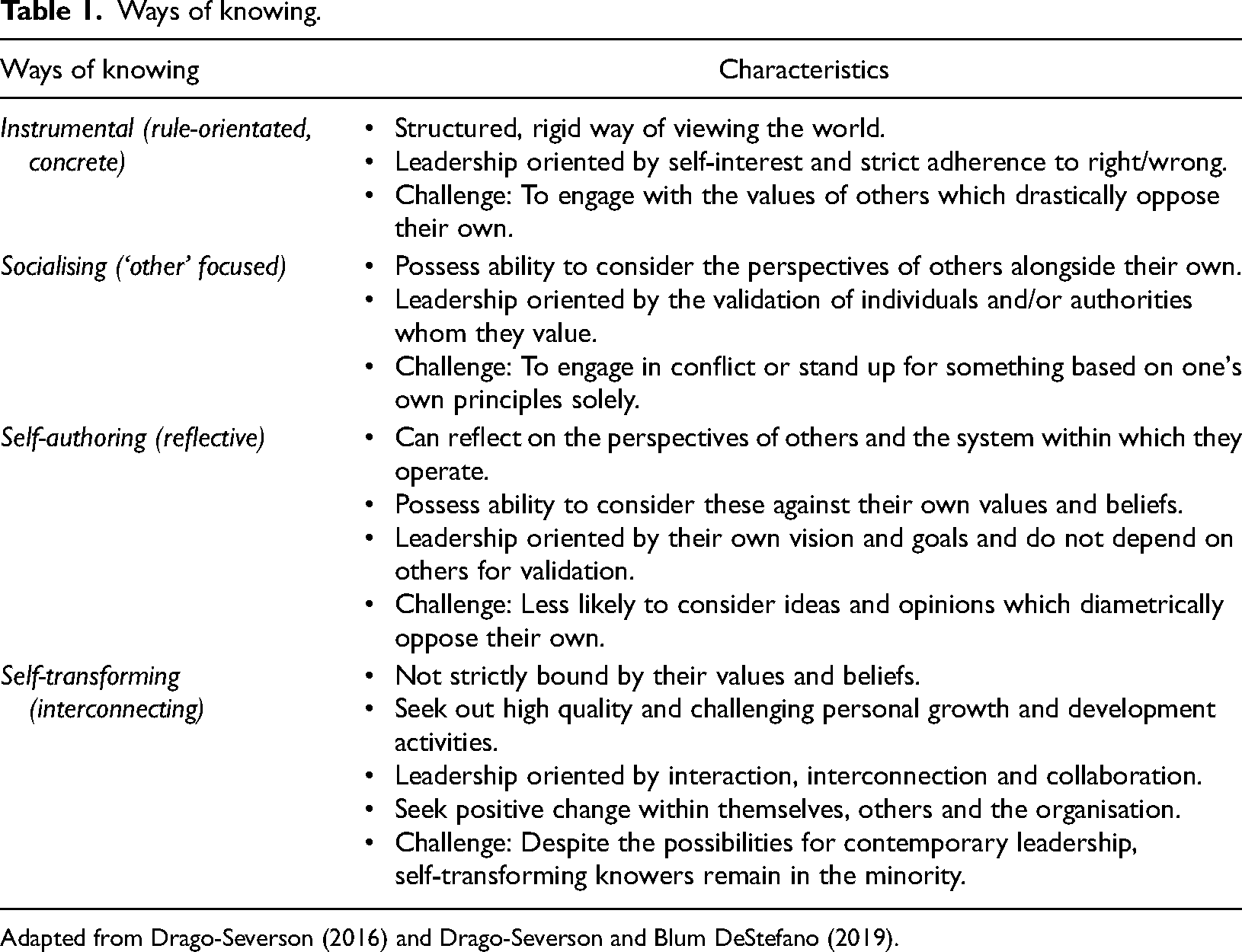
Adapted from Drago-Severson (2016) and Drago-Severson and Blum DeStefano (2019).
Principals’ ways of knowing and growing edges for distributed leadership.
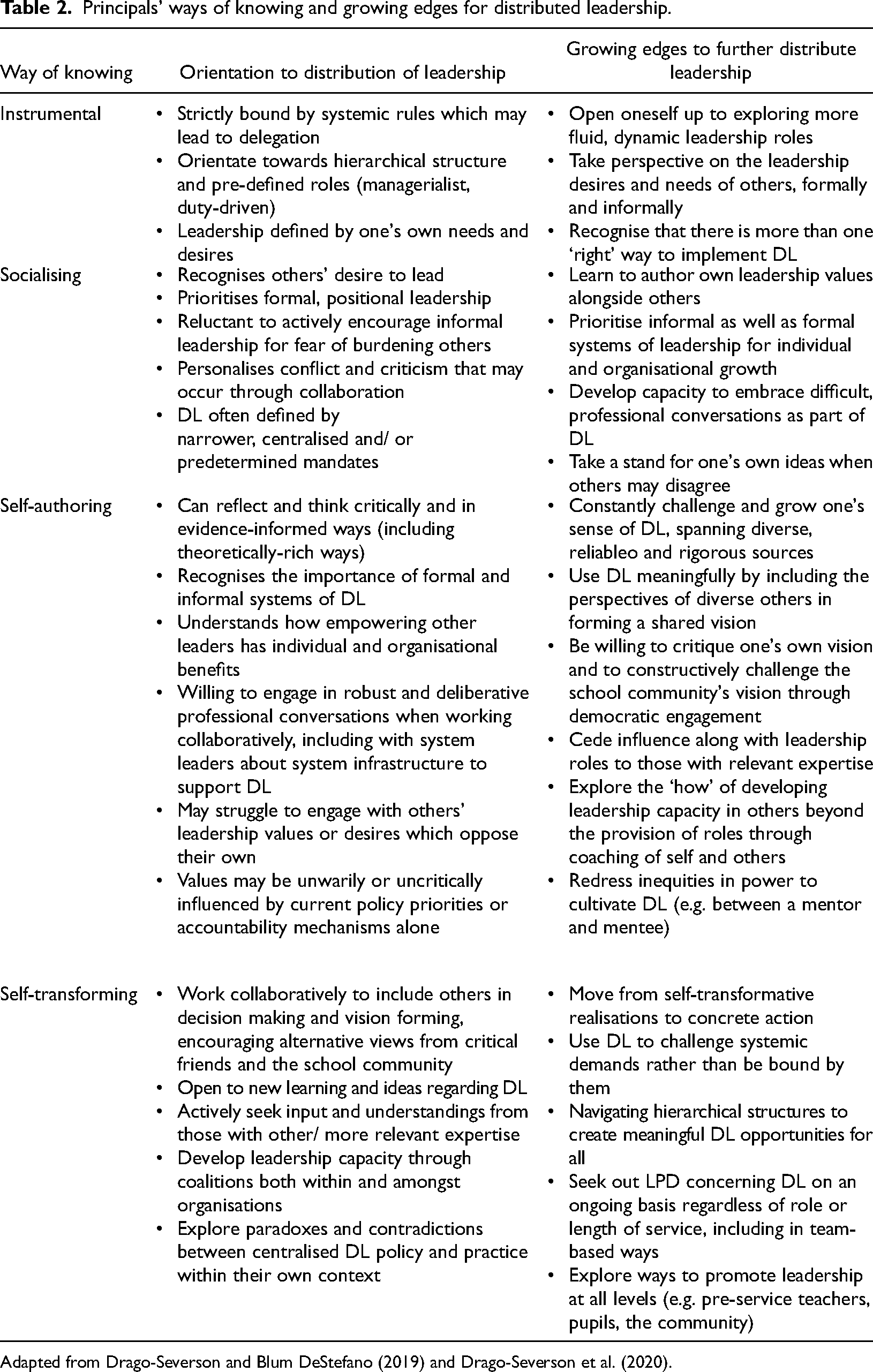
Adapted from Drago-Severson and Blum DeStefano (2019) and Drago-Severson et al. (2020).
Therefore, the theory offers a lens through which to analyse and facilitate adults’ learning and development in stages connected to their meaning-making of self and others which, in the educational leadership literature, are referred to as ways of knowing (WOK) – ‘ways of seeing, understanding, and making sense of the world’ (Drago-Severson, 2016; Drago-Severson and Blum-DeStefano, 2019), although individuals may reside between two WOKs with dual elements in varying prominence. As Drago-Severson and Blum-DeStefano (2019: 2–3) state: ‘Growth, according to constructive-developmental theory, is connected to increases in an individual's cognitive, affective, interpersonal, and intrapersonal capacities that enable a person to better manage the complexities of leading, teaching, learning, and living’.
The study
The research questions underpinning this small-scale study were:
What are Irish primary school principals' ways of knowing concerning DL as they implement national policy in their schools? What are the implications of this for principals’ developmental needs and the aspirations of the policy context?
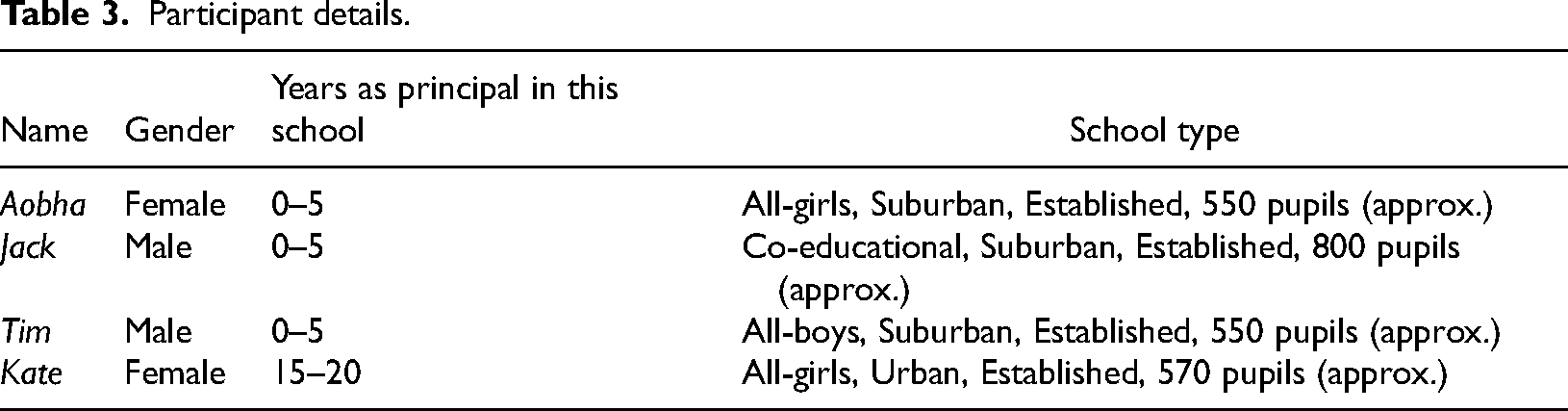
A qualitative approach employing semi-structured interviews allowed for the attainment of rich descriptions of participants’ actions (Brooks and Normore, 2015; Knapp, 2017) regarding policy implementation in their context pertaining to challenges around DL. Four primary school principals were purposively sampled (Merriam and Tisdell, 2015). Each interview was recorded and transcribed verbatim for analysis. An overview of the participants can be seen in Table 3, two of whom (Kate and Aobha) we spotlight in detail through vignettes in this paper, although the discussion thematically encapsulates all participants’ (including Jack's and Tim's) views.
Participant details.
The data were analysed in two ways, primarily pertaining to each research question. For the first, to map each participant on the theory of constructive-develop mentalism and to examine each participant's WOK, the data were coded deductively using a pre-existing coding frame drawing on constructive-developmental theory whereby coding connected to WOKs, as described in Table 1. Analysing the data in this manner enabled us to establish each principal's WOK, in this case in relation to DL. For the second, inductive coding was used to explore the key themes across participants’ accounts.
Vignettes: A way to present findings in context-rich ways
Vignettes were employed to synthesise the interview data and to provide vivid, rich descriptions (Jacobsen, 2014; Reay et al., 2019) of the participants’ WOKs concerning DL in their professional contexts. Therefore, the vignettes are influenced by principals’ subjective realities, and employing vignettes is consistent with this study's qualitative and interpretivist foundations (Jacobsen, 2014). Two vignettes from the study's four participants were chosen as they highlight the range of ‘developmental diversity’ (Drago-Severson and Blum-DeStefano, 2019: 5, para. 2) both within and between different WOKs displayed by participants. We also hope these vignettes will be applicable to and useful in professional development settings as a generative resource through which to stimulate theory-rich, research-grounded and practice-rooted reflection and professional conversation.
Findings
Vignette 1: Kate – ‘learning to stand your ground’
Kate's WOK in relation to DL was identified as socialising, with significant elements of self-authoring. Kate brings strong relational qualities to her work around DL. She feels very strongly that all staff ‘should be involved in the decision-making process’ and that she actively encourages ‘members of staff who have an interest in a particular thing, to maybe run with that even though they’re not in a promoted post’.
Kate's socialising WOK means she prioritises others’ feelings. Citing pay inequalities, she is ‘careful of not piling on responsibilities to people who have no leadership position’. While she is supportive of those who take on informal leadership roles, as principal, she also likes to be informed of such activity as she points out that ‘the buck stops with me’. Despite this, she endeavours to avoid ‘micro-managing’ and to allow professional agency without ‘criticising and dictating’. This demonstrates a tendency on behalf of the socialising knower to orientate towards valued others’ views of them. This is also apparent in Kate's descriptions of in-school management meetings where she concludes each one asking ‘is there anything else I should be doing?’.
Yet, Kate still finds the conflict and challenging conversations arising from such openness difficult. Furthermore, she admits to taking things personally and to being ‘not good at taking criticism at all’. This was laid bare in her recounting of a verbal challenge against her by a colleague which left her ‘completely shell shocked’. These difficulties are synonymous with a socialising WOK, and Kate is conscious of feeling torn or personalising dissent as conflict. Despite this, Kate has also displayed significant signs of a move towards a self-authoring WOK. This was apparent when she disagreed with how one of her management teams decided to lead out an external policy amongst the staff. Kate decided to take a principled stand underpinned by her own beliefs resulting in a plan being formulated with that teacher to the satisfaction of both parties. The success of taking a more self-authoring stance seems to have strengthened her confidence, and as a result, she now ‘wouldn't be as worried about standing [her] ground’. Kate explained how this experience highlighted the challenges of ‘finding a balance’ between authoring her own leadership values and not dampening the enthusiasm of other leaders in the school.
Kate attributes most of her learning to her predecessor, ‘on the job’ experience and ‘the support of good people’ around her, outside of her staff. As a growing edge, it seems that Kate needs to gain more certainty in authoring her values in relation to others, particularly those undertaking informal leadership. Gaining confidence from working collectively with other leaders can help her to construct her vision for school-wide change consistent with the self-authoring WOK.
Vignette 2: Aobha – ‘Not doing it the way it was always done’
Aobha's WOK concerning DL is self-authoring with emerging shoots of self-transforming. Aobha can take perspective on the needs and values of others concerning DL. She believes that DL is about ‘shared leadership’ and people bringing forward ideas of ‘innovation and creativity’ and being allowed to ‘carry those through’.
Alongside her consideration of others, Aobha has authored her own firm beliefs on DL. As a relatively new principal, she is determined to enact a clear vision for change around DL and to depart from ‘the way it was always done’. This is the most striking aspect of her self-authoring WOK as she aims to create an ‘enabling environment’, unimpeded by cultural legacies, for the leadership of others to prosper which will ‘be of benefit to them and to the school’. Aobha feels that the structure of the Irish primary school system mitigates against ‘a distributed leadership model like what's in the books’. She is adamant that DL ‘requires time for collaboration and consultation’. Despite time and structural constraints, Aobha has tried to change structures in her school to ‘allow teachers out of their class to facilitate this whole distributed leadership’.
Aobha has also focused on formally appointed middle leaders (assistant principals) in her school. Before her appointment as principal, she reports these leadership roles as being very much ‘duty-driven’ where nobody ‘entered into that realm’ inhabited by the postholder. Aobha is encouraging those in formal roles to focus more on the leadership rather than the managerial dimensions by encouraging them to lead meetings, to spearhead collaboration in teams, and to ‘identify those talented people [leaders]’ and mentor them within those teams. Changing this mindset has challenged Aobha and has been ‘a constant battle in diplomacy’ as people can think ‘you’re criticising what they’re doing’ by tapping into their growing edges. However, she has willingly engaged in these difficult ‘professional conversations’ in the spirit of building leadership capacity, highlighting how this work is both complexes, both personally and professionally, and never-ending given her belief in leadership capacity building as gentle pressure, relentlessly applied.
Formal, university-based leadership development has influenced Aobha's learning progressing to a self-authoring WOK, as has the support of valued others within and beyond her staff, indicating the benefits of system, network and school-based supports in fostering a rich tapestry of LPD. Tapping into these has helped her to communicate her vision with clarity and to author her leadership in a way that ‘fits very well with distributed leadership’. However, Aobha admits her growing edge is to become more open to deep collaboration and mutuality concerning conflicting opinions. Aobha is cognisant of, and aspires towards, a more self-transforming WOK whereby ‘adapting your vision’ to ‘tally with everybody’ is central to DL. However, her ability to actualise this by learning ‘to step back … and let people take over’ remains a ‘constant challenge’, and possibly indicates gaps in the sources of leadership development with which she enthusiastically engages.
Discussion
Realising reform towards a DL model
Each participant displayed strong relational qualities and deep, rather than more superficial, understandings of DL and its benefits for their staff as they moved through a socialising, to a more self-authoring WOK. However, as the vignettes also show, these understandings do not always reconcile with a shared understanding of DL with MLs and TLs. Further and more sophisticated collaboration (i.e. working together, rather than merely with others) is needed to optimise DL enactment and to further foster shared understandings. In short, while DL policy appears prevalent in the discourse of principals, the developmental supports necessary to implement it optimally are not. Furthermore, principals can be more attentive not only to the organisational structures required to foster DL, but also to its culture. More active consideration about participation in and leadership of system, network and school-based supports could support this reculturing, especially given the history and legacy issues detailed earlier on in the paper, which appear to connect to the contemporary issues experienced by leaders in practice.
Notably, leadership policy in Ireland has reinstated the role and importance of MLs, as well as principals’ responsibilities to develop the leadership capacity of others, including MLs. Aobha has specifically endeavoured to author her vision for MLs to work on their leadership capacity and that of others as they engage in collaborative work. However, participants’ descriptions of developing leadership capacity as ‘nebulous’ and ‘intangible’ suggest that the participants may require professional support in this area as they author their visions around DL (Lárusdóttir and O’Connor, 2017), including negotiating power dynamics. Participants’ accounts suggest that MLs may also require support as they can be reluctant to enact leadership amongst their colleagues, preferring instead to be guided by more managerialist, ‘duty-driven’ roles. A possibility here is that they do not see themselves as leaders due to lack of preparation for, or exposure to, experiential leadership learning opportunities (Ho and Ng, 2017; Lárusdóttir and O’Connor, 2017) or need more active encouragement from the most senior leader in the organisation, the principal, to enact the leadership distributed to them in both practice terms, despite policy advances as outlined.
In terms of TLs and other, informal leadership practices, self-authoring principals such as Jack and Aobha advocated the importance of fostering peoples’ talents, innovation and creativity but also aligning these to the organisational and instructional priorities of the school (Grissom et al., 2021). Jack and Aobha recounted trying to grow the capacity of others, which in turn promotes innovation and benefits learning in their schools for children and adults (Drago-Severson and Blum-DeStefano, 2019), dimensions associated with DL rather than more licensed or scripted forms. Therefore, principals need to be supported in strategically letting go of leadership (King and Stevenson, 2017), through a focus on organisational culture and accessing or promoting access to, rigorous and relevant professional learning. As Kate moved towards increased self-authorship, she gained confidence in voicing her own views. However, an important tension here, is that this led her to impose her views on the leadership of others. Similarly, Aobha freely admitted that stepping back to let others lead can be a challenge for her. She shared how this mindset was challenged with the sudden onset of the COVID-19 pandemic where Aobha and colleagues were thrust into the world of remote teaching. Now, with a more urgent need for a functioning, interactive website, and her inability to be physically present, it became inevitable that, in some situations, Aobha became a follower to the leadership of others. Her team, although working remotely, interacted to create the website with success. This example provides us with an example of how senior leadership taking a step back – or being forced to owed to expertise deficits – can actually be generative and pave the way for other leaders to step up (King and Stevenson, 2017). It also tallies with the emerging evidence on MLs’ crucial role in crisis leadership required in response to the turbulence of COVID-19 in schools (M. Brown et al., 2021), extending to pre-service teachers on placement (Farrell, 2021), demonstrating that DL can be manifest at all levels on a staff (Murphy, 2019b).
In sum, a key priority for principals in a system prioritising a DL model is that both they themselves, as well as their MLs and TLs, require ongoing development within and beyond the school, especially in exploring how DL develops the leadership capacity of both self and others. In so doing, principals can develop their capacities beyond merely the creation of leadership roles and their management if DL is to reconcile managerial, prescriptive requirements with the values and needs of MLs and TLs and, ultimately, progress to more sophisticated WOK of DL rather than synonymising DL with more superficial views of collaboration or seeing it in structural terms alone through role allocation. We expand on the importance and the interplay of structure and culture in the next section.
Context: The role of both structure/restructuring and culture/reculturing
Structures at school level were cited by all participants as problematic. Aobha feels that current primary school structures restrict the time necessary to facilitate DL. However, in her self-authoring WOK, Aobha has begun to effect change by trying to put structures in place to enable the enactment of informal leadership. However, she concedes that organisational barriers can make this difficult. Common examples of such barriers in the broader Irish context can include a lack of volunteerism or fallout post-appointments to middle leadership (Murphy, 2020). Similarly, Jack has taken action within his own context to overcome broader structural constraints. Each week he conducts assembly, which provides an opportunity for teachers from a class level to meet and engage in leadership but what is less clear is the nature of this leadership activity. For example, the work of Lárusdóttir and O’Connor (2017) shows how TLs and MLs cite the intensification of predetermined, managerial and bureaucratic tasks take precedence over their potential contributions to genuine leadership in the school.
Fitzgerald and Gunter (2008) posit that DL ‘orthodoxy’ cannot succeed in schools due to hierarchical structures immersed in accountability. Such issues lead to the inability and unwillingness of principals to cede influence to others thereby mitigating against DL (King and Stevenson, 2017; Murphy, 2019b). Aobha cites the challenges of working within the structures of a highly centralised system. Her authorship of a DL model is occasionally redirected to circulars (i.e. policy documents) rather than community-centred collaborative actions anchored in her school context. Jack's willingness to mentor informal leaders displays the reciprocal and interactive nature of DL activity. This also connects to ‘Developing Self and Others’, as mentioned earlier vis-à-vis the framework shaping the policy context and this study. This ought not be an afterthought to managerial tasks but core to the purpose of work as educative work. Nonetheless, as we have stated, such work is highly complex, ought to be more actively and earnestly recognised as such, and with this, more provision for resources should be afforded to developing and celebrating this core work of leading schools.
External policy mandates, structures and accountability, as noted in previous studies of DL in the Republic of Ireland (King and Stevenson, 2017; Lárusdóttir and O’Connor, 2017; Murphy, 2019b; O’Donovan, 2015), influence how the participants author their leadership and WOK connected to DL in this study. Although the participants distribute leadership, their accounts of interactions with emergent leaders suggest that autonomy and capacity to influence are not always distributed accordingly (Fitzgerald and Gunter, 2008), thus restricting MLs agency. While participants’ accounts indicated MLs working collaboratively through teaming, which would seem to contradict the findings of Lárusdóttir and O’Connor (2017) who reported the domination of managerial tasks over leadership, MLs’ involvement in decision-making does not necessarily infer leadership. There may, for example, be unequal power relations given the data reveal a sense that most power and influence lie almost exclusively with those in hierarchically higher formal positions, as observed by Liljenberg (2015) in the Swedish context.
Expanding on organisational culture further, Kate was reluctant to place too much work on those in formal leadership positions as she felt that the remuneration involved was not sufficient. However, Aobha, who displayed strong self-authoring characteristics, felt strongly about the need to move away from a post-culture with its list of duties (Sugrue, 2015) and used the moratorium on ML positions as an opportunity to enact her vision of DL along more informal lines. She felt that, with remuneration out of the equation, there was a move away from a post-culture where leaders with relevant expertise and interests could step up to realise organisational and school community priorities (Leithwood et al., 2019). In contrast, Kate's socialising WOK, whereby she prioritises others’ feelings shows how she feels torn, encouraging such leadership for fear of increasing teachers’ workloads. Three out of the four principals in this study identified tensions between paid and unpaid roles with one account citing union issues as hampering DL, aligning with other recent studies (Murphy, 2020), demonstrating that a systemic priority is perceived by many system leaders as being associated with a system inequity. Challenges also arose when the domains of those with formal, positional authority, were entered into by informal TLs with more relevant expertise. Kate's progression into a self-authoring WOK allowed her to act as a mediator between a teacher with formal authority and an informal leader with expertise and interest in subject-specific initiatives, in this case, Physical Education. Through the creation of a new role for the informal leader, Kate is learning to author her leadership and WOK concerning DL (Ho and Ng, 2017) however, notably, this is contingent on system resources and Kate's access of ongoing leadership development.
Leadership preparation and development
For Tim, formal, university-based postgraduate studies in educational leadership provided him an understanding of DL, and along with professional learning as a novice principal, provided the foundation for his self-authorship. Jack also highlighted how coaching and leadership development programmes he engaged with after being appointed principal have assisted his enactment of DL in practice, tallying with leadership learning being considered a long-standing and fundamental aspect of support in leading change (Harris and Muijs, 2005). Jack's willingness to open his thinking beyond his expertise by embracing the networks he tapped into through these developmental opportunities suggests these facilitated a move towards a more self-transforming WOK. It also signals possibilities for principals for creating professional learning networks (PLNs) to support DL practice (C. Brown et al., 2020). Therefore, this demonstrates the necessity for more investment in rigorous (i.e. evidence-informed) and relevant (i.e. collaborative) leadership capacity building activities (Cunningham et al., 2019) for both aspirant and appointed leaders, including but not limited to, for example, sponsored and job-embedded graduate studies in educational leadership. Such a move would underscore the importance of leadership learning rather than seeing it in more performative ways typically outside of the school day that can render the process both unsustainable and inequitable.
Participants’ accounts also point to the importance of transformational learning. For example, the support of valued others, including her predecessor, served as a source of rich learning for Kate and was crucial in developing a more self-authoring WOK. The data in this study indicated that for the self-authoring knowers, transformational learning occurred through reflection on problems around DL and honing interpersonal skills (Drago-Severson and Maslin-Ostrowski, 2018), often through transformational learning experiences. Aobha displays the adaptive, as opposed to technical, nature of learning to develop the leadership capacity of her MLs and TLs as she implements new leadership structures. Participants also deemed intrapersonal learning important. Jack showed as he progressed to a self-authoring WOK that he has learned to better process the emotional labour related to DL. Conversely, Kate's socialising WOK means this learning is still being developed. In sum, this demonstrates that each leader is on a learning trajectory all of the time, underscoring the importance for differentiated learning approaches offered by a constructive-developmental approach and this should be on the radars of those in LPD provision.
The respondents emphasised the importance of the trusting relationships which underpin DL similar to the findings of Lárusdóttir and O’Connor (2017). However, participants in this study suggested that this is an area of potential focus for LPD. Aobha felt that to achieve DL in her vision that she must learn to trust the leadership abilities of her staff. The ability to build trusting relationships and provide others with a sense of agency is essential in an education system where MLs and TLs are at the coalface of the school's work and, with support, are optimally positioned to enact leadership should it be distributed to them (Grootenboer et al., 2020; Hargreaves and Shirley, 2019; Lipscombe et al., 2021). Furthermore, each participant expressed the importance of the freedom to make mistakes as necessary for DL. Alongside accessing LPD, they felt that school contexts where risk-taking and initiative are encouraged and supported, create an enabling culture and positive, trusting relationships synonymous with DL (Lárusdóttir and O’Connor, 2017) and are key for school-based, job-embedded LPD. For example, Jack described how he has undertaken professional learning to establish his school as restorative, where leadership learning is centred around support and avoiding blame. This shows emerging elements of a self-transforming WOK as Jack is transforming, both cognitively and affectively, to in how he collaborates with others (Drago-Severson and Blum-DeStefano, 2019). These qualities, dispositions, and organisational properties are, therefore, important for transformative learning and, by extension, to foster research-informed practitioners empowered to realise the aspirations of SSE policy ambition, which sits on the DL model, in agentic rather than prescriptive ways, truly building leadership capacity.
Implications for principals’ leadership development informed by constructive-developmental theory to support DL in practice
Based on the data gathered and in the tradition of constructive developmental theory, we propose in Table 2 possible orientations towards the distribution of leadership associated with each WOK, as well as suggestions about developing principals to progress in their knowledge and practice to realise enactment of DL. However, our study is limited (i) by its small sample, (ii) that there is no particular technical or structural blueprint for realising the enactment of DL (Harris and DeFlaminis, 2016), although there is still an impetus for research to guide practice and (iii) the systemic challenges principals encounter which, on occasion, will limit the suggestions offered from the data as growing edges. Nonetheless, we hope what follows will serve as a generative guide for both school and system leaders as they navigate enactment of DL in practice while also guiding them in their pursuit of leadership development.
Conclusion
In this study, we have explored how principals’ leadership development can be informed by constructive-developmental theory to enact DL in practice. The principals’ accounts restate the observations in the little research on DL in the Republic of Ireland that practising leadership in a DL model is, for many, a radical departure from the hierarchical and managerialist structures of the relatively recent past. Therein lies a suite of tensions associated with the reform trajectory that, to a great extent, shape principals’ ways of knowing (WOK) DL in practice and, as we have argued, ought to inform approaches adopted in leadership preparation and development programmes. Indeed, these tensions also likely shape school leaders’ WOK more broadly, including MLs and TLs.
We have argued that beyond organisational structures, culture plays a key role in principals’ enactment of DL, as well as transformational and transformative learning to support this reculturing both within and beyond the school. To realise this reculturing, we propose that how principals seek to foster professional learning and leadership development as a sustained and sustainable part of organisational life, rather than in a more episodic, ad-hoc and/ or pressed fashion, is crucial. This challenging task by any reasonable estimation is rendered more difficult when system resources that are required to achieve this, including time, are scarce in supply, despite system restructuring and articulation of priorities, although another challenge in itself may well be the contemporary discourses with which DL is tied up. Nonetheless, principals can engage in practices to realise DL in a manner which may complement the busy policy environment in which their practice is situated and, as they move along the developmental continuum, especially to self-authoring and self-transforming WOK, challenge the policy status quo pertaining to DL. As advanced by Drago-Severson and Blum-DeStefano (2013), and congruent with constructive-developmental theory and WOK, the pillar practices of (i) teaming (collaboration required for DL), (ii) the provision of leadership roles (formally, with assistant principals in middle leadership, and informally), (iii) collegial enquiry (through school self-evaluation) and (iv) mentoring (through pre-service teacher education school placement and induction mentoring) hold generative possibilities in the Irish policy context as experiences through which to foster educational leadership development of self and others through the distribution of leadership. As we have stated, to foster DL through these activities involves principals actively working to foster shared vision and understanding with MLs and TLs at all levels in a trusting, safe environment that may require courageous leadership practices in addressing power inequities or a school's cultural organisational issues, which may require significant external and/or systemic support. Should we truly hold it that our system operates in a DL model, we must not expect unreasonable, heroic actions by individual principals who, by the nature of the principalship, already bridle significant responsibility.
The socialising and self-authoring WOKs observed in this study showed that all principals show care and commitment towards promoting DL. However, while this study has indicated possible ways forward in responding to principals’ developmental needs in respect of enacting DL, tensions will remain in its full realisation and in allowing scope for principals to move towards self-transforming WOK. Partly, this is because of the aforementioned systemic tensions that undermine the requisites for self-transforming WOK. In that sense, we argue that it is both imperative the system asking for adoption of this leadership model pay attention to this issue as well as learn, as system leaders, the same lesson King and Stevenson (2017) highlighted to us about the necessity for school leaders to learn to ‘let go’ of leadership. Instead, we argue the priority for system leaders should be to continue to pay attention to resourcing the substance of sustained and sustainable leadership development and capacity building that is rigorous and relevant, nuanced and differentiated, and ultimately responsive to aspirant and appointed leaders who work together in a DL model to serve the diverse educational needs of our communities and their schools.
Footnotes
Declaration of conflicting interests
The author(s) declared no potential conflicts of interest with respect to the research, authorship and/or publication of this article.
Funding
The author(s) received no financial support for the research, authorship and/or publication of this article.

Supplemental material
Supplemental material for this article is available online.