



Abstract
Video games are part of youth culture and game-making by youth has been studied in relation to knowledge acquisition but to a lesser extent as youth engagement into cultural participation. A Systematic Literature Review (SLR) was conducted to answer the following research questions: (a) Does there exist, in sources, a conceptualisation of cultural game jams? (b) Who are the main stakeholders and participants? (c) What are the outcomes of cultural game jams? From the 68 eligible sources only 13 mention “Cultural themes” and no conceptualisation of “cultural game-making” was found. Youth, as game-makers, are referred mainly as “students,” co-creators with Education institutions, developers, and creative industries. Youth motivation to participate in jams is related with a future career in game development. Models for the design and assessment of the game jams’ achievement, tools to facilitate ideation, and games are the most referred outcomes of game jams.
Introduction
Game-Making by Children and Youth
The discourse about the impact of video games on audiences/players and learners has long been associated in media studies and education studies as a dichotomy of risks and affordances (Drotner & Erstad, 2014), still prevalent in a complex sociotechnical and digital infrastructure (Livingstone et al., 2013). Nevertheless, video games created by children and youth themselves have been studied as powerful tools for learning and personal development, facilitating what is sometimes referred to as transformational play (Barab et al., 2010).
Without neglecting the role of playing games in an instructionist approach, the constructionist approach of games as experiences to be created or played is more aligned with “connected gaming”. As Kafai et al. (2016) put it: learning to play and make games intertwines the traditional roles of the player and the designer and are mutually informing processes for learning. In a study conducted by Costa (2020) a media and information literacy (MIL) program was promoted in a sample of 58 children aged 9 to 14 years old through the creation of digital games. Results indicate statistically significant differences between pre- and post-test measures in several groups of MIL skills, namely Operational Skills, Editorial Skills, Digital Identity Management Skills, Critical Media Literacy, Learning and Social Interaction (see Costa et al., 2018 for MIL skills). In addition to these approaches, game play and creation can be used as a reflexive tool for children to establish and develop their own critical understanding of media. First, some have noted that critical media literacy requires children/youth to know a topic to be able to produce a related game. Secondly, game design and content creation also provide children with opportunities to integrate and reflect on their everyday media experience (Costa et al., 2020).
Games as Culture, for Culture and Through Culture
Games are dynamic cultural worlds that shape, reflect, and transmit values, identities, and worldviews. They serve as bridges and barriers, capable of fostering or hindering inclusion and community. This dual nature renders games a significant cultural force, particularly for young people, who are both consumers and potential creators of games. The games we play, the messages they convey, and the communities they cultivate influence our ethical orientations, sense of belonging, and civic engagement within and beyond the gaming world itself. The cultural significance of games can be observed in both their constructive and detrimental effects. On the one hand, research has documented how games can promote social inclusion (Stewart et al., 2013), global citizenship and empathy (Bachen et al., 2012), and ethical reflection (Sicart, 2011). Movements such as “games for good,” “games for change,” and “game-based learning” exemplify the potential of games to cultivate diversity (Plass et al., 2015), provide spaces for community and belonging (Gee, 2005; Schrier, 2021), and empower marginalized voices (Gray & Leonard, 2018).
However, alongside these benefits, games can also perpetuate exclusion, intolerance, and even indoctrination (Bogost, 2010). Studies on toxic gaming environments (Paul, 2018), sexism and harassment in gaming spaces (Fox & Tang, 2014), and the ideological conflicts embodied in movements such as #GamerGate (Massanari, 2017) have extensively documented the darker sides of gaming culture. These issues underscore the extent to which games are sites of cultural negotiation, contestation, and struggle.
Games are as integral to our cultural landscape as literature, film, theater, and music (Raessens, 2006). They engender worldviews, encode values, and serve as mediums for storytelling and identity formation (Muriel, 2021). The stakes of understanding and shaping games as cultural worlds are exceptionally high for young people, who constitute a significant portion of gaming audiences. According to ISFE (2021), more than 72% of European youth aged 15 to 24 engage with games, making them a critical site for cultural socialization. Youth are especially susceptible to the benefits and risks of games, as they learn, adopt, and internalize values that will influence their personal lives, professional trajectories, and civic participation.
Games as culture can be extended in two complementary concepts: as methods and approaches for cultural and societal engagement and reflection (games for culture) and as dynamic cultural expressions, preservations, and transformations of cultural heritage (games through culture). While both perspectives highlight the role of games in shaping cultural identity, heritage, and empowerment, they differ in emphasis.
Games through culture frame game-making as an intrinsic cultural practice that interprets heritage and actively contributes to its development and reimagination. Games are recognized as cultural artifacts (Muriel, 2021) and mediums for storytelling and identity formation (Schrier, 2021). This conceptualisation emphasises game-making as a creative process that preserves and innovates cultural traditions and heritage (Plass et al., 2015), wherein cultural heritage institutions shift from curators to co-creators of living, evolving cultural expressions (Gee, 2005). From a broader commercial perspective, digital games frequently engage with culture as a medium for retelling and transforming cultural heritage (Camuñas-García et al., 2024). Popular titles such as Assassin's Creed: Odyssey (Politopoulos et al., 2019) This War of Mine (de Smale et al., 2019/2017), and The Witcher III (Mochocki et al., 2024)., illustrate how games can disseminate and critically explore historical and contemporary issues, perspectives, and narratives.
The framework of games for culture positions games as sites where youth not only engage with but also actively reshape cultural and societal narratives. Research highlights their potential as instruments of social inclusion (Stewart et al., 2013), ethical inquiry (Sicart, 2011), and empowerment (Gray & Leonard, 2018). Through this conceptualisation youth become active participants in reimagining and reshaping cultural and societal narratives, wherein game design serves as a dialogic and creative process for exploring, problematizing, critiquing, and transforming cultural and societal issues (Raessens, 2006). Examples of such perspectives include, for instance, Detroit: Become Human (2018), which leverages geographical and historical heritage to problematize societal issues, such as race and ethnicity, alongside digital and artificial cultures and futures (Tompkins, 2021), and serious games which, through tangible—both cultural and natural—heritage, promote awareness, empathy, and discussions of contemporary issues in local and global culture (Camuñas-García et al., 2024; Poullis et al., 2019).
Games for culture foregrounds the role of games in addressing societal challenges, while games through culture recognises them as cultural inquiry and creation in their own right. Together, these perspectives frame games as for and through culture, underscoring their capacity to shape identity, sustain heritage, and drive cultural and societal change.
Game Jams
The game jam movement began in 2002 with the “0th Indie Game Jam,” organized by Chris Hecker, Sean Barrett, Jonathan Blow, Casey Muratori, and Doug Church. This inaugural event challenged participants, working individually or in teams, to develop game prototypes within 3 to 4 days, emphasizing rapid experimentation and collaborative creativity. More than two decades after the first game jam, new formats have emerged, and conceptualisations are not universal; yet the fundamental principle endures: game jams are gatherings of enthusiasts united by a shared goal of creating games (Ferraz & Gama, 2019). This collaborative environment, characterized by its accelerated and time-constrained structure, further highlights the disruptive and performative nature of the practice (Kultima, 2021), fostering experimentation and creative risk-taking.
Participants form teams, and, following a theme provided by the organizers at the beginning of the event, are expected to develop a game—or a prototype of a game—within the provided time. Musil et al. (2010) identify seven key characteristics of game jams: rapid prototyping, having a theme, being open to all, having a limited timeframe, encouraging team formation, being digitally oriented and having a public dimension of presentation to a panel. Contreras-Espinosa and Eguia-Gomez (2022) identify four types of learning that take place during a game jam: (1) cooperative, which takes place through the division of work into various tasks between the participants; (2) and (3) project-based and problem-based, that takes place through the ability of participants to solve challenges for previously unconsidered challenges; and lastly (4) collaborative learning, that takes place through collaboration to achieve a common goal of creating a game. These moments of collaboration reflect the open nature of game jams, which is also an important feature, given that despite having started in a context of expert programmers and designers, they are now open to people of all skill levels, from experts to complete beginners (Kultima, 2021, 2015).
Within the logistics of a game jam, time is a defining parameter that shapes the event's dynamics (Kultima, 2015). Durations range from as little as 2 h (Petri et al., 2018) to up to 1 week (Arya et al., 2019; Aurava & Sormunen, 2023; de Salas et al., 2016; Laiti et al., 2021; Ramzan & Reid, 2016; Steinke et al., 2016), with longer formats enabling broader creative exploration and the production of more complex games. The Global Game Jam (GGJ), established in 2009, remains the largest and most prominent event, held simultaneously worldwide (Arya et al., 2019; Kultima & Alha, 2011). Alongside it, alternative formats have emerged, including Indie jams (Eberhardt, 2016; Kultima, 2021) and Serious Game Jams (SGJs) (Aibara et al., 2022; Danilovic et al., 2022; Lai et al., 2021; Ramzan & Reid, 2016). SGJs, centerd on learning and raising awareness of social issues, differ from traditional formats by extending beyond the standard 48h frame and incorporating pre-jam activities to prepare participants for the theme (Gonçalves et al., 2024).
Cultural Game Jams (CGJs) are emerging as a form of SGJs. In CGJs, participants design game prototypes inspired by cultural heritage. These prototypes serve as a way to preserve, transform, question, and engage with the past and future of cultural heritage. The process is collaborative and spans multiple fields, including STEM, the Social Sciences, and the Arts & Humanities (Keogh & Hardwick, 2024). With game-making being a social and embodied craft requiring both critical, cultural, esthetic, and technical skills (Keogh, 2022), CGJs engage with transdisciplinary, tangible, and value-sensitive design processes (Friedman & Hendry, 2019) to encourage the creation, dissemination, and reimagination of cultural heritage toward enabling senses of cultural belonging and agency (Eriksson, Holflod, & Nørgård, 2024).
This study is part of a larger Systematic Review on game jams and game-making co-creation practices among CHI, Creative Industries (CI), Higher Education Institutions (HEI), and Youth Citizens (YC) (Costa et al., 2024). The present analysis focuses on “Cultural” Game Jams and cultural game-making, and seeks to answer the following research questions: (a) Does there exist, in sources, a conceptualisation of cultural game jams? (b) Who are the main stakeholders and participants? (c) What are the outcomes of cultural game jams?
Methodology
Eligibility Criteria
This study followed the PRISMA 2020 guidelines for systematic reviews (Page et al., 2021). Inclusion criteria required peer-reviewed publications in English from February 2002 to February 2023, marking the time frame since the first game jam. For the review, three scientific databases were selected: ACM Digital Library (ACM), b-on, and JSTOR. Additionally, external sources were included through search in electronic resources such as websites of game associations, projects, or European funded programs.
Selection and Data Collection
For first screening, reading abstracts, two researchers independently screened articles using Rayyan 1 in blind mode. Disagreements were resolved collaboratively. In screening, 2 full-text articles were imported into NVivo 14 for thematic analysis, using a top-down coding guide developed by researchers; new categories were created as they emerged from the data. Following Braun and Clarke (2019), two primary approaches to qualitative data analysis were explored: the deductive approach and the inductive approach. The deductive approach is guided by existing theories, frameworks, or specific research questions. It is considered theory-driven, as the researcher analyses the data to identify patterns that align with or challenge predefined ideas, hypotheses or research questions. In contrast, the inductive approach involves generating themes directly from the data itself, without being constrained by pre-existing theories or frameworks. Four researchers manually coded the final articles, categorizing complete sentences based on thematic relevance. In our analysis using NVivo 14, we began with a deductive approach, applying (Reid, Smy, & Donald, 2020) framework to categorize the data. Following this, an inductive approach was adopted, allowing new categories to emerge from the data.
Intercoder Reliability
The Intercoder Reliability (ICR) was used as a measure of consistency and validity. Cohen's Kappa was adopted as the ICR indicator. In screening 01, 12% of records (158 papers and 2 coders) were coded, exceeding the recommended minimum (O’Connor & Joffe, 2020). Agreement and disagreement rates were computed in Rayyan, and Cohen's Kappa was calculated in MS Excel. An average Kappa of 0.74 indicated “substantial” correspondence (Landis & Koch, 1977) with 95.57% agreement and 4.43% disagreement. For screening 02, 33 articles were coded by four coders. NVivo 14's code comparison query yielded a Kappa of 0.76, also showing “substantial” correspondence (Landis & Koch, 1977), with 98.12% agreement and 1.88% disagreement.
A total of 68 articles were included in the review: 37 articles from the scientific databases and 31 from external sources (see Figure 1).
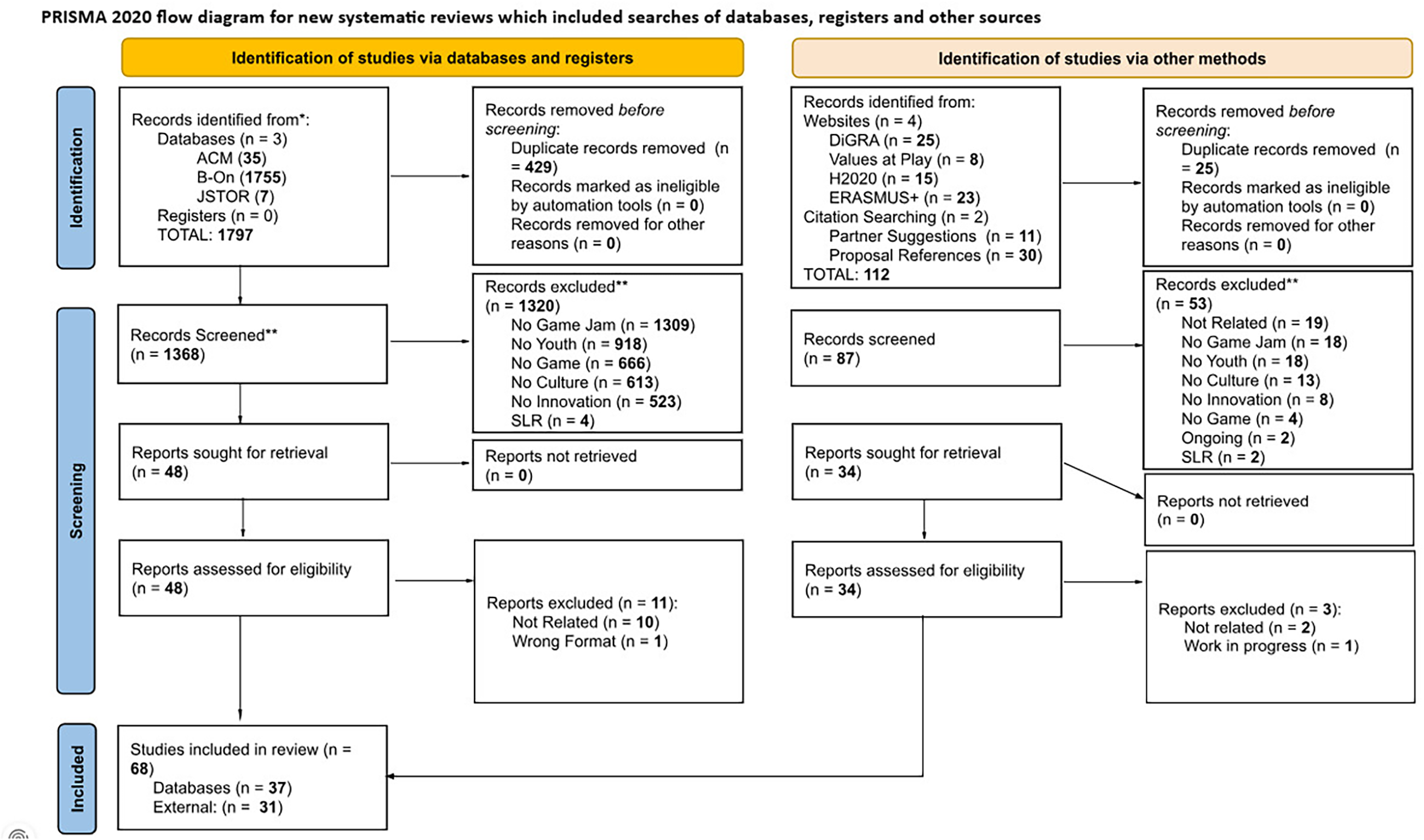
PRISMA 2020 flow diagram.
Results
Does There Exist, in Sources, a Conceptualisation of Cultural Game Jams?
In a total of 68 sources, “Cultural themes” are mentioned in 13 sources. This category includes the subcategories “Cultural Heritage,” “Cultural Values,” and “Regional Culture.”
Cultural heritage is increasingly conceptualized not merely as tangible monuments and artifacts but as a living process encompassing intangible practices, values, and community meanings. This shift reframes heritage from static preservation to dynamic, socially embedded, and performative practices, highlighting the interdependence of material and immaterial dimensions as equally central to cultural identity (Naurath, 2006; Ruggles & Silverman, 2009; Smith, 2006; Vecco, 2010). Cultural heritage is increasingly represented in commercial games, as well as in educational games designed for history teaching and learning and interactive, playful experiences aimed at enhancing museum visits (Anderson et al., 2010; Nijdam, 2021). The latter applications, in particular, provide broader access to cultural heritage materials without jeopardizing their integrity (Mortara et al., 2014). In Laiti et al. (2021), the game jams have been used as a means for learning about, interacting with and reflecting on indigenous cultures such as the Sámi. Nijdam (2021) analyses the indigenous worldviews embedded in two games produced during the 2018 Sámi Game Jam.
In Egea-Vivancos and Arias-Ferrer (2021), the role of video games in cultural heritage and history teaching is analyzed, with a particular focus on the value of immersive virtual reality (IVR) and the relevance of CREAM model (Civic Education, Historical Relevance, Engagement, Applicability and Multimodality) in the design of a video game. Although the first prototypes received positive student reactions, the authors note that IVR is costly and did not evaluate student learning outcomes in this study.
Concerning “Cultural Values,” Belman, Nissenbaum, and Flanagan (2011) describe “values conscious design” as when the designers have “systematically considered the moral, social, and political resonances of design features” (p. 2), which leads to the creation of games that are culturally different from the mainstream games of the global game industry. In Flanagan and Nissenbaum (2007), the Values at Play (VAP) project is presented as a framework that designers can use to embed humanistic values in their work. The authors refer to projects such as Layoff Game and Profit Seed, that demonstrate processes that inspire and put into practice social activism, and empathy, among other values.
In what respects “Regional Culture,” Belman et al. (2011) call attention to the diversity of values according to the regional culture in which they are inserted. For example, when considering the globalization of the game industry, regional aspects remain a factor of influence in game development: “the regional Nordic game program as well as the Norwegian state has primarily developed policies to support game development that aims to protect local cultural heritage” (p. 25). For the authors, the same applies to cultural differences among regions and nations in what respects values in their culturally specific contexts. As an example, the value of autonomy might particularly resonate with American citizens but may be less important in societies that are more inclined toward collectivist values. Lai et al. (2021) refer to the Finnish Game Jam as a regional movement that organizes game jams. For Wirman and Jones (2018) the Global Game Jam Hong Kong (GGJHK) has always included many games based on local cultural references and places. In GGJHK2018 games about learning Kung-Fu, local slang and pop-culture references are very popular, as well as caricatures of local celebrities or even deities appearing regularly as game characters. Local political references have also been featured in several GGJHK games. In conclusion, none of the sources explicitly use the term “cultural game jams,” despite discussing games and game jams in relation to culture and cultural heritage.
Who are the Main Stakeholders and Participants in Cultural Game-Jams and Game-Making?
Game jams are dynamic events that promote creative expression, collaboration, and cultural exploration. They convene a diverse range of stakeholders—individuals, groups, and organizations who affect, are affected by, or perceive themselves to be affected by the decisions, activities, or outcomes of such events. Each stakeholder contributes uniquely to the success and broader impact of game jams, providing resources, expertise, and opportunities for meaningful engagement.
The analysis of sources indicates that youth constitute one of the most significant participant groups in game jams. While many accounts refer to them simply as “students,” their role extends far beyond this label. As Contreras-Espinosa and Eguia-Gomez (2022) emphasise, the social dimension of game jams strongly influences teamwork and group dynamics. Across the different phases of a game jam, young participants engage in continuous dialogue about ideas and design challenges, which enables them to identify shared interests and cultivate collaborative relationships.
Game jams also provide a hands-on environment in which youth assume diverse roles—such as designers, programmers, or artists—while simultaneously acquiring the communication practices and technical terminology associated with game development. Digital tools further facilitate collaboration by allowing participants to exchange notes, sketches, and resources in real time, thereby ensuring collective awareness and engagement throughout the design process. By fostering teamwork, problem-solving, and creative communication, game jams offer youth distinctive opportunities to develop both technical and soft skills. Their active involvement not only enhances the immediate game jam experience but also contributes to broader objectives related to education, professional growth, and cultural exchange. Similarly, Aurava and Sormunen (2023) found that Finnish educators value game jams as a tool for teaching soft skills like communication and collaboration, demonstrating how educational institutions integrate game jams into structured learning environments. Figure 2 presents a coding matrix from NVivo14 that maps the intersection between the category of Participants and a selection of the most frequent Stakeholder in sources. This analysis reveals that “students” are more frequent in initiatives that involve HEIs, Governmental Institutions, Parents and Teachers as stakeholders, with only one common code for the CHIs category. The European Union (EU) and Parents, as stakeholders, have links with the “Youth, Children, Teens” category. Researchers have cross initiatives with HEIs and CIs. Therefore, it seems there is an opportunity to increase CHIs as stakeholders and co-creators of games with children and youth as a form of empowerment to cultural participation. Such still needs stakeholders specialized in game design and game development that synergistically cooperate with youth and CHIs. Recognizing stakeholders’ role explicitly in research and practice is essential to understanding the full impact of these collaborative events and fostering their continued development. A notable example of a large-scale game jam that relied on strong stakeholder collaboration, is the GGJHK, as discussed by Wirman and Jones (2018). This entirely online event attracted thousands of participants from 108 countries who worked together over 48 h. The primary organizer, the Hong Kong Polytechnic University's School of Design, partnered with Cyberport, a local business park, to facilitate the event. Higher education institutions played a crucial role by providing credibility, logistical support, and academic engagement. In addition to the primary organizer, seven other universities contributed by lending their names for marketing, distributing promotional materials, and encouraging student participation. Staff and students from these institutions actively managed the event, with many students volunteering in roles such as registration assistance and event documentation. Volunteers were also encouraged to participate as jammers, creating an immersive learning experience that blended organization with hands-on engagement. Although Lai et al. (2021) and Laiti et al. (2021) recognize the critical role of organizers in game jams, they do not explore in depth who these organizers are or how their involvement shapes the event's success. Organizers undertake fundamental tasks such as selecting themes, guiding participants through cultural themes, and fostering skill development—yet their contributions remain largely overlooked in academic discussions. Serious games for cultural heritage similarly rely on a network of stakeholders, including museums, government agencies, and educational institutions. Mortara et al. (2014) examine how museums have supported cultural heritage games like China Quest Adventure, The China Game, and Fascinating Egyptian Mummies, which use interactive experiences to educate players. These projects require interdisciplinary collaboration between educators, game designers, scriptwriters, and cultural experts to ensure historical and cultural accuracy. However, despite the importance of engagement and outreach, initiatives specifically promoting youth participation in cultural game jams remain scarce. While these games aim to educate broad audiences, there is limited discussion on how young people are actively involved in their development or how these initiatives foster youth empowerment beyond their role as learners. Sotamaa et al. (2020) further highlight the role of government support in cultural game development, yet there is little emphasis on structured efforts to encourage youth engagement as creators. This gap underscores the need for more intentional efforts to promote youth inclusion in cultural game development, ensuring that young participants are not merely consumers but active agents in the preservation and transformation of cultural heritage through game-making.
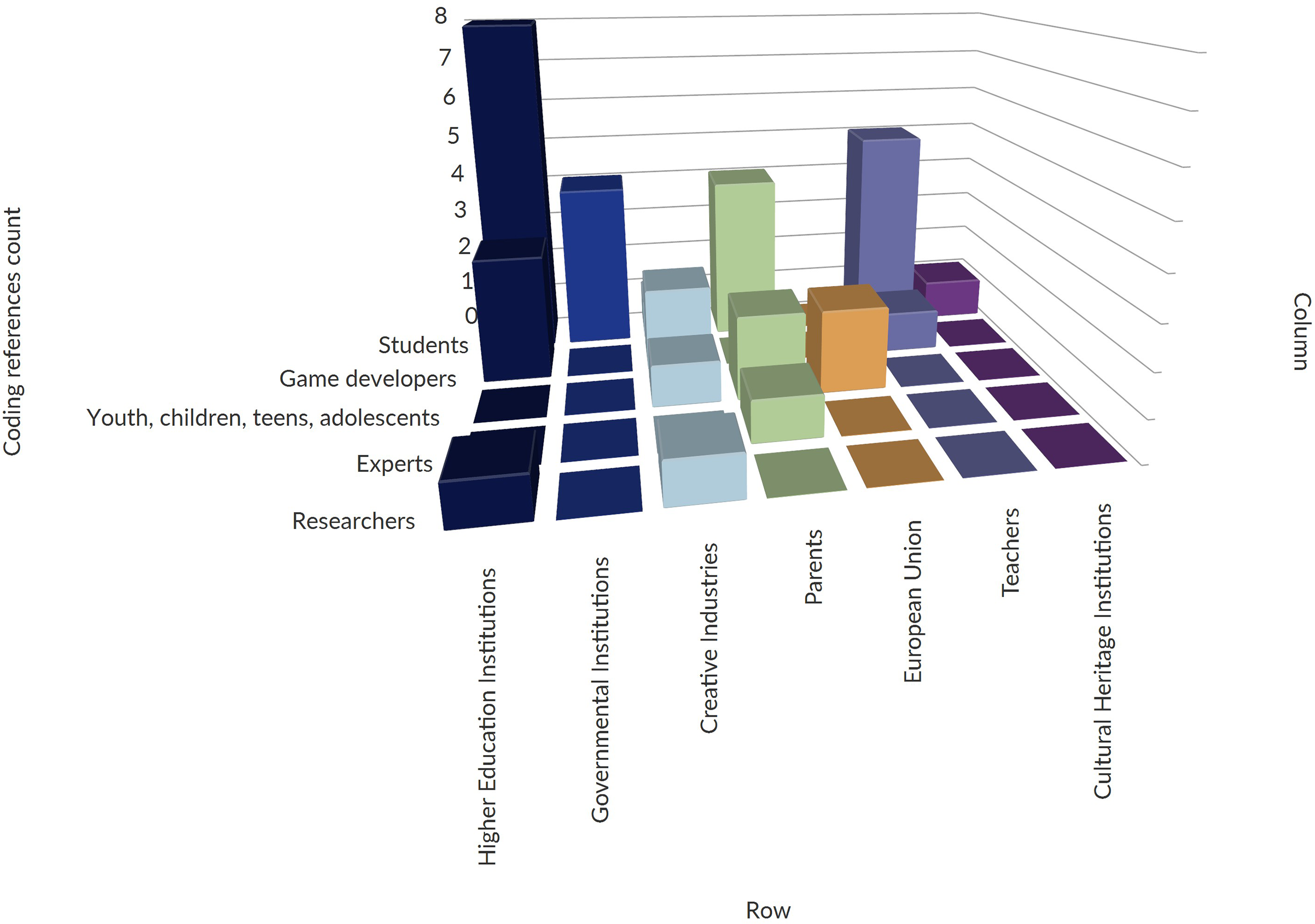
Intersections between the category of participants and stakeholders.
What are the Outcomes of Cultural Game Jams or Game-Making for Culture?
The value derived from a game jam extends beyond the mere act of participation. A crucial aspect involves the assessment of the game jam's achievement of its intended outcomes, as defined by (Reid, Smy, & Donald, 2020). For the present analysis both outcomes from game jams and game-making are presented, ranging from games produced, tools developed, and research outcomes achieved.
Games as Culture
The analyses show that both Games through Culture and for Culture are documented in sources. In Games through Culture, Anderson et al. (2010) demonstrate multiple examples of cultural heritage and history games that have been created for educational purposes. For example, Ancient Pompeii involves a virtual reconstruction of the Roman city of Pompeii, where avatars are being used to simulate the behavior of the city's population in real-time. The main goal of Ancient Pompeii is to simulate a realistic crowd of Romans interacting in various buildings within the city. History Line: 1914–1918 is a strategy game set during World War I, including animated introductions and informative cutscenes detailing the historical context of World War I. The goal of the game is to educate players about the events leading up to World War I and the key battles of the conflict, offering both strategic gameplay and historical context. Furthermore, Egea-Vivancos and Arias-Ferrer (2021) take the example of Fundacion Integra, a public institution in Spain, whose project focused on the introduction of cultural heritage among high school students. An evaluation of the virtual reality videogame—El misterio de la Encomienda de Ricote (Escribano-Miralles, 2016)—used to tour and learn about the history of a sixteenth-century building (La Encomienda) linked to the Order of Santiago in Ricote (Murcia and Spain), was conducted with youth. The results showed that the students in the sample had great interest and motivation to play those types of video games, but “nevertheless, the knowledge they acquired from playing was very confusing and inconsistent” (Egea-Vivancos & Arias-Ferrer, 2021, p. 387). Schut (2007) found a bias in digital simulations of history such as The Civilization and The Total War series since the themes embody masculine ideals of aggressiveness and domination in military scenarios, without the economic and political context. This example reflects another key theme when considering history and culture: that it is not an objective representation of the past, but rather a construction of it. Mortara et al. (2014) also call attention to important factors when designing games for cultural heritage: (1) engagement should be considered in the design of a game, through appealing visuals and meaningful interactions; (2) technology, as three-dimensional (3D) environments have the advantage to create realism and situated learning, two important factors for the understanding cultural heritage; (3) interactivity, that also contributes to engagement, with the use of touchscreens, AR or other gesture-based controls; and (4) educational impact: games should balance historical accuracy with engaging narratives to foster empathy and learning.
In Games for Culture, Ciampaglia and Richardson (2017) highlight the significance of representative game-making in addressing social justice issues. They examine 12 games created by teens who faced social injustices, such as racial discrimination. To foster community dialogue, the games were showcased in a street exhibition called “Street Arcade,” empowering youth to engage in civic participation and shape their relationship with their community. One of the games, called Can You Serve and Protect?, explored the tensions between the Chicago Police Department and the African American communities it serves, where the player is a white officer on his first day on the job. The player, as a white officer, is faced with multiple scenarios: two African American teens having an argument; a young Black man running down the sidewalk; and another White officer beating an unarmed Black teenager. Faced with these challenges, the player must critically decide between assisting or reporting a situation.
The Sámi Game Jam (2018) is identified here as a CGJ, in the sense that it is focused on the revitalization of Sámi culture, produced a total of six games, although only three were analyzed by the authors (Laiti et al., 2021). For example, in Rievssat game, the player incorporates the perspective of a bird—specifically, a Northern Finnish ptarmigan bird—that watches its habitat, which used to be a safe home, be dominated by colonizing forces. While the ptarmigan bird's home is becoming increasingly uninhabitable, the bird questions what place to call home now, feeling disconnected. This is a representation of how many indigenous cultures, like the Sámi, were forced to adjust to a new culture, negotiating their identity. One other game, Lost Memories, represents the experience of Sámi community members in feeling pressured to choose between two universes: their cultural traditions and a new modern world. The player is transported to a 3D representation of two worlds and makes a permanent choice, of either staying in the traditional world of Sámi culture or following the path to a new progressive world, leaving behind their traditions. Such dichotomy emphasises the threat of losing identity. At last, Jodus – On the Move, a 2D Top-Down game, follows the same thematic line, with a landscape divided into two contrasting scenes: one urban environment, with gray cities and giant infrastructure and one nature environment, surrounded by trees, rocks and a river. All the games were considered successful in capturing the experience of Indigenous people, reflecting how they navigate between two contrasting realities in their daily lives, never fully belonging to either, yet always present in both. Sámi Game Jam extended beyond the typical timeframe, lasting 5 days. Prior to the jam, a cultural program to involve the participants with Sámi Culture and with members of the community. The extended jam period was to allow the participants additional time to engage, research and brainstorm the complexity of the theme. The restricted timeframe of 48 h has been identified by some authors as a negative aspect of game jams. Another negative aspect of game jams in sources, is that many outputs from game jams are superficial and lack depth in the themes explored, posing a challenge for companies to turn an outcome from a game jam into a final game (Arya et al., 2019; Lai et al., 2021; Wirman & Jones, 2018). Although the playful nature of game jams can be an advantage, further research is needed to understand how different game jam formats influence and drive creativity and design processes, thereby advancing knowledge of the unique design dynamics these events foster (Goddard et al., 2014; Olesen & Halskov, 2018).
A salient feature of cultural game jams is the integration of expert knowledge, whereby specialists contribute to shaping and directing the creative process. For example, in the Sámi Game Jam, Sámi representatives took part as participants and were also available to answer questions from others. This preparation and direct engagement with the theme enabled participants to create more culturally grounded games while experimenting with and reflecting on the digital creative process.
With the organization of cultural games growing, the focus here was to analyze the outcomes of cultural game jams, both in terms of duration and games produced. It is possible to conclude that (1) only a few articles describe and analyze the games produced and (2) game jams following the typical time frame of 48 h, led to the creation of simpler games when compared to longer game jams.
Tools Developed
Our analysis identified three tools for examining the intersections of culture, games, game jams, and youth: the CREAM model (Egea-Vivancos & Arias-Ferrer, 2021), the VNA method (Kultima & Alha, 2011), and the SGJOM (Serious Game Jams Operation Manual) ( Aibara et al., 2022).
The CREAM model outlines principles for designing educational games, particularly in history and cultural heritage. Its five dimensions—Civic Education, Historical Relevance, Engagement, Applicability, and Multimodality—emphasise the civic role of games in fostering cultural awareness, the need to promote critical engagement with history, the importance of intrinsic playability, alignment with classroom contexts, and the use of multimodal media to reinforce learning. This model underscores both the opportunities and responsibilities of embedding cultural content in games.
The VNA (Verbs, Nouns, and Adjectives) method accelerates ideation through three card decks that generate unexpected word combinations, sparking novel game concepts (Kultima & Alha, 2011). Initially developed for casual games, the method has been adapted to game jams to foster rapid creativity under thematic and temporal constraints (Kultima & Alha, 2011). Applied to youth cultural game-making, it can help simplify complex cultural themes by facilitating multiple entry points for design.
Although most game jams follow a 48h format, scholars have advocated for extended durations, ranging from 5 days (Laiti et al., 2021) to a full week (Arya, Gold, Farber, & Miklasz, 2019)). Responding to this, Aibara et al. (2022) developed the Serious Game Jam Operation Manual (SGJOM), which structures jams into preparation, lecture, and development phases. The manual emphasises both the value of expanding beyond 48 h and the need to prepare participants for the theme in advance through expert input, workshops, and information sessions.
Conclusion
Our analysis shows that the concept of the CGJ is still in its early stages, as it has yet to be clearly defined in the literature. This gap creates a valuable opportunity for scholarly inquiry and positions our work as a timely contribution to shaping and advancing this emerging field. One notable exception is the Sámi Game Jam, which is discussed in the literature as a cultural heritage tool—not only because of the games it produced, but also because of its distinctive process. This process included careful theme preparation with cultural facilitators, extended beyond the typical timeframe of game jams, and introduced a critical dimension of reflection on cultural identity, particularly that of the Sámi minority.
While some studies address youth engagement with cultural or socially themed games, most game jams focused on heritage or history learning treat youth solely as players rather than creators. This highlights an opportunity for more participatory game-making with nonspecialists’ youth, supported by cultural heritage institutions (CHIs) that act not merely as curators but as co-creators of cultural artifacts and experiences. For instance, many museums provide educational programs for children and youth, yet these largely frame youth as audiences rather than active contributors. Integrating cultural game jams into formal educational contexts—similar to Finnish educators who employ game jams to teach communication, collaboration, and other soft skills—can complement structured learning while fostering creativity and engagement.
In what respects stakeholders—whether organizers, participants, researchers, or community representatives—they role is underrepresented in academic discussions on serious and cultural game jams. Their meaningful involvement is, however, essential for shaping themes, ensuring culturally sensitive games, and enhancing the overall impact of these events. Youth, in particular, are frequently positioned merely as participants, often framed as “students” who attend game jams primarily to develop technical and soft skills alongside more experienced creators from education and the creative industries. Yet this limited framing risks overlooking their potential as active stakeholders. By reimagining youth not only as learners but as co-creators, cultural game jams can become powerful spaces for self-expression, critical engagement, and cultural participation. Furthermore, CHIs, though rarely acknowledged as direct stakeholders in youth-oriented game-making, are well positioned to adopt the cultural game jam format as a means of empowering younger generations. Doing so would enable youth to critically reflect on the games they play and create, and to understand how these practices generate value for players, cultural heritage, and society at large.
With regard to games as outcomes of game jams, only a small number of articles describe or analyze the games produced, including whether they were further developed after the event.
Finally, three key tools emerged for exploring the intersections of culture, games, game jams, and youth: the CREAM model Egea-Vivancos & Arias-Ferrer, 2021), the VNA method (Kultima & Alha, 2011), and the SGJOM (Serious Game Jams Operation Manual) (Aibara et al., 2022). These frameworks offer valuable guidance for cultural game-making with youth and other audiences. They also highlight the potential for developing flexible tools that can be adapted to diverse contexts and engage participants with varying levels of gaming experience.
As a limitation, the articles analyzed come from selected scientific databases and external sources, which may not capture the full scope of relevant literature.
Future research should aim to develop a comprehensive framework for cultural game jams with youth—one that brings together stakeholder involvement, participatory models of collaboration, suitable materials and methods, effective tools, practical logistics, and robust evaluation strategies. Such a framework would not only support the broader adoption of cultural game jams but also affirm young people as co-creators and equal partners in reimagining cultural heritage through game-making, rather than positioning them merely as participants. In particular, there is a pressing need to establish evaluation guidelines within game studies that address cultural and serious games, offering ways to critically assess how culture is appropriated, represented, and reimagined in gameplay.
Footnotes

Funding
The author(s) disclosed receipt of the following financial support for the research, authorship, and/or publication of this article: this work was supported by the European Union′s Horizon Europe Research and Innovation Programme under grant agreement number 101095058 in the context of EPIC WE project.
Declaration of Conflicting Interests
The author(s) declared no potential conflicts of interest with respect to the research, authorship, and/or publication of this article.
Data Availability Statement
The datasets generated during the current study are available from the corresponding author on reasonable request.