



Abstract
This study explores the datafication of digital intimacy in female-oriented otome games, analyzing how these games construct databases of idealized masculinities and romantic narratives, balancing empowerment and commodification. Through digital ethnography, walkthrough, and interviews with Chinese women players between 2023 and 2024, we reveal how otome games mediate intimacies between women players and virtual male characters, reflecting sociocultural values and shaping affective experiences. These women-oriented games collect intimate data to optimize design and profitability, offering immersive, customizable romantic experiences while commodifying emotional investments. This dual dynamic underscores a tension in emotional capitalism, where intimacy is both enriched and exploited. By examining the interplay between digital intimacy, datafication, and emotional capitalism, our study further contributes to the critical discourse on how role-playing games monetize personal and emotional experiences, emphasizing the need to safeguard user sovereignty as digital platforms capitalize on affective labor.
Introduction
The digitalization of everyday life is transforming intimate practices across the globe. The proliferation of digital technologies has catalyzed a profound reconfiguration of intimacies, destabilizing long-standing sociocultural frameworks that have historically defined relational practices. Within this evolving landscape, otome games, a genre of narrative-driven video games primarily aimed at female players, exemplify this transformation. These games center on fostering romantic relationships between a female protagonist and various male characters, evolving from Japanese media traditions like light novels and manga to focus on character development and romantic plots. This digital transformation of romantic narratives and character design showcases how digitization and technology are actively reconfiguring relational dynamics.
As networked connectivity dissolves spatial and temporal boundaries, digitalized intimate world generates hybridized zones where the public/private binary collapses (e.g., social media oversharing, algorithmic dating apps) and the local/global nexus becomes porous (e.g., transnational digital care networks). This transformation not only contests Eurocentric paradigms of intimacy—rooted in ideals of romantic individualism and nuclear domesticity—but also fosters emergent, pluralized modes of connection that reflect the technocultural logics of platform capitalism (Ge & Hu, 2025; Illouz, 2018; Steinberg et al., 2024). Within this milieu, Rambukkana and Wang's (2020) intervention in communication studies posits two dialectical axioms central to theorizing digital intimacy. They assert that digital platforms are not passive conduits but active co-constructors of intimacy, for instance, the architectures of apps like Tinder's swipe logic, Instagram's ephemeral stories, encode normative scripts of desire, trust, and disclosure, while user practices reciprocally reshape platform affordances, such as TikTok's shift from dance trends to intimate life-story formats. Second, they argue that digital intimacy constitutes a technosocial entanglement: a dynamic interplay where media infrastructures and relational practices mutually constitute one another. For instance, the rise of situationships (ambiguous digital relationships) reflects both the temporal fragmentation of app-based communication and user-driven resistance to normative relationship labels. By combining these concepts, it becomes evident that while digital technology has reshaped practices of intimacy, intimate connections have equally influenced the digital realm, profoundly shaping its development and dissemination.
This bidirectional dialectic underscores that digital intimacy is neither a mere translation of analog practices nor a deterministic outcome of technological design. Rather, it is a co-evolutionary process, as algorithmic governance reshapes intimate norms (e.g., Instagram's beauty filters recalibrating body image standards), grassroots user tactics—from alt-texting memes as covert flirtation to subverting platform monetization through reconfiguring the digital sphere itself. Such reciprocity demands a materialist analysis attuned to how power, capital, and agency circulate within networked intimacy economies.
Digital intimacy, as a contested and multivalent construct, encompasses phenomena ranging from the micropolitics of erotic exchange to the macroscale formation of transnational affective publics. While historically anchored in Western conceptions privileging physical proximity and heteronormative relationality (Giddens, 1992), contemporary theorizations reframe intimacy as a porous assemblage of affect, labor, and infrastructured relationality—simultaneously mediated by digital platforms and materially embodied. While intimacy can mean many things (e.g., closeness, proximity, interconnectedness, connection etc.), digital intimacy can mean phenomena as narrow as sexuality and kinship, and as broad as all kinds of interconnectedness and international news publics (Ito & Okabe, 2005; Rosenberg, 2015). Lauren Berlant's (1998, p. 281) seminal intervention destabilizes intimacy as merely a private sentiment, recasting it as a publicly oriented aspirational narrative “about something shared, a story about both oneself and others that will turn out in a particular way.” Further, she argues that there is no clear division between public and private, individual and collective subjectivities, with such spaces orientated towards, and formed within, a public audience. Thusly, the political sphere and public institutions can be read as “institutions of intimacy” (Berlant, 1998). This reorientation reveals institutions as infrastructures of intimacy (Wilson, 2016), where political economies and affective regimes co-constitute one another. In this sense, we can understand intimacy as a kind of political experience, as a structure of feeling, which possesses social and political implications and propel potential movements or discourses.
While traditional discussions of intimacy have typically centered around physical contact, sex, romance, and passionate love, often within the context of marriage (e.g., Attwood et al., 2017), contemporary discourses on intimacy now encompass nonsexual relationships within family life (e.g., Chambers, 2013). Intimacy can manifest both in long-distance relationships and in moments of co-presence. Shared experiences and physical proximity can deepen the sense of intimacy (Jamieson, 2013). In today's global digital age, spending time together digitally can mimic the process of building intimacy through co-presence to some extent. However, true intimacy often requires disclosure and meaningful interaction, such as through chat rooms, email, and Internet telephony, to foster genuine connection and emotional intimacy. Scholarly preoccupations with digital intimacy have largely fixated on human-to-human interactions mediated through platforms, and the trendy themes include the practices and politics of dating apps (Hobbs et al., 2017; Miles, 2017), online relationships (Dalessandro, 2018; Subrahmanyam & Šmahel, 2011), and cybersex (Banerjee & Rao, 2021). Yet, the burgeoning domain of human-to-virtual-human intimacy, particularly within gaming ecosystems, remains critically underexplored, despite its profound significance in reconfiguring agencies, desires, and sociotechnical power. Virtual characters, far from inert narrative props, function as ideological scripts as their design encodes market logics, cultural norms, and political valences (Nakamura, 2020) while players have formed intensive affective attachments with these virtual characters.
This study interrogates the digital intimate relationships between gamers and virtual characters as a dialectical technosocial practice and explores how they are formed, enriched, mediated, and intensified. Building on posthumanist frameworks, we reject reductionist binaries (real/imaginary, human/nonhuman), instead situating intimacy as a distributed agency emerging through iterative human-algorithmic entanglements. Rather than viewing this intimacy narrowly as a phenomenon of imaginary affect, sexuality, and relationship, we consider intimacy as a multifaceted aspect of public life and a mode of existence. Stimulated by digital interactions and immersive technology yet firmly grounded in material reality, this intimacy straddles the realms of privacy and publicity, individuality and collectivity. Gamers not only privately enjoy interactions with their beloved virtual characters but also actively share these experiences within their gaming communities. The virtual characters within the games are not neutral entities; rather, they are meticulously designed by game creators who imbue them with values and implications influenced by factors such as industry trends, market demands, sociocultural norms, and political meanings. As such, these characters have the potential to shape and reflect broader societal values and ideologies. By examining human-to-virtual-human digital intimacy between gamers and characters, we shed light on the broader landscape of digital intimate relationships within political and public institutions. This exploration illuminates on how digital intimacy intersects with a wide array of sociocultural and political discourses, as well as its potential to drive certain types of social movements. We suggest that otome games exemplify the paradox of digital intimacy: they create immersive spaces for players to explore alternative masculinities and romantic agency, yet simultaneously mine user interactions to refine monetization strategies and fortify platform governance. This dual function mirrors broader platform political economies, where emotional engagement is repackaged into marketable data and deployed for heteronormative ideological governance.
Otome Game as a Database
This study concentrates on otome games to investigate the intimacy between female gamers and virtual male characters within the gaming environment, as the design of otome games offers a unique platform for exploring the dynamics of intimacy between players and characters. Otome game, derived from the Japanese term 乙女ゲーム (literally “maiden game” or “girl game”), is a narrative-driven video game targeting female players. Otome games center on fostering romantic relationships between a player-controlled female protagonist and male characters, who often serve as secondary narrative anchors. These games typically position a solitary heroine within a cast of archetypal male figures, each representing distinct romantic tropes. Players navigate branching storylines through dialogue and action choices that dictate relational outcomes, often supplemented by stat-building mechanics or minigames that steer plot progression. 1 Core gameplay integrates dating simulation elements, requiring players to engage in character-specific interactions, respond to queries, and select dialogue options to cultivate rapport with chosen love interests, thereby merging narrative agency with strategic intimacy-building.
The affordance of otome games largely involves three parts of storytelling, including textual narrative, visual representations, and voice acting (Saito, 2021). A prevalent feature in otome games is “full voice” (フルボイス, furu boisu), which entails comprehensive voice acting throughout the entire gaming experience. Love interests are often portrayed by well-known voice actors, adding depth to their characters. Certain milestones or achievements within the game trigger special events, often accompanied by a computer-generated (CG) image as a reward. These images typically depict the love interest alongside the main character in a particular pose, accompanied by dialogue. Notably, while the majority of otome game heroines remain unvoiced, this decision is partly attributed to budget constraints associated with voicing all of their dialogue for earlier otome games. However, such a tradition remains, as it also allows players more space to project themselves onto the avatar, enhancing their immersive experiences.
Otome games often echo the romantic entanglements found in harem manga, sharing stylistic elements with shōjo and josei manga in Japan (Hyeshin, 2009). Emerged from a rich tradition of Japanese media, otome games trace their roots to transmedia narratives shaped by converging media ownership dynamics since the 1960s (Steinberg, 2012). In Japan, otome games draw inspiration from light novels, which served as precursors and heavily influenced their game design. Light novels, characterized by their reliance on established media tropes, offer a unique approach to character development, with artists incorporating fragmented elements from existing works to create new, easily recognizable personalities (Liang, 2020). In recent decades, a trend has emerged in Japanese animation, comics, and novels where creators prioritize character creation before story development, reversing traditional storytelling principles. Azuma (2009) introduces the concept of “database animal” to describe this consumption of media elements, stating that the transmedia strategy repeatedly presents characters and features to the audience, reinforcing their impressions. This concept of “database” involves a fluid authorship of content, particularly evident in fan platforms where context is drawn from a wide array of otaku narratives across different media (Azuma, 2007). As personal computers gained popularity in Japan in the late 1990s, shōjo light novels, with their focus on romantic plots tailored for female audiences, underwent digital transformation, giving rise to otome games. This evolution retained the streamlined character design characteristic of their literary predecessors (Azuma, 2007).
Azuma's concept of “database animal” resonates with the term “datafication” referring to the process of putting things “in quantified form so that it can be tabulated and analyzed” (Mayer-Schönberger & Cukier, 2013, p. 78). Scholars have expanded on the concept of datafication, emphasizing that it extends beyond simply digitizing symbolic material. Instead, datafication involves the transformation of various aspects of human life into formats amenable to large-scale automated analysis. This dynamic characterizes datafication as a social process, wherein human behaviour is rendered into analyzable data, a phenomenon sometimes referred to as “datafication of everything” (Mayer-Schönberger & Cukier, 2013, pp. 93–94). Mejias and Couldry (2019) underscore two crucial aspects of data production: the external infrastructure facilitating its collection, processing, and storage, and the mechanisms for value generation, encompassing monetization, state control, cultural production, civic empowerment, and more. These elements constitute a multilayered, global infrastructure encompassing dissemination, access, storage, analysis, and surveillance, predominantly owned or controlled by corporations and states. Ge (2024) in their study of affective labor in serializing male–male romances online suggests that in the digital sphere, affects and desires are “datafied” into a database of micronarratives and tropes (e.g., character archetypes, worldbuilding like post-apocalypse) that creators strategically deploy to invoke fans’ affective responses.
Thus, we consider otome games as a “database” of “constructed intimacy” which includes diverse romantic elements to tell the stories and attract the female players for engagement. The creation of stories, virtual human characters, and their interactions with gamers in otome games is influenced by various factors including industrial demands, market requirements, cultural policies, state control, and gendered ideologies. While otome game design and production involve quantifying romantic elements from human life and cultural/artistic works, sociocultural values are also integrated into the process, impacting users’ gaming experiences. Recognizing the datafication of intimate practices mediated in otome games, our aim is to explore how gendered values are integrated into the mediated intimate interactions between female gamers and male characters, as well as how gamers perceive their digital intimacy.
Despite garnering significant public attention and achieving marketing success, academic interest in otome games remains relatively sparse. Most scholarships in this field are context-based and consist of qualitative research, predominantly focusing on the Japanese otome games. Studies explore various themes such as players’ sexuality in relation to the games (Hasegawa, 2013), the dynamics between the game industry and fan practices (Andlauer, 2018), and taboo subjects within otome games (Cosmo, 2018). The Chinese context has also attracted scholarly attention, with examples such as Liu and Lai's (2022) analysis of Mr. Love: Queen's Choice, which illustrates how otome games contribute to a broader digital media economy that reinforces gender stereotypes, and their further analysis of Light and Night discussing the establishment of alliance between game developers and players to resist the government restrictions on erotic materials. Further, Wagner and Liang (2021) propose that otome games offer an empowerment through a Sinocentric-cosmopolitan female gaze, challenging the traditional male gaze concept in a Mulveyian sense and shifting towards a form of mobile phone gazing.
Expanding beyond Japan and China, Ganzon (2019) extends the research scope to include Korean otome games and global players by arguing that otome games may reflect essentialist gender ideals, promoting their distribution particularly among those seeking authentic Asian products. While acknowledging that otome games can serve as ideological tools to train women as consumers in capitalist societies, Ganzon (2018) also highlights the potential for the growing international fandom to resist such forms of interpellation. However, much of the existing literature consists of empirical case studies examining individual games and their players, neither adopting a cohesive overarching framework nor engaging with the broad conversation of global digital intimacy. Therefore, this study aims to bridge this gap by positioning the human-to-virtual-human intimacy within the debates of global digital intimacy, using otome games as a lens. This approach seeks to expand the conversations within the field of digital intimacy, broadening beyond themes of human connection and relationships, encompassing implications for various aspects of society, such as communication, identity formation, and social movements, while also considering how these dynamics are influenced by broader sociocultural and political contexts. By exploring digital intimacy in this comprehensive manner, the research contributes to a deeper understanding of the complexities of digital interactions and their societal impacts.
Otome games diverge significantly from Western-centric focus on parasocial intimacy as explored in games like Dragon's Dogma, Fable III, and Dragon Age: Inquisition (Navarro-Remesal, 2018) because they are explicitly designed for a female audience with a focus on romantic relationships with virtual male characters. While Western RPGs may offer some gender performance and player choice in romance, otome games center their entire gameplay around cultivating rapport through dialogue and choices that directly influence relational outcomes with predesigned male archetypes. This contrasts with the broader gender exploration and player freedom in Western games, and instead positions otome games as curated databases of idealized masculinities and romantic scenarios. Furthermore, while Western games might present dynamic characters influenced by player actions (Blom, 2023), otome games offer a controlled autonomy, where player choices are bounded within prescripted pathways, which means that although players can shape the discourse by “doing,” their performance within otome games is largely guided toward specific, often heteronormative, romantic fulfillment.
Thus, this study examines how otome games mediate digital intimacy through structured narratives between female players and virtual male characters, framing these interactions as datafied assemblages that codify idealized masculinities into quantifiable romantic scripts. We interrogate how datafication—the transformation of intimacy into a market-oriented “database” of desires—shapes players’ perceived autonomy while enabling corporate extraction of emotional labor. Analyzing the tension between immersive storytelling (empowerment) and algorithmic commodification (exploitation), we reveal how these games operationalize intimacy as both cultural artifact and capital, embedding gendered ideologies into their technical architectures. The research urges critical scrutiny of the infrastructural power dynamics that convert affective engagement into proprietary assets, asking: How is the datafication process formulated? How do female gamers perceive their autonomy and agency within the structured romantic narratives of otome games, and what are the underlying forces and logics that shape the ownership, control, and commodification of the intimate data generated within these digital interactions? We argue that otome games serve as repositories of idealized masculinities and romantic narratives, offering players the opportunity to explore and engage with these ideals through immersive technology and compelling storytelling. Simultaneously, these games systematically collect and analyze user data to optimize game design and maximize commercial profitability. This dual dynamic exemplifies a broader phenomenon wherein digital intimacy functions both as a site of personal empowerment and a mechanism of datafication, commodifying emotional engagement into a marketable asset.
Method
This study selects China as its primary research site due to its influential role in the global otome game market, marked by a rapidly growing domestic player base and internationally successful titles. China's gaming industry, exemplified by companies like Papergames and miHoYo, has pioneered globally popular games such as Mr. Love: Queen's Choice (2017-) and Tears of Themis (2021-). The significant profitability and cultural resonance of this sector are well-documented. For example, Papergames’ Love and Deepspace (2023-) generated 21 million RMB during Chinese Valentine's Day 2024. 2 More importantly, China's cultural context, shaped by Confucian values and evolving post-reform gender norms, offers a cohesive framework to analyze how otome games mediate heterocentric relationships and romantic fantasies. Focusing on China allows for an in-depth exploration of gaming practices within a shared cultural milieu, avoiding overgeneralization while establishing a benchmark for future cross-cultural comparisons.
Methodologically, the study adopts a tripartite approach integrating digital ethnography, walkthrough analysis, and semistructured interviews. This mixed-method design is predicated on the understanding that digital media and technologies are deeply embedded in the everyday lives of our participants and that no single method can capture the full complexity of their engagements.
The first phase employed digital ethnography, informed by the work of scholars such as Christine Hine (2017), who advocate for understanding the Internet as an embedded, embodied, and everyday phenomenon rather than a separate sphere of life. This involved immersive participant observation with popular otome games fan communities on social media platforms on Weibo and RedNote from June 2023 to March 2024. Our approach was not merely to observe but to actively engage, tracing the networks of connection and meaning that flow between online and offline contexts. Following Jenna Burrell (2017), we conceptualized our field site not as a bounded location but as a network of actors, spaces, and media. This strategy allowed us to document player interactions, analyze discussion threads, and identify emergent patterns of emotional engagement, which proved crucial for developing our subsequent research instruments. This participant observation facilitated an insider perspective critical to interpreting the nuanced interplay between game design and player subjectivity.
The second phase employed a walkthrough methodology between October 2023 and March 2024 to systematically map game mechanics, narrative structures, and character archetypes. By critically analyzing interfaces, decision-making pathways, and evolving affordances, this approach revealed how otome games operationalize intimacy through scripted romantic scenarios and culturally coded masculinities. Drawing on Light et al. (2018), this approach involved a critical deconstruction of game interfaces and decision-making pathways. By treating the game as a sociotechnical system, this method revealed the technological and ideological scaffolding that guides player behavior, transforming emotional investments into quantifiable data points.
The final phase comprised semistructured interviews with 33 players (aged 18–25), predominantly university students, reflecting the core otome demographic. Recruited via snowball sampling, participants averaged 2–45 h of weekly gameplay, ensuring representation of diverse engagement intensities. Interviews, conducted face to face or via WeChat/phone, explored three thematic axes: (a) modes of interaction with virtual characters, (b) expressions of intimacy and sexual fantasy, and (c) perceptions of agency within predetermined narratives. Rather than viewing the interview as a pipeline for transmitting knowledge, we approached it as a complex social event in which accounts are actively constructed. Following Mats Alvesson's (2003, 2011) framework, we recognized that interview accounts can be a form of “local accomplishment” and “identity work,” shaped by the interplay between interviewer and interviewee (Alvesson, 2003, p. 15). To this end, our interviews were deliberately dialogical and flexible. While we had a thematic guide, we encouraged “give and take” to allow for the co-construction of meanings, which enabled a richer understanding of how participants narrate their experiences, expressions of intimacy, and perceptions of agency. Audio recordings were transcribed and anonymized, providing qualitative data that was triangulated with our ethnographic and walkthrough findings to capture the dialectic between player autonomy and systemic constraint.
Through the analysis of interview data and reflection on our own experiences before, during, and after the research process, we anticipate that the findings and discussions will serve as “a fusion of horizons [that] takes the form of broadening one's own horizon through a dialogical encounter of questions and answers.” (Ellis, 1998) In this sense, we believe that our dual identities as researchers and fans can not only help alleviate participants’ potential skepticism toward outsiders and facilitate better communication but also enable us to explore the phenomenon from the perspective of concerned insiders (Hill, 2002). The following section examines the datafication of fundamental elements of game characters and narratives within otome games. It then explores gamers’ autonomy and agency within these structured romantic narratives, investigating the forces that shape this intimate database, identifying the entities that own and control the data, and analyzing the underlying logic driving these processes.
Otome Games as a Database of Idealized Masculinities and Romance
Positioning otome games as curated databases reveals their dual structural–ideological function: they operationalize romantic desire through idealized masculinities and heteronormative romantic scripts. These games assemble a repository of male characters constructed around homogenized traits that mirror hegemonic cultural scripts of Chinese masculinity—elite professionalism (CEOs, doctors), protective authority (military officers, detectives), and refined gentility (artists, scholars). Such archetypes naturalize classed, gendered hierarchies by valorizing state-aligned virtues like stability, moral propriety, and capitalist success. Nonnormative masculinities—working-class labor, queer expressions, or subversive identities—are systematically erased, narrowing romantic possibility to forms that reinforce capitalist heteronormativity. This database logic ensures players encounter only sanctioned fantasies, where desire is circumscribed by market-driven and sociopolitical imperatives that equate romantic fulfillment with adherence to dominant power structures.
Our digital ethnography and walkthrough investigation reveal that China-produced otome games often exhibit an elliptization of male character designs, which generally align with three distinct types of Chinese masculinities (Table 1). The first type, “wolf warrior masculinity,” is characterized by boldness, assertiveness, physical strength, and toughness, representing a self-reliant, heroic figure who serves as both protector and warrior (Hu & Guan, 2021). The second type, metrosexual masculinity, features urbanized, white-collar men with a refined and aesthetically pleasing appearance, typically from the affluent class (Louie, 2016). The third type, flower-like young man and soft masculinity, includes men with a traditionally feminine, beautiful appearance. This archetype not only frequently appears in television series across South Korea, Japan, Taiwan, and mainland China but also dominates the commercialized boys’ love (BL) literature and manga genres in East and Southeast Asia (Hu et al., 2023).
A Brief Outline of Male Character Design in Selected Otome Games.
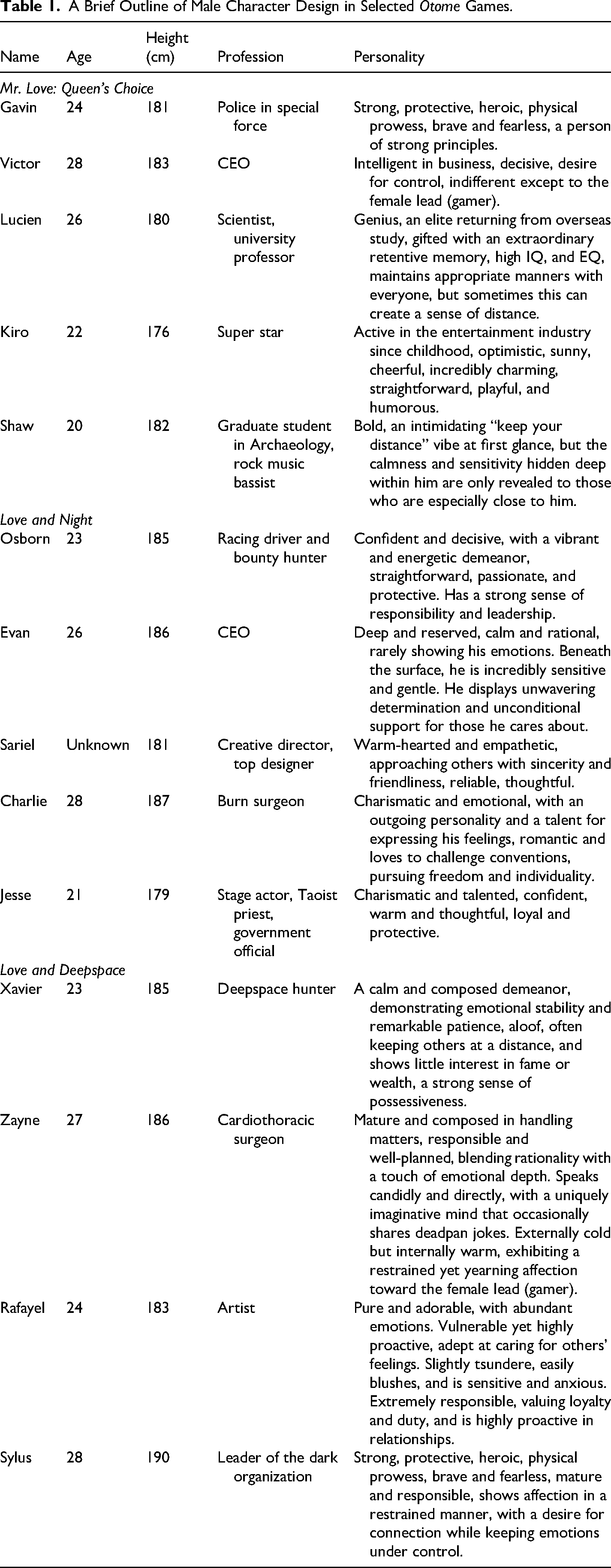
Otome games in China exemplify a tension between state-endorsed hypermasculinity and market-driven gender representations. These games reinforce the “wolf warrior” archetype—bold, nationalist masculinity aligned with state agendas—while simultaneously incorporating metrosexual or effeminate characters to cater to female consumer preferences. Historically, Louie's framework positions softer masculinities, tied to wen (cultural attainment), as culturally valued over wu (physical strength) (Louie, 2014). However, Hu et al. (2023) contest this during the pandemic, noting a surge in state-promoted “wolf warrior” nationalism and anti-effeminacy rhetoric, marginalizing nonconforming masculinities. The inclusion of effeminate characters thus reflects not cultural tradition but commercial elitism, balancing state propaganda with market demands. This duality underscores how otome games mediate between authoritarian gender norms and capitalist consumerism, revealing the fraught interplay of political control and commercial pragmatism in shaping digital romantic fantasies.
Beyond the heavy stereotypification and elitism of male characters, otome games serve as a rich repository of romantic scenarios designed to cater to traditional expectations for heterosexual women. The second layer comprises heteronormative romantic narratives structured around tropes like “rescued intimacy” (e.g., danger-driven bonding), “slow-burn mentorship” (e.g., workplace romance), or “fated reunion” (e.g., childhood friends rediscovering love). These scenarios are algorithmically tailored to evoke emotional investment, leveraging familiar story arcs that resonate with societal expectations of romance. While players exercise agency through dialogue choices, these interactions remain bounded within prescripted pathways, reflecting the very controlled autonomy—a design strategy that balances player engagement with ideological conformity.
Once we recognize that romantic scenarios are datafied in otome games, the question then becomes: how do female gamers perceive these often clichéd romantic narratives? The top three mentioned scenes by our interviewees, evoking their strongest feelings of romance and intimacy are weddings, everyday life, and proposals, which are all closely related to marriage (see Figure 1). Within the category of everyday life, gamers highlight activities such as cooking together, watching films, shopping, making phone calls, messaging, and taking selfies—mundane interactions typically shared by real-life couples. Other romantic scenarios favored by female gamers include dating, celebrating birthdays, Valentine's Day, anniversaries, and sharing private moments. Specific details within these scenes, such as wearing bikinis at the swimming pool, enjoying a candlelight dinner, and watching fireworks together, are often emphasized as particularly memorable. These scenes, especially those involving weddings and proposals, are presented as emotional or romantic spectacles for female gamers to consume and enjoy, aligning with longstanding traditional expectations for heterosexual women (Landman, 1996).
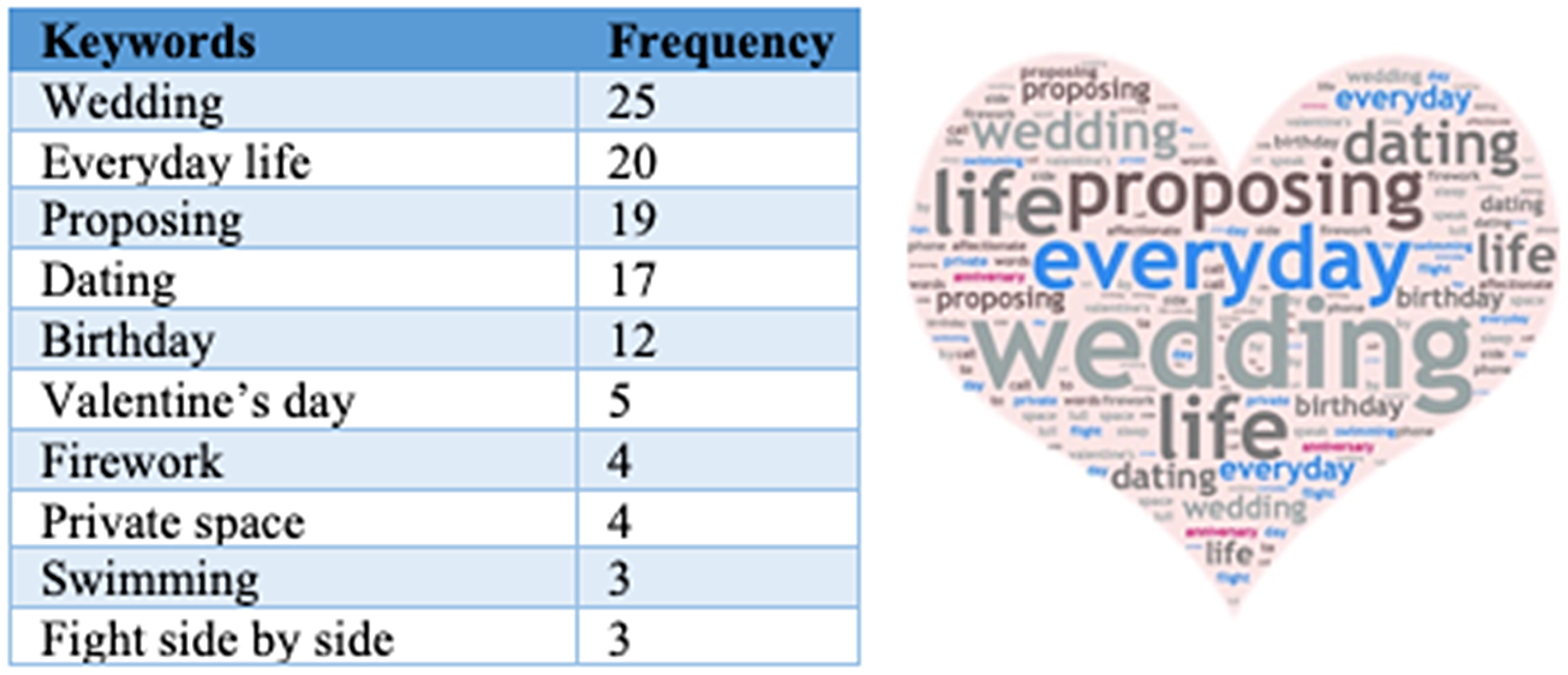
Top 10 Frequently Highlighted Words of Female Gamers Preferred Romantic Scenarios.

Screenshots From XG About the Scenarios She Mentioned Above.

Screenshots From HR About the Scenarios She Mentioned Above.
While most participants reported finding romantically moving moments within the game, this further highlights the game's role as a database of diverse romantic scenarios, ensuring that every player can discover content tailored to their preferences. Specifically, the interviewee XG recounted two instances with Evan from Love and Night: an unexpected introduction to his childhood caretakers after a drenching at an art exhibition, which felt deeply familial; and a rain-disrupted proposal where she reassured him about his bloodline, prompting his earnest marriage question (see Figure 2). Another interviewee, HR, highlighted her favorite wedding scene with Charlie from the same game, valuing it not just for its visuals but for Charlie's moving dialogue (see Figure 3). His spontaneous take on marriage—prioritizing love over ceremony and stating any moment could be perfect—profoundly resonated with HR, offering an understated yet warm portrayal of commitment that enhanced her sense of romance and intimacy.
Extending beyond weddings and proposals, otome games as a curated database of romantic scenarios also provide the appealing companionship mode, offering features like ASMR-style lullabies, study support, and workout interactions to enhance the gamers’ intimate experience. Interviewee ZT highlighted the intimacy of nocturnal lullaby segments, where male characters deliver affectionate, subtly suggestive monologues that provide a deeply romantic experience, especially before sleep. These scenarios, separate from core narratives, are often gated by randomized “card draw” mechanics requiring investment, effectively compartmentalizing romantic content into monetizable fragments. This design positions games as modular repositories of desire, promising a personalized experience where players can selectively engage with curated fantasies. However, this inclusivity is illusory; the database's boundaries exclude identities and narratives that challenge elite, heteronormative frameworks, such as working-class suitors or queer relationships. This exclusionary inclusion confines player “choice” within a commodified imaginary of romance, constrained by Chinese sociocultural norms.
The Dual Logic of Empowerment and Commodification
The dual-layered database of otome games is comprised of Chinese ideals of masculinity and romantic scenarios, shaped by the male characters presented in these games, which in turn reflect societal expectations for heterosexual women. This raises critical questions about the underlying structure of the database: Who or what controls and owns this database? When game producers create content, how is the gamer's subjectivity shaped? To what extent do gamers possess autonomy and control over their own experience of intimacy?
Some of our interviewees believe that they have little to no control over their fate in otome games, as the storylines and narrative trajectories are predetermined. All the available male characters are predesigned, meaning that while gamers can choose from these options, they must also accept aspects of the characters that they might not prefer. This lack of customization limits the player's ability to tailor the experience fully to their liking, as they must navigate the game with characters who may not entirely align with their personal preferences. While gamers can explore the story world, interact with male characters, and participate in events, the choices and dialogue options are largely prescripted, and their decisions seldom influence the story's outcome. This perspective aligns with Azuma's analysis of early Japanese otome games, where gameplay often involved passively reading through scenarios with limited interaction—typically confined to selecting one of two choices that only appear sporadically (Azuma, 2007). Saito (2021) further elaborates that the player's experience is often pre-embedded in the game's script, with the digital device simulating the player's gameplay within the game itself. Unlike characters in literary texts, who are often unaware of the meta-world beyond their narrative, the digital device in otome games may contemplate the existence of an external world beyond its diegetic setting. This shared perception of parallel plots between the digital device and the player fosters a sense of sympathy, leading players to equate the game system with an inescapable force of fate.
In contrast, some interviewees maintain that they possess autonomy and control over various aspects of the game. They believe they exercise power by deciding whether to engage with the game, selecting which male characters to develop intimacy with, choosing which story segments to pursue, and determining whether or not to spend money. These players feel empowered by otome games, as the storylines and character designs are crafted to cater to their preferences, fulfilling their intimate and sexual fantasies. In these games, the female lead (representing the gamer) is always portrayed as a central figure of desire, who can have multiple boyfriends simultaneously, all of whom are invariably devoted to her. As KL mentioned, games offer scripted security where relationships deepen without breakup risks, fostering confidence in the male lead's constant presence. Real-life dating, however, revolves around unpredictable uncertainties and insecurities about lasting commitment, creating a starkly different dynamic.
The contrast between idealized virtual intimacy and messy real-world relationships reveals a paradoxical autonomy for gamers. While they gain a sense of control and fulfillment within the game's structured narratives—choosing specific archetypes and navigating predefined paths—this control is ultimately bounded by the developers’ design. The gamers’ reliance on games as emotional substitutes due to real-world deficits suggests that their autonomy in shaping their actual intimate lives might be indirectly influenced or even diminished. They can control the simulated intimacy, but this control is an illusion, operating within a system designed and owned by others, reinforcing certain ideals while excluding others (e.g., working-class or queer relationships). This highlights that while gamers feel agency within the game, their broader romantic imaginary and expectations are shaped and confined by the game's pre-established parameters. Our findings reveal that most interviewees’ ideal real-life boyfriend types closely align with their favorite virtual partners in otome games, generally falling into two categories: mature, reliable, and stable; or transgressive, confident, and expressive. However, participants predominantly prefer the mature type for real-life relationships, largely excluding the transgressive archetype. While enjoying adventurous virtual experiences with characters like Osborn, a racing driver from Love and Night, many admitted they would avoid such risks in reality due to anxiety about safety, highlighting a clear distinction between virtual and real-world romantic preferences. This selective engagement with virtual partners suggests that players are not merely seeking perfect ideals but are often willing to accommodate aspects of these characters that might be less desirable in a real-life partner. The overarching idealized narrative within the game, coupled with its controlled environment, allows players to largely gloss over these “less welcome sides”—such as a racing driver's dangerous profession—transforming potential anxieties into an exciting facet of a safe, fictional romance, thereby making the virtual engagement distinctly preferable to the complexities and uncertainties of real-life relationships.
While players align their preferences with stereotypical masculinities, this indicates that their “choice” operates within a database of predefined archetypes, which suggests a form of bounded autonomy; gamers control their selection from established types, but they don't fully define or create new forms of intimacy outside these parameters. Our interviewees like Qianqian and Tao explicitly state that male characters in games “consistently respect the protagonist's choices” and model “healthy relationships as the norm.” This direct contrast with real-life dynamics, where “control is illusory” and agency is disregarded, demonstrates that gamers find a significant degree of perceived control over the narrative of their intimacy within the game. They choose to immerse themselves in a space where their desires for equality, mutual respect, and emotional safety are consistently prioritized. This points to the sense of empowerment among gamers fostered by the games’ emphasis on respectful and equal love, especially in a patriarchal context, which can be interpreted as a psychological form of control over their emotional landscape—they are able to experience and engage with a preferred model of intimacy that validates their desires, even if it's within a fictional setting. Hence, this finding implies that gamers exercise autonomy by choosing a virtual space where their intimate needs are met, which is a form of exerting control over their emotional well-being by selecting an environment that delivers desired intimate experiences, albeit in a simulated form.
Regarding scripted romantic scenarios, while many interviewees expressed a desire to experience such moments in reality, none reported having experienced similar real-life situations. They acknowledge that the romantic scenes in otome games are highly idealized, featuring beautiful visual design and background music, which may seem awkward in real life. Aya and Tao expressed disillusionment with real-world romance, contrasting it with otome games’ idealized narratives. Aya, reflecting on self-doubt, stated: “Pure love feels unattainable—I crave Evan-like care, not wealth or looks, but real life disappoints.” Tao emphasized unmet desires for “grand, explicit displays of love” in reality: “If I can’t find dramatic proposals or unwavering affection offline, games provide characters who fulfill those fantasies.” Both framed games as emotional substitutes, bridging gaps between aspirational intimacy and real-world reticence. This profound disillusionment with real-world romance underscores how the idealized narratives of otome games, despite potentially containing characters with less welcome sides that players accept, are nonetheless overwhelmingly preferred. The games effectively allow players to selectively engage with romantic perfection, subtly overlooking minor imperfections or challenging traits, because the core promise of unwavering affection and emotional safety is consistently delivered—a stark contrast to the perceived deficits in real-life romantic prospects. Therefore, while otome games provide a rich database of romantic scenarios that cater to traditional expectations of heterosexual women, many female gamers remain disillusioned with real-life male counterparts. They often hold idealistic expectations influenced by the games, yet they do not fully project these romantic scenarios onto their real lives.
Even if gamers can exercise some autonomy and maintain a relatively rational mindset while engaging with the heavily stereotyped database of otome games, the fact remains that these games are meticulously designed to keep players engaged. This continuous engagement generates significant data behind the scenes, accessible only to the game producers. These producers can analyze players’ behaviors, including their preferences for certain types of masculinities, favored personal traits, and the most engaging romantic scenarios. This data is then used to further develop and enrich the game database, ultimately driving commercial benefits. In this process, the datafication of digital intimacy occurs, where gamers’ interactions and preferences are transformed into data. Although players might be aware that their intimate experiences are being datafied, they have little to no control over this process.
At this juncture, the interplay between social media and social capital becomes particularly relevant. Digital intimacies can be seen as a form of social capital that shapes experiences and mobilizes intimacy, identity, and belonging, potentially transforming into other types of capital (Abidin, 2018). When individuals’ sharing practices are primarily viewed through the lens of social media's commercial business models, intimate communication can be understood as a form of free labor (Andrejevic, 2007). The media practices that constitute online intimacy simultaneously generate valuable content, attention, social networks, and data. Dobson et al. (2018) refer to this phenomenon as “digital intimacy as social capital” and “digital intimacy as labor,” arguing that digital intimate publics, while contributing data to the commercial models of advertiser-funded social media platforms, do not lose their political significance. However, over time, the existence of digital intimate publics on commercial platforms becomes exploitative as these publics solidify into the material form of the platform itself. Intimate relations, once private, become visible to and owned by private platforms, with users unknowingly contributing to the platform's evolving architecture. Similarly, otome games function in this way. The seemingly private interactions between gamers and male characters are often shared beyond the confines of the gamers’ community, extending to broader public platforms like Bilibili. Simultaneously, these interactions are collected and analyzed by game companies to build commercial databases and refine future game designs. In this sense, “digital intimacy involves reproducing social relations as data, transcribing social relations into databases” (Dobson et al., 2018, p. 19). In other words, while platforms institutionalize practices of public intimacy, they simultaneously privatize these relationships as property. The public nature of these intimacies is limited, as participants have little control over how platforms manage and utilize their intimate relationships.
The database structure of otome games can be understood through Miguel's (2018) notion of the “double logic of empowerment and commodification,” which suggests that platforms simultaneously empower and exert control over users. In this context, otome games function as tools for communication, facilitating interactions not only between female gamers and virtual characters but also among gamers themselves. However, they also serve as mechanisms for user control. Hesmondhalgh (2013) defines commodification as the process of transforming objects and services into commodities, which can be exchanged and sold. This raises important questions about the types of information that can be traded. As Miguel (2018) discusses, many societies hold that certain aspects of life, such as personal relationships, religion, and political views, should be protected from market influences. Despite this, a common method of monetizing web traffic is through the commodification of user data, which is then used to deliver tailored advertisements or shared with third parties. Andrejevic (2010) illustrates how social media platforms extract value from user interactions, stating that “the social factory puts our pleasure, our communications, our sociability to work, capturing them in order to extract value from them” (p.90). Similarly, Arvidsson (2006) contends that personal relationships can be appropriated as a source of surplus value under capital. Otome games operate within a double logic of empowerment and commodification by offering players immersive romantic experiences while simultaneously collecting and analyzing their interactions for commercial gain. On one hand, these games empower players by providing personalized narratives and emotional engagement; on the other hand, they commodify these intimate experiences by transforming user data into valuable assets for game developers. This duality highlights how otome games both enhance and exploit players’ emotional investments.
Otome games construct experiences of romance, fantasy, and intimate relationships for gamers, a phenomenon that can be understood through Illouz's concept of “emotional capitalism.” Illouz (2007) theorizes the intricate ways in which intimate life and the economy are intertwined, shaping each other in a mutually reinforcing manner. We are embedded in an emotional culture that values authenticity, often expressed through the display of intimacy. This dynamic creates new intersections between public and private life. In this evolving landscape, Illouz argues, intimate lives are increasingly mediated and articulated through social media, reflecting the broader culture of emotional capitalism, where “emotions have become entities to be evaluated, inspected, discussed, bargained, quantified, and commodified” (Illouz, 2007, p. 109). Otome games exemplify the datafication of digital intimacy within the framework of emotional capitalism by transforming players’ romantic and emotional engagements into quantifiable data. This process involves analyzing interactions between gamers and virtual characters to refine game design and enhance user experience, ultimately commodifying intimate experiences. Through this lens, emotional connections in otome games are not only shaped by the economic motives of game developers but also contribute to a broader culture where emotions are commodified and leveraged for profit.
In a broader context, datafication refers to the ability of commercial digital media to capture and transform activities that once escaped systematic value extraction into information commodities (Andrejevic, 2010). Recent theoretical advancements, such as the concept of “deep mediatization” (Hepp, 2019), highlight an intensified entanglement between media practices and datafication, particularly on digital platforms (Andersen, 2018). This deep mediatization logic extends beyond traditional media contexts to areas like otome game development, where players actively share gameplay videos and experiences on platforms such as Bilibili and YouTube. This practice fosters a collective intimacy-sharing environment, where players exchange personal experiences through collaborative data practices. Consequently, otome game developers are incentivized to refine character designs and visual elements to maximize engagement on video platforms, aligning with the visual data processing and algorithmic logics of these platforms to attract more gamers and consumers. In this process, not only is the intimate data generated within the game exploited by the companies, but so is the data from players’ shared content and experiences. Individuals can be influenced by these processes of datafication and deep mediatization even if they have limited access to or engagement with digital technologies, which underscores the reduced agency individuals may have within these systems (Burgess et al., 2022).
Concluding Remark
This study deepens our understanding of the datafication of digital intimacy by examining otome games as spaces where romantic desire, cultural ideals, and capitalist logics intersect. Through the lenses of idealized masculinities and scripted romantic scenarios, the research uncovers how these games mediate intimacy, reflecting and shaping players’ emotional experiences. Otome games construct curated databases of romantic archetypes, embedding culturally specific fantasies of masculinity into their design. This systematic structuring transforms players’ emotional investments into quantifiable interactions, making intimacy legible, extractable, and monetizable. While players experience empowerment through customizable romantic encounters, this autonomy is counterbalanced by commodification, as their emotional data are harvested for profits. This dual logic: empowerment alongside exploitation, highlights the complex interplay between intimacy, technology, and capitalism in digital media.
Datafication, as a cultural process, both emerges from and shapes societal values and meanings (Burgess et al., 2022). It is not neutral but deeply embedded in sociocultural contexts, and individuals actively engage with, resist, or disrupt these processes. The study concludes with a poignant example from an interviewee, MX, who shared how a peer gamer found solace in her virtual boyfriend, Victor, from Mr. Love: Queen's Choice, during a period of domestic violence. This underscores the potential of otome games to provide emotional support and empowerment in real-life struggles, even as they commodify intimacy. By situating otome games within the political economy of interactive entertainment, the study reveals how datafication reconfigures intimacy as both deeply personal and industrially standardized, emancipatory and extractive. Future research must address the ethical implications of this tension, particularly as advancements in AI and affective computing create increasingly “realistic” virtual companions. As digital intimacy blurs the line between the virtual and “real” human connections, there is an urgent need for frameworks that prioritize user autonomy and well-being, ensuring that the pleasures of virtual companionship do not come at the cost of unchecked corporate control over intimate human experiences.
AI Usage Statement
In the preparation of this article, we utilized generative AI tools to assist with several tasks. Specifically, AI was employed for organizing interview materials, translating Chinese interview data into accurate English, and for comprehensive typo correction and proofreading of the manuscript. It is important to note that generative AI was not used for the development of any ideas, arguments, or analytical insights presented in this research. All conceptual content and original thought originated from the human authors.
Footnotes

Ethical Considerations
Ethics approval was granted by the Ethics Committee of Xi’an Jiaotong-Liverpool University on December 07, 2022 (No. ER-HSS-11000072320221202105254). The procedures employed in this study comply with the principles outlined in the Declaration of Helsinki.
Funding
The author(s) disclosed receipt of the following financial support for the research, authorship, and/or publication of this article: This project is supported by XJTLU Research Development Fund RDF-22-01-079.
Declaration of Conflicting Interests
The author(s) declared no potential conflicts of interest with respect to the research, authorship, and/or publication of this article.
Informed Consent
All participants are required to thoroughly review the provided information detailing the project's aim and procedures, and to sign the consent form prior to participating in the interview.