




Abstract
Anonymous digital intimate publics (ADIPs) are digital platforms where anonymous posters share intimate stories. Because these platforms are anonymous, conventions such as user profiles, time stamps and ‘likes’ are not part of the site’s functionality. Nonetheless, intimate connections are shared and developed on these sites. Rather than an isolated occurrence, multiple platforms have emerged with similarities in the intimate connection and communication that takes place on ADIPS. This research uses Lauren Berlant’s intimate publics to build a conceptual framework which sees intimacy as a broad and often ephemeral occurrence which creates worlds and connects communities. Building on existing literature in the field of digital intimate publics, this research considers how anonymity and more-than-human actors contribute to the dynamics of ADIPs. This research compares similarities across three ADIPs: Queering the Map, PostSecret and the City of Melbourne’s tree email program. By ascertaining the thematic similarities of the posts, further theoretical insights can be made about how ADIPs dissolve the artificial divide between public and private, reveal the capacity for intimacy-building in ephemeral and imagined circumstances, and ultimately demonstrate a repeated drive to challenge the current distant norms of contemporary Western intimacy.
Internet platforms have produced new social locations where relational, intimate communities can be built and maintained (Fuchs, 2011: 288; Kirby et al., 2021: 1045). Within these digital platforms, powerful affective connections form, and personal and community identities take shape. These connections generate digital intimate publics (Dobson et al., 2018: 7), some of which can occlude binary concepts of digital and analogue, public and private, known and anonymous, making them fluid, non-normative and interpretable. This article explores such occlusions by examining three digital platforms that emphasise vulnerable storytelling and anonymity: Queering The Map (QtM), PostSecret and the City of Melbourne’s tree email program. We refer to these sites as anonymous digital intimate publics (ADIPs).
ADIPs are platforms where users are anonymised, yet affective connections and intimate communities improbably persist through vulnerable and heartfelt posts. The urge to connect and communicate across these ephemeral, anonymous spaces appears so affectively compelling that multiple sites have emerged to satisfy this need, sometimes even transforming spaces originally intended for another purpose. Of particular importance to us is the disproportionate use of these platforms by marginalised, vulnerable or stigmatised groups (Grønning and Tjora, 2018: 392; Kirby et al., 2021: 1052). Digital platforms such as ADIPs which can give voice to these groups and affirm solidarity, and shared experiences can be instrumental in breaking down stigma. ADIPs have the capacity to respond to widespread loneliness, isolation and atomisation (Bauman, 2000; Cabalquinto and Soriano, 2020) through a novel digital context. By identifying multiple platforms where stories of love, loss and (be)longing (Kirby et al., 2021) are shared to foster communication and connection, this article provides important context for how digital platforms and digital intimate publics can be used to create connection and defy loneliness and isolation.
Using multiple case studies, we draw links across ADIPs, demonstrating the repeated drive for intimacy, connection and communication across digital intimate publics. By extending Kirby et al.’s (2021) ‘Queering the Map: Stories of love, loss and (be)longing within a digital cartographic archive’ to the PostSecret and tree email ADIPs, our research finds that public intimacy flows seamlessly between the analogue and digital. Secondly, we find that intimacy implicates both organic more-than-human entities like trees, as well as inorganic more-than-human entities like the concept of anonymity. Finally, we posit that imagined connections create actual, tangible impacts to user behaviour. This article explores multiple sites to analyse modes of communication and connection through theories of intimacy and affect. Supplementing the research of Kirby et al. (2021), we look to Berlant’s (1998) work in intimate publics, and subsequent work on digital intimate publics (boyd, 2010; Dobson et al., 2018) to frame ADIPs as sites of meaningful connection and powerful affective entanglement between users.
Intimate and networked publics
The sites of study explored in this research are located primarily in North America and Australia and have an emphasis on family and romantic relationships as a locus of (dis)connection. It is important to acknowledge that the data from the tree emails and QtM used for this research are located on stolen Wurundjeri and Boonwurrung land, where distinct constructions of intimacy have existed forever (Bignall et al., 2016: 469). The contemporary Western normative construction of intimacy will be called ‘distant’ publics throughout this research, to distinguish them from Berlant’s (1998) intimate publics, but also to refute a simplistic construction of them as conventional or uncontested.
Intimacy is the foundation of the range of ADIPs used as case studies in this research. The posts made on these sites often document emotions, secrets or personal experiences. When this content is posted on globally accessible platforms, the intimate is made public and relational worlds are built between prosumers. Berlant’s (1998) work on intimacy broadens the scope of what is considered an intimate relationship. Berlant’s definition of intimacy as ‘the kinds of connections that impact on people’ (Berlant, 1998: 284) implies that intimacy is located within connection and impact, expanding beyond monogamous, romantic, coupled relationships and even beyond face-to-face personal interaction. Intimacy is conceptualised by Berlant (1998) as inherently a public emotion – felt, expressed and experienced publicly. It thereby holds world-building potential, where ‘it creates spaces and usurps places meant for other kinds of relation’ (p. 282). Berlant’s conceptualisation also recognises that ‘attachments make people public, producing trans-personal identities and subjectivities’ (Berlant, 1998: 283). Trans-personal identities dissolve the binary of self and other by creating ways of doing and becoming which inform not just a discrete individual, but a whole community. Likewise, trans-personal subjectivities describe the non-objective, the personal and the opinion as a collective experience. This concept is useful in that ADIPs disrupt public/private boundaries through connections between a poster (producer) and a reader (consumer), making ADIPs a space where the distances of geography, time and anonymity are dissolved, where affect persists and intimacy flourishes. The capacity of intimate publics to generate interpersonal connection is transformed anew by their existence online, calling for supplementary theories to transform Berlant’s theory of intimate publics into the digital age.
Berlant’s theory of intimacy is contextualised into the digital age by boyd’s (2010) work on networked publics and other scholarship in the field of digital intimate publics. boyd (2010) defines networked publics as ‘publics that are restructured by networked technologies; they are simultaneously a space and a collection of people’ (p. 40). Like Berlant (1998), boyd (2010) highlights that networked publics blur the public/private divide, rendering them ‘meaningless binaries’ (p. 48). boyd (2010) notes that networked publics are instrumental in ‘obliterating the distinctions between consumers and producers’ (p. 52), further challenging an implied divide between public and private. Traditional production on these platforms may look like posting or commenting content, while consumption may look like more passive contributions such as increasing watch counts or showing affirmation or disagreement with content through tools such as ‘likes’ and downvotes (Kirby et al., 2021: 1046). However, there is potential to broaden this conception: where production may be created by participating in an atmosphere, culture or imagined community, and consumption through ‘lurking’, participating in a shared affect without making a tangible change to the site itself (boyd, 2010: 49).
When the language of intimacy is applied to ephemeral and anonymous spaces, their poignancy and meaningfulness is revealed. Berlant’s (1998) work on public intimacy has also been reimagined in a digital context through research on digital intimate publics (Kolehmainen, 2022: 69; Larsen-Ledet and Rossitto, 2023; Lindgren and Richardson, 2023) Traditional, private, romantic, Western conceptions of intimacy (Kolehmainen et al., 2022: 1) overlook an array of other structures and experiences of intimacy. As such, intimacy is understood here as ‘connections that impact on people, and on which they depend for living’ (Berlant, 1998: 284). By broadening intimacy to include any connection between people which impacts them, new intimate connections are recognised and validated. To complement this, affect – defined as ‘bodies’ capacities to affect and become affected’ (Kolehmainen et al., 2022: 2) – understands emotional impacts in many forms: positive and negative, direct and more amorphous, individual and collective, human and more-than-human (Juvonen, 2022: 116; Kolehmainen, 2022: 69; Kolehmainen et al., 2022: 2).
Combining the two key theories of intimacy and affect broadens intimacy from a person-person experience into one which is more-than-human, implicating for example technology, objects and spaces (Juvonen, 2022; Kolehmainen, 2022; Méndez de la Brena, 2022). Resisting the anthropocentrism of contemporary distant publics is not a modern innovation but rather rooted in (under cited) Indigenous knowledges (Bawaka et al., 2016: 269; Bignall et al., 2016: 469) which are important to acknowledge, particularly given the nature of this research which is partially located to stolen and unceded Wurundjeri land in so-called Australia. Indigenous knowledges understand that ‘all the animals, plants, winds, processes, things, dreams and people that emerge together in nourishing, co-constitutive ways [. . .] create Bawaka Country’ (Bawaka et al., 2016: 269) in North East Arnhem Land, so-called Australia. This is an ontology which emphasises co-constitution and intimate connection between all manner of actors, not limited to humans.
Intimacy in digital intimate publics is often depicted as a ‘diminished and dangerous corruption of the real thing’ (McGlotten, 2013: 7). Yet users often turn to these sites when seeking solidarity or connection which they lack in interactions in the analogue world (Kolehmainen, 2022: 69; Larsen-Ledet and Rossitto, 2023; Lindgren and Richardson, 2023). This affirms that digital intimacy has the capacity to queer, challenge and rewrite contemporary restrictive, normative intimacy rules while retaining legitimacy and impact.
In digital intimate publics, anonymity is reframed from an inhibitor of connection to a facilitator of it. Anonymity does not equate to an absence of emotional investment (Turkle, 2011: 235). Indeed, anonymity has been foundational to connection in many historical intimate publics, like 1920s newspaper advice columns (Golia, 2021: 115). Anonymity can even become a ‘condition of [. . .] existence’ for intimate publics (Rice, 2012: 44), which rely on its capacity to entice contributions from those who may only do so under anonymity (Jaidka et al., 2022; Kolehmainen, 2022: 69; Larsen-Ledet and Rossitto, 2023; Lindgren and Richardson, 2023).
Anonymity also reorients the rubric for trust and connection. Rather than relying on an authenticity which is difficult to determine in digital anonymous spaces, trust is instead related to ‘experience, emotions and empathy’ and this trust builds up intimate publics (Zdanowicz-Cyganiak, 2022: 104). Furthermore, anonymity obscures identity markers and in so doing, may bring about connections that would otherwise have been overlooked. Among these, for example, connections across time as online posts are accessed around the globe and into the past through the digital archive (Sharp and Shannon, 2020: 141).
The term imagined, used throughout this article, gestures to Berlant’s (1998: 283) assertion that intimacy exists ‘on the street, on the phone, in fantasy’. Importantly, imagination is different from the intangible or unreal: this research finds that connections which are imagined or anticipated are tangible, affectively impactful and create real impulses to confess and share intimately in public spaces.
Methodology
Using data collected from ADIP case studies QtM, PostSecret and the City of Melbourne’s tree email program, we demonstrate the repeated drive for intimacy, connection and communication across digital intimate publics. This research considers how the actors of ADIPs communicate and connect. This question is designed to expand the research of Kirby et al. (2021) by drawing on their prior work focused on the platform QtM and applying their analytical logic to other similar platforms to explore the generalisability of the results. The thematic codebook established by Kirby et al. (2021: 1049, 1050, 1052, 1054) details a range of themes that characterise the connection and communication present on QtM. By demonstrating that these themes also describe the communicative capacities of PostSecret and the tree emails, the three case study websites are crystallised as belonging to the same phenomenon: ADIPS. Once this similarity is asserted, each case study is utilised comparatively to understand how ADIPs function and create connection. By showing that ADIPs are a genre of intimate public, the intimate connections that persist through anonymity and imagination are regarded not simply as a unique or one-off phenomenon but a repeated mode of connection and communication for participants.
QtM is an interactive cartographic platform where users anonymously tag locations of queer experience, participating in ‘digitally archiving LGBTQ2IA+ experience in relation to physical space’ (Queering the Map, n.d.). PostSecret is a platform where participants are encouraged to use postcards, mailed to the curator Frank Warren (n.d.), to ‘reveal anything – as long as it is true and you have never shared it with anyone before’. A selection of postcards are displayed for a week and then removed from the platform and made untraceable. The tree emails are part of a program run by the City of Melbourne (2020), in Narrm, Australia, where each tree in the council municipality is tagged with an email, accessible from the online map. Although these emails were originally established to report on the tree’s health, they have been co-opted by authors internationally who have been writing the trees love letters through the email system (Burin, 2018). Although these emails are usually unpublished, a small number have been released to media sites.
In all these case studies, both the producer and the consumer of the content occupy alternating, simultaneous and fluid roles as prosumers (Fuchs, 2011) and are rendered anonymous by the sites’ functionalities. Yet an affective atmosphere is generated by the demonstration of public intimacy and vulnerability that occurs through and with these prosumers. Research has been done on some of ADIP sites as isolated studies (Kanai, 2017; Kirby et al., 2021; LaRochelle, 2020; Phillips and Atchison, 2020; Poletti, 2011; Smirnova, 2016; Straughan et al., 2023), but to date they have not been recognised as a repeated subsection of digital intimate publics and site of unique affective connection and social relationships.
Data collection
To collect data from the case study ADIPs, we gathered primary data from the QtM and PostSecret websites and secondary data from news articles about the tree emails. The platform architecture of QtM and the tree emails organised posts geographically, and so data for these sites was focused on Narrm/the City of Melbourne. To collect data, posts were collected from each site and transcribed directly into a spreadsheet. To recognise the importance of the visual element of PostSecret posts, the data was also screenshot and collated in an accompanying document.
The data for the tree emails was determined by collecting all the unique posts that were mentioned on the first page of Google search results for ‘Melbourne tree emails’ on July 11th 2023 (posts repeated across sites were logged as a single data point). In total, this provided 44 unique posts for the tree email case study. The tree email program, run by the City of Melbourne, is contained to the municipality's geographic boundaries. Although QtM posts are geotagged all around the world, the spatial boundary of the tree emails was replicated for the data collection of the QtM posts. We collected every post made to the QtM website within the geographic boundaries of the City of Melbourne as of August 5th 2023. This resulted in 331 data points for the QtM case study.
The PostSecret data points were not determined by geography, but instead by time as a number of posts are made available for a week and then hidden and replaced. To account for this, PostSecret posts were sampled on a time scale that provided the maximum number of data for the research period. Because the PostSecret platform publishes posts in two categories, Sunday Secrets and Classic Secrets, only Sunday Secrets posts were used as they were implied to be novel posts, whereas Classic Secrets were not. To provide as many data points as possible, posts were sampled weekly for the duration of the research phase of this research, from March 3rd 2023 to August 6th 2023. This was 23 weeks of data, resulting in 226 posts.
Because all of the sites used are publicly accessible, posts are considered public and available for data collection. However, this anonymity also means that no participant can be asked to give explicit permission for their post to be used in research (Kirby et al., 2021: 1049). To maximise the privacy of participants, the location of posts were anonymised, as were names, initials and photographs of people. All other data, including spelling and grammar, was transcribed as exactly as possible. A further ethical consideration concerns the vulnerability of the posts made, including the disclosure of intimacy and the assumption of shared emotional connection and camaraderie as part of a digital intimate public. To recognise the vulnerability of these posts being analysed in an academic context, Author 1 contributed to the sites. Recognising their role as a researcher and holder of meta-context, none of their submissions were included in the data analysis. However, we see this as an opportunity to ensure ethical and respectful analysis by making their contributions equally vulnerable to future academic analysis.
Data analysis
The coding process entailed identifying the primary themes in the dataset and tagging each post with one or more of the themes. These themes, determined by Kirby et al. (2021: 1049, 1050, 1052, 1054), were public/private relationships; loss, regret and longing; declarations of desire and (be)longing; and absence, place and community. They examine, respectively, ways that communication on QtM uses subversion of the artificial public/private divide, stories of loss, confession and sensations of place to build community and intimate affect (Kirby et al., 2021: 1049, 1050, 1052, 1054). Comparative analysis of the data confirmed that these four themes were relevant across the three ADIP case studies used. Coding found that 98% of total posts fit into these four categories, with 100% of total QtM posts, 100% of total PostSecret posts and 77% of total tree email posts falling into one or more themes. From this thematic repetition it is clear that each case study belongs to a similar genre of digital intimate public, characterised by similar post themes. Starting from this point of shared character, broader observations were made about how and why communication and connection occurred on ADIPs. Identifying the synergies and similarities across sites presented two main analytical concussions: that ADIPs disrupt the artificial public/private divide, and open worlds of intimate connection that are ephemeral, imagined and deeply meaningful.
The guiding research framework, developed by Kirby et al. (2021: 1049), only analyses data points that are identified as ‘stories for someone’. These stories are posts that ‘gestured toward a specific reader or audience(s)’ through ‘clear references to personal details, or [which] were written to/for others’. Although this was only 26.5% of posts identified by Kirby et al. (2021: 1049), we contend that all stories posted are ‘stories for someone’ in the sense of contribution to the imagined collectivity of the digital intimate public. As such, we have analysed all posts in the data sample.
Analysis of the data involved tagging each post with themes of connection and communication identified by the research of Kirby et al. (2021). From these tags, the three case study ADIPs are shown to share similarities in thematic content. Such repetition incites deeper investigation into the communication and connection on these platforms. ADIPs queer the artificial public/private binary, by creating a space that is simultaneously global, public and voyeuristic as well as confessional, vulnerable and localised. The digital dissolution of these binaries implicate and replicate the analogue world.
Intimate flows through the analogue/digital and public/private binaries
The thematic similarities in the posts of QtM, PostSecret, and the tree emails demonstrate that in multiple cases, across multiple platforms, geographies, identities and times, the same threads of communication and connection exist. The findings demonstrate that all three case study ADIPs contain a significant number of posts that fall into the four thematic categories identified by Kirby et al. (2021), indicating a measurable and theoretically significant repetition across multiple sites. On the basis of this similarity it becomes clear that each of these sites are not outlier modes of digital public intimacy, but a consistent, repeated phenomenon. When these similar sites are compared, behavioural trends emerge: intimacy flows between actors in ways that complicate and defy an artificial public/private divide and challenge the norms of anthropocentrism and concreteness which define distant publics.
The very structure of ADIPs publicise intimacy by encouraging users to make their intimate experiences accessible to a global digital intimate public. However, the communication on these platforms, which dissolves the artificial divide between public and private, mirrors dynamics already present in the analogue world. On all three sites, users complicate what is seen as public and what is seen as private:
I came out here, sitting on a rural train, huddled in the luggage space because i was scared other passengers would over hear the phone call
Queering the Map
Dear English Oak, I have chosen to write to you given your proximity to the Shrine of Remembrance and that your status is ‘unknown’. I write about a friend of mine . . . someone who has reached an intersection in life. To the outside world he has control, but within it can feel like a labyrinth with too many possible pathways, all without much clarity or light. How can I help him during this time of decision and indecision? Thank you wise old tree.
City of Melbourne tree emails (Burin, 2018)
“WHEN I GO TO A PARTY I LEAVE SECRETS UNDER RUGS / AND ALWAYS UNDER THE STAMP WHEN I SEND CARDS AND LETTERS”.
PostSecret.
The authors of the QtM, PostSecret and tree email posts all use their ADIP of choice to narrate the complicated interplay of private and public life, and in doing so reproducing it anew. In the QtM post, the user contrasts the perceived danger and insecurity of their regional service train carriage against this other, queer-accepting world accessed through their phone. In this way, the phone exists as a channel to other worlds – ones where supportive loved ones can be relied upon to be receptive to a coming out, even when the user might be physically surrounded by hostility or uncertainty. A ‘private’, vulnerable and secretive act is made possible through the actor of the phone amidst the public and unpredictable world surrounding.
The tree emails user similarly positions the private world as inside and in dialogue with the public world. The labyrinthine uncertainty of the friend is positioned as a secret ‘[t]o the outside world’, a deeply held personal and private affair. Yet the publicness of this secret is reinforced in layers: this feeling has been shared with a friend, who now shares it with a tree, and as collateral the City of Melbourne staff member who processes these emails is now also part of the public bearing witness. Although these is a degree of anonymity at play which protects the original friend, the facts of this complex, lonely, lost feeling are being shared opening and empathetically. Like the QtM post, the tree email blurs public and private locations and topics into a totally self-same experience.
Likewise, the PostSecret postcard (Figure 1) begins with unnamed secrets, disseminated across floors and mailboxes. The author describes a risky play which flirts with discovery and implies that the vitality of the private world is bolstered by its proximity to the public. Although the author leaves their rug- and stamp-secrets unsaid on the PostSecret platform, their postcard is itself a confession and a layering of private secrets made public. The viewers of this website will of course be drawn to the enticing stamp on this postcard, rendered flat and unmoveable by its digital form, and the possibilities of further unravelling the illusory barrier between public and private. Rather than coincidentally blurring these fallacy worlds, this postcard shows that users of ADIPs can be keenly aware of the relationship between privacy and publicness and active in complicating it.

PostSecret postcard with the illustration of a rug.
Posts are typically documented on ADIPs through the use of a personal technological device like a smartphone or laptop. The posts made on these private devices, however, are intended for a public readership – often even global. These shared emotions are often the result of a public exchange on the platform creating an internal reaction in the reader. Like a pinball, the use of digital intimate publics ricochets between experiences labelled public and private, collecting aspects of each and moving seamlessly between them to render the labels ‘meaningless binaries’ (boyd, 2010: 48). The intimacy expressed on ADIPs has an unbounded flow between public and private, and similarly takes a seamless flow between human and more-than-human.
The organic more-than-human actors of intimate publics
More-than-human actors are foundational to the communication and connection that takes place across ADIPs. Although the norms of contemporary distant publics frame intimacy as exclusively human, the posts of ADIPs explicitly and implicitly integrate more-than-human actors, from trees to technology. In the tree emails, for example, trees are explicitly referred to as agentic contributors to intimate publics.
Dear Green Leaf Elm, I hope you like living at St Mary's. Most of the time I like it too. I have exams coming up and I should be busy studying. You do not have exams because you are a tree. I don't think there is much more to talk about as we don't have a lot in common, you being a tree and such. But I'm glad we're in this together
City of Melbourne Tree Emails (Ley, 2015)
This is my favourite tree at my apartment. . . Sadly, I can only afford one more rent increase – I don’t know what to do or where I’ll go. But I’ll miss this Tree
PostSecret
Had my first date w my girlfriend here on gay hill
Queering the Map
In each of the above posts, users understand their life experience as mediated through more-than-human actors, in this selection particularly those relating to place and the natural world. For the author of the tree email, the fact that trees cannot read or respond directly to the emails they receive does not deter authors from expressing their connection to the tree earnestly and vulnerably. The author directly addresses the tree as ‘you’, demonstrating the persistence of an affective relationship between email author and tree despite a language barrier of sorts. In this tree email, the author compares their personal experiences to the tree’s experience, drawing a thread of intimacy and empathy between themselves and the tree. Even when the author and tree ‘don’t have a lot in common’, their connection through space and affect binds them ‘in this together’. Berlant’s intimate public is not a proposition for a new way of organising or experiencing public relationships, but rather an appeal to redefine intimacy to (re)encompass intimacies made latent by distant public norms. This is particularly relevant for the human and more-than-human intimate relationships that take place on the stolen Wurundjeri Woiwurrung land in Narrm/the City of Melbourne, where this interaction was documented, and where intimate connections with nature have been acknowledged forever by Indigenous communities.
The intimacy communicated through the tree email is complimented by the PostSecret postcard (Figure 2), inventively fashioned out of a plastic-protected piece of tree bark. Both the QtM and PostSecret posts entangle experiences of urban housing with their respective trees, demonstrating the persistence of more-than-human connections even in times of manufactured separation. The PostSecret contribution is steeped in uncertainty and fear, reflecting the emotional complexity of intimacy different from the normative construction which focuses on intimacy-as-love. Not simply the subject of the postcard, but becoming the postcard, the tree is centred in the confessor-witness affective flow as an agent.
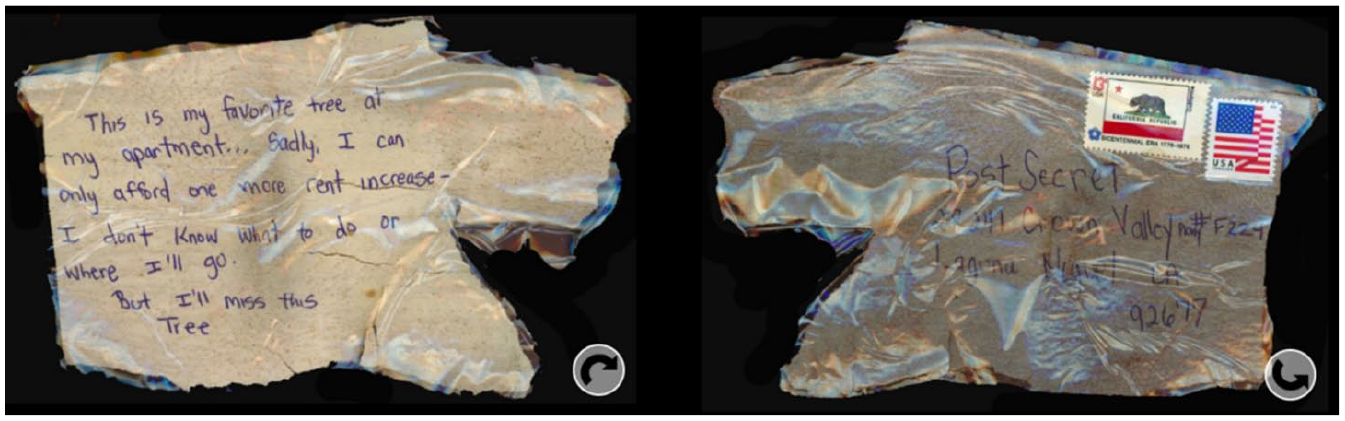
PostSecret postcard made from laminated tree bark.
Of course, trees are not the only more-than-human actors involved in affective flows with humans. Laptops (Kolehmainen, 2022), cigarettes (Méndez de la Brena, 2022) and place itself (Bawaka et al., 2016) are all agents, as shown in the QtM submission referencing ‘gay hill’. This geotag is part of a cluster of queer experiences that have happened around this location. By function of its design, which mandates a geotagged pin to make a post, QtM integrates place as a more-than-human actor in all the relationships and intimacies being documented. This act expands the corpus of more-than-human actors considered as agents in public intimacy, from the tangible and finite, like a tree, to the more rhizomatic place.
Distant publics create a normative assumption of intimacy as heterosexual, monogamous, feminine and private, all of which also assume intimacy to be exclusively human. Intimacy between people, particularly heteronormative or family connections, is permitted by distant public norms, while the possibility of connection between more-than-human and human actors is overlooked. In this post, the user breaks down these limitations, asserting intimacy with more-than-human actors, such as trees or places. Although the intimacy between organic more-than-human actors is more directly acknowledged by users of ADIPs, inorganic more-than-human actors are also agents in the flows of intimacy.
The inorganic more-than-human actors of intimate publics
Organic more-than-human actors are integrated in the production of intimacy. Extending this, inorganic actors such as technology, and even circumstances such as anonymity, are actors which contribute to the assemblage network that produces intimacy.
I bought this Post card to send to my grandfather. I procrastinated and he died before I got around to it. I regret taking so long. I've kept this card and the secret since (8 years). I now release both.
PostSecret
Gays work here. You're safe.
Queering the Map
Dear Nettle, I just moved in three months ago and I’m very glad that I can talk to you through this system. I live in the first floor and I can actually see you through my window! I’m having trouble sleeping at night because of the noise of cars and ambulances at night, hope you’re not suffering that much and be able to have a good sleep. Thank you for blocking the noises from the street and wish the birds don’t do harm to you. Pleasant to meet you and have a nice day! Cheers!
City of Melbourne Tree Emails (Burin, 2018)
Intimacy is an assemblage of different actors, including known and unknown people and organic actors like the tree emails recipients. Just as concrete organic and inorganic more-than-human entities are actors in intimate connection, so too are abstract inorganic entities, like technology and anonymity.
In the above tree email, the author expresses that they are glad to have the email system to connect with the tree. Their conversation begins without words, with the tree ‘blocking the noises from the street’ and the author hoping that it isn’t negatively impacted by ambulances or trees. There is a shared presence and affective flow between these two actors that already exists, but is brought into sharper focus when mediated by the email system. This inorganic technological actor allows the author to communicate in a familiar-to-them way, down to the email-style sign-off of ‘Cheers!’. It opens a forum for the author to put into words their feelings of gratitude to the tree, and in doing so makes them material and concrete. Rather than technology becoming a barrier to intimacy or creating only shallow modes of interaction, it is used here as a device for reflection and reaffirmation of more-than-human intimacy and gratitude. What might have been a tenuous connection becomes more solid for being documented.
In the PostSecret postcard (Figure 3), anonymity does not remove intimate connection. Indeed, this user was able to divulge a vulnerable confession that they had held for ‘8 years’ because the structure of anonymity relieved their shame and allowed them to connect intimately with the PostSecret audience. The postcard author describes both mailing the postcard and confessing their secret as a ‘release’ from the anguish caused by stigma. Anonymity sets ADIPs apart from other digital intimate publics, by making intimate connections more tenuous and freeing users to make confessions that they otherwise might not (Larsen-Ledet and Rossitto, 2023: 5). Anonymity becomes an enabling factor in connection, not something that makes a connection superficial, and exists as an actor that intercepts and changes the affective flows of this intimate exchange, giving the poster the confidence and freedom to confess without fear of shame.

PostSecret postcard from Huntington Beach, Surf City, California, U.S.A.
Anonymity facilitates contribution for the author of the QtM post. Geotagged to a corporate building in the central business district, this post reassures readers that they are not alone in their queerness. Because of the anonymity of the site, the user can proclaim their existence without jeopardising their safety or privacy. Further, because this post is anonymous and the poster is unidentifiable, they can take on the form of any coworker or businessperson seen by the reader. Anonymity allows the poster to be both wholly unidentified yet simultaneously imposed onto everyone, simultaneously everywhere and permeating into a range of public contexts, amplifying their impact. As such, anonymity becomes an enabling rather than constraining force, projecting rather than silencing.
Because anonymity is a conceptual factor that demonstrably changes the communication and connection of digital intimate publics, it becomes one of the more-than-human actors that contributes to the assemblage production of intimacy. The construct of anonymity, already blurred and variable in ADIPs, changes and shifts with every post’s interaction with it. Anonymity influences which posts are made, such as permitting someone to confess something they may be too ashamed to confide in friends or family. In turn, posts on ADIPs contain clues, like locations, names, photographs, handwriting or narratives, which alter the state of anonymity and create an affective zone which is functionally anonymous, but constantly gestures to the risk – and thrill – of discovery. With every post toying with the fluid nature of anonymity, the nature of anonymity itself as a construct is altered. Thus, ADIP prosumers create a symbiotic relationship between themselves and the abstract, inorganic, more-than-human actor of anonymity. Rather than limiting consideration of more-than-human actors to simply the concrete, pushing the conceptualisation of actors in intimate assemblages into the abstract opens new ways of understanding intimate flows.
Imagined audiences
Imagination is mobilised in ADIPs to create a sense of audience because the structure of the platforms erases typical audience indicators such as likes, replies or follower counts. This imagined audience is not unique to ADIPs and instead flows seamlessly between analogue, technological and imagined realms with the same recognition. All these worlds are real, tangible and affective, and digital intimate publics demonstrate the commonalities and conversation between these worlds. For example, this post from QtM creates a network between analogue and digital intimate publics that highlights the integration of an imagined audience:
The Lesbian Loo/Dyke Dunny in the [university campus library]? Covered in graffiti, it was one of the most affirming spaces I knew in my first year at uni (2000). I wonder if it's still there, but now I'm a man and I live on the other side of the world, so I can't check.
Queering the Map
I don't feel the need to meet my biological mother. But I don't hate her. <3 I want my biological mother to know that she made a good choice for me. I'm very happy.
PostSecret
Dear Syzygium Lilly-Pilly, This is not a report on your wellbeing, in case someone reading this is looking for issues they need to fix. This is simply a letter to a tree, because I would like someone new to talk to, a stranger, and what better stranger to pick than a tree who lives across the world? [. . .] Sincerely, a friend
City of Melbourne Tree Emails (Burin, 2018)
The graffiti recounted in the above QtM post is anonymous and resists typical networked or face-to-face conventions such as the ability to reply to a statement, or a concrete knowledge of the time that a statement is made. The post serves two purposes. Firstly, those who attend this campus are made aware of this bathroom graffiti and can now contribute to the anonymous analogue intimate public of the bathroom stall, joining the established community. Secondly, users of the QtM platform who read the post, even if they cannot attend the campus, can through the narrative of the post imagine this place of solidarity and empathetically connect with it, without ever attending the location physically or reading the graffiti themselves. The graffiti of the bathroom was never private, but contravened the conventions of the space and asserted the publicness of the most private spaces and their capacity to foster affirmation and solidarity, especially for queer students who may otherwise have felt isolated. The QtM post amplifies this contravention of public space, globalising the bathroom graffiti not in written content but in affective resonance, and inviting others to join an imagined community that publicly engages in the intimacy of solidarity and support.
Affective resonances are also made global and imagined on PostSecret. The above postcard (Figure 4) is addressed to the author’s biological mother, who they have never met, yet it is intended for the imagined audience of PostSecret. Although the author ‘want[s their] biological mother to know’ that they are at peace, the sentiments in this postcard will likely never reach their subject. Instead, this postcard may impact unknown and anonymous PostSecret users who are adopted children experiencing similar emotional paradoxes, or bio-parents who are grappling with the imagined feelings of their adopted bio-children. The postcard performs an address to a concrete, known audience, but functions in the world of the imagined.
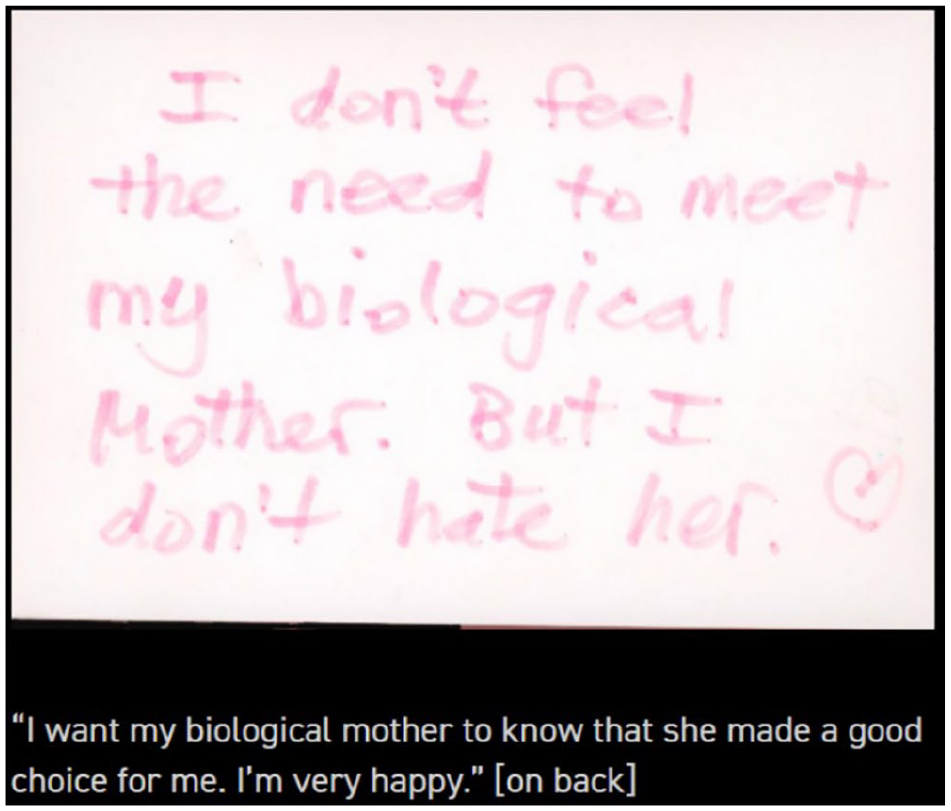
PostSecret postcard written in pink marker.
The anonymised prosumers of PostSecret create affective flows between unknown postcard authors and imagined readers, all human. Yet the tree emails draw the imaginative act further, to include more-than-human actors. The author ‘would like someone new to talk to, a stranger’, and directs this desire to the tree. They are seeking comfort, visibility and connection and has found that not only does the tree meet their needs, but it does so in a way that is not less-than-human, but stands on its own qualities. The author rhetorically asks ‘what better stranger to pick than a tree who lives across the world?’. Rather than personifying the tree, it is allowed to exist as its own entity, with its own agency and value separate from humanness. Its unfamiliarity, non-humanness and distance from the author become enabling, rather than constraining forces for intimate connection.
The intimate public community of ADIPs necessitates an act of imagination. Because users cannot reply or otherwise interact with posts, there is no way to confirm that the emotions of the poster are shared by the audience. Imagination must be used to anticipate the future readers of a post and also to anticipate their emotions to facilitate the sense of shared affect that binds intimate publics. However, this imagination is not unreal or intangible. Artificial divisions between real and imagined are collapsed, as even imagined affective connections have real impact on users and their sense of belonging and connection (Jaidka et al., 2022; Kolehmainen, 2022: 69; Larsen-Ledet and Rossitto, 2023; Lindgren and Richardson, 2023). As such, the act of imagining the audience of ADIPs creates real-world impacts on the poster, and their faithful act of imagination extends their affective flow into the future and creates intimate flows which touch the lives of those who are anticipated, and actual.
Conclusion
This research has extended the research of Kirby et al. (2021) from QtM to also include PostSecret and the City of Melbourne’s tree email program. In doing so, the research has established a new category of networked/intimate public, called Anonymous Digital Intimate Publics or ADIPs. Expanding research to include multiple case studies offers new depth of understanding to digital intimate publics, and in particular affirms that multiple similar sites are being created and used, calling attention to the widespread, repeated expressions of public intimacy in anonymous digital settings. Intimate publics mediated by digital technology create global, more-than-human connections which broaden the types of publicness that are intimately connected and connective. They demonstrate the vitality of community connection even in anonymous and imagined contexts and the repeated drive across platforms to build affective networks.
The findings focus on two predominant themes, the dissolution of the artificial boundaries between public and private, and the capacity for digital intimate publics to persist through anonymity and increasingly tenuous and imagined links between members of the intimate public. This research finds that digital intimate publics stitch together multiple simultaneous realities, including those conventionally deemed public and private, by declaring conventionally private, emotional or intimate expressions on a global stage.
Furthermore, ADIPs embrace more-than-human actors, like trees or digital technology, as actors in the intimate relationships built through these platforms. Pushing the boundaries of actors included in intimacy further, this research demonstrates that inorganic more-than-human actors, in the form of the concept of anonymity, play an active exchange of intimacy with the prosumer poster of the ADIP sites. The ephemeral nature of these publics does not render them intangible, instead, users connect affectively through a number of posts, both vague and highly specific, united by the expression of public intimacy in the face of distant conventions. Importantly, imagination is foundational to ADIPs, and good faith holds together and sustains the intimacy on these platforms in a creative, not destructive, way. This study of QtM, PostSecret and the City of Melbourne tree emails affirms that even in the digital age, communication and connection seek to build public intimacy and community solidarity.
Footnotes
Data availability statement

Funding
The author(s) received no financial support for the research, authorship and/or publication of this article.
Ethical considerations
Informed consent for information published in this article was not obtained because website source material was already anonymised and/or de-identified.
Consent to participate
Not applicable.
Consent for publication
Not applicable.