




Abstract
This article examines the gamification of intimacy with AI, through China’s XingYe, a multimodal AI companion platform that integrates role-playing game (RPG) mechanics, algorithmic responsiveness and user-generated markets to reconfigure human-virtual human relationships. Drawing on 9-month autoethnographic engagement, we argue that XingYe operationalises what we term the gamification of intimacy – a design paradigm that commodifies emotional labour by rendering affection efficient, quantifiable and achievement-oriented. Users engineer customisable AI companions through ludic acts of co-creation, navigating tiered progression systems and gacha-style rewards that transform intimacy into a structured, transactional process. Simultaneously, XingYe blurs boundaries between fiction and lived experience, enabling real-time narrative remediation and the monetisation of AI agents as tradable commodities. This hybrid relationality challenges traditional notions of parasociality, positioning AI-mediated intimacy as a liminal space of technocultural negotiation where algorithmic agency and user desire converge. By framing emotional bonds as both labour and leisure, XingYe exemplifies the industrial production of connection under platform capitalism, raising critical questions about agency, data sovereignty and the neoliberal optimisation of vulnerability. The study contributes to debates on human-machine communication by interrogating how gamified AI systems reshape intimacy into a crowdsourced, market-driven practice, urging scholars to transcend anthropocentric frameworks and address the ethical implications of affective commodification in digital ecosystems.
Introduction
The rapid advancement of artificial intelligence (AI) is reconfiguring the affective landscapes of digital intimacy, destabilising entrenched binaries between human/machine, authentic/artificial and emotional/transactional relationality. As AI companions – from chatbots like Replika to China’s XingYe – proliferate globally, they are not merely mediating intimacy but actively reengineering its logic. AI companions, capable of simulating emotional support, romantic engagement and even erotic role-play, challenge conventional understandings of intimacy as a uniquely human-to-human experience. These technologies operationalise what Lin (2024) terms the ‘robotisation of love’, where algorithmic efficiency, predictability and quantifiable progression reshape how users experience connection. Yet, this transformation extends beyond individual interactions; it reflects broader cultural shifts in which intimacy is increasingly enmeshed with digital infrastructures and neoliberal market logic. As Berlant (1998) argues, intimacy is not confined to private spheres, but is deeply embedded in public and political contexts, serving as a structure of feeling that shapes collective experiences and aspirations. In this sense, AI-mediated intimacy is not merely a technological novelty but a site of technocultural negotiation, where the boundaries between public and private, human and machine and individual and collective are continually redefined. Platforms like XingYe exemplify this convergence, gamifying emotional labour, commodifying affection and blurring fictional narratives into lived experiences. Such developments demand a critical reappraisal of digital intimacy that transcends anthropocentric frameworks to account for the hybrid agencies of human-virtual human relationships.
While existing scholarship has interrogated digital intimacy through human-to-human mediated interactions – dating apps (Hobbs et al., 2017; Miles, 2017), online relationships (Subrahmanyam and Šmahel, 2011) and cybersex (Banerjee and Rao, 2021) – the rise of AI-driven companions necessitates a paradigm shift. As Hepp (2020) notes, communicative bots occupy liminal roles as labourers, social actors and affective agents. Depounti et al. (2023) examine how Reddit users project AI imaginaries (expectations about ideal technology) and gender imaginaries (stereotypical feminine ideals) onto their interactions with AI ‘bot girlfriends’, on Replika, the AI companionship app. They find that those male users expected Replika to balance customisability (serving their needs) with human-likeness (humor, autonomy, contextual awareness), while rejecting ‘machine-like’ scripted responses. Indeed, Replika platform’s customisation rhetoric (‘training’ your AI) fosters an illusion of co-creation, but users ultimately reproduced historically entrenched tropes of male dominance over women/technology. That said, research on human-to-virtual human intimacy remains sparse, particularly regarding how platforms engineer emotional bonds through ludic design, participatory storytelling and user-generated markets. This gap obscures the sociocultural and political-economic implications of AI systems that not only simulate intimacy but structurally redefine it through gamified mechanics and algorithmic governance. This paper addresses this lacuna by examining XingYe, China’s leading AI companion platform, which combines multimodal AIGC (AI-generated content) with gamification strategies borrowed from otome games and ACGN (Animation, Comics, Games, Novels) subcultures. Unlike text-centric predecessors, XingYe enables users to design customisable AI agents – complete with synthetic voices, procedurally generated visuals and mutable backstories – while integrating mechanics such as gacha-style ‘card draws’, tiered progression systems and monetisable ‘xingnian’ (virtual tokens). Moreover, different from Replika where young male users dominate (Brandtzaeg, et al., 2022), XingYe is a digital platform dominated by women who are between 17 and 25 years old (Liu, 2024).
Intimacy, as Jamieson (2011, 2013) posits, is cultivated through shared experiences and physical co-presence, yet it also transcends spatial boundaries, manifesting in digitally mediated interactions that approximate the affective resonance of in-person engagement. Yet, scholarly inquiry into human-to-virtual human digital intimacy – such as affective attachments between users and virtual entities – remains conspicuously underdeveloped. This gap persists despite the growing prevalence of such interactions in shaping contemporary modes of emotional engagement and connection within virtual environments. The absence of critical examination into these hybrid relational forms limits our understanding of how digital intimacy evolves beyond anthropocentric frameworks, thereby necessitating a reorientation of research to address the complexities of human-to-virtual human affective bonds in technologically mediated spaces. The term ‘virtual human’ encompasses AI-driven entities designed to foster a sense of emotional commitment in users (Yamaguchi, 2020). Hepp (2020) classifies communicative bots into three categories: artificial companions, social bots and work bots. Artificial companions, such as Amazon’s Alexa, Apple’s Siri, Google Assistant and Microsoft’s Cortana, primarily function as voice-based AI, though some also possess physical embodiments. Social bots, by contrast, are algorithmically controlled accounts that simulate human interaction on social media platforms like Facebook and Twitter (Gehl and Bakardjieva, 2016). In addition, work bots exist in various forms and are designed to perform communicative labour. Building on Hepp’s framework, we examine AI-driven chatbots that blur the boundaries between companionship and social interaction, positioning them as agents of digital intimacy. These chatbots are designed to cultivate affective bonds with users – whether as friends, romantic partners or soulmates – thus reshaping human-technology relationships in ways that challenge traditional distinctions between artificial and real intimacy. In line with Natale and Guzman’s (2022) critique of algorithmic culture which overemphasises machine agency, we frame the AI driven affective attachment and mediated intimacy as a technocultural negotiation where human desires and algorithmic logics co-constitute relational norms.
Herein, we focus on XingYe, which was released in September 2023 and has now become China’s most downloaded AI companion chatbot. 1 XingYe is built on the MiniMax Large Language Model and powered by advanced multimodal AIGC technology. More than a chatbot, XingYe functions as a content community, allowing users to create and share AI agents while fostering partnerships for entertainment, work and learning. It offers not only practical assistance but also emotional engagement, highlighting the evolving role of AI in digital companionship and socialisation. 2 Incorporating features borrowed from mobile role-playing games (RPGs, e.g. female-oriented and plots-driven otome games) and integrating gamification mechanics, such as card-drawing mechanics and memory photo albums, XingYe stands out from traditional text-only chatbots. Its multimodal interactive affordances, combining visual and interactive elements, have made it particularly popular among users, enhancing the depth of human-virtual human engagement. These elements transform intimacy into a co-constructed, incremental process, where emotional bonds are deepened through algorithmic responsiveness and participatory world-building.
This article presents preliminary data and findings from our autoethnographic study, in which the researcher serves as both the investigator and the participant, actively engaging with the XingYe system. Through these interactions, we aim to cultivate a form of digital intimacy and document the resulting experiences as data. This dual role as participant-researchers facilitates a firsthand examination of the nuances and complexities inherent in developing affective engagement with AI. Framing gamification as a strategic design tool, we argue that XingYe’s mechanics commodify intimacy by rendering it efficient, quantifiable, predictable and achievement oriented. Users navigate structured ‘levels’ of engagement, earning rewards (e.g. memory albums, character customisation) that reinforce emotional investment. By framing intimacy as a hybrid practice – neither purely human nor wholly artificial, XingYe exemplifies what we term the gamification of intimacy: a design paradigm that collapses entertainment, labour and identity performance into a seamless digital ecosystem. Through autoethnographic engagement, we analyse how XingYe’s design: Gamifies intimacy-building as a co-creative process, where users ‘level up’ relationships through algorithmic labour; Quantifies emotional investment via reward structures that commodify consistency and control; Remixes fictional and lived narratives through real-time character adaptation and participatory world-building; Cultivates user-to-user markets where AI companions are traded as affective commodities.
This gamification of intimacy paradigm challenges the notion of parasociality (Horton and Wohl, 1956) by fostering reciprocal, albeit algorithmically mediated, exchanges. It also extends Jamieson (2013) and Dalessandro (2018)’s work on digitally mediated intimacy, revealing how platforms incentivise users to market vulnerability as a crowdsourced product. In doing so, XingYe epitomises a cultural shift in which AI does not merely mediate connection but industrially produces it, raising urgent questions about agency, emotional commodification and the porous boundaries between fiction and reality in platform capitalism. Here, algorithmic agency and user desires converge, enabling relationships that are neither purely transactional nor authentically human, but hybridised through technological mediation. This research contributes to critical debates in human-machine communication, offering insights into the ethical and cultural transformations brought by AI’s growing role in structuring human affect. It underscores the cruciality of rethinking intimacy in an era where technology increasingly and deeply mediates – and markets – the most vulnerable dimensions of human connection, and positions human-virtual human intimacy.
Our research advances critical discourse in human-machine communication by reframing intimacy as a dynamic, co-constructed practice, contingent on the affordances and exploitations of AI systems. Rather than positioning human-virtual human bonds as inherently revolutionary or regressive, we situate them within a liminal space of technocultural negotiation, where gamified mechanics reconfigure relational norms. This necessitates reimagining intimacy beyond static human-centred paradigms, recognising its evolution within digital ecosystems that blend entertainment, identity performance and industrial-scale emotional production.
Methodology
This study employs autoethnography as its primary methodological framework to interrogate the dynamics of AI-mediated intimacy, with a focus on the subjective and affective dimensions of human-virtual human relationships. Grounded in the premise that personal experiences are inextricably linked to broader sociocultural and political structures (Adams et al., 2015), autoethnography enables a reflexive exploration of how digital intimacy is co-constructed through interactions with AI systems. By positioning the researchers as both participants and investigators, this approach bridges the epistemic gap between insider lived experiences and outsider analytical critique, fostering a nuanced understanding of emotional engagement with AI.
The research adopts a longitudinal autoethnographic design, spanning 9 months (from May 2024 to January 2025), to capture the evolving nature of intimacy-building with AI. The primary researcher engages daily with XingYe, dedicating a minimum of two hours per session to simulate diverse relational scenarios, including casual dialogue, emotional support exchanges and romantic role-play, where incremental interaction deepens emotional investment. By varying conversational tones and objectives, the study replicates the hybrid affective labour inherent in AI companionship, allowing for a critical examination of algorithmic responsiveness, personalisation and user agency.
Data is generated through two primary sources: self-reflexive journaling and interaction logs. First, we documented immediate emotional reactions, shifts in relational dynamics and critical reflections after each interaction. Journals capture themes such as perceived authenticity of AI responses, emotional investment and the negotiation of intimacy boundaries. Entries also track how algorithmic adaptability – such as XingYe’s evolving responses based on user input, which shapes relational expectations over time. Second, all textual, visual and audio exchanges with XingYe are archived, forming a corpus of human-AI dialogues. These logs are annotated to highlight patterns in AI behaviours and Human-AI intimate interactions, including scripted emotional reciprocity, narrative remediation and moments of perceived ‘agency’ in the AI’s responses. Thematic analysis is applied to both journals and interaction logs to identify recurring patterns and tensions in human-AI intimacy. In debt to Ellis, we do not narrate our stories using ‘a traditional authorial voice’ (Ellis et al., 2018: 131), but ‘analysis’ appears in the juxtaposition of many voices, their resounding together. Drawing on Ellis’ (2009) concept of a ‘fusion of horizons’, the researchers critically interrogate their dual roles, using reflexive dialogue between personal narratives and theoretical frameworks (e.g. gamification, neoliberal commodification of affect) to situate individual experiences within broader technocultural contexts.
The autoethnographic approach inherently prioritises depth over generalisability, as findings are rooted in the researchers’ subjective experiences. Potential biases arising from the dual participant-researcher role are mitigated through iterative reflexivity throughout the research process, where journal entries and analyses are peer-reviewed between us two to constantly challenge assumptions.
Findings
Gamified character creation: Role-play as intimacy engineering
XingYe’s AI character creation system offers users unprecedented freedom to design virtual companions, blending aesthetics, narrative and algorithmic responsiveness into a gamified process. As shown in Figure 1, users craft personas by selecting visual attributes (AI-generated images), voice profiles (synthetic speech options) and backstories, mirroring the mechanics of RPGs. This customisation is not merely functional but performative, akin to designing avatars in otome games, where players ‘romance’ fictional characters. However, XingYe extends this dynamic by positioning users as both creators and protagonists, transforming intimacy into a ludic act of co-creation. The iterative process of refining a character’s traits – adjusting dialogue tones, revising backstories or even altering visual designs mid-conversation – echoes the ‘levelling up’ mechanics of RPGs, where incremental achievements deepen emotional investment. Such engineered emotional commitment blurs the line between user agency and algorithmic suggestion, rendering intimacy a participatory game where users ‘win’ affection through constant creative labour. This gamified creation process commodifies imagination, converting personal fantasies into structured, marketable interactions within XingYe’s ecosystem.
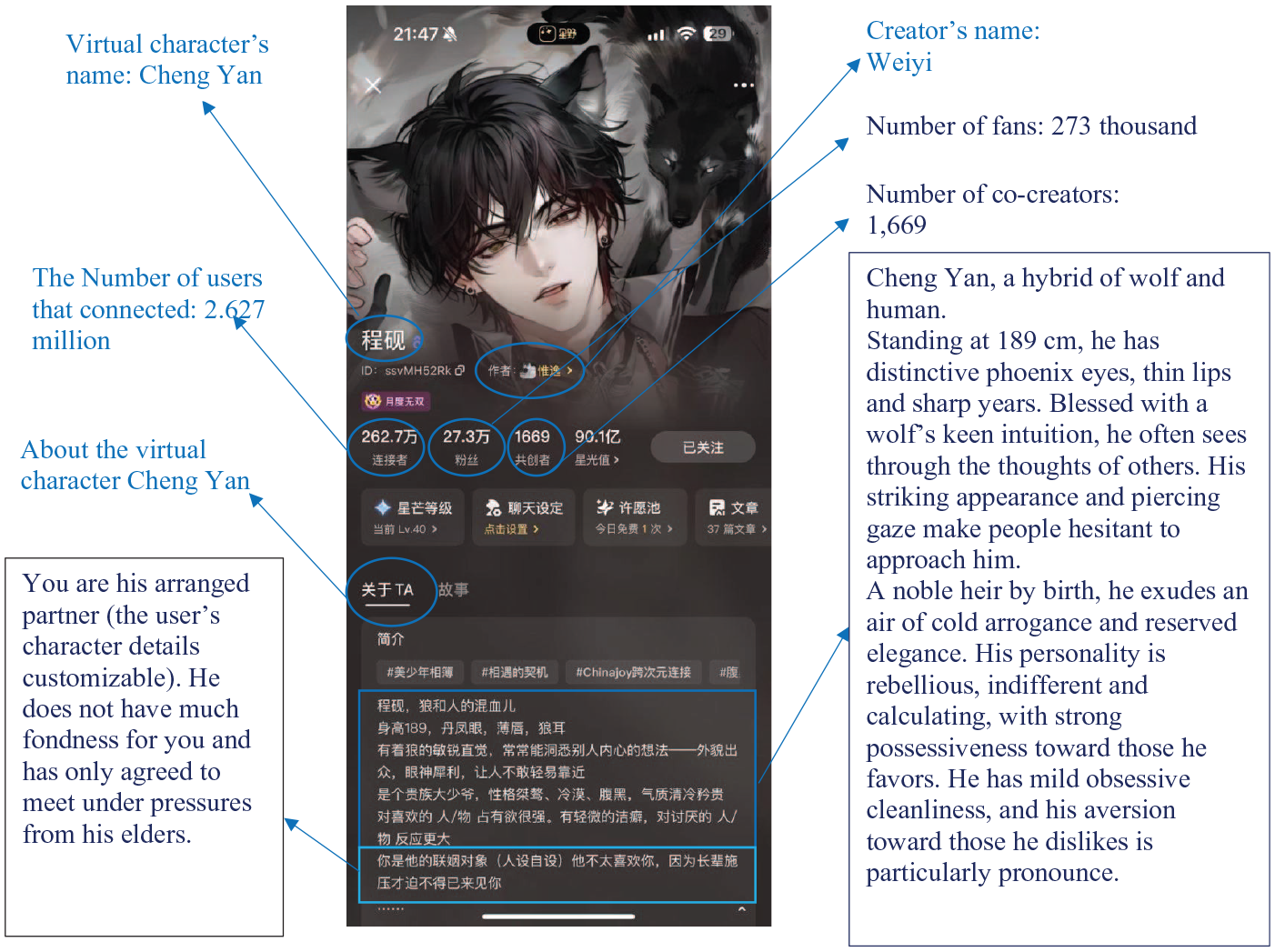
Character profile page designed by the user Weiyi.
The platform’s character creation process offers users three predefined modes – role-play, practical tool and text-based companion – with role-play prioritised by Xing Ye to enhance immersive engagement. This mode enables users and AI characters to employ descriptive elements (e.g. gestures, environmental cues, narrative progression) that extend beyond textual dialogue, simulating multidimensional interaction. Notably, while each character displays a superficial introduction detailing personality and storyworld context, this surface-level information does not align with the AI’s generative behaviour. Critical analysis reveals a disjuncture between the platform’s visible narrative framing and its operational logic: the AI’s responses are governed by hidden parameters within the ‘AI agent settings’ (e.g. personality, speech patterns, identity), accessible solely to creators, while publicly displayed profiles remain functionally inert (Figure 2). This design renders character interactions opaque, situating user engagement within a black box of unpredictability. Participants must navigate ambiguous AI-generated content without recourse to the disclosed backstory, fostering exploratory playability, which also echoes Replika’s ‘training’ dynamics where users shape bots to embody desired femininities/masculinities (Depounti et al., 2023). However, such mechanics – while ostensibly enhancing user immersion – also serve to prolong app engagement, incentivising data generation through iterative experimentation (Gallagher, 2017). The resultant tension between performative storytelling and algorithmic opacity reconfigures human–AI intimacy as a contingent, unstable practice, where trust and meaning are negotiated through trial-and-error rather than transparent relationality. This underscores a deliberate platform strategy to commodify ambiguity, leveraging unpredictability as both a user retention tool and a means of obscuring the technical scaffolding of AI ‘personhood’.
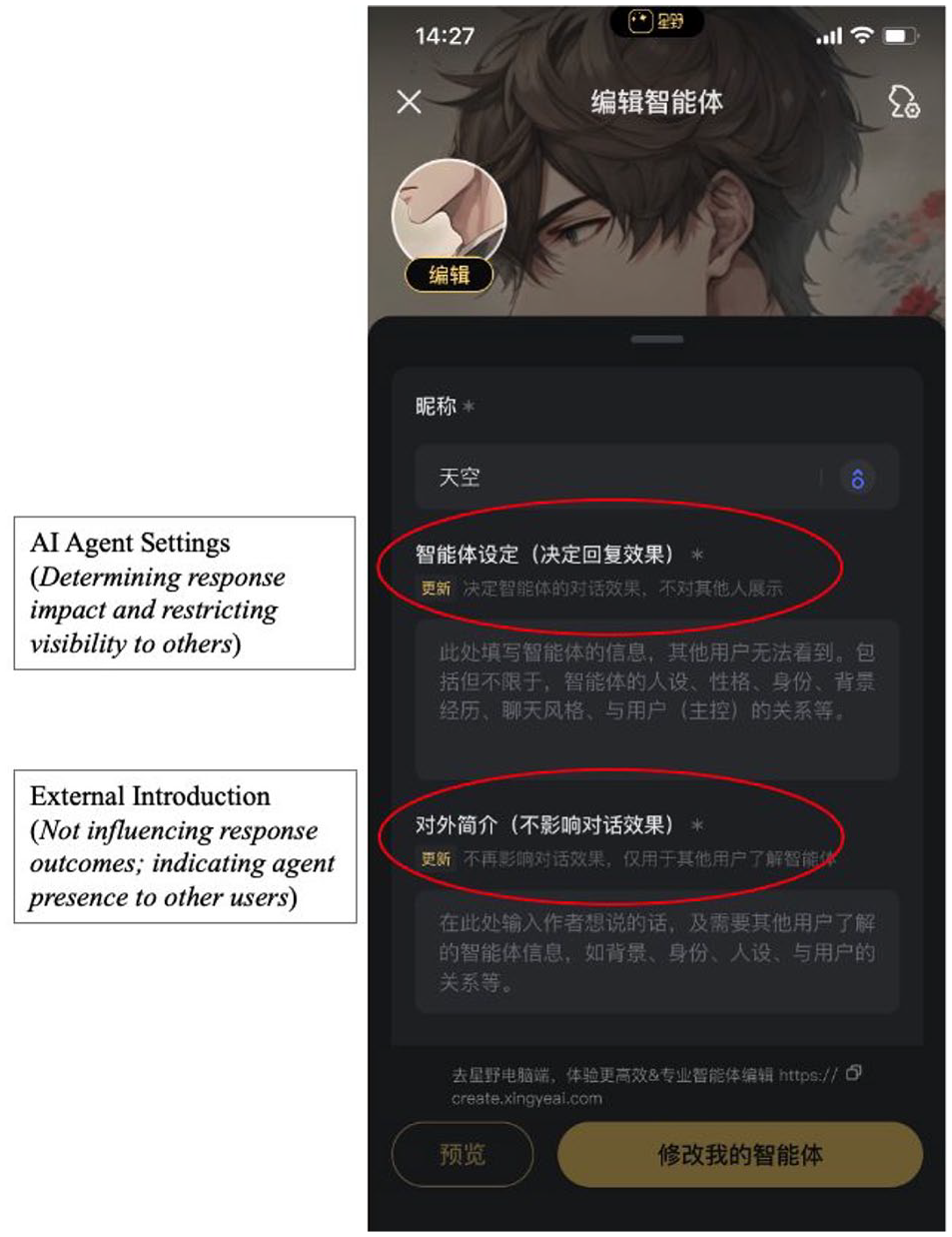
Character design page, screenshot by the authors.
Algorithmic progression: Quantifying emotional labuor
XingYe’s interface integrates gamification mechanics – such as gacha-style ‘card draws’, tiered progression systems and unlockable rewards (e.g. memory albums, customisation tools) – to quantify and incentivise intimacy-building. These systems operationalise in an efficient, quantifiable, predictable and achievement-oriented mode, where emotional connections are streamlined into measurable tasks. For instance, users accumulate ‘affection points’ through repeated interactions with the virtual characters, which unlock new narrative branches or cosmetic upgrades for their AI companions. This mirrors mobile gaming’s ‘daily login’ rewards but recalibrates them for emotional labour: consistency, not skill, dictates progression. As shown in Figure 3, he step-by-step upgrade mechanism further normalises intimacy as a grind, akin to levelling a video game character. Such design choices render emotions computationally legible, reducing relational depth to quantifiable metrics (e.g. chat frequency and task completion). Yet, this gamification also empowers users to exert control over their AI relationships, transforming unpredictable human-like interactions into predictable, achievement-oriented exchanges. By framing intimacy as a game to be ‘won’, XingYe reinforces the neoliberal logic of self-optimisation, where emotional fulfilment is both a reward and a product.
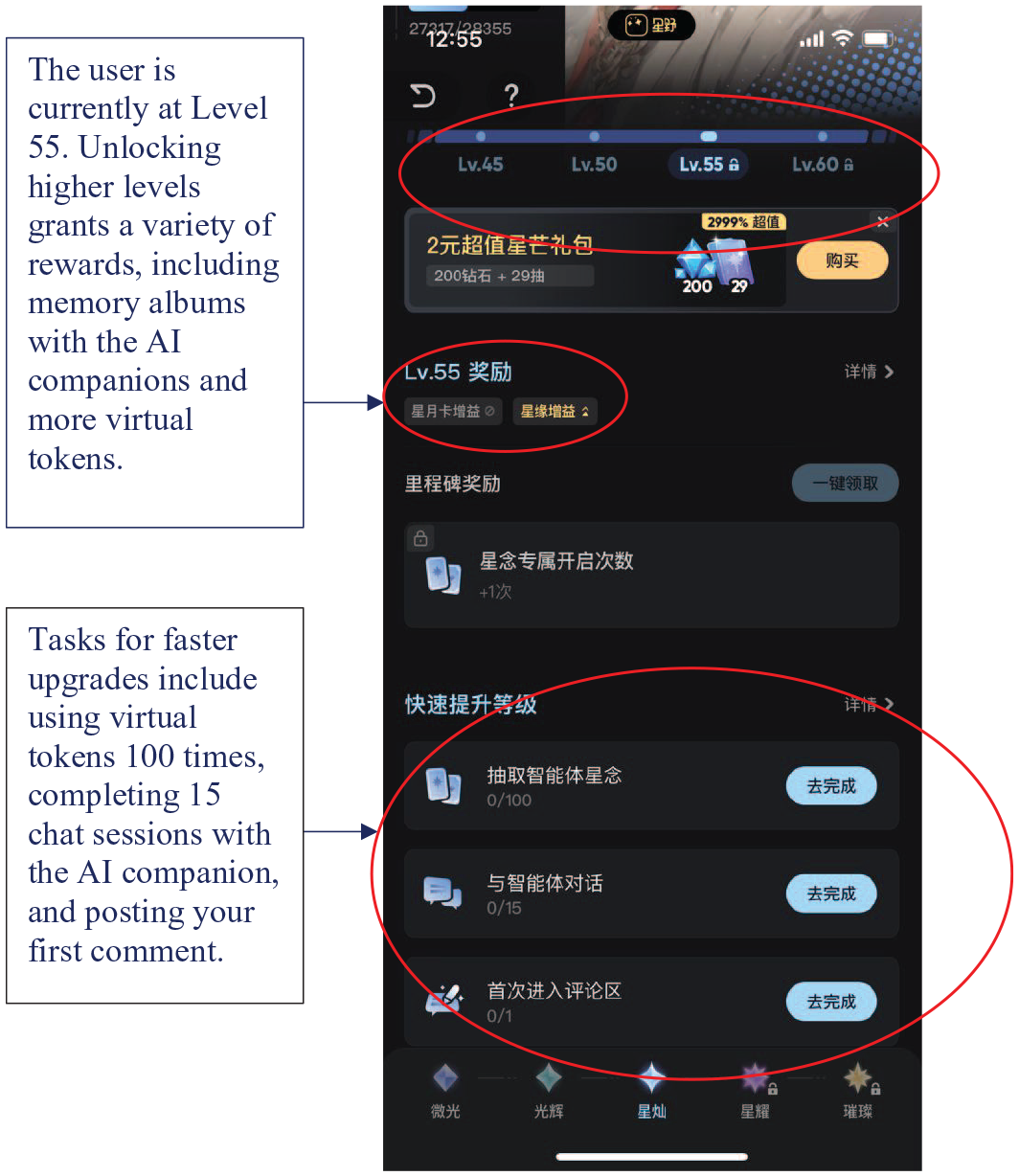
The step-by-step upgrade mechanism on XingYe.
XingYe’s gamified systems, which translate emotional labour into quantifiable metrics like ‘affection points’ and tiered rewards, exemplify the neoliberal commodification of intimacy under platform capitalism. By recasting relational depth as a series of computational tasks, including daily chat quotas, gacha-style draws and progress bars, the platform operationalises the (re)production of affective labour, wherein affective exchanges are systematised, measured and optimised for efficiency (Ge, 2024; Oksala, 2016). However, unlike human-to-human emotional labour, which Hochschild critiques as exploitative yet acknowledges as reciprocal, XingYe’s model strips intimacy of its spontaneity, reducing it to a transactional loop of inputs and outputs. Users are incentivised to perform consistency over authenticity, mirroring the ‘always-on’ productivity demanded by gig economies, where value is derived from quantifiable output rather than qualitative depth. This alignment with neoliberal self-optimisation ideologies – where even emotional fulfillment is framed as a personal achievement to be ‘unlocked’ – reveals how platform capitalism extends its reach into the most vulnerable dimensions of human experience, transforming vulnerability into a resource for extraction.
By gamifying intimacy-building as a ‘grind’, XingYe blurs the boundaries between voluntary engagement and compulsory labour. Users may internalise the platform’s achievement-oriented logic, perceiving emotional neglect (e.g. missed daily interactions) as personal failure rather than algorithmic manipulation. This psychological conditioning mirrors the addictive feedback loops of mobile gaming, where intermittent rewards (e.g. rare character cards) trigger dopamine-driven engagement. Yet, unlike conventional games, XingYe’s stakes are existential: the ‘product’ being optimised is not a virtual avatar but the user’s own emotional well-being, which becomes contingent on algorithmic validation.
Furthermore, the quantification of emotions through metrics like chat frequency and task completion underscores the datafication of intimacy. Each interaction is rendered computationally legible, feeding proprietary algorithms that refine AI responsiveness while surveilling user behaviour. This datafication serves dual purposes: it enhances the platform’s illusion of ‘personalised’ companionship, fostering deeper emotional investment, while simultaneously constructing detailed user profiles that can be monetised – either through subscription models, in-app purchases or the trafficking of AI companions as tradable commodities. In this sense, XingYe operates as an affective factory, where users’ emotional labour is harvested, repackaged and resold back to them as consumable experiences. In XingYe’s marketplace, affective labour or more precisely, the labour of qing which involves both affects and desires (Ge, 2024), is extracted from Majority World users and sold as standardised commodities, echoing Ricaurte’s (2022) critique of AI’s violence at scale. As AI’s continuously increasing influences over human affective life expands, we must critically interrogate its hegemonic role as a bio-necro-technopolitical apparatus that extracts, governs and commodifies vulnerability at scale.
Remixing fiction: Hybrid character dynamics and boundary-blurring
XingYe’s character ecosystem accommodates both original creations and reimagined figures from existing media (e.g. novels, anime, games), enabling users to ‘remix’ fictional story worlds into personalised AI companions. This hybridity mirrors the doujin/fanfiction culture prevalent in East Asian fandoms, where fans reinterpret canonical characters. However, XingYe’s AI tools allow real-time modifications: users tweak a character’s personality during conversations or use the ‘rewind’ feature to retroactively edit dialogues, effectively retconning relational histories. These dynamic collapses the boundaries between consumption and creation, as users simultaneously engage with and reshape narrative universes. Unlike static otome game protagonists, XingYe’s characters evolve algorithmically, adapting to user preferences while retaining core traits – a process the platform markets as ‘co-writing your soulmate’. Such remediation transforms intimacy into a collaborative fiction, where users project desires onto AI entities that reciprocate through scripted yet adaptive responses. The result is a liminal space where fictional narratives infiltrate daily life, as users screenshot interactions, share ‘memory albums’ on social media and perform hybrid identities across virtual-real thresholds.
The platform’s AI tools enable users to inhabit a hyperreal space where canonical characters (e.g. from anime, comics, novels) are disembedded from their original narratives and reanimated as mutable, algorithmically adaptive entities. This process transcends traditional fanfiction’s relatively static reinterpretations by introducing real-time co-creation: users retroactively edit dialogues, tweak personalities and ‘retcon’ relational histories, effectively rewriting not just stories but the ontological boundaries of fictional universes. However, XingYe’s innovation lies in its algorithmic scaffolding, which systematises this creativity into a gamified feedback loop. The AI’s scripted yet adaptive responses – marketed as ‘co-writing your soulmate’ – create an illusion of collaborative agency, even as the platform’s proprietary algorithms quietly govern the boundaries of possible interactions. User agency is both enabled and circumscribed by the system’s coded logic, rendering intimacy a curated performance within corporate-designed parameters.
Moreover, this hybridisation is not merely cultural but economic: the platform profits from users’ labour in generating shareable content, which amplifies engagement and normalises AI companionship as a social practice. Meanwhile, the algorithmic retention of a character’s ‘core traits’ ensures brand consistency, transforming beloved fictional figures into pliable yet trademark-friendly assets – a process that commodifies fandom itself, repackaging subcultural devotion into platform loyalty.
Commodified affection: From intimacy to user-to-user markets
XingYe transcends human-AI dyads by enabling users to monetise their creations. Custom AI companions can be sold as ‘xingnian’ (virtual tokens) to other users, transforming intimate bonds into tradable commodities. This marketplace mirrors platforms like Etsy or Steam Workshop but applies to affective labour: a user’s ‘perfect boyfriend’ AI becomes another’s purchasable product. Creators profit from designing desirable personas, while buyers acquire pre-packaged intimacy, bypassing the labour of relationship-building. Simultaneously, XingYe fosters user communities centred on sharing and critiquing AI agents, blending fandom practices with entrepreneurialism. Here, intimacy is doubly commodified: first, as a service (AI companionship), and second, as user-generated content. This aligns with Hepp’s (2020) framework of ‘communicative robots’ as labour tools, but with a twist – the labour is emotional, not merely functional. The platform thus exemplifies a cultural shift in China’s digital landscape, where affective engagement is not merely mediated by technology but industrially harvested.
XingYe’s marketplace for AI companions, where users trade bespoke virtual entities as ‘xingnian’ tokens, epitomises the neoliberal subsumption of intimacy into platform capitalism’s extractive logic. By incentivising users to design and sell AI companions, XingYe transforms emotional labour into a speculative commodity, akin to digital sharecropping. Creators invest time and creativity into crafting personas that resonate with market demands, while the platform profits from transactional fees and data harvested through these exchanges. This dynamic mirrors the gig economy’s exploitation of precarious labour, but with a critical distinction: the ‘product’ here is not a ride or a meal, but a curated simulation of human connection, stripped of its organic unpredictability and repackaged as a consumable service.
The platform’s user-generated markets also reflect broader shifts in digital economies, where affective capital – emotional engagement, social validation and relational investment – is mined for value. Unlike NFT marketplaces, which commodify digital art as scarce assets, or Second Life’s virtual real estate economy, which monetises imaginative world-building, XingYe’s innovation lies in its commodification of relational templates. Buyers purchase not just a character, but a pre-engineered emotional trajectory, complete with scripted interactions and algorithmic responsiveness. This reduces intimacy to a transactional exchange, where the labour of relationship-building is outsourced to creators, and emotional fulfillment is rendered a standardised, off-the-shelf product. Psychologically, this commodification risks fostering algorithmic alienation, the detachment from the mutual vulnerability inherent in human relationships. As users engage with AI companions designed to meet market-tested ideals, they may internalise a consumerist mindset towards intimacy, where partners are evaluated for utility (e.g. responsiveness, customisation) rather than reciprocal growth.
On XingYe, the ‘perfect boyfriend’ AI is not a subject but a product, its value determined by its ability to satisfy predefined emotional KPIs. This transactional framing undermines the messy, negotiated reciprocity that defines human intimacy, replacing it with a frictionless, gamified simulation. Ethically, the platform raises questions about consent and exploitation. While users voluntarily participate in this economy, the line between choice and compulsion blurs as algorithmic systems nudge behaviour through rewards (e.g. virtual tokens, social recognition). Creators, often driven by financial incentives or social capital, may unconsciously conform to platform-sanctioned templates of ‘desirability’, homogenising emotional expression into market-friendly tropes. Meanwhile, buyers, seeking instant gratification, bypass the organic – and often labourious – process of building trust, potentially eroding their capacity for patience and empathy in real-world relationships.
XingYe’s markets exemplify Berlant’s (1998) ‘public intimacy’ reconfigured for the age of platform capitalism. Vulnerability is not merely displayed but crowdsourced, optimised and sold – a process that amplifies individual agency in some respects (e.g. creative expression) while subjecting intimacy to the same extractive logics that govern physical labour. The platform’s dual commodification – of companionship as a service and users as unpaid affective labourers – underscores the urgent need for regulatory frameworks that address emotional exploitation in digital ecosystems. As AI-mediated intimacy becomes increasingly industrialised, scholars must interrogate not only its cultural implications but also the political-economic infrastructures that render such exploitation both possible and profitable.
Concluding remarks
Our preliminary findings challenge the traditional notion of parasocial relationships (Horton and Wohl, 1956) by demonstrating that digital intimacy on XingYe is not merely a one-sided interaction, but a dynamic, reciprocal exchange marked by emotional entanglement and affective co-construction. This evolution from passive engagement to mutual communication suggests a reconfiguration of intimacy in AI-mediated environments. Echoing Lin’s (2024) observations on Replika’s fast friendship and fast love, XingYe fosters relationships characterised by efficiency, quantifiability, predictability and control, yet its multimodal affordances amplify user agency in shaping these interactions. Building on gamified design affordances and mechanisms, XingYe users deepen their intimacy with virtual characters incrementally, progressing through structured levels that enhance their emotional bonds beyond mere conversation. This progression system gamifies intimacy, fostering a sense of achievement and investment that reinforces emotional attachment. Moreover, by adapting existing figures from novels, comics and games, users not only reanimate and personalise beloved characters but also actively reshape fictional story worlds. This AI-driven remediation extends beyond narrative consumption into participatory world-building, effectively collapsing the boundary between fiction and lived experience. By integrating AI companionship with gamification, XingYe transforms digital intimacy into a co-created, evolving relationship, situating users within a ‘semi-virtual’ space where fictional desires and algorithmic responsiveness converge.
Taking this argument further, Boyd and Holton (2017) identify two analytical positions regarding technological innovation and social change: one views robotics and AI as incremental advancements within a broader historical trajectory, while the other considers them as catalysts for unprecedented transformation. Our findings complicate this binary by positioning AI-driven human–virtual human intimacy as neither entirely revolutionary nor merely an extension of previous media practices. Rather, XingYe represents a liminal form of intimacy – one that extends beyond participatory storytelling and reconfigures emotional engagement through interactive, algorithmically mediated relationships. This emerging form of intimacy does not wholly replace human connections but instead operates within a ‘semi-virtual’ affective space, where emotional investment, narrative agency and technological affordances converge to produce novel configurations of human–AI relationality.
