



Abstract
While the volume of education-based video game research has increased, the field has yet to settle on a consistent definition of educational video games (EVGs). Available definitions of video games do not account for the nuances of games used within education and have not been developed for that purpose. Several systematic reviews and meta-analyses have concluded that the lack of standardized definition is critically hampering a cohesive approach to research in this area. This article begins by reviewing the current scholarship on video game definitions and then suggests a definition for EVGs to improve research outcomes in the field. Given that the major potential of video game use in education is to improve learning, we advocate that educational research scholarship needs to develop a common foundational approach to defining EVG and associated educational technologies. We hope that this definition will advance the field by suggesting a common language and operationalization of EVGs.
Introduction
“While I agree that fighting over a definition … can easily turn into an unproductive dispute, it often results in valuable scientific insights concerning the identity of the defined phenomenon in relation to other phenomena.” (Karhulahti, 2015, p. 7)
Video games are now an established part of popular culture, and are frequently used in educational settings worldwide. The commercial industry for educational video games (EVG) is growing, and a recent report indicated that teachers are increasingly using video games as a teaching tool (Drossel et al., 2017). A US study of secondary and middle school teachers reported that 74% of teachers use digital games in their classroom teaching (Takeuchi & Vaala, 2014), and 51% of Australian parents report that their children use video games in their curriculum and classroom learning (Brand et al., 2019). This growing popularity of video game use for education around the world can be attributed to the belief that video games can increase student engagement (Nash & Brady, 2022), can be used as rich multimodal narrative texts (Buckingham & Burn, 2007), and foster critical thinking and cognitive skills (Hubert-Wallander et al., 2010). Additionally, the use of video games within the classroom has coincided with a rise in educational adaptations of commercially successful video games such as Minecraft (Mojang Studios, 2011), Roblox (Roblox Corporation, 2019), and Assassin's Creed (Ubisoft Montreal, 2009).
But exactly what is a video game, or an educational video game? What separates video games used in an educational setting from applications, simulations, gamified teaching processes, or tutoring systems with game elements? Is a popular online quiz platform, like Kahoot (Kahoot ASA, 2013), a game or an application? If a science experiment is done in virtual reality, can this be classed as a game, or is it a simulation? Where is the line between a simulation and a game?
Defining EVGs is essential for refining the field of research, which currently spans a significant variety of topics. EVG research can include (but is not limited to) medical, military, and business learning applications, video games created specifically for classroom and learning use, incidental or specific learning from commercially available video games (both within and outside of classroom contexts), or the creation of video games for learning (Connolly et al., 2012). Within the sphere of EVG research, the term video game can be applied to simple games with textbook-like content delivery, designed to be used in short classroom interventions (Beavis et al., 2014), but is also being used to refer to long-form games that include engaging environments designed as immersive challenges to be taught over several weeks (Richards et al., 2013). The multitude of applications, software, hardware, and simulations that are currently collected under the term “educational video game” is a substantial challenge for the field of educational research. When researchers argue that EVGs are effective in promoting student learning, engagement, or critical thinking, it is not necessarily clear that these conclusions apply to all forms of EVGs, or which version of EVGs these conclusions apply to (Richards et al., 2013). An accurate definition of EVGs within the research field will allow for more effective application of research findings within classrooms, and more accurate and specific language for use in curriculum and education policy.
To address this problem, we can look at the history of video game definition. There is a rich history of debate surrounding the definition of “games,” both digital and non-digital, within game research (Arjoranta, 2019; Stenros, 2017; Tavinor, 2009a). Unfortunately, this debate is muted within education. In a report analysing the market potential for K-12 digital learning games, Richards et al. noted that: “… there has been little agreement between experts in the field about what falls under the category of ‘learning game’ and what is not a game, but has ‘game-like’ elements. Not surprisingly, the literature of games contains no agreed upon definition of a learning game.” (2013, p. 11)
In the same report, structured interviews were conducted with game developers, game publishers, university researchers, investors, and government education policy officials. It was noted that, across all 50 interview participants, there was no consensus about what could be considered an educational game (Richards et al., 2013).
To address the problem of defining EVGs, this article will briefly outline the differences between “real” and “nominal” definitions, and their influences on how we have produced our definition. We then discuss the scholarship of traditional, non-digital game definitions, their common features across time, and significant existing reviews of the research (Stenros, 2017). This leads to a review of prominent digital video game definitions (Tavinor, 2009a) and the theories surrounding them. We propose that while there have been many attempts to define exactly what a video game is, the field of research remains disparate and resistant to regulation or unification, due to research that does not speak to the wider context of the field (Stenros, 2017). Existing research around definitions of EVGs is then outlined, with reference to the limited existing consideration for definition within EVG research. The common features of all the reviewed definitional works are then combined, with new elements, into a new proposed definition for EVGs. This definition has three essential criteria for artefacts to be considered EVGs; they must have rules, outcomes influenced by player effort, and be used in an educational context to fulfil learning outcomes. Additionally, our definition includes three disjunctive criteria; it should have an element of fantasy or role-play, elements of conflict or challenge, and/or elements of interaction between players. The purpose of this definition is to advance the field of EVG research by proposing a common definition to be used, and to create an opportunity to ignite debate surrounding the definition in the field at the same time.
Useful Definitions
Definitions can serve a variety of functions and are used in a variety of contexts, for different reasons. While the philosophy of definition is a complex area of scholarship, for this article, the creation of a definition can be categorized as either “real” (sometimes referred to as “empirical”) or “nominal.” John Locke (1689) defined the “nominal” definition of a concept as the abstract idea that it represents, whereas the “real” definition of a concept is the literal constitution of the object being defined. In the case of video games, the “nominal” definition would refer to the cultural and social uses of the word video game and the concepts that it refers to in common usage. The “real” definition of video games would be more concerned with the essential qualities that separate a video game from other objects.
To define video games in educational practice, the “nominal” definition is less important than the “real,” practical definition. This is because we are looking to solve a functional problem that requires boundaries. In creating a definition of EVGs, we are specifically interested in the use of this definition within research, and the application of the definition in operationalizing what EVGs are. While the “nominal” definition is valuable in many other contexts, including the discussion of video games in the wider culture, for our purposes we need to focus on the boundaries of a “real” definition. To create a usable definition, philosophical tools like naming the “necessary” and “sufficient” conditions of an object or phenomenon allow a line to be drawn between what something is and is not. While the functions of definitions can vary, the ongoing debate of terms can be a valuable function in itself—the debate around definition often furthers the field of research and helps define the essential problems within it (Arjoranta, 2019).
What is a Game?
To understand the value of definition and game definitions, it is essential to acknowledge the influence of Wittgenstein and his concept of “familial relationships” (1968). The link between Wittgenstein and the definition of games is referenced widely in definitional writing about games, whether digital or traditional (Stenros, 2017). Wittgenstein proposes that there is not one common characteristic that would allow for a simple definition of a game. Instead, it is necessary to consider the similarities and connections between all things that are considered a game, such as entertainment, conflict, rules, and skills. While none of these elements are common to all games, they are instead a family of features that can overlap to create a picture of “game-ness.” Wittgenstein further asserts that definitions (particularly that of games) have boundaries that are flexible and constantly adapting to new uses and that this is a benefit of their use. While Wittgenstein was more concerned with how language functions in relation to the concept of games, rather than the actual definition of games themselves, Wittgenstein has become an almost universal reference in the academic discussion of games definition and is influential to all following definitions of the term (see e.g., Crawford, 1983; Stenros, 2017; Suits, 1967). The definitions of games, video games, and EVGs discussed in this article are summarized in Table 1.
A Summary of Game, Video Game, and Educational Video Game Definitions.
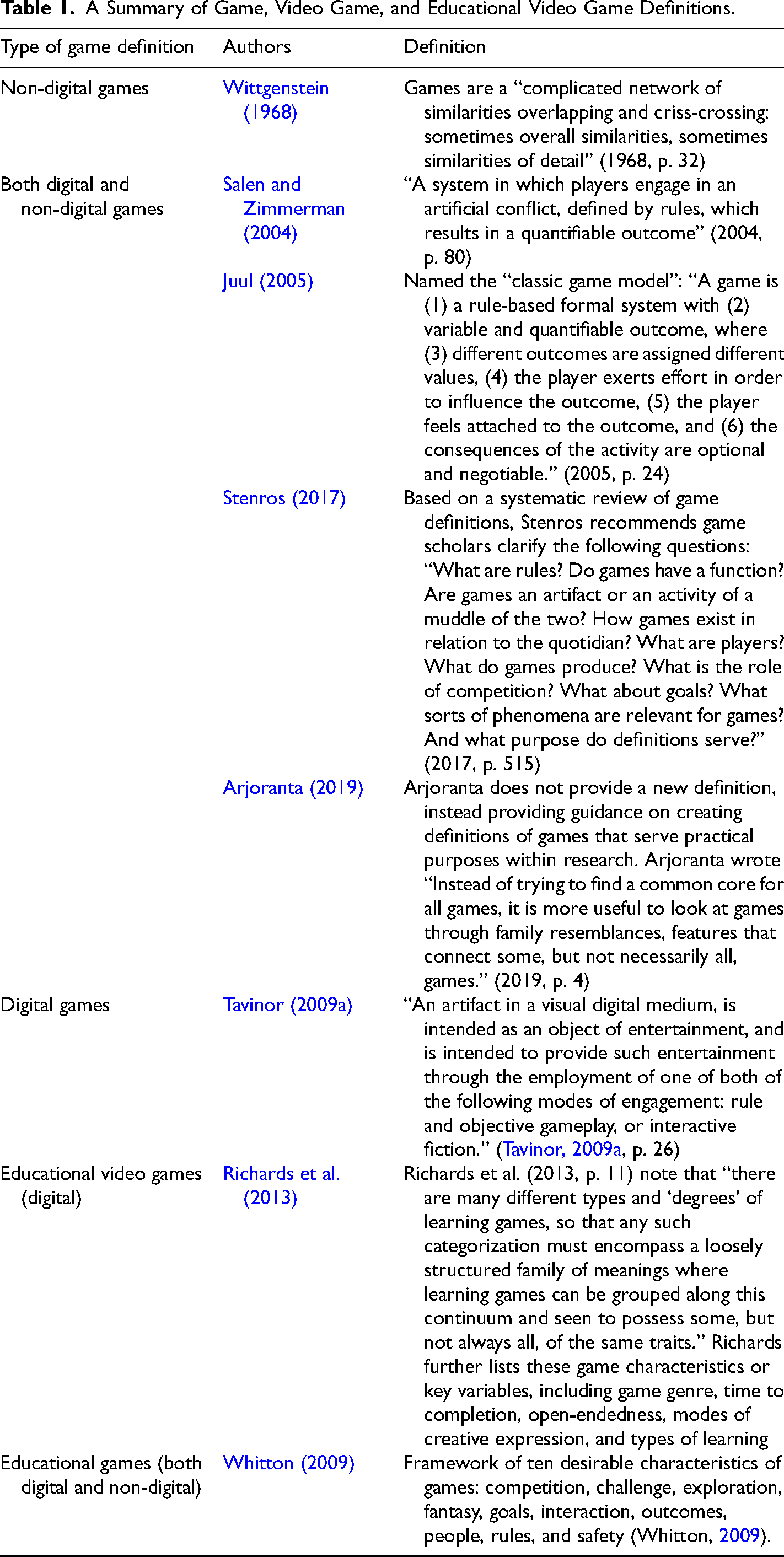
The question of what constitutes a game, and subsequently what constitutes a video game, is a historical and ongoing debate (Crawford, 1983; Juul, 2005; Salen & Zimmerman, 2004; Suits, 1967; Tavinor, 2009a). There are two dominant syntheses of game definitions that are accepted within video game scholarship, usually with minor criticism: Juul (2005), and Salen and Zimmerman (2004). Juul's “classic game model” describes a game as “an artefact involving rules, variable and quantifiable outcomes, player effort and attachment to the outcome, and negotiable consequences” (2005, p. 104). Salen and Zimmerman summarize and compare eight existing definitions of games, including those that are commonly referenced in game writing, to create their definition: “A game is a system in which players engage in an artificial conflict, defined by rules, that results in a quantifiable outcome” (2004, p. 11). Both papers summarize previous definitions of traditional, non-digital gaming, and combine these to create a new definition. Whilst both encompass some facets of video game definition, they are not comprehensive, and both definitions are widely challenged in the literature (Arjoranta, 2019; Bateman, 2015; Karhulahti, 2015; Tavinor, 2009b). For example, Arjoranta (2019) argues that Juul's (2005) definition of games specifies the inclusion of challenges, but this excludes whole genres of games, such as walking simulators. Karhulahti (2015) posits that “quantifiable outcomes” outlined in both Salen and Zimmerman's (2004) and Juul's (2005) definitions are not clearly conceptualized and require more nuanced discussion. Tavinor (2009b) argues that Salen and Zimmerman's (2004) and Juul's (2005) definitions are insufficient to define video games specifically, as they are mostly concerned with non-digital games. Despite this, game scholars commonly acknowledge these definitions with varying exceptions and additions, and they are “grudgingly accepted” (Stenros, 2017, p. 500) as a basis for game definitions within the research field.
In 2017, Stenros conducted a systematic review of over 60 game definitions (both digital and non-digital) to explore the key differences between classifications and identify the divisive questions within the field of game scholarship. Stenros stated that, despite there being more definitions of games than ever before, this had created “more polyphony than clarity” (2017, p. 500). He describes the overall corpus of game definition writing as heterogenous, encompassing formal and strict definitions, incomplete conceptualizations, and highly contextual approaches to games (Stenros, 2017). In the review, ten themes that indicate contested points of interest for game definitions and game studies were outlined: rules, purpose, and function, whether games are an artefact or activity, how games are models of culture, the role of the player, (un)productivity, competition and conflict, goals and end conditions, construction of the category, and coherence (Stenros, 2017). Stenros proposes that these categories should be the basis for game scholars to develop and clarify their contextual definition of a game, and to assist in the development of definitional precision within the game studies field (2017).
Building on the existing body of game definition writing, Arjoranta (2019) uses a Wittgensteinian lens in his approach to game definition. Following Wittgenstein, Arjoranta (2019) describes definitions as highly contextual tools, dependant on the purpose and context of the author. He asserts that there is no such thing as a perfect definition because the usefulness of a definition is contingent on its purpose. Arjoranta (2019) proposes that the most useful definitions are those that are concerned with solving practical problems and that they are highly contextual. Considering this, Arjoranta's means for creating useful game definitions is to ensure that any new definitions are specific to a particular use and must consider previously published definitions. If a new definition for games is being written, it should be purposeful and say something useful about games. In the case of our present investigation, this can be made specific to EVGs. Most research that speaks about EVGs speaks to the definition of just games, but this may need to be refined for educational research to be more effective in discussing games in education.
Defining Video Games
Each of the definitions outlined thus far is at least partially concerned with the definition of non-digital games. In the case of Wittgenstein (1968), writing before the ubiquity of video games, non-digital games are the sole focus of his definitional work. Salen and Zimmerman (2004) synthesized eight game definitions to create their own, none of which are explicitly concerned with defining digital video games. Similarly, Juul (2005) combines seven game definitions, none of which specifically define digital video games. While neither Juul (2005) nor Salen and Zimmerman's (2004) definitions exclude digital video games, they were not created with video games as their sole focus, and particularly not with EVGs in mind. Recently, the definitions of non-digital and digital video games are often discussed in tandem (see Arjoranta, 2019; Bateman, 2015; Stenros, 2017), with authors noting that the issue of definition is common to both, so it is useful to discuss them together. It is possible that the amalgamation of non-digital and digital video game definitions contributes to the ongoing difficulties of game definition. Indeed, Tavinor notes that the reason that the definitions of Juul (2005) and Salen and Zimmerman (2004) are commonly found insufficient for defining digital video games is that they simply do not try to do so (2009b), as they do not make the distinction between digital and non-digital games.
A notable exception that deals specifically with digital video games is that of Tavinor (2009a), who provides an alternative definition of video games by summarizing and critiquing the three dominant theories within game scholarship: narratology, ludology, and interactive fiction (2009a). Figure 1 provides an outline of each of these theories. Tavinor asserts that the three theories in isolation are not enough to provide necessary and sufficient conditions to define video games and encompass artefacts that are not considered video games within their definitions (Tavinor, 2009a).

Definitions of narratology, ludology, and interactive fiction (from Tavinor, 2009a).
Narratology argues that games are a continuation of narrative structures that have previously been seen in books and movies, and describe games as texts, to be studied in the same way as literature (Poole, 2000). Tavinor (2009a) rejects narrative as an essential feature of games, citing games such as Tetris (Nintendo, 1989) and other puzzle games as examples of games that can exist without a narrative. Ludology emphasises the “game-ness” and interactivity of video games as their essential feature, citing the way non-digital games such as Chess and sports games are migrated from one medium to another (physical to digital) as evidence of the essential nature of ludology to games (Aarseth, 1997). Tavinor (2009a) asserts that ludology, and interaction, are not sufficient to be the essential feature of a video game. He notes that traditional games, such as Dungeons and Dragons (Mearls & Crawford, 2014), can include interactivity without being considered a video game. Interactive fiction describes video games as fictional worlds within which the player asserts control and makes impactful decisions (Tavinor, 2005). Tavinor defines fictional worlds as encompassing both those that include clear fantasy elements such as the orcs and dragons of Elder Scrolls V: Skyrim (Bethesda Game Studios, 2011), and the more life-like fantasy such as driving sportscars around the Nürburgring in Gran Turismo (Polyphony Digital, 2004). Interactive fiction is not an essential condition of video games, though, as Tavinor (2009a, 2009b) notes that not all games involve fiction (such as Tetris [Nintendo, 1989] and digital forms of Sudoku and Chess), Learning science: Computer games, simulations, and education workshop sponsored by the National Academy of Sciences, Washington, DCand that non-video game artefacts such as pen-and-paper role-playing games and childhood games of pretence all involve interactive fiction, without being considered video games.
After establishing the existing gaming theories of narratology, ludology, and interactive fiction as individually insufficient in providing necessary and sufficient conditions to define video games, Tavinor proposes his disjunctive definition of video games (2009a). Disjunctive definitions are those that include an “and/or” clause, so that a property of a video game can be considered individually or jointly sufficient to meet the definition of a video game but is not individually necessary. In the case of this definition, Tavinor defines video games as: “An artifact in a visual digital medium, is intended as an object of entertainment, and is intended to provide such entertainment through the employment of one of both of the following modes of engagement: rule and objective gameplay, or interactive fiction.” (2009a, p. 26)
With the inclusion of both gameplay and interactive fiction as disjunctive requirements, this definition comes close to being inclusive of most artefacts that could be considered video games—although the specific meanings of keywords within the definition (especially interactive fiction) require considerable explanation and clarification from the author to be sufficiently inclusive.
Karhulahti (2015) noted significant issues with Tavinor's definition, including that the use of “interactive fiction” is problematic, as the term has been established in gaming culture to refer to a specific genre of text-based games, which is not what the term is being used to describe here. Further, Karhulahti highlights that the use of “intention” is awkward, as “all intentions, save our own, are speculation more or less” (2015, p. 8). The inclusion of entertainment as a requirement for classification as a video game complicates the use of this definition within the context of video games and education, as according to Tavinor's definition, games created for learning are not video games (2009a). Tavinor notes that serious games, or games for education are “clearly video games with extended functions” (2009a, p. 31, emphasis original), highlighting the need for further definition when it comes to games within the context of education. As will be discussed further, building on Tavinor's (2009a) definition with the inclusion of further elements of context and classification for education can address this need for the definition of educational games.
Defining Video Games in Education
The issue of video game definition becomes more complex within the field of education research. In the last 20 years, research concerning video games in education has dramatically increased and has resulted in a plethora of game-based research areas. Despite the significant body of literature surrounding digital game-based learning (Connolly et al., 2012; Young et al., 2012), the essential definition of video games is rarely engaged in any meaningful way. EVG researchers pay scant attention to the intrinsic definition of video games and focus instead on the categorization of games in relation to their application to education. Authors frequently reference Vygotsky (1978) and his work on games and play as a means for child imaginative development (see Young et al., 2012), the definitional work of Prensky and his concept of “digital natives” (2001), Juul (2005), or Salen and Zimmerman (2004). Often, educational researchers do not define games within their research, but instead identify and discuss the classification of games, or categorize how the games relate to learning (Connolly et al., 2012). Educational researchers use classification systems to categorize games, such as learning outcomes, function, educational content, and genre. This preference for categorization, rather than philosophical definition, has resulted in a field that embraces a more formulaic approach to language and classification, compared to more traditional game scholarship.
It is widely acknowledged that EVG research lacks coherence (All et al., 2013; Cole et al., 2023; Girard et al., 2016) and that this is a barrier to progress in developing and understanding the impact of EVG in education. To address this, classifications are often used in place of definitions to develop organizational frameworks for understanding games (Connolly et al., 2012). While the classifications themselves vary, this is generally ordering games into their primary function (such as games for entertainment, games for learning, serious games), genre (action, adventure, fighting, puzzle, role-playing among others) or platform (PC, console, mobile). Classification of digital games within research scholarship can also be based on the measurement of outcomes or learning interventions, such as skills-based learning, cognitive or affective outcomes (see Garris et al., 2002 for an example of frameworks), or motivational variables such as engagement, interest, and effort. Seminal video game education researcher James P. Gee goes as far as classifying games as “good” or “bad” concerning language learning (2003). These classifications, while useful in discussing the impact and implementation of games in education, highlight a significant gap in the discussion of the definition of video games within the field of education research.
Richards et al. (2013) proposed a matrix of more than 30 game characteristics or variables that can be used to classify EVGs. They note that there are many types and “degrees” of learning games, acknowledging that EVG can be placed along a continuum of what could be considered purely educational, and what could be considered purely a video game. The matrix created by Richards et al. (2013) includes variables such as timescale, genre, modes of creative expression, and “open-endedness” so that EVGs can be more easily selected for commercial sale to schools. While the focus of Richards et al.'s (2013) classification is on the commercial and investment analysis of EVGs, it highlights important considerations for the application of EVGs into classroom practice, such as time limitations and adaptability to curriculum needs.
A notable definition of games within the context of education is Whitton's (2009) proposed “characteristics of games.” As a summation of other game definitions, Whitton (2009) created the framework for ten defining characteristics of games: competition, challenge, exploration, fantasy, goals, interaction, outcomes, people, rules, and safety. Whitton does not claim that the ten characteristics are essential to defining what a game is within education, but rather an open list or desirable characteristics for definition. The more of these characteristics that an activity exhibits, the more “game-like” it is. This framework was created to make the definition of a game as “open and inclusive as possible” (2009, p. 28). While the framework is a good basis for a summary of characteristics within game-like educational activities and a good start to discussing issues of game definition within an education context, Whitton did acknowledge that stories, role-plays, and puzzles possess the framework's characteristics, and hence can be considered game-like. Thus, this approach may be broader than desirable in the EVG research field.
A Working Definition of Video Games in Education
As the previous discussion shows, definitions of video games do not account for the nuances of games used within education and are not designed for that purpose. Existing video game definitions are often used within the context of education research to define EVG concepts (see Backlund & Hendrix, 2013; Killingsworth et al., 2015; Young et al., 2012). Therefore, there is a current and pressing need for working definitions of video games within an education context, to separate video games from other educational technologies (Young et al., 2012). This is needed to define and differentiate video games, as opposed to simulations, learning applications, non-digital games, and student response systems, amongst others. Technology in education is a rapidly expanding area of research (Cole et al., 2023; Connolly et al., 2012; Stenros, 2017), and there is value in defining EVGs, and setting them apart from the substantial number of other educational technologies available.
Considering the discussion of previous definitions, and to begin the conversation around EVG definition, the following definition is proposed. To define EVGs, three dominant game definitions were combined to create a baseline description of a digital video game (Juul, 2005; Salen & Zimmerman, 2004; Tavinor, 2009a). To make the definition specific to the context of education, Whitton's (2009) characteristics are also included, with the addition of learning outcomes and educational context. Therefore, an artefact is defined as an EVG if it meets the following criteria:
It is an artefact exclusively in the visual digital medium, used as an object of education through the following:
Rule-based gameplay (Juul, 2005; Salen & Zimmerman, 2004; Tavinor, 2009a; Whitton, 2009); Variable and quantifiable outcomes, influenced by player effort (Juul, 2005; Salen & Zimmerman, 2004; Whitton, 2009), and; Fulfillment of learning outcomes in an educational context. (d)Elements of fantasy or role-playing (“that which is not real”, Whitton, 2009); (e)Elements of conflict or challenge (Salen & Zimmerman, 2004; Whitton, 2009); (f)Interactions with others (directly, through leader boards, collaborative or competitive; Whitton, 2009)
and needs to include at least one of the following:
This definition includes three essential criteria (rule-based gameplay, outcomes influenced by player effort, and used in an educational context for learning outcomes), and three disjunctive criteria (fantasy or role-play, competition, and interaction with others). Similar to the definitional logic of Tavinor (2009a), including both essential and disjunctive criteria within the definition allows for there to be a set of conditions that may describe EVGs, not all of which may be individually necessary, but when combined appropriately are sufficient. All three essential criteria are necessary for an object to be considered an EVG, and this allows for video games to be distinguished from EVGs. The disjunctive criteria are non-essential, meaning that an artefact may possess all three disjunctive features, but if it does not have the essential criteria, it is not an EVG (or maybe not even a video game, although that is a separate argument).
By including three non-essential, disjunctive characteristics, this definition allows for flexibility to include cases that fulfil some of the common features of video games, but not all, to still be included. This disjunctive clause was included to acknowledge and encompass the significant variety of video games that exist, and continue to be created, and their diverse uses within classroom practice.
The essential criteria were collected from common features of existing definitions of both non-digital and digital games. Rule-based gameplay was included as an essential criterion, as explicitly included in the definitions of Juul (2005), Salen and Zimmerman (2004), and Tavinor (2009a). Rule-based gameplay refers to a consistent framework of interaction between the game and the player, and “provide the structure out of which play emerges” (Salen & Zimmerman, 2004, p. 98). This sometimes takes the form of explicit rules explained before play starts, though more commonly (as in the case of open-world games such as Minecraft [ Mojang Studios, 2011 ]) the rules are discovered as the player proceeds through the game.
The second essential criterion is the inclusion of variable and quantifiable outcomes, influenced by player efforts. This means that there must be effects or consequences as a result of player input, such as winning, losing, or receiving a score. This is included as an essential criterion to distinguish EVGs from more informal or purely creative play activities, such as media design or creation. For example, a class may be set an activity to design a website (which is rule-based, and so could meet the first criteria) and for a learning outcome (meeting the third criteria). Without a win condition, or a consistent scoring framework, this activity would not be considered an EVG under this definition. This also meets face validity (not many would consider a website-making activity a video game), strengthening the proposed definition.
The third essential criterion distinguishes EVG from other video game artefacts. We propose that any object meeting the other essential criteria (rule-based gameplay, with variable outcomes) being used in an educational context to fulfil learning outcomes is defined as an EVG. The educational context in this definition can be a situation, whether formal or informal, in which learning is taking place. This is supported by the requirement of meeting a learning outcome. Similarly, within this definition a learning outcome can be formal (in the case of meeting a curriculum requirement, or institutional condition for award), or informal (such as informal assessment in a classroom setting, or even personal goal setting for learning). The aim of including this criterion is to distinguish incidental learning from video game playing, and instead focus on learning gained from video game play that is purposeful, in the hopes that this will assist in focusing the EVG research field. Additionally, this criterion was made intentionally broad to be inclusive of games made purposefully for educational reasons (such as Labster [Labster, 2011] or MinecraftEDU [Mojang Studios, 2011]) as well as games made for commercial entertainment, but used in educational settings for learning (such as using The Witcher 3 to teach narrative structure in an English classroom).
The first disjunctive criterion is the inclusion of fantasy or role-play. This can be defined as the inclusion of clear fantasy elements, such as magic, talking animals, or superpowers. In addition to this, though, role-play can also include more “life-like” realities such as driving simulators or war games, which exist in reality but are not necessarily part of the player's everyday life. This criterion is given an either/or condition, as we recognize that not all EVGs include fantasy or role-playing elements (such as traditional games made into digital ones, e.g., Chess or Sudoku, as mentioned previously).
The second disjunctive criterion is that of conflict or challenge. The definition of this can be taken from Salen and Zimmerman's (2004, p. 98) concept of conflict in games: “All games embody a contest of powers … from cooperation to competition, from solo conflict with a game system to multiplayer social conflict. Conflict is central to games.” While conflict or challenge is likely to be present in most objects considered to be video games, it is included as a disjunctive criterion to distinguish educational simulations (such as HistoryMaker VR [Schell Games, 2020] or science simulations) from EVGs. This is expanded upon in the next section.
The final disjunctive criterion is interaction. This is defined as direct gameplay with others, such as in multiplayer games, or as indirect interaction, such as leader boards or asynchronous communication (e.g., player messages in Elden Ring [FromSoftware, 2022] or bottled messages in the high-definition re-release of The Legend of Zelda: The Wind Waker HD [Nintendo, 2013]). While not all EVGs will include interaction with others, it is included as a disjunctive criterion to recognize the importance of social interaction with others to video game definitions (Salen & Zimmerman, 2004; Whitton, 2009).
The above definition adds clarity to what can be considered an EVG for classroom and research purposes. Additionally, this definition allows for the differentiation of EVG from other game-like artefacts often used in educational research and classroom settings, such as simulations, tutoring software, and gamified learning activities. The specific sub-sections of these game-like artefacts that have been excluded in this definition are discussed below.
Simulation-only software
Digital simulations (such as laboratory software, human body, or vehicle simulations) are a useful technology for education and allow students to “observe and interact with representations of processes” that would otherwise be inaccessible in a classroom setting (National Research Council, 2011, p. 19). Video games and simulations share many similar characteristics, and often within educational research simulations and games are categorized together as educational technologies (Clark et al., 2016). Despite this, simulation-only software has been excluded on the basis that it does not meet the requirement of gameplay as outlined in the definition above. While there is an element of simulation in almost all digital video games, simulation-only software differs from video games in three ways: simulations generally do not provide variable and quantifiable outcomes for the player, there is no element of interaction with others, and there is no conflict or challenge involved. The rules and goals of a video game, including scoring or reward systems aimed at tracking player progress, are absent in simulation-only software (Clark et al., 2009). This is not to say that all simulations are not games; there has been a significant increase in the number of educational simulations which share game elements, such as challenges, points, or levels (see Alien Rescue [TEXAS Education, 2012], Second Life [Linden Labs, 2003], Labster [Labster, 2011]). If a digital artefact only involves simulated situations or phenomena, without game-like interactivity, it does not meet the requirements for video game definition, and so has been excluded from our proposed definition.
Intelligent tutoring systems
Software that is described as “intelligent tutoring systems” (ITSs) or “automated tutoring environments” has been excluded as an EVG in this definition. ITSs can be generally defined as computer programs that provide automatic feedback on learning activities, such as Massive Open Online Courses (MOOCs), or mathematics and spelling-based learning software. While EVGs and ITSs share some similarities in intention (such as supporting student learning, and increasing learner engagement and motivation), the method and focus of achieving these outcomes are markedly different (Long & Aleven, 2017). There is generally no metaphor or fantasy elements to an ITS, and there is usually no social interaction, conflict, or challenge as part of student learning. The main purpose of an ITS is to provide “cost-effective yet personalised tuition” (Mills et al., 2007, p. 692) and the two different systems adopt very different approaches to learning, being grounded in different bodies of theory (Long & Aleven, 2017). Despite this, it is also important to note that some ITSs can include some game elements. Specifically, the ITS iSTART-ME was designed to address the issue of disengagement and boredom during the use of traditional ITSs (Jackson & McNamara, 2013). While the inclusion of points, levels and mini-games means that some ITSs border on meeting the definition of a video game, the combination of ITS and gamification is a complex system that requires more thorough investigation than can be provided within the broad question of this definition.
Gamification
There is significant overlap in the concepts of video games in education, digital game-based learning, and gamification. The term gamification has grown in popular usage, particularly in the fields of business and education research, and is used to encompass a wide variety of parallel or overlapping concepts about games, game design and gaming attributes. Despite this, it is important to note that games and gamification are not the same, even though they can sometimes be used interchangeably in insouciant common usage (Sailer & Homner, 2020). The definition of gamification is “the use of game design elements in non-game concepts” (Deterding et al., 2011, p. 10), and so, by definition, video games are outside of the scope presented (see Landers et al., 2018). It is for this reason that research that solely focuses on gamification elements in education (such as avatars, badges, points, or leaderboards within traditional classroom activities) is excluded from this definition.
Discussion and Conclusion
Discussing the need for video game definition, Arjoranta stated that “useful game definitions are not confused about the purpose of definitions, they fit the particular use case and take into account previously published works” (2019, p. 118). By creating a “useful definition,” this article intended to further the discussion of EVG categorization and use, making the case for a working definition of EVGs that considers the past definitional writing of traditional and digital games. At the core of our definition, we propose that an artefact meets the criteria of an EVG when it is delivered in a visual digital medium, is rule-based with quantifiable outcomes which are influenced by the player and is used in an educational context to fulfil learning outcomes. Additionally, there is at least an element of fantasy/role-play or conflict/challenge or interaction with others (directly or indirectly).
The existing field of EVG scholarship encompasses a heterogenous collection of applications, hardware, software, interactive learning modules, and simulations that are all currently collected under the term EVG, the definition of which has not yet been agreed upon. The current body of research is not yet actively engaging in the complex problem of defining EVGs.
While the supplied definition will not suit all needs and is not exhaustive or inclusive of all educational technologies that could be considered video games, we present it as a starting point for future research that requires a definition of EVGs being studied. There is an opportunity for future research which considers the exclusions of this proposed definition, and how this might impact the field of research. An example of this would be the case of non-visual or aural digital games, which the visual medium criterion of our definition currently excludes. While this is currently a small sub-section of digital games, there is scope for subsequent research that considers alternate game types, media, and the ongoing evolution of gaming mediums, and how this could be incorporated into the definition of EVGs in the future. For now, the provided definition will allow for more accurate and specific language when applying EVG interventions for research and will potentially result in a research field that can be more easily summarized, results compared, and discussed, which is currently a significant problem in EVG research (see All et al., 2016; Backlund & Hendrix, 2013; Connolly et al., 2012; Girard et al., 2013).
Footnotes
Declaration of Conflicting Interests
The author(s) declared no potential conflicts of interest with respect to the research, authorship, and/or publication of this article.
Funding
The author(s) received no financial support for the research, authorship, and/or publication of this article.
