



Abstract
The spectatorship of games has become a topic of growing interest with the parallel rise of esports and livestreaming platforms. Taking Saltybet.com as its primary case study, this paper examines cases where zero-player games played by artificial intelligence-controlled characters are the focus of spectatorship. A discourse analysis identifies trends and themes in the recorded chat transcripts of 15 livestreamed tournaments from Saltybet.com where players bet fake money on the outcome of fighting game matches between AI opponents. Several themes are identified that guide discussion on how spectators discuss AI players as well as their own and the community's behaviour. These insights may be applicable to understanding the broad appeal of the entertainment people derive from AI generally whether they were meant to entertain or not. The discussion explores how the absence of human players and the scale of Saltybet's niche audience contribute to a unique, but foolish space.
Introduction
While much has been made of the rise of game spectatorship and esports on streaming platforms like Twitch, comparatively little has been written on AI spectatorship (Johnson & Jackson, 2022; Juul & Björk, 2012) which is defined here as the spectatorship of games in which two or more AI players compete each other in the absence of a human player. Although highly competent or powerful AI typically occupy academia's or the mainstream's attention, there are also examples of popular reception of AIs championed as entertaining for their apparently inefficient, imperfect, or sub-optimal behaviour.
Many videogames have offered the option to pit AI against each other without a human player in various fighting, sports, or party games such as Baseball Simulator 1.000 (Culture Brain, 1989) or Mario Party 2 (Hudson Soft, 2000). These cases come under one of the categories of so-called zero-player games (Juul & Björk, 2012). However, the broad appeal of these modes did not develop much of an audience until the advent of livestreaming sites, most prominently Twitch.tv. For example, streams of various Mario Party games, disparagingly given the offensive ableist title ‘Mario Retardy’, pit ‘bad’ AI against each other (Hudson Soft, 2000; UltraNick24, 2013).
There are also autonomous AI robot competitions such as Robot Sumo or Robot Soccer where AI are often anthropomorphised as being foolish or othered (Robert McGregor, 2017; HTWK Robots, 2018). Inefficient or poorly performing robots have been the subject of entertainment more generally as well such as the work of robotics Youtuber Simone Giertz (The Late Show with Stephen Colbert, 2016). Johnson and Jackson (2022) have noted several cases that involve other nonhuman agents playing games over Twitch including algorithms, automated game systems, and, in one case, inputs triggered by a live fish. The viral sharing of mistakes by AI applications such as Alexa, OK Google, or Autocorrect are often presented as entertaining for the AI's unusual behaviour (Wood, 2014; Chokshi, 2018). Procedurally generated romantic matchmaking between AI in BadCupid (Kitfox Games, 2019) is another example of AI spectatorship. AI presented for the enjoyment of spectators or as an example of foolish behaviour has also been noted elsewhere (Wood, 2014; Gera, 2019; The Late Show with Stephen Colbert, 2016). A distinction is made between those AI that are intentionally implemented to be incompetent (BadCupid), those AI that emergently develop unexpected behaviour (digital evolution, artificial life, Mario Party,), and mixtures of emergent and designed surprising behaviour (Saltybet.com). Further to this study's relevance, games that involve pitting AI against one another (albeit at the behest of a human player) briefly grew in popularity within the ‘Autochess’ genre in 2019 (Carter, 2019). Despite all these various cases, almost no focused academic study of the topic of AI spectatorship exists which this paper seeks to examine as its focus.
One prominent example of AI spectatorship, that is the focus of this paper, is the streaming site Saltybet.com (Salty Bet, 2013b), mentioned briefly by Seering et al. (2017, p.2). Saltybet's popularity within a niche of the fighting game community has been noted in games media (Caldwell, 2017) and interviews with the individual ‘Salty’ (the pseudonym of the human streamer who runs Saltybet streams) (McCormick 2013; Miller 2013).
Many discussions of AIs focus on their ability to be optimised for a specific task. Research concerning AIs that play games normally focuses on their capacity to learn or play in a way that is comparable to human players, such as the various Deepmind AI that have defeated professional players of Chess, Go or DOTA2 (McAloon, 2019a; 2019b; 2019c) or to learn how to perform a very specific task within a game-space defined by a fitness function (Martínez-Arellano et al., 2017; Geijtenbeek et al., 2013). There has also been much recent discussion of the ethics of generative art tools (midjourney, DALL-E) or AI that use natural language processing (ChatGPT, Microsoft Bing), many of which have been mocked for their odd or unethical results or behaviour (Acres, 2023; Farrington, 2022; Mata, 2023).
In contrast, the research discussed here analyses how a specific spectating community (Saltybet) constructs the spectatorship of AI players presented for the purpose of entertainment. The entertainment appeal of AI spectatorship appears to stem from a mixture of the AI's behaviour, the visual depiction of an AI character as well as the context in which the spectatorship happens. Similar pleasure can be found in Lehman et al.'s (2018) account of failures or unexpected solutions by machine learning programmes given a task without specific enough parameters or ill-defined fitness functions, and it is noteworthy how many of the examples are highly entertaining.
The major goal here is to open a discussion on the place of AI designed to entertain as well as the use cases of AI that are sub-optimal or – to put it characteristically – ‘foolish’. The research question that this paper seeks to answer therefore is: how is AI vs AI spectatorship constructed in online streaming chats (using the Saltybet community as a case study)?
Through the themes distilled from the analysis of its live chat, it will be argued that Saltybet spectatorship can be understood as an actively performed parody of the fighting game community that allows spectators to experience bizarre underdog narratives vicariously through foolish AI and enhanced by betting.
Case Study: Saltybet.com
M.U.G.E.N is a fighting game engine. Content is created by the community, and thousands of fighters, both original and from popular fiction, have been created.
– Saltybet's Nightbot's response to the chat command ‘!mugen’, used to introduce newcomers to Saltybet.
Saltybet is the panacea to every sadness in the life
– Saltybet spectator describing Saltybet
Saltybet streams involve a betting phase that precedes a fight. During the betting phase, betting spectators can speculate on which character will win (expressed as betting on blue or red). Bets are frequently made based on the character's visual appearance, gambling fallacies, character loyalties (e.g. characters from a series such as DragonBall Z), traits such as having a sword (which makes it likely that a character will have large disjointed hitboxes, giving them a reach advantage) or prior knowledge of a specific AI. Spectators can pay a premium monthly subscription fee to have access to odds and ‘behind the scenes’ info on the roster of AI fighters (known as Illuminati) which allows them to make more informed bets. Bettors choose how many S$ to wager based on their assessment of the AI which is repaid depending on the odds assigned to the character and whether they win or lose. Then the fight begins with a best of two or three rounds determining the winner. The stream has a relatively small but dedicated audience and has been running, almost continuously, on Twitch since May 2013.2
Although Saltybet can be watched on Twitch, the website Saltybet.com offers viewers additional features and a slightly different user interface to make informed and regular betting possible and relatively quick. When matches begin, it often quickly becomes clear which AI will win or lose due to certain behaviours or traits of the AI such as extremely damaging attacks, stun-locking an opponent so they cannot act, inactivity on the part of a poor AI or other similar behaviours. Throughout the betting and fighting phases (and like most streams on Twitch), a live chat feed can be seen next to the broadcast where players participate in discussion of the matches and Saltybet itself (see Figure 1). The stream rotates between three modes: matchmaking (free-form matchmaking used to refine balance), exhibition matches (themed matchups that can be requested by premium users) and tournaments.
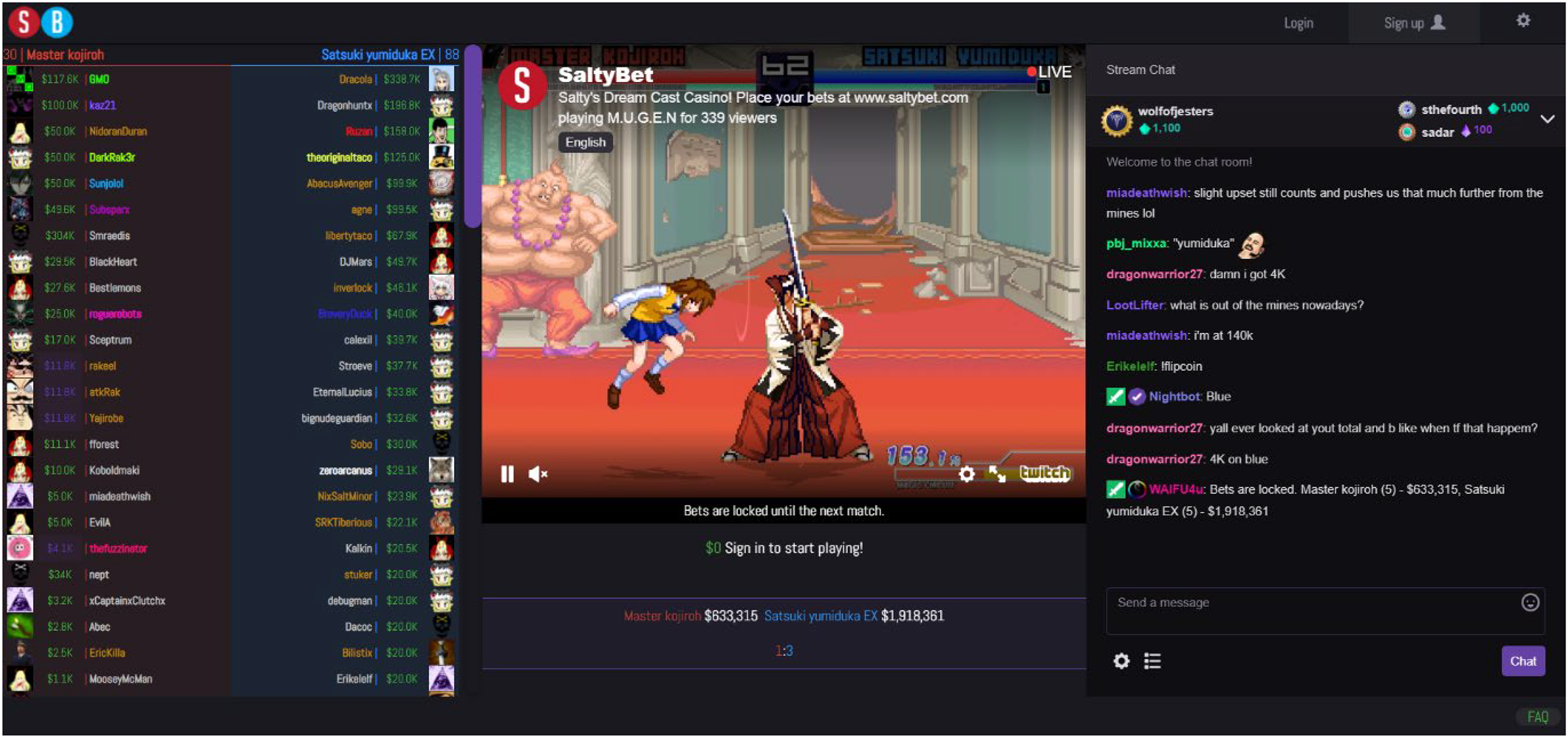
A screenshot showing the layout of a Saltybet stream. Bettor/bets information [left], Match stream and match information [centre], live chatlog [right]. (Saltybet.com, 2019).
Methodology
There have been many studies of Twitch spectatorship that adopt a variety of approaches to studying and collecting data (Harpstead et al., 2019). Data from chat is frequently used by many researchers as a point of interaction via ethnography, surveys, and other methods, often with the aim of understanding the audience as participants or a community (Hamilton et al., 2014; Diwanji et al., 2020). Saltybet may not technically come under some definitions of online community since criteria like ‘commitment to others’ (Hammond, 2017) but the live audience could be considered a type of discourse community (Kehus et al., 2010). Thus, a direct way of looking at how Saltybet audience members construct AI spectatorship is through their live discourse.
Discourse analysis of live spectators of Saltybet is the approach taken to understand how the spectator experience of AI is shared and constructed by a small online community. To provide first-hand insight into Saltybet discourse, livestreams of Saltybet.com, the behaviour of the AI in the stream, as well as the behaviour of human spectators in the chat were observed. The aim is to generate discussion of themes derived from specific periods of streaming alongside a log and subsequent discourse analysis of the Twitch chat and streamed content. As discussed by Recktenwald (2017), discourse analysis of interactions captured during live streams can be useful in understanding how spectators engage with content, and this has not yet been done for AI spectatorship. Furthermore, Ford et al. (2017) note that Twitch chat discourse might be better understood by looking at specific factors, of which AI spectatorship constitutes a unique site since the absence of a human streamer and the novel content means that constructed spectatorship practice could be revealing.
When practicing discourse analysis, it is important to acknowledge the assumption that language usage constructs identity (in this case, that of a community) rather than revealing inherent truths about the subject (Phillips & Hardy, 2002, p. 85). Likewise, it is also worth acknowledging that the case study is a small snapshot of a longstanding and niche community, and that it is being examined through a lens that privileges AI as a unique aspect of that community. Not all possible voices will appear in the text analysed and there are more meanings and representations of the Saltybet community that are possible than can be fully ascribed here.
Observations were primarily made of tournaments which are special events on Saltybet.com in which a single elimination bracket is created from AI characters of roughly even ability. Spectators can more easily benefit from short-term legacy information that is inherent in tournament structures and so these tend to be more interesting for the betting audience, drawing larger audiences than the general streamed content which runs random matchups constantly. Tournaments also have a natural start and end point and are the densest in terms of chat activity compared to longer periods of unstructured stream content with little discourse. Since the stream runs almost continuously 24/7, no archives are kept by the SaltyBet channel except for short clips that are infrequently uploaded to the SaltyBet Youtube channel (last upload was in 2013) (Salty Bet, 2013a).
All the recordings of tournament footage, results, and chatlogs were done over the course of the 2–25 July 2019–6 years after the Saltybet channel first went live via Twitch. Overall, 15 tournaments were recorded. These broadcasts were recorded at various times of day between 9:00am and 00:00am BST. This was done to mitigate the issue of a standard recording time biasing results exclusively to one time zone or another. Theoretically it helps provide a cross-section of the audience rather than only one regional audience – however, anglophone, North American voices are largely dominant as is the associated cultural bias this implies. In total, the recordings resulted in close to 20 h’ worth of footage and chat discourse. Recording was done for the rough duration of tournaments (which varied from 40 min to an hour long) with the author as a live observer keeping written notes during live recording to ensure a first-hand insight into the experience of spectating Saltybet for these specific events. Tournaments also provide a bracket which helps to give a traceable narrative structure to the collected text data. Helpfully, a chatbot on Saltybet announces character matchups when betting closes so there is a record of matches played in the chatlog itself.3 Transcripts are quoted in this paper and where emotes have been used they have been left as the raw text command but underlined to help the reader more clearly see where they have been used and to distinguish them from text communication. Spectators’ usernames have been coded with the number of tournament and the number of the spectator in order of appearance in the extract e.g. Tournament 5 Responder 6 would be ‘T5R6’.
To record discourse for discourse analysis, a twitch chat scraper was used to record chatlogs directly from Twitch. The scraping tool used in this study was a modified version of an open-source scraper originally created by Brendan Martin (2019). The final script used was an edited version of the above developed by the authors (See Appendix 1). The script collects raw text data from the Twitch internet relay chat and converts it into a raw text file as well as an Excel document that organised individual words by frequency. The date, time, username, channel name and message content were collected. Emotes are converted to their raw text equivalent e.g. ‘wtfsalt’ corresponds to Figure 2. Although chat participant data is not explicitly private or forbidden by Twitch from use, it was anonymised to protect users as they have not consented to be recorded (Twitch.tv, 2023a; 2023b).

The ‘wtfsalt’ emote. Emote is normally an animated gif.
Although this research involves the collection of raw qualitative data from the chat, the subsequent interpretation is done by an informed observer who is familiar with Saltybet and fighting game techniques and terminology. This obviously biases the interpretation of the data and risks a lack of critical distance from the subject, but it is argued here that an expert perspective is needed to make sense of an, at times, incomprehensible community discourse. This research requires some degree of informed engagement that helps cut through some of the ‘noise’ of Saltybet's chat which, as is shown later, features a highly ironic tone, slang, and community in-jokes. Irony is identified here not as a colloquial defense of behaviour (e.g. “I was only being ironic”), but a genuine category of technique in which opposites are frequently juxtaposed often humorously. This is sometimes done towards toxic ends and sometimes not, but the identification of irony should not be seen as a defence of any given behaviour, only an observation of what took place in the Twitch chat. The issue of bringing familiarity to the analysis of data has been noted before by Cheung and Huang (2011) when approaching the analysis of transcriptions of streamed gameplay on Twitch.
The data were analysed in Excel to determine common words, phrases, and themes, and to look at the discourse for individual tournaments as well as in aggregate. The qualitative insights and discussion of the resulting themes are seen as the main takeaway in terms of the character of the discussion rather than only what words literally appeared the most in discourse. Given the ironic and highly context-dependent nature of the Saltybet tournaments recorded, it was not a priority to provide a comprehensive quantitative analysis of the discourse, but some quantitative analysis is insightful when supporting the existence of certain trends.
Discourse Analysis Findings
AI spectatorship is not necessarily reflected in the most common topics, words, or phrases, but does manifest in some surprising ways and certain patterns of discursive behaviour reveal a lot about the nature of engagement with Saltybet and AI spectatorship. In the chat log itself there is a lot of noise, and several bots dominate the conversation with one (‘WAIFU4u’) announcing matchups and betting odds for every new match as well as requests for information and another (Nightbot) speaking when given specific commands by chat. While it is tempting to discount bots since they aren’t really members of the Saltybet community, they are actors in the Twitch discourse that inform its construction and usage, even if just to provide information or regurgitate memes. Emote usage is consistent throughout, as is slang, various memes, and in-jokes. The tone of the Saltybet chat is highly ironic in tone which can make it a slippery subject for analysis but is also revealing about how the community of Saltybet construct spectatorship of AI.
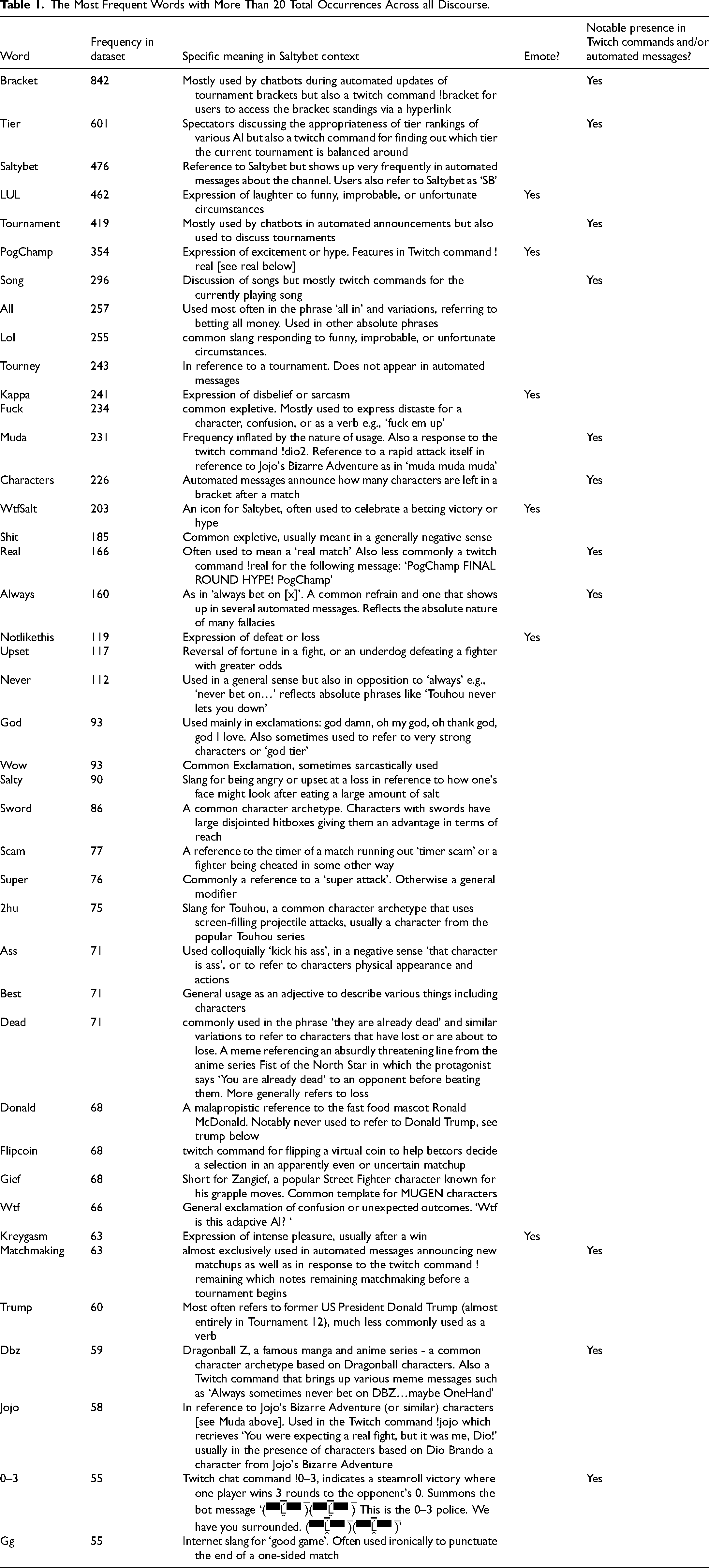
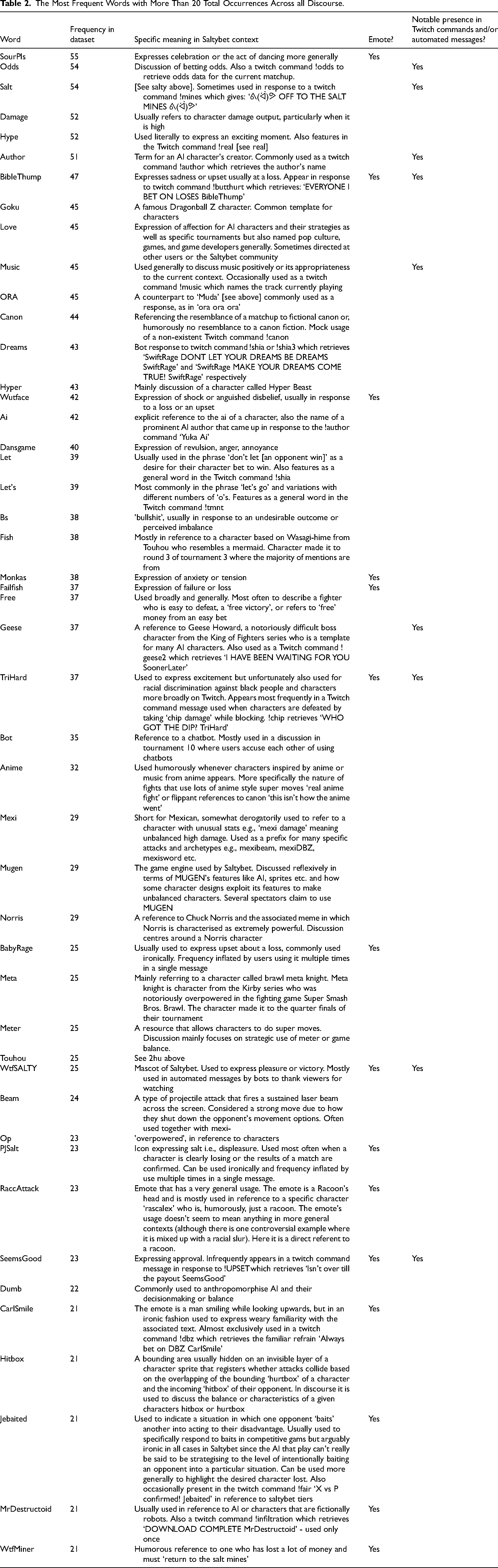
After an initial word count, discounting typical stop words, punctuation, and usernames, some of the most common words were gathered in Table 1. Context is always important when analysing the words in aggregate. For example, one of the most popular phrases of the first tournament was ‘mudamudamudamudamudamuda’ (and variations with differing numbers of ‘muda's). This references the Jojo's Bizarre Adventure fighting game (Capcom, 1998) which is itself a reference to the use of the Japanese word ‘muda’ [translating to ‘useless’] in the original Jojo's Bizarre Adventure manga (Hirohiko Araki, 1987). In the original manga, it is used as a sort of insulting battle cry where a major villain repeats it rapidly while attacking one of the series protagonists.
The Most Frequent Words with More Than 20 Total Occurrences Across all Discourse.
Some tournaments produced unusual results which have been discounted from the general discussion of AI vs AI spectatorship as they are not seen as relevant enough or common enough to help answer the research question. For example, tournament 12 happened concurrently with a political event which led to lots of ‘off-topic’ discussion, particularly regarding American presidential politics. The word ‘trump’ features 60 times in this tournament making up the majority of mentions in the overall dataset suggesting that political events are not always a regular talking point. Even when they were, the community moved quickly to reject trolls and move conversation to be ‘on-topic’. Saltybet's relatively niche audience aims to preserve itself and the focus of the streams when tangents threaten to overwhelm the discourse: T12R1: Don't engage with T12R2. It's just going to lead to more BS. Also I don't trust anyone with 884 in their name that defends trump. […] T12R3: This is not the kind of SB [Saltybet] chat I wanted to see this morning
The formal content of the discussion breaks down similarly to other active Twitch chats, particularly competitive fighting game streams that include the prevalence of emotes, memes, insults (directed at the players), words of encouragement, hype, and automated messages from bots regarding tournament structure. There is also what Ford et al. (2017) dubbed the Twitch chat's collective reactions to events on stream as ‘crowdspeak’. It can be seen during saltybet streams but due to the low number of viewers (200–400) generally it is not as intense as major esports streams except during particularly climactic matches.
Word frequency, as shown in Tables 1 and 2 and charted in Figures 3 and 4, does sometimes indicate a particular topic's prevalence or a sense of how AI vs AI spectatorship is constructed but in a general way. To better understand the core of AI vs AI spectatorship, the words were organised by prevalent themes that were pervasive across the discourse (see Table 3). It is tricky to separate commands, responses, and ‘genuine’ discourse, and it was considered useful to include Twitch commands in the analysis, despite their large prevalence in the data (as illustrated in Figure 3 and 4), as commands were frequently used as shorthand for memes and help paint a picture of the values of Saltybet spectators. Much of the discussion and response to the AI play was characterised by various qualities of AI but also more self-reflexive performance of FGC and discussion of Saltybet culture itself. Thus, the construction of AI spectatorship of Saltybet can be discussed across eight common themes coded to the common words and phrases in the dataset. This is presented in Table 3 in order of most-to-least prevalent.
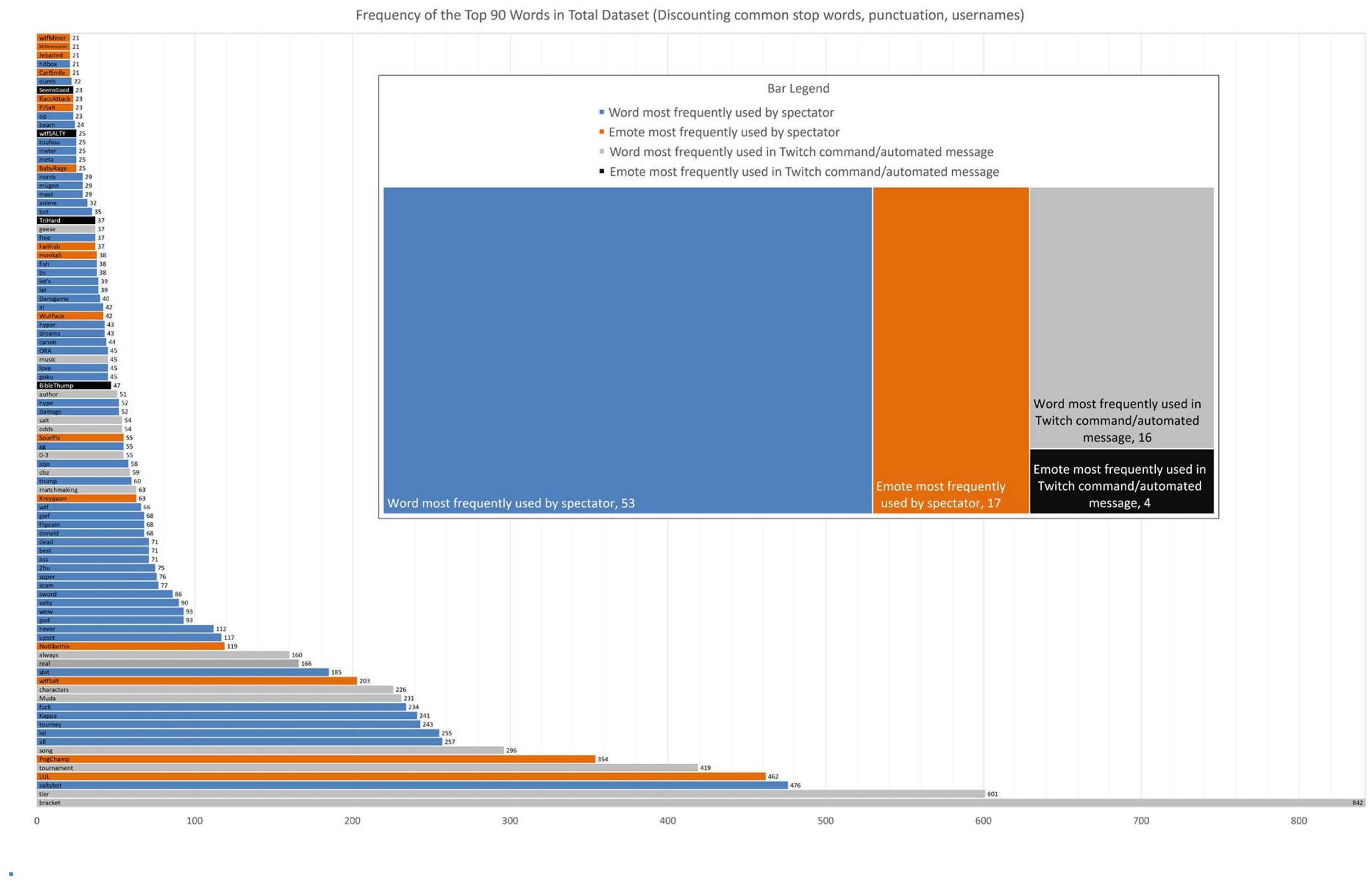
The most frequent words charted from data in Table 1. Treemap indicates proportion of words/emotes used by human spectators/in automated messages.
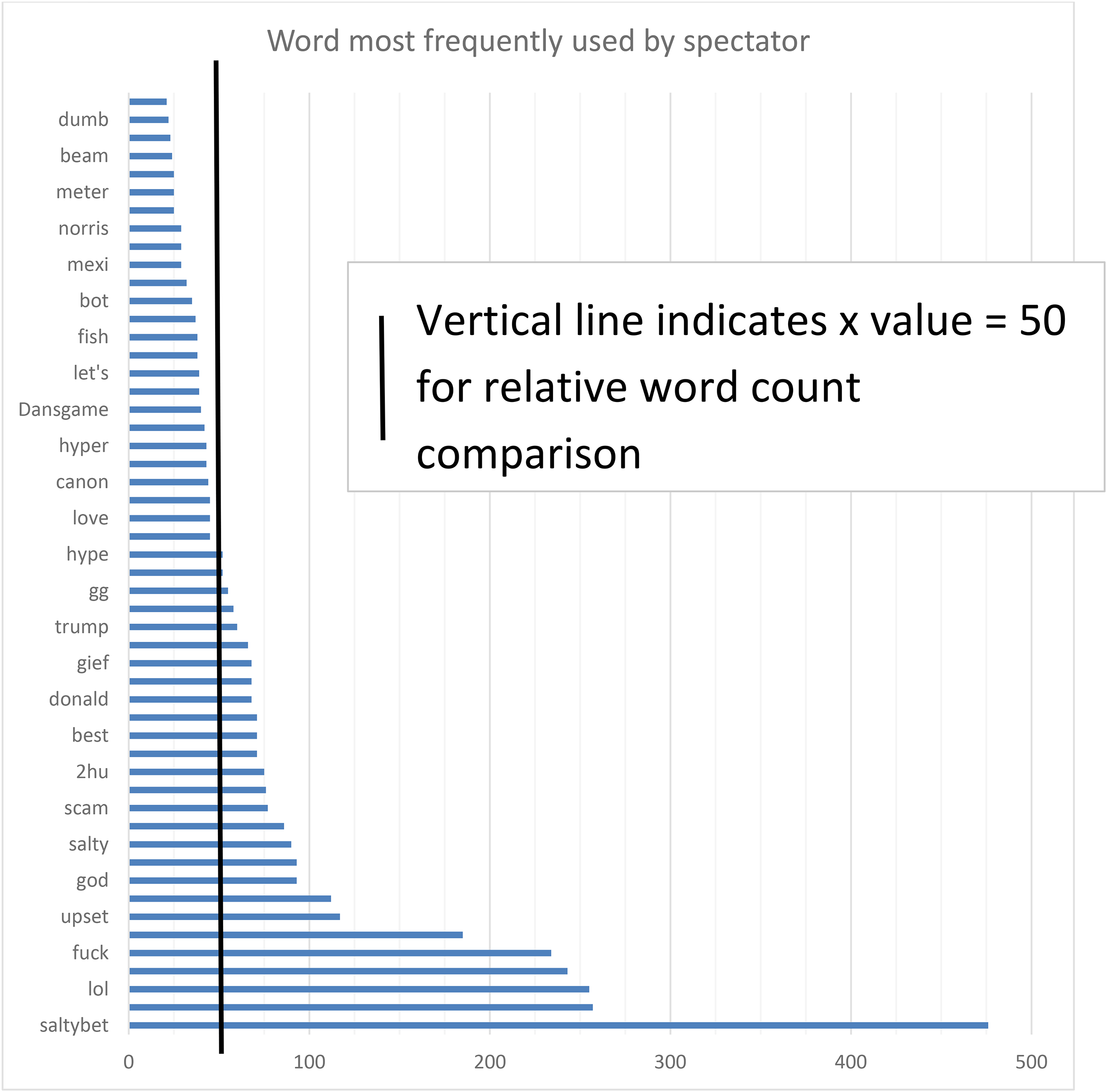
Bar chart multiple of the most frequent words divided by words/emotes used by human spectators/in automated messages.
The Most Frequent Words with More Than 20 Total Occurrences Across all Discourse.
Themes and Theme Frequency Derived Using Table 1 Where Each Count is a Theme Associated with a Word. Words/Emotes Can Be, And Were, Associated with Multiple Themes.
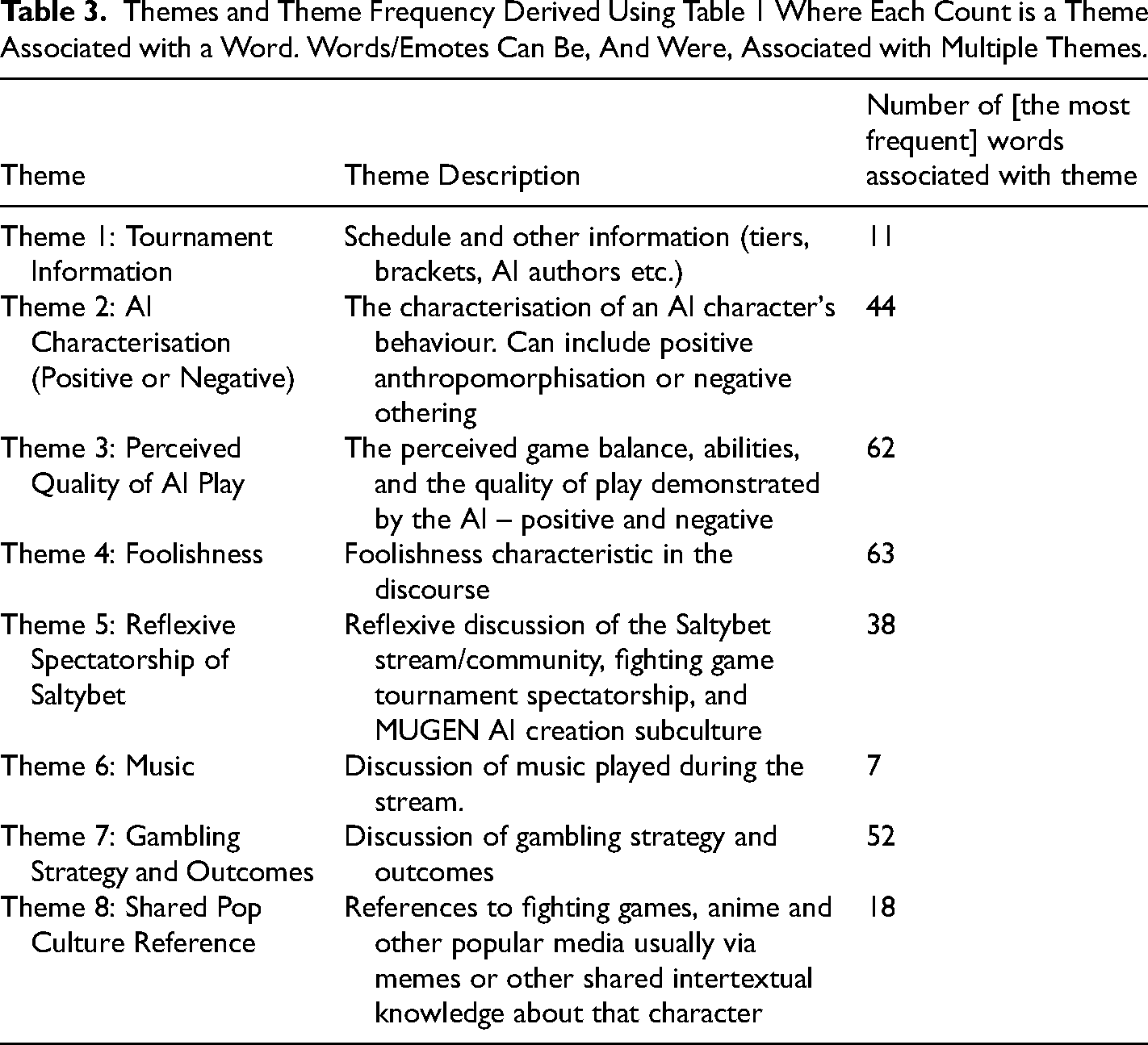
Since some themes are more prevalent than others in the dataset and to simplify the discussion, they have been grouped by their thematic relevance to one another to structure the discussion like so:
Spectators Discussing Qualities of an AI character
Perceived Quality of AI Play AI characterisation (Positive or Negative) Shared Pop Culture Reference Performance of Saltybet Spectatorship
Gambling Strategy and Outcomes Reflexive Spectatorship of Saltybet Miscellaneous - Tournament Information and Music Perceived Foolishness
Spectators Discussing Qualities of an AI Character
Perceived Quality of AI Play
When discussing the unusual appeal of AI borne of digital evolution, a key issue for Lehman et al. (2018) is whether the behaviour is surprising. They categorise three behaviours that result in surprise:
subverting expectations, exploiting bugs going beyond expectations with good solutions
Although the AI featured in Saltybet do not originate from evolutionary algorithms or machine learning like those examined by Lehman et al. or Heess et al. (2017) (Saltybet AI are all finite state machines (Orkin, 2006)), spectators make many qualitative assessments of them in the context of competitive viability or learning behaviours (often ironically). The surprise is dependent on the same thing in both cases, expectations that are tested by novel behaviour on the part of the AI.
Cheung and Huang (2011) highlight that suspense is a key motivation to spectate games which is further supported by Karhulati (2016, p.10) and Wulf et al. (2018, p.16). Cheung and Huang use the concept of ‘information asymmetry’ to discuss how players and spectators will have different known and unknown information available to them leading to suspense. They note that: ‘All information asymmetry is reduced and eliminated as the game progresses. But as the information is revealed, the spectator is entertained in the process’ (Cheung & Huang, 2011). Information asymmetry may be what makes Lehman et al.'s (2018) surprising AI entertaining and is likely at work in the appeal of AI spectatorship in the case of Saltybet; however, it is may also be related to the uncertainty derived from the appeal of betting on the AI (discussed later).
Surprise is expressed in the chat logs of tournaments during ‘upsets’ where an AI comes back from a point lead or an underdog with low odds performs significantly well. Spectators often characterise positively the quality of play, generally by whether an upset happens or not, framing their enjoyment of the uncertainty of AI in terms of climax and anti-climax. In short, close matches, or matches where reversals happen are more exciting than matches that are no contest – much like other forms of game spectatorship. This usually manifests in simple expressions of surprise e.g. ‘PogChamp’, ‘wow’, ‘upset’, ‘clutch’, or describing the match as a ‘real’ match specifically one in which it reaches the final possible round of a best of five sets. The word ‘dream(s)’ is common to Saltybet discourse and often reflects the desire for an upset. Depending on how an underdog character is doing spectators may claim ‘the dream is alive!’, ‘dream.exe is installing!’, or when the underdog's upset is stymied, ‘dream.exe has crashed’. Surprise is also a factor during the betting phase which lasts around a minute and in which spectators have only the physical appearance of the AI's idle animation and name as information when making their decision.
Discussions about what constitutes good, bad, or entertaining play and the balance of Saltybet itself come up often, usually because of a specific AI behaviour that is perceived as dull or unfair. While the concept of fairness is wrapped in a veneer of ‘sporting’ morals (particularly in nonhuman contests (Kalof & Taylor, 2007, p.323)), it is likely that the balance is required purely because the exercise would be otherwise dull for spectators – something commented on in the chat. T7R1: element is one of the most op fighters i've ever seen in S tier T7R2: ALWAYS BET PERIODIC TABLE T7R3: damn my money real bad right now T7R4: $73064 → +$22521 | 1:3.2 T7R5: all of her attacks always hit it seems T7R6: Element wins so often T7R7: She isn't demented enough to leave S though T7R2: $2289 → +$706 | 1:3.2 T7R8: cause while Mugen is fun to watch, it does get boring after a while seeing mexi or i-frame abuse T7R2: and thats after all in on the last 4 matches T7R9: Fire Water Wind and Wight T7R1: @T7R7 for sure. she's just super strong T7R10: Element got eliminated in the first round of the Grand S tier championship TPFufun T7R2: got a whole massive 3k T7R2: :| T7R6: really? Interesting T7R11: characters that break fighting game rules/mechanics like having startup or vulnerability frames are kinda dumb T7R2: T7R1: maybe SS tier should be all Tourney winners T7R12: gdqAAAH riPepperonis method7JV T7R8: @11 ez_eight they should make a new tier T7R13: they are dumb and broken, but fun to have around T11R1: This has been the biggest job fair ever T14R1: this character is broken holy shit As long as the character doesn't crash the game/system, they will probably make at least one appearance. If they end up in the roster and fail to entertain, they may be removed. Some people like to see very balanced characters and matchups which I understand, but you won't get the fun Radish & Barney dance party moments without a few broken characters. (McCormick, 2013).
Discussions of quality often insult or compliment AI depending on the perception of them. Some treat the AI as if they were a human player without reference to them as AI, although this is usually done knowingly as a form of humorous irony. Spectators are clearly aware that the fighters are AI and judge their quality along those lines as well. Variations of ‘AI’, ‘robot’, and the emote ‘MrDestructoid’ are not always explicitly used in reference to the AI as AI, but it does happen (although it is sometimes mixed up in discussions of those characters that are also fictionally robots). T4R1: Ichirin looks like she has p bad AI T7R8: one-trick AI going on there T7R14: I don't understand how these matches can be so close then so incredibly one sided. T7R13: she always spam the pig move […] T7R8: @T7R14 the AI just goes stupid at times T10R1: that's how it be a lot of the time, AI matters […] T10R2: Wtf is this adaptive AI? T11R2: whay are ais such fucking idiots? T13R1: Why does she rush in if she has a ranged, AI y T14R2: The DBZ fighters of this model type always seem wonky. Either they charge up all the time or their AI is all over the place T15R1: this vegeta is so well made T15R1: its reminds me of goku hell T15R2: wtf am i watching T15R3: vegeta has a pretty nicee ai T15R4: >vegeta's AI good
T4R2: that sword must be made my mexicans judging that kind of power Kappa
T7R8: cause while Mugen is fun to watch, it does get boring after a while seeing mexi or i-frame abuse
T8R1: what the fuck is his hitbox
T8R2: so why does minecraf-
T8R3: WHAT
T8R4: HAHAHAAH
T8R5: LOL
T8R6: oh
T8R7: this is gonna be terrible past first round with mixed tiers
T8R8: MEXICO
T8R9: MEXI
T8R10: oh okay
T8R11: evo17Mexico evo17Mexico
T8R12:
T8R13:
Due to the familiarity of Saltybet's small but dedicated audience with M.U.G.E.N., almost no spectators display appreciation for AI on a formal technical level. When an AI is received favourably by the audience, appreciation turns to the anthropomorphised character of the AI rather than the AI itself. Ronald McDonald templates are infamously powerful in Saltybet, and enjoyment of the AI's skill tends to focus more on the humorous juxtaposition of a corporate mascot with its bizarre but effective fighting style.
AI Characterisation
In their discussion of why we watch others play, Taylor summarises: ‘Simply put, there is no single reason’ (Taylor, 2018, p. 39) and that several motivations are at work in a complex web. The question of why people spectate AI likely has a similar answer but the factors and reasons for the appeal may not necessarily be the same simply because the spectator knows they are not watching a human player. Many spectators watch others play games to see a game played well, to an extraordinary level of skill, for suspense, or to see a specific person's style of play (Taylor, 2018, pp.92–93). When spectating AI, the appeal of watching another person turns to questions about what makes an AI an entertaining agent to watch. The quality of play that many AIs demonstrate varies a lot and there are cases where it can be entertaining to watch an AI do something where the same would not be true for a human player and vice versa.
Unlike human matches, AI in Saltybet cannot really be said to be engaging in mind games since their strategies are broadly deterministic. However, they do sometimes display unusual behaviours that could not necessarily have been predicted, especially by the spectating audience that is usually unaware of how a given AI is programmed. Examples include repeatedly using the same attack to exploit defensive behaviour in an enemy AI; inhuman reaction times; unusual movement such as ducking repeatedly (such as the aforementioned ‘dance-off’); avoiding all enemy attacks because of idiosyncratic movement, AI glitching, or crashing the game and even doing nothing. Thus, in order that the audience understand or rationalise otherwise bizarre behaviour, we can see characterisation happening.
As identified by Taylor (2018), Sjoblom and Hamari (2016), Hamilton et al., (2014, p.5) and Wulf et al. (2018, p.7), a major part of the appeal of spectating the play of others is the presence of a professional player or the content-creator/streamer, their personality and how they engage with their audience. Taylor states that esports streamers focus on a specific title, a love for competitive gaming as well as the specific player's skill whereas ‘On variety channels, the personality of the broadcaster is so central to the content of the channel that they become the anchor’ (2018, pp.92–93). The appeal often revolves around the player/streamer. Saltybet is closer to an esports stream given its competitive nature, but without any human players whatsoever. The streamer, the eponymous Salty, never speaks or shows themselves during streams and the streams are heavily automated via bots and anonymous staff present in chat or behind the scenes for matchmaking and tournament brackets.5 Because of the lack of a human presence, the spectating audience are keen to see personality where there is arguably none.
In discussion of the aesthetics of fighting games and the board game Go, Johnson and Woodcock (2017) note that spectator appreciation is aligned to the ways in which different games can be mediated as well as the different skills the games employ. For fighting games, they determine two major ways that this aesthetic value manifests that meet (or challenge) different social expectations of competitors: courteous sportsmanship and rebellious braggadocio. AI can’t really ‘perform’ or intend to meet social expectations and so characterisation steps in to make AI spectatorship align with fighting game spectatorship generally. The narratives constructed by the spectating community of Saltybet must fill in a make-believe aesthetic that the ‘players’ are engaged.
In their paper on ‘nonhuman streamers’ Johnson and Jackson note the ‘agency gap’ which can be observed also in Saltybet streams: ‘[w]e use this term to refer to the observation that in these channels lacking a human agent – an agent who can talk, engage, interact, joke, as well as playing the game itself – the audience increasingly seems to ‘take up the slack’ in generating ideas of intentionality within that channel’ (2022, p.443). They argue that having no human focus ‘democratises’ participation and spectators must provide context and commentary instead. Saltybet is framed in a similar way to Twitch livestreams of fighting game tournaments between human opponents, but since it lacks live audio commentary the discourse in the Twitch chat takes on the descriptive and narrative work when it comes to matchups, game information, and flavour commentary. Thus, an agency gap exists in Saltybet which is filled by characterisation to explain AI behaviours.
Some AI are characterised as exhibiting rude, disrespectful, or honourable behaviour. Other times they are ‘scammers’ or simply ‘broken’. Characters are sometimes referred to, often disparagingly by their intelligence (‘potato’, ‘dumb’, and ‘stupid’). T8R7: minecraft goku has a mexibeam that he is often too stupid to use […] T8R15: this darth vader is so stupid haha […] T8R16: stop getting so close dumb bird
In his discussion on the moral agency and patiency of machines, Gunkel suggests that: ‘the exclusion of the machine appears to be the last socially accepted moral prejudice’ (2017 p.131) in reference to the disputed moral agency/patiency of machines. A prevailing view is that moral agency, especially in terms of culpability, resides only with humanity (Gunkel, 2017, p.27; Floridi & Sanders, 2004). Meanwhile, computers are argued to be a tool like any other that can be used to achieve various moral aims. AI and ethics researcher J.J. Bryson (2010; 2018), a prominent sceptic of awarding rights to AI, reminds us that AI are no more than a medium or tool that can be used in different ways, some of which may be unethical. Despite rational arguments that confirm machines as having no moral patiency (Gunkel, 2017, p.26, p.96), the anthropomorphisation of AI is still prevalent in society most likely due to the Eliza effect whereby people interpret superficially complex actions as genuinely intelligent (Fauconnier & Turner, 2002, p.5). The implication of prominent philosophical arguments like Bryson's is that the ‘suffering’ of AI is morally acceptable (Gunkel, 2017, p.153). One can humiliate them as much as they like without feeling ethically compromised and, indeed, their foolish behaviour is highly attractive as it may suggest using them for this purpose. In this sense, AI spectatorship could be seen as a morally acceptable alternative to other nonhuman combat games such as dogfighting or cockfighting (Kalof & Taylor, 2007; Geertz, 2005, p.62). While Saltybet operates in a different cultural context and does not involve animals, it could be seen as a more sanitary alternative to other forms of nonhuman spectatorship towards a subject with no meaningful rights, although the Saltybet community do not generally make this explicit point.
Shared Pop Culture Reference
The Saltybet audience clearly shares a frame of reference through pop culture, specifically manga, anime, cartoons, corporate mascots, and videogames (particularly fighting games). Frequent mentions and memes relating to DBZ, Touhou, Jojo, Anime, as well as specific characters such as Geese (King of Fighters), [Zan]gief (Street Fighter), Donald (Ronald McDonald) show an awareness of Saltybet's inherently intertextual nature. Many of the AI fighters are based on well-known pop culture characters or behave in ways that can be interpreted as aligned with the character (or comically misaligned). The process of characterisation is further aided by the design of many AI which can be said to be ‘themed’. This theme can build off of an existing well-known character (e.g. Akuma from the Street Fighter series) or a distinct character concept such as ‘Killer Whale’ (a character that makes the stage appear as a pool, placing their opponent on a raft and only pops up as a killer whale to attack). This theming means that the underlying systems of an AI are costumed by a character that the audience enjoys demonstrating knowledge of via memes, in-jokes, or experience with popular culture. T14R3: gotenks ai is garbage, jiust like the show

Chuck Norris EX vs Mega_Donald.
Performance of Saltybet Spectatorship
Gambling Strategy and Outcomes
It is quite hard to separate enjoyment of gambling from the construction of AI spectatorship by Saltybet's audience. Gambling as a means of engaging with the outcome is present in other similar cases such as animal fighting or other zero-player games which suggests gambling and nonhuman play are connected to heighten the surprise of something that is ‘out of the control’ of humans or as a basis to engage the community in shared activity. Streams of Baseball Simulator 1.000 where players help create NPC AI and bet Twitch currency on the outcome of matches are another case where this happens on Twitch (Kyle's Stream Dump, 2022). While some have hypothesised that gaming habits may further lead to gambling habits via esports spectatorship, it is hard to tell from the discourse whether Saltybet's community likely gamble outside of engaging through Saltybet (Macey & Hamari, 2018, p.345). Saltybet spectators are clearly familiar with fighting games and the fighting game community since these can be classed as a form of esports, but gambling is often presented with absurd faux seriousness in the discourse and not often taken seriously.
The topic of betting strategy stood out as prominent in the chatlogs, second to direct discussion of the characters and balance of Saltybet. As mentioned before, Saltybet also allows spectators to bet S$ on AI matches but the same system is used on real fighting game tournaments (between human players) and the Saltybet streams were originally developed to maintain interest on fighting game channels when no regular tournament was being broadcast (McCormick, 2013). Salty mentions in an interview, gambling is a way of guaranteeing further interest from the spectator. Although players can bet on the outcomes of matches, the Saltybet streams do not always feature the behaviour that might be expected of habitual gamblers, mainly because no real money is involved. Players verbally reinforce jokes about gambling fallacies and to lose all of one's money is often met with humour. Overall, there is an ironic flavour to betting in Saltybet, it is not (outwardly) taken seriously.
The ironic tone of the chat discourse is evidence of this as it provides no shortage of mock gambling superstitions and memes relating to bets. The frequent use of emotes (commonly the Kappa emote) after declarations about betting strategy or match results strongly indicates that chat messages are meant ironically, although this may just be a performative layer as other spectators did get apparently upset at major losses due to the time invested. T8R17: @T8R28 I lost 250K T14R4: HERE IS WHERE I LOSE IT ALL T8R18: this tourney isn't about money it's about the emotion T8R19: Im not even mad T8R18: that tourney gave me agita T8R7: ban tourney creator T8R20: T8R21: that was free T8R3: descolour T8R22: That entire tourney was awful. T8R23: Congratulations everyone, we've just wasted our time T8R24: that tourney was fantastic T8R25: @T8R23 not all of us T8R26: it was amusing T8R3: That tourney was amazing idk what you mean dude T8R4: got 100k, not completely waste T8R27: @T8R23 welcome to SB
Reflexive Spectatorship of Saltybet
Bryson (Gunkel, 2017, p.26) describes AI as ‘extensions of the user’ as nothing more than media that can be used to various ends. The AI rather than just being the focus of spectatorship can also be seen as a focal point for a creative community. Following from this, the community and Saltybet itself were often the subject of reflexive discourse. Community and social interaction have been cited as a core appeal of spectating games (Wulf et al., 2018, p.9, p.16), and this is no different for Saltybet. Many streams form communities which are a major commonality between AI spectatorship and regular spectatorship. Saltybet has a peripheral community in the M.U.G.E.N. modding scene and the AI are enjoyed as artefacts created for entertainment, not just for their game balance or their unusual behaviour and the characterisation it allows. T15R1: most of the pokemon characters are really well made T15R5: dumb question, are these AI fights? T15R6: they are ai […] T15R7: !faq yes T15R8: Salty surfer is GOTLIKE. nightbot: No, it's not real money. No, they are not real people fighting; it's AI vs AI. Go to saltybet.com to place bets. Read the FAQ http://www.saltybet.com/about T15R9: yes T8R29: mixed tier? T8R30: fucking veku… T8R31: I mean christ, requester can't even spell “coming” correctly T8R18: SUPREME VEKU T8R32: Veku Supreme hold the mayo T8R33: s u [b] r e m e T8R30: itll be funny to watch veku fight minecraft goku T8R9: potato salad T8R30: prepare for lopsided ondds T8R31: @ T8R 29 GreenChocolatee custom means some asshole illuminati made it T8R34: T8R35: custom means it was arranged by someone T8R30: odds* T8R14: Its a turney that was made custom by someone in the community, rather then just by RNG
Social integrative motivations (Sjöblom & Hamari, 2016, p.23) may be at work given that Saltybet has a small but stable audience and a dedicated community external to the Saltybet streams. Streamers normally play a role in community curation and moderation and while Saltybet has mods it still may seem relatively impersonal compared to streams where human players are a focus (Taylor, 2018, p.109). The appeal of having others see your interaction in a stream is common to many streams (Karhulati, 2016; Recktenwald, 2017), and this likely becomes a reinforced aspect of streams with no streamer on camera. Salty themselves identifies three key factors that makes Saltybet compelling which are in summary:
unique, lovable, and nostalgic characters betting on matches interacting in the chat (Miller 2013).
Some of these factors are specific to Saltybet spectatorship and some are more general appeals of spectating streams. Interestingly, Salty doesn’t comment much on the behaviour of AI as a core appeal which suggests that the appeal of the streams may lie in its jocular, nostalgic aspects and its general similarities to a competitive fighting game stream.
Like Twitch generally, Saltybet ‘[…] might function as [a] kind of “haven” where gamers […] can be among themselves, maintain their community, and stay away from opinions that may offend them’ (Wulf et al., 2018, p.16). Although the community demonstrates reprehensible toxic elements, there were also several times the audience was observed defending the stream and attempting to redirect focus on to enjoyment of the match itself. Although small, the audience is dedicated and does not tolerate intrusive topics. Would-be trolls were frequently derided in chat. As mentioned earlier when a tangent regarding US politics arose in the chat, the community moved swiftly to remind others that the community were only interested in discussing the stream and rejected attempts to goad the community into controversial off topic discussions.
Taken as a whole, Saltybet is clearly a stable community, but the nature of this community is most evident in its ironic and performative aspects. Yates (2001, p.117) notes that: ‘Coherence to group norms and the strong expression of group identity is only likely to take place in contexts where the maintenance of the group is more salient than individual personal expression.’ Given that individual expression is very difficult in Twitch chats with hundreds of participants, socially constructed norms tend to be reinforced via repetitive rituals. Saltybet inherits its framework for these kinds of spectatorship rituals primarily from fighting game tournament spectatorship. Saltybet is an extension of the fighting game community as discussed by Salty in interview with Miller (2013). For this reason, many spectators likely understand that Saltybet works as a sort of loving mockery of competitive fighting game spectatorship, and this is supported by the discourse in the chat. Saltybet can thus be understood as an actively performed parody of the fighting game community that allows spectators to experience bizarre underdog narratives vicariously through foolish AI and enhanced by betting.
Miscellaneous – Tournament Information and Music
A portion of the discourse was taken up by chatbots providing information on tournaments, brackets, results, and other specific requests from users such as what the author of a given AI is. Requests for author information were seen as further evidence of a desire to learn more about the AI and community of Saltybet. Spectators can find information on AI and authors on Saltybet's fan wiki (Saltypedia, 2013). Some of the informational messages are automated to happen at predetermined points like after a match and others are triggered by using twitch chat commands. Although the bots aren’t really spectators or participants as such, the prevalence of this type of discourse suggests that, like many streams, viewers want information on what they are watching. Even though Saltybet is framed as foolish, people still take it seriously enough to have an instrumental need for such information.
Lastly, there is prominent discussion of music in the chat. Although not necessarily a primary appeal for many, some engage with Saltybet partially to hear its eclectic soundtrack drawing from video game soundtracks, anime, and niche music genres. As an extension of FGC fandom, many fighting game soundtracks are associated with enjoyment of a particular era for each community member. A chat command (!song) can recall the track currently being played and several discussions were recorded where discourse focuses on the music currently being played. T2R1: I know, I'm ranting a bit. I just love Tim Follin's music. […] T2R1: Aw yeah, another great track […] T2R1: Jesus, it's like this tourney's soundtrack was made of my favorites T3R1: the music here is always jamming T9R1: starcraft music T7R14: Music is so fitting for this savagery
Perceived Foolishness
Saltybet's AI, and the entire community itself, can be considered foolish under more traditional definitions that state that a fool's ‘acknowledged defects are socially acceptable as a form of entertainment’ (Welsford, 1968, p.55). This is something the discourse apparently revels in and would not necessarily be a negative self-identification, nor is it meant as a negative or derogatory classification here. Although a radically different context from court jesters and fools of ancient civilisation or the mediaeval period, Saltybet AI are defective in a way that is acceptable (perhaps even preferably so) to their audience. The audience itself also humorously acknowledges the absurdity of watching and betting on foolish AI for entertainment. Many AIs are characterised similarly resulting in the perception that the AI (and by extension AI spectatorship) are generally foolish in a way that is celebratory of foolishness.
This perceived foolishness extends to the spectators of Saltybet themselves who often frame their lack of success in betting as comical. There is an undercurrent implying that the act of watching Saltybet is ironically foolish yet, simultaneously, earnest fun. Newcomers are often welcomed into the stream who may not be aware of the layers of self-referential humour or even how Saltybet itself works. The perceived foolishness thus masks a genuinely passionate niche subculture that congregates around AI spectatorship.
The mediaeval court-fool no longer has a place in the modern age and generally died out around the enlightenment period (Welsford, 1968, p.193). Welsford argues that this is because certain societal roles are contingent on a social order that governs itself based on divine rituals and religious creeds. One might argue that they are a relic that was rightfully done away with because the notion of fools is incompatible with human rights and dignity. However, AI might make for excellent ‘fools’ due to their frequent tendency to be anthropomorphised and lack of moral patiency. Welsford suggests that the appeal of the fool lies in their immunity to the whims of fate and acts as a surrogate through which we vicariously experience a temporary invulnerability to the ‘slappings’ of life. Welsford (1968, p.314) states: ‘if the fool is ‘he who gets slapped’, the most successful fool is ‘he who is none the worse for his slapping’…’ which echoes the enjoyment Saltybet spectators seem to derive from watching AI ‘slap’ each other without consequence.
Foolishness is one of the most pervasive characteristics of the discourse and it extends to other practices such as gambling and the general performativity of Saltybet spectators. That is, foolishness is a socially constructed marker of Saltybet reinforced through performative repetition.
Conclusion
Discourse about Saltybet reveals various themes that construct two major thematic areas:
spectators discussing qualities of an AI character the performance of Saltybet spectatorship by spectators.
These two areas, it is argued, are both characterised by foolishness that are perceived by the spectating audience as a distinct and appealing feature of Saltybet. AI spectatorship involves many behaviours on the part of spectators. These include gambler's fallacies, the use of text chats, Twitch emotes, memes, narrativization, community in-jokes, characterisation of AI, and ironic parody of fighting game spectatorship. Saltybet can thus be understood through multiple specific strands that relate back to a general theme of ‘perceived foolishness’ (both of the AI and the community's self-perception of the Saltybet experience).
The study is not without limitations. Surveying the audience and community through questionnaire and interview might be more direct than discourse analysis in determining how Saltybet and AI vs AI spectatorship is constructed by its audience. The method taken here also privileges those spectators that speak up in chat so non-speaking ‘lurkers’ are not featured in the dataset and analysis. The analysis also doesn’t provide an overview of spectatorship outside of tournaments or discourse in non-live settings like forums or even in-person fighting game events. However, it has provided a useful insight into how AI vs AI spectatorship is constructed in the context of online streaming chats where a human participant is absent.
The results discussed here cannot easily be generalised to other examples of AI spectatorship, though the existence of similar cases lends some credence to AI spectatorship as a practice characterised by perceived foolishness despite these being understudied. The cases of ‘Mario Retardy’ streams, BadCupid, Robot Sumo as well as cases where virtual betting is a part of AI vs AI spectatorship such as Kyle Bosman's streams of Baseball Simulator 1.000 (Kyle's Stream Dump, 2021, 2022) are all case studies that could be the focus of comparative analyses of case studies to better understand AI vs AI spectatorship. This could also help further the understanding of public perception of seemingly foolish results from generative AI such as Midjourney, ChatGPT, etc. For now the results here likely say more about Saltybet than they do about AI spectatorship more broadly.
From investigating how the online streaming audiences construct AI vs AI spectatorship through discourse, the overall impression is that these practices are enjoyed by spectators in a partially ironic but also passionate manner. It is theorised here that part of the appeal is in morally permissible forms of nonhuman competition supported by a ritually foolish tone as well as sources of entertainment found in other forms of streaming communities, particularly fighting game spectatorship.
Footnotes
Declaration of Conflicting Interests
The author(s) declared no potential conflicts of interest with respect to the research, authorship, and/or publication of this article.
Funding
The author(s) received no financial support for the research, authorship, and/or publication of this article.

Notes
Author Biographies
Appendix 1 - Twitch Scraper Script based on Brendan Martin's (2019) Template
Please note the nickname is the name of the Twitch account the scraper uses to authenticate data scraping.