



Abstract
Popular culture media is a potent wellspring of nostalgia. From remakes and revivifications to perpetual production, aesthetics of nostalgia are commonplace among fan communities who continually encounter and experience both collective and personal pasts during engagement. Existing research has overlooked the role that fans’ gaming capital holds in the emergence of nostalgia, especially in leisure communities such as the trading card game, Magic: The Gathering. Drawing from qualitative interviews with Magic: The Gathering players in Australia, this paper applies the theory of gaming capital to illustrate how the continual acquisition of knowledge ultimately results in nostalgic attachment to times in which one knew very little. While the experience and knowledge gained by transitioning from novice to adept is seen positively, this paper argues it is nonetheless permeated by a pervading sense of loss. Paradoxically, gaming capital bifurcates into a parallel stream of value, specifically nostalgia for lost wonder and inexperience.
Introduction
In November 2022, as part of the popular trading card game (TCG) Magic: The Gathering's (MTG) 30th anniversary celebrations, game development company Wizards of the Coast (WotC) released a recreation of the game's first complete set of trading cards. Dubbed “30th Anniversary Edition,” it was marketed to consumers as “a commemorative and collectable product that reinvents the cards you love from the game's origin” (WotC 2023). “30th Anniversary Edition” was the zenith of WotC's attempts to capitalize on a pervasive and potent atmosphere of nostalgia that permeates the culture of this TCG. However, MTG products designed to elicit nostalgia from players like “30th Anniversary Edition” nonetheless overlook the role of players’ gaming capital in the formation of nostalgic experience, and as a result cannot fulfil nostalgic fantasies of returning home.
Magic: The Gathering's play environment constantly changes as players adapt existing decks to accommodate or counter new play pieces (Magruder, 2022). Players’ experiences evolve over time to reflect their improving knowledge, and their card collections burgeon to include many sets. Through this evolution players continually accrue what Consalvo (2007) describes as gaming capital: expertise with and knowledge of a game's rules, lore, and culture. However, while a player can nostalgically reengage with discontinued MTG sets and cards from these sets via secondary markets or through official WotC remasters like “30th Anniversary Edition,” they cannot erase or reduce their acquired gaming capital. As such, experiences of MTG play and play objects are irreparably changed by time. This article illuminates how this phenomenon of irretrievable nescience in the cultural sphere of MTG works to proliferate nostalgia for times in which players held minimal gaming capital. It argues that while the atmosphere of perpetual change inherent to MTG provides ample opportunities for revisitation and reconstitution of personal and shared cultural pasts, it also works to create a paradoxical sense of loss as players are confronted with the knowledge that experience cannot be forgotten.
In illustrating this phenomenon, I draw from semistructured qualitative interviews conducted with Australian-based players of MTG. I begin by providing an overview of the essentials of MTG as a game and its ludonarrative structure. I explicate Boym's (2001) framework of restorative and reflective nostalgias which underpins this research and follow by breaking down Consalvo's gaming capital theorem and analyzing various markers of MTG gaming capital and their impacts on players and the wider community. Finally, I engage with participants’ nostalgias and demonstrate how their reserves of gaming capital led to a burgeoning of the emotion via both player agency and financial changes over time.
Magic: The Gathering
Released by WotC in 1993, MTG is considered the progenitor of the wider TCG genre as it is known today (Ohm, 2023; Zhu, 2023). In its basic form, players construct a deck of 60 or more game cards from their collection and bring that deck to compete in head-to-head games involving a mix of random chance and strategy, with the goal of reducing their opponent's life point pool from 20 to 0 (Magruder, 2022). In-person play is facilitated by specialized retailers who host tournaments or casually among groups of players. Online play using digital cards is officially facilitated by Magic: The Gathering: Arena (MTGA), which draws an average of 7 million monthly active users as of August 2023 (ActivePlayer.io, 2023). Comparatively, in-person play accounts for approximately 40 million regular attendees at events worldwide as of 2020, but since casual in-person play is unaccounted for in this estimate, the actual number of MTG players is likely much higher (Jones, 2023). Different play experiences are available through “formats” (rulesets) which adjust deck size limits, card legality, starting life points, number of players, and more (Švelch, 2020; Zhu, 2023). Each format shapes additional subcommunities within the overarching MTG cultural sphere on account of their distinct play experiences.
Ludonarratively, game cards feature artwork of characters, landscapes, and magic spells from a myriad of proprietary fantasy settings inspired by real-world mythological corpuses, preexisting fantasy literature, and tropes. Over time the number and variety of source materials adapted into MTG has expanded from a proprietary combination of Tolkienesque Western medieval and science fantasy tropes into a “multiverse” of worlds drawing on themes such as Japanese feudalism, gothic horror, 1920s gangster culture, and sixteenth-century colonization. Furthermore, as of 2019 WotC introduced Universes Beyond to their release schedule; further expanding the MTG corpus into external intellectual property such as Doctor Who, Final Fantasy and Warhammer: 40,000 (Hancock & Ratner, 2022).
Magic: The Gathering cards are sold to players in randomized blind booster packs of 15 or more game cards and ready-to-play preconstructed decks as part of thematic sets containing between 250 and 350 new cards each. Crucially, while each set is only produced for 6–12 months on average before being replaced by the latest release, the cards it contained remain legal for play in most formats well after this period. This adds to a “database of cards all co-existing in a timeless continuum despite sometimes referring to different historical events in the fictional world” (Švelch, 2023, p. 69). Despite this database of cards having expanded from the initial 295 to over 25,000 mechanically unique cards as of July 2023, the core gameplay experience has remained consistent since its 1993 inception. Engagement with the game and its varied communities thus encourages a consistent and constant stream of learning to take place.
Nostalgia
While MTG's evolution creates a rich nostalgic environment, nostalgia itself has been subject to its own conceptual evolution. Nostalgia first emerged as a description of a pathologic homesickness among travelers and soldiers abroad (Hofer, 1934). Etymologically, it draws from Grecian roots of nostos; a return or journey home, and algia; pain or a condition of pain (Boym, 2001). In this, nostalgia still bears its historical and pathological roots, which have since been shed as the term evolved (Davis, 1979). Now, what once described a physical pain from physical distance has been supplanted with an evocation of yearning; mental pain from temporal distance. Boym outlines this reorientation in her influential work, The Future of Nostalgia (2001). She articulates nostalgic experience through a framework of restorative nostalgia, where an individual desires to return to or rebuild a past object, time, or space; and reflective nostalgia, where an individual instead expresses nostalgia for its former place within their life journey (Boym, 2001, p. 55; p. 354). While this framework highlights nostalgia's ability to provide respite from an uncertain future in the comfort of the past, as well as a potential to entrance with temporal mirages (Wilson, 2005), it is reductive to consider these forms of nostalgic experience as diametrically opposed; as Boym (2001, p. 41) stipulates, “[they] are not absolute types, but rather tendencies, ways of giving shape and meaning to longing.” Moreover, emotional responses to either form of nostalgic experience cannot be polarized as positive or negative, as each has the capacity to evoke satisfaction or melancholia depending on biographical circumstances (Cheung et al., 2013; Cox et al., 2015; Sedikides et al., 2008).
Nostalgic experience is integral to continued participation in the MTG cultural sphere, where continual card releases drive players to acquire new game pieces and adapt existing decks to remain competitive (Altice, 2016). Remnants of obsolete play patterns and once-competitive strategies permeate collective memories, enticing players to both revisit and reflect. Player desires to reengage with previous content releases have resulted in the formation of a collectors’ market for discontinued products, as well as community managed formats that exclusively allow early cards like “Premodern.” Likewise, the presence of old cards and their playability in official formats allows players to adapt old favorites to new situations or even create decks centering around them; both avenues that provide potential for players to ground the past in the present (Wilson, 2005).
While nostalgia's influence in TCGs remains an academic lacuna, research on nostalgia in games and popular culture studies has increased following the continued popularity and profitability of high-profile media franchises. Successful marketing and remediatization strategies have seen franchises such as Marvel, Pokémon, and Star Wars not only resonate with new cohorts of consumers but also established fans who have aged since their original releases (Koh, 2009; Wulf et al., 2018). Importantly, consumers of these media regularly seek out, create, and consume nostalgically focused content (Natterer, 2014). For example, in a study of Dungeons & Dragons community content, Gillespie and Crouse (2012) highlight a desire to recapture the aesthetic feel of early module art. This is reflected in the video gaming arena as well, with nostalgic fondness emerging for gameplay patterns and hardware limitations inherent to early video games from the 1980s and 1990s (Johnson, 2017; Ellis, 2022). Game developers have since capitalized on this desire by designing new games that utilize these stylistic tropes to elicit nostalgia in players (Makai, 2018; Wulf et al., 2018). This creative strategy has been successful in reconstituting nostalgic imagery not just for “retrogamers” eager for new content but also younger fans familiar with and interested in the genre (Ahm, 2021; Wulf et al., 2018). Robinson and Bowman (2022) noted this with regard to the release of World of Warcraft: Classic which was specifically designed for players to recreate early experiences of World of Warcraft in 2004. Remastered and rereleased experiences like these serve as avenues for “gamers [who] not only want to engage with new gaming experiences but also want to revisit experiences to which they have an emotional connection” (Robinson & Bowman, 2022, p. 422). Moreover, the presence of new and/or remastered content can renew community engagement which “drives interest in games. With publicity for the newer game, people either reminisce… [or] can revisit the older game…” (Bergstrom & Poor, 2021, p. 9). Finally, video games also can serve as platforms which convey historical nostalgia via fictionalizations of the past (Shaw, 2015; Taylor & Whalen, 2008) which can be heightened through applications of art styles synonymous with certain historical times, like with BioShock's art deco setting (Buinicki, 2016) and the neon dystopia of Far Cry 3: Blood Dragon (Sloan, 2015). Furthermore, the “affective materiality” of the interactive medium allows the player to closely engage with the period depicted (Veale, 2017).
The medium of the trading card itself similarly holds potential for aesthetic, historical, and tactile evocation of nostalgia. Compared to the digital space, partaking in TCGs with printed trading cards echoes a time before computing ubiquity (Suominen, 2007). Additionally, MTG cards sport a backing design and gameplay symbols that remain virtually unchanged since the game's inception, which adds a sense of historical continuity and tactility to play. Furthermore, although current MTG cards are redesigned to improve readability, cards printed in the 1990s and 2000s with the original “retro” frame are still legally playable alongside their modern counterparts. The original MTG card frame evokes the aesthetic allure of retrogames and may attract players in comparable ways. These circumstances create atmospheres and markets of nostalgic media content that remain potent avenues for further research beyond the scope of this paper.
From Capital to Gaming Capital
While encounters with antiquated gaming media conjure up nostalgia for past engagements—imagined or otherwise—each experience is coded and given social value by gaming capital. Described by Consalvo (2007) in her exposition on the socially constructed act of cheating in video games, she positions gaming capital as an extension of Bourdieu's (2002, p. 241) theory of capital, in which “accumulated labor” in the form of one's material and immaterial possessions comprises the mechanisms by which social power and standing is dictated. In these terms, gaming capital is a form of cultural capital either specific to one or more strands in the cultural field of gaming or generalizable and socially valuable across it (Fine, 2013; Huang & Liu, 2022; Sotamaa, 2010).
Gaming capital is generated when players learn by playing games themselves or by consuming paratexts (Consalvo, 2007). Paratexts are orbital textual productions consumed and produced by players in response to their experiences, which in turn shape future experiences of subsequent players who consume them in a cycle of iterative experiential production (Paul, 2018). Certain paratexts have burgeoned into new texts through this cycle of iteration, such as with popular video game Counter-Strike emerging out of Half-Life and the community-managed multiplayer MTG format Elder Dragon Highlander out of nascent multiplayer experimentation (Consalvo, 2017). These then spawn paratexts of their own, leading to an ever-increasing web of interconnectivity between texts, paratexts, and their cultural fields.
However, existing scholarship on gaming capital fails to articulate how this acquisition of gaming capital for players removes potential ways to experience game activities and their paratexts. While players always possess the potential to encounter and explore new arenas in the overarching field of gaming, their previous experiences will always remain transferable (Paul, 2018; Walsh & Apperley, 2009). For instance, if a MTG player takes up a different TCG, their prior experience with competitive play will preclude them from engagement as a total novice as they will possess preestablished presumptions regarding the game and its community (Bergstrom, 2021). Similar examples exist within retrogaming communities; specifically when players engage via new input devices (Bowman et al., 2023; Heineman, 2014). I am not arguing that such a situation is detrimental to the individual and their community engagement; on the contrary, this difference of preestablished knowledge can breathe new life and new perspectives into said communities by virtue of unique life experiences. Rather, acquired knowledge prevents gaming adepts from experiencing emergent naive play as novices do, especially in the case of long-time players of MTG. This permanent separation between adept and novice is the crux of a nostalgic longing that emerges in parallel to the acquisition of gaming capital.
Method
This study draws on in-depth semistructured interviews conducted in 2021 and 2022. Participants were asked to elucidate their personal histories of play; their opinions on the current state of MTG and its community; and their understanding of and perspective on the concept of nostalgia. This approach grounded the data in the lifeworlds of participants, since insights into phenomena as subjective as nostalgia can only reliably be gathered from the perspective of lived experience (Creswell, 2007; Langdridge, 2007). Moreover, it accounts for the longitudinal malleability of participants memory, since the topical value of collected interview data is undiminished regardless of whether events discussed by participants are affected by the passage of time. In fact, where nostalgia is concerned it is to be expected (Nora, 1989). As participants were recruited through a mix of self-selection and snowball sampling, a generous eligibility requirement of 12 months play was chosen to maximize potential engagement. Due to the rapidity of regular change in MTG's cultural field and the significant catalogue of discontinued MTG products, the potential for fast nostalgic attachment demanded an expansion of the pool of participants away from the stereotypical enfranchised “nostalgic”; especially since studies have shown that age is not a determinant factor of nostalgia proneness (Lammersma & Wortelboer, 2017; Rana et al., 2021).
Supplemental photo-elicitation was used in concert with these interviews to ground data via the socially constructed understandings of artifacts (Baudrillard, 1968; Berger & Luckmann, 1966). Photo-elicitation of consumer goods has proven to be an effective means for both the study of subjective phenomena through objects and the evocation of deeper responses during interviews (Croghan et al., 2008; Holbrook, 2006). As tabletop MTG is a game mediated by the physical objects with which it is played, discourse should involve these artifacts themselves. To accomplish this, participants were requested to supply a photograph of a self-identified nostalgic or sentimental MTG-related object and bring it to the interview. Each participant's pictured item held threefold potential; ground participant recollections of nostalgia, increase the potential for further recollections via self-reflection (Turkle, 2008), and present insights into the inherently tactile and visual nature of MTG engagement and participation. The use of items in this way represents a lucrative avenue for further methodological research into player nostalgia.
This paper focuses specifically on four participants drawn from a larger pool of 20, as they recounted particularly illustrative examples of nostalgia related to their level of gaming capital. I coded their interviews using Creswell's (2007) thematic analysis framework for ethnographic study involving an iterative process in which data are coded in cycles as new data are collected. For participants’ photographs, I considered them in line with Croghan's (et al., 2008, p. 355) position as “an additional presence” in the interview that “allows participants to introduce new and possibly contentious topics in ways that are not possible in a purely verbal exchange.” I analyzed the images through a process of interpretive reflection and reading as articulated by Emmison et al., (2012) within the context of the image's related interview, where I narrativized the image and identified distinctive aspects analogous to the coding process of the textual data.
I approached this cultural field from the position of intimate insider or “acafan” as described by Gillespie and Crouse (2012). I have been an active player of MTG since 2014 and participated in LGS communities regularly since 2017. My prior knowledge allowed me to achieve rapid access to MTG cultural sites and establish rapport with interviewees. As Taylor (2011) describes, an intimate insider can use prior knowledge of a field to cultivate richer research relationships with participants. However, they also risk failing to consider established cultural norms and attending their fieldwork with appropriate reflexivity (Gair, 2012; Taylor, 2008). To counteract this, I endeavored to bracket my own experiences and preconceptions through continuous reflection (Langdridge, 2007), and by following the phenomenological tradition of epoche as described by Moustakas (1994). I drew on existing knowledge in analysis only to comprehend central aspects of cultural engagement such as rules and terms and refrained from including personal experiences. As with any research, it is impossible to shed the influence of one's positionality and achieve true objectivity or viceversa as true insider (Bayeck, 2022; Bergstrom, 2021). As such, I contend that further research from MTG outsiders would be beneficial in ameliorating the limitations above and supplementing this paper's findings (Table 1).
Summary of Participants.
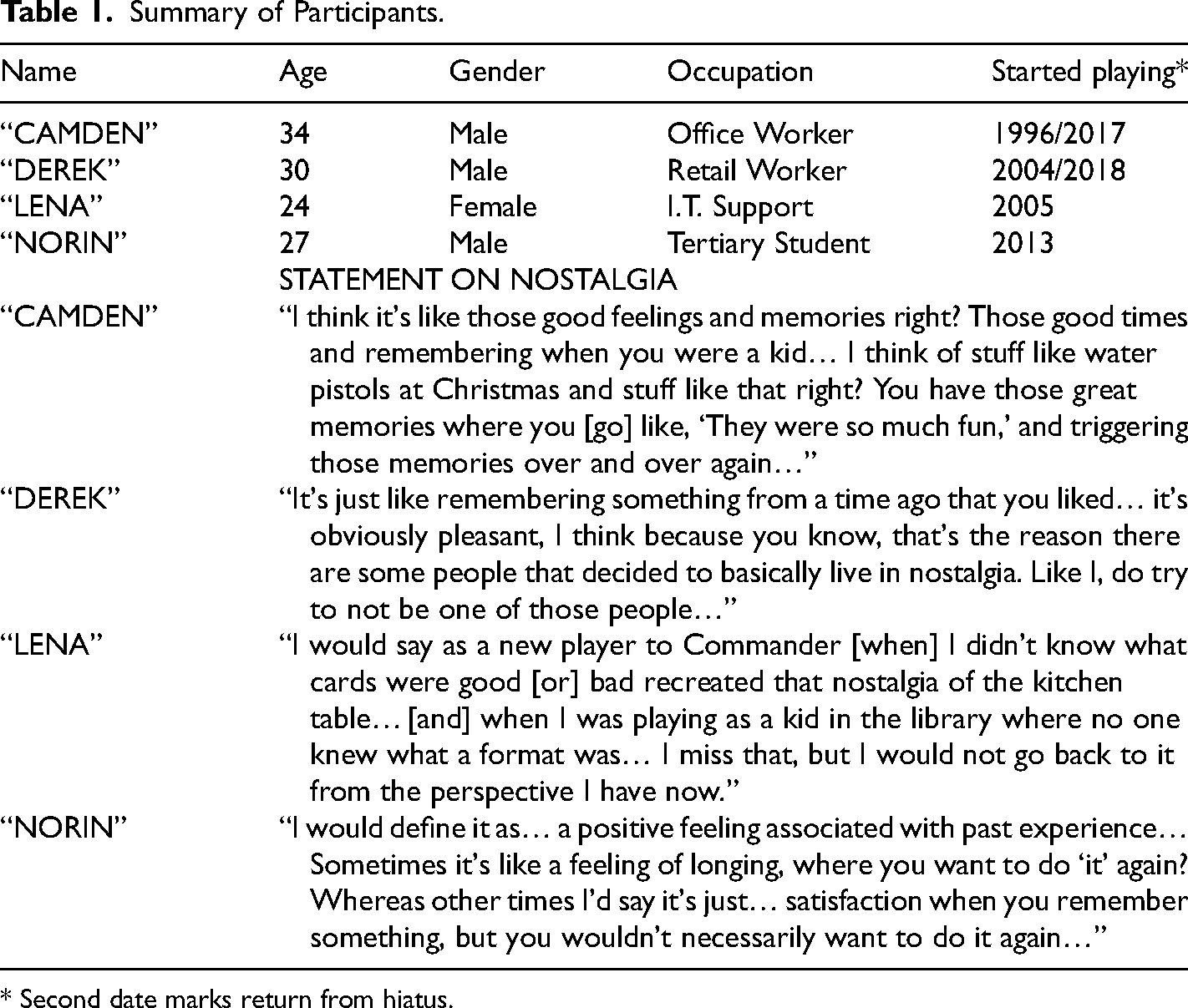
* Second date marks return from hiatus.
Gaming Capital in MTG
As MTG play is mediated via tactile game pieces, a significant denominator of gaming capital is predicated on ownership of cards and physical peripherals. This is especially salient in relation to the in-game “power” of various cards. In community parlance, a powerful card is any that provides an in-game effect that provides significant gameplay advantage. Notably, powerful cards are context-specific, and thus a generally powerful card may be outclassed by another weaker card depending on the current demands of gameplay. For example, Norin recounts an early interpersonal interaction regarding fundamental card evaluation techniques (Figure 1): [My friend] told me through a card called Capashen Knight… he told me why Capashen Knight was better than a 2/2. It's a 1/1 with first strike but you can pump1 it with its own ability… it has potential to grow into the game while a 2/2 will always just be a 2/2.
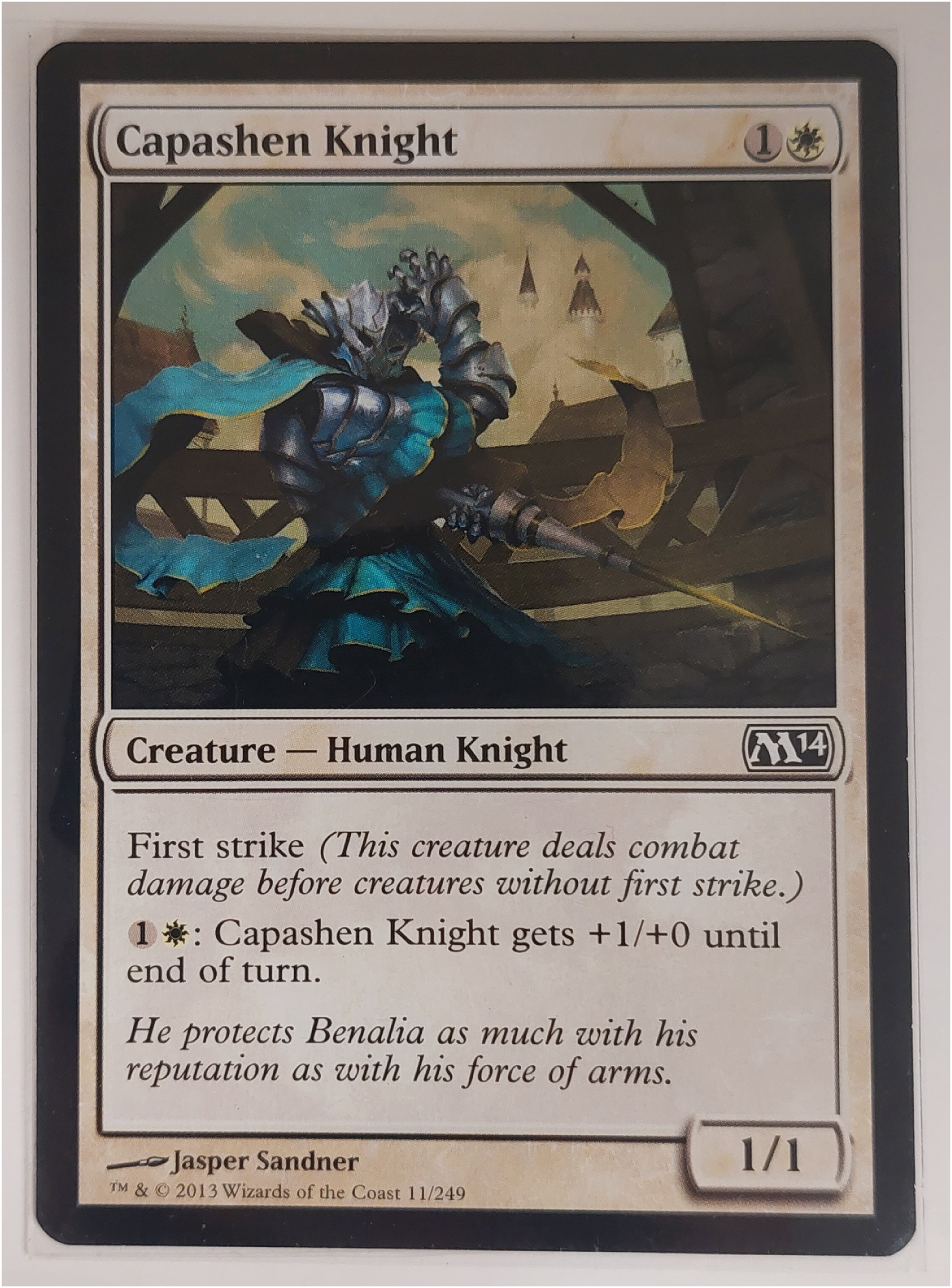
A copy of Capashen Knight.
This exchange is a basic example of player collaboration which disseminates strategic knowledge from adept to novice (Fine, 2013). Although potentially discoverable via third-party paratextual strategy guides or trial and error, sharing of this knowledge can tighten community bonds through mutual exchange of capital; the adept's gaming knowledge for the chance that the novice will continue to participate and grow to become an established regular player.
In terms of capital acquisition, knowledge from first-party and third-party textual sources mirrors that of other games in being the key paratextual avenues for players to increase their capital. More intrinsic to analog games like MTG however is a predominance for gaming capital exchange via second-person interaction within gameplay itself. Analogous to tabletop role-playing groups, MTG communities are mediated through their spaces of play (Fine, 2002). Knowledge, norms, and cultural mythologies are exchanged as part of participation in these spaces, since gameplay inherently requires discussion with one's opponent/s such as announcing plays, clarifying rules, and commenting on card choices. This imparting of knowledge applies not only to mechanical and organizational aspects of play but also highlights the social status of expressional facets such as sleeves, playmats, and deck boxes (Weninger, 2006). The culturally determined necessity of these items becomes more apparent the longer one is engaged with regular play, along with their potential for self-expression—enabling players to display artwork from official third-party sources or custom designs (Trammell, 2013).
Nostalgia and Wonder
Nostalgia for one's previous experiences in a leisure culture field runs deeper than surface-level attachments to aesthetics and positive memories. While these attachments remain potently nostalgic, the transition from novice to master via gaming capital acquisition gradually eliminates the early sense and experience of the game-player-self, represented by an open horizon of possibility. It is this gradual loss as the horizon of possibility shrinks that is a fulcrum of nostalgia that no product nor revisitation can satiate. For although a player can preserve their first starter deck and replay with it years later, they are incapable of returning to the (in)experience level of those early forays—just as one cannot rewind time and return to childhood. Lena felt this keenly in relation to a formative experience of play with her first deck and a particular card in it (Figure 2), when she described how: You could find the Reckless One [online] and you could spend five cents on it because it's an unplayable [card] from Onslaught!2 But you can’t find [my] Reckless One which was the bomb3 of my goblins deck when I was eight years old, and [which] won a whole bunch of games for me and [I] played unsleeved on the pavement!
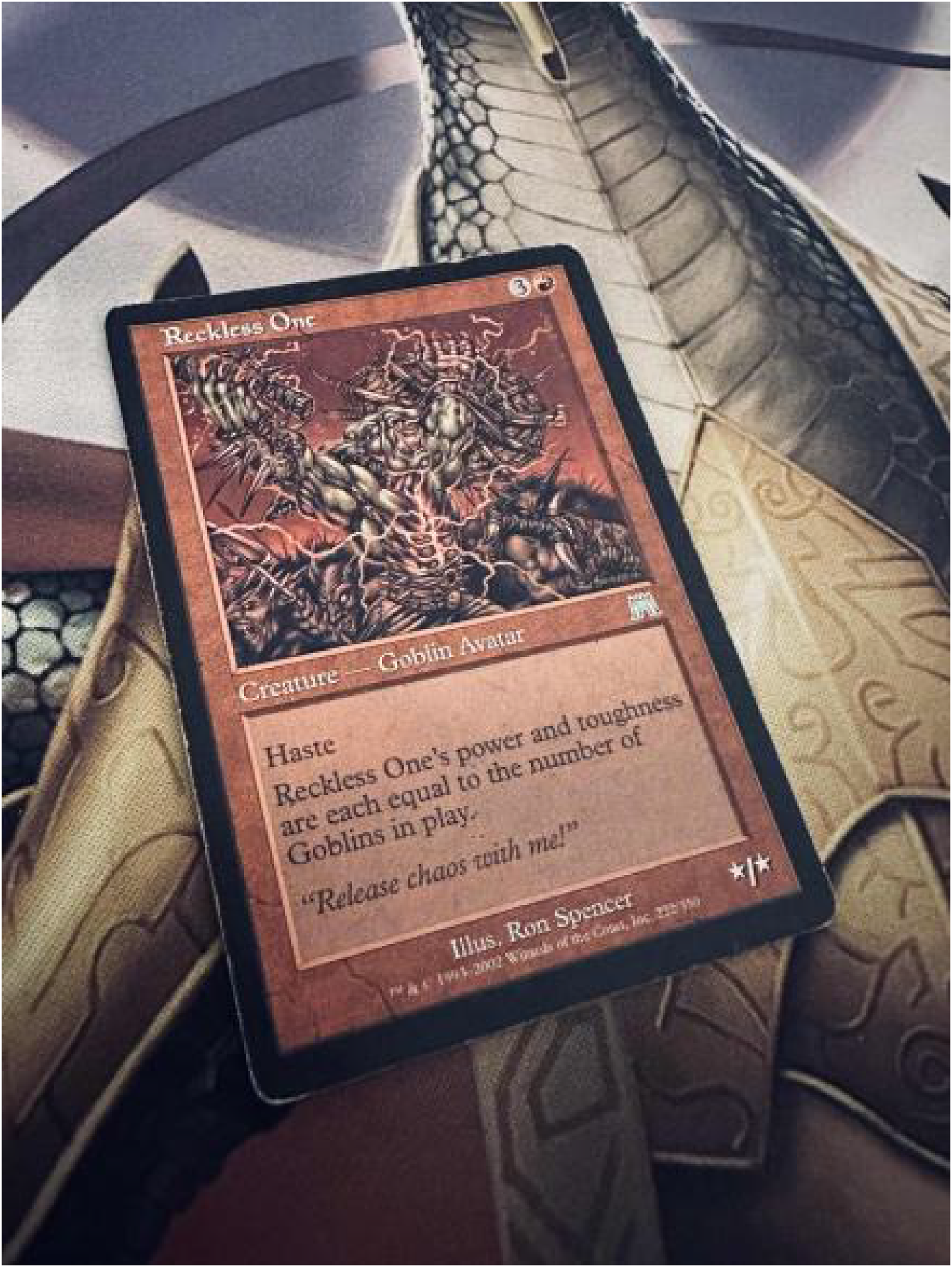
Lena's copy of Reckless One.
As she details, although she retains ownership of the cards, their gameplay value to her has since been replaced with a culturally mediated and capitalized understanding of card power. The card, “Reckless One,” which she identified as being the “bomb3” card of her deck in memories of early play based on her early success, she now filters through this framework of communal gaming capital which is reflected in the market price. Furthermore, in reflection she considers the manner of play—that of using cards “unsleeved on the pavement”—in the same manner, as this mode of play is quickly learned to be not ideal; especially with financially valuable cards. While she could rebuild the framework of these memories with the capital at her disposal, neither specific cards nor the mode of play can again be regarded with the same reverence because of her current level of gaming capital. It and the rest of Lena's deck gradually transformed from gameplay object of high power to reflective nostalgic locus over the course of her gaming journey. Like the eight-year-old novice she once was, the state of gaming capital naivety is lost forever. And after being confronted by an encounter with a young player during a tournament, the full effect of this transformation was made apparent. As she recounted (Figure 3): [I remember] this nine-year-old kid who I played against once. … He [played a] turn-one Raging Goblin! It was like in the movies when you get dragged back to the past and you’re a kid again. It's what I did with this deck back in the day; turn one, play [a] goblin, attack for one, pass [the turn]. He’d built his deck around this legendary goblin he found in a pack that he thought was cool. … I did let him beat me because how could you not when a kid brings a deck like that! But it was just so magical! I lost to Mono-Red Goblins; it was just a beautiful moment! He was nine years old, and I had a flashback to literally being a nine-year-old, with a Goblins deck, playing against people who probably thought, “Oh man I [want to beat] this kid!” It was just an absolute circle of life [moment], it was so cool!
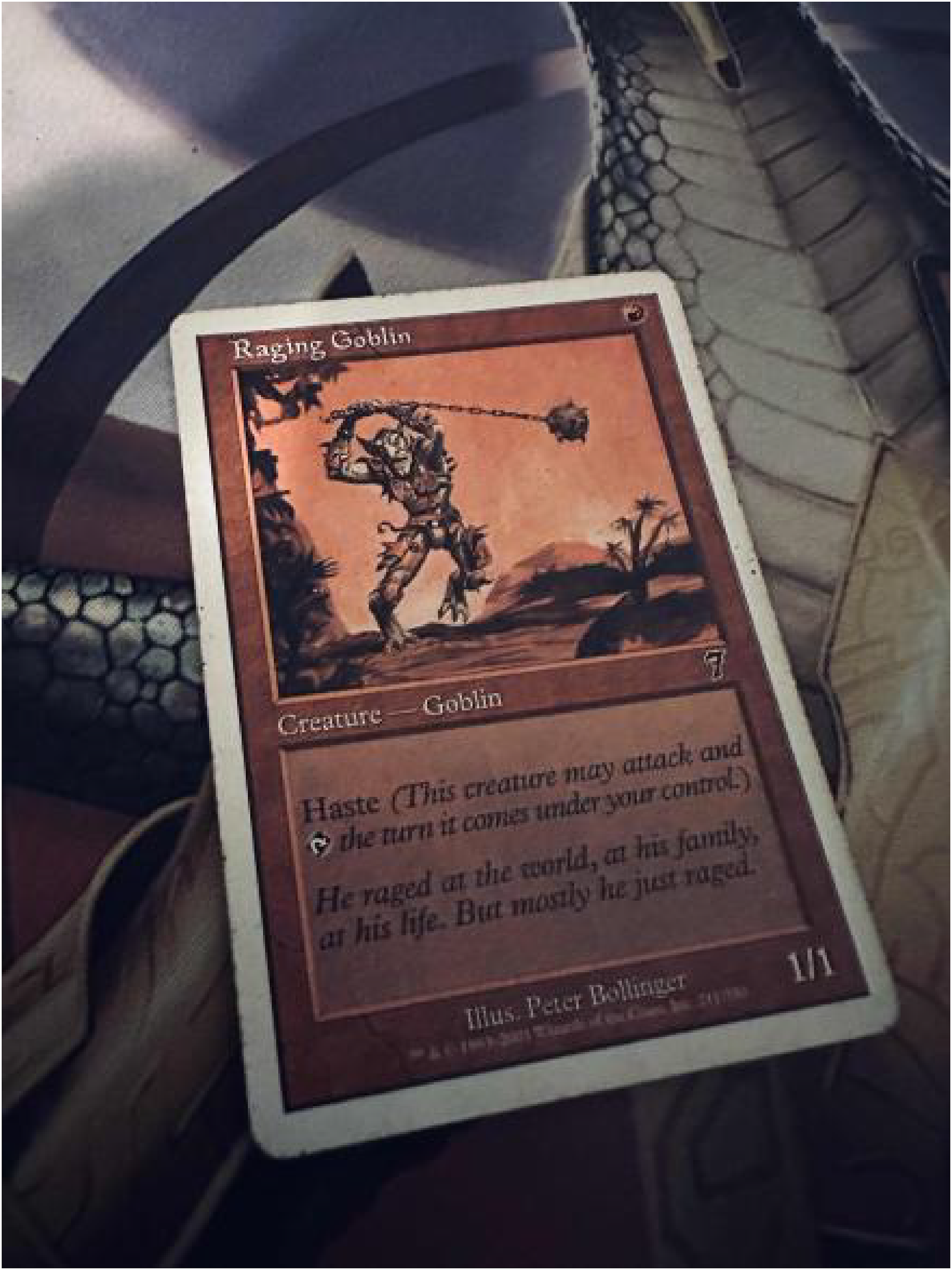
A copy of Raging Goblin owned by Lena.
Here is evidenced the powerful nostalgic response experienced by Lena, as her recalled wonder is reflected in the contemporary wonder of another. And not wishing to dispel the fleeting state of their wonder as she nostalgically recalled it, responded by allowing him to remain ensconced in that state by handing him a victory he otherwise would not have achieved.
Analogous to a childhood experience of creative play with minimal resources, these early experiences of imaginative play work to fill gaps in players’ gaming capital, which is then later responded to nostalgically. These manifest as what Derek described as a “sense of wonder” toward the potentially limitless possibilities they face. He described this response within his own early learning experiences following a lengthy hiatus from the game The sense of wonder. I think it's still there. I had that sense of wonder of like, back when I didn't know what the cards were [and going,] “Oh what's this, [it] is cool.” I remember being annoyed when I [first] saw a planeswalker.4 I hadn't seen one before because it was an entirely new [card] type. I was familiar with everything else, but I was like “What is this?” … I think everyone misses the time when the world was still full of like mystery and wonder where you could just like Google [MTG]…
Derek's “sense of wonder” here reflects Lena's early experience of play in more abstract terms—as an atmosphere of mystery that surrounds the game and the potential cards that exist in lieu of available gaming capital. While originally picking up the game with a group of friends during school in 2004, he moved on from the game after a year before returning in 2018 with the release of MTGA and encountering the “planeswalker4” card type. He recounted the experience as a mixture of annoyance and mystery, but later recalled it fondly. Since the breadth and depth of MTG-related gaming capital that is drawn upon during regular play is significant, as Norin highlighted earlier with his statement on the high knowledge barrier to entry, play with other regular players coalesces into an experiential plateau—there is little to surprise beyond the game's inherent unpredictability once the core aspects of play have been learned (Jones, 2023). Derek discusses an example of this from his early days of play (Figure 4): [We had] five people playing at once and everyone just—no one played removal5 [cards], no one played counterspells,6 everyone was like—I hear stories like this nine-year-old girl who is a pro player and plays Elves and is just… good at the game. And then I was like eleven, I didn't even understand what a counterspell was… All I really have from memories was playing a bunch of bad creatures and then someone will play Wrath of God and then everyone played their creatures again… I eventually made a red-blue deck that had a bunch of artifacts in it. I was like, “Man, no one's done this before!”
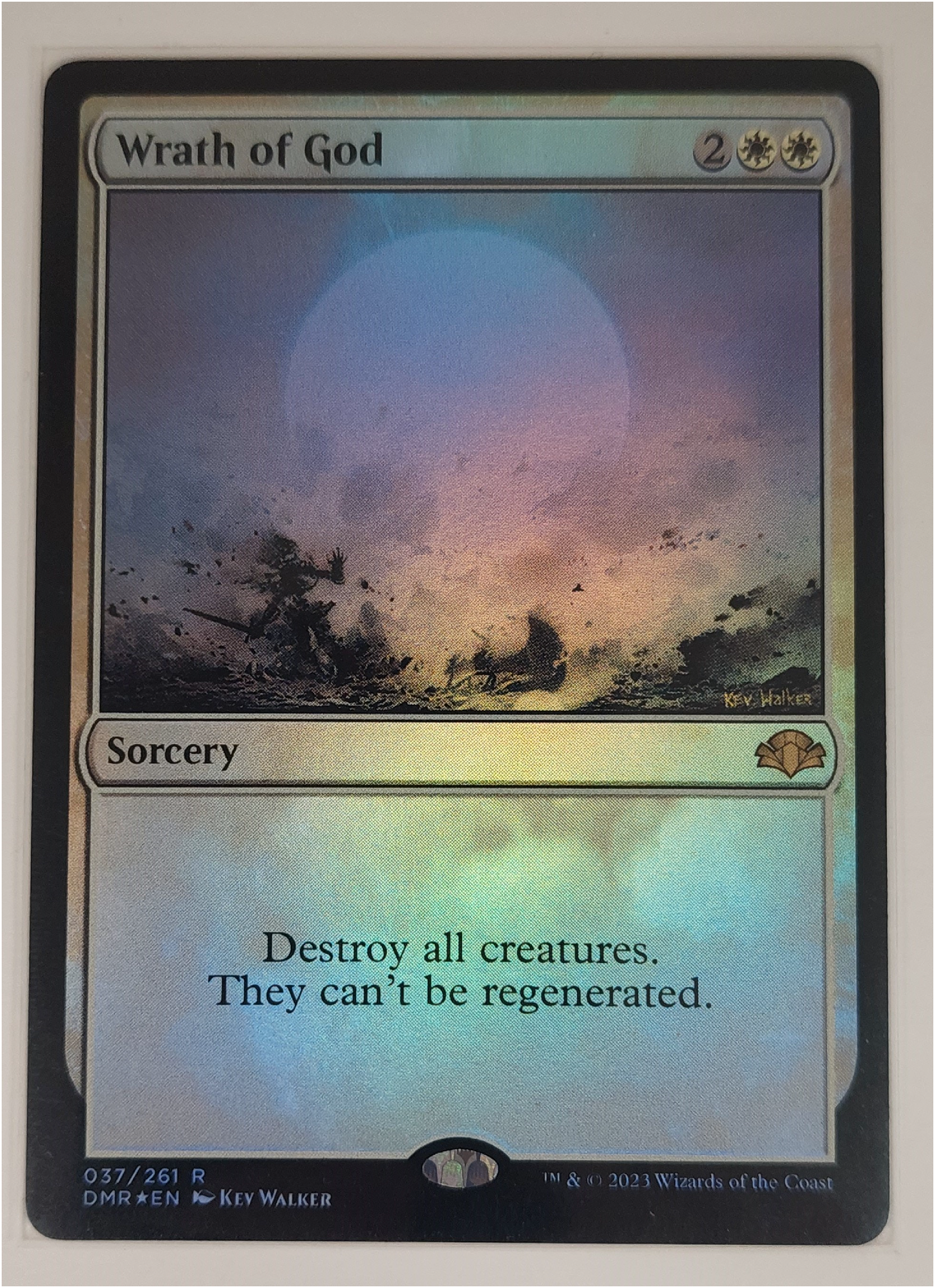
A copy of “Wrath of God.”
The creative and unrestrained play that takes place in the scenario from Derek's memory further highlights a fondness for naive play. However, they do not highlight a restorative nostalgic desire to recreate these experiences (Boym, 2001), as neither Derek nor Lena articulates a desire to reconstruct these memories or return to this environment of play. Rather, nostalgic reflections are presented through the rearticulation of past experiences into contemporary gaming capital structures, such as Derek's development of a new deck; stating he “built that deck because [he] had [a card called] Catapult Master, even though [he didn’t] play with it because [he] didn't ‘get it’” at the time. Even in this rearticulation however, what is expressed is a reflection upon and keen understanding of what is lost from temporal advancement and its related capital accumulation. Building a deck based on a prior experience both cannot retroactively convey knowledge across time and is coded by the norms of experience that expertise enshrines. In these expressions dwells a mourning of a lost and irreclaimable past in which the cultural field of MTG was still invested with “mystery and wonder” as Derek claimed, where potential possibilities of play had yet to become homogenized by efficiency and experience. This situation reflects Bergstrom's (2021) findings regarding player skill, where players may be misread as novices devoid of any gaming capital rather than of the specific capital required to achieve mastery at the game. Interestingly though, these responses highlight the prioritization of the novice's creativity in applying gaming capital from non-MTG sources over mastery of MTG itself.
Although on the surface the acquisition of gaming capital is considered positively in regard to developing player agency, participants illustrated that communal and subsequently optimized strategies actually degrade this agency. Camden encapsulated this through discussing popular formats of play If you look at Standard and you look at Modern, a lot of those formats7 become really homogenized and really similar because pro players get involved, they say what's the best deck and because if they've made a call that it's the best deck everyone plays it, and then that format becomes defined around that, and that's when it gets stale and it gets boring and you lose that creativity. Which is part of this information age right? Like everyone's so accessible with the information, and so [with the] deckbuilding process… I think you lose that [creative] spice…
Creative agency, or “spice” as Camden describes it, is an important aspect of MTG engagement (Jones, 2023). Despite this, it exists in a tenuous relationship with the zero-sum objective of winning, where one's individually unique decision-making and desires are subordinated to this goal. The application of creative agency in this way is a means through which players may challenge predominant narratives of ludic achievement through dominative victory and resist hegemonic play structures (Fron et al., 2007; Paul, 2018). This situation is at the heart of intracommunity debates and tensions which rest beyond the scope of this paper. It is a challenging quandary for players to navigate once they are made privy to the perpetual knowledge production of the online MTG community, and one that heavily influences not only their choice of cards but also their choice of format. It is an inescapable aspect of regular play for invested players and is a key factor in reminiscence for a seemingly simpler past.
Nostalgia and Financial Naivety
Financial gaming capital is a key factor in MTG players experiencing degradation of agency. Beyond the intrinsic gameplay value of cards, a secondary market governs both card prices and trade exchanges between individual players. This is an aspect of MTG play that is not readily apparent to a novice, as navigating intricacies of the game's secondary market such as the various online marketplaces and ensuring an equitable person-to-person trade demands existing gaming capital. To Norin, navigation of this aspect of MTG brought with it risks that manifested early because of his inexperience. He recounted that during his first store visit in 2013, he opened a financially valuable card from a pack, which he was then approached about. As he recalls, “[the player] said, ‘Hey do you mind if I have this card?,’ and being a very new player, I went, ‘Yeah sure, why not!,’ and I didn't realize [that] I just got scammed out of twenty bucks right then!” As a result, in the years since all copies of this card now bear a nostalgic association with his early naivety; an emblem of a lesson learned and gaming capital acquired.
However, in terms of financial gaming capital's impacts on gameplay itself, these take more time to manifest in the experience of play, both in terms of card acquisition and in opportunity cost. For example, Camden expressed how “it's very painful when you look back [thinking things like,] ‘That was too expensive,’ [and,] ‘I would never pay that.’ Like I should have just done it! All the Underground Seas, all the dual lands…” This response stems from learning the current price of certain powerful game cards; namely, the “dual lands” of which “Underground Sea” is one example. These cards are part of the Reserved List; vintage cards subject to a legally binding promise made by WotC in 1996 that prohibits their official reprinting (WotC 1996). Reserved List cards were the subject of market-wide buyouts between 2017 and 2021, with “Underground Sea” itself climbing from $323USD in 2017 to a high of ∼$1250USD in 2021 for the cheapest printing (MTGGoldfish, 2023). What were once game pieces played in schoolyards or on kitchen tables were transfigured into collector's pieces worth several hundred dollars each; a circumstance in line with broader collectable cultures surrounding retro video gaming, comics, and other ephemera-turned-extravagance (Swalwell, 2007). Overlooked however is the effect this has on players seeking to engage with the content of the media itself; especially if the media was once more readily accessible, as with early MTG. This is especially salient regarding the Legacy and Vintage formats which allow most cards to be played—including cards on the Reserved List which restricts entry to wealthy players. Lena describes the impact this situation has on her aspirations to participate The fact that some formats, specifically Legacy and Vintage7, require you to invest thousands [upon] thousands of dollars into Reserved List cards that are only that expensive because the company is holding itself to a barely legally binding promise that they made in the ‘90s is pretty [terrible]! No other card game has this issue! There is no other card game where the early play pieces for a certain format cost thousands and thousands of dollars, it's unheard of! … They [WotC] won’t acknowledge that pretty much nobody can get into [the formats] unless they bought the cards ten years ago or earlier, or they are stupid rich. And it sucks… because you just have to be able to finance a [MTG] deck which is stupid.
Established players such as Lena and Camden encounter clear limitations to their agency on account of their capital level—represented by their knowledge reserves and echoed in their relationships to their material possessions. This is compounded by the expression of nostalgia for past times in which these limitations appeared less constraining; in this case, prior secondary market prices for staple Legacy and Vintage cards. A classic nostalgic paradox is thus created—a cherished present is only realized in its present absence. To the novice who is not yet versed in intricacies of play, financial and historical implications carry little weight if they do not interfere with play as it is experienced in the moment. But the adept who is versed in these wider factors of play is instead beholden to them and cannot return to this emergent style of engagement. In this way, the novice experiences a play unburdened by broader economic and social limitations (Bergstrom, 2021). Metaphorically, if we were to consider the full extent of possibilities one can imagine as a distant horizon, these limitations act as boundaries which, given sufficient time as the player engages further with the game, narrow the available options to that of a linear pathway which is the only available option for community engagement as an adept. That once vast array of possibilities is reduced to a deterministic result from the social and economic factors of participation and is mourned when reflected upon. As an adept player, Norin seeks to preserve and encourage the emergent play of others through his practice with sealed booster packs won from tournament play. Instead of opening or using them himself, he instead considers that You could give ‘em to a new player. I'm sure it's more meaningful than just opening [the packs] and going, “Oh I got this fifty-cent rare… guess I’ll put it in the trade folder with the others.” … [Before] you take it out because no-one will trade for it cos it's trash!
Here, Norin's disenchantment with his prizes stems from this broader knowledge. His gaming capital prohibits the same level of potential wonder at the contents of his winnings, as he can evaluate a particular set's game pieces and can acquire any he desires via direct purchasing. However, like with Derek, he recognizes the potential for a new player to have a meaningful experience from the act of opening a booster pack; something, which for Norin, has long since lost its novelty and luster. This player who is yet to have their expectations tempered can yet possess the element of wonder. But as their knowledge grows, the circumstances of play form constraints that shape and winnow possibilities until an unenchanted reality remains. This dynamic transition into a linear acquisition of gaming capital combined with financial cost and/or constraint is ripe for the germination of nostalgic sentiment.
Conclusion
This paper has analyzed how the acquisition of gaming capital in MTG leads to the proliferation of nostalgic reminiscence through the recollections of four MTG players. It has demonstrated that since accumulation of knowledge capital is linear and cannot be erased once gained, it creates the conditions for nostalgia generation for an irreclaimable past with one or more positively associated aspects that the individual mourns. Naive early forays into a hobby space where elements of free play and unconstrained interaction flourish irrespective of established cultural norms are cherished and sentimentalized upon reflection as players realize their experiences and knowledge—considered as universal monikers of ludic achievement and success—in fact form constraints on play. In MTG, cards thought to be inefficient or insignificant prove to be powerful gameplay tools, and vice versa. The acquisition of gaming capital in this sense, whether codified by community, financial or gameplay knowledge, shrinks the horizon of possibilities to that of linear, and hegemonic, paths of deterministic action. This paper shows that players experience nostalgia for instances of play that were not bound by these cultural determinants and reflect both positively and negatively on these instances. Furthermore, it draws attention to the hegemonic nature of MTG's gaming capital in preventing nostalgically fueled returns to previous states of play on players’ terms, and that especially in terms of nostalgia related to early instances of MTG products, WotC retains significant power in controlling when and how players can engage with these early products.
This paper presents a wealth of further opportunities for researchers in the arena of game studies, nostalgia studies and sociology. MTG provides a uniquely potent field on account of its interplay with capitalistic market forces, continuous temporal change and evolution, as well as player resistance and acquiescence to both recent and long-standing cultural norms. In addition, future research should maintain a strong connection to the objects of play and I argue researchers must remain cognizant of the interplay between players and these objects in these endeavors.
Footnotes
Acknowledgments
The author wish to thank Dr. Clarissa Carden and Associate Professor Margaret Gibson for their insights; the reviewers for their generous and helpful feedback; and Maryline Kassab for her endless love and support. This paper was supported by an Australian Government Research Training Program Scholarship.
Declaration of Conflicting Interests
The author(s) declared no potential conflicts of interest with respect to the research, authorship, and/or publication of this article.
Funding
The author(s) disclosed receipt of the following financial support for the research, authorship, and/or publication of this article: This work was supported by the Australian Government Research Training Program Scholarship.
