




Abstract
Despite growing sociocultural interest in, and engagement with, tabletop hobby games, and in particular board games, the surrounding culture(s) remain underexamined. Drawing from 43 semi-structured interviews, this article explores board gaming culture from the perspective of women who play modern board games. The findings highlight women’s experiences as a minority and the difficulties they face when entering board games spaces – often perceived as ‘male spaces’ and associated with geek masculinity. The findings also show a ‘gender-gap’ in board games, where women’s reduced levels of experience, awareness and integration into board game culture act as a barrier to their participation and negatively impact their sense of belonging. Despite these barriers, the presence and experience of other women helped to deconstruct the notion that board games were solely for men. Furthermore, the findings also show how men and women are actively constructing newer, more inclusive board games cultures which eschew exclusion and challenge board game’s associations with geek masculinity. This research provides insight into some of the barriers to entry women face as well as the changing nature of contemporary board game culture.
Introduction
As an age-old and ostensibly ‘analogue’ pastime and culture, board gaming – and tabletop hobby gaming specifically – has enjoyed a dramatic, and unexpected, rise in popularity in countries like Britian, the United States and throughout Europe across the first decades of the 21st century (Booth, 2015). Tabletop hobby games are those games not targeted at the mass-market but at consumers with more specialist interests (e.g. Settlers of Catan, Gloomhaven, Terraforming Mars), sometimes referred to as hobby gamers (Woods, 2012). Hobby games can be further broken down into subcategories such as tabletop roleplaying games (TRPG); war games; collectable card games (CCG); euro games and modern/designer boardgames more generally (Mayer and Harris, 2010). 1 The latter in particular have seen significant growth in interest over recent decades (Sousa and Bernardo, 2019) and it is often remarked that we live in a ‘golden age of board games’ (Konieczny, 2019; Sousa and Bernardo, 2019).
Board games are a phenomenon that have challenged assumptions around the presumed evolution of gaming, as something that was all but inevitably shifting away from analogue to digital (Konieczny, 2019). Indeed, while not (yet, at least) comparable to the video games industry in terms of reach or market share, an Internet-facilitated proliferation of designers and their products, retailers, consumer conventions, ‘meetups’, and a range of online communities and content creators has seen board gaming cement its place as an integral part of broader ‘geek’ and gaming culture. As something that is both archetypally ‘pre-digital’ and now facilitated by the digital, to borrow from Cramer (2015), board games’ increasing popularity is therefore now best understood as ‘post-digital’: a phenomenon carrying revivalist sentiments and a growing disenchantment with technology, while at the same time dissolving fundamental analogue/digital distinctions.
Despite seemingly ever-increasing interest, research into board games, unlike other areas of geek culture, is still very much in its infancy (Sousa and Bernardo, 2019). Although studies have started to explore some of the social aspects of the hobby, such as their capacity as a conduit for sociality (Cross et al., 2023; Rogerson et al., 2016) or how board gaming practices are constrained by parenthood (Rogerson and Gibbs, 2018), research from a sociocultural perspective is very much lacking (Booth, 2018). Specifically, research exploring the role of gender within board game culture is virtually absent from the field. This is a notable omission given the prejudice and discrimination women are often subject to when participating in other geek cultures (e.g. Scott, 2019). Accordingly, this research draws from 43 interviews with women who play board games to better understand the extent to which the culture is governed and influenced by wider geek norms, and in particular, geek masculinity.
Similar to other geek spaces and cultures, our findings suggest that board games are very much associated with men and, specifically, notions of geek masculinity. If and when women do come to board games, they thus face additional barriers to entry that men often do not have to contend with. However, the visible presence of other women, particularly in positions of power, are helping to challenge the perception that board games are not for women or that women are not welcome. Furthermore, participants described a duality in board game culture; with older cultural norms aligning more closely with exclusionary geek practices, and newer, more inclusive cultures also being actively adopted and shaped, including among male players. Accordingly, this research presents novel insight into women’s experiences of board game culture; a culture simultaneously tied to its exclusionary geek roots but, at the same time, growing beyond them.
Gender inequalities and ‘geek’ culture
To understand board gaming as a culture and community – and how gender inequalities and dynamics operate therein – we first need an understanding of the broader ‘geek’ cultural ecosystem of which it is part. Within this broader geek culture, the identities, cultures and communities of certain media fandoms (especially science-fiction and fantasy ones), forms of gaming and other geek interests have long been understood by feminist media scholars to be governed by the logics of geek masculinity. Informed by the work of Connell (1995; Connell and Messerschmidt, 2005), geek masculinity is argued to represent ‘hegemonic masculinity’ within a particular setting, one which ‘disavows stereotypically masculine interests in favour of technology and gaming’ (Braithwaite, 2016: 3) but which also (in this geek cultural setting) ‘occupies the hegemonic position in a given pattern of gender relations’ (Connell, 1995: 76). According to Massanari (2015): Geek masculinity therefore privileges the white, able-bodied, young straight cisgendered male over the woman of colour, for example, or the homosexual older man, or the disabled trans woman. This is not to say that these individuals are not active in geek culture but that they remain marginalized, relegated to its fringes, and frequently silenced. (p. 129)
Indeed, while the actual demographics of such communities are changing – and can often comprise comparable numbers of women/girls and men/boys – the cultures around which these communities of fans and hobbyists coalesce are perceived to operate within a gendered identity framework that determines the de facto rules of inclusion and exclusion. Trammell (2023) describes the entrenched White masculinity present within hobbyist geek cultures (including board games but also other tabletop communities) as perpetuating the dominance of White men through the depoliticisation of hobby cultures and what Trammell refers to as networks of privilege: ‘A form of social gatekeeping that polices the boundaries of networks along racial, gendered, and socioeconomic grounds. Network privilege results in the endurance of privileged networks – clusters of people with homogeneous demographic makeups, interests, and worldviews’ (Trammell, 2023: 31).
Geek cultures and spaces are, however, not immune to cultural contestation. Salter and Blodgett (2017) discuss geek cultures as a ‘battlefield’ in which longstanding logics of marginalisation persist but are increasingly challenged by shifting demographics of gender, sexuality and race/ethnicity. Here, an old guard of boys and men ‘who have made geekdom the core of their identity’ are depicted as hostile to the increasing proliferation of girls and women in their spaces. Maloney et al. (2019) similarly emphasise the process of change within geek culture but highlight how this change is happening from within, with geek masculinity itself increasingly contested among boys and men; and consequently, ‘the sociopositive change we all wish to promote is, in fact, already internally in motion within the existing culture’ (p. 98). As Maloney et al. (2019) argue, geek cultures are becoming more inclusive at the intersection of both shifting demographics and the changing nature of boys’ and men’s attitudes in these spaces: ‘as the attitudes and behaviours of boys and men continue to change in gaming spaces, girls and women become more likely to enter them, and vice versa’ (p. 9). These changes take place within the wider sociocultural context of debates around the changing nature of masculinities and gender relations. Although men have long been seen to demonstrate masculinity through their domination of women and other men (Connell, 1995; Connell and Messerschmidt, 2005), some scholars document a contemporary attenuation of this ‘hegemonic’ form (Anderson, 2009; Anderson and McCormack, 2018; Scoats, 2017), and highlight an emerging pattern of more open and inclusive masculine expressions.
Recent scholarship on geek cultures provides a mixed picture regarding the extent to which they remain governed by hegemonic forms of geek masculinity or are – depending on the specific geek space, community or media under examination – undergoing processes of sociopositive change. Echoing Massanari (2015), Scott (2019: 1) sees a landscape in which girls and women, though numerically comparable to boys and men in their participation in fandoms and gaming, often remain marginalised as a ‘surplus audience’. At the same time, and mirroring broader 21st century ‘culture wars’ across the developed world, Scott (2019) acknowledges that geek cultures find themselves amid a conflict ‘marked by growing fan activist efforts surrounding issues of diversity in media production cultures, and pushback from mostly cisgendered, heterosexual . . . white male fans who view these efforts as an unwelcome encroachment’ (p. 2). Fine’s (2019) analysis of the popular geek podcast, The McElroy Brothers, highlights the positive role that some cisgender heterosexual men are playing in contesting inequalities in geek cultures. Here, the high-profile brothers (including Griffin McElroy, co-founder of the popular geek culture website, Polygon) ‘deploy new, exciting narratives that trouble conventional (White) (geek) masculinity, creating space for alternative ways of being’ (Fine, 2019: 143).
Accordingly, geek culture has historically been dominated by men and exclusionary forms of geek masculinity, but there is evidence that this is being meaningfully contested in some spaces, including among boys and men.
Gender and gaming
As a prominent subset of broader geek culture, video gaming is the focus of much of the scholarship looking at gender relations in gaming cultures and spaces. Here, similar logics of exclusion and inclusion, and the normative power of geek masculinity, have been highlighted. Indeed, recent scholarship exploring female (video) gamer identities echoes the broader analyses of geek culture previously outlined, conveying a sense of girls and women as both active participants and subject to outsider status. Kelly et al.’s (2023) study of gendered perceptions of gaming competence highlights the ingrained subcultural prejudices female gamers face, whereby ‘the perception of female competence was low even when objective skill was exactly the same’ (p. 73). Buyukozturk’s (2022: 28, 37) symbolic interactionist analysis of how ‘how gamers reproduce gender inequality in gaming’ found that women engaged in online multiplayer contexts ‘traded place for peace’ through various strategies aimed at rendering their gender invisible (e.g. choosing male avatars and/or muting microphones during play).
Other research has found that women strategically underplay their involvement or investment in video games to navigate potential prejudice. Kuss et al. (2022) provide a complex picture of female gamer identity in which women navigate gendered logics of inclusion/exclusion within the culture but also take pride in their geek status and, in some cases, report being more likely to experience (gendered and non-gendered) geek stigmatisation from others outside the culture. Moreover, Kuss et al. (2022) see a vicious cycle at work, whereby ‘gaming-related stigma . . . could cause some to act as if they do not play. When female gamers hide the fact that they game, the result is that other female gamers risk feeling more like the odd ones out’ (p. 6). Thornham (2008) similarly highlights the markedly more individualised and self-deprecating ways in which women often articulate their relationship with gaming: The gendered public/private narratives emphasised by feminist theory can be found throughout the discussions about gaming. Indeed, a typical response from the women was either to laugh at themselves for their comments. . . or to frame them within caveats such as ‘personally’, ‘it’s just my opinion’, or ‘I know it’s childish/stupid/funny but . . . (p. 137)
The broader implications of women having to navigate video games in a manner that reduces their visibility or perceptions of their interest in the hobby is that it reinforces the notion that video games are a male hobby. Noting that any attempt to quantify the actual gender demographics of who is defined as a gamer depends on the strictness of the gamer definition – Paaßen et al. (2017) argues: The association between gaming and the male gender leads to less visibility of female gamers – due to a reduced feeling of fitting in, reduced self-identification, prescriptive stereotyping, and active discrimination – which in turn leads to a stronger association between gaming and the male gender. (p. 429)
Furthermore, Paaßen et al. (2017) warn that this gendered channelling of pursuits and interests ‘may preclude [girls and women] from a range of affective, behavioural, perceptual, cognitive, and physiological benefits’ (p. 429) associated with video gaming. Supporting this argument around exclusion from, and in, video gaming cultures, Thornham (2008) found that women who played video games need to engage in ‘a wider sociocultural negotiation and interpellation with certain stereotypes’ (p. 132) to make sense of themselves as participants in gaming as ‘a boy’s thing’.
Thus, despite some of the wider sociopositive developments within geek culture more broadly, and notwithstanding Maloney et al.’s (2019) more optimistic analysis which focused on both geek and video gaming cultures, research on women’s experiences of the latter generally suggests that it remains stubbornly resistant to cultural change; and women are often compelled to employ various strategies to downplay their visibility and protect themselves from prejudice.
Women and board games
Although there is currently limited research into board games culture specifically, looking at hobby game cultures more broadly (i.e. including miniatures games, TRPGs, etc.) suggests that – comparable with video games and echoing some similarities with geek culture generally – they are unlikely to be welcoming spaces for women.
For example, looking at the design of the games themselves, early versions of the popular TRPG, Dungeons & Dragons, often rendered women invisible, aligned them with narrow gendered stereotypes or presented predominantly sexualised manners (Garcia, 2017). Similar erasure and sexualisation has been found in the tabletop miniatures war game Warhammer 40K (Muñoz-Guerado and Triviño-Cabrera, 2018). Exploring lived experiences, McKinnon-Crowley’s (2020) analysis of the popular fantasy-themed competitive card game Magic: The Gathering (MtG) provides useful qualitative depth, highlighting the ways in which female players are rendered ‘perennial’ outsiders; how they experience forms of sexism and misogyny that remain unchallenged by potential [male] allies; and how they navigate such challenges in order to continue engaging with their beloved pastime. Falcão et al. (2021) similarly highlight the reinforcement of conservative gender values by male players within MtG. Looking to board games specifically, the few studies that explicitly explore the intersections of gender within board gaming similarly indicate that they are likely unwelcoming to women. In respect of participation rates, initial research suggests it is a heavily male-centred cultural space, potentially reflecting Trammell’s (2023) aforementioned concept of networked privilege. Cross et al.’s (2023) survey of more than 1500 board gamers found a demographic split of roughly 75 percent men and 25 percent women; similarly, Booth’s (2021) large-scale survey of board gamers was approximately 70 percent male. However, it should be noted that neither of these surveys claim to be representative and may also reflect certain types of gamers: that is, those invested in the hobby enough to spend their time in board game-specific online spaces where recruitment might take place. Accordingly, there is a significant degree of uncertainty around the gender demographics of board gaming.
Regarding the content of games, women are often depicted significantly less on the board games’ boxes in comparison to men (Pobuda, 2018). Jones and Pobuda (2020) also argue that the tendency in modern board games’ rule books to utilise male pronouns, and their broader (lack of) representation of women may contribute to the cultural message that board gaming is a space for White, middle-class and cisgender heterosexual men. Girvan (2022), however, highlights opportunities for women to challenge and subvert the maleness of board games through a re-visioning and reconfiguration of characters and themes, helping to foster a wider engagement with feminist perspectives.
In terms of women’s experiences within board game culture, Booth (2021) highlights a range of behaviours that may serve to exclude women and gatekeep their participation: The microaggressions, gendered assumptions, paternal attitudes, casual sexism at a gaming table, throwaway homophobic remarks, and mansplaining . . . all add up to an environment that can sometimes be implicitly or explicitly hostile or alienating to players that don’t fit the ‘traditional’ [male] mold. (p. 174)
Indeed, Peaker’s (2019: 48) thesis demonstrates how women’s expressions of resistance against sexism within board games culture are frequently dismissed as inappropriately political interventions and ‘ruining the fun for other people’ (Trammell, 2023). Davis’ (2013) unpublished ‘preliminary report’ on women and board gaming presents a mixed picture of board game culture – finding both exclusionary and inclusive practices – with participants ultimately articulating ‘a desire for a more diverse gaming community’ (p. 17).
More inclusive gaming spaces may, however, already exist. Barbosa’s (2021) research around a board game café in Portugal suggested that the clientele of the café was roughly even between men and women, with some of their interviewees explaining that the presence of a female owner had a positive impact in challenging the perceived masculine nature of the hobby. The female co-owner also highlighted that they had intentionally tried to construct a cosy space with an attractive decor as they felt that these facets specifically appeal more to female customers. In his discussion of board game communities in Hong Kong, Harrington (2023) also highlights how the cultural development and motivations of specific board game groups may hypothetically impact on how welcoming they are to women.
Accordingly, the extent to which geek masculinity, as a (sub)culturally specific expression of masculinity, governs the culture of board gaming – this resurgent, curiously both older and newer geek culture and community – is a key concern of the current article. Numerous studies have explored how geek masculinity impacts the perceptions and experiences of girls and women in other geek culture settings and communities. However, the extent to which geek masculinity similarly influences board culture is currently unknown. Thus, this article expands our understanding of board game culture and the role that gender plays for women involved with modern board games.
Methods
Participants
Participants were recruited using snowball sampling via the first author’s personal connections, posting physical (posters) calls for participants in a small number of board game shops and cafes in England, posting in online groups for board games, and sharing via social media such as Facebook and (formerly) Twitter. Information regarding the study explained what we meant by ‘modern board games’, 2 and that participants were invited to take part if they were ‘a woman who has an interest in modern/designer board games, or you view it as a hobby, or you consider yourself a board gamer’. Specifically, the study focused on accessing participants who had some sort of personal interest in board games (in contrast to more casual players) as it was hoped that they would more likely have experience of wider cultural elements and activities connected to board games. A total of 43 semi-structured interviews were conducted.
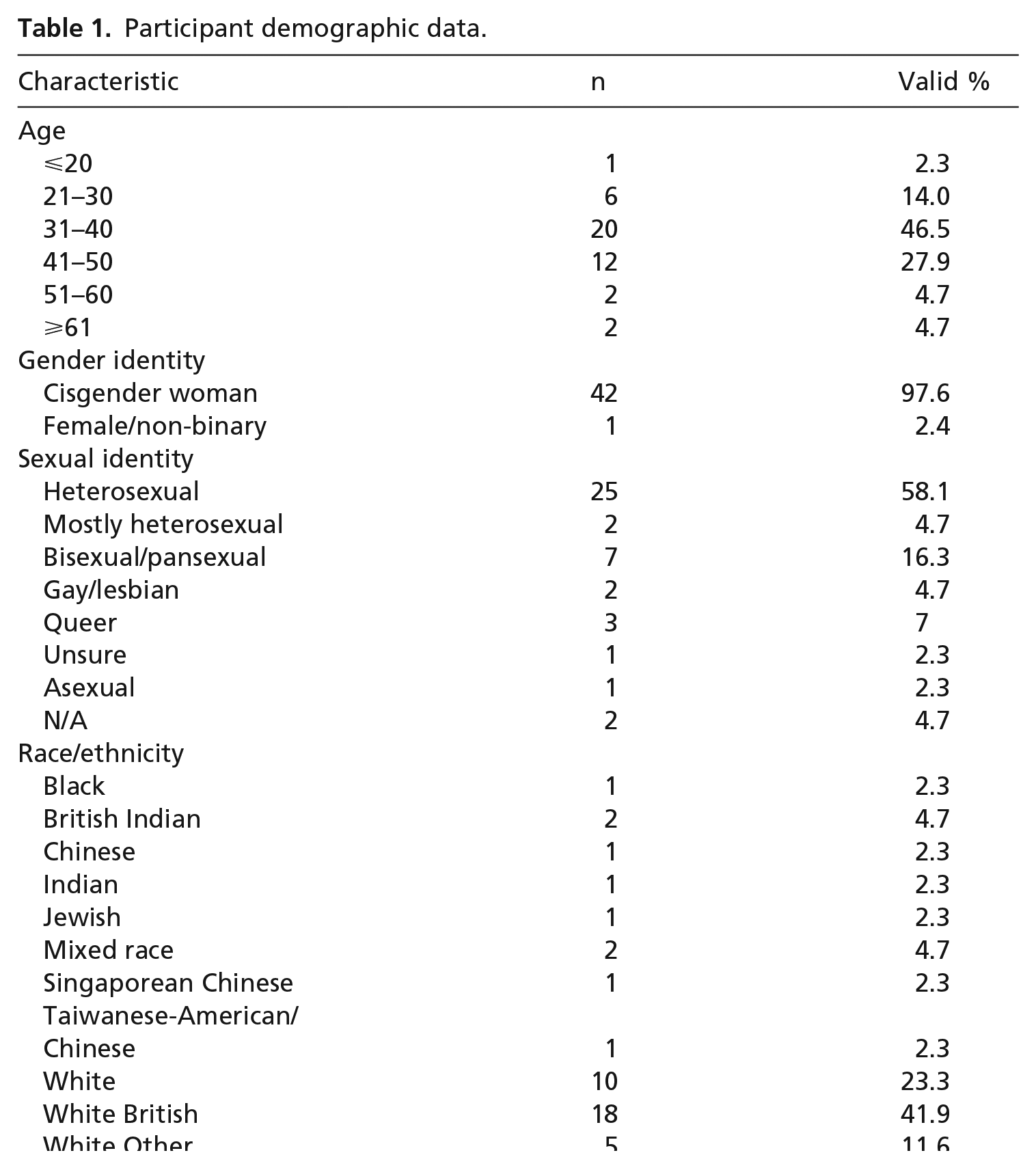
Regarding participant demographics (see Table 1), there was a mean age of 38.9 years old (SD = 9.6), participants were predominantly White (76.8%; including White, White British, White other) and just over half identified as heterosexual (58.1%). The majority of interviews were with women from and based in the United Kingdom, the United States and Canada. Within the ‘Results’ section the following participant details are provided after each quotation and include pseudonym (if not already referred to in the text), age, race/ethnicity and sexuality.
Participant demographic data.
Procedures
Potential participants were directed to a webpage which included a lay summary of the study as well as a more in-depth participant information document and consent form. It was explained that the study wanted: To understand and explore the experiences, perspectives, and attitudes of women within modern tabletop (specifically board game) culture. Within board game culture, women are often in the minority, and this project thus aims to explore how they navigate and experience this predominantly male space.
Participants consenting to take part in the study were offered an in-person (depending on location) or online interview which were recorded and transcribed for analysis. Interview lengths ranged from 30 to 80 minutes. No monetary incentive or reward for taking part in the research was offered. All names and identifying information have been changed. Ethical approval for this study was attained through Coventry University’s FAH ethics board.
Analysis
Data analysis was conducted utilising Braun and Clarke’s (2021) reflexive thematic analysis, a method which allows for flexibility in interpreting and exploring participants’ experiences (Braun and Clarke, 2006). The authors first familiarised and immersed themselves in the data, creating an initial level of codes. These codes were then discussed and refined, exploring both the semantic (explicit) and latent (inferred) meanings being created. Initial themes were generated (Braun and Clarke, 2021) and (re)organised until it was agreed that themes were meaningfully and accurately representing the ‘patterns of shared meaning’ (Braun and Clarke, 2019: 592) across the data.
Author positionality
Both authors here are cisgender men with a commitment to social justice, as evidenced by our respective research agendas and backgrounds, and an awareness of the potential pitfalls related to our normative positioning. All of the interviews and participant recruitment were conducted by the first author, a man who has been avidly playing board games for over 10 years. Entering into the interview process, the first author was thus positioned with both insider status (as someone with knowledge and experience of board games and their communities) and outsider status (not being a woman). As Merton (1972) argues, ‘individuals have not a single status, but a status set’ (p. 22), thus the notion of being solely an insider or an outsider is overly simplistic (Savvides et al., 2014). Accordingly, while authors recognise their positioning as (partial) outsiders they also believe that analysis and interpretations coming from these perspectives have the potential to offer alternative and important understandings (Bridges, 2016).
While acknowledging that there is no singular ‘truth’ to be found in reflexive thematic analysis (Braun and Clarke, 2021), the authors recognise that their individual positioning may have co-constructed knowledge in particular ways (Olmos-Vega et al., 2023). Indeed, during the interview process the first author capitalised on their knowledge and experience with board games while explicitly recognising that they could not share the experience of being a woman in a male dominated space. Despite the unavoidable impact of the researcher on the research process, both authors engaged with and discussed personal, interpersonal, methodological and contextual reflexivity with the aim of recognising the impact of our prior experience and biases and how these could be reduced across the research process (Olmos-Vega et al., 2023) – for example, the selection of broader, open questions and allowing participants to focus on what they felt was important.
Results
Board games as a male space
To varying degrees, all participants shared in the impression that men normally outnumber women in board game spaces – public games groups, online groups, conventions, shops – as well as in the broader culture (e.g. board game media, design, etc.). When asked about this, Mary said: ‘it’s definitely something that I noticed . . . Obviously, as a female gamer, it’s very kind of very male dominant’ (29, White British, heterosexual). Similarly, Claire said: ‘Going into gaming shops, and events, it certainly is [male dominated]. Yeah. Weighted towards males, there’s a lot less females there’ (42, White British, heterosexual). For Fran, her awareness of just how male the hobby was emphasised when she started attending larger events with her husband: ‘I think I really noticed that there was a gender disparity when we started doing UK games Expo’ (64, White British, heterosexual).
As there are often fewer women in board games spaces, it was not uncommon for participants to be the only one at a given games night or around a table when playing. Accordingly, many described a clear and discomfiting awareness of their minority status in that context: ‘you can’t not be aware of it when you walk into a room’ (Mina, 43, British Indian, unsure). Moreover, the act of entering these spaces was frequently seen as an intimidating one: ‘It’s really difficult as a woman to walk into a place which is all men’ (Lauren, 48, mixed race, heterosexual); ‘To a woman, going into any space that’s male dominated can be quite intimidating’ (Amy, 20, White British, heterosexual); ‘It’s fucking terrifying. Because there’s that bit as the bell rings as you open the door, and then there’s a few looks, and then you’re just like, ‘agghhhh I’m not a spectator sport’ (Holly, 38, White British, bisexual).
Reinforcing the sense that board games were a male space, the hobby was also clearly associated with geek culture. Stereotypes and experiences of geek or nerd culture could consequently be off-putting for some women: I think [board games are] are related to nerd culture, which is like, very masculinized, unnecessarily so. And so board games, like science etc., for no actual reason have been taken into the domain of masculinity. So I think a lot of women just don’t gravitate to it because it doesn’t seem right. (Lorna, 33, White, N/A)
However, for the women who identified with geek culture, these expectations were less of a barrier: ‘I feel like I kind of fit in because I’ve always been like, a weird kid. And so I kind of feel like I fit in with the nerdy community’ (Elle, 27, White, asexual). Indeed, some even found that being a geeky woman gave them especial standing within these spaces: ‘There can be a bit of a bit of kudos and a bit of status in being a woman who’s into that kind of thing’ (Charlotte, 35, White British, heterosexual). Similarly, woman who were used to predominantly male environments, such as their friendship groups or workplaces, were less likely to be put off by the maleness of board game spaces: ‘Having worked in the tech industry, and lot of the time being the only woman running meetings being in charge of blokes, because of that, it don’t bother me’ (Jane, 65, White Other, heterosexual).
It was also clear that, as women, many participants had not experienced the same level of integration into board gaming culture over the life course, thus creating a gender gap in which women had fewer opportunities, less awareness and less access to the culture. For example, Rosie said, ‘So when I was in high school and in school, it was always very standard for boys to play, and none of the girls really ever played’ (32, White, heterosexual). Going against gendered geek stereotypes, especially during the teenage years, was seen as a stumbling block to participation in board gaming, one that many girls would find it impossible to overcome: There is still a stereotype that if you play games you must be a geek and therefore you’re not attractive and therefore you’re never going to meet anyone and what a swot and you probably like doing your homework and all of those silly things . . . [I] think it takes balls, girl balls, to go challenge those stereotypes and it’s much easier to just be like ‘Yes I’ll play with dolls’. (Cath, 41, White, pansexual)
The lack of childhood and teenage exposure ensuing from gendered stereotypes may mean that awareness, experience and knowledge gaps develop between men and women over time: ‘Most of my female friends tend to have the same point of experience I had, where if they had any board game experience as a kid, their teenage years just wiped it out’ (Holly, 38, White British, bisexual).
When women were newer to games and thus took more time to familiarise themselves with a given game’s rules, or needed to ask more questions than other players, their feelings of ‘otherness’ were intensified: If I felt like I didn’t understand something, but everyone else understands it, then I’m just a bit like, ‘Oh God am I the stupid one? Why did that not click? Why did I not understand that?’ (Mary, 29, White British, heterosexual)
A further consequence of women’s comparative lack of knowledge, experience and awareness is that participants felt they often needed “inviting” into board game spaces to overcome these barriers: ‘Women tend to join groups based on friend recommendations like, “I’m in this group, come join me”. And if there’s not many women in the group in the first place, you’re not going to get that social invite’ (Edith, 31, White British, heterosexual). Sarah also said: There are people who, in certain spaces, who I think for the most part, it doesn’t occur to anyone to invite someone in. And that’s the thing with a hobby, somebody has to introduce you to it because they want you to get into it . . . A hobby starts in a group and it just sort of stays endemic to that group unless people are inviting and spreading. (30, White, heterosexual)
In confirming board gaming spaces as informed by exclusionary logics of geek masculinity, participants’ narratives echo much of the literature on broader geek, as well as video gaming, cultures. However, their impressions suggest a contemporary culture in which boys and men remain numerically dominant to an extent that numerous scholars (e.g. Salter and Blodgett, 2017; Scott, 2019) have argued is not (or no longer) the case across various fandoms, video gaming communities and other geek spaces. It was also clear that women’s relative lack of experience with, and knowledge of, board games over the life course acted as a barrier to their relaxed enjoyment of the hobby, and that active inclusion efforts (e.g. being invited into groups by friends) were an important mitigating factor. Ultimately, what shone through most in this section was the degree of unassuming courage – or ‘girl balls’, to borrow Cath’s playfully defiant masculine-coded reappropriation – conveyed by participants in overcoming exclusionary pressures to explore/enjoy this hobby in ways that male counterparts would likely take for granted.
The impact of women’s visibility
Although board game spaces were often described as male dominated, that is not to say that women were absent from them. Participants highlighted that the presence of women in board game culture helped to break down the barriers that the perceived maleness of these spaces could create. Seeing other women in these spaces helped them appear more approachable and safe: It’s really difficult as a woman to walk into a place which is all men. So once you have a critical mass of women there; once you have a few women, I think I feel I feel okay about walking into that place by myself . . . there are some places where I wouldn’t feel happy to just walk in for myself. (Lauren, 48, mixed race, heterosexual)
Sandy explained how the diversity of people she had experienced helped her to feel like she belonged despite her worries about being an older woman: I was quite astonished to realize that actually, there are all kinds of women here and there, there are kind of laddish women, and there are more feminine women, and there are older women, and there are a younger women, and there’s trans women, and there’s just every kind of woman, and I’m not a fish out of water, and I do fit. (58, White British, heterosexual)
Furthermore, the presence of other women was seen as an indicator that a group was more likely to be inclusive of women: I will say that I would definitely feel naturally more welcome if I saw that the group had women . . . visibility is such an important thing to feeling welcome, right. Like I said, seeing another woman, you know, automatically there’s a one less hesitation, a little bit more evidence that this group is more likely to be open to the idea of playing with another female. (Lana, 37, Chinese, heterosexual)
Correspondingly, some took a lack of women in board game spaces as an indication that something might be ‘wrong’ with the space and it would not be a welcoming environment: ‘I feel like spaces where there aren’t a lot of women are red flag, I don’t want to be there’ (Erin, 35, White, queer); ‘like okay, there’s no women. I’m just gonna back out slowly’ (Mary, 29, White British, heterosexual).
Having women in positions of power could also help shape the dynamics of the space. For example, Kerry described how having diverse members of staff at the game shop she played at gave her more confidence that she would be supported if she encountered any negative behaviour from men: Both of [the board game shops I play at] have had women and gender non-conforming people on staff, which is awesome. I think if there wasn’t at least like one person who wasn’t a man on staff in either of those places, it would have been a little bit different honestly . . . the fact that I know that there’s someone who’s super knowledgeable and would have my back if I had some kind of problem, and I could go to them and say ‘Hey, this guy’s being kind of a jerk. Could you do something about it?’ (24, White, bisexual)
Jane explained how one of the organisers of the board game group she attended was a woman, and that this helped to shape the culture of their group in positive ways, especially in comparison to one of the other male organisers: Josie is one of the major forces in the group, although run by a chap as well, the chap is not very welcoming to anybody, male or female, he is an equal opportunity bigot. But Josie makes a lot of effort to make sure that people come into the group, especially single women. They don’t just stand around looking at stuff, we include them in, we add them into the game . . . And so because it’s driven by a woman to a certain extent, it makes it more friendly for women, . . . . So because Josie is so good, it means that we do get quite a few new women coming through the group and being welcomed in. (65, White Other, heterosexual)
Some participants also highlighted how the broader post-digital landscape of online board gaming communities were giving women greater visibility and representation, connecting people to more diverse communities and spaces, and thereby challenging the geek masculine status quo: It’s felt more welcoming since I’ve been able to find a few groups on Facebook that are primarily for women and people who are queer, trans men, things like that. And I’ve been to conventions, where there’s more women present and it’s more evenly balanced. I feel like those are welcoming spaces. (Ashley, 41, White, bisexual)
Jenny described how watching a popular YouTube channel in which a prominent male board gamer actively included women in his videos helped give her the confidence to become involved in the culture: Watching Wil Wheaton’s YouTube show which showcased a lot of games. And as I understand now, he deliberately tried to make sure that he had invited like a lot of women onto the show to play the games with him. So I think that’s something which encouraged me to go to the meetups, which I suspected would have been predominantly male, because I’d seen him with women playing the games. (46, White, bisexual)
However, not all saw women’s online representations as entirely positive. Lisa felt that there were still very narrow depictions of women involved with board games and progress still needed to be made in diversifying the ways in which they were represented. Talking about some of the content she had encountered online: It’s women as accessories, you know, there’s some guy who’s kind of got his wife along, and he’s there doing this thing. And she’s like, ‘yes love, yeah, that’s lovely. Yeah, I’m here I’ll be doing The Price is Right, holding the box’. Or it’s some, you know, dance mom type thing. ‘Yeah, I’m doing this!’, and ‘hey, I’ll do that!’ . . . it’s like, the women don’t even know themselves what place they can have or what their role could be, because there is no articulated space for them. So the only way they can be seen is as a parody of themselves or as an accessory . . . I want to see content by women. And I want it to be good content. I’m rooting for good content. (49, Jewish, mostly heterosexual)
Ultimately, while board games spaces are still dominated by men, the increasing presence of women in these spaces played a crucial role in dismantling barriers for other women. Furthermore, digital mediation of this resurgent media culture was clearly serving as a mechanism for this social change. This theme underscores the transformative potential of women’s presence and influence in reshaping the inclusivity of board game spaces, while suggesting that there is still significant progress to be made.
Shifting board game cultures
Although the perception of board games as a male space, and ensuing gender gaps within the culture, act as barriers to women’s involvement, there was substantial evidence to suggest that the culture is changing. The mainstreaming of board games into the public consciousness, and a wider range of people becoming involved, were helping to strip the hobby of some of its geek masculine associations: ‘The board game community is definitely outgrowing that [geeky] stereotype’ (Linda, 49, White British, gay). Aligning with the rise of a more gender inclusive ‘geek chic’ aesthetic, some suggested that board games were now fashionable: ‘I feel like there’s a younger kind of cooler group of people who are attracted to board gaming now’ (Cath, 41, White, pansexual); ‘they’re quite trendy now in a sense, you see board game cafes springing up, it’s like the norm’ (Emma, 35, White British, heterosexual). Describing this change over time, Lorna said: I very clearly remember the older world gaming. The game shop that I went to in high school was much darker and more cramped, and full of Warhammer figurines and some Magic the Gathering. And then if you look at a board game cafe or store today, it’s bright and airy, and colourful, and it’s a completely different experience. (Lorna, 33, White, N/A)
This is not to say that board game culture has entirely shifted. Rather, there appears to be an ‘older culture’ of games more readily aligned with longstanding gendered stereotypes coexisting in tension with a newer, more inclusive culture (sometimes within the same space). Most closely associated with war games and CCGs, the older culture of games was viewed as (geek) masculine, insular and cliquey, resistant to social change, and more frequently encountered at board game shops: ‘I’ve definitely had the experience of walking into a board game store. And it’s like a record scratches. And everybody turns in like their head swivels. And it’s like, what are you doing here?’ (Ashley, 41, White, bisexual).
Inclusive board game culture was more associated with (customer) experience – board game businesses looking to make sure no potential customer would feel like they weren’t welcome – socialising, being open to everyone, not readily identified with geek culture and most likely to be seen in spaces such as board game meetups and cafes: ‘Our local board game lounge cafe just feels like a normal hipster Café’ (Priya, 34, British Indian, heterosexual). Edith described the difference between board game cafes and this older culture of gaming: [Board game cafes are] centred around food, centred around more social experience for everyone, inviting ‘Muggles’ that tend to be from the outside world. Those are open and inviting spaces meant to get more customers through the door. It’s the backstreet/out of town places where the main clientele is the same people over and over again, same crowd of lads’ doing the same games every night. That’s the ones I avoid. (31, White British, heterosexual)
Edith’s reference here to ‘Muggles’ – taken from the Harry Potter novels and describing ordinary and non-magical people in this fictional fantasy context of wizards and witches – conveys an important sense of these cafes as aiming to shift away from the hobby’s arcane, and deeply gendered, roots in order to become more welcoming environments for all, including the uninitiated.
However, the awareness of the older gendered culture potentially colonising these newer and more inclusive spaces could still cause apprehension: There’s a board game café in my city that has open nights. And my biggest reason for hesitating, is being afraid of running into the bad side of the board game groups, because I just don’t even want to know they exist in my city. (Sue, 39, White Other, bisexual)
Alongside the advent of more customer-focused board game environments, it was also clear that these female participants were cultivating the sorts of gaming cultures and spaces that they wanted to exist, making active efforts to bring people together and include everyone. For example, Lauren described how she helped make the group she co-organised a welcoming environment: So we did put in place various kind of rules at the start about inclusivity. And it sounds a bit draconian, but behavior rules as well, you know, basically just be nice to people and stuff . . . we wanted to make it a place that was welcoming . . . So we’ve had quite a few women turn up who haven’t known anybody, who haven’t been to these things in the past. And I’ll try and place them with people who I know were going to teach well and be encouraging. (Lauren, 48, mixed race, heterosexual)
For others, cultivating the culture they wanted meant attending ‘women only’ games nights or choosing to mainly play with people they already knew: Why travel all that way to play games with people who, you know, a small minority of them are going to be a bunch of pricks? When I could just go: ‘You know what? I’ve got house, I’ve got a game table. I’ve got games. I’ve got friends, you come over. We’ll just play games with people I like’. It’s just easier. (Aubrey, 35, White British, heterosexual)
Accordingly, despite some of the concerns women had prior to their entry into board games (as outlined in the first ‘Results’ section), the contemporary proliferation of a more inclusive board game culture meant that many described positive experiences with the groups and events they had attended, including in their encounters with men: ‘I’m really loving the hobby. I haven’t been not welcomed anywhere’ (Linda, 49, White British, gay) My experiences of board game situations, and particularly the men that I have played board games with, they are definitely in the like, inclusive, bring people in, love the game so much you want to love it too, kind of category. (Talia, 35, mixed race, bisexual)
It is worth noting that a small number of participants also highlighted the presence of a marked inclusiveness of sexual diversity in the spaces they inhabit, an insight which is also reflected in the demographics of the sample: I feel like the board game community is super accepting of sexualities that are not straight. So I’ve met a lot of queer friends through board gaming . . . I just think it’s always been a really welcoming community for trans and for queer folks. (Kerry, 24, White, bisexual) Board gaming is very much sort of an equaliser, gives you a level playing field. Your sex has very, very little to do with your brain cells. And we got people, male, female, not sures, homosexual, transsexual, transitioning, all sorts of people. (Jane, 65, White Other, heterosexual)
In sum, participants here saw the contemporary emergence of a more inclusive board game culture, one marked by a departure from traditional geek stereotypes, and which stands in stark contrast to the older, more gendered and exclusionary culture. Furthermore, these two ideologically disparate cultures seemed to be operating in tandem, sometimes even coexisting in the same spaces, which suggests an increasing subcultural polarisation. Finally, active and successful efforts on the part of players, organisers and managers of spaces such as cafés to foster more inclusive board gaming environments suggest a geek culture in the midst of a transformational process that other geek cultures – subject to highly effective forms of reactionary pushback from a self-styled (and gendered) ‘hardcore’ – have not (yet) been able to achieve.
Discussion
Board games are growing in popularity as part of a post-digital renaissance in leisure activities that, while digitally mediated, have a tangible materiality, and attract interest for their opportunities for in-person sociality and fun. Based on our in-depth interview study, this article has explored women’s perceptions and experiences of board game culture, specifically focusing on the extent to which they feel equal and included. Three key themes were explored in our data. First, board games and their surrounding culture were often seen as the domain of geek masculinity, which subsequently created barriers to women’s involvement and integration, as well as contributing to a gender gap where women often entered into the hobby with lower levels of awareness, experience and confidence. However, the increasing presence and visibility of women within the culture was having a positive impact, helping to deconstruct the notion that board games were ‘for men’. In addition, it became clear that board gaming is a divided cultural space, with the persistence of an older, more exclusionary male-centred culture increasingly coming up against a newer, more inclusive one. Moreover, in respect of the latter, men and women were both seen to be active in constructing these newer cultures.
Echoing wider research into geek culture, and Trammell’s (2023) discussions around networks of privilege specifically, it is perhaps unsurprising that our research found that women wanting to participate in more public-facing gaming activities often had to grapple with feelings of being an outsider – felt most intensely when entering into gaming spaces for the first time. The perception of board games as a male hobby reflected the numerical reality as reported by participants, as well as the longstanding gendered assumptions around gaming as part of a wider geek culture. These geek masculine assumptions seemed to restrict women’s awareness of board games and, in turn, create barriers to their involvement. Indeed, to go against gendered expectations, particularly during the teenage years, was seen as difficult. Consequently, if and when women were able to overcome these barriers and engage in board games as an ongoing leisure pursuit, they were often subject to what we refer to here as a ‘board game gender gap’ – a skill and experience deficit which further intensified the feelings of not fitting in, and of being a burden on other players. This helps set the stage for the reproduction of board games as a ‘male space’, creating the self-sustaining feedback loop described by Paaßen et al. (2017) whereby women’s ‘reduced feeling of fitting in, reduced self-identification, prescriptive stereotyping, and active discrimination . . . leads to a stronger association between gaming and the male gender’ (p. 429). Thus, although our participants reported a notable lack of active discrimination against women in board game groups and spaces, entrenched cultural assumptions and gendered norms served as powerful and multidimensional barriers for them to overcome.
Simultaneously, and as stated, it was clear that women’s increasing visibility and representation within broader board game culture was playing a pivotal role in helping to overcome the perceived and exclusionary geek masculinity of the hobby. Women’s presence indicated that these spaces were safe, and that potential allies against undesirable behaviour were more likely to be found. In particular, women in positions of power within groups appeared to have a significant positive effect on other women’s sense of security and belonging. These findings echo Salter and Blodgett’s (2017: 203) ‘cultural shifts’ in suggesting that change is largely occurring as the cumulative product of women’s agency in overcoming barriers of entry, navigating through gendered perceptions and supporting each other in public settings. However, and in a manner echoing Maloney et al.’s (2019) ‘optimistic feedback loop’ (p. 9), the presence of prominent male content creators actively promoting women’s involvement instilled a sense that a more inclusive form of geek masculinity was also emerging as a complimentary force for change. Indeed, if women continue to see themselves represented within board game culture and public groups, and more prominent male figures in the community continue to promote this change, the perception of board games as a ‘boy’s thing’ will likely continue to shift – an optimistic sentiment shared by many of our participants.
As a community that has experienced its resurgence precisely at a moment in which the gendered inequalities of broader geek culture (and society at large) are being more openly critiqued and challenged, the cultural norms of board games were being similarly subject to contestation. Participants drew an important distinction here between the older, more gendered and exclusionary board games culture, and a newer, more inclusive one in which they were welcomed as active and equal members. The culture of board games was still informed by, and associated with, geek masculinity, but participants saw themselves as actively and successfully fostering these alternative and exciting new cultures. The social change represented here appears to be the product of an amalgamation of intra-reinforcing factors: the greater visibility of women within the scene; the ways in which geek masculinity has become an increasingly contested identity among boys and men; the digitally mediated mainstreaming of board games both in terms of visibility and accessibility (e.g. products availability beyond specialist shops); and concerted efforts across the industry to broaden the consumer appeal of their product (e.g. board game cafes looking to cater to a diversity of people).
Thinking beyond what was reported by our participants, another contributing factor for why board game culture might more easily develop and shift in comparison to other geek cultures, is the analogue nature of the hobby. While it is possible in this post-digital era to play many board games online, it principally remains an in-person leisure activity. Overt forms of misogyny or discrimination are simply much more difficult to practice in contemporary social spaces without the shield of temporal and geographical distance and (relative/potential) anonymity, provided by digital forms of communication and sociality and documented in ‘toxic’ multiplayer video gaming lobbies. Furthermore, and similarly in comparison to more technologically advanced and ‘coded’ video games, board gaming lends itself more generally to disruptive DIY practices (Xu et al., 2011). Indeed, owing to the analogue nature of most board games, players can opt to change and challenge the systems they interact with as they desire: if players do not like a rule, they can modify or discard it. If they find aspects of a game offensive or tiresome, they can often simply remove them; if they feel something is unfair, they can alter play accordingly. In this sense, the analogue freedom and autonomy that board games provide in many ways echoes the shifting and contested malleability of the culture our participants describe.
Footnotes
Declaration of conflicting interests
The author(s) declared no potential conflicts of interest with respect to the research, authorship and/or publication of this article.
Funding
The author(s) received no financial support for the research, authorship and/or publication of this article.
Data availability statement
Data sharing not applicable to this article as no datasets were generated or analysed during the current study.
