



Abstract
This article examines the evolution of immersive spatial design in Dungeons & Dragons through phenomenological analysis of interiors in Tomb of Horrors, the only module recurrent for all the game's major editions. Drawing on game studies, phenomenology, and historiography, I compare the module's textual and visual assets to assess how spatial immersion is constructed, disrupted, and reimagined. The analysis shows that the first edition's visual–textual dissonance produces interpretive ambiguity that might enhance embodied player engagement. Later editions increasingly removed visual assets, but the rise of mixed-media platforming via virtual tabletops (VTTs) brings the visuality of spatial immersion back into focus. By reading the dissonance of visual and textual assets through Heideggerian and Merleau-Pontian models of space, I argue that VTT designers can benefit from intentional ambiguities to enrich experiential depth. Tomb of Horrors thus becomes a key site for understanding how tabletop and digital design practices shape ludic interiority.
Keywords
Introduction
On August 18, 2022, Wizards of the Coast announced the forthcoming release of One Dungeons & Dragons (One D&D), a revision to the fifth edition of Dungeons & Dragons (D&D), a tabletop roleplaying game (TTRPG). An anticipated feature of One D&D was a virtual tabletop (VTT) for the game system, and a preliminary version of that VTT, titled Sigil, is currently available (D&D Beyond, 2025). Sigil is the official D&D counterpart to third-party VTT platforms such as Roll20 and Foundry Virtual Tabletop because VTTs emerged as valuable tools to connect players during the lockdown measures of the COVID-19 pandemic (Scriven, 2021) and have since remained viable platforms to mediate D&D gameplay. As one play-tester of Sigil noted, the platform allows players “to visualize and see everything and hear everything” (Dungeons & Dragons, 2023)—a remark that underscores Sigil's emphasis on sensory immersion. Yet, VTTs present visual experiences in ways that prompt questions about how immersion is constructed in TTRPG fantasy worlds, especially in the design of interior spaces.
In this article, I draw on phenomenology, game studies, and historiographical analysis to examine immersive spatial qualities in D&D, focusing on the sensorial relationship between textual and visual information in the design of interior spaces. Specifically, I examine the textual assets (i.e., scripted descriptions) and visual assets (i.e., maps and handouts) from the Tomb of Horrors module for the D&D game system. Gary Gygax, a founding designer of D&D, published Tomb of Horrors in 1978. It is one of the first prepackaged module adventures for the game system, and the most notoriously difficult (Ewalt, 2013; MacLaurin, 1999; Mona et al., 2004). Furthermore, it is the only module to be released, revised, and/or recontextualized for all five major editions of the D&D system (Cordell, 1998, 2005; Gray, 2010; Gygax, 1978; Sims et al., 2017). An analysis of the module's various editions demonstrates how the textual and visual assets have changed over time, concluding that the first edition offers the most effective (though far from perfect) coordination of visual and textual information in support of gameplay vis-à-vis spatial immersion. This analysis ultimately suggests that the early forms of sensory coordination in Tomb of Horrors provide valuable lessons for contemporary VTT designers. Although the immersive potential of VTTs lies in real-time audiovisual feedback, the underlying logic of how space is described and visualized in modules like Tomb of Horrors can inform how designers signal attention and structure spatial experience in virtual environments.
Context
Dungeons & Dragons is a traditionally analog TTRPG defined by the imaginative freedom of its players and the probabilistic resolution of declared actions—typically determined through dice and guided by rulebooks. The dungeon master or game master (GM) usually describes and referees activities during in-game scenarios, and the other players, who have created player characters (PCs), make decisions that affect their PCs’ ability to perform actions in the game's imaginary worlds. This is how D&D functions as participatory storytelling, offering one of the most radically open forms of open-world gameplay. Meaningful play (Salen & Zimmerman, 2004) during a game session is often reflected in how successfully the GM and other players can coconstruct and describe the game world in a reciprocal fashion. To aid in this reciprocity, the GM's scenarios are usually narrative-driven, reflecting what Mizer (2019) called the “linked adventure structure of pulp fantasy” (p. 18). Thus, in “sandbox” versions of D&D gameplay (p. 127), where players are presented with an expansive global, regional, or urban environment, they have multiple opportunities to explore (or ignore or subvert) any narrative hook that the GM offers as an adventure module in the linking structure of a campaign (i.e., the full adventuring careers of a group or groups of PCs).
Tomb of Horrors is anomalous to the sandbox; it is closer to a “railroad” (Alexander, 2015), a linear narrative that the GM imposes on the other players to foreclose their improvisational agency. Unlike a sprawling regional map to navigate in myriad directions, Tomb of Horrors is almost entirely interior to one game setting (a burial site), and the tomb's main denizen is an undead wizard with magical infrastructures (e.g., anti-infiltration enchantments) dangerous enough to dissuade PCs from circumventing the intended sequence of tomb interiors. Thus, Tomb of Horrors foregrounds the spatial and narrative control of game designers over some improvisational contributions of GMs and players alike. But such a game design works, in part, because it is a module, a single link of quasi-railroading in what could otherwise be the distinctly open sandbox of a game world. The players can choose not to engage with the tomb even if they discover it in their open game world. Likewise, much of the tomb interior is not unidirectional, meaning that players can choose to remove their PCs from the deadly environment at many opportunities. More importantly, Tomb of Horrors works as a game design because the restrictions placed on the players are mainly to keep their PCs from using in-game abilities (e.g., magic) to disrupt the sequencing of interior spaces. Improvisation with the materials available within the spaces is not impossible for players who can outwit the game designers. Decades after publishing the first edition of the module, Gygax (1998) recalled one player using a pair of destructive artifacts together in a way that vaporized the undead wizard (p. 3). But most of all, Tomb of Horrors works as a game design because players who choose to engage with its highly controlled interiority are rewarded with intensive detail (rather than sprawling regionality) to explore, finding clues to help them survive the lethal interior.
This is why the visual assets of Tomb of Horrors, as designed, are so important to its gameplay. The assets mostly comprise handouts that the GM gives to the other players when their PCs discover a new space, artifact, or encounter within the tomb. The ability of players to reflect on these images, even outside game sessions, reinforces the ludic structures of D&D as an example of incorporation (Calleja, 2011), an immersion that is both transportive, making the player feel as though they (through their PC) are within a specific space of the game world, and absorptive, making the game world part of the player's sensorium and consciousness outside the ludic structures of a game session. Calleja's advocacy for incorporation as a stronger sense of ludic immersion is, of course, tied to the digital construction of virtual game worlds, and I will turn to this with my conclusive return to the digital structures of VTTs. For now, I bracket off Tomb of Horrors as an analog game design, the strongest early example of preplanned visual-cum-textual immersion among D&D modules.
Designing Immersion
Immersion is a major topic in game theory (e.g., Juul, 2005; Murray, 1997/2017; Wolf, 2001) and studies of TTRPGs (e.g., Bowman, 2010; Torner & White, 2012; White, 2014). Phenomenology is a theory that often articulates the structures of immersive experience. Fine's foundational sociology of D&D, for example, states that “for the game to work as an aesthetic experience players must be willing to ‘bracket’ their ‘natural’ selves and enact a fantasy self” (1983/2002, p. 4). The act of bracketing the subject's relationship with the Kantian noumenon might be the first step in phenomenology (Husserl, 1913/1983), but in tandem with incorporation (Calleja, 2011), a more complex phenomenology of D&D understands the aesthetic pleasure of vacillation between immersion and interaction, to borrow a rhetorical distinction from Cover (2010). For example, American comedian Stephen Colbert played a charity D&D game in 2019, showing markers of player immersion, such as referring to his PC's actions through first-person language: “I whip a rock at one of the stone imps.” However, when the GM described a dungeon as having “reflective glass and onyx pillars that rise up in various places,” Colbert broke character to make a joke about cliched interiors: “Nowhere in the universe is there as much onyx and obsidian as there is in a D&D module” (Critical Role, 2019). Metatextual moments between players are as much a part of the game as are the immersions of PC interactions with the game world or the incorporation of PC experiences into the player's sensorium and consciousness.
Mizer (2019) consequently recognized that a D&D game world is closer to the interworld of Merleau-Ponty (1945/1962), “a world partially drawn into the subject's experience and partially shared between subjects” (Berger, 1999, p. 21). This nuanced phenomenology is also evident in Heidegger's discussion of space in “Building Dwelling Thinking” (1954/1993). Heidegger noted spatial abstractions, such as the Latin spatium, designating the measurable articulation of space as intervals determined by a unit of measurement, and extensio, designating a mathematical representation of space that theoretically extends beyond what is physically present as intervals to be measured. But he insisted that the thingness of a locale (Ort) taking place in the world is not strictly accountable through those abstractions: “the fact that they [spatium and extensio] are universally applicable to everything that has extension can in no case make numerical magnitudes the ground of the nature of spaces and locales that are measurable with the aid of mathematics” (pp. 357–58; emphasis original). Thus, the human subject does not just stand at the outer edge of an endless extension of intervals; we are embodied in space, with perceptual experiences that connect us with places, even when we are not physically present to measure them mathematically. Setting aside the potentially infinite extension of space, I focus on the spatial particulars of a shared environment for gameplay, dwelling on the Heideggerian distinctions between abstract spatium and embodied Ort.
Mizer (2011) has furnished an intellectual ground for such a dwelling. In his anthropological study of D&D's spatial distanciation, Mizer distinguished between abstract spatial markers, such as a GM declaring mathematical dimensions for rooms so that players can map the spaces for PC navigation, and a GM's sensorial descriptions of spaces to create memorable locales that immerse players in their PCs’ experiences. But he likewise insisted that these abstract and embodied descriptions of space are not mutually exclusive. They result in “a hybrid system in which individuals engaging in wayfaring performances would foreground one or the other of the spatial models depending on the specific contexts of a given performance” (p. 12). The Heideggerian relationship between mathematical spatium and experiential Ort is a more precise phenomenological language for this spatial modeling. Mizer also provocatively suggested that part of D&D's success as a TTRPG is its medievalist fantasy of embodied spatial descriptions that supersede abstract demarcations—a game world for a latter-day John Ruskin railing against industrial systems that abstract landscape into geography (Schivelbusch, 1977/2014). Yet, for Mizer (2011), modern spatial abstractions are necessary to make the GM's narrative switch to embodied description that much more memorable by contrast (p. 18).
While I share Mizer's interest in the relationship between abstract and embodied spatial experiences in D&D, I have yet to see empirical evidence to support the memorability of the latter because of how differently “modern” the former is; abstract systems of measurement long precede modernity. I also find Mizer's anecdotal evidence problematic: “According to old-school dungeon creation techniques, roughly one-half of all rooms in a dungeon are ‘empty,’ and characters may wander for hours before finding a room full of treasure guarded by a deadly beast” (2011, p. 18). This characterization of the earliest D&D modules as half empty, where PCs labor through “long hours of distanciated space” (p. 18) before achieving a memorable moment of experience, is a misperception. Gygax and Arneson (1974) did state that “as a general rule there will be far more uninhabited space on a [dungeon] level than there will be space occupied by monsters” (p. 6), but Gygax (1979) went on to detail extensive tables of “dungeon dressing” to make those “empty” spaces anything but abstractly unmemorable (pp. 217–21). And this says nothing of the tricks and traps that Gygax also tabulated in his version of the Dungeon Masters Guide (pp. 216–17). Tricks and traps, far more than monsters or even treasures, are the most memorable (or at least abundant) elements for gameplay in Gygax's Tomb of Horrors. Thus, the spatial model of PCs laboring through abstracted emptiness to achieve an authentically premodern experience hidden therein is certainly possible for GMs who conduct early D&D modules with minimal interventions, but this was not the given or even the expected approach to spatial experience.
For this article, I dwell on Tomb of Horrors, where Gygax described all the dungeon spaces, to explore a different relationship between spatium and Ort among the visual and textual descriptors of interiors. In this case, description is not tantamount to communication. If D&D is an interworld of individual and shared subjective experience, then the GM does not simply present the spatial conditions of a dungeon with perfect clarity to a perfectly receptive group of other players. Heidegger (1947/1993) famously declared that “language is the house of Being” (p. 217), and Bachelard (1958/1964) subsequently developed The Poetics of Space to consider language's (in)ability to convey the reverie of one's subjective spatial experience. Miscommunications arise, sometimes leading to metatextual attempts at levity (Mizer, 2011, pp. 7, 10, 13–14). And without going as far as to claim that visual and textual assets in Tomb of Horrors are poetic forms of literature and visual art, they are poetic in the Bachelardian sense of attempting to convey the thickness of experience over and above the transparency of information. Thus, the value of a media archeology that traces the history of visual and textual assets across all five editions of Tombs of Horrors is that the revising editors mostly self-identified as former players of the original module. Their experiences with the original module seem to have affected their revisions in ways that reveal the sensory effects of the original.
Game Time: Zeroth Edition
Before discussing assets in the published editions of Tomb of Horrors, it is worth noting that Gygax (1975) designed the earliest version of the adventure for tournament play at the first Origins Game Fair in 1975, taking inspiration from—and giving credit to—Alan Lucien's design for “The Tomb of Ra-Hotep” (Siegel, 2019). As Witwer et al. (2018) described in a visual history of D&D, the tournament had 120 PCs divided into groups of 15 to explore the tomb, and there was a two-hour time limit, where tournament scoring depended on how far each group progressed through the tomb. This is important because remnants of the tournament structure remain in the published versions of the module. For example, a few of the chambers deep within the tomb, such as an abandoned laboratory, include cluttered objects “calculated to waste time for the players” as they search for clues to navigate the interior (Gygax, 1978, p. 6). This calculation makes sense in a timed tournament, but in the longform version of D&D, where players gather across multiple untimed sessions, they do not necessarily lose anything when searching all those items; Tomb of Horrors is not an adventure of roving monsters that force the PCs to move constantly or risk death.
I also call attention to this detail because, when Gygax (1978) converted the tournament adventure to a published module, he had longform gameplay in mind: “Negotiation of the Tomb will require quite a long time, so be prepared to spend several sessions with this module. When the game ends for the day, assume the expedition is spending the intervening time until play again commences resting and recovering” (p. 2). This temporal relationship between game time and real time is uncommon among D&D adventures. The epic scope of sweeping landscapes tends to create game sessions that condense many days of travel for PCs. Typically, then, a game session starts from the very moment of game time when the last session ended, no matter how much actual time has elapsed between game sessions. But the spatial minutiae of Tomb of Horrors and the patience needed for the more cerebral, less combative, challenges of the dungeon interior benefit from having time for reflection.
This distinction between cerebral and physical challenges highlights a crucial asymmetry for the construction of gameplay in D&D. The game mechanics involve PCs with physical, social, and intellectual attributes, but a player can declare, “I try to slash the goblin with my sword,” and their PC will succeed or fail at that action through modifiers and a die roll. In theory, a PC could simply declare, “I try to befriend the sentry” or “I try to solve the riddle,” with die rolls modified to measure social or intellectual success or failure, but those parts of the game tend to rely on the players’ roleplaying and problem-solving skills, respectively, for enjoyment and reward, rather than relying exclusively on the PCs’ attributes. Thus, with the abundance of intellectual challenges and careful maneuvers to avoid traps in Tomb of Horrors, the immersivity of gameplay is not primarily the intensity of the PCs’ physical activity in descriptive combat and lavished monetary rewards, with the players reveling in the memory thereof between game sessions. Instead, the players can continually reimmerse themselves in their PCs, studying the visual handouts for hours of real time between sessions, if desired, much like their PCs would study their surroundings while resting in a room, recovering from a wound, or in halted progress. Thus, the tangibility of the visual handouts, invaluable to the immersivity of Tomb of Horrors, was well understood across the first three editions of the module but diminished in the fourth edition and was essentially absent in the fifth.
Setting the Trap: The First Edition
Another remnant from the 1975 tournament context is the approach to the tomb, located on a hill. For the game worlds of D&D, where magic can make the impossible possible, Gygax designed the tomb to include punitive measures against PCs with magical abilities to bypass physical barriers, such as becoming ethereal and floating through walls. These punitive measures include attacks from demonic minions who also use the ethereal plane to come and go from the tomb, upkeeping the interiors so that their traps can threaten future adventurers. Furthermore, PCs could tunnel through the hill to infiltrate the tomb at an unexpected point. In tournament play, this was impractical because the days of digging tunnels and reinforcing them to avoid collapse would have consumed the entire two-hour session just to plan, initiate, and describe. Although there is no specific mechanism in the module to stop players from doing this in longform game sessions, Gygax (1978) provided a detail to discourage excavation; the tomb's hill includes “a crumbling cliff of sand and gravel” (p. 2), materials that do not lend themselves to tunneling.
Beyond the opportunities for physical or magical excavation, this module includes an implied social contract between the GM and the other players, ensuring that at least one point of entry will be available in the game's design. Thus, the first challenge in Tomb of Horrors is finding entry via a prescribed path. In this case, there are three prospective points of entry (keyed as Areas 1–3 on the map represented in Figure 4), though the players might assume that the first entryway that their PCs find is the only one. For the sake of highlighting the relationship between visual and textual information in the module, I will detail all three prospective points of entry in separate subsections.
First False Entrance
In terms of spatial experience, the visual–textual relationship for the first false tomb entrance is discordant. This false entrance is mapped as 20 ft wide and 30 ft deep, textually described as 20 ft high. Figure 1 is the handout that the GM gives to the other players when they enter this space, but the handout shows a hallway taller than it is wide. Nevertheless, in terms of embodied space, the handout is valuable because it conveys a lack of clarity between the wall and ceiling planes, suggesting uncertainty from above, especially because of the added detail of cobwebs—mentioned textually, as well. I will return to the significance of cobwebs; the immediate point of including them was to encourage the PCs to investigate the ceiling by clearing away the strands and revealing the “badly fitting stones” above them (Gygax, 1978, p. 3). In other words, the ceiling is rigged to collapse if prodded or if the false double door at the end of the corridor is opened. Thus, the details of the drawing are clues to help visually perceptive players make good decisions within the game, regardless of how discordantly the drawn clues match with the spatium of the room's dimensions from the GM's map and textual descriptions.
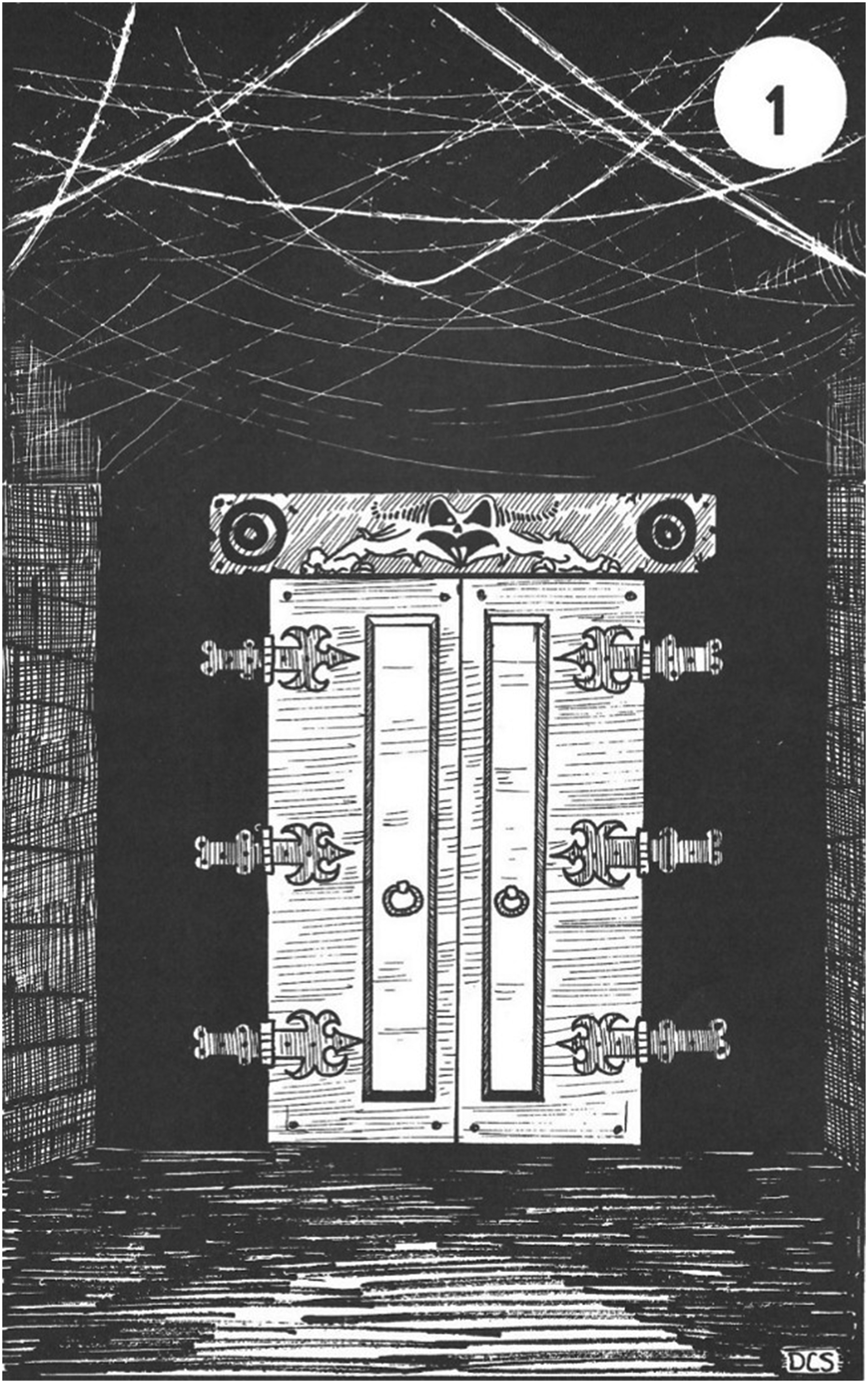
Illustration of the First False Tomb Entrance for the First Three Editions of Tomb of Horrors (Cordell, 1998, 2005; Gygax, 1978).
Second False Entrance
The proportions for Figure 2 also diverge from the spatium of the textual description and the map. The corridor is supposed to be 20 ft wide and 60 ft deep, with a ceiling that is only 10 ft from the floor. In Figure 2, the height and width of the corridor are essentially square, when they should be squat, and the doors at the end of the hallway are only about five feet tall under the lintel if the ceiling height is true to its textual spatium. However, the perceptual experience of the handout provides clues to the danger in this dead end. Unlike the space depicted in Figure 1—which is mostly centered to the picture plane, implying that the PCs are looking down the center of the corridor—the perspectival design of Figure 2 is skewed to the right, as if the PCs are—or should be—walking along with the right-hand side of this space. Furthermore, the twinned (false) doors at the end of the hallway are not as bilaterally symmetrical as they seem. Only the left-hand door is hinged on this side, suggesting movement on the left-hand side. This is important because the floor is rigged with a pressure plate near the doors, causing a 10-ft-thick stone barrier to slide across the hallway from the left-hand wall, enclosing the space near the doors. PCs on the right-hand side of the hallway (if taking their embodied cues from Figure 2) have a better chance of escaping the trap because the stone barrier is moving from the left.
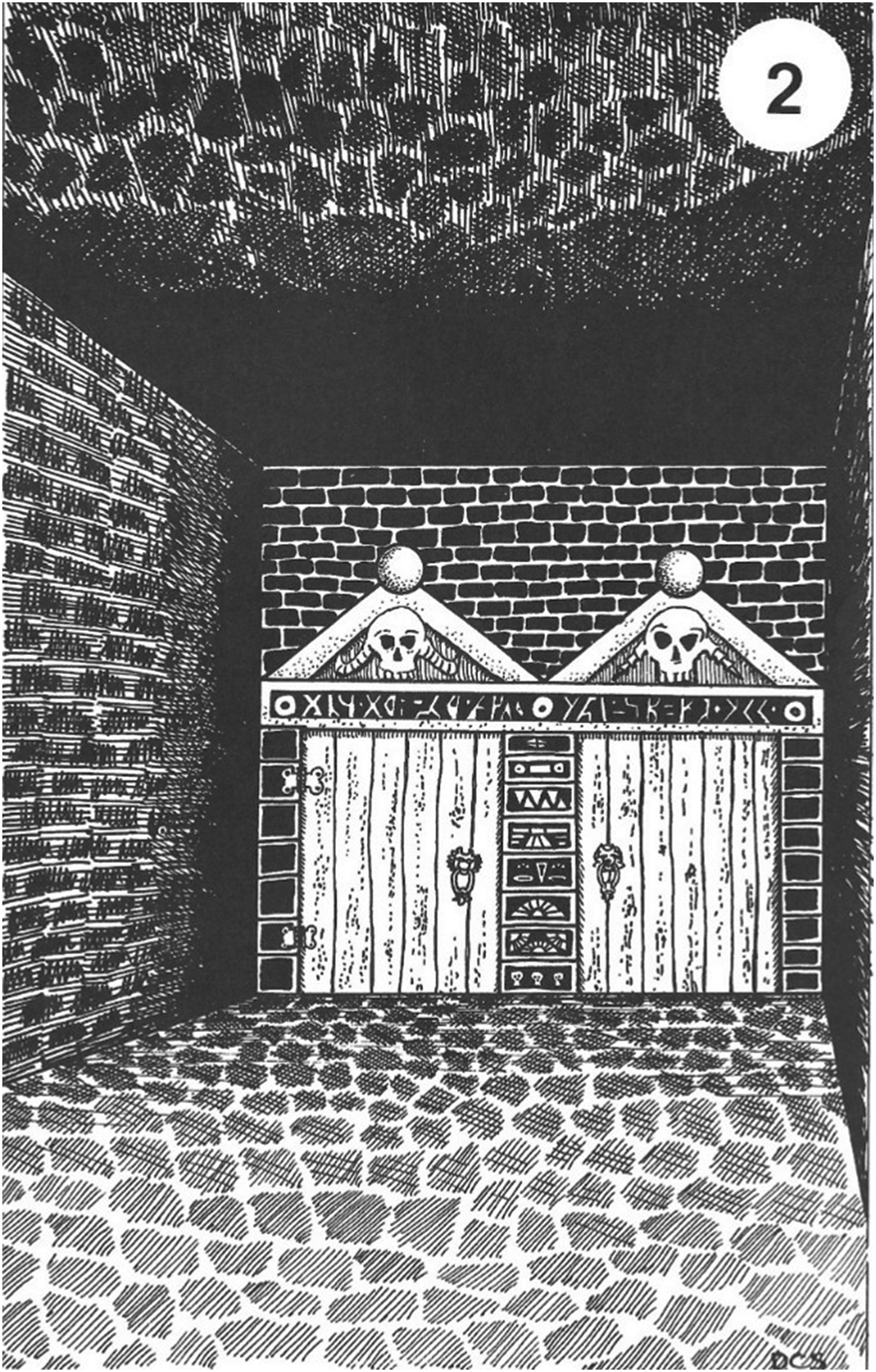
Illustration of the Second False Tomb Entrance for the First Three Editions of Tomb of Horrors (Cordell, 1998, 2005; Gygax, 1978).
True Entrance
The first false entrance to the tomb has cobwebs. The second false entrance does not, nor does the true entrance, presented as a handout in Figure 3. If the PCs discover all three entrances (or two, including Figure 1), then they might notice the discrepancy. In fact, for the description of the true entrance, Gygax (1978) made a specific point to remark on the “stones and pigment undimmed by the passage of decades” (p. 3). As mentioned above, the demilich has demonic minions protecting the tomb from the ethereal plane; they also materialize within the tomb for regular upkeep. Thus, the fact that they do not upkeep the area represented in Figure 1 is a clue to its status as a false entrance, which the players might not know this early in game. But after several more well-tended chambers throughout the complex (Figure 4), the presence of cobwebs in Figure 1 might have added significance for the observant.
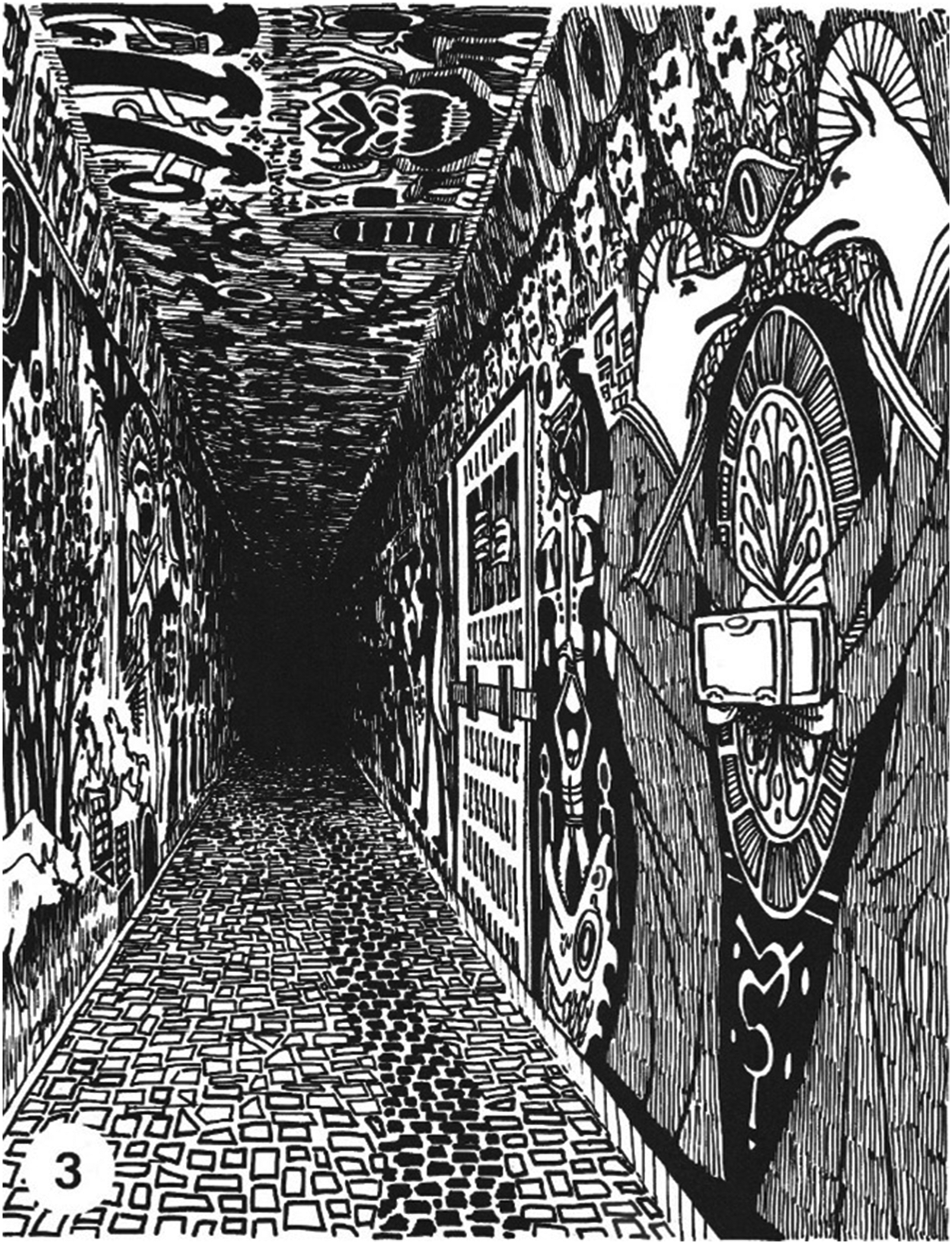
Illustration of the True Tomb Entrance for the First Three Editions of Tomb of Horrors (Gygax, 1978; Cordell, 1998, 2005).
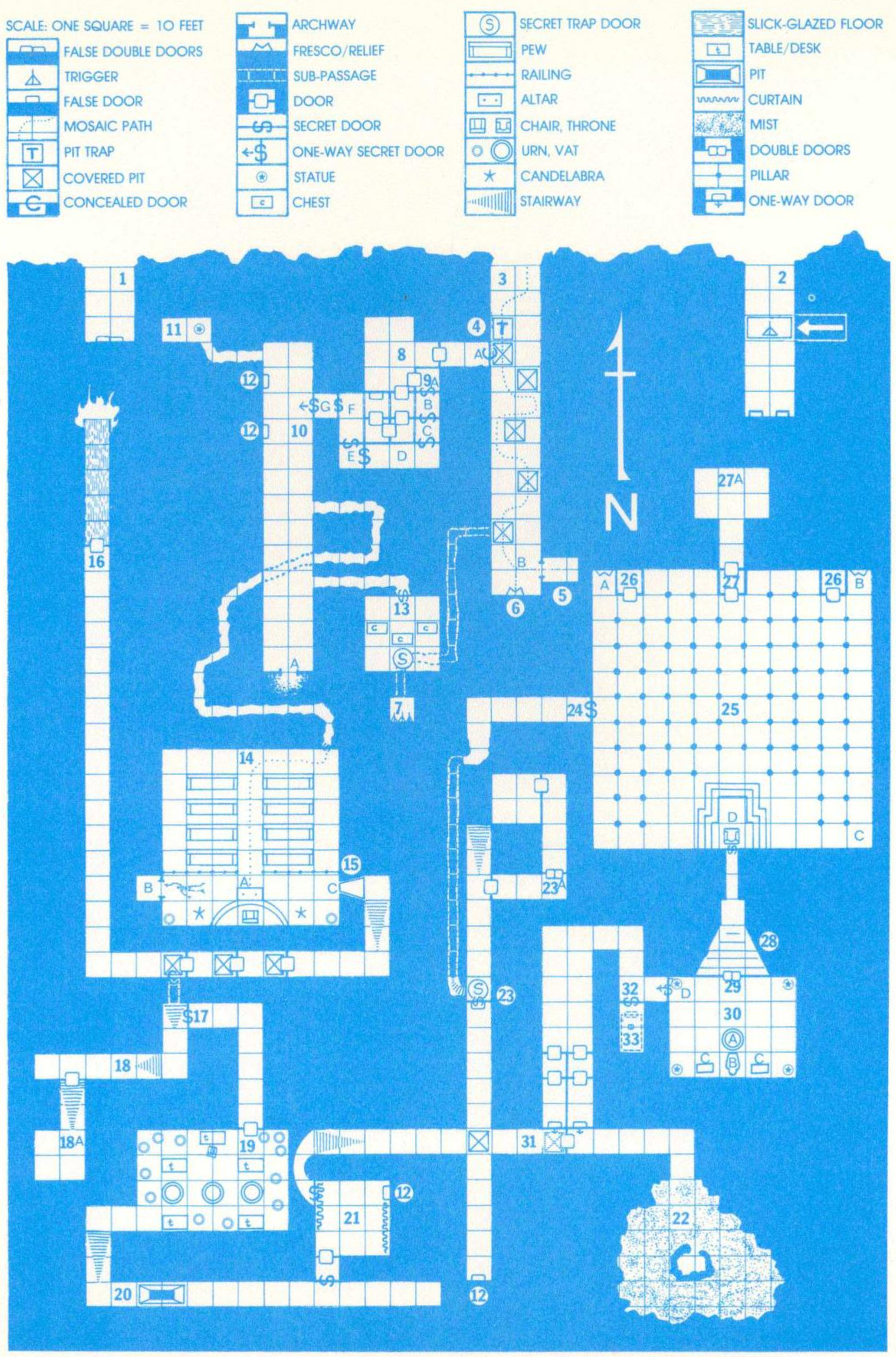
Map From the First Edition of Tomb of Horrors (Gygax, 1978/1981).
In the pristine interior of the true entrance, the abstract proportions still do not match Figure 3, with the height and width mapped and described as 20 ft × 20 ft. The image is of a hallway taller than it is wide. In addition, the mosaic design on the floor includes a meandering pathway, specified as two feet wide in the text, represented as dark tesserae in Figure 3. Proportionally, that two-foot-wide pathway would make the hallway about 10 ft wide instead of 20 ft. Nevertheless, as with Figure 2, the perspectival arrangement of Figure 3 is skewed, this time to the left. The angle in Figure 3 is not meant to recommend a pathway down the hall—there are dangers on all sides here—but to create a fuller view of the frescoes on the right-hand wall. This is because two details of note are visible on that right-hand section. The jackal-headed figures on the far right hold an actual chest that protrudes from the wall. This chest is a trap. Furthermore, to the left of the jackal-headed people, a painted door is showcased among the frescoed images of torture and monstrosity. Chipping off the plaster at that part of the fresco reveals an actual door leading farther into the tomb. Otherwise, the PCs can progress deeper into the hallway at Figure 3 because, unlike Figures 1 and 2, this space does not have a visible back wall from the entrance, just shadows beyond the limit of the PCs’ presumed light source. It invites further investigation because it is the true entrance, and at the far end of the hall, the meandering path on the mosaiced floor forks in two directions (visible as a dotting line in Figure 4). It forks left to an archway filled with swirling mist (Figure 5) and forward to the representation of a green gaping devil on the mosaiced back wall (Figure 6).
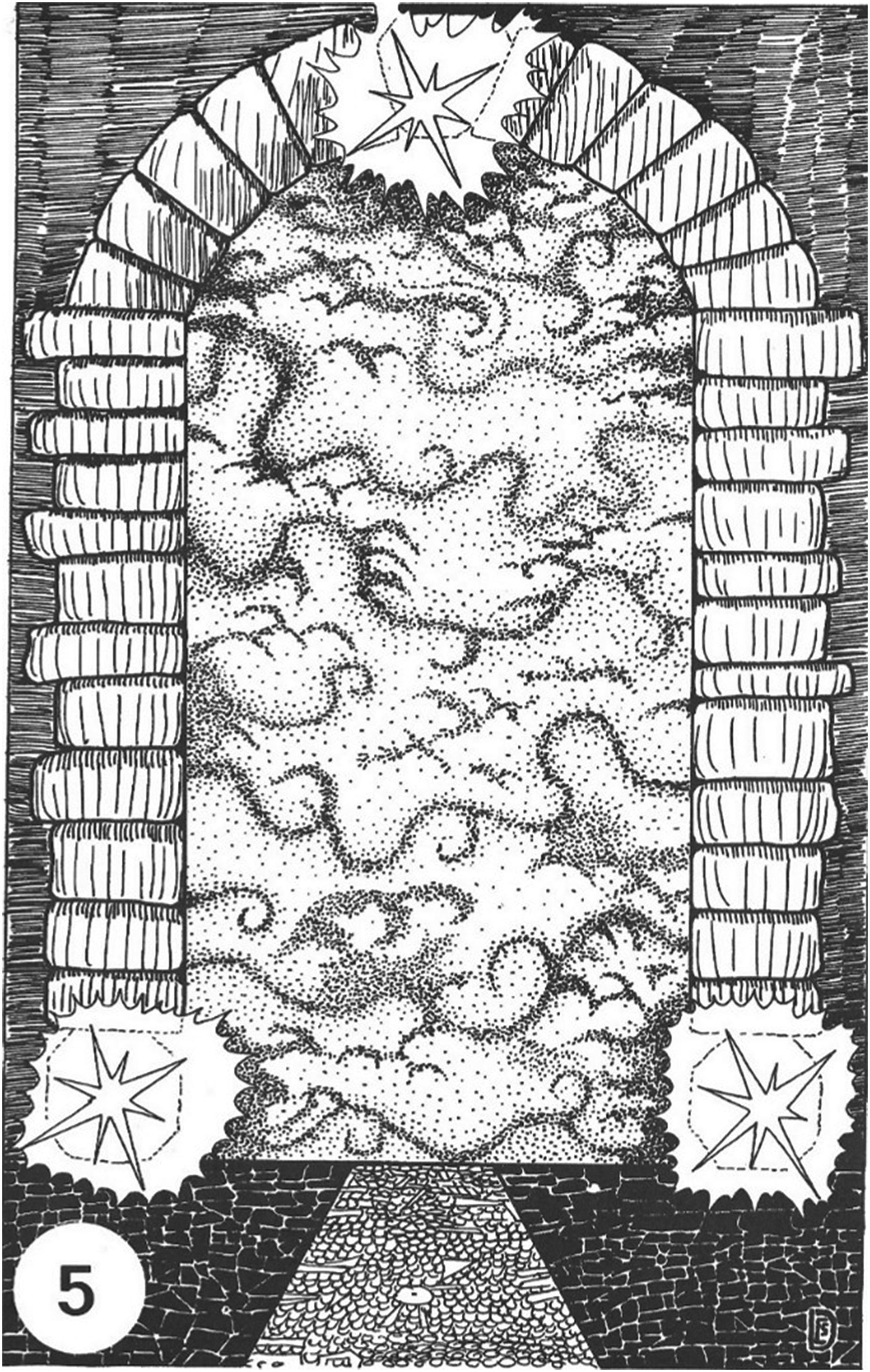
The Misty Archway in the Entrance Hall for the First Three Editions of Tomb of Horrors (Cordell, 1998, 2005; Gygax, 1978); the Fourth Edition Includes the Archway, Though Cropped to Avoid Showing the Floor (Gray, 2010).
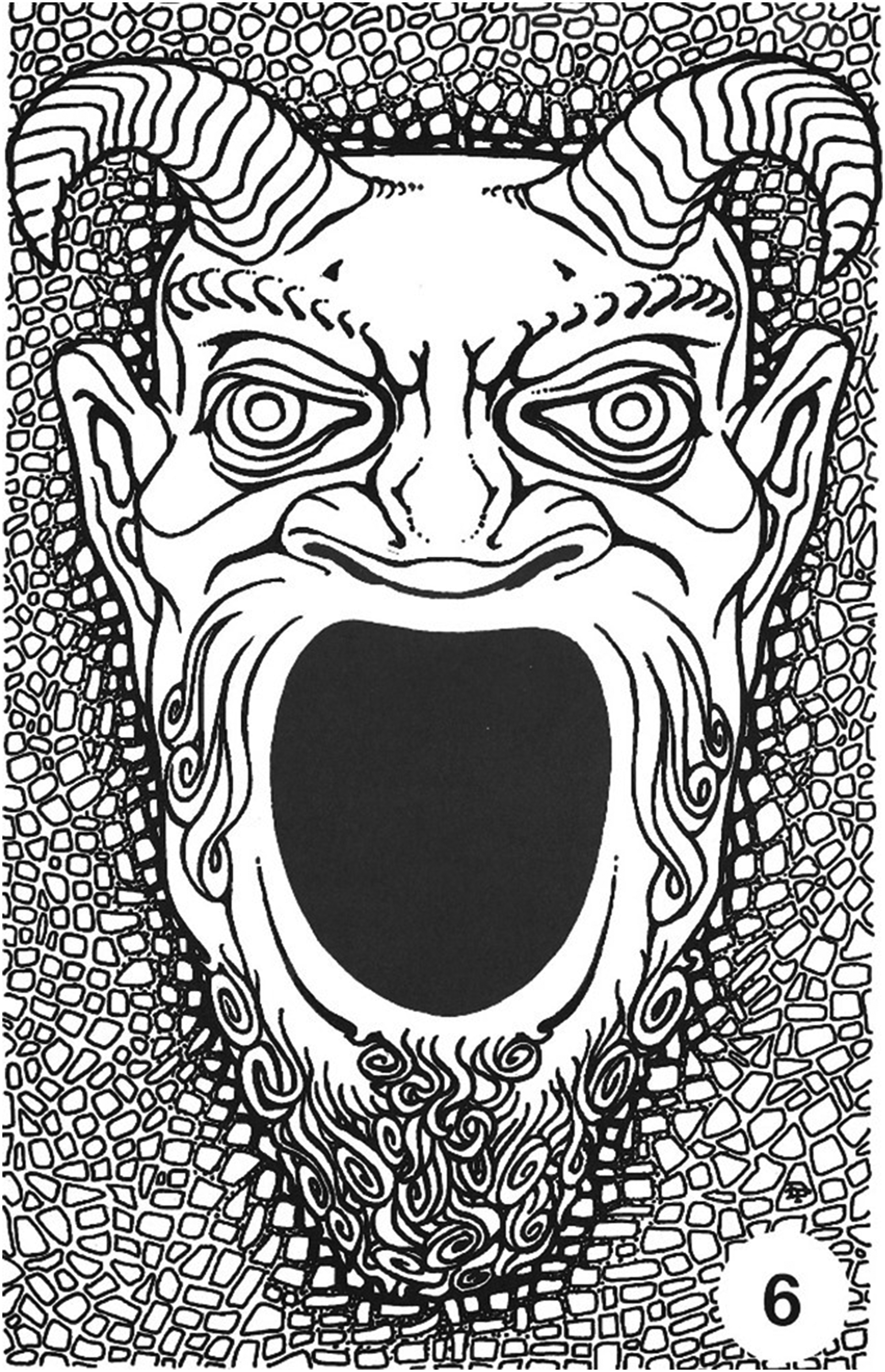
The Gaping Devil Face in the Entrance Hall for the First Four Editions of Tomb of Horrors (Cordell, 1998, 2005; Gray, 2010; Gygax, 1978).
Starting with the handout in Figure 5, I note that Gygax (1978) emphasized the meandering path because it “leads directly into this archway” (p. 4). The emphasis is his, suggesting vocal inflection to ensure that the PCs are aware that they can progress through the misty portal. There is a puzzle involving the arch—something I will set aside because the most interesting detail in Figure 5 is the meandering pathway itself. Unlike in Figure 3, where illustrator David A. Trampier visualized the pathway as dark tesserae among lighter fragments of stone, the other illustrator for the module, David C. Sutherland III, switched the pathway to outlined tesserae in Figure 5 so that he could subtly embed symbols among the bits of stone. These symbols are not supposed to convey a direct meaning to the players; they imply a language that the PCs might be able to read within the game world. In other words, the symbols signify a coded message on the floor, and if the PCs go back to follow the entire pathway again, they can read the full message—a series of clues to navigate the tomb.
As with the emphasis that Gygax (1978) used to guide the PCs at the misty archway, his description to accompany the handout in Figure 6 has a telling use of emphasis: “The face [of the devil] has a huge O of a mouth; it is dead black” (p. 4). Trampier's drawing of the face is not entirely successful in terms of matching an ambiguous textual description—Gygax described the face as “set in mosaic” (p. 4), not set against a mosaic. In other words, the text could be interpreted to mean that the fiendish face is not a relief sculpture set against an otherwise flat, mosaiced wall. As textually described, the face itself could be mosaiced, and visually that would have made the lack of any tessellation in the gaping maw that much more ominous in its total blackness. The mouth is a hole in the game's multiverse, capable of annihilating anything that touches it. Thus, Gygax's pointed use of the “dead” adjective emphasizes the semantic flatness of the surface—visually ineffective yet narratively absolute as a warning.
Rearming the Trap: Revisionist Histories
Phenomenologically, the later editions of Tomb of Horrors are more complex because they were designed by people who typically played the first edition of the adventure as a PC and/or GM. Cordell, author of Return to the Tomb of Horrors for the second edition (1998) and revisionist of Tomb of Horrors for the third edition (2005), reminisced that his “memories of playing through this adventure in the early ‘80s engender fond nostalgia” (1998, p. 5). Likewise, Gray, revisionist of Tomb of Horrors for the fourth edition (2010), declared of his own teenaged encounter with the first-edition module that “the tomb was a challenge like nothing we’d ever played before” (p. 34). Thus, because former players became revisionists for later editions, their changes are telling of what they learned from the original and what escaped their attention.
Second Edition
Cordell's Return to the Tomb of Horrors (1998) made no changes to the module itself. A reprint of the first-edition version was packaged in the boxed set for his larger adventure. Nevertheless, the events before and after the PCs enter the tomb tell of Cordell's engagement with the original module. As a preamble to the tomb, the PCs can encounter the last survivors of a previous group of adventurers who tried their luck with the cryptic interior. This encounter rewards the PCs with the journal of a wizard who led that former group into the tomb. The journal provides clues to help the PCs survive the interior, and it hints that the tomb is just the first part of the demilich's larger plan.
Among the journal entries about the tomb, one recounts that a slow-witted warrior stuck his hand into the mouth of the devil face in Figure 6, promptly losing his hand in the annihilating forces of the lightless void. The clue here is the danger of reaching blindly into any space at the tomb—not just the fiendish face in Figure 6. The chest protruding from the wall in Figure 3, for example, appears to be empty when opened, but if a PC reaches in to feel around with their hand, a lever is discovered in the apparent emptiness. Pulling that lever is not beneficial; it opens a deadly pit trap under the chest, a fate foretold when opening the chest itself. Pressing the latch to open the chest causes the chest's bottom to swing open, not unlike the floor under the victim who blindly pulls the lever within the chest. Furthermore, the misty arch in Figure 5 is the first of three such arches in the tomb, all of which issue punitive effects for those who blindly step into the mist rather than solving the puzzle of the surrounding features. Ironically, then, for those who make it through the tomb in the second edition, the only way to continue in Cordell's larger adventure is to gather some of the demilich's remains from his crypt and carry those remains into the annihilating maw of the devil in Figure 6, transforming the void into a portal. Cordell's point, therefore, is that a PC who follows the clues leading up to the tomb would not be stepping blindly into the void. They would know that the dead black mouth leads on to the next narrative arc.
Third Edition
Although Cordell did not change the tomb itself in his expansive sequel for the second edition, he was given a chance to update the tomb for the third edition of the game system in 2005. Because this version of Tomb of Horrors is a stand-alone module, it does not include the pre- and post-tomb adventures from Cordell's Return to the Tomb of Horrors. Thus, the revisions do not focus on the risks of blindly reaching into the unknown as a pattern to highlight the path onward, beyond the tomb. Instead, Cordell's revisions focus on nuancing the clues to dangers strictly internal to certain parts of the interior.
Concerning the two false entrances to the tomb, Cordell reused Figures 1 and 2 as handouts. Textually, however, he provided scripted descriptions for the GM to read to the other players, and in many textboxes, Cordell inverted Gygax's phrasing. Gygax (1978) wrote to the GM—never explicitly for the GM to read to the other players—that the first false entrance is of “plain stone, roughly worked” and that the second false entrance is “another plain stone passageway” (p. 3). In his textboxes for recitation to the players, Cordell (2005) referred to both false entrances as a “roughly worked, plain stone corridor” (p. 5). In other words, Cordell used the exact same phrasing for both false entrances so that the PCs could recognize Figure 3 as the true entrance because it is not described in identical terms. If that weren’t enough, Cordell chose to interject the phrase “roughly worked” at the start of the descriptions for the false entrances, calling greater attention to their shoddy artisanship when compared to the true entrance.
With the textbox description for the true entrance, Cordell made another crucial change. Gygax (1978) wrote: “No stonework can be seen on the walls or the ceiling 20 ft above, for some sort of cement or plaster has been smoothed over all of these surfaces and then illustrated” (p. 3). Cordell (2005) wrote: “A few chips and gaps reveal that cement or plaster covers the underlying stonework of the corridor, and it mostly provides a smooth surface for the many illustrated scenes” (p. 6). Thus, although the third edition uses the same handout as the first edition (Figure 3), the textual detail is an implicit signal for the players to chip away at the frescoes to discover the concealed door. And thus, like his descriptions of the two false entrances, Cordell was willing to let his GMs give more textual hints to the other players.
Fourth Edition
Gray (2010) wrote the fourth edition of Tomb of Horrors not only as an update to the popular module for the rules of that game edition but also because he published a larger adventure for which the tomb was only a part (Marmell & Gray, 2010), much like Cordell's Return to the Tomb of Horrors for the second edition. To that end, Gray's stand-alone version of Tomb of Horrors was a teaser to stimulate a market for his expanded adventure.
Unlike Cordell's 2005 version, Gray's (2010) version is not as generous with the number of visuals (all taken from the original publication, though), and the visuals are not treated as images that the GM can easily extricate from the document to share with the other players as handouts. Some of the figures are spread across two facing pages and in ways that crop part of the image and omit potentially useful visual details. Other images have text intended for the GM's only wrapped around them in ways that make it difficult to show the visuals without revealing textual details about the module. Consequently, Gray's images seem to be for the GM, not the other players, serving as clarification for how the rooms (their few denizens, mostly) appear.
Even more peculiar is Gray's choice to include the two false entrances on the map for the tomb (Figure 7), but neither false entrance has a keyed section in the text. They are left for the GM to describe. Furthermore, unlike the map for Gygax's original (Figure 4) or Cordell's revision, Gray's map omits the sliding stone barrier in the second false entrance. The implication is that neither false entrance is trapped; they just end in false doors. Thus, Gray omitted the illustrations of those two areas. Likewise, no illustration is provided for the true entrance to the tomb (just the individual images of the misty arch and devil face: Figures 5 and 6, with the former severely cropped). Finally, Gray did not continue Cordell's textual detail about the exposed stonework through chips and gaps in the plaster. Instead, Gray changed a different detail from the Gygax text. Gygax (1978) stated: “Certain of the frescoes show rooms of some buildings” (p. 3), whereas Gray (2010) stated: “Certain of the frescoes create the illusion of an interior space” (p. 3). This emphasis on illusions is not only a descriptor of trompe-l’oeil fresco effects but also a bit of foreshadowing for another fresco-decorated hallway in the tomb, where some of the paintings are illusions in the sense of magical spells in the game system, concealing passage deeper into the tomb. Thus, Gray's perceptual signifier of illusionistic art is to help players overcome that obstacle with an early warning upon entry into the tomb: beware illusions!
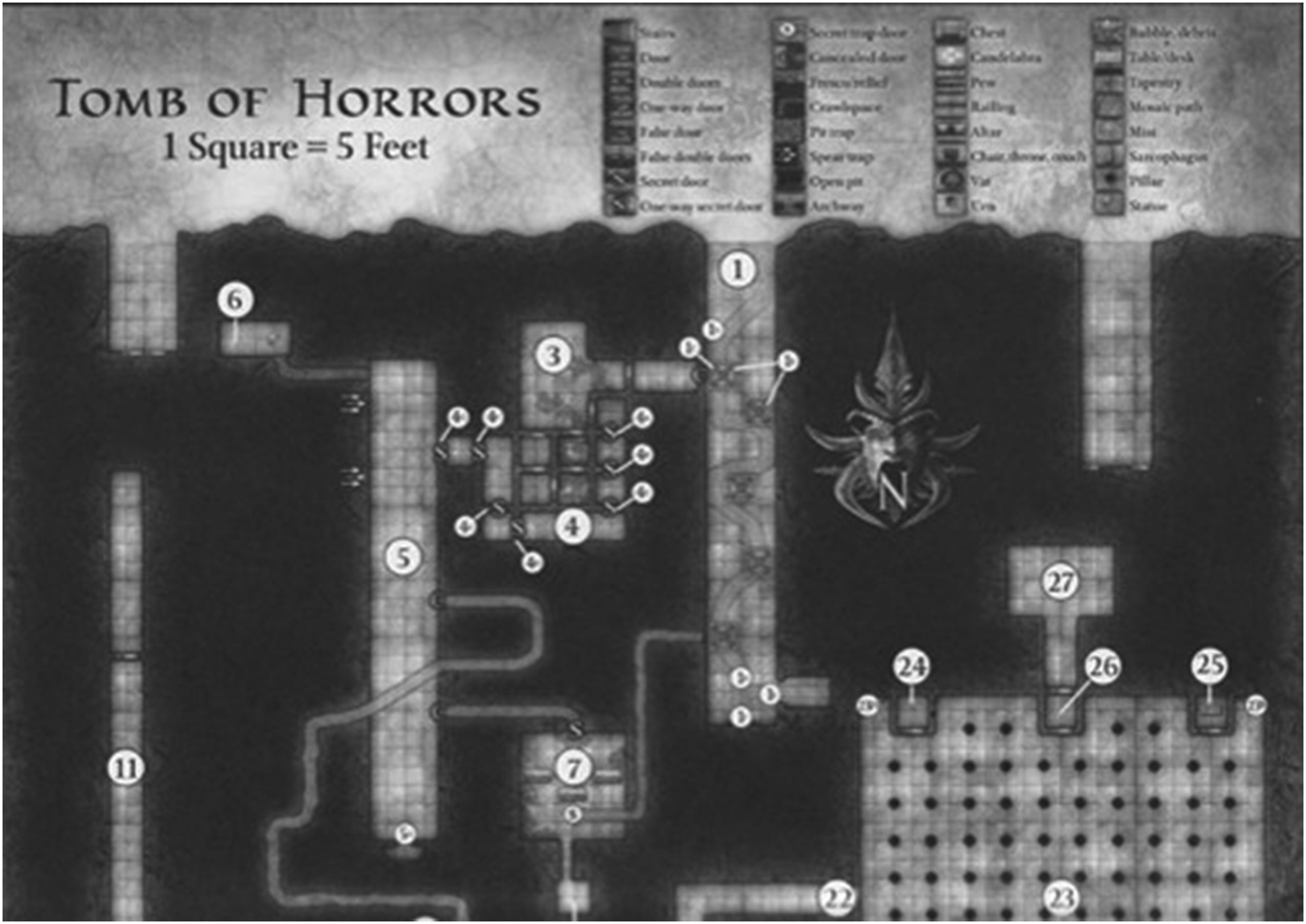
Half of the Two-Page Map for the Fourth Edition of Tomb of Horrors (Gray, 2010).
Fifth Edition
Sims et al. (2017) were collaborators on Tales from the Yawning Portal, an anthology of classic D&D modules, including Tomb of Horrors, revised to suit the rules of the game's fifth edition. There is no clear sense, based on the book, which of the collaborators was/were responsible for the tomb's revisions because there is no autobiographical preface or afterword reminiscing about playing the first-edition game. Furthermore, of all the revisions, the fifth edition comes textually closest to Gygax's publication (1978), basically transcribing segments of Gygax's document as textboxes for the other players and limiting almost all the revisory work to the mechanics of fifth-edition gameplay. The major difference is that a new illustrator, Chris Seaman, offered his renditions of classic Tomb of Horrors vignettes from the 1978 module, though the number of images is the fewest of all the editions. For example, although the fifth edition brings back the original traps and keyed descriptions of the two false entrances, it does not provide visual handouts for players to pick up on subtle visual cues to the dangers in the hallways. Instead, Seaman concentrated on an image for the true entrance (Figure 8).
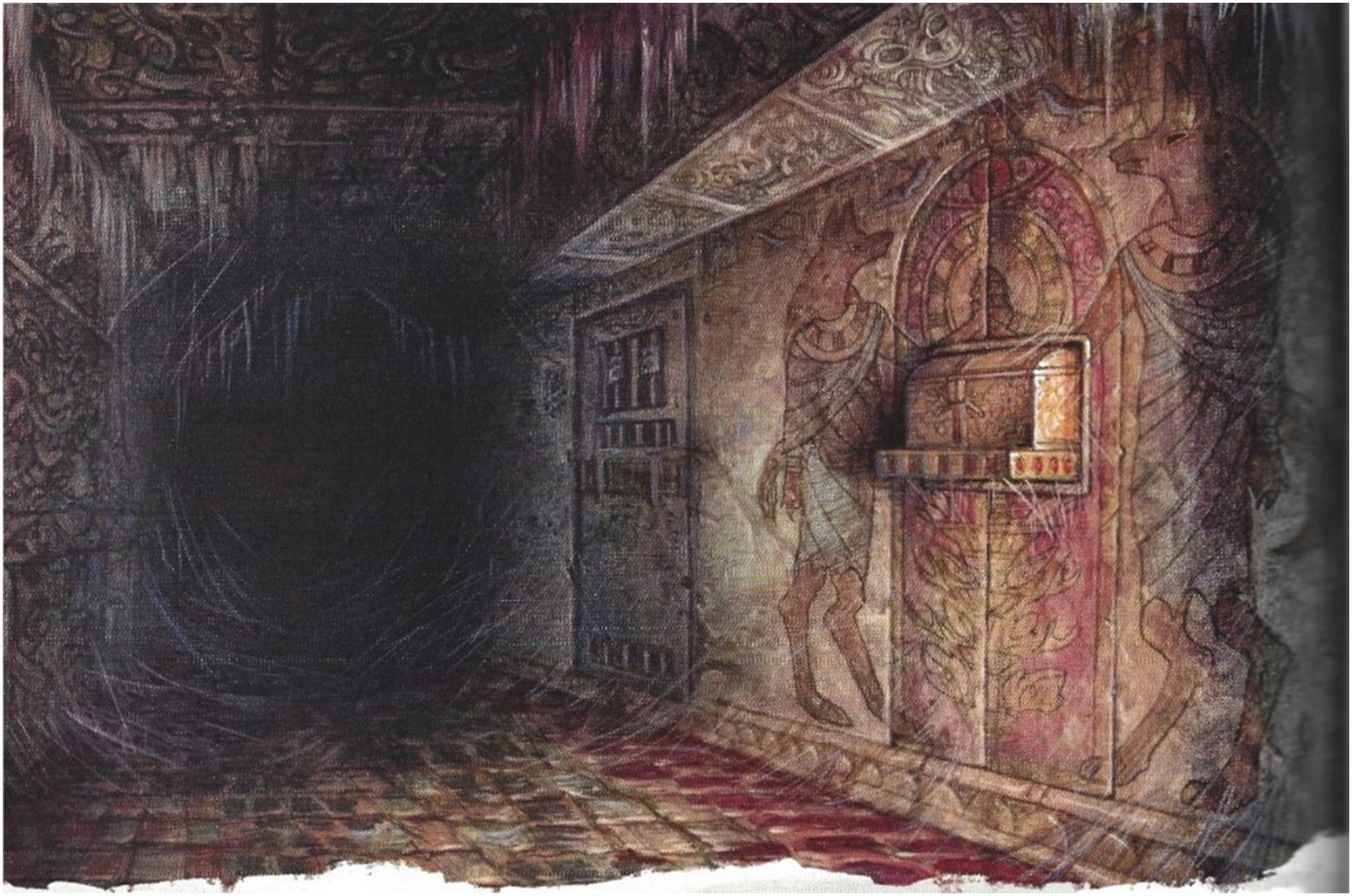
The True Tomb Entrance for the Fifth Edition of Tomb of Horrors (Sims et al., 2017).
Much like the first published drawing of this hallway, the 2017 version has a proportional discrepancy; the space, though not as seemingly narrow as Figure 3, still is not squarely 20 ft × 20 ft in width and height, and if the red-tiled pathway on the floor is two feet wide (as described), then the width of the hallway still seems to be about 10 ft rather than 20 ft. Additionally, whereas the 1978 drawing of this hallway is skewed on the left-hand side, the 2017 version is presented from the perspective of someone on the left-hand side of the space. This was done for the same reason—it creates a clearer view of the right-hand wall, where two painted details are of immediate note—the anthropomorphized jackals holding an actual chest and the trompe-l’oeil representation of a door in the plaster. The difference is that the Trampier drawing from 1978 includes those details among a veritable horror vacui of imagery on all surfaces of the corridor. In the 2017 image, the left-hand wall, the ceiling, and the header atop the right-hand wall are all teeming with vague demonic imagery, but the focal wall plane on the right-hand side shows nothing but the jackal vignette and the painted door, making it much more obvious that these are details to investigate thoroughly. Finally, and somewhat bafflingly, Seaman opted to dress the 2017 interior with dense layers of cobwebs, despite the Gygax (1978) text—faithfully rendered in this revision—stating that the demilich's demonic minions continually maintain the interior of this tomb. The whole point of having cobwebs only in the first false entrance was to play into the stereotype of a neglected burial ground, home to generations of industrious spiders, duping imperceptive players.
Show Time: A Conclusion
The diminished use of visual assets for the fourth and fifth editions of Tomb of Horrors indicates a different approach to visualization in the twenty-first century. Mizer (n.d.) noted that D&D emerged through the twentieth-century context of miniature wargaming, but modeled figurines of PCs and their battlegrounds were not as vital for D&D's early editions as they are today. Furthermore, Gygax's visuals for the 1975 tournament version of Tomb of Horrors were in the name of fair tournament play. The tournament competitors were split into groups, and the different GMs running the concurrent sessions might not highlight the same details in their verbalizations. Thus, the handouts were considered consistent environmental cues for all groups (Witwer et al., 2018). The inclusion of such visual information subsequently did not become standard practice among modules for longform gameplay in the first and second editions of D&D because textual aspects of the game dominated.
With increased customization of PC abilities in the twenty-first century, the newest editions have emphasized the grid of a battle map to structure cooperative tactics among the special attacks of PCs and their opponents. Furthermore, the advent and increasing availability of 3D printing and other digital and material technologies have opened a mass market for battle maps with complex topographies and detailed environmental factors, including online tutorials on crafting such environments for Tomb of Horrors (e.g., Wyloch's Armory, 2021). To that end, with the popularity of online gaming communities, especially a company called Critical Role (online since 2012, hosting Colbert's charity gaming session mentioned earlier in this essay), the act of watching others play D&D has perhaps become as valued as playing the game oneself. This form of spectatorship has played into the sensibilities of the creators at Critical Role, actors based in Los Angeles. They use their production budget to craft intricate miniature environments with theatrical lighting and multicamera setups to make the game as visually engaging as possible for such spectatorship. Game time is becoming show time, and showing an interior on Critical Role means removing the rooftops from the miniatures.
Citing Ong (1982) on orality and literacy, Mizer (n.d.) argued that the increasing reliance on battle maps means that “players hold an inescapably isometric, third-person view of the game world,” whereas “when imagining a combat scenario based on oral description, the player is free to visualize from any angle, significantly including a first-person perspective” (p. 21). Setting aside the obvious counterpoint that players can move their bodies relative to battle maps to see the combat encounter from different angles, Mizer's point about the lack of an embodied first-person perspective is apt. As we have seen with Tomb of Horrors, though, a first-person perspective is not the privilege of orality. The representational techniques of visual handouts feature perspectival approaches to space that support the first-person experience that Mizer highlighted, simultaneously offering insights that enhance or contradict the orality of textual cues. Thus, spatial immersion in gameplay is not simply a function of representational fidelity across media but of cross-media ambiguity, perspectival constraint, and interpretive work.
In fact, the interpretive work when presented with contradictory sensorial information in the first edition of Tomb of Horrors brings us back to the question of visualized space and VTTs. Without fretting over the intentions of Gygax, Sutherland III, and Trampier to coordinate text and visuals, it is worth asking if the perceptual cues in the visual handouts could be strengthened because of their role in sensorial discrepancies. To what extent, as available with Figure 2, would player perception of those discrepancies telegraph danger and meaning through the visual handouts when juxtaposed with the textual descriptions and the spatium of a top-down map? Particularly, in the hall of illusions briefly mentioned with the fourth-edition module, could subtle perceptual mismatches between the map, text, and visual handouts convey the effects of illusory interiors in ways that reward player engagement in addition to the passive perceptual attributes assigned to their PCs? These types of structured vacillations between in-game immersion and player interaction with the materials of gameplay on the tabletop are important for the development of VTTs; the virtual environment of a VTT is a site of shared, kinetic, affective, spatial, ludic, and narrative incorporation of the players with the space of gameplay (Calleja, 2011) but not necessarily for Calleja's sense of coherence. The proposed strategic lack of coherence could be especially effective with VTTs for at least two reasons.
First, the analog map in Tomb of Horrors (Figure 4) is a visual asset for the GM, not the players. In other words, the perceived disproportions of Figures 1 to 3 are relative to the information on the map and text combined. The text indicates the ceiling height. The map conveys the width and depth of the spaces. Therefore, in the analog module, unless the other players are drawing an accurate map as part of the shared media literacy that Garcia (2019) highlighted as the social construction of space in D&D, they would not necessarily know the cartographic dimensions of the interiors relative to the perspectival sensations from the handouts. With VTTs, however, the inclusion of battle maps has become standard. GMs running games on a VTT are not obliged to design their own maps; they can simply import images from the module and build invisible barriers to block views from exterior to interior or from one interior room to the next. Consequently, it is de rigueur for players using a VTT to see the width and depth of the spaces they navigate, making the visuality of handouts from Tomb of Horrors that much more discordant when presented through the handout function embedded in most VTTs. Empirical follow-up studies could be conducted to test how consistent (or strategically inconsistent) spatial information across visual and textual assets might affect player perceptions. A revised version of Tomb of Horrors for the newest edition of the game system could precisely leverage these visual and textual modalities to make the module meaningful to Sigil's differences from an analog tabletop.
For GMs willing to craft and import their own virtual models of Tomb of Horrors interiors, there are also digital design tools, such as Dungeon Alchemist, to shape terrains and populate dungeon interiors with relative ease when compared to structuring physical models of comparable detail for an analog tabletop. These types of virtual designs are readily importable to major third-party VTTs but currently only as top-down maps, with limited orthogonal depth to suggest the materiality of walls. Ironically, within the Dungeon Alchemist platform, one can see the designs from all angles and can embed tokens in the models to get first-person perspectives within the interiors. Such angles can also be screen-captured for import as handouts on VTTs, seemingly rendering the disproportional handouts of Tomb of Horrors irrelevant. However, this is the second current issue with spatial visualizations in VTTs.
Virtual tabletops have been designed as virtual extensions of battle-mapping traditions, from the crafting traditions of wargamers to the snap-together configurations of 3D-printable forms today. In all cases, the roofs of models are typically removed to provide players with views of the interiors from where they stand above a physical tabletop, as in Critical Role, and this has carried over into the battlegrounds for VTTs and the designing language of Dungeon Alchemist. Even with the advancements of Sigil, D&D's official VTT, where the models can be seen from multiple angles, the rooftops are removed, denying the interiors an essential part of their interiority. And as we have seen with the first false entrance to Tomb of Horrors (Figure 1), spatial and material awareness of the ceiling is essential to the players’ perception of opportunities to avoid that trap. Until VTTs can offer not only multiple camera angles of fully enclosed interiors but also perspectival disorientations, occlusions, and partial revelations—mimicking the embodied uncertainties of Tomb of Horrors visual and textual assets—they will privilege spatial coherence over experiential thickness. It is in shadowed corners, along ceilings veiled in cobwebs, and through hallways canted with slight discordance that the phenomenological experience of a TTRPG lives.
Update On July 10, 2025, the production team for Dungeon Alchemist released an updated version of the software. Now, users can create multistory spaces, including ceiling planes for all interior levels of a building. Granted, the room heights remain incrementally fixed. Likewise, the ceilings are simple, flat surfaces, and the ability to dress a ceiling surface is limited to what can be stacked from the walls or raised from the ground, upward to the ceiling level. Nevertheless, this is a step toward more immersive spatial experiences for D&D's mapped interiors.
Footnotes

Funding
The author(s) received no financial support for the research, authorship, and/or publication of this article.
Declaration of Conflicting Interests
The author(s) declared no potential conflicts of interest with respect to the research, authorship, and/or publication of this article.