




Abstract
The healthcare budget is increasing day-by-day as the population of the world increases. The same is the case regarding the workload of health care workers, that is, doctors and other practitioners. Under such a scenario where workload and cost are increasing drastically, there is a dire need of integrating recent technological enhancements with the said domain. Since the last decade, a lot of work is in the process considering the said integration bringing revolutionary changes. For remote monitoring, existing systems use different types of Internet of things devices that measure different health parameters. One of the major problems in such a system is to find an optimum routing approach that can resolve energy and thermal issues that are taking the limelight in the research arena. In this article, a dynamic routing technique is proposed which is keen to connect multiple in vivo/ex vivo Internet of things devices and a sink (focusing thermal and energy problem) and then forwarding data from sink to remote location for monitoring. Performance parameters are kept energy efficiency and thermal awareness and analytical results show that the proposed protocol supersedes existing approaches in said metrics.
Keywords
Introduction
Internet of medical things (IoMT) is an open research area that uses Internet of things (IoT) devices for remote monitoring for the healthcare domain. Quality of life for elderly people can be enhanced using IoMT technology. Moreover, using this IoMT technology, a patient can stay at home while a doctor can check the patient’s vital signs on a personal digital assistant (PDA) or mobile phone. 1 This not only gives ease but is also cost-effective. Figure 1 illustrates the use of IoT devices connected to a person that transmits data to his medical staff for remote monitoring and to observe real-time variations in the patient’s vital signs. Considering IoMT, two types of IoT devices are utilized normally, that is, on the body and implanted IoT devices. Implantable IoT devices can be planted inside the patient’s body such as cardiac arrhythmia monitor and endoscope capsule. While a wearable IoT device stays on the body like a watch on the wrist. 2 Due to the natural behavior of such networks (energy dissipation constraints and thermal emission constraints), researchers are focused to orchestrate novel ways to transmit data seamlessly and energy efficiently. A dynamic routing technique can be the answer to such problems, where minimal transmissions are required to preserve energy, and the routes are dynamically adopted due to the change in temperature of sensor nodes. A thermal increase in the sensor deteriorates human tissues and this needs to be eliminated.

Scenario of health monitoring via Internet of medical things.
Major metrics to be focused while designing a routing protocol for IoMT are (1) channel quality, (2) prioritizing IoT devices, (3) energy efficiency, and finally (4) sensor temperature awareness. Many IoMT protocols have been proposed in the literature; however, the majority of protocols encompass only one or a couple of above-mentioned parameters. To the best of our knowledge, none of the proposed protocol has incorporated all of the four metrics. A good balance among all of the factors is highly important which not only increases reliability but also takes effective care of the health of a patient. To ensure link quality, power, thermal, and priority awareness in IoMT routing, we propose a dynamic routing protocol. The major performance metrics regarding the proposed study are to improve the network lifetime, reliability, energy conservation, and reduce radiation effect on a patient body. The rest of the article is organized as follows: Section “Literature review” presents the literature review. In section “Proposed methodology—a thermal aware routing protocol (ATAR),” the proposed routing protocol is explained, while results and discussion are shown in section “Results and discussion.” Finally, section “Conclusion” concludes this article.
Design issues: WBAN routing protocol
As discussed earlier, design issues of wireless body area network (WBAN) routing protocols are
Link quality
Prioritizing sensors based on health parameters
Energy efficiency
Thermal and radiation effects on the human body.
Link quality
Transmission of data from an IoT device to a remote location, with minimal energy utilization and dissipation, is one vital challenge in WBANs. Majorly, channel fading, interferences, and weak signals affect the normal transmission among sensor nodes and the outer world, and retransmissions are required to dissipate the same data.
As discussed earlier, sensors are implanted or on the body of a human being. Hence, signal propagation is around or inside a human body; therefore, channel fading effects largely resulting in an increase in packet drop ratio (PDR), ultimately decreases overall network performance. 3 PDR, which is the probability of a successful transmission from a source to a destination, is an important metric in most WBANs. An increase in packet error rate results in a very low PDR. This is measured by observing the end-to-end PDR. It has been observed that significant performance gains are achieved using a multi-hop network, even if there is a double-hop limit imposed on the network 1 . Table 1 represents the bitrates and delay requirements regarding healthcare monitoring systems.
Bit rate and delay requirements of healthcare data.

ECG: electrocardiogram; CVP: central venous catheter.
Prioritization of health parameters
The other important factor is the prioritizing of important signs for proficient and instantaneous triage. Patients can be in an emergency or non-emergency condition. Moreover, the patients or critical parameters that need urgent services must be given high priority, and such data need to be transmitted with high reliability with no delay. The patient with non-emergency issues or the IoT devices which sense non-critical signs have different needs as compared to emergency patients or critical signs. Hence, non-critical data can have the luxury of being transferred with high reliability but on a low priority basis. 4 Reliability in WBAN is a ratio between packets received and packets transmitted from destination and source, respectively.
Each WBAN application carries its own requirements. For example, an electrocardiogram is used for heart rate monitoring during surgery as real-time measurements are required. If it exceeds the acceptable delay, then it becomes useless.
Energy efficiency
It is not a viable solution to replace batteries of implanted sensors again and again. Hence, to preserve energy and to increase network lifetime, the multi-hop transmission has proven its efficiency over the direct transmission method. Therefore, multi-hop localization has received more and more attention in recent years. 5 Braem et al. 6 presented a comparative analysis regarding the energy efficiency of multi-hop and single-hop WBAN routing. The results of the study suggested using relay nodes for data transmission from a source node to an external network or end station. However, there is a trade-off between energy efficiency and latency. More relay nodes mean more delay; however, there is a vital improvement in minimizing the packet retransmissions that result in an increase in network lifetime. 7 Considering implanted sensors, there is a need for transmitting data using a relatively higher power level. Hence, the study in Lin et al. 8 suggests using the relay node/s to preserve energy. This not only maintains the connectivity but also enhances the successful transmission of the data.
Thermal and radiation effects on the human body
Electromagnetic (EM) radiations are emitted during the transfer of signals from a source to a destination. These EM waves are disruptive for human tissues; hence, there is a major concern in engineering industries and research arena regarding health implications. As a result, numerous organizations of the international level have provided safety guidelines for EM wave absorption in human tissues. Standards for radio frequency (RF) near-field exposure are based on the spatial peak specific absorption rate (SAR) for any body tissue. Physiological impacts and damage to tissues due to EM propagation are induced by a gradual rise in temperature. Continuous use of implanted IoT devices causes tissue and DNA reparation slowly and gradually due to these radiations and rise in temperature. 9 Such biological changes that are caused by EM radiation absorption and device operation are often known as thermal effects. Excessive and prolonged exposure to high levels of radiation can be risky. 10 Heat dissipated by WBAN’s node’s antenna and other circuits can also cause tissue damage. The human body has its self-defense thermoregulatory mechanism, but it only works when heat/radiation stays below tissues sustainable limits. 11 One easy solution to this problem is not to use implantable nodes around the routing path which are heavily utilized areas. SAR is the metric that is normally used to measure the rate at which radiations/heat is absorbed by human body tissues. For instance, a sensor implanted near the brain will not damage the general functions of the brain unless the temperature rises for more than 4.5°C. 10 The author claims that a 0.1°C increase in temperature is enough to activate an intense human body thermoregulatory response. It is also studied that a significant amount of damage happens if 15 min of exposure results in an SAR of 8 W/kg in tissues. Temperature-sensitive organs get damaged because of the lack of blood flow, for example, lens cataracts. 12
The International Commission on Non-Ionizing Radiation Protection (ICNIRP) has found the value of 2.0 W/kg for 10 g of tissue. However, the Federal Communications Commission (FCC) has given an upper bound of SAR as 1.6 W/kg for over 1 g of tissue. 13 ICNIRP has provided the highest possible temperature of human brain tissues is 0.25°C and as per FCC standard, its value is 0.13°C. Any increase in this temperature could cause serious injury to the brain.
Literature review
Recently, health care and WBAN are burning issues in terms of cost reduction, energy and thermal awareness, improvements in remote monitoring, and data processing for early diagnosis. Considering only the routing aspect of IoMT, lot of research has been conducted; however, there is a need for cost reduction along with the above-mentioned four design constraints of a WBAN routing protocol.
A self-organizing WBAN protocol is presented by Watteyne et al. 14 which is a self-organization protocol. The major objective of this protocol is to reduce the direct transmission to the sink from the source node, however, if there is a shorter distance to the sink than protocol allows IoT devices to communicate directly. Transmission power control (TPC) protocol is another WBAN routing protocol proposed by Quwaider and Biswas 15 based on the dynamic postural position inference (DPPI) process. The main objective is to increase the PDR and reduce energy per packet (EPP). In the DPPI process, on-body line characteristics (e.g. RSSI measurement) produce a person’s current postural position and the protocol assigns the best possible power link as per current posture received in DPPI process. 16 Considering delay tolerant networks (DTNs) in Quwaider and Biswas 17 presented a store and forward packet routing protocol. In this protocol, human posture’s new multi-scale topological regions are identified which improved the performance.
Lower overhead energy-efficient routing scheme (EERS) protocol is proposed by Liang et al. 18 which is the combination of adaptive power control approach and multi-hop approaches. This protocol performs better than the previously discussed protocols as it maintains a better trade-off in PDR and energy consumption. Moreover, EERS maintains energy balance, packet reception rate, and reduces the delays in data collection.
WBAN routing protocol named iM-SIMPLE 19 is much reliable, energy-efficient, and provides high throughput. In this protocol, sink node selects the forwarder node using a cost function and informs all the nodes about this new selection. This selection is based on the least cost to travel. In the second phase, selected data are forwarded to the forwarder node, while the forwarder node forwards this aggregated data to the destination.
Another scheme is proposed by Xiao et al. 20 which adopts power transmission based on the receiver feedback. This protocol continuously compares the currently used power (based on RSSI feedback) with predefined power to improve the TP threshold if needed.
A protocol focusing on multi-hop WBANs is proposed by Nabi et al. 21 There are two things in this protocol, that is, each node has information of all the nodes in the network and each node must keep minimum power to maintain a stable link to avoid disconnection. This power adoption is based on receiver feedback.
Link-state-estimation-based TPC (LSE-TPC) 22 uses a different approach, it adjusts the power level based on the two-state link estimation method. The state-link estimation method uses low TP levels. The problem of abrupt and dynamic human body movement that changes the whole topology is tackled by this protocol. However, LSE-TPC is not a thermal aware routing protocol.
Oey et al. presented a comparative analysis of baseline WBAN protocols which takes care of thermal effects such as thermal aware routing algorithm (TARA), 23 least temperature routing (LTR), and adaptive least temperature routing (ALTR). 24 TARA was proposed by Tang et al. In this protocol, data are routed from source to sink by avoiding heated nodes. 25 That was a quite good effort; however, TARA missed other important factors like reliability. The only drawback of this protocol is the higher PDR.
LTR and ALTR protocols were proposed by Bag et al. LTR selects the neighbor nodes with the lowest temperature. It uses a constant hop-count value and allows it to transmit packets as long as the current hop-count remains below the maximum hop-count (the constant one). The difference between ALTR and LTR is that when the packet exceeds the maximum hop-count, it uses a short hop route to forward the packet to the sink.
Least total route temperature (LTRT) 26 is a hybrid of LTR and shortest path routing. LTRT choses the least temperature route instead of only selecting the next hop. The major drawback of this protocol is to get complete information, on the whole, the network regarding temperature by every node. This results in the generation of huge control traffic that consumes much energy. Hence, in this protocol, thermal awareness is prioritized; however, energy is compromised.
Previously discussed approaches do not consider all of the above-described WBAN design issue parameters. To the best of our knowledge, some focused on one or two but no study was found focused on all four parameters.
Proposed methodology—a thermal aware routing protocol (ATAR)
As stated earlier, this work intends to create an equilibrium among different trade-offs and try to comply with all four design issues of IoMT routing. Most of the WBAN protocols use a higher TP level for data transmission which results in the decrease in a network lifetime. It is ideal to use the minimum possible power level and to focus on optimizing the throughput. In this proposed work (ATAR), we can adjust the power levels as per transmission conditions. During the transmission process, each node adjusts its power level by looking at its neighbor nodes. The neighbor node’s value is obtained by the received signal strength indicator (RSSI) value. A neighbor with maximum RSSI value means less TP is required that ultimately results in energy efficiency and minimal heat generation.
However, different types of radios have their own different power levels (e.g. CC2420 have eight different power levels). The maximum current used in the highest power level is 17.4 mA, while the minimum current is only 8.5 mA.
Our proposed technique has two thresholds for RSSI: ThLo and ThHi. If RSSI is less than the ThLo, TP would be increased a level up else TP would be set a level down. To avoid data packet loss, a margin value is set above ThLo. This margin value’s variation depends on RSSI value. If five consecutive RSSI values are less than the ThLo, the margin value becomes fold.
Results and discussion
Simulation setup
Castalia simulator is utilized to simulate the proposed protocol. Besides simulating only ATAR, a comparative analysis is also conducted among the state of the art protocols, that is, LSE-TPC and multi-path ring routing (MPR). Table 2 shows the simulation parameters.
Simulation parameters.

RSSI: received signal strength indicator.
Impact of sink position
Placement of the sink at different position matters. The packet reception is different when the sink is placed at different locations. It is clear from Figure 3 that Sink Node 1 receives the maximum number of packets at a lower data rate; however, when data rate becomes high, packet reception is reduced for Sink Node 1.
Impact of sink position
Figure 3 shows the packet reception is reduced for sink node 1 (Figure 2). We have to find the optimal position of the sink very carefully. But this is beyond the scope of this article. It is shown from the figure that more data rate gives us more packets at the sink.
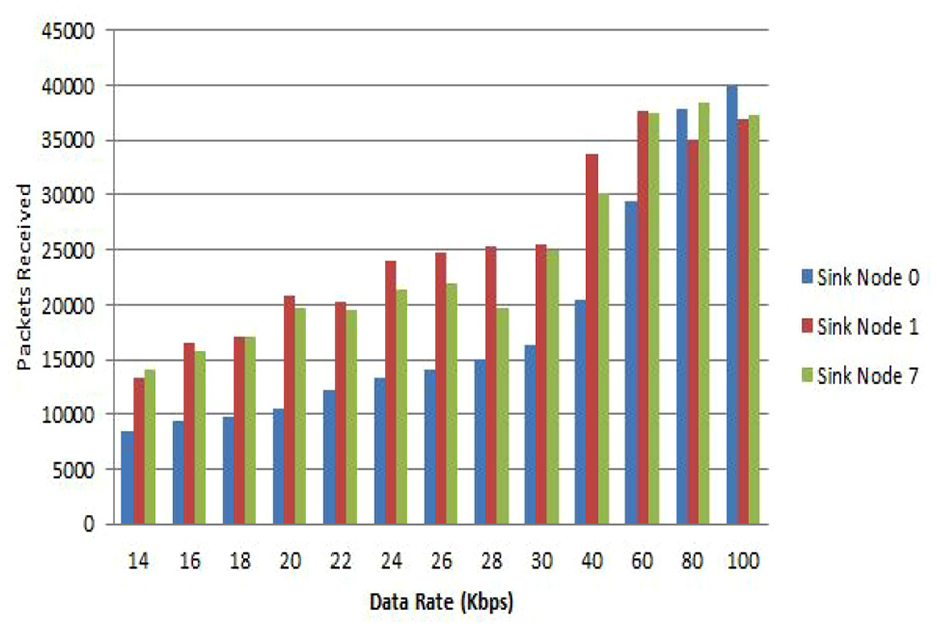
Data rates with respect to sink nodes.

Packets received at different sink positions.
TP levels and PDR
Successfully received packets are the primary concern of IoMT. ATAR tries to maximize successful packet reception in the minimum TP level. As described earlier, we can save more energy at a low power level which not only gives us energy saving but also increases the packet reception.
Figure 4 shows the packets received with respect to time. ATAR not only focuses on energy saving but also minimizes packet loss.
Received packets with respect to time.
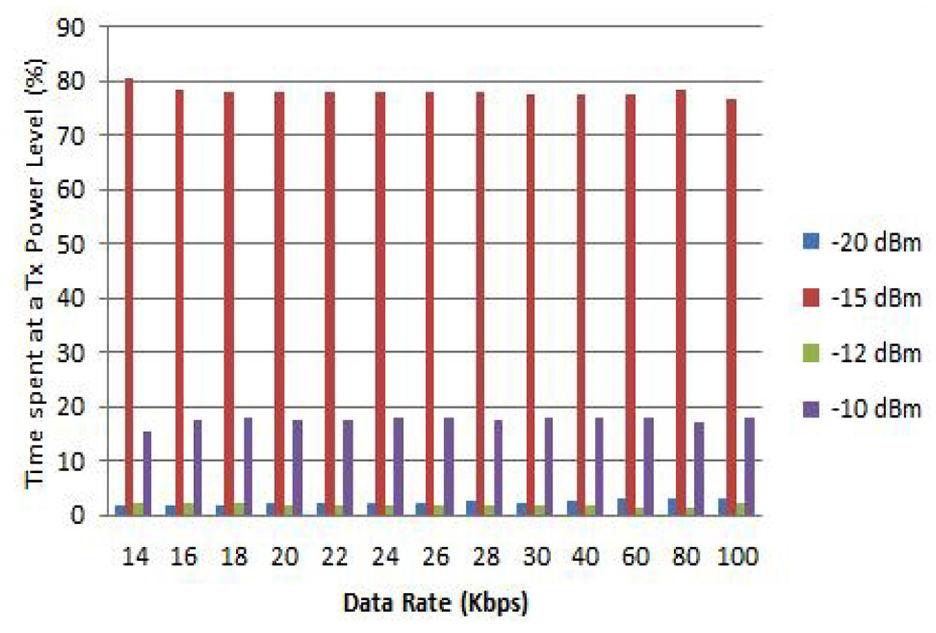
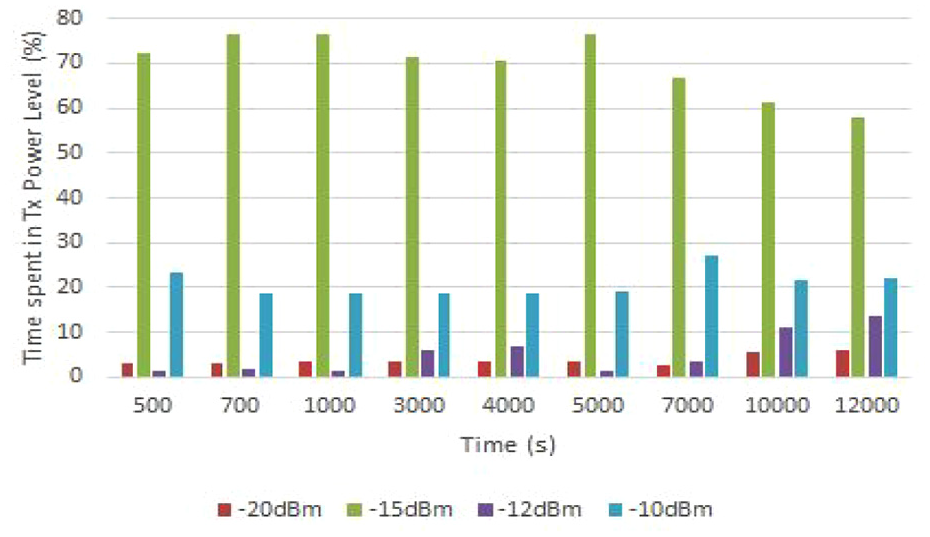
In the proposed approach, we can select the desired TP level to minimize packet loss. Figures 5 and 6 show that the proposed protocol (ATAR) selects −15 dBm as the most appropriate power level. In Figure 5, data transmission is done with different data rates, while in Figure 6, TP level switching is observed on a timeline.
Different transmission power levels versus data rate.

Different transmit power levels over time.
In both cases, the proposed protocol selects the best level where the packet loss is minimum.
Heating ratio (HRatio)
Heating ratio (HRatio) is a ratio that is obtained by dividing time a node’s SAR crosses the threshold with total simulation time. The threshold is kept at 0.34 Ws/kg in this study.
Figure 7 shows the heating ratio using different TP levels. Figure 7 clears that the minimum power level gives us minimum HRatio.
Heating Ratio (HRatio) of different transmit power levels.
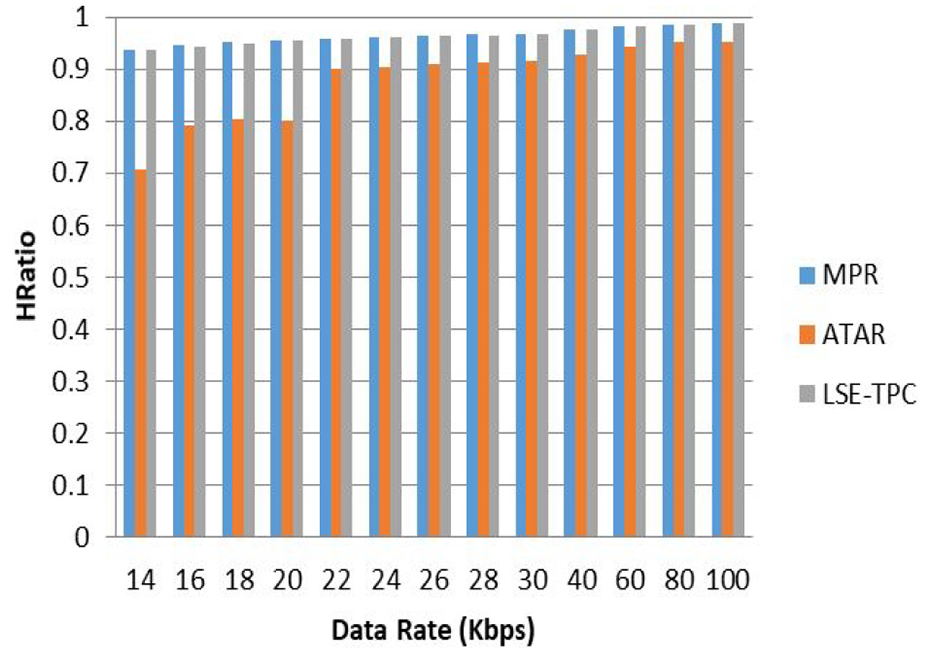
Figure 8 shows the comparisons of HRatio of the proposed approach with the two existing approaches: MPR and LSE-TPC. 27 It is seen from the figure that ATAR has the lowest heating ratio than the other two.

Heating ratio (HRatio) of different routing protocols.
Conclusion
Remote health monitoring is a very critical aspect as it is one vital solution for multiple problems. It is a low-cost solution along with early and easy monitoring of patients. Hence, researchers across the globe have been focusing on enhancing remote monitoring techniques. Currently, thermal and energy constraints are major challenges WBAN faces. In this work, the same is dealt with and is compared with the state-of-the-art protocols. The comparative analysis depicts that the proposed protocol is not only energy-aware but also thermal aware. Moreover, it uses RSSI as feedback; hence, it takes care of channel quality along with prioritizing the sensor nodes which issue critical or time-constrained data. There is still a lot of room for betterment, that is, applying machine learning approaches to analyze the collected data for different purposes mainly for early diagnosis for elderly people.
Footnotes
Handling Editor: Benny Lo
Declaration of conflicting interests
The author(s) declared no potential conflicts of interest with respect to the research, authorship, and/or publication of this article.
Funding
The author(s) received no financial support for the research, authorship, and/or publication of this article.
