




Abstract
The rapid growth of mobile data traffic demand will cause congestion to the future communication network. The cache-enabled device-to-device communication has been proven to effectively enhance the performance of wireless communication networks. This article investigates the caching deployment problem from the energy efficiency in the cache-enabled device-to-device networks. According to the random geometry theory modeling, the closed form expression of energy efficiency is derived, which measures the average number of successful transmitted file bits per unit time and per unit power consumption. And then we establish an optimization problem to maximize energy efficiency. As the formulated optimization problem is a multiple-ratio fractional programming problem that cannot be solved conveniently, we propose a quadratic transformation method to nest in the energy efficiency maximization problem. To tackle this problem, an iterative optimization algorithm is proposed to optimize the caching policy and network energy efficiency. The simulation results demonstrate that the proposed policy can achieve higher energy efficiency and hit probability in the cache-enabled device-to-device network.
Introduction
Recently, the demand for video delivery services has dramatically increased, which promotes the exponential growth of wireless data traffic.1–3 However, conventional solutions like the ultra-dense network with increased base station (BS) deployment density, the millimeter-wave communication using higher frequency spectrum communication, and the multiple input multiple output (MIMO) technology cost too much and have reached their limits. 4 Thus, new paradigms need to be studied to enhance the performance of traditional cellular network architecture. 5 Since device-to-device (D2D) communication can directly communicate with nearby user equipments (UEs) without data forwarding through the BSs, as a result, D2D communication has attracted widespread attention in recent years.6–8 From a practical perspective, the storage of UEs is growing rapidly at low cost. Inspired by these facts, the cache-enabled D2D communication was proposed in Golrezaei and colleagues9,10 to offload more transmitted data traffic. Incorporating cache-enabled D2D communication into the traditional network brings an amount of benefits such as improving offload gain, decreasing communication delay, and enhancing spectral and energy efficiency (EE). 7 Simultaneously, the cache-enabled D2D communication is also conducive to improving the performance in various new application scenarios of the sixth generation (6G), 11 including human-centric services, extremely low-power communications, long-distance, high-mobility communications, and so on.
The cache-enabled D2D communication has proven to be a promising technology that can effectively offload network traffic and reduce congestion. 12 Recently, cache policy in the cache-enabled D2D communication network often focuses on maximizing the content hit ratio or reducing transmission delay. The main goal of the above caching policy is to offload as much network data traffic as possible. However, they completely ignore the energy cost of data transmission and data storage. Furthermore, an optimal hit rate does not indicate that EE will be optimal. Therefore, it is very meaningful for us to design the cache policy from the perspective of network EE. The design of cache policy based on EE not only guarantees the requirements of green communication but also can maintain the EE of future wireless networks at a reasonable level. Work in this direction, we have carried out an in-depth study on cache deployment in the cache-enabled D2D network. Then, we find that the design of cache policy considering EE is promising, and there are few articles in this area. This means that the design of energy-efficient caching policies in D2D networks is very important, but this problem has not been solved in existing research work.
In this work, we consider the cache-enabled D2D networks in which UEs can obtain desired content through D2D communications and self-cache with different energy costs. Motivated by the fact that a large number of redundant transmissions and high transmission energy cost, we use network EE to establish the model for the problem and propose caching policy design. The design goal is to maximize network EE. As such, the research question about the design of a green content caching policy can be expressed as: how to design a caching strategy to maximize network EE while ensuring data traffic offload? how to turn the non-convex cache policy design problem into a convex optimization problem? In this article, we focus on the solutions for these two problems. As far as we know, this is the first initiative to investigate this research issue.
The main contributions of this article are listed as follows:
By jointly considering the influence of D2D-cache and self-cache, we derive the hit ratio and EE in closed form based on the stochastic geometry theory modeling. By utilizing the hit ratio and EE formulations, we propose a cache policy design problem based on EE. As we know, the cache deployment optimization of EE based on the cache-enabled D2D network has not been considered explicitly before.
Through analysis, it is prove that the proposed EE optimization problem is a multiple-ratio fractional programming (FP) problem. We propose a novel method to solve the EE maximization problem of multiple-ratio FP, which converts the concave–convex multiple-ratio FP problem into a sequence of the convex optimization problem. We can easily analyze the performance with low complexity. Then we propose an alternate optimization algorithm to obtain the optimal caching policy design based on network EE.
We evaluated the proposed design and analyses through simulation. The simulation results of our proposed cache policy are compared with the baseline and the max-hit-rate design using different key parameters. Finally, the feasibility of our proposed caching policy was verified.
The other sections of this article are arranged as follows. Section “Related works” explores a related literature review. Section “System model” constructs the system model. Section “Problem formulation and analysis” describes the problem formulation and analysis. Section “Caching policy for EE optimization” describes the caching policy for EE optimization. Section “Simulation and numerical results” demonstrates simulation and numerical results. Finally, section “Conclusion” concludes this article.
Related works
The wireless edge cache technology has been widely used in various network scenarios. Due to the limited cache capacity, it is impractical to cache all content on mobile user devices. Through the research in recent years, scholars have proposed caching policies with different optimization objectives for the cache-enabled D2D network.13–21 Chen and Yang 13 optimizes cache policy by user interests and activity status to maximize the offload rate of the D2D network. Malak et al., 14 in the presence of interference and noise, study the cache strategy and transmission in D2D network and derive the closed expression of the optimal cache strategy. In Chen et al., 15 the authors consider the gain of self-caching, and propose a caching strategy based on D2D caching network. These works mainly focus on transmission in single-hop networks, and in Krishnan et al. 16 the authors extends single-hop transmission to multi-hop application retransmission. They mainly studied the impact of content retransmission on the optimal content placement strategy in static and mobile UE scenarios. Dehghan et al. 17 propose an optimized cache placement policy based on the routing, by reducing the transmission delay for each link. Based on random geometry and optimization theory, Chen et al. 15 investigate an optimal content placement strategy, which maximizes the cache hit ratio of D2D communication network. In Deng et al., 18 the authors construct the content deployment problem in the D2D network scenario, which jointly considers the effects of UEs’ mobile characteristics, cache capacity, and the number of content codes. Chen et al. 19 jointly optimize the cache policy and user scheduling in D2D cache network to maximize the success rate of data traffic offloading. Giatsoglou et al. 20 propose a D2D caching strategy for millimeter-wave networks and study its offload gain. In Gregori et al., 21 the authors propose a method to optimize content caching and delivery in the same time frame. In Sadeghi et al., 22 the authors use local and global Markov processes to model user requests and propose a Q-learning-based file placement algorithm to find the optimal cache policy when the probability of movement is unknown. Chen et al. 23 consider the remaining battery capacity of mobile users in the cache-enabled D2D. They studied the correlation between the offload gain of the network and the energy cost of each content provider. The author introduces a user centered protocol to reduce the energy consumption of helping users transfer files. Then, the cache strategy is optimized to maximize the offload opportunity and the transmission power of each assistant to maximize the offload probability. Lee and Molisch 24 study the potential benefits of individual preferences to establish the cache design problem and reduce the average energy consumption of the system through the resulting content placement strategy. In Ji et al., 25 the optimal caching policy cannot maximize the offload traffic in the wireless network, and the energy consumption of UEs in the network is very high.
The above research shows that most researchers are optimizing caching policies for different UEs with limited caching capacity to increase the offload gain of the caching network, but they ignore the cost of data transmission. In the actual network, because of the UEs’ limited battery capacity and selfish behavior, some users do not want to be the cache-enabled users because it will waste their energy to transmit the files. Even if the UEs are willing to cache the content and provide the requested content to the requesters, what they really want to achieve is to maximize the EE in the D2D network. 26 It has been proven in Perabathini et al. 27 that caching the contents in the cache-enabled D2D UEs can provide significant gains in terms of EE. However, the design of caching policy based on EE analysis in the cache-enabled D2D network is still a research subject to be solved, and need to be further investigated. In this research work, we propose a novel caching policy which considers the EE of the network. This caching policy can maximize EE and keep the network traffic offloading at a reasonable level.
System model
This research considers a D2D caching network model, in which UEs are modeled as a homogeneous Poisson point process (HPPP) with density

Cache-enabled D2D network model.
We considered a limited content library

where ε represents how skewed the popularity distribution is. Note that estimating the popularity distribution of documents is always an open research problem, which is not in the scope of this article (see the literature30,31). Each UE follows the set caching policy
When requesters want to obtain content from the content library
Case 1: Self-cache. If UEs can cache the required content in their own cache, they will get the content directly from their own cache without establishing any communication links.
Case 2: D2D cache hit. If the required content cannot be found in its own cache, it will be obtained from the neighboring cache UEs (i.e. within the D2D radius
Notice that UE preference follows the order above. When the required content is not found in the above case, the content will be downloaded from the core network to the nearest BS through the backhaul and then transmitted to the UE, which will generate a large energy cost.
Problem formulation and analysis
In this section, we analyze the UEs’ access probabilities, and these conclusions will serve as the basis for the conclusions obtained in the following sections. We formally define the main optimization problem aiming at EE in this article. We strive to find an optimal cache placement policy
Cache hit probability analysis
We define the cache hit ratio as the probability that UEs can find the requested content in local cache, including the self-cache and the D2D cache hit cases:
1. Self-cache: When the requester makes a request message, the probability that the content is found in its own cache space is defined as self-caching, so the probability of self-service should be the same as the probability of caching

2. D2D cache hit: If the requester cannot find the required content in the self-caching, they will seek help from nearby cache UEs. The probability that there are k active UEs nearby in the PPP model can be expressed as

The probability that at least one cache UE has cached the required content within the requesters’ communication range and the requester can obtain the required content through D2D communication can be calculated as

Finally, through equations (2) and (4), we can obtain the hit ratio of the overall caching system in closed form as

The EE analysis for cache-enabled D2D network
We considered a linear power consumption model in this article. The power consumption of active cache UEs and inactive cache UEs are expressed as

where

where

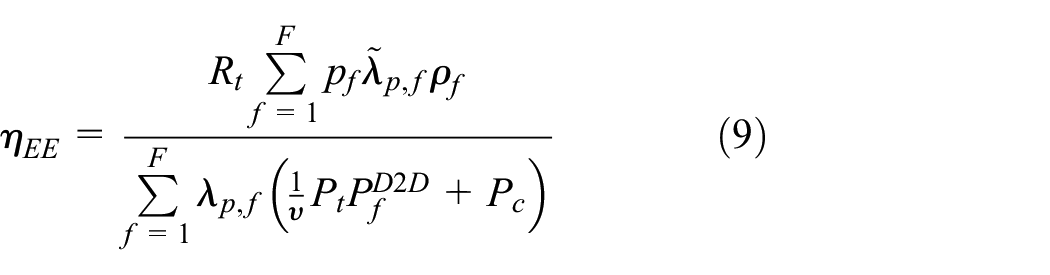
Finally, substituting equations (5) and (6) into equation (8), we can derive the expression of EE as
Caching policy for EE optimization
First, we make some alternative transformations to equation (9). The optimal caching policy design problem for maximizing the cache-enabled D2D network EE can be described as the following nonlinear optimization problem



The objective function (equation (10a)) is derived from equation (9). Constraint (equation (10b)) is the cache capacity of the cache-enabled UE. Constraint (equation (10c)) is the probability that the file f is cached by the cache-enabled UE. In order to further solve our optimized problem, we use Theorem 1 as Shen and Yu’s derivation. 33
Theorem 1. Given M pairs of nonnegative function

So, the multi-ratio sum optimization problem can be transformed into an optimization problem in the following equation (12)

It has been proved in Shen and Yu
33
that the optimal value of the objective function through the above transformation is the same as that of the original optimization variable. Where
Proof
We can easily obtain that the objective function (12) is concave in

The objective function in equation (11) can be obtained by substituting the value of equation (13) into the objective function in equation (12).
We apply Theorem 1 to the multi-ratio sum term in equation (10). Then, we can equate the original optimization problem to the following optimization problem

where

Clearly,

Proposition 1
The EE-based caching policy optimization problem
Proof
See Appendix A.
When
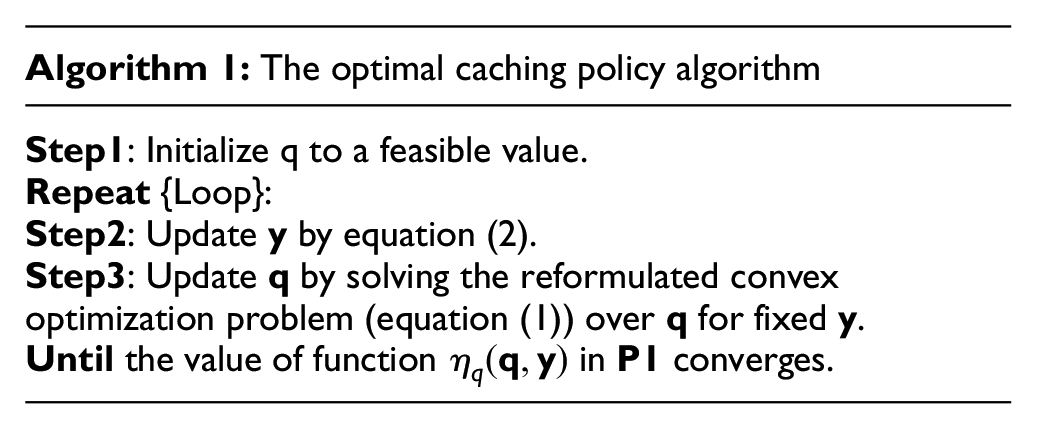
Computational complexity: Through Algorithm 1, we can easily get the optimal caching policy with computation complexity
Simulation and numerical results
In this subsection, we analyze the offloading gain and the EE of the proposed caching policy based on the D2D network by using MATLAB software. In the simulation, unless otherwise stated, the parameters taken in the simulation are given in Table 1. Besides our optimized caching policy (with legend “Proposed EE design”), we also considered the other two caching policies for comparison. (1) the uniform caching policy (i.e. the cache policy obeys uniform distribution, with legend “Uniform-baseline”) as the caching baseline and (2) cache policy for maximizing the cache hit probability(with legend “max-hit-rate design”). 15
Simulation parameters.

In Figure 2, we compare the proposed EE design, the max-hit-rate design, and the uniform caching probabilities with different Zipf parameters (i.e. an

Optimal caching probabilities with different Zipf parameters.
In Figure 3, we compared the EE of different caching policies regarding Zipf parameters. It can be seen from the simulation results that the proposed EE design can show the optimal network EE compared to the other two caching policies. Besides, when the Zip parameter
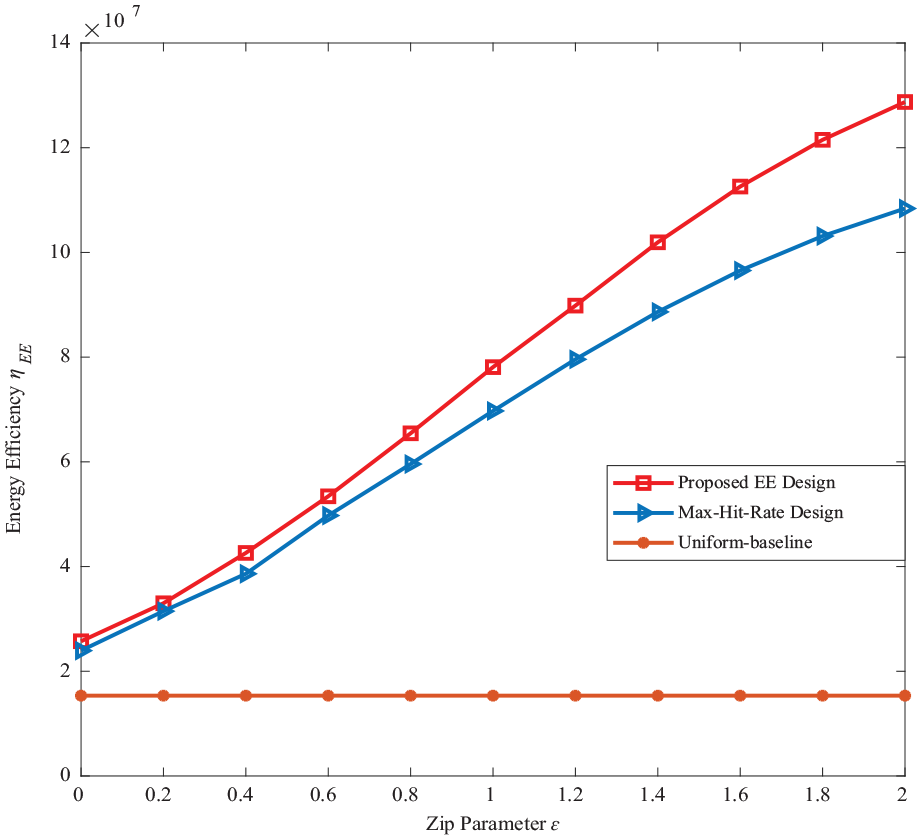
EE comparisons between different caching policies.
In Figure 4, we use the Zip parameters to evaluate the hit rate of the proposed caching policy, that is, the proposed EE design, and compare it with the max-hit-rate design and the uniform caching policy. From the simulation results, we can observe that the hit rate increases as the Zip parameter increases, except that the hit ratio of the uniform caching policy has not changed. This is because the uniform caching policy is evenly distributed. It means that introducing caching into networks does improve the hit rate. In particular, it can be observed that when the Zip parameter

Impact of Zip parameter on hit ratio with different caching policies.
Figure 5 shows the system EE performance with different distances. In the simulation, we use two sets of Zipf parameters

The EE of different caching policies versus distance.
In Figure 6, we show the hit ratio with different caching policies versus Zipf distribution parameter

The hit ratio of different caching policies versus distance.
In Figure 7, we use Zipf parameters

The EE of different caching policies versus UEs density.
In Figure 8, we examine the impact of user density on hit ratio. As expected, the hit ratio of all caching policies increases rapidly with UE density. This is because the dense deployment of active cache UEs in the real network can increase the network storage space and the increase in the number of cache UEs also increases the probability of establishing D2D communication. We noticed that when the density of active UEs increases significantly, the max-hit-rate design and the uniform caching policy starts to diverge from the best proposed EE design. We also can observe that when the Zipf parameter is

The hit ratio of different caching policies versus user density.
Conclusion
The cache-enabled D2D communication is a potential technology to solve future network congestion, which can maximize the overall network EE and offload gain. In this article, we propose a novel D2D caching policy for the content-related EE in the D2D communication network. Based on random geometry theory modeling, we deduce the theoretical expression of the hit rate and define the EE. And then we formulate a cache deployment problem as maximizes the overall EE of the D2D communication network. By applying the quadratic transform, we transform the multiple-ratio FP problem into a solvable convex programming problem, then we solve the problem by using the iterative optimization algorithm. Furthermore, we compare the proposed caching policies with other caching policies by utilizing some key parameters, such as the cooperation distance between users, the user density, and the Zipf distribution. We evaluate our analysis results by simulation and numerical and the results show that the performance of the proposed caching policy outperforms previously proposed schemes.
Footnotes
Appendix 1
For ease of notation, we set
Furthermore, the second-order derivative of
The inequality in Equation (20) comes from scaling a term in the numerator. Denote
Therefore,
Combining the above proof results, we can obtain that each
Handling Editor: Peio Lopez Iturri
Declaration of conflicting interests
The author(s) declared no potential conflicts of interest with respect to the research, authorship, and/or publication of this article.
Funding
The author(s) disclosed receipt of the following financial support for the research, authorship, and/or publication of this article: This work was supported by the National Natural Science Foundation of China (Nos. 61571364 and 61401360) and the Seed Foundation of Innovation and Creation for Graduate Students in Northwestern Polytechnical University (No. CX2020149).

Data accessibility statement
The data used to support the findings of this study are available from the corresponding author upon request (Email: