




Abstract
In wireless multi-hop networks, especially large-scale wireless multi-hop networks, obtaining the network topology is of vital significance. In fact, in both proactive and reactive routing protocols, before establishing an appropriate end-to-end route, the source node needs to obtain the global or local topology. Our previous research has studied the impacts of weak links on reactive routing protocols, which can also be considered as local topology discovery process. In this article, in order to get insight of the impacts of weak links on topology discovery process, especially the global topology discovery on which the proactive routing protocols rely, we apply a Markov chain to model the most common used topology discovery process in large-scale wireless multi-hop networks. Considering the fading characteristics of wireless channel, we analyze the impacts of weak links on topology discovery algorithms. Simulation and theoretical results show that, with the increase in the network scale, the weak links have great impacts on the stability and even on the feasibility of wireless multi-hop networks.
Keywords
Introduction
There are two important kinds of routing protocols, proactive and reactive routing protocol,1,2 in wireless multi-hop networks. Generally, in proactive routing protocol, nodes collect the global topology by periodic broadcast and make the routing decision based on the global topology. While in the reactive routing protocol, before making routing decision, only the local topology between the source and the destination nodes is collected and kept in short-term. Therefore, a topology discovery process is necessary in establishing an appropriate end-to-end route in wireless multi-hop networks. In other words, the source node must get the global or local network topology before calculating the end-to-end routes.
Owing to the fading characteristics of wireless propagation, weak links exist and have great impacts on the topology discovery of wireless multi-hop networks. 3 Even in a fully connected network, because of the weak links, the source nodes may fail to get the correct topology, which makes the routing decision unavailable. The impacts of weak links are reflected in the following two aspects of topology discovery:
1. Topology collection
Weak links result in weak connections. First, the connection relationship of these two nodes, especially the nodes on the coverage edge, may change from time to time owing to the weak links. For proactive and reactive routing protocols, the dynamic change of network topology makes it hard to collect the real-time and correct topology, which greatly affects the performance of routing protocols. However, because of the cumulative effect of packet loss rate in wireless multi-hop network, the topology information may lose during multiple transmission. The failure of topology collection leads to the failure of route establishment.
2. Topology update
When the topology changes are detected, the topology update information should be spread globally or locally. The reactive routing protocols, for example, once a node in the multi-hop route has detected the change of connection, it started a route repair process to inform the source node. Similarly, on one hand, during the spread process of topology update information, the global or local topology may change again because of the weak connections. Therefore, before the last topology update information reaches its destination, another topology update information is sent. In other words, the topology update information is useless for the nodes’ multiple hops away. On the other hand, the topology update information may also lose during multiple transmission.
In conclusion, the unavoidable weak links in wireless multi-hop networks have great impacts on the topology discovery process and make it difficult to obtain the correct topology in time. Topology discovery is the precondition of routing discovery in wireless multi-hop networks. However, the impacts of weak links on topology discovery or routing discovery are always ignored in recent studies.4–7 Plenty of topology discovery algorithms are proposed without considering weak links. Although with the notice of such impacts, researchers mainly focus on designing mechanisms to deal with weak links 8–11 and propose evaluation model for wireless multi-hop network. 12 The power control method, 13 artificial intelligence (AI)–based link quality prediction,14,15 software-defined networking (SDN) 16 architecture, and multi-channel mechanism 17 are applied to deal with the weak link problems and good results have been achieved. However, the innate characters and how the weak links affect the topology discovery are seldom researched.
Our previous studies18,19 have focused on the impacts of weak links on reactive routing protocols, which can also be considered as local topology discovery. We mainly analyze how the weak links affect the discovery of local topology from the source to the destination nodes. We apply the Markov chain to model the local topology discovery process and finally get the probability of routing success and the distribution of hop count, respectively. 18 The theoretical and simulation results show that, it is difficult to obtain the local topology correctly and quickly owing to the impacts of weak links in the large-scale wireless multi-hop networks.
In this article, we further analyze the impacts of weak links on topology discovery and focus on the global topology discovery which is the precondition of proactive routing protocols. Considering a commonly accepted topology discovery algorithm, two important parameters, the topology stable duration between a given node and its neighbor nodes and the spread time of topology change, are studied. By comparing these two parameters, we discuss the feasibility of topology discovery algorithms in multi-hop wireless networks.
The main contributions of this article are as follows:
We apply a Markov chain model to analyze the commonly accepted topology discovery algorithms.
We theoretically point out the limitation of large-scale wireless multi-hop networks with proactive routing protocols.
We offer an accurate research model to evaluate the feasibility of wireless multi-hop networks, and our results have vital importance on network planning in large-scale wireless multi-hop networks.
The rest of this article is organized as follows. In section “System model,” the topology discovery model and the channel model are presented. The Markov chain model is proposed to analyze the topology discovery process and the details of such model are discussed. The Markov chain model is solved in section “Model solving.” Two important parameters, the topology stable duration and the spread time of topology change, are obtained. The simulation and theoretical results are compared in section “Simulation and theoretical results.” In section “Conclusion,” we conclude this article.
System model
In this section, we apply a Markov chain model to analyze the commonly accepted topology discovery process in wireless multi-hop networks. We consider a network with low node mobility which means that the position of nodes remains stationary during topology discovery process. The channel model, topology discovery process, and the Markov chain model will be discussed, respectively, in the following sections.
Channel model
Owing to the fading characteristic of wireless propagation, packets may lose when transmitting between two nodes. In this article, we apply the log-normal shadow fading channel to model the wireless channel between neighbor nodes. The deployment of nodes in wireless multi-hop network is as shown in Figure 1. Let

The deployment of nodes in wireless multi-hop network.
According to the log-normal shadow fading channel model,
20
the packet delivery rate

where


where

Delivery rate of two nodes with distance x.
Topology discovery process
As discussed above, there are two kinds of topology discovery, global and local topology discovery. For reactive routing protocols, the local topology between source node and destination node should be discovered before establishing an end-to-end route. While for the proactive routing protocols, generally, each node has to get the global topology before calculating routes to other nodes.
In this article, considering the universality, we focus on commonly accepted global topology discovery algorithms. The topology discovery process is as shown in Figure 3. All nodes periodically broadcast HELLO packets to their neighbors with the same broadcast period
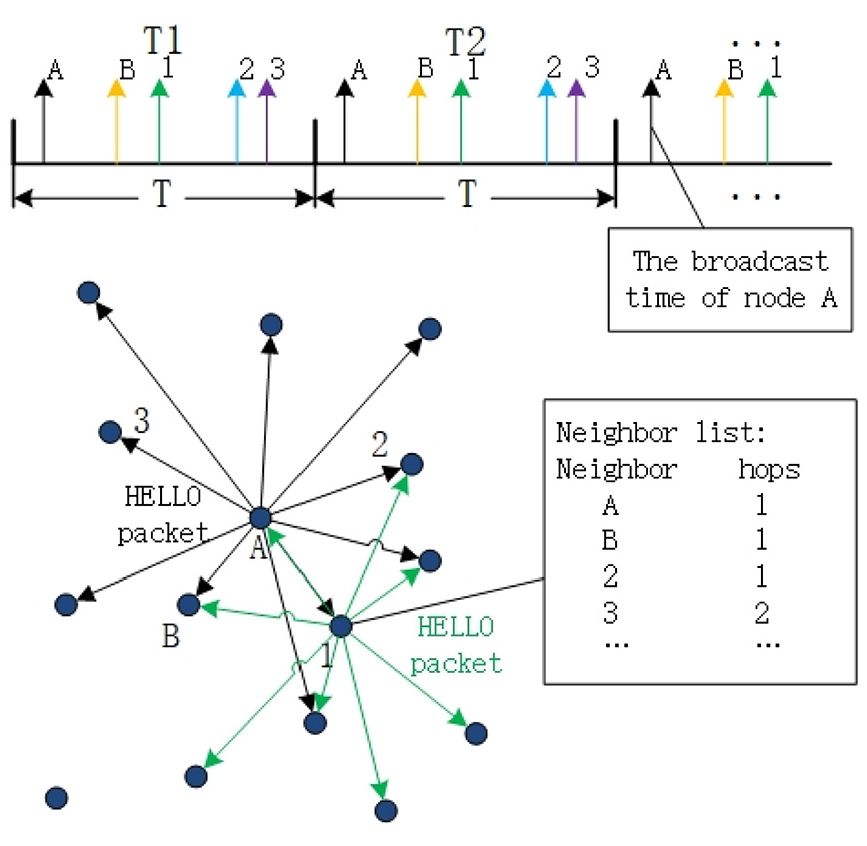
The topology discovery process.
In wired networks, if two nodes can receive each other’s HELLO packets, they are definitely connected. However, in wireless networks, the HELLO packets may lose even the distance between two nodes are very close. Therefore, taking the weak links into consideration, we study the most common used topology discovery algorithms. All nodes periodically broadcast HELLO packets at the beginning. For a given node, if it continuously receives

The process of HELLO packets.
Markov chain model
A node collects the HELLO packets from its neighbor nodes to obtain the topology information. Because all nodes have the same broadcast period and periodically send HELLO packets, without considering the case of packet loss, one node can receive and only receive one HELLO packet from the same neighbor node during one broadcast period
For example, to guarantee the accuracy of topology mentioned above, node A adds node B into its neighbor list after continuously receiving
The MAC layer protocol is considered perfect and the size of HELLO packet is small enough to ignore collisions.
During a broadcast period
Because of the space separation of neighbor nodes, the receptions of a given HELLO packet are independent.
For a given node, the transmissions of HELLO packets at different broadcast periods are independent.
Based on the assumptions and the topology discovery process above, we have the facts as follows:
Whether node A can receive the HELLO packet from node B at period
The connection state change of node
We define a two-dimensional random variable
Specifically, state
States
Considering the above two facts, we have
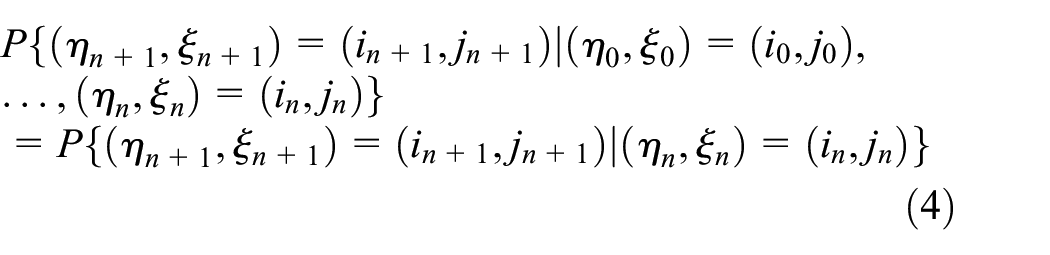
Thus, the topology discovery process can be modeled as a Markov chain
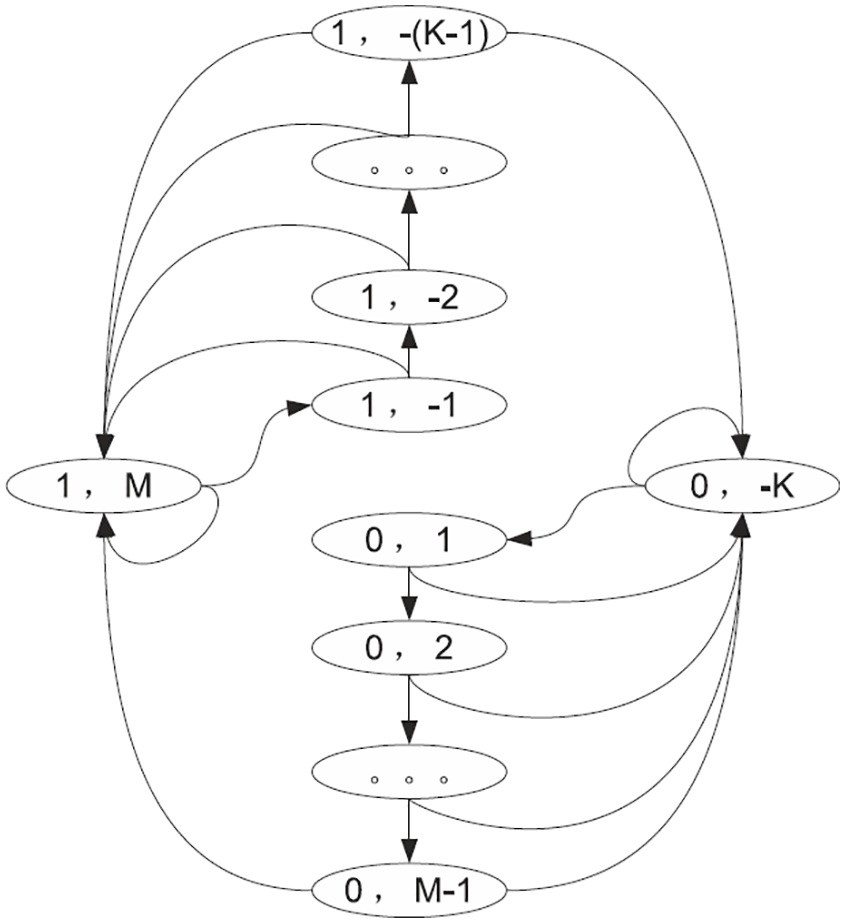
The state-transition diagram.
From Figure 5, for example, state
Topology update process
The topology update process is shown in Figure 6. If a node detects the change of its neighbor list, it broadcasts the new neighbor list to its neighbors the next broadcast period. The new neighbor list is regarded as the topology update information and will be spread to the edge of the network according to the topology discovery process. Therefore, this article mainly focuses on analyzing the details of the spread of new neighbor list.
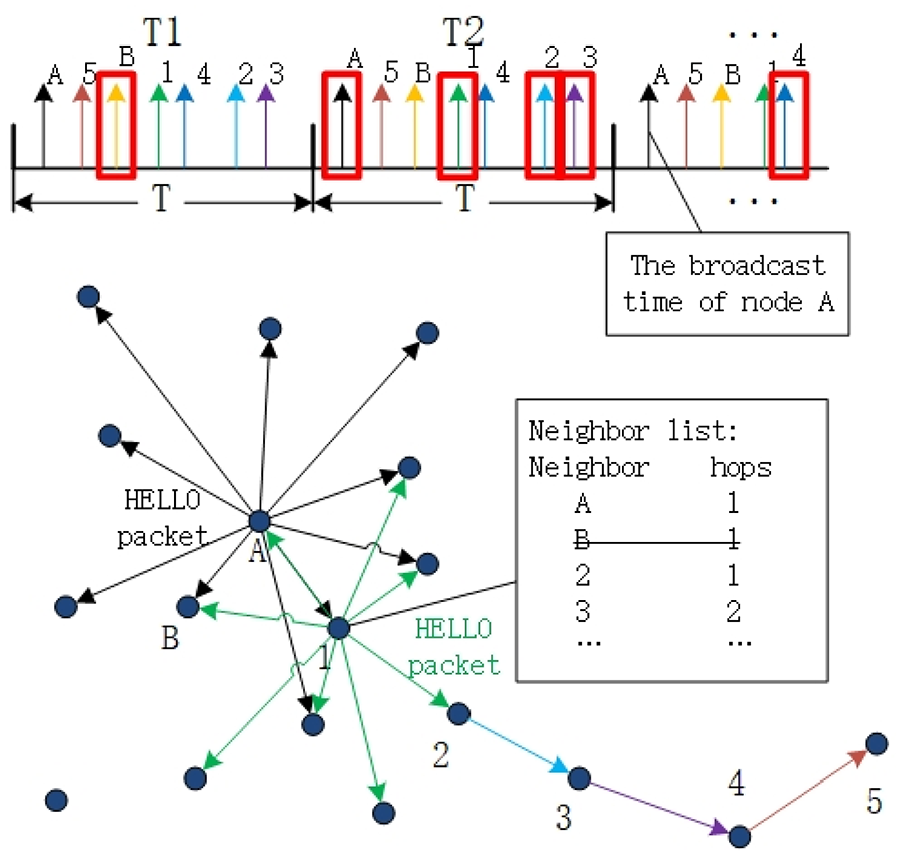
The topology update process.
As shown in Figure 6, at
Let
Model solving
In this section, we solve the Markov chain model to get the matrix of transition probability and steady-state distribution, respectively. Then, the probability of state change for a given broadcast period and the distribution of
Markov chain model solving
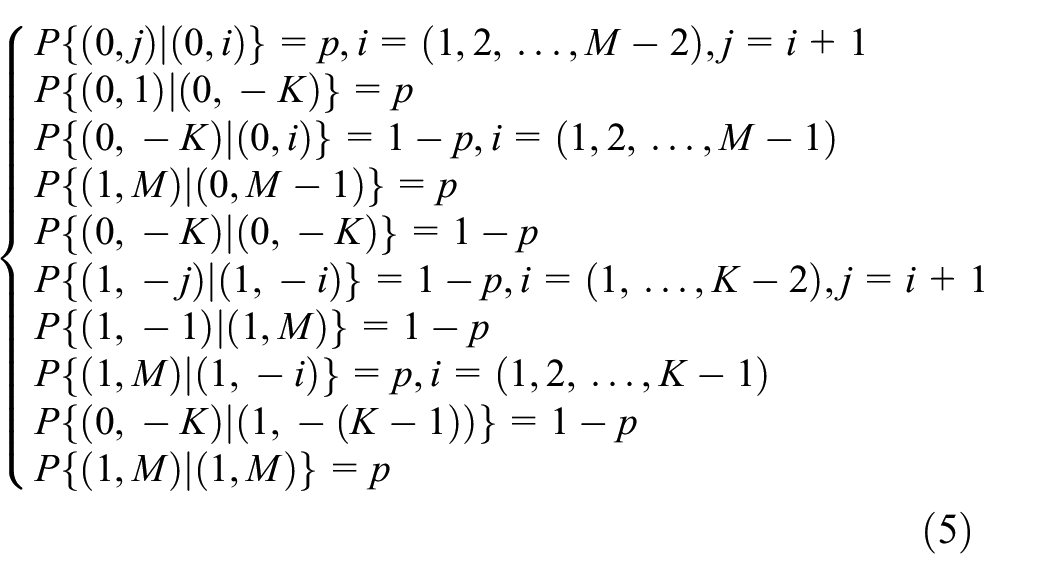
The one-step transition probability of the two-dimension is defined as
where
From the state-transition diagram, it is easy to know that there are

Then, we have a new Markov chain

We defined a

Let

Solving equation (9), we get the steady-state distribution of one-dimensional Markov chain

Distribution of topology stable duration
From the description of topology discovery process and the state-transition diagram mentioned above, it is easy to divide the states into two categories: connected states

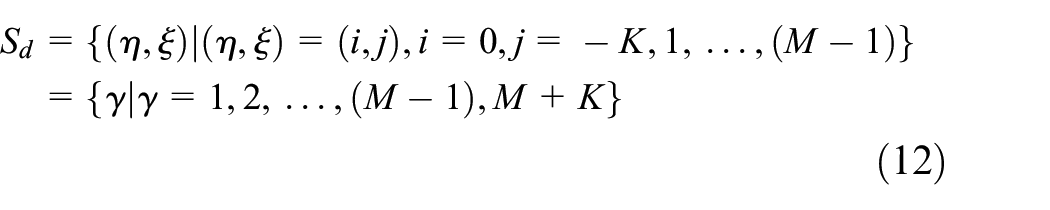
Two nodes are considered stable in both cases: these two nodes remain connected or disconnected. Therefore,

In order to get
Definition 1
For given states

Definition 2
For given states

which denotes the probability of that the state transfers from

From the state-transition diagram, we know that for state

Considering the steady-state distribution, we obtain


Then, we have
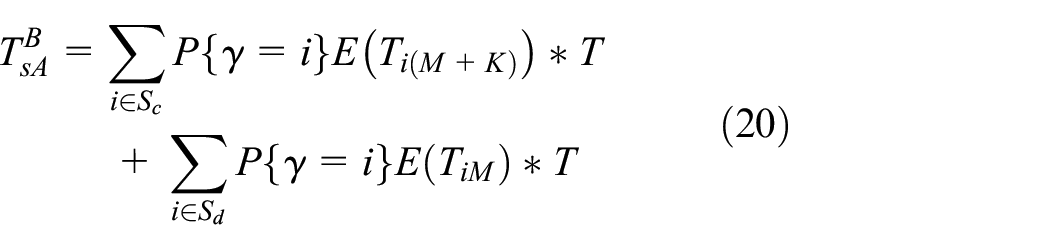
where

Let
We define the probability of topology change during a given broadcast period of node A as

According to the state-transition diagram, we have

Then, the average of

Spread time of topology update
As shown in Figure 6, node A detects the change of local topology and modifies its neighbor list. This topology update information will be spread to the edge of network. During the transport of this topology update information, the local topology of node A may change again. As a result, the nodes at the edge of the network may never get the correct topology of node A. Therefore, it is necessary to figure out the relationship between
We assume that all nodes apply the same topology discovery algorithm and have the same broadcast period T. As shown in Figure 6, each node selects its startup time evenly within
Node A detects the change of its connection with node B at node B’s broadcast time

where

From Figure 6, it is easy to know that

Then, we have the average spread time of topology update


which denotes the topology stable duration of node A in the h-hop-away nodes. If the topology effective time
Simulation and theoretical results
In this section, we use MATLAB simulation platform to build a liner multi-hop network with randomly distributed relay nodes. A common topology discovery algorithm and fading channel model are applied in the network. Some important parameters are shown in Table 1. In order to get insight into the impacts of weak links on topology discovery process, we mainly analyze two important parameters, the topology stable duration
Introductions of some important symbols.

Impacts on local topology stable duration
We analyze local topology stable duration on two aspects. First, for two give nodes A and B, we analyze the point-to-point topology stable duration
Point-to-point topology stable duration
The point-to-point topology stable durations

The point-to-point topology stable durations between nodes A and B (M = 3).

The point-to-point topology stable durations between nodes A and B (K = 3).

The point-to-point topology stable durations between nodes A and B (M = K).
In Figure 7, we set
In Figure 8, we set
Compare the simulation and theoretical results of Figures 7 and 8, we find that if the distance
Figure 9 shows the theoretical result of the stable duration when
Local topology stable duration
The local topology stable duration is also known as neighbor discovery process which is important in the topology discovery algorithms and even in the proactive routing discovery algorithms. In this part, we analyze the performance of the common topology discovery algorithms in neighbor discovering under the impacts of weak links. In wireless multi-hop networks, the global topology changes too frequently and the global topology stable duration is not that important. Thus, we focus on the local topology stable duration and analyze the network stability.
The local topology stable durations of node A

The local topology stable durations of node A (M = 3).

The local topology stable durations of node A (K = 3).

The local topology stable durations of node A (M = K).
In Figures 10–12, we have the similar conclusion as the point-to-point topology stable duration: with the increase in
Impacts on feasibility of topology discovery algorithms
Considering the propagation of topology update information, we compare

The topology effective time
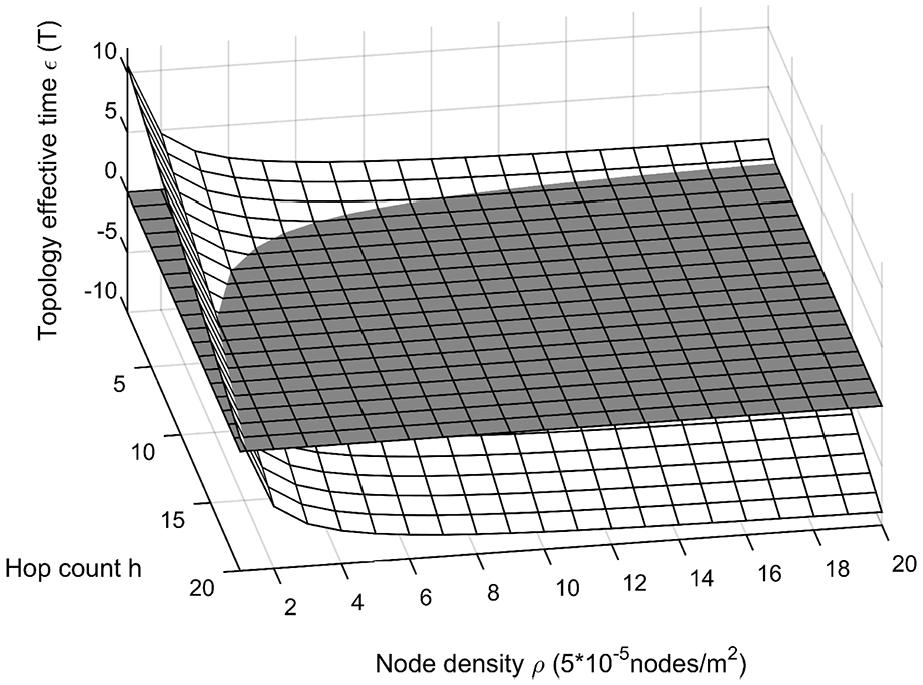
The topology effective time
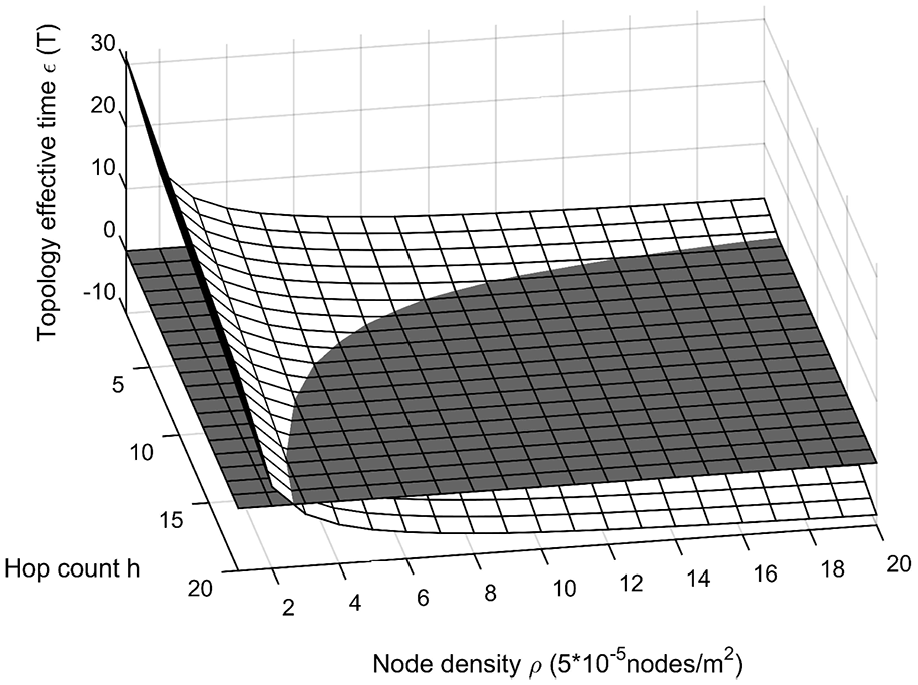
The topology effective time
No matter what kind of topology discovery or routing protocol is applied, proactive or reactive, the main idea of finding an appropriate end-to-end path is to discover the topology between source and destination nodes. The source node starts a topology discovery process and finally obtains the connection relationship between itself and its destination node(s). The connection relationship in wireless networks, especially in large-scale wireless multi-hop networks, is unstable and changes from time to time. Due to the weak links, the unstable connected nodes may be considered disconnected by the topology discovery algorithms. As a result, when the change is detected, the topology update process is necessary. Both processes take time and as mentioned above, topology effective time
Conclusion
In this article, we apply a Markov chain model to analyze the topology discovery process and get the impact factors of feasibility of large-scale wireless multi-hop networks. Our early study has pointed out the impacts of weak links on the process of reactive routing protocols. This time, we consider the most common used topology discovery process in proactive routing protocols and give an in-depth analyze of the impacts of weak links. Theoretical and simulation results have demonstrated that the topology discovery algorithms cannot maintain a stable topology. With the increase in network scale, the condition gets even worse. Actually, no matter what kind of routing protocol (or topology discovery algorithm) is applied, the impacts of weak links exist and have non-negligible influence on the feasibility of wireless multi-hop networks.
In order to avoid the impact of weak links, the future research may focus on the following two aspects. First, the artificial intelligence technology can be applied in wireless link prediction or topology prediction. If a node can predict the existence of weak links in advance, the impact of weak links is weakened.14,15 Second, as we discussed above, the existence of weak links seriously affects the routing or topology discovery process. It is one of the better solutions to minimize packet interaction in the process of routing or topology discovery. Therefore, the SDN-based networking strategies 16 can reduce the distributed packet interaction, which helps to improve the feasibility and stability of the wireless multi-hop networks to a certain extent.
Footnotes
Handling Editor: J Svalastog
Declaration of conflicting interests
The author(s) declared no potential conflicts of interest with respect to the research, authorship, and/or publication of this article.
Funding
The author(s) disclosed receipt of the following financial support for the research, authorship, and/or publication of this article: This work was supported by the School of Information Engineering, Shaoguan University.
