




Abstract
Recent studies about wireless multi-hop networks mainly focus on two aspects, network performance and network strategy. A mass of models and algorithms about network connectivity, path reliability, and node mobility have been proposed to improve network performance. However, hop count, an important factor of wireless multi-hop networks, is rarely researched. In this article, we propose some feasible research methods to figure out the connections between hop count and network connectivity, and path reliability and node mobility, respectively. By modeling the network connectivity, path reliability, and node mobility, we get the maximum hop count of arbitrary wireless multi-hop network. This study shows that the hop count limitation has great effect on network stability. With an increase in hop count, the network stability gets worse. Thinking about this situation, we propose some feasible advices to avoid the hop count limitation problem, which may provide some useful theoretical foundation for further study on wireless multi-hop networks.
Introduction
Wireless multi-hop networks mainly refer to wireless sensor networks (WSNs), wireless mesh networks (WMNs), mobile ad hoc networks (MANETs), and so on. Due to their flexibility, there is a bright future in terms of their wide applications in fields of Internet of things (IOT), vehicle ad hoc networks (VANETs), aeronautical ad hoc networks (AANETs) as well as inter-stellar communications (ISC).
In wireless multi-hop networks, network stability is one of the most important network performances and also the prerequisite of their wide spread. Network stability mainly reflects in three aspects: network connectivity, path reliability, and node mobility.
Network connectivity describes the connections between any two nodes in the network. Generally, network connectivity is measured by the probability that any two nodes connect with each other within the network. The greater the probability value, the better the network connectivity. Thus, the network is more stable. Plentiful of research works focused on the network connectivity.1–6 Authors in the literature
1
studied the connectivity of wireless multi-hop network in a shadow fading environment and determined the greatest lower bound of network connectivity under the condition of a certain node density. Then, the minimum node density for a certain probability of network connectivity was deduced. Connectivity of AANETs
2
and MANETs3,4 was also studied and some important conclusions were obtained. In VANETs, the impact of multi-cooperation strategy
5
on network connectivity was studied. To further analyze the network connectivity, a probabilistic connectivity matrix was introduced as a tool to measure the quality of network connectivity.
6
The largest magnitude eigenvalue of the probabilistic connectivity matrix was proved to be a good measurement of network connectivity. However, the major focus of the literature works mentioned above is on the connectivity between any two nodes within the network. The measurement of network connectivity does not care about the network scale which lacks practicability in network planning. As a result, we define the measurement of network connectivity as the probability that a given node has an N-hop route
At present, most research works about path reliability focus on the expectancy time of the links.7,8 Link expectancy time was defined as the stability factor and used as one of the routing metrics.
7
Actually, link expectancy time is the result of node mobility. In terms of path reliability, we just lay emphasis on the success probability of routing discovery in a given N-hop path. We define the path reliability as the probability of routing success
Node mobility describes the dynamic change of network topology caused by the motion of nodes. Generally, node mobility is measured by the link expectancy time
In wireless multi-hop networks, hop count is an important factor influencing network performance. The impacts of hop count in wireless multi-hop networks were studied.14–16 Rahmatollahi and Abreu 14 deduced the close-form of hop count distribution in multi-hop wireless network with arbitrary node distribution and routing scheme. However, they ignored the impact of routing discovery procedure on successfully establishing a usable route. The wireless channel was also assumed ideal. 14 Similarly, Kuo and Liao 15 and Yildiz et al. 16 also studied the existence and the impact of a multi-hop path without considering the routing discovery. Actually, literature works mentioned above analyzed the impact of network connectivity on hop count instead of the impact of hop count on network connectivity. Obviously, as the hop count increases, the network becomes less stable, which is shown in several aspects as follows:
In terms of network connectivity, as the hop count increases, the probability of existence of an N-hop route for a node in the network decreases, and the network becomes less stable.
In regard to path reliability, with an increase in the hop count, the number of links increases as well as the error probability. Namely, the success probability of routing discovery decreases, and the network becomes less stable.
As for node mobility, when the hop count increases, the number of links increases and the path expectancy time decreases. However, an increase in the number of links leads to the instable end-to-end connection. The probability of failure in routing discovery increases. Thus, the routing discovery time increases, and the network becomes less stable.
It can be seen that hop count is one of the most important network features and has significant impact on network stability. To guarantee the network connectivity, link reliability, and node mobility, respectively, the hop count must be lower than the maximum hop count
We propose a framework for analyzing stability of wireless multi-hop networks and define the stability factors as network connectivity, path reliability, and node mobility.
We figure out the relation between hop count and network stability and finally get the maximum hop count which has significant importance on network planning.
We provide some optimum proposals and future research directions to deal with hop count limitation problem.
The remainder of this article is organized as follows. Section “Stability components” presents analysis models for network connectivity, path reliability, and node mobility, respectively. Simulation and theoretical results are shown in section “Simulation and theoretical results.” In section “Analysis,” we analyze the maximum hop count deduced from network connectivity, path reliability, and node mobility, respectively. In section “Possible solutions,” we propose some possible solutions to deal with hop count limitations in wireless multi-hop networks. Finally, section “Conclusion” concludes the article.
Stability components
In this section, we mainly analyze the relation between network stability and hop count limitation. As mentioned above, network stability factors include network connectivity, path reliability, and node mobility. By modeling network connectivity, path reliability, and node mobility, respectively, we finally deduced the relations between hop count and network stability factors in wireless multi-hop networks.
Network connectivity
Network connectivity is the precondition of communications between any pair of nodes in the network. It decides whether multi-hop routes exist or not between any pair of nodes. As one of the basic performances of wireless multi-hop networks, network connectivity is determined by more basic network attributes. Such attributes include node distribution, node density, and effective communication radius. If channel fading and interference between nodes are taken into consideration, channel propagation model and medium access protocol also have great impact on network connectivity.
Traditionally, research works on network connectivity mainly focus on the probabilities of interconnection between any pair of nodes under the condition of certain network attributes. Traditional network connectivity is determined by node distribution, node density, channel propagation model, and effective communication radius.
Recent research works about network connectivity seldom analyze the relation between hop count and network connectivity. As a result, we are not able to get the network radius and the impact of network connectivity on a given node. Unlike the traditional definition of network connectivity, we use the probability of existence of N-hop route
For simplicity, we assume that the effective communication radius is
For a given finite area

where
For disjoint areas

We assume that the nodes distribute in area
Let

where

Distribution of nodes within area
If

We define indicative function

which indicates the connection of node i and node j. Therefore, it is easy to get the network adjacent matrix A, and

According to the definition, we know that matrix A is a Boolean and symmetric matrix. For a given A,
Let

By changing the non-1 elements to 0, we get the n-hop-only reachable matrix
When
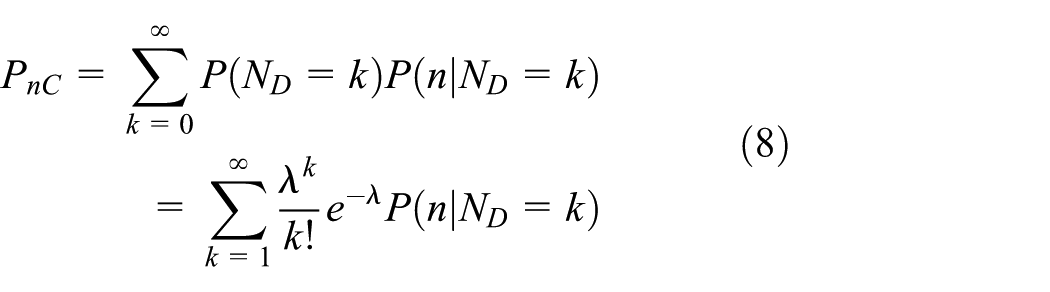
where
Path reliability
The measurement of path reliability is defined as the probability of routing success of a given N-hop path in wireless multi-hop networks. For a given path, with an increase in hop count, the number of links between source and destination nodes increases. After multiple forwarding, the packet loss rate increases; thus, the probability of routing success decreases. Despite an appropriate N-hop path between source and destination nodes, the source node may fail to find it because of the low success probability of routing discovery. As a result, for a given multi-hop path, there exists a maximum hop count
Link model
Let

where

Delivery ratio of two nodes with distance x.
We consider an N-hop path as shown in Figure 3. Let
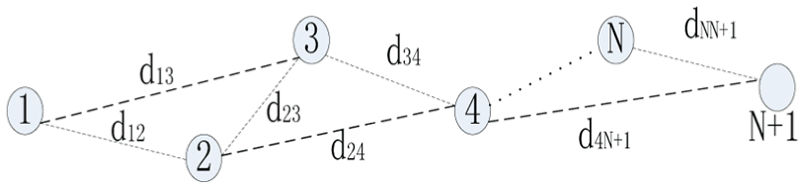
An overview of N-hop path.
Routing mechanism
At the beginning of routing procedure, the source node broadcasts a RREQ packet. The relay nodes forward the RREQ as long as they receive it. The destination node immediately replies the source node with a routing response (RREP) packet once it has successfully received the RREQ. The RREP follows the path, which consists of nodes that used to forward the RREQ, back to the source node hop by hop. After receiving the RREP in the source node, the routing discovery procedure finishes. In this part, we assume that a shortest path–based routing mechanism is applied. Therefore, the relay node which is the nearest to the destination node has the highest priority to forward the RREQ. The process of routing discovery is shown in Figure 4.

The process of routing discovery.
Because of the packet loss rate of each link, the RREQ and RREP may lose after several times of forwarding. Especially, for the routing algorithms applying broadcast mechanism, the reliability of RREQ transmission is not guaranteed without retransmission mechanisms. If the routing discovery procedure fails in the source node, the data transmission between source and destination nodes is not available.
The probability of routing success
In order to get the mathematical result of
The packet transmission processes of nodes are independent. The RREQ broadcast time of node i and node j is separated.
The receptions of RREQ of relay nodes are independent. Because of space separation of node i and node j, the reception of RREQ of node i has nothing to do with node j.
When two or more relay nodes have successfully received the same RREQ, the relay node that is closer to the destination has higher priority to forward the RREQ.
Let n denote the process of the nth RREQ. We define random variables

Thus, the routing discovery procedure can be modeled as a Markov chain
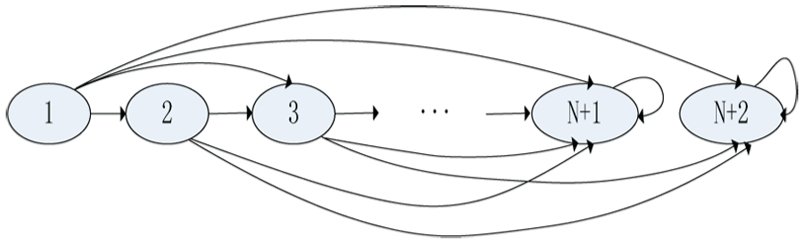
The state transition diagram of Markov chain.
The transmission route of RREP is the same as RREQ. Here, we consider the transmission of RREQ and RREP at the same time. From Figure 5, for example,
In the routing discovery procedure, the condition for a relay node to forward RREQ is that the relay node has successfully received the RREQ from the last relay node (or the source node) and other relay nodes (or the destination node) that are closer to the destination node have failed to received the RREQ. Hence, we have the one-step transition probability of Markov chain
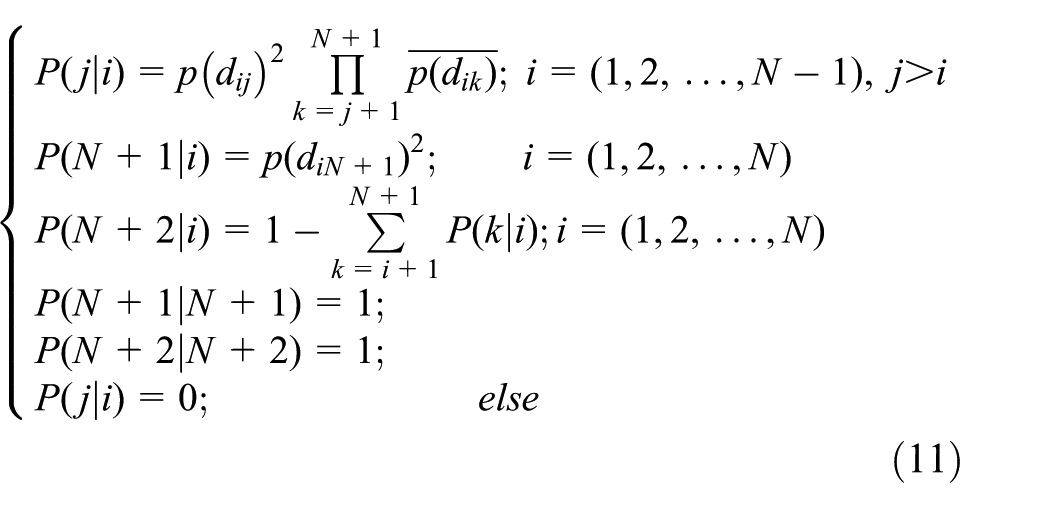
The first equation in equation (11) means that node j has received the RREQ from node i and node j has the highest priority to forward it. The second equation means that the destination node has received the RREQ and replied RREP to node i. The third equation means that all relay nodes have failed in processing the RREQ from node i or replying RREP to node i. The fourth and fifth equations denote that once the source node has succeeded or failed in routing discovery, the state will not change any more.
Let Q denote the transition probability matrix and

and

The probability of routing success

Node mobility
Node mobility is the feature of wireless multi-hop networks, such as MANETs, VANETs, and AANETs, whose nodes are moveable. Node mobility has great effect on wireless multi-hop networks by changing the network topology dynamically. For the communicating nodes, the change of network topology means the rebuilt or repair of the route used. Thus, node mobility inevitably brings the additional routing overhead and delay overhead. As a result, the frequency of the change of the network topology is another important measurement of network stability. In this article, we define node mobility as the frequency of the change of network topology.
Breakage of any links leads to the change of network topology. Therefore, link expectancy time
On the other aspect, because of the unreliability of wireless links, the end-to-end packet loss rate increases with the number of hop count. Therefore, the source node may have to restart the routing discovery procedure again and again which increases the routing discovery time
In order to get
Path expectancy time
We consider a wireless multi-hop network and assume that the speed of nodes v uniformly distributes in
Distribution of relative speed
Let
Let


Related motion between two nodes.
It is easy to find the probability density function (PDF) of relative velocity

Distribution of link expectancy time
Link expectancy time
As shown in Figure 6, we assume that the original distance between two neighbor nodes d uniformly distributes in
The remaining link expectancy time is given by

Since

From equations (17) and (18), it is easy to find


where
Distribution of path expectancy time
For a given N-hop route, as shown in Figure 7, the path expectancy time is given by

where

Expectancy time of links in a given N-hop route.
For the non-adjacent links, like link 1 and link 3 in Figure 7,

where
For a given N-hop route, the average path expectancy time

Routing discovery time
In wireless multi-hop networks, a multi-hop route must be established before communication. No matter what kind of routing protocol (active, passive, or hybrid routing protocol), there is a period of time, called routing discovery time
For a given path, with an increase in hop count, the end-to-end packet delay increases inevitably. However, in consideration of that the path expectancy time
Let
From equation (14), we have the probability of routing discovery failure for a given N-hop path

The average routing discovery time

Simulation and theoretical results
Simulation parameters
We use MATLAB to simulate the node distribution, the routing discovery procedure, and the node mobility, respectively. We consider a network of size D and a given path of N hops. Some important parameters are shown in Table 1.
Simulation parameters.

Network connectivity
The nodes are randomly deployed in area

Probability of existence of n-hop route with

Probability of existence of n-hop route with
The probability of existence of N-hop route
Figure 9 shows that, for a given
Path reliability
In order to analyze the probability of routing success, we simulate the routing discovery procedure in MATLAB. Nodes are stationary and the source node broadcasts an RREQ to start the routing discovery procedure. The relay nodes forward the RREQ and the destination node replies the source with RREP. We apply the link model in Section “Stability components.” Simulation and theoretical results are shown in Figures 10 and 11.

Probability of routing success of a given route with

Probability of routing success of a given route with
The probability of routing success of a given N-hop route
In Figure 10, we keep the signal attenuation threshold
In Figure 11, we keep the effective communication radius
Node mobility
To study the node mobility, we consider a given path of N moveable nodes. We first analyze the relative speed and remaining link expectancy time. Then, the path expectancy time and the routing discovery time, respectively, are analyzed. Simulation and theoretical results are shown in Figures 12–16.
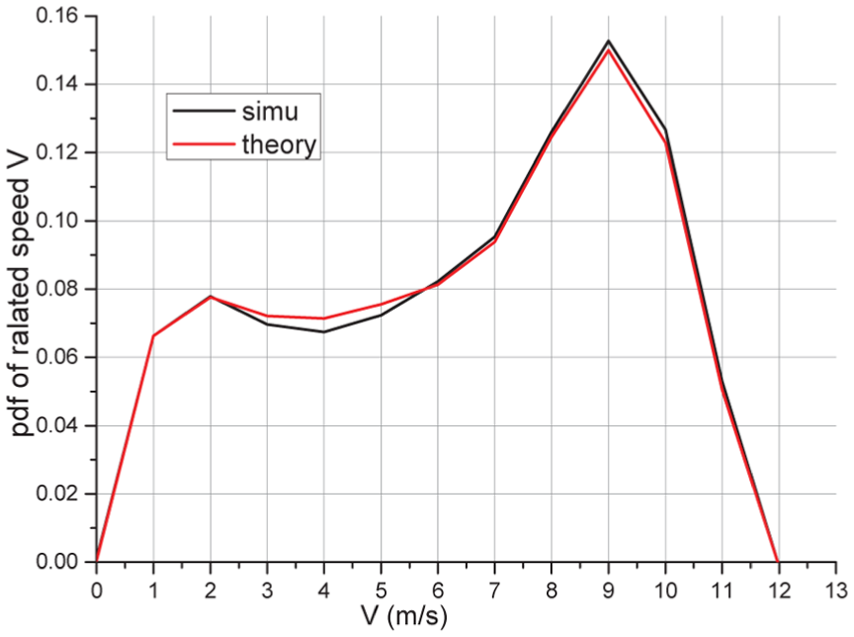
PDF of related speed with

PDF of link expectancy time with

Average path expectancy time.

Average routing discovery time with

The difference between
The PDF of related speed is shown in Figure 12 with
Figure 13 shows the PDF of
Simulation and theoretical results are shown in Figure 14. The average
Figure 15 shows the simulation and theoretical results of
More importantly, with an increase in hop count n,
The difference between
Analysis
From the simulation and theoretical results above, we have three maximum hop counts
For simplicity,

which denotes that
Similarly,

and

Through theoretical analysis, we qualitatively know that
In most of wireless multi-hop networks, node mobility has little impact on network stability. For example, in wireless multi-hop networks, such as WSNs, WMNs, and low-speed MANETs, the impact of node mobility can be ignored to some extent. While in some particular wireless multi-hop networks, AANETs, VANETs, and high-speed MANETs, for example, there is important significance to study the impact of node mobility on wireless multi-hop networks.
First, we analyze the condition without node mobility. Generally, the channel model does not change in the same scene. For a given channel model, the wireless propagation model we apply in this article with given
However, without considering the node density
In general, node mobility model does not change in the same scene. Thus, we just analyze the impact of
The impact of
On the contrary, as
Possible solutions
Form the analysis above, there is a maximum hop count if network connectivity, path reliability, and node mobility of wireless multi-hop networks are satisfied. The maximum hop count
In order to overcome restrictions brought by the hop count limitation, one of the most direct ways is to reduce the hop count in a route. Adding a few base stations in wireless multi-hop networks could be a feasible scheme. Communication between the base stations is wired communication with high reliability and low latency. Since the base stations have stronger communication abilities, they have higher priorities to act as relay nodes than ordinary nodes, and two base stations, together with base stations between them, can be seen as an ordinary node. As a result, the number of relay nodes between source node and destination node in a route decreases. However, by adding base stations into network, we actually add diversities into nodes in the network. The routing strategy may be completely different from the ordinary routing strategies, and the deployment strategy of base stations is also a new research point. This may be unfeasible in some kind of networks, such as MANETs, that base stations are not allowed. In such kind of networks, network stability may never be achieved unless hop count limitation problem is settled.
In view of non real-time services in networks with node mobility, delay tolerate networks (DTNs) 18 may be a feasible solution to deal with the restrictions of hop count limitation. In DTN, nodes send packets in store-carry-forward way. On one hand, without considering the end-to-end delay, the impact of node mobility can be ignored. To a certain extent, node mobility is helpful for DTN. On the other hand, despite the low density of nodes in DTN, as long as the nodes have chances to meet each other, the non real-time services are guaranteed. As a result, the impact of network connectivity can also be ignored. In fact, a real-time multi-hop route is not necessary in DTN, and because of the carry-and-forward strategy, DTN could be seen as a one-hop wireless communication network. In other words, for the maximum hop count 1, network connectivity, path reliability, and node mobility are all out of consideration. However, limited to the type of service, the application area of DTN in wireless multi-hop networks is relatively small.
For wireless multi-hop networks whose nodes remain static, such as WSNs and WMNs, we do not need to care about the impact of node mobility. If the nodes are not stochastically deployed, an optimal node deployment strategy19,20 is easy to meet the requirements of network connectivity and path reliability, which can greatly increase network stability. From the analysis above, we know that path reliability and network connectivity are negatively correlated in some cases. We can increase path reliability without affecting network connectivity and then appropriately relax the requirement of path reliability to increase network connectivity. For example, we can increase path reliability by applying more advanced modulation technologies or increasing the wireless signal transmission power. And then we appropriately increase the effective communication radius to increase maximum hop count deduced form network connectivity.
Another solution to increase the maximum hop count is to apply central control routing algorithms such as software-defined wireless sensor networks (SDWSNs).21,22 By avoiding routing discovery procedure, the path reliability will be greatly improved. As a result, wireless multi-hop networks whose nodes remain static, optimal node deployment strategies, advanced physical layer technologies, and central control routing algorithms may be the keys to achieve high network stability.
Conclusion
In this article, we mainly analyze the relation between expected hop count and network stability in wireless multi-hop networks. We finally find out the hop count limitation of certain wireless multi-hop networks by analyzing stability factors including network connectivity, path reliability, and node mobility. Relations between hop count limitations deduced from network connectivity, path reliability, and node mobility have been analyzed comprehensively. Meanwhile, to deal with the hop count limitation, we proposed some practical schemes, which aim at reducing the hop count in wireless multi-hop networks. The hop count limitation of wireless multi-hop networks also has reference significance in network planning when determining the coverage radius of networks, the minimum number of nodes, and so on.
The main purpose of this article is to provide a framework for analyzing stability of wireless multi-hop networks and point out the relation between hop count limitation and network stability. In our further study, more details about relations between hop count limitations deduced from different aspects will be analyzed. More basic network attributes will be taken into consideration to improve the accuracy and scalability of theoretical model for hop count limitation research. The final goal of hop count research is to find out the limitations of network performances in wireless multi-hop networks and provide the basis of network planning.
Footnotes
Academic Editor: Sangheon Pack
Declaration of conflicting interests
The author(s) declared no potential conflicts of interest with respect to the research, authorship, and/or publication of this article.
Funding
The author(s) disclosed receipt of the following financial support for the research, authorship, and/or publication of this article: This work was supported by Beijing Laboratory of Advanced Information Networks and the National Science and Technology Major Projects of China under Grant No. 2015ZX03003002-002.