




Abstract
The reliability of face recognition system has the characteristics of fuzziness, randomness, and continuity. In order to measure it in unconstrained scenes, we find out and quantify key broad-sense and narrow-sense influencing factors of reliability on the basis of analyzing operation states for six dynamic face recognition systems in the practical use of six public security bureaus. In this article, we propose a novel evaluation method with True Positive Identification Rate in dynamic and M:N mode and create a novel evaluation model of system reliability with the improved Fuzzy Dynamic Bayesian Network. Subsequently, we infer to solve the fuzzy reliability state probabilities of the six systems with Netica and get two most important factors with the improved fuzzy C-means algorithm. We verify the model by comparing the evaluation results with actual achievements of these systems. Finally, we find several vulnerabilities in the system with the least reliability and put forward a few optimization strategies. The proposed method combines advantages of the improved fuzzy C-means model with those of the dynamic Bayesian network to evaluate the reliability of the dynamic face recognition systems, making the evaluation results more reasonable and realistic. It starts a new research of face recognition systems in unconstrained scenes and contributes to the research on face recognition performance evaluation and system reliability analysis. Besides, the proposed method is of practical significance in improving the reliability of the systems in use.
Introduction
Nowadays, the public security situation is confronted with two major difficulties. Traditional and non-traditional security threats are intertwined. The complexity of social contradictions and the threat of terrorism are increasing. The situation has brought unprecedented pressure and challenge to public security agency in their work of combating, preventing, managing, and controlling threats. However, the increase in police force is far from enough to meet the actual demand. So the face recognition technology, which can transform science and technology into combat powers directly, has become an important means to solve this problem. Face recognition is a kind of biometric recognition technology based on face feature information. Compared with other biometric technologies, the face recognition technology has unique advantages, such as non-mandatory, contactless, intuitive, convenient, and quick. Accordingly, it has broad application prospects. As one of the most popular biometric technologies, face recognition is a milestone for the advancement of security technology. The dynamic face recognition system is a kind of technical equipment that is especially for public security prevention and control in public areas, which is funded, used, and managed by public security agency. It is a product of the face recognition technology, and it is also a Hand of Midas for the efficiency and value of the public security video surveillance. Its basic principle is to identify target faces automatically in the public security video surveillance. At present, the dynamic face recognition system has become indispensable for public security agency, 1 and it plays an irreplaceable role in public security business.
With the increasing application of the dynamic face recognition system, its reliability has been paid more and more attention by public security agency and scholars. Face recognition is one of the most challenging problems in pattern recognition and computer vision. The reliability of the face recognition system is influenced by many factors, such as power supply, weather, and system performance. Although the face recognition system in constrained scenes has perfect reliability and the recognition accuracy is comparable to human eyes, in unconstrained scenes, for example, the dynamic face recognition system often has unsatisfactory, even greatly discounted reliability. The reliability of the dynamic face recognition system is an important influencing factor of the system effectiveness, and the reliability evaluation of the dynamic face recognition system has become a crucial research topic naturally.
The academic research works on reliability start from World War II. The reliability analysis gradually extends from electronic and aerospace systems to many other fields, such as machinery and communication. The common methods of system reliability analysis include fault tree analysis, 2 Markov process, 3 Monte Carlo simulation, 4 failure mode effects and criticality analysis, 5 reliability block diagram, 6 dynamic fault tree, 7 fuzzy numbers, 8 GO methodology, 9 Petri net, 10 universal generating function, 11 binary decision diagrams, 12 Bayesian network,13,14 and dynamic Bayesian network.15–18 Most of the methods suppose that the variables of system reliability only have two states (either 1 or 0). However, there may be multiple discrete, even continuous state variables in the reliability of many complex systems. At the same time, because of the complexity and uncertainty of systems, there is fuzziness in variable states of reliability. The fuzzy Bayesian network emerges subsequently. The deficiencies of the fuzzy set theory itself may cause information loss in the process of fuzzy Bayesian network inferring and solving. In addition, the above-mentioned research works do not consider broad-sense but narrow-sense influencing factors of reliability. For example, the recognition performance is an important factor that influences the reliability of the dynamic face recognition system.
At present, there are a few relevant research works on the security system. Lv 19 evaluates the reliability of a set of security equipment by testing their lives and fitting their failure functions. The method is quite time-consuming, and it only analyzes internal failure factors. In Qu et al., 20 a failure risk evaluation index system of a video surveillance system and the fuzzy analytic hierarchy process model are created to evaluate the system failure probability, that is, the reliability evaluation of the video surveillance system. The index system is mostly qualitative, and the evaluation method itself is rather subjective.
Aimed at the problems in previous research works, we propose a relatively objective and effective reliability evaluation model with the improved Fuzzy Dynamic Bayesian Network. It is a novel reliability evaluation model with a combination of improved fuzzy C-means and dynamic Bayesian network. We evaluate the reliability of dynamic face recognition systems with the improved Fuzzy Dynamic Bayesian Network model and find out important influencing factors and vulnerabilities, and put forward a few optimization strategies.
The innovations and contributions of this work are summarized as follows:
We find out influencing factors of the reliability of face recognition systems in unconstrained scenes, including both broad-sense and narrow-sense factors, and quantify them scientifically and reasonably.
We propose a novel evaluation method with True Positive Identification Rate (TPIR) of face recognition systems in dynamic and
We create a novel evaluation model of system reliability with the improved Fuzzy Dynamic Bayesian Network, which can dynamically evaluate the reliability of the systems with characteristics of fuzziness, randomness, and continuity. The Membership functions of the improved Fuzzy Dynamic Bayesian Network model are constructed not according to subjective experience but objective sample data. So the proposed model is obviously more advantageous than previous methods.
We conduct evaluation experiments on six dynamic face recognition systems in use and verify the model by comparing the evaluation results with actual achievements of these systems. Experimental and verification results show that our approach is reasonable and realistic.
Approach
The Bayesian network, also known as the belief network, is one of the most effective theoretical models in the field of random uncertainty knowledge representation and inference. It has obvious advantages in logic descriptions of random unascertained failures, while the simple Bayesian network has some limitations, mainly because it can only describe discrete random variables with finite states.
Jousselme et al. 21 categorize unascertained knowledge into two kinds, which are ambiguity and vagueness. They correspond to random variables and fuzzy variables, respectively. The influencing factors of the dynamic face recognition system reliability are random, fuzzy, and continuous. “Incidence” is used to indicate the possibility of a random event, and the Membership Degree is used to indicate the extent to which a fuzzy event belongs to a certain state. Both the possibility and the Membership Degree are continuous. For example, “high incidence of camera failure” is a mixed event with the characteristics of randomness and fuzziness. The occurrence of this event involves probability and degree. “Incidence” is random and “high” is fuzzy. To describe “high incidence of camera failure,” we need to consider both the probability of “incidence” and the degree of “high.”
In many complicated cases, the variables are all random, fuzzy, and continuous. If we describe this kind of variables with the simple Bayesian network, it is equivalent to assigning all of the degrees to 1 or 0. It means that the node variables either belong to a certain state or do not belong to the state at all, without considering intermediate states of node variables. The fuzzy Bayesian network and the Fuzzy Dynamic Bayesian Network can solve the kind of problems. The former is a model that combines the fuzzy set theory and the simple Bayesian network,22–29 which is premised on the basis of the hypothesis that the system reliability state is independent of time. The latter is a model that combines the fuzzy set theory and the dynamic Bayesian network,30–32 which is premised on the basis of the hypothesis that the system reliability state is related to time and changes with time. If we regard the state change process of the system reliability as a series of snapshots, each snapshot describes the state of the system reliability at a specific time. Actually, every snapshot, also known as a time slice, is a fuzzy Bayesian network. The Fuzzy Dynamic Bayesian Network is a special form of the fuzzy Bayesian network, and it consists of a series of fuzzy Bayesian networks. Because the system reliability state is often time-dependent in reality, the Fuzzy Dynamic Bayesian Network is more suitable for system reliability description. But for both the fuzzy Bayesian network and the Fuzzy Dynamic Bayesian Network, there is a major defect in the construction of Membership functions. It may cause inaccuracy in evaluation results.
The improved Fuzzy Dynamic Bayesian Network model consists of the improved fuzzy C-means and the dynamic Bayesian network. Its main idea is to use improved Membership functions in fuzzy sets to represent the states of continuous variables and compute the prior probabilities on the basis of considering degrees. The fuzzy C-means is a mathematical model that is used for the soft classification of samples according to their attributes.33,34 Because the Membership functions of the improved fuzzy C-means model are constructed according to objective sample data, they have obvious advantages over fuzzy Membership functions that are constructed according to subjective experience in unascertained information processing. The improved fuzzy C-means model is good at processing fuzzy unascertained information, while the dynamic Bayesian network is good at processing random unascertained information. We combine them to create a new approach to evaluating the reliability of complex systems, which is the improved Fuzzy Dynamic Bayesian Network. In this section, we only present the approach of the improved fuzzy Bayesian network, and we extend it on time series to get the improved Fuzzy Dynamic Bayesian Network model in the process of modeling in the next section.
Suppose
We need to quantify to what degree
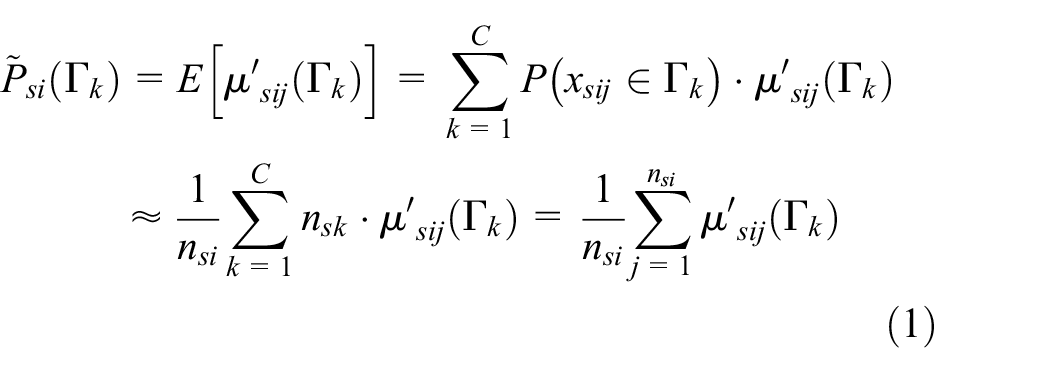
where
In order to introduce the improved fuzzy C-means algorithm conveniently, we suppose
Let

Equation (2) is a certain distance from

where
The general form of the objective function of the improved fuzzy C-means is

Then we can transform the improved fuzzy C-means into the following optimization problem: solve the minimum for
If we regard system
Evaluation experiments
Data acquisition
In this article, one part of the raw data come from the 1-year maintenance records and local weathers of six dynamic face recognition systems in six public security bureaus. Because these data are rather sensitive, we use
Modeling
The first task of improved fuzzy Bayesian network modeling is to set the network nodes. We regard all specific influencing factors of reliability as the root nodes of the improved fuzzy Bayesian network, subsystems as intermediate nodes, and the system reliability as the leaf node. The summary of the specific variables serving as the nodes of the model is shown in Table 1. On the basis of analyzing causal relationships between these nodes and basic data, we create an adjacency matrix of the network nodes. We first construct a framework of the improved fuzzy Bayesian network. Then we extend it along the time axis to obtain the improved Fuzzy Dynamic Bayesian Network with an interval of 1 month. It consists of five time slices, namely, five snapshots of the fuzzy Bayesian network. Figure 1 shows a framework of two time slices. For each time slice, there are 21 root nodes (influencing factors of reliability), 6 intermediate nodes, and 1 leaf node. There are other model parameters as follows: the number of systems




where
Variables used to construct the improved fuzzy Bayesian network.

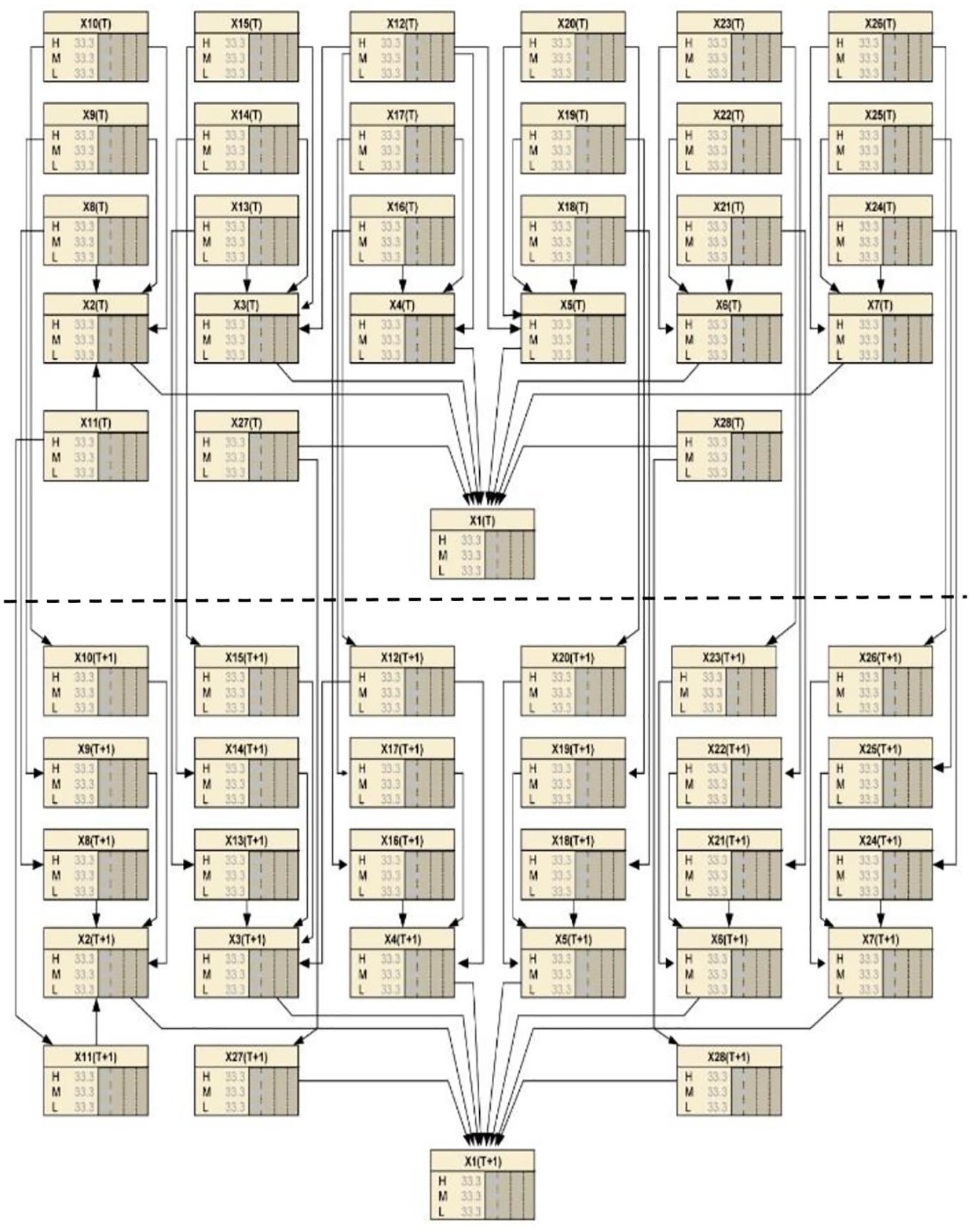
Improved Fuzzy Dynamic Bayesian Network model. This is a model framework of two time slices, Time
The prior probabilities of the root nodes can be computed or evaluated through the following procedure. To begin with, we need to set some intermediate parameters. These parameters are some statistical results related to reliability factor failure coefficient

When an influencing factor of the reliability is narrow-sense, the calculation equation of its failure coefficient

where
When an influencing factor of the reliability is broad-sense, to be specific, the recognition performance is different from the narrow-sense factors in calculation method, whose calculation equation is

where
The specific evaluation process of
The specific evaluation process of
The specific evaluation process of
According to the series of experiments and calculations above, we obtain the reliability factor failure coefficients and some related parameters. For example, a batch of statistical results of system
A batch of statistics on reliability factor failure coefficient and related parameters.

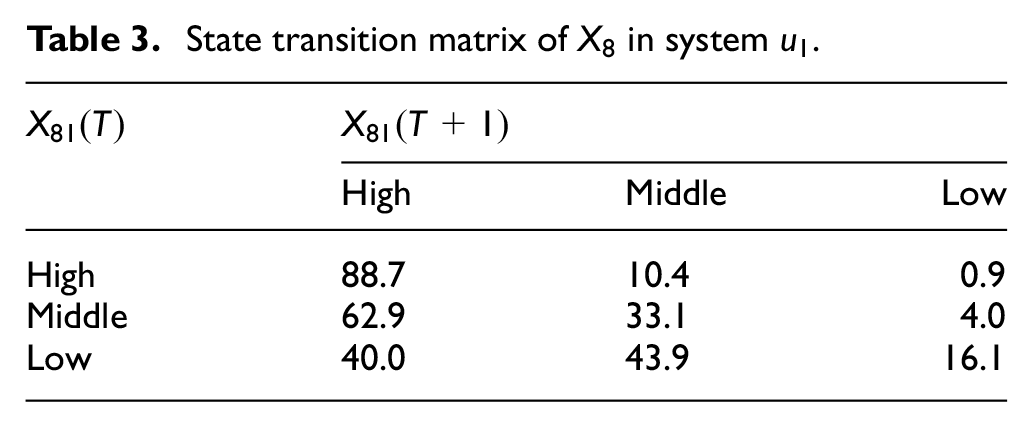
The data in this table are the statistical results based on a performance evaluation report and a day’s maintenance records of system
State transition matrix of
Inference and solving
In this article, a piece of software named Netica is used for inference and solving. First, the model is initialized. The initial state parameters of each node are all set to 0.333. When the fuzzy prior probabilities of root nodes are put into the network, root node states of the network are updated. As soon as the conditional probabilities and the state transition probabilities are put into the network, the network inference is triggered. Then the fuzzy probability distributions of all nodes are obtained, and the fuzzy reliability state probabilities of a system in each time slice are obtained. As far as system
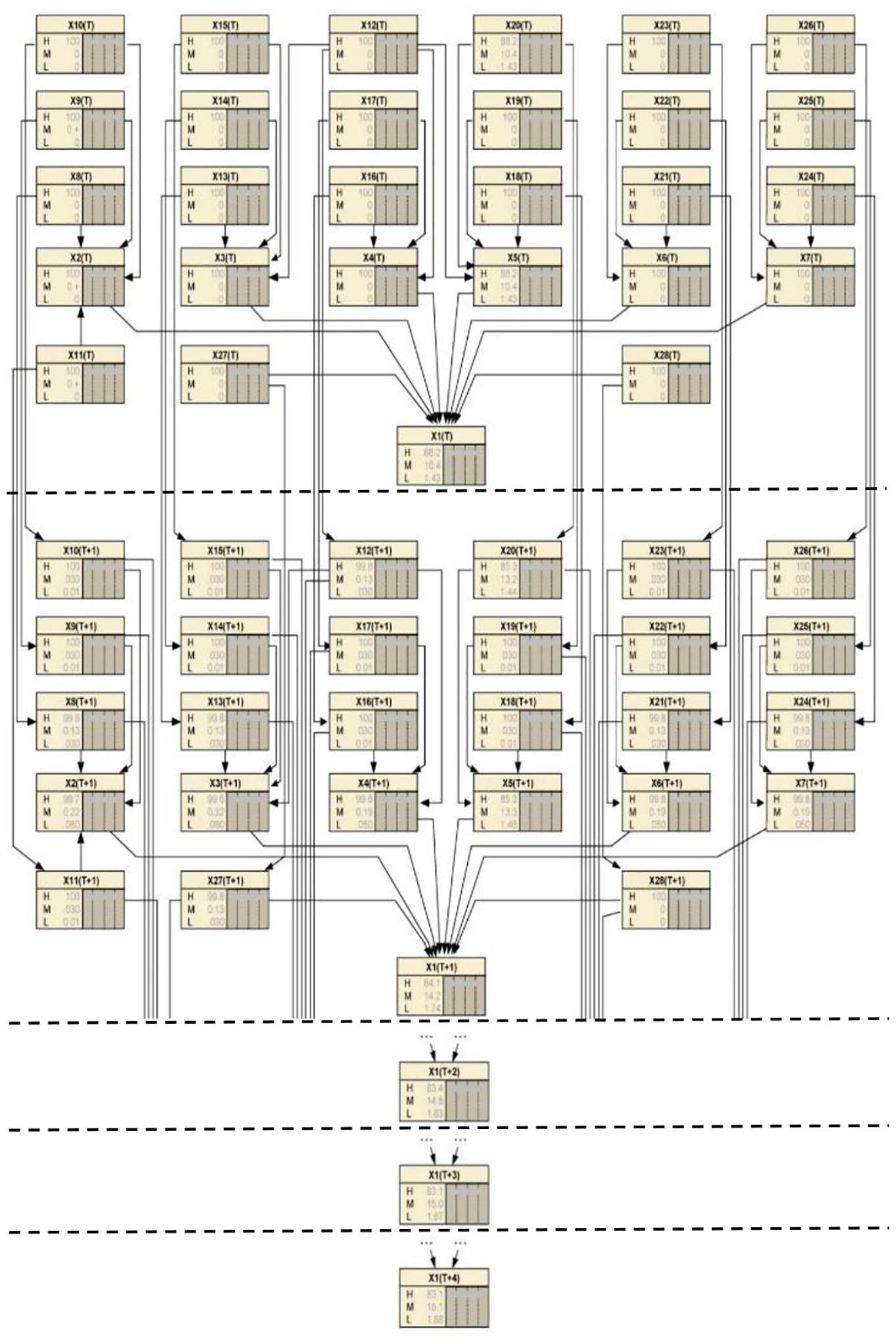
Sketch of inference and solving of the improved Fuzzy Dynamic Bayesian Network model, taking system
Fuzzy reliability state probabilities.

Bold is the maximum state probability of a system in each time slice.
Clustering weights of indicators.

The higher the weight, the more important an indicator.
Analysis and verification of results
As shown in Table 4, at time
As can be seen in Table 5, there are two indicators with far larger clustering weights,
In addition, we verify the evaluation results according to three kinds of actual achievements of the systems, including arresting criminal suspects, breaking cases, and warning to key population. First, we use
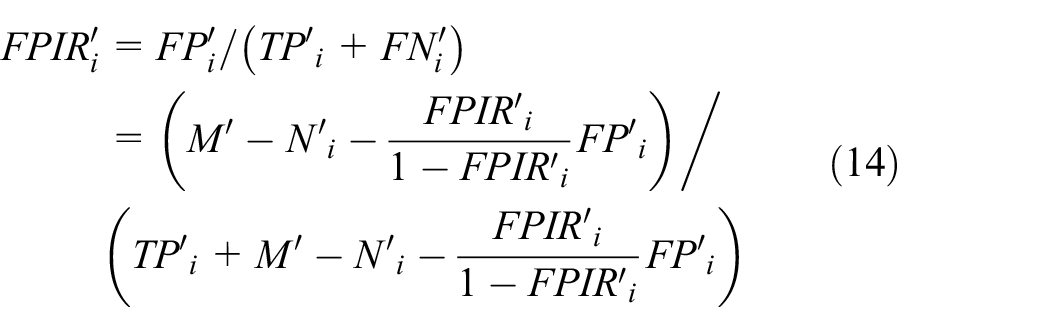
We substitute the known parameters of system
Actual achievement state probabilities.

Bold is the maximum state probability of a system in each time slice.

Comparisons of evaluation results with actual achievements, taking
The original intention and the primary purpose of the reliability evaluation are to find vulnerabilities in the light of the evaluation results and improve the reliability effectively. According to Table 5, we know that factor
Conclusion
In this article, we propose a novel evaluation method with TPIR in dynamic and
Footnotes
Handling Editor: Wei-Chang Yeh
Declaration of conflicting interests
The author(s) declared no potential conflicts of interest with respect to the research, authorship, and/or publication of this article.
Funding
The author(s) disclosed receipt of the following financial support for the research, authorship, and/or publication of this article: This work was supported by the Basic Special Project of Ministry of Public Security of China (grant number 2016GABJC01) and the National Key R&D Program of China (grant number 2016YFC0801003).
