




Abstract
Vehicle ad hoc network is the key technology for a future Internet of vehicles and intelligent transport system. However, involvement of vast number of vehicles in Internet of vehicles limits the performance of vehicle ad hoc network. To tackle this problem, a novel vehicle ad hoc network architecture with two different technologies such as software-defined networking and named-data networking is proposed in this article. In the proposed software-defined networking controlled vehicular named-data networking, IP addressing issue is resolved by named-data networking and global view of the network is attained by software-defined networking. Emergency data dissemination is initiated with packet classification. For packet classification, policy-based bifold classifier is proposed in roadside unit and supported by evolved interest packet. Subsequently, best disseminator selection is carried out by trustworthy weighted graph scheme based on novel weight value, which is computed by considering significant metrics. Content retrieval is accomplished by roadside unit and assisted by a controller. Location of content producer is obtained from a controller and optimal route is selected by roadside unit. Optimal route selection is performed by roadside unit for both content retrieval and vehicle-to-vehicle communication using novel region-based hybrid cuckoo search algorithm. Hybrid algorithm combines cuckoo search and particle swarm optimization algorithm to perform efficient route selection. Involvement of software-defined networking controller supports numerous users by providing a global view of the network, which includes network status and traffic information. Extensive simulation in NS-3 assures better interest satisfaction rate, interest satisfaction delay, forwarder interest packets, average hop count, and gain of scalability in software-defined networking controlled vehicular named-data networking than traditional vehicle ad hoc network.
Keywords
Introduction
Vehicle ad hoc network (VANET) is an emerging paradigm that enables communication between vehicles in ad hoc manner.1,2 This communication may include safety or non-safety information. Safety information includes driver assistance, alert information, and warning alert, whereas non-safety information includes weather information, traffic information, the nearest parking lots, and gas station. 3 Internet of vehicles (IoV) is an evolution of VANET where vast numbers of vehicles are interconnected to design smart vehicular network. 4 However, VANET alone is not able to provide global view, and involvement of numerous vehicles introduces IP addressing issue. 5 Software-defined networking (SDN) is a major solution to resolve network management problem in which global view of the network is enabled by separating data plane and control plane.6,7 SDN technique over named-data networking (NDN) infrastructure offers more control on the network resources because SDN can separate data plane and control plane in logical manner. VANET would be integrated with SDN to utilize advantages of SDN in large network environment.8,9
Similarly, NDN is evolved network architecture of content centric networking (CCN), which enables data retrieving based on data name instead of IP address. 10 NDN can be integrated with either SDN 11 or VANET. 12 In SDN-based NDN, SDN provides efficient network management and NDN concept is involved in all network elements. 11 In NDN-based VANET, NDN makes popular content retrieval easy.12–14 There are, however, number of challenges to implement an SDN controlled vehicular NDN (VNDN). In this article, we focus on the data dissemination problem, including both the emergency message and delay tolerant packet transmissions. Information centric network (ICN) is also integrated with VANET15,16 with SDN controller functionalities.
Data dissemination is a foremost process in VANET, which plays a significant role in safety message transmission and delay tolerant transmission. 17 Usually, data dissemination considers following metrics: means dissemination delay, average number of nodes, average delay, and data delivery ratio. Data dissemination can be carried out by load balancing scheme in VANET. 18 An enhanced cooperative load balancing (ECLB) approach is involved in data dissemination in which remaining delay tolerance of submitted requests is considered. Scheduling approaches also concentrated by researchers for data dissemination. 19 Here, dissemination efficiency is improved by space–time network coding (STNC) strategy.
Data dissemination to a desired number of receivers in VANET (DOVE) 20 was originally proposed to perform budget-constrained data dissemination services such as digital billboards and/or electric coupon systems. We notice that, in a case of emergency as well, the concept of the DOVE can be utilized to control total traffic flow by not only delivering the fact of an accident but also navigating a specific number of vehicles to a detour, which cannot be implemented with conventional broadcasting systems. However, the packets in the DOVE can experience long delay since it is not designed for time-critical communications. The emergency-VNDN (eVNDN) 21 was proposed to handle, namely, emergency messages in VNDN systems. However, the eVNDN does not always improve the delay problem in a large-scale VANET since the forwarder nodes which determine the routing performance of SDN-based VNDNs are selected randomly.
Motivations of this article
The main motivation behind this work is to mitigate the IP problems in the traditional networks. In VANET environment, the mobility is unpredictable and dynamic over time period. Thus, network management becomes major issue. In addition, VANET involves with lot of data packet requests and exchanges for parking, traffic rate, and so on. Thus, IP-based network architecture is not suitable for VANET environment. Therefore, this article integrates VANET with emerging NDN and SDN technologies. NDN resolves the IP-based issues while SDN improves the network management.
Main contributions
This article proposes a new solution to the forwarder selection problem for the emergency data (ED) dissemination in VNDNs by combining the trustworthy weighted graph (TWG) scheme and the region-based hybrid cuckoo search (RHCS) algorithm. In RHCS algorithm, the best forwarder is selected based on significant metrics such as velocity, link duration, link stability, and forwarding probability. Thus, RHCS selects best forwarder for content retrieval and vehicle-to-vehicle (V2V) communication:
A novel SDN controlled VNDN architecture that integrates SDN and NDN in VANET is proposed to improve the efficiency of VANET.
Evolved interest packet is introduced which supports delay minimization in an emergency for immediate data transmission.
A novel policy-based bifold (PBF) classifier is proposed to perform packet classification at roadside unit (RSU). Here, packets are classified into twofold: in the first fold, packets are classified into emergency and normal packets, and in the second fold, classified packets are further provided with a weight value.
ED dissemination is realized by selecting best forwarder using TWG scheme based on significant metrics.
V2V communication and content retrieval are supported by optimal route selected by RSU through region-based RHCS algorithm.
The rest of this article is organized as follows. The “Preliminary knowledge” section provides background information about SDN and VNDN. In the “Related works” section, existing works on VANET are reviewed. The “Problem definition” section highlights the problems in existing works. In the “Proposed SDN controlled VNDN” section, detailed discussion about proposed SDN controlled VNDN with novel algorithms is provided. The “Performance evaluation” section evaluates the performance of proposed work in terms of performance metrics. In the “Conclusion” section, we conclude our contribution to future work.
Preliminary knowledge
VANET and SDN
VANET is a sub-class of mobile ad hoc network (MANET), which plays vital role in vehicle communication. 3 In VANET, each vehicle is act as sender, receiver, and router with the help of wireless sensors and on board unit (OBU) equipped in it. Typical VANET consists of vehicles, RSUs, and base station (BS). 9 SDN is an efficient paradigm that allows separation of control plane from data plane.6,22 Data plane includes data forwarding elements such as switches and routers. In control plane, SDN controller is employed to manage entire network. Involvement of controller provides the global view of the network which makes network management simple. SDN can be combined with other technologies such as network function virtualization (NFV), VANET, 23 NDN, cloud, and so on, to provide flexible network management. In SDN-based VANET, SDN realizes the following advantages:
Efficient network management
Avoidance of transmission interference
Supports cooperative data dissemination
Minimizes transmission delay
Enables cooperative sensing
NDN
NDN is a new evolution in networking that resolves the problem of IP addressing issue in conventional network. 24 NDN is a robust receiver-driven communication model in which communication is performed by exchanging two types of packets such as interest packet and data packet. These two packets carry the hierarchical application-specific content names instead of destination IP address. Format of interest packet and data packet in NDN is depicted in Figures 1 and 2.

Packets in NDN.

Evolved interest packet.
Each data element involving NDN is often called as NDN node, and each NDN node is comprised with the following data structures: 25 forwarding information base (FIB), pending interest table (PIT), and content store (CS). Here, FIB provides forwarding table while PIT records incoming and outgoing interface of an interest. CS is a temporary cache that stores recent data packets in order to improve interest satisfaction delay (ISD). Through these entities, data forwarding and content retrieval processes are performed.
Related works
In NDN-based VANET, priority content forwarding was performed by prioritized VNDN. 26 Here, a naming scheme in which vehicles were categorized into high and low categories and timing schemes was involved. In naming scheme, it was not required to name all packets, and the packets were provided with common name based on category. The timing scheme was involved in order to provide data rebroadcast timer. However, the Interest packet drop occurs since forwarders are not optimal forwarders and also rebroadcast timer is designed for data packets only. And also emergency packets are suffered from high delay since other packets also categorized under high priority category. Data dissemination problem was considered as processor scheduling problem in which roads are treated as processors in data dissemination to the desired number of receivers (DOVE) method. 20 Here, data dissemination delay was minimized by optimal workload assignment strategy. To tackle with overhead, this method was utilized by the road layout and traffic information of the roads. But when number of receivers increased, then this method introduces high overhead. In general, emergency message should be disseminated to multiple receivers within the region, which leads to high latency. To enable efficient V2V communication, a cooperative data scheduling (CDS) process was introduced in hybrid VANET with SDN. 27 In this method, RSU acted as an SDN controller, and vehicles were scheduled for V2V communication in order to enable route among them by RSU. And multi-hop communication was performed in hop-by-hop manner in which vehicle was scheduled at each next hop. But scheduling alone is not able to result in efficient packet forwarding. Perhaps queuing delay is minimized but transmission delay is high due to inefficient forwarding nodes.
In SDN-based VANET, data dissemination was performed with the help of SDN application layer. 28 For this purpose, the network comprises three modules such as content management module, content cutting module, and pre-cache module. Through these modules, the required content was retrieved in the network. However, route selection and emergency message transmission are not efficient. In urban VANET scenarios, NDN was involved to boost up the packet forwarding process. 29 Here, geo-location information was utilized for packet forwarding process, and packet forwarding was involved with best forwarder selection and forwarder decision process. Packet priority was provided based on latency, and best forwarder was selected based on geo-location. Forwarder selection is inefficient since geo-location is only considered. All packets with lower latency are considered as high priority packet, which increases time delay for emergency packets. A multi-prolonged approach was presented to improve content dissemination in VANET. 30 In this scheme, interest message was allowed to carry the type, name, and location of the requested content. In the case of content not available in any intermediate nodes, then the interest packet eventually reached the intended destination. This method increases the number of interest packet retransmission since the forwarder node selection is not efficient. Emergency message transmission also follows the same forwarding approach, which increases latency for emergency packets. In IoV, priority-based content delivery was performed by NDN. 31 Here, each content was provided with priority value which was provided based on the additional parameter. The additional parameter included in NDN packet was “freshness.” Based on name prefix and freshness, priority was given to content in the network. Although this method is able to provide content retrieval, this method is not able to support efficient V2V communication.
Geographical opportunistic forwarding protocol (GOFP) was introduced to handle geo-tagged name-based content retrieval in VNDN. 32 Three critical parameters were involved in forwarding decision-making such as opportunistic forwarding strategy, position of vehicles, and trajectories. To realize this forwarder selection, each packet was included with multiple trajectories. Some of these trajectories were position, near degree of vehicle, nearest time, nearest distance, and comprehensive nearest metric. However, including multiple trajectories in each packet increases overhead at packets. And selection of forwarding vehicle without considering significant metrics results in performance degradation. In CCN-based VANET, SDN was incorporated to deal with routing for content retrieving. 33 Initially, a path was constructed between consumer and producer by controller. If the content was not available in the path, then the controller requests the content in several paths on the same path. Here for an interest controller request data from several paths, this results in several responses. Similarly, energy consumption and resource utilization in each intermediate vehicle in all paths are high for the same interest.
In VNDN, controlled data and interest evaluation (CODIE) method was introduced to control data flooding or broadcasting storm in the network. 34 Here, hop count was included in interest packet by consumer node and increased by each intermediate node, which received that interest packet. Based on hop count in interest packet, the data packet was transmitted to the consumer. This method is not suitable for delay tolerant emergency message dissemination since it introduces high delay in packet transmission. Data packet routing through hop count is not effective since the intermediate vehicles can be redirected or rerouted from their path. In eVNDN, packet name was utilized to differentiate emergency message from normal message. 21 In this approach, interest packet was included with application name, location, time stamp, hop count, and publisher information. In this method, PIT also modified in which PIT for emergency message is kept for some time. This method increases delay and hop count for emergency packet transmission since forwarder is selected in a random manner. Maintaining PIT entry in PIT table for a long time limits the ability of vehicle to act as forwarder. To ensure content retrieving, dynamic PIT entry lifetime (DPEL) approach was presented in VNDN. 35 In DPEL, each vehicle was allowed to compute PIT lifetime for each packet dynamically. But computation of PIT lifetime for each incoming packet increases overhead at each vehicle. And the vehicle is able to forward limited number of packets since interest packets with high PIT lifetime are kept in PIT for a long period of time. This method also failed to handle ED, which have minimum lifetime since this method simply increases the PIT lifetime to ensure successful transmission. An SDN- and an NDN-based VANET architecture was designed. 36 The authors have concentrated on the security aspect of the network to improve the overall performance. However, mitigating security threats alone is not effectual to improve the network performance. A broadcast storm avoidance mechanism (BSAM) was presented for SDN- and NDN-based VANET. 37 This work caches all interest and data packets at the controller. However, caching all packets in the controller leads to the large amount of delay.
Problem definition
In VNDN, distributed interest forwarder selection (DIFS) method was incorporated to select optimal forwarder node. 38 Here, forwarder node selection was carried out based on neighbor node information which was maintained by each node. However, forwarder node selection is not able to determine congestion (or) traffic on the intermediate node. If congestion is high on the selected forwarder node, then dissemination delay also increased rapidly. Besides if the selected forwarder is a selfish or a malicious node, then the interest packet is dropped at the forwarder node. In CCN-based VANET, forwarder node selection is performed by RobUst Forwarder Selection (RUFS) method. 39 In RUFS method, interest satisfaction rate (ISR) was considered for best forwarder node selection. However, this method requires periodic exchange of recent satisfied list (RSL) with neighbor nodes which increases control message overhead among vehicles. This will result in high congestion and bandwidth consumption in the network. And the forwarder node has high chances of being malicious or selfish node which leads to packet loss. Thus, the forwarder selection process involves problems of selfish forwarder selection and ineffectual selection.
Routing was performed with the help of SDN in VANET, 40 in which each vehicle acted as SDN switch and performed local search for routing. Global route search was performed at controller which was able to communicate with switches. In local search, predefined (or) previous route is selected for routing. Here, if the route is congested or vehicles in the route are moved, then that previous route is not feasible. Considering distance metric alone for route selection increases delay for packet transmission.
Thus, forwarder selection process in existing research works is involved with limited metrics, which affects both content retrieval and emergency transmission in the network. Henceforth, it is necessary to improve ED dissemination and content retrieving in VANET with a novel architecture. These problems are considered in our work and resolved by our proposed SDN controlled VNDN network.
Proposed SDN controlled VNDN
Network overview
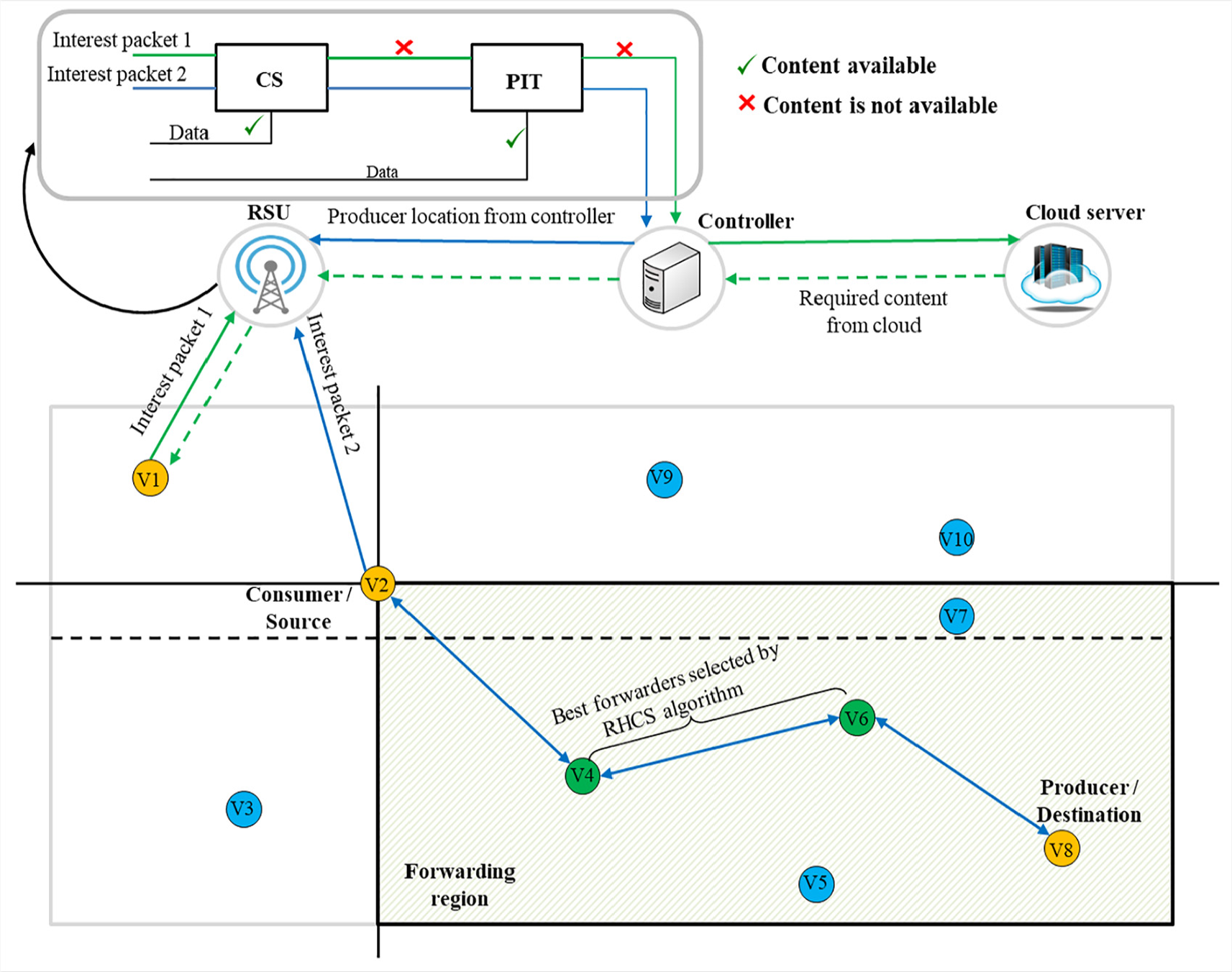
To support ED transmission and to enable efficient routing in VANET, a novel SDN controlled VNDN architecture is proposed. Our proposed SDN controlled VNDN consists of the following entities: (1) vehicles, (2) RSUs, (3) SDN controller, and (4) cloud server. In SDN controlled VNDN, interest packet is evolved with additional fields in order to facilitate ED transmission. Then, the evolved interest packets are classified at RSU by PBF classifier. Here, packets are classified into normal packets and emergency packets by utilizing optimal policies. Then, emergency packet is disseminated in the network, and normal packets are taken for further process. Emergency packet dissemination involved with two processes such as RSU coverage partition and best disseminator (BD) selection. In the first process, road in particular, RSU’s coverage is partitioned into required number of sections. In each section, BD node is selected by TWG scheme in which each vehicle is provided with a novel weight value. BD is able to transmit the emergency message to multiple destination vehicles. Normal interest packet can be requested for V2V communication or content retrieval. For content retrieving process, RSU searches its PIT and CS initially. If the content is not available in RSU, then it forwards requests to controller. Controller which maintains global view of the network detects the location of content producer and replied to RSU. By receiving, producer location RSU discovers the optimal routing path between consumer and producer by using a novel RHCS algorithm. By utilizing RHCS algorithm, RSU is also able to support route selection for V2V communication. Each significant process is detailed in the following sections.
Packet classification
In SDN controlled VNDN, interest packets are initially transmitted to nearest RSU since destination IP address is unknown by vehicles. In content retrieval, the consumer vehicle need not know about the producer IP address but only needs to know the data name. Then, the consumer packet is sent to a neighbor node to retrieve required content. However, this method leads to interest packet flooding in the network which is not suitable for efficient network. To resolve this problem, vehicle transmits the interest packet to RSU at first. The incoming interest packets are classified by RSU using PBF classifier in which packets are classified based on optimal policies. PBF classifier utilizes packet features presented in evolved interest packet.
The evolved interest packet includes following additional fields: (1) source coordination, (2) emergency flag, and (3) emergency type. Evolved packet format is depicted in Figure 3. In evolved interest packet, the following packet features are considered in PBF classifier: name, lifetime, emergency flag, and emergency type. Here, name represents the content or data name, lifetime refers to the interest packet lifetime, emergency flag represents the packet type (i.e. if this flag is set, the packet is an emergency packet, otherwise it is a normal packet), and emergency type represents the severity of the message. All subsidiary fields are involved with binary values in order to prevent packet overhead. The corresponding binary values for subsidiary fields considered in PBF classifier are depicted in Table 1.
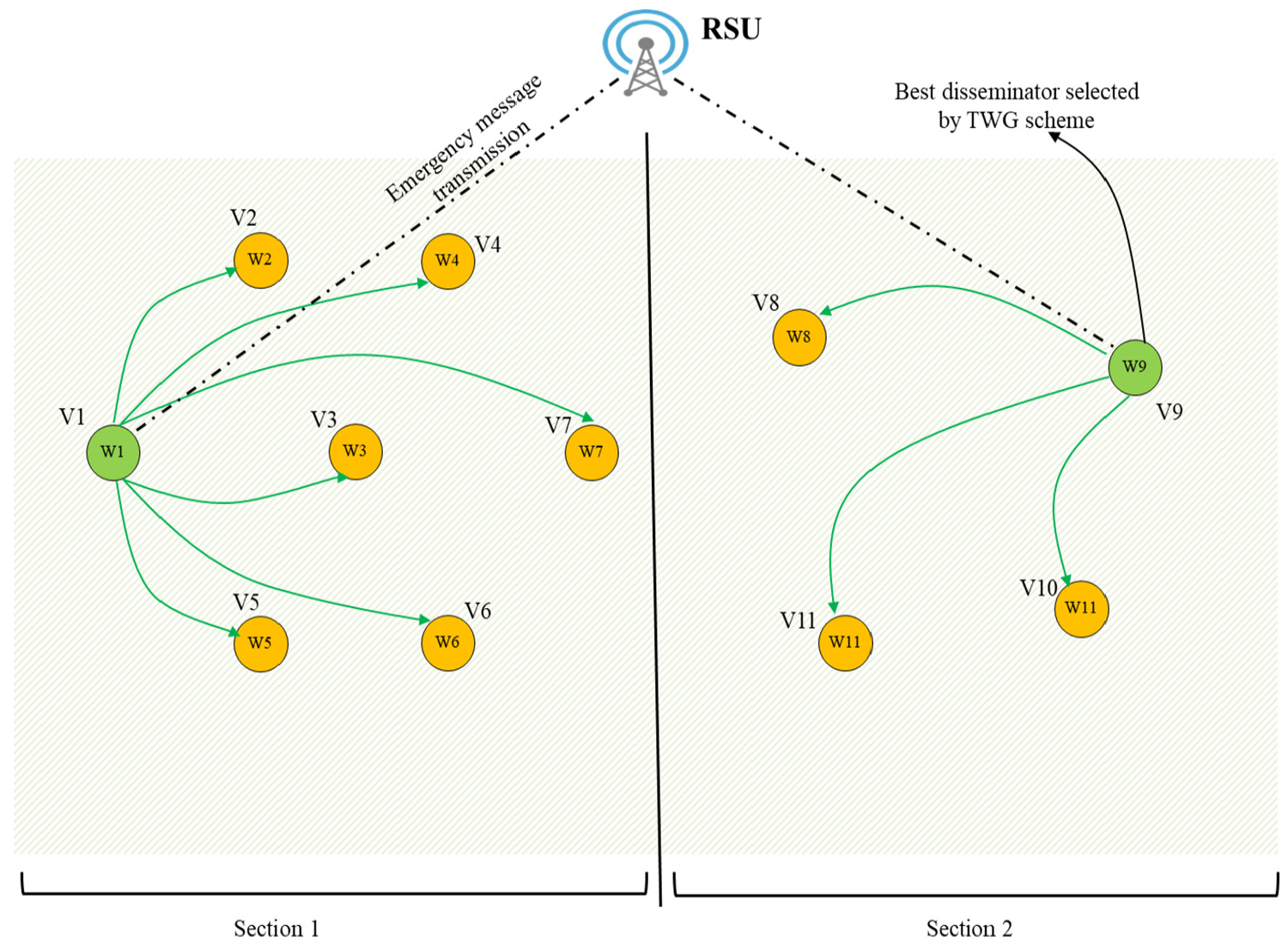
Best disseminator selection in TWG scheme.
Subsidiary fields.
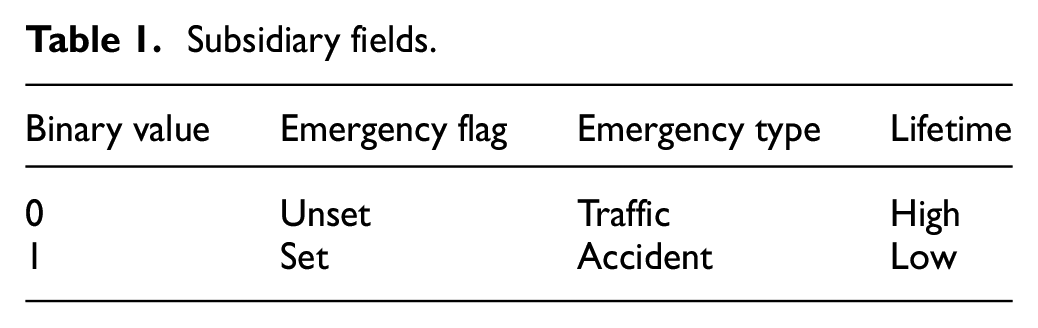
If a packet has emergency flag as 0, then that packet is normal packet. If a packet is emergency packet, then the next feature emergency type is considered. If emergency type is 1, then that packet may convey accident information. PBF classifier performs classification in two folds.
In the first fold, all packets are classified into normal and emergency packets, and in the next fold, emergency and normal packets are sorted based on weight values. Upon received packets, RSU applies the following policies:
Separate packets based on emergency flag
1—Emergency packet (PE)
0—Normal packet (PN)
For all PE
Find weight value (WE)
Sort PE based on WE
For all PN
Find weight value (WP)
Sort PN based on WN
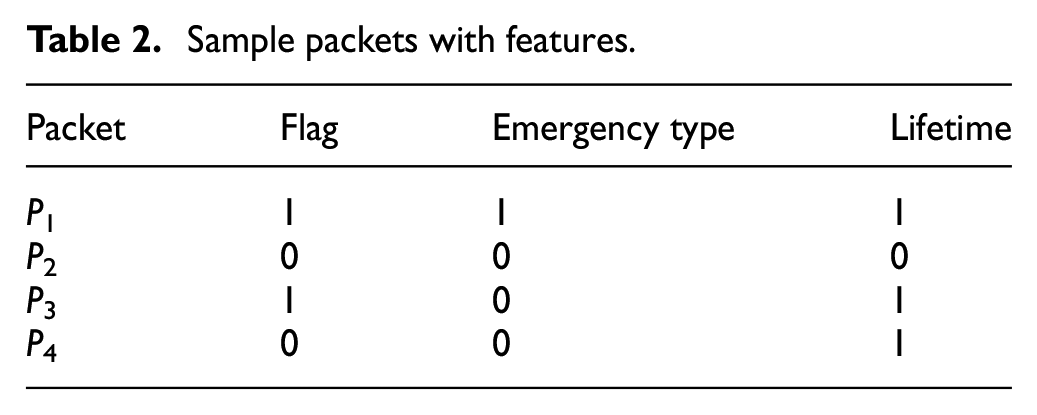
Here, the values for lifetime and emergency type for PE are obtained from Table 1. If lifetime of packet is low and emergency type is accident, then the packet is provided with weight value “2.” Similarly, for PN, the destination is source coordination obtained from evolved packet. By using source coordination, RSU determines distance with source. If the distance is high, then the packet is provided with value “1,” and if lifetime is low, then that normal packet is provided with weight value “2.” Consider sample packets illustrated in Table 2. In this example, P1 and P3 are emergency packets, while P2 and P4 are normal packets. This separation process is performed at first. Then weight value is computed for each packet. Here, P1 has weight value higher than P3, that is, P1 has high priority than P3. In this manner, all incoming packets are classified at RSU. For emergency packets, RSU follows emergency dissemination process, and for normal packets, RSU performs routing process with the help of controller.
Sample packets with features.
ED dissemination
In SDN controlled VNDN, the following assumptions are made:
Coverage range of all RSUs (CR) in the network is equal.
Coverage range of all vehicles (CV) in the network is equal.
Each vehicle is able to communicate with at least one RSU by either a direct link or multi-hop communication through neighbor vehicles.
CV < CR.
Based on the above assumptions, initially road lies in particular RSU’s coverage range, which is divided into multiple sections. RSU is responsible to determine the number of sections and to select the BD for each emergency packet. Number of sections (L) is detected by the following equation

After detecting the number of sections, the road under RSU coverage range is divided into L equal sections for ED transmission. In each section, BD is selected for ED dissemination. BD selection is involved with TWG scheme in which a novel weight value is computed for each vehicle in the section. After dividing RSU’s coverage, node graph is constructed for each section as shown in Figure 4.

Overall architecture of SDN controlled VNDN.
Then for each node in the graph, weight value is computed. Based on weight value, BD vehicle is selected for ED dissemination. Here, BD selection also considers trust value in weight value computation in order to select trustworthy disseminator. In addition, weigh value for each vehicle is computed based on significant metrics such as velocity

In equation (2), the weight value is computed by considering multiple metrics, and each metric is normalized before weight value computation as follows





Thus, each metric value is normalized and integrated as weight value using equation (2).
Here, trust value is provided to each vehicle based on the number of successful transmissions up to 100. For each malicious activity, trust value is reduced as penalty. Number of PIT entries in PIT represents the load on vehicle in terms of the number of interest packet. Here, traffic density defines the number of vehicles presented in the particular section. This value is the same for each vehicle in that section. Main reason for considering this metric is the fact that when traffic is minimum in the section, the disseminator requires to transmit ED to small number of vehicles. In this scenario, even all vehicles are able to act as a disseminator. However, when traffic is increased, it is necessary to select the BD to handle numerous vehicles. Thus, considering traffic density as the metric improves the selection of BD. After the selection of BD in each section, the emergency message is broadcasted to each vehicle in each section by disseminator. It is worth mention that the BD is able to broadcast ED in the section within single hop since the road is divided based on both RSU and vehicle coverage range. For example, consider an RSU with 300-m coverage, and each vehicle has 50-m communication range. Then the road is divided into six equal sections in which each section corresponds to 50 m. Thus, a disseminator is able to communicate 50 m which is equal to one section. So that for this example, six BDs are selected regardless of the number of vehicles presented in the road. In addition, BD with significant metrics minimizes transmission delay for an emergency message.
In Algorithm 1, overall process of TWG scheme–based ED dissemination is illustrated. Thus, involvement of TWG scheme enables efficient ED dissemination through BD without increase in transmission time.


Content retrieval
In SDN controlled VNDN, content retrieval and V2V communication are performed with interest and data packet in which data are identified by unique data name. Since content provider is not known, the interest packet is transmitted to a neighbor node in hop-by-hop manner in traditional NDN. This leads to packet flooding in the network. To resolve this problem, all users send the interest packet to nearest RSU for required content. The content producer may be another vehicle or else cloud server. After packet classification, for normal packets with content request, RSU search its CS; if the content is available, then it provides that content to the requested vehicle. Otherwise, RSU searches the request in PIT table; if any entry is found for the request, then the entry is incremented and requested packet is provided to the requested vehicle.
If the content is not available in RSU, then RSU requests the location of content owner/producer.
In our work, we have adapted SDN concept to maintain the entire network through SDN controller. Here, SDN controller is major part of our work which supports content retrieval and network management. Major responsibility of controller is to manage the network and to maintain the network details. In SDN, the controller maintains global view, which includes network status and traffic information. Integration of VANET with SDN will improve the network performance by maintaining global view on the network status. The global view includes the vehicle information, content information, and current position of vehicles. Thus, the controller is able to detect the content owner and sends the content owner’s location to RSU. Here, the requested content may be available in the cloud server or in another vehicle. If the content is available in cloud server, then controller should reply with the content to RSU, otherwise it sends the location of data owner to RSU. Upon receiving content owner location, RSU finds an optimal route between content consumer and content provider. Here, optimal route is the one which has best forwarder nodes. The forwarder nodes are selected by RHCS algorithm.
In RHCS-based routing process, the best forwarders are selected in particular region only. Process of RHCS algorithm based routing is illustrated in Figure 5. Initially, the forwarding region is selected based on source/consumer coordinates. Then, best forwarders are selected between consumer and content owner, which is detected by hybrid cuckoo search (HCS) algorithm by considering significant metrics. Here, the following substantial metrics are considered for best forwarder selection: velocity (υ), link stability (LS), link duration (LD), hop count (HC), and forwarding probability (Pi). In HCS algorithm, possible solutions are initialized in cuckoo search and evaluated by HCS algorithm. Cuckoo search algorithm relies on the following rules:
Each cuckoo lays one egg at a time in random nest.
The best nest with high-quality egg is carried over to next generation.
The number of nests is fixed, and host bird discovers cuckoo’s egg with a probability of (0,1)
RHCS-based routing.
At first, possible solutions are initialized as nest with eggs. Here, the eggs with nest represent vehicles from which the best forwarder is to be selected. At each iteration, the egg is updated with better solution. Then, a new egg say cuckoo egg is laid on random nest and the cuckoo’s egg is very similar to host bird egg. New cuckoo egg is generated by Levy flights as 41

where new solution

Here, link stability and link duration are computed between two neighbor nodes. LS is computed as follows

LS of link between vehicle i (Vi) and vehicle j (Vj) is computed in terms of transmission range (R) of Vi and distance between Vi and Vj (Dis(Vi, Vj)). And link duration between two vehicles is computed as follows 42

Link duration computation considers coordinates of the vehicles Vi(Xvi, Yvj) and Vj(Xvj, Yvj). When both LS and LD are large, then communication between both vehicles is efficient. However, in best forwarder selection, Pi plays a vital role since it decides the ability of a vehicle in data forwarding. Pi is computed as 43

where

where
After selection of best forwarder, interest packet reaches producer and required content is retrieved to consumer. However, RHCS algorithm is not only perform efficient content retrieval but also support V2V communication. If a vehicle requests to communicate with other vehicle, then it must send the interest packet to RSU with destination coordinate. Based on destination coordinate, RSU performs RHCS algorithm and selects best path between source vehicle and destination vehicle, as described above. Thus, involvement of RHCS algorithm achieves better performance in both content retrieval and V2V communication.
Performance evaluation
In this section, we evaluate the performance of proposed SDN controlled VNDN in terms of performance metrics. This section is comprised with two sections such as simulation setup and comparative analysis.
Simulation setup
Our proposed novel SDN controlled VNDN is implemented using NS-3.26 which is an event network simulator. NS-3 is utilized due to its advantages such as topology definition, model development, node configuration, and so on. Implementation of NDN in VANET is supported by ndnSIM which is developed to implement NDN experiments. Ubuntu-14.04 operating system is installed on PC to support our simulation.
In Table 3, significant simulation parameters are considered in the implementation of SDN controlled VNDN. We have simulated our proposed work with 20 vehicles and RSUs. The interest packets are generated by vehicles, and the content retrieval is assisted by RSU and controller. After setting up all simulation parameters, we start simulation in order to evaluate the proposed work.
Simulation parameters.

RSUs: roadside units; SDN: software-defined networking.
Application scenario
We provide one application scenario of our proposed SDN controlled VANET in smart city application. Smart city application is a succession of Internet of Things (IOT), where a huge number of smart devices are communicating with each other. Smart city application aims to improve all aspects such as waste management, traffic management, water management, and air pollution management of smart world. Our proposed VANET environment will support traffic management. In smart cities, there will be hundreds of vehicles communicating with each other through content name without knowing the content owner. This large-scale network can be managed by SDN controller, and the content retrieval can be assisted by RSU.
Comparative analysis
In this section, proposed SDN controlled VNDN is compared with existing works such as RUFS, 39 DIFS, 38 ICN-SDVANET, 15 RISC, 7 CDS, 27 Secure VANET, 36 and BSAM. 37 Here, comparisons are made based on the following performance metrics: ISR, ISD, average hop count (AHC), and gain of scalability. In any network, scalability evaluates the efficiency of the algorithms involved in the network with the changes in network size, that is, scalability measures the ability of proposed architecture to support increasing network size.
In Table 4, disadvantages in previous research work are provided. These disadvantages are played a vital role in comparative analysis.
Disadvantages in existing works.

CDS: cooperative data scheduling; VANET: vehicle ad hoc network; SDN: software-defined networking; RUFS: RobUst Forwarder Selection; CCN: content centric networking; DIFS: distributed interest forwarder selection; NDN: named-data networking; ICN: information centric network; BSAM: broadcast storm avoidance mechanism.
Effectiveness of ISR
ISR is defined as the ratio between total number of satisfied interest packets and the total number of requested interest packets. This can be computed as

where IPS refers to the number of satisfied interest packets, while IPR refers to the total number of requested interest packets. Higher ISR value indicates the efficiency of forwarder selection process with the help of RHCS algorithm.
In Figures 6 and 7, comparative analysis on ISR with respect to network size and vehicle speed is depicted. From the graphical analysis of Figure 7, we can see that SDN controlled VNDN maintains moreover constant ISR regardless of network size. Even with small number of vehicles, proposed SDN controlled VNDN achieves ISR up to 0.6 while other methods suffered from lower ISR.

Flowchart of content retrieval in proposed work.

Comparative analysis on ISR with respect to network size.
Figure 8 also indicates that proposed SDN controlled VNDN achieves better ISR even with high-speed vehicles. But increasing velocity of vehicle limits the forwarding capability. However, in SDN controlled VNDN, BD selection and best forwarder selection processes are considered velocity as major parameter. Higher ISR value indicates the efficiency of forwarder selection process with the help of RHCS algorithm. ISR in both RUFS and DIFS schemes is limited by inefficient forwarder node selection. Also, the introduction of additional complexity in ICN-SDVANET and content distribution through centralized entity in RISC method minimizes the ISR.

Comparative analysis on ISR with respect to vehicle speed.
Effectiveness of ISD
ISD is defined as an average delay introduced during interest satisfaction. In other words, it is defined as the time taken by interest packet in content retrieving. The ISD is mainly caused by the interest broadcast storm that makes forwarding nodes to be bottle-necked and drop interest packets.
Comparative analysis on ISD is depicted in Figures 9 and 10. Here, we can see that proposed SDN controlled VNDN shows better performance in ISD with respect to network size and vehicle speed. This is because, in SDN controlled VNDN, interest forwarding is realized through best forwarders. Best forwarders improve interest forwarding in terms of delay and satisfaction rate since best forwarder is selected based on significant metrics. But in RUFS and DIFS, interest forwarding is performed with forwarders which are selected based on limited metrics. Furthermore, ICN-SDVANET and RISC methods forward the content through non-optimal forwarders which results in the highest ISD. Proposed SDN controlled VNDN provides ISD below 0.5 ms when varying number of nodes and vehicle speed.

Comparative analysis on ISD with respect to network size.

Comparative analysis on ISD with respect to the vehicle speed.
Effectiveness of forwarder interest packets
Forwarder interest packets (FIP) metric represents the total copies of interest packets forwarded in the network. In other words, this metric represents the number of copies required to satisfy the interest.
In Figures 11 and 12, we compare FIP of proposed SDN controlled VNDN with existing RUFS, and DIFS schemes with respect to number of vehicles in the network and speed of vehicles in the network. In both comparisons, DIFS method requires large amount of copies of interest packets above 2000 in order to satisfy the interest packets due to inefficient forwarder selection. Similarly, RUFS method requires above 1000 copies of interest packets to satisfy the packet. However, SDN controlled VNDN requires nearly 500 packets for interest satisfaction. Best forwarder selection process minimizes the requirement of number of forwarding interest copies for interest satisfaction. Moreover, when network size is increased, ICN-SDVANET and RISC methods minimize FIP since both use the centralized entity for content forwarding and also involve with a content loss. Thus, FIP is minimized in both methods.

Comparative analysis on FIP with respect to network size.

Comparative analysis on FIP with respect to vehicle speed.
Effectiveness of AHC
AHC represents the average number of hops required for content retrieval. When best route selection is involved in the network, the AHCs required for content retrieval are minimized.
In Figure 13, we compare AHC of proposed SDN controlled VNDN with existing RUFS, and DIFS schemes with respect to average vehicle speed and network size. In SDN controlled VNDN, AHC is 10 nodes for a network with vehicles in average speed of 50 m/s and 5 nodes for a network with 20 vehicles. Proposed routing scheme and emergency dissemination scheme consider hop count and distance as significant metrics, which minimize the AHC. However, in average speed of 50 m/s, DIFS method provides 30 nodes and RUFS method provides 20 nodes as AHC. Inefficient forwarder selection increases the AHC in both methods.

Comparative analysis on AHC.
Effectiveness of gain of scalability
Gain of scalability is defined as the total number of vehicles that are served via either V2V communication or content retrieval in the network. Higher the metrics show more ability of a network to support a higher number of vehicles.
In Figure 14, we provide comparative analysis on gain of scalability with respect to vehicle speed. When vehicle speed is 20 m/s, in SDN controlled VNDN, 110 vehicles participate in communication while CDS method supports only 21 vehicles for the same vehicle speed. SDN controlled VNDN shows better performance due to involvement of efficient routing and ED dissemination. Thus, proposed SDN controlled VNDN is able to support numerous vehicles, which improve the scalability of the network.

Comparative analysis on gain of scalability.
Effectiveness of packet transmission
This metric evaluates the total amount of packet loss (both interest and data packets) in the network. Packet loss occurs when the content is not found or when the time exceeds.
In Figure 15, the packet loss attained by the proposed and existing works is compared. The analysis shows that the proposed work achieves better performance, that is, 5% of packets are lost in the network. However, in prior works, 42% of packets are lost. Thus, the proposed work achieves better performance in terms of packet loss.

Comparison on packet loss.
From the comparative analysis, it is clear that proposed SDN controlled VNDN is able to handle varying network sizes as well as varying network parameters (i.e. vehicle speed), which result in improved scalability of the network. The overall result is achieved with the help of a centralized SDN controller and NDN packets. Involvement of SDN controller provides the global view of the network, which improves ISR, ISD, FIP, AHC, and gain of scalability.
Conclusion
In this article, we proposed a novel SDN controlled VNDN architecture to enable efficient emergency transmission and efficient content retrieval in VANET. To support ED transmission, initially interest packets are classified at RSU by PBF classifier. This classification process is supported by evolved interest packet, which includes additional significant fields. After classification, ED transmission is involved with BD selection, which is achieved by TWG scheme. Here, major significant parameters are considered for BD selection. Content retrieval and V2V communication are performed through an optimal route selected by RSU. An optimal route with the best forwarder nodes is selected by RSU with the help of the controller. In route selection, RHCS algorithm is utilized for efficient routing. On the whole, proposed novel SDN controlled VNDN opens up the way for future IoV in which scalability is a major concern. We are interested to improve the performance of SDN controlled VNDN in different scenarios in the perspective of Quality of Service (QoS) metrics.
Footnotes
Handling Editor: Syed Hassan Ahmed
Declaration of conflicting interests
The author(s) declared no potential conflicts of interest with respect to the research, authorship, and/or publication of this article.
Funding
The author(s) received no financial support for the research, authorship, and/or publication of this article.
