




Abstract
As a promising technology in signal detection, the chaotic detection system can significantly improve the accuracy of weak signal detection in strong background noise. It benefits from its characteristics of the sensitivity to the initial condition and the immunity to the Additive White Gaussian Noise. However, the fundamental challenges of the existing chaotic detection system are the sensitivity to narrow-band noise and the influences of multi-target detection with adjacent frequency, which bring great difficulties in the real application. To address these problems, in this article, we focus on the weak multi-target detection with adjacent frequency under the narrow-band noise, and a novel chaotic detection system that integrates the detection algorithm based on period-chaos duration ratio is proposed. In order to enhance the robustness to narrow-band noise, the Melnikov method is used to analyze the Duffing difference system. To realize the detection of weak multi-target with adjacent frequency, we proposed the detection system using the rule named general critical state. Furthermore, simulation results corroborate that the proposed system based on period-chaos duration ratio can achieve satisfactory performance in terms of the weak multi-target detection under narrow-band noise, and it is well investigated by extensive simulation for testing its effectiveness.
Introduction
Nowadays, weak signal detection has been widely used in various fields of society, such as mechanical fault detection, 1 biomedical science, 2 deep space exploration, 3 geological disaster prediction, 4 and so on. Furthermore, with the rapid development of the Internet of Things (IoT), the circumstance of signal detection is becoming more and more challenging. 5 As the main feature of IoT, radio-frequency identification (RFID) is mostly used for passive functions such as tracking and identification, which promote the further growth of weak signal detection technology. As a dominant way in signal detection, the linear detection method mainly includes correlation detection, time-domain averaging, time-frequency domain transform, wavelet transform, and so on. 6 The objective of these traditional linear methods is to improve the signal–noise ratio (SNR) at the receiver and then recover the target signal by filtering or other technologies. However, they are sensitive to the noise changes and also consume much time, which all limits their widespread application.
During recent years, nonlinear detection technology is becoming a hot research issue in weak signal detection. It provides a new thought of signal detection under ultra-low SNR conditions, which is that the presence or absence of a target signal can be discriminated according to the state change of the nonlinear system. As an essential branch of the nonlinear detection, the chaotic detection has obtained many remarkable achievements, 7 which is original from “Butterfly Effect” and described by Lorenz 8 through the mathematical equation, and by now has been widely used in signal detection and chaotic communication. 9 The significant properties of the chaotic detection system are the sensitivity to the initial condition and the immunity to Additive White Gaussian Noise (AWGN). Comparing with traditional methods mentioned above, it is these characteristics that make the chaotic system suitable for signal detection under ultra-low SNR conditions.10,11 Moreover, the recent work discussed by scholars has indicated that not only the Duffing oscillator array in chaotic system is an effective scheme to detect target signal fast, but also the Duffing difference system can attain a more obvious distinction in the time-domain waveform of chaotic system. 12 In particular, a lot of research shows that the Duffing difference system with two coupling oscillators can detect the target signal accurately, 13 such as maximum-variance detection, 14 zero-cross detection, and fractional order Duffing oscillator detection. 15
Researchers exploit many techniques to realize weak signal detection by the nonlinear methods. Liu et al. 16 showed that a distorted weak acoustic signal can be detected in a wide area and the narrow-band noise interference can be overcome. Zhao and Yang 17 proposed Van-Der-Pol Duffing oscillator to detect weak signal under low SNR with other different far-away frequency signals. For further development, Lu et al. 18 combined the extended Kalman filter with a chaotic system to get better performance with lower computational complexity, but it does not extend the detection method to multi-signal detection. The traditional chaotic system can attain accurate detection result under many blind area environment. 19 Although these recent papers have derived different schemes for weak signal detection by the chaotic system, these methods require the detection signal is single due to the property of Duffing oscillator and fail to attain satisfying performance under multi-target signal.
To sum up, these previous proposals focus on the single periodic signal detection, which is a common situation in mechanical fault detection, while it is not applicable in communication areas. On the one hand, although chaotic detection system is immunity to AWGN, it can be affected by the narrow-band noise, which widely exists in communication field. 20 Due to the influence of narrow-band noise, there is no apparent distinction in different output state in the time-domain waveform of a chaotic detection system, which made it not applicable at all. On the other hand, the situation of weak multi-target detection with adjacent frequency exists widely in communication, such as RFID in IoT, biomedical signal processing, and target tracking. But the previous chaotic detection techniques are not efficient and reliable enough to achieve detection of multi-target with adjacent frequency. In consideration of these two focuses, based on the analysis of narrow-band noise and multi-target with adjacent frequency, the fundamental challenge of the existing chaotic system is how to make it applicable under this situation. Moreover, the critical state is not apparent because of the influences of multi-target with adjacent frequency, and a new concept has to be introduced to distinguish the chaotic state and the large-scale periodic state.
Different from detecting a single target signal in AWGN hypothesis, the chaotic system suffers a significant performance loss in the detection of multi-target with adjacent frequency in narrow-band noise. Therefore, the previous analysis needs to be reconsidered. In this article, we investigate the obvious distinction in the time-domain waveform of Duffing difference system; we propose the general critical state to discriminate the output state of multi-target effectively; and we obtain an accurate detection in narrow-band noise. Major contributions of this article are threefold.
To the best of our knowledge, we first propose a rule of the probability of a period state that discriminates the output state of the Duffing difference system in narrow-band noise. Here, Melnikov function is adopted and this method is different from existing chaotic detection methods under AWGN.
In our work, a novel chaotic system is proposed to realize the detection of weak multi-target with adjacent frequency. To be specific, the general critical state is introduced to analyze the output state of the chaotic system from a new perspective.
We provide performance analysis of the proposed period-chaos duration ratio (PCDR)-based algorithm. Specifically, we simulate PCDR of the time-domain waveform for assessing the accuracy of multi-target detection with adjacent frequency in narrow-band noise. Also, simulation results provide evidence to support such predominance.
The following parts of this article are organized as follows. In “Basic model and Melnikov method” section, we analyzed the basic Duffing model and its corresponding Melnikov analysis method. “Problem formulation and analysis” section formulated and analyzed the proposed problem. “Detection scheme based on the PCDR” section presents the proposed chaotic detection system and a detection algorithm based on PCDR. Numerical results for evaluating the performance of the proposed system are provided in “Simulation and results” section, which is followed by conclusions in “Conclusion” section.
Basic model and Melnikov method
Basic model of Duffing oscillator
As the most classical model of chaotic system, Holmes-Duffing oscillator has been extensively studied and evaluated by Holmes, 21 which is expressed as

where
Define


Substituting equations (2)–(4) into equation (1), we have

The dynamic equation of the Duffing oscillator can be expressed as

Based on equation (6), the Duffing oscillator system is established by Simulink as shown in Figure 1.

Duffing oscillator system.
In Figure 1, Sine Wave is the sinusoidal driving force; Fcn is the nonlinear restoring force; Integrator1 and Integrator2 are the first-order and second-order derivatives; Gain0 is the coefficient of the integrator; Gain1 is the coefficient used to adjust the integrator when drawing the phase diagram; and Gain2 is the damping ratio. After simulating, the phase diagram and time-domain waveform of the Duffing oscillator will be displayed on the XY Graph and Scope, respectively.
When

The phase diagrams and time-domain waveforms corresponding of the Duffing oscillator: (a, b) the chaotic state, (c, d) the critical state, (e, f) the large-scale periodic state.
From Figure 2, we can see that the orbits of phase diagram are disordered in the chaotic state, and the time-domain waveform corresponding is non-periodic. Otherwise, the orbits of phase diagram are ordered in the large-scale periodic state and the time-domain waveform corresponding is periodic. Then, the critical state contains the chaotic state and the large-scale periodic state. We can discriminate the time-domain waveform is the chaotic state or the large-scale periodic state intuitively and straightforward, but it is also inefficient, error-prone, and affected by strong background noise easily. The high accuracy of discriminating the output state of the chaotic system is considered a key issue in weak signal detection.
The Melnikov analysis method
Melnikov method22,23 is a quantitative analysis method to discriminate the output states of the chaotic detection system based on Melnikov function. And it is a criterion to distinguish large-scale periodic state from chaotic state. Melnikov method describes the splitting of the stable and unstable manifolds of the hyperbolic fixed point defined on the cross section. 24 For small perturbations, if the stable manifold and the unstable manifold intersect transversely at a certain point, then a horseshoe map may exist and the Melnikov function will oscillate around zero with a relatively large amplitude, which means the system is in the chaotic state. Otherwise, if the system orbit is in the large-scale periodic state, the stable manifold will coincide with the unstable manifold and the Melnikov function will stay zero.
In equation (6), when

Otherwise, when

Based on the general expression of nonlinear system, we set


The definition of Melnikov function is as follows

where

where


As for
It can be found that when the value of

When

The relationship between Melnikov function and
Problem formulation and analysis
In this section, based on the detection method of the critical state in Duffing system, the property of narrow-band noise is formulated by Melnikov, and the effect of multi-target detection with adjacent frequency on the chaotic system is analyzed.
The critical state of Duffing system
The critical state means chaotic state and large-scale periodic state occur alternately. When a target signal inputs into the Duffing system, the system equation is changed from equation (1) to

where
Then, the total periodic driving force of the system is

where the amplitude


The input of target signal causes
Comparing to the chaotic detection system consisting of a single Duffing oscillator, the Duffing difference system has better performance to discriminate the chaotic state and the large-scale periodic state. The model of Duffing difference system established by MATLAB Simulink is shown in Figure 4. And the time-domain waveform of the critical state in Duffing difference system is shown in Figure 5.

The model of Duffing difference system.

Time-domain waveform of the critical state in Duffing difference system.
Comparing to the waveform of critical state in Figure 2(d), Figure 5 has more apparent discrimination between the chaotic state and the large-scale periodic state in a critical state. So, in this article, we use the Duffing difference system to detect the target signal.
The analysis of narrow-band noise
When the background noise

According to the analysis in “Basic model and Melnikov method” section, we can get the corresponding Melnikov function as shown

where



Obviously,

where

The limit of

Furthermore, the mean value of

According to equation (27), in theory, the noise just makes the orbits rough in the phase diagram and it cannot change the output state of Duffing system. But, in real application,
Due to the influence of noise on

where
Based on the another expression of equation (21)

when

where

Then, the derivative of

From equation (32), the

Time sequences of
From Figure 7, we can see that
Moreover, the effect of
The detection of multi-target with adjacent frequency
Multi-target detection is a common phenomenon in the field of communication since the fast development of IoT and RFID. Nevertheless, the principle of chaotic detection is that it changes the presence or absence of a target signal into the apparent differences in system output states. So, the Duffing system can only detect the signal that has the same frequency to the frequency of the oscillator. In view of the multi-target detection, it still works when the frequencies are far away from each other because there exists apparent critical state. However, the multi-target with adjacent frequency cannot be detected due to the disorder of the critical state and its form will be decided by the combination of input multi-target.
When the multi-target

where




According to equation (33), we can conclude that the value of
When

and the solution set is


where
The schematic diagram of time points of state changed in the critical state is shown in Figure 8.

The schematic diagram of time points of state changed in the critical state.
In Figure 8, when
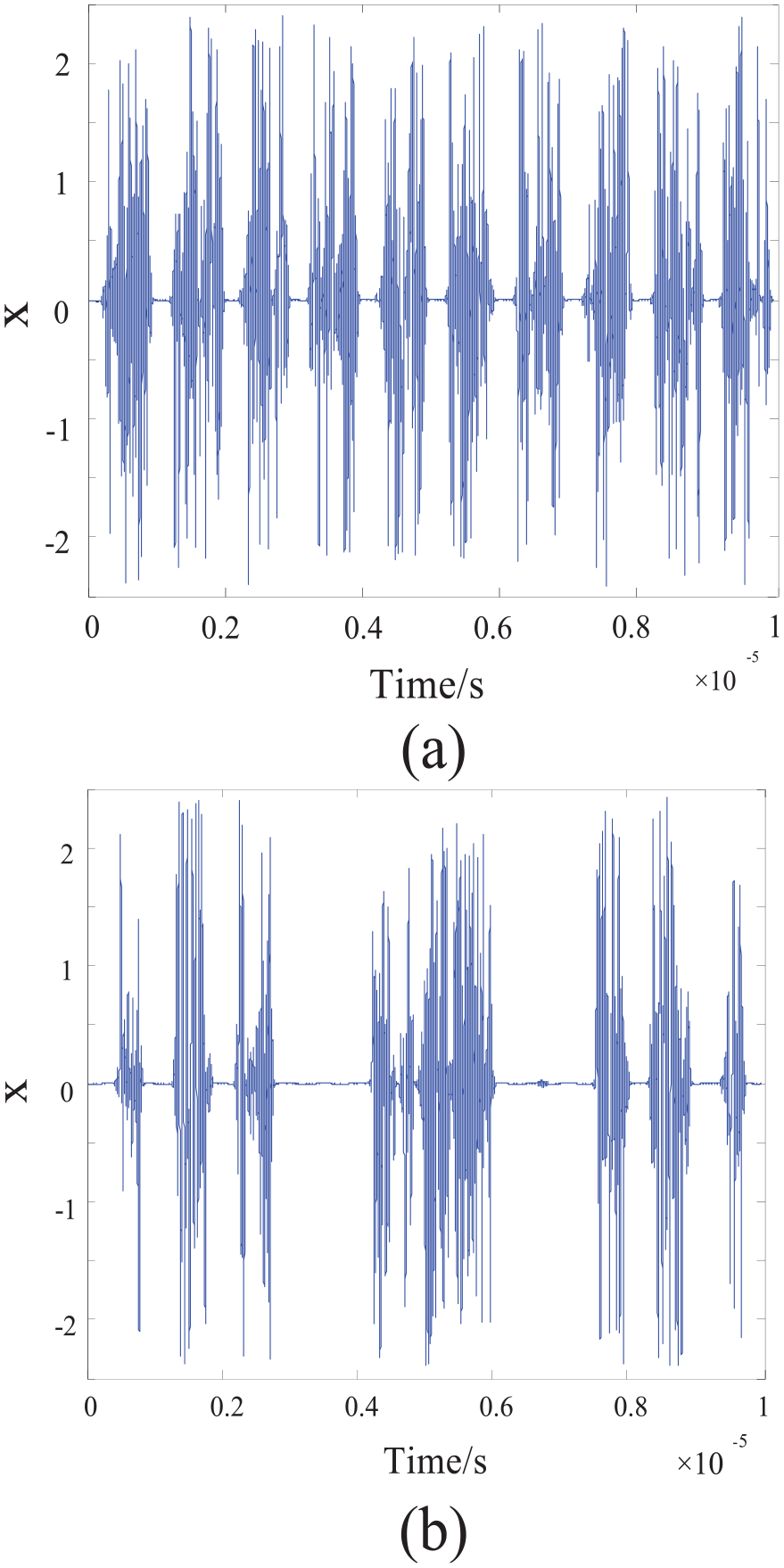
The critical state of three signals with adjacent frequency: (a) equidifferent frequency, (b) random frequency.
From Figure 9(a), the critical state of multi-target with equidifferent frequency is the same to that of a single signal, and it is impossible to distinguish them from the previous chaotic detection system. In Figure 9(b), the critical state is composed by different periods, which is due to the solutions in the function
Based on the analysis above, when the multi-target with adjacent frequency is input into the detection system, as for the different combination of multi-target
Detection scheme based on the PCDR
The problems of narrow-band noise and multi-target with adjacent frequency are analyzed in “Problem formulation and analysis” section. Hence, in this section, we proposed the new concept of general critical state to discriminate the output state of the chaotic system and then detect the multi-target by the detection algorithm based on PCDR.
General critical state and PCDR
The critical state is composed of the chaotic state and the large-scale periodic state. Although, during the period of the critical state, there are infinite combinations of chaotic state and large-scale periodic state, the ratio of these two states’ duration is constant. In the previous chaotic detection system, the period

we can get the frequency difference
Considering the limitation of the critical state, we proposed a new concept named the general critical state and the details of the definition are as follows:
The general critical state is a common state in Duffing oscillator, which is independent of the target signal, the influence of other signal, and the noise. The large-scale periodic state, critical state, and chaotic state are all a special state of the general critical state.
The general critical state is divided into two states, general periodic state and general chaotic state, which is based on the different probability of periodic state duration.
In general critical state, the output state can only be discriminated by the probability of the large-scale periodic state and the chaotic state. As
We further proposed the algorithm based on PCDR of the time-domain waveform to discriminate the large-scale periodic state and the chaotic state. The definition of PCDR is as follows

where
During the process of detection, we will make real-time monitoring of the change of PCDR until it is stable. The variation range of PCDR is
Detection algorithm based on PCDR
According to the analysis in “Problem formulation and analysis” section and the definition of PCDR, we proposed a scheme based on the general critical state and PCDR to achieve the detection of the target signal in multi-target under the narrow-band noise, as outlined in the steps explained below.
In situations of narrow-band noise where the multi-target exists, we prefer to arrange the chaotic detection system with Duffing oscillator. Step 1 carries out the Duffing difference system for weak multi-target detection. In this mode, we can get the critical amplitude of driving force
Step 3 is designed for the frequency detection of each signal in the multi-target set. In this step, the traditional detection system with Duffing oscillators array will be built. As there are many signals in each multi-target set, the Duffing array system with the advantage of less time-consuming can detect the target signals in a time unit. The PCDR values of every oscillator in the Duffing array system can also be obtained, which is the criterion of detection of the weak target signal in the multi-target set by the comparison to

Simulation and results
In this section, the performance of the proposed approach in Algorithm 1 is well investigated, and numerical results are presented to demonstrate the proposed method. The simulation is implemented on MATLAB. All the simulation parameters of the Duffing difference system and the frequency value of multi-target sets are shown in Table 1.
Simulation parameters and values.

In this article, we focus on the weak multi-target detection with adjacent frequency under the narrow-band noise; in this case, we choose the different signal sets with different frequencies that are all close to the oscillator frequency
In summary, there are two steps in the detection of multi-target with adjacent frequency. First, using the proposed detection system and algorithm above, we can achieve the detection of the multi-target set with the target signal. Second, in this multi-target set, a new Duffing array system is built to detect the frequencies of target signals in the set.
The detection of multi-target sets with target signal
In Table 1, there are five signal sets of multi-target and 15 signals in total. For the simulations,
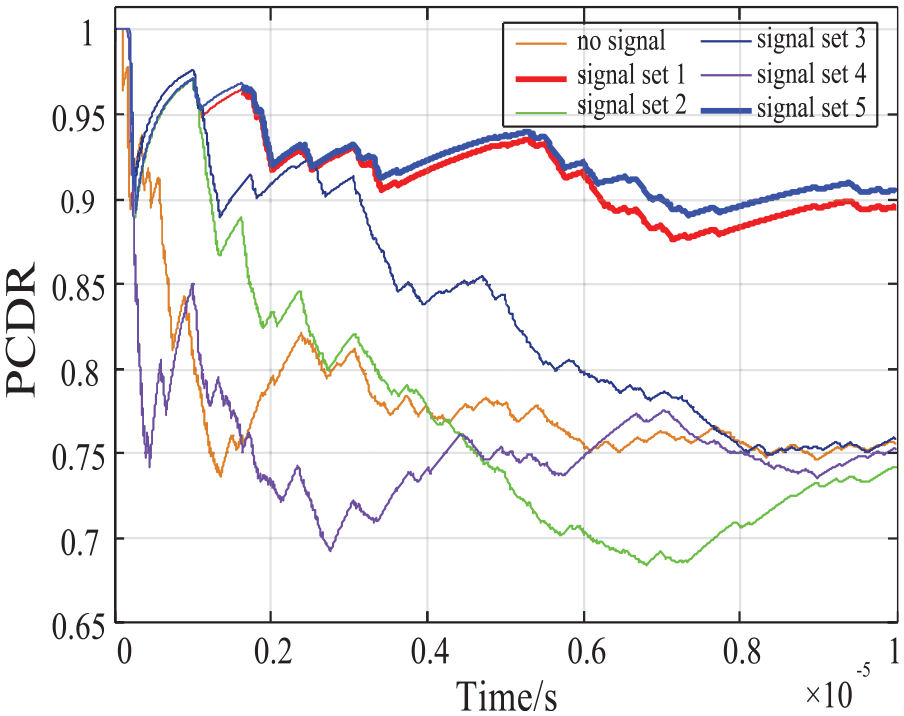
The performance of PCDR of five multi-target sets in Duffing detection system.
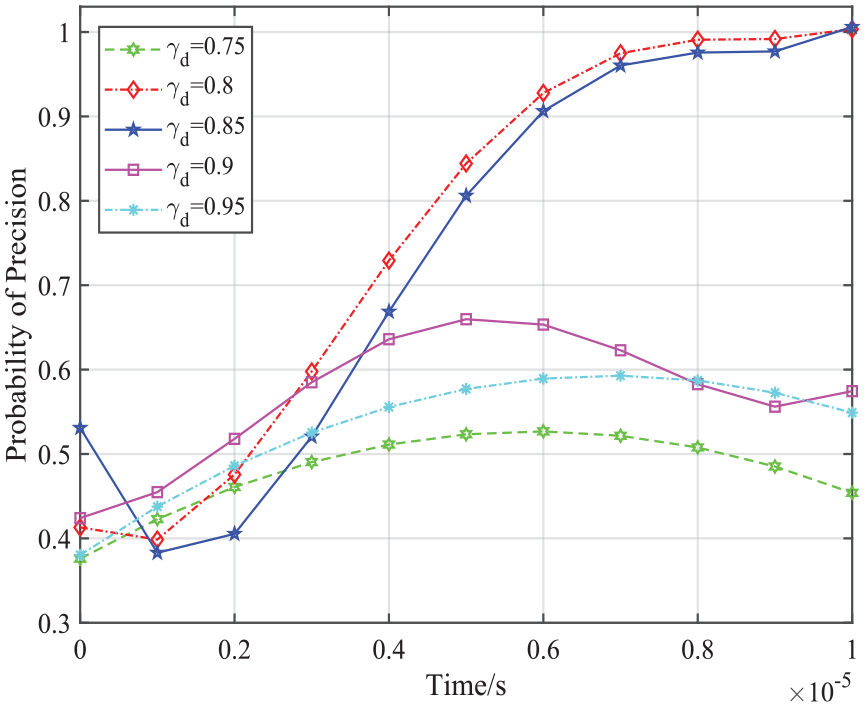
Figure 11 provides the precision probability comparison of target signal detection in multi-signal sets against different amplitude threshold

Precision probability comparison with different amplitude threshold
The detection of target signal in a multi-target set
Based on the detection result in the previous subsection, we can know that the target signal is included in the signals set1 and set5. In this subsection, all signal frequency in the signal set1 and signal set5 are obtained by a new Duffing array system. Taking the multi-target set1 as an example, we built a new Duffing array system composed of seven Duffing oscillators, whose frequencies contain not only the same frequency but also very adjacent frequency to the signal sets. By the proposed detection system, no matter how close the signal frequency is to the oscillator’s, the system can only detect the same frequency as the oscillator’s, which is better showed in the PCDR value that varies over time. In Table 1, we can see that the frequencies in signal set1 are 50, 50.2, and 53.7 MHz, so we set the frequencies of the oscillators in Duffing array system as follows: 50, 50.1, 50.2, 50.3, 53.6, 53.7, and 53.8 MHz, which contain two adjacent frequencies (50.1 and 50.3 MHz) to the 50 and 50.2 MHz and two adjacent frequencies (53.6 and 53.8 MHz) to 53.7 MHz, respectively.
According to the step 3 in Algorithm 1, then

The performance of PCDR of signal set1 in the Duffing arrays system.
Different from that of all signal sets input into the same oscillator to detect whether the target signal is in these sets or not in the previous subsection, we input the signal set1 containing three frequencies into Duffing array constituted of seven oscillators with different frequency to get the accurate detection on each signal in signal set1. From Figure 12, we can see that the PCDR becomes stable gradually over time; obviously, PCDR value differs according to the different oscillators. The oscillators with frequencies 50, 50.2, and 53.7 MHz have a larger value of PCDR of 0.85 and above; in contrast, the other four oscillators with adjacent frequency (50.1, 50.3, 53.6, and 53.8 MHz) all have PCDR value of 0.78 and below. As a result, all frequencies of signal set1 are detected. Moreover, the simulation on precision probability comparison of target signal detection against different amplitude threshold
Precision probability comparison with different amplitude threshold
Conclusion
In this article, we have proposed chaotic technical-based schemes for achieving super-resolution detection on multi-signal detection with adjacent frequency in narrow-band noise. At first, we construct a typical chaotic detection system by Duffing difference oscillator and analyze its characteristics by Melnikov method. Afterward, as the previous methods are not suitable anymore in discriminating the large-scale periodic state and chaotic state accurately, a novel rule named general critical state is proposed, which is derived from a new point of view. Then, by comprehensive theoretical analysis and derivation, we derive that the large
Footnotes
Handling Editor: Hongying Meng
Declaration of conflicting interests
The author(s) declared no potential conflicts of interest with respect to the research, authorship, and/or publication of this article.
Funding
The author(s) disclosed receipt of the following financial support for the research, authorship, and/or publication of this article: This research was supported in part by the MSIT, Korea, under the ITRC program (IITP-2019-2017-0-01637).
