




Abstract
Vehicular delay-tolerant networks are widely used in intelligent transport application. Vehicle nodes exchange and share various information in vehicular delay-tolerant networks. However, current delay-tolerant network routing algorithms do not take into account the dynamic characteristic of traffic flow, and they do not effectively resist cyber attacks, such as black hole attack. To address this issue, we propose a data dissemination mechanism for vehicular delay-tolerant networks. In this mechanism, we develop a combined model to estimate the real-time traffic density. Simultaneously, we propose the metrics which include node interaction dispersion, node interaction freshness, node interaction participation, and node interaction contribution to evaluate behavior of nodes. Based on these metrics, a routing method is constructed. In this routing method, a relay node is selected by evaluating communication interaction behaviors among vehicle nodes. Considering the factors of traffic flow density and communication behaviors of vehicle nodes, a message forwarding strategy scheme is built for different traffic density scenarios. Extensive simulations show that the proposed mechanism exhibits superior performance over existing methods in forwarding traffic information and alleviates negative effects from black hole attacks.
Keywords
Introduction
With the wide application of intelligent transportation systems (ITS), vehicles in these networks can communicate with each other through vehicular ad hoc networks (VANET). However, similar to other open dynamic networks, VANET in urban environments has dynamic topology, short interaction times among vehicles, and uneven distribution of vehicle nodes. 1 Therefore, the network transmission capability is limited and efficiency of vehicle communication is restricted.2,3
To address these problems, the vehicular delay-tolerant networks (VDTN) have been adopted. 4 A delay-tolerant network (DTN) is a special type of wireless network having intermittent connectivity, no infrastructure, network partitioning, and long delays. In DTN, the message propagation process is store-carry-forward. Messages can be propagated in a hop-by-hop manner over an existing route and buffered at the each hop until the next hop appears.
When DTN is extended to vehicular networks, it becomes a VDTN. When a vehicle finds a neighbor node suitable for relaying, it will forward its message to the neighbor. Otherwise, the vehicle will carry the message and continue to search for a suitable node. The strategy of selecting relay nodes directly affects the performance of the routing protocol and influences transmission efficiency and overhead of the network resource.5–7
In VDTN, there are two kinds of communication ways. One is communication among vehicle nodes. The other is communication between vehicle nodes and road side units (RSU). RSU can help to transmit the messages, however, mass deployment of RSU is limited due to the reason of cost. Communication among nodes can help to sharing various messages and cannot be reduced and replaced. Therefore, data dissemination technology is very important for communication among nodes and presents a challenging problem.
Compared with traditional networks, VDTN is more susceptible to various network attacks because of its characteristics. It faces black hole attack, denial-of-service attack, and replay attack, among others. The attacks reduce the efficiency of the whole VDTN, especially efficiency in forwarding messages.
Black hole attacks are among the most common hacks aimed at vehicle networks. In black hole attacking, malicious nodes choose uncooperative behaviors in communication. Once the packets are drawn to a black hole node, they are then dropped instead of relayed, and the communication of the vehicle networks is disrupted without knowledge of the other nodes in the network. When emergency information, such as extreme weather forecasts, is dropped by malicious nodes, this behavior can result in dangerous driving conditions and even endanger drivers’ lives.
Because of vehicle nodes’ mobility, the efficiency of vehicular networks is affected by the dynamic traffic flow, which we approximate as a particle fluid composed of traffic bodies. Like other fluids, it can be described by three basic parameters: traffic volume, velocity, and density. In particular, vehicle speed and traffic density are crucial metrics that have an important role on forwarding data in vehicle networks. The existing routing protocols for DTN do not account for characteristics of vehicular networks. They also do not consider the dynamics of traffic flow or different characteristics of traffic scenarios. These protocols are not suitable for the vehicular networks. 8 In addition, they cannot resist cyber attacks because security is not considered.
In this article, by considering traffic density and integrating multi-dimensional influence factors involving node behavior into the evaluation model, a data dissemination mechanism is proposed. It effectively improves the efficiency of message transmission and reduces network overhead.
Compared with the existing works, our contributions can be summarized as follows:
We propose a combined model for estimating real-time traffic density, a very important metric of traffic flow that affects message forwarding.
Based on analyzing communication behaviors of vehicle nodes, we propose a method of evaluating cognitive interaction of nodes to help select relay nodes.
Considering the characteristics of traffic flow and cognitive interaction of nodes, we design a routing protocol to ensure reliable forwarding of message stability. This protocol can effectively improve the forwarding efficiency of information in VDTN.
The forwarding mechanism proposed in this study can effectively recover from black hole attacks.
The second section of this article provides an overview of relevant research on information forwarding in DTN. The third section describes our design of the data dissemination scheme proposed in this study. We discuss the simulation experiment and analyze the results in the fourth section.
Related works
DTN enables communication where the connection between a source node and a destination node cannot be always sustained. 9 In VDTN, vehicular nodes are highly mobile, and they suffer from frequent disconnections. To deal with disconnections and long delays in sparse opportunistic vehicular network scenarios, VDTN uses a store-carry-forward algorithm. Nodes are allowed to store packets when there is no contact with other nodes. The nodes carry the packets for some distance until meeting other nodes, and forward messages based on some metrics to the nodes’ neighbors. 10
Vahdat and Becker 11 proposed the Epidemic routing strategy based on multi-copy ideas. The strategy is essentially a flooding algorithm, 4 which exchanges higher packet delivery rate at the cost of increasing network overhead. Therefore, this strategy performs better in large-scale random mobility models where network resources are sufficient, but it is not good for scarce network resources. In order to solve the problem of resource consumption, Spray and Wait was developed. Spray and Wait is a restricted flood routing strategy composed of two phases: the spray phase and the wait phase.12,13 This method effectively reduces network overhead by reducing the number of packet copies in the network, and reduces network congestion rate with as few forwarding turns as possible. However, both of the above strategies rely on copy forwarding, so information redundancy of the node is high, and there is no rationale behind selecting the relay node.
To determine reasonable relay node more effectively, Lindgren et al. 14 proposed the Prophet routing strategy, using the probability of encounter between nodes as the basis for message forwarding.15,16 Through screening relay nodes, the generation of inefficient replicas is effectively reduced, improving the use of network resources. 17 Although the Prophet route mitigates the consumption of network resources to a certain extent, this strategy does not consider situations that would occur with the vehicle nodes in a real urban traffic network. 18
MaxProp 19 proposed addresses scenarios in which either transfer duration or storage is a limited resource in the network. This proposal unifies the problem of scheduling packets for transmission to other nodes and determining which packets should be deleted when buffers are low on space. Existing approaches have a bias toward short-distance destinations, which MaxProp addresses by using hop counts in packets as a measure of network resource fairness. In addition, where existing approaches fail to remove stale data from network buffers, MaxProp uses acknowledgments that are propagated networkwide, and not just to the source. MaxProp also stores a list of previous intermediaries to prevent data from propagating twice to the same node. However, MaxProp does not consider the affect the communication of behaviors from the nodes.
Vehicle-assisted data delivery (VADD), Geographical opportunistic routing (GeOpps), and GeoSpray are also classical VDTN routing protocols. VADD 20 is a vehicular routing strategy aimed at improving routing in disconnected vehicular networks and it is based on the use of predictable vehicular mobility. Geographical opportunistic routing (GeOpps) takes advantage of vehicles’ navigation system to get recommended routes and select vehicles which are likely to move closer to the destination node. 21 GeoSpray chooses routing decisions based on geographical location data and combines multiple-copy and single-copy schemes. 22 During vehicle travel, if there is another vehicle that has a shorter estimated arrival time, the packet will be forwarded to that vehicle. The process repeats until the packet reaches the destination. The minimum delay used by VADD is indirectly obtained by selecting the next forwarding node whose path’s nearest point is closest to the destination. GeOpps requires navigation information to be exposed to the network; thus, privacy might be an issue. GeoSpray starts with a multiple-copy scheme, spreading a limited number of bundle copies to exploit alternative paths. Then, it switches to a forwarding scheme, which takes advantage of additional contact opportunities. In order to improve resource utilization, it clears delivered bundles across the network nodes. However, they are all unicast with only one destination node.
In summary, the existing methods have been effective in their targeted applications, but cannot consider the effect of traffic flow or account for risk from various cyber attacks.
We propose a new data transmission scheme that considers the characteristics of dynamic traffic flow and evaluates the communication behaviors of each node. This scheme can improve the efficiency of forwarding messages and resist black hole attacks in VDTN.
Data dissemination mechanism
Our data transmission mechanism uses a combined model to evaluate the density of traffic flow. Considering the traffic flow density, a routing protocol is proposed to forward messages based on a filtering method used to select relay vehicle nodes. The filtering method introduces a series of metrics, calculated according to the node communication behaviors, to choose suitable relay nodes. The illustration of mechanism is shown in Figure 1.

The mechanism of data dissemination.
As shown above, when a vehicle node would like to forward a message, it collects the speeds of its neighbor nodes to detect traffic flow density based on a combined model constructed from three classical models. If the value of traffic flow density is high, the vehicle adopts a filtering method based on evaluating node behavior to select suitable relay nodes. If traffic flow density is low, that means there are a few sparsely distributed vehicle nodes on the current road. In a low traffic density environment, filtering is not used in selecting relay nodes.
VDTN model
To formulate the problem, we construct the VDTN model, given a VDTN that consists of a set
The characteristics of vehicle nodes in VDTN fall into two categories. The first is mobility characteristics, such as speed and location of a node. The second is communication characteristics that reflect communication behaviors among nodes, such as communication range, bandwidth, and buffer size.
The definition of vehicle nodes in VDTN is as follows

Where ID denotes the identification of vehicle nodes. Type information includes car, bus, taxi, and so on. The location information denotes the exact position of a vehicle node, which can be defined as a latitude and longitude. The range means the transmission ranges of a vehicle node, bandwidth denotes which bandwidth is adopted in the communication, and buffer size means the size of a node’s buffer.
Messages dissemination in VDTN is illustrated in Figure 2. In VDTN, vehicle nodes can share various messages, including traffic information, weather forecast, and entertainment, among others. This information helps drivers to have a safe and comfortable driving experience. When a vehicle node would like to transmit a message, it will select a suitable relay node from its neighbor nodes according to a pre-determined data transmission scheme.
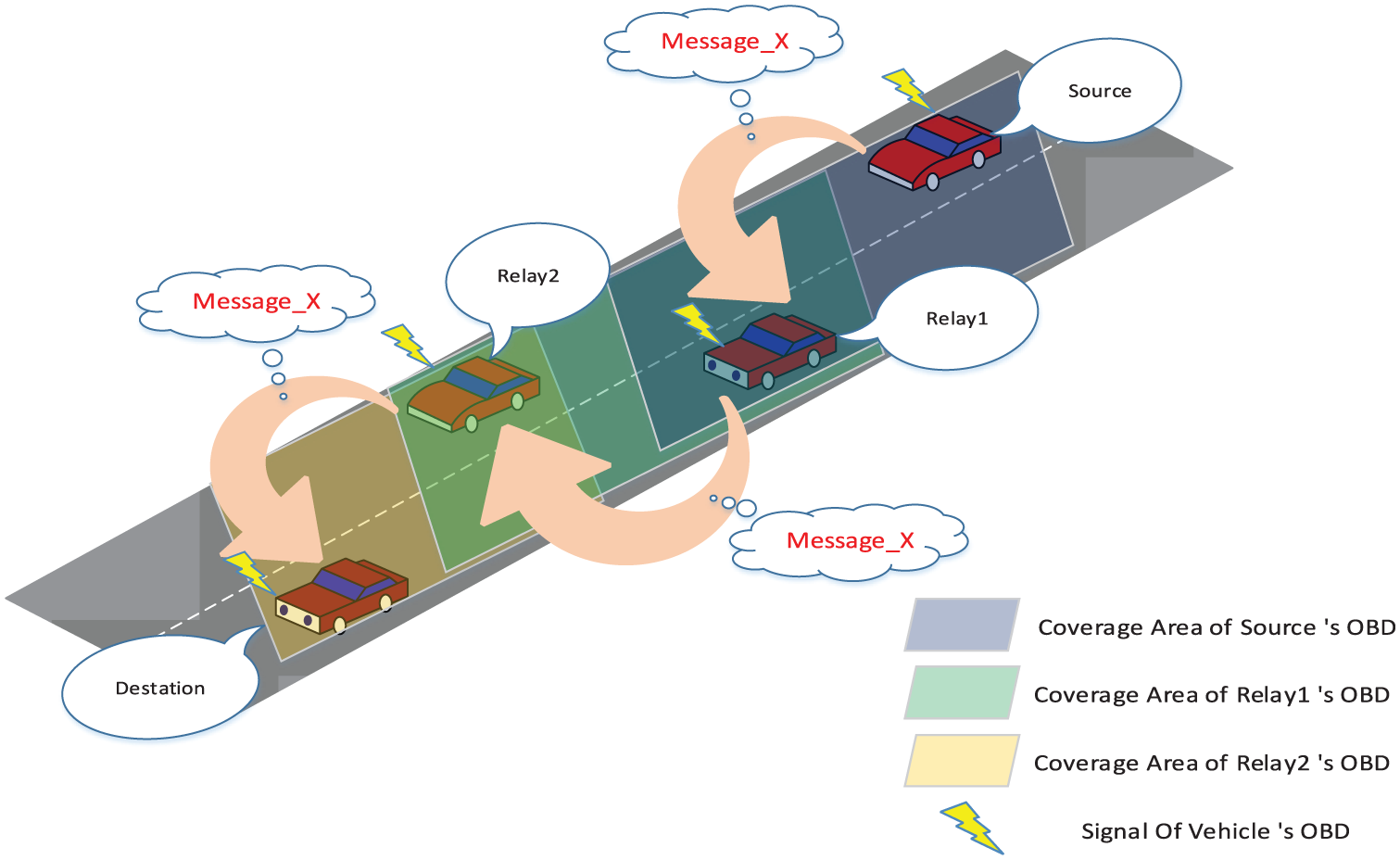
Messages dissemination in VDTN.
Traffic flow detection
Because of vehicle node mobility, traffic flow on the roads has a big influence on VDTN. Speed and traffic density are regarded as the key concepts in traffic flow theory; the relationship between them can reflect dynamic change in traffic flow, which affects data dissemination between vehicles.
Traffic flow density is a crucial metric to reflect real-time traffic flow. Generally, the number of a vehicle node’s neighbors in high traffic density environment is larger than in low traffic density environment. In addition, when the node selects a relay node, it has more candidates in a high traffic density scenario. If an unsuitable routing strategy is used, it may cause network congestion in high traffic density. On the contrary, an unsuitable routing strategy may lead to high delay and low delivery rate in low traffic density. Because of the difference between high and low traffic density, we should adopt different forwarding strategies in each to improve the efficiency of transmission.
Evaluating traffic density is a challenging problem. Underwood, Greenshields, and Grenberg models are three kinds of classical methods relating vehicle speed and traffic flow density. In a real transport scenario, traffic flow is very complex and changes over time, making it impossible to use a single model to get accurate results. To improve the accuracy of evaluating result, based on these three classical models, we propose a combined model to evaluate traffic density models.
Usually, the speed of vehicles and the traffic density are approximately inversely proportional to each other. That is, when the traffic density is very small, the vehicles on the current road can travel close to the maximum limiting velocity. When the traffic density approaches the road maximum capacity, the speed of vehicles tends toward zero.
Assuming that vehicles equipped with various sensors can collect information on their neighbors’ speeds, a set
In order to clarify the models, some existing concepts used in this article will be introduced as follows.
Definition 1
Definition 2
Definition 3
Generally, the Underwood model can be written as follows

V denotes the current speed of a vehicle node.
Greenshields model is described as follows

where
The Grenberg model is ideal under high density, and the calculation of the Grenberg model is as follows

where
In reality, there is a balance between vehicle speed of vehicles and traffic flow density. When equilibrium is reached, according to empirical values,
In the following formula transformation, in order to better distinguish different models,



Based on the above analysis, we assume that the current speed


According to the above definition, these three equations can be converted into equations (10)–(12). In the following formula,


According to the above definition, these three equations can be converted into equations (13)–(15)


When we finish the transformation of the three models, we proposed a combined model based on three models mentioned above and can effectively improve the accuracy of evaluating results. The computing process of the combined model is as follows

where
In the next section, we will choose different routing strategies based on the traffic flow density calculated by equation (16).
Strategy of routing protocol
Relevant definitions
To describe the proposed routing protocol strategy, we first introduce several concepts about communication behaviors of vehicle nodes.
Definition 4
Node interaction dispersion


where
Definition 5
Node interaction freshness λij reflects the node’s recent interaction activity. The calculation is as follows

where
Definition 6
Node interaction participation µij reflects the frequency of communication interactions between two nodes over a long period of time. It is calculated as follows

where
Definition 7
Node interaction contribution

where
Using these four definitions, we can evaluate the communication behavior of a node using the following equation

where
Routing strategies design
Using the concepts mentioned above, we propose a novel routing strategy. The process of the strategy is as follows.
Step 1: When a vehicle node
Step 2: Once a neighbor node
Step 3: According to the combined traffic density model, the relative traffic density is calculated. We set threshold of traffic density to 0.2. If
Step 4: If
Step 5: Once node
The algorithm of the entire protocol strategy mentioned above is shown in Algorithm 1.

Simulation experiment and result analyzing
Simulation environment
To evaluate the performance of the proposed routing algorithm, we used the Opportunistic Network Environment (ONE) specifically for DTN simulation to conduct our experiments. The ONE simulator has been used to investigate application scenarios for VDTNs. To evaluate the performance of our protocol, we created a mobility model to simulate the vehicle behavior on the road.
As shown in Figure 3, the vehicle nodes perform simulated movements based on the Helsinki, Finland city map. The settings of the nodes are not arbitrary and include various types: emergency vehicles such as police vehicles and ambulances, vehicles with fixed lines such as buses and trams, and randomly distributed vehicles such as private cars and taxis.

The part of Helsinki’s city map.
In the simulation experiments, the nodes deployed in the network changed from 50 to 500 to simulate the performance changes of the protocol proposed in different environments from its sparse network environment to its dense network environment. The position of all nodes is shown in Figure 4.

Position of all nodes before the start of simulation.
In simulation experiments, shortest-path map-based movement model for the vehicle nodes are adopted. This model initially places the nodes in random places but selects a certain destination in the map for all nodes and uses Dijkstra’s shortest path algorithm to find the shortest path to the destination.
The movement characteristics of vehicle nodes in our simulation are described in Table 1 and parameters of the simulation environment are shown in Table 2.
Vehicle parameter settings.

Simulation parameter settings.

Because Epidemic and Prophet routing algorithms are commonly used in DTNs, the proposed routing algorithm is compared with them. In the simulation experiments, we select three performance evaluation metrics: the delivery rate, average latency, and overhead.
Delivery probability: the ratio of number of f messages transmitted to that of messages generated in networks.
Average latency(s): the average time spent from the creation of the messages to their successful delivery to destination nodes.
Overhead ratio: the difference relayed and delivered messages upon the number of delivered messages.
Simulation results
In the simulation experiments, we will compare our data dissemination scheme with the traditional routing algorithms. The whole simulations include two parts. In the first part, we evaluate the performance of our data dissemination scheme in an environment free from cyberattacks. The second part shows the performance of our scheme when the VDTN faces black hole attacks.
Evaluating performance under no attacks
In this part, we compare our
Figure 5 shows the delivery rate changes with the different number of nodes in experiments. The delivery of DTFR outperforms the other method. In the initial stage of the experiment, the delivery rate increases with more nodes. When the number of nodes is above 250, the delivery rates in Epidemic and Prophet routing decrease. However, the delivery rate of DTFR gradually stabilizes, with a slight increase. In Figure 6, as the number of nodes increases, the average latency of each algorithm decreases. Compared with Epidemic and Prophet, the DTFR method has a lower latency. Figure 7 shows that as the number of vehicle nodes increases, the overhead of the Epidemic and Prophet methods is higher than that of DTFR.

Delivery rate varies with number of nodes.

Average latency varies with the number of nodes.
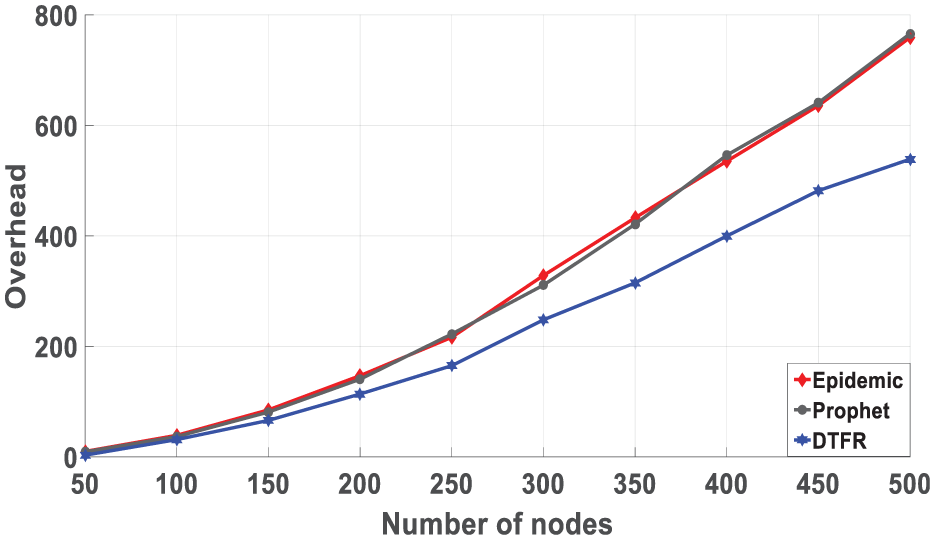
Overhead varies with the number of nodes.
Figure 8 shows that with an increase in the buffer size, the delivery rate of DTFR maintains a significant advantage. Figure 9 shows that compared with Epidemic and Prophet, DTFR has a low overhead. Figure 10 shows that DTFR has a poor performance at low buffer size because the vehicle has no room for storing information about other vehicles. However, with the increase of buffer size, the average latency decreases, and when the buffer size exceeds 40 M, the average latency is much better compared wih the other methods.

Delivery rate varies with buffer size.

Overhead varies with buffer size.

Average latency varies with buffer size.
The above simulation results show that compared with Epidemic and Prophet routing algorithms, the proposed method achieves efficient message forwarding. In Epidemic routing strategy, a node randomly selects one of its’ neighbor nodes which it encounters as a relay node. In Prophet routing strategy, whether message can be delivered or not is based on the comparison of node encounter probability. In the process of selecting a relay node, these two kinds of routing algorithms do not take into account effect resulted from communication behavior of nodes and traffic flow density in urban city. Compared with Epidemic and Prophet routing algorithms, traffic flow densities are detected and behavior of nodes is evaluated by metrics proposed in our mechanism. In DTFR proposed, different routing strategies are adopted in different traffic density scenario, and relay nodes are selected based on their communication behaviors. The experimental results show that DTFR improves the efficiency of data dissemination.
Evaluating performance under attacks
A black hole attack is one of the most common cyber attacks. It essentially causes information to drop out of the network, severely affecting data transmission. In the second part of our experiments, we evaluate the performance of the proposed strategy when it faces black hole attacks. In our simulation experiment, the total number of vehicle nodes is 300. The number of malicious nodes changes over time.
The experiments show that, as the number of malicious nodes increases, DTFR maintains a relatively high delivery rate and the delivery rate of other two algorithm decreases dramatically in Figure 11. Figure 12 shows that the overhead of DTFR is better than that of other algorithms. Figure 13 shows that the average of latency of DTFR is lower than that of other algorithms. The proposed DTFR evaluates the historical communication behavior of vehicle nodes and select reliable relay nodes according to the evaluating results. In VDTN, vehicle nodes which are captured by black hole attack do not transmit and drop messages received. Because of such uncooperative communication behaviors of black hole nodes, they achieve relatively high values of node interaction dispersion and achieve low values of evaluation metrics which include node interaction freshness, node interaction participation, and node interaction contribution. In the proposed DTFR method, nodes which are more cooperative are selected as relay nodes and it is less likely for black hole nodes to be selected as relay nodes. The effects of malicious nodes are relieved in DTFR. DTFR therefore has advantages in delivery rate, overhead, and average latency when the VDTN faces a black hole attack.

Delivery rate with the malicious number of nodes.

Overhead varies with the malicious number of nodes.

Average latency varies with the malicious number of nodes.
Conclusion
To improve transmission performance of VDTN networks in urban areas, this article establishes a new data transmission scheme. In this scheme, a combined model of traffic flow density is built and a routing protocol suitable for different traffic flow densities in urban traffic scenarios is designed. For selecting suitable relay nodes, we introduce a series of metrics—node interaction dispersion, node interaction freshness, node interaction participation, node interaction contribution—to evaluate the communication behavior of a node. In our simulation, the routing strategy algorithm proposed in this article significantly improves the message delivery rate, and effectively reduces the delay and overhead compared with traditional methods. In addition, it also can relieve the effect of black hole attacks. In the subsequent research, social information of the vehicle nodes will be introduced to further optimize the algorithm and improve the transmission efficiency of messages in VDTN.
Footnotes
Handling Editor: Juan Cano
Declaration of conflicting interests
The author(s) declared no potential conflicts of interest with respect to the research, authorship, and/or publication of this article.
Funding
The author(s) disclosed receipt of the following financial support for the research, authorship, and/or publication of this article: This research is supported by the Shaanxi Province Key Innovation Team Project (granted number: 2017KCT−29), Funding of Selected Science and Technology Projects of Oversea Scholars from Shaanxi Province (granted number: 2017023), and the Shaanxi Provincial Key Scientific and Technological Project (granted number: 2018GY−032).
