




Abstract
Delay-tolerant networks are novel wireless mobile networks, which are characterized with high latency and frequent disconnectivity. Besides, people carrying mobile devices form a lot of communities because of similar interests and social relationships. How to improve the routing efficiency in multi-community scenarios has become one of the research hot spots in delay-tolerant networks. In this article, we present a network model of the multi-community delay-tolerant networks and formulate a dynamic quota-controlled routing problem of minimizing the average number of copies of a message that satisfies the required delivery probability under the given time-to-live of the message as a nonlinear optimization problem. To solve this problem, we propose an improved genetic algorithm called genetic algorithm for delivery probability and time-to-live optimization for the dynamic quota-controlled routing scheme to reduce the routing cost further. In addition, a cost-efficient dynamic quota-controlled routing protocol based on genetic algorithm for delivery probability and time-to-live optimization is proposed, which can dynamically adjust message copies according to its assigned delivery probability and time-to-live in different communities on the shortest path. Both the numerical and simulation results show that our routing with the proposed algorithm is more cost efficient.
Introduction
Delay-tolerant networks 1 (DTNs) are wireless mobile networks, in which mobile carriers (e.g. human beings) communicate with each other via their short-distance and low-cost devices to share data objects. 2 DTNs can be used in challenging environments such as wireless sensor networks, military networks, vehicular ad hoc networks, wildlife tracking, and space communications.3,4 Unlike conventional mobile networks such as mobile ad hoc networks, intermittent and uncertain connectivity makes data forwarding a challenging issue in DTNs, and thus the store-carry-forward strategy is often adopted in DTNs’ routing protocols in order to overcome the lack of connectivity. 5
Lots of DTN routing protocols have been proposed. Direct delivery 6 and epidemic 7 routings are viewed as the two extreme routing schemes, since the former scheme keeps only one copy and the latter does not limit the number of copies of a message in the network. To obtain a better tradeoff between performance and resource consumption in DTNs, routing protocols with quota-controlled scheme are proposed, in which each newly generated message is associated with a quota to constrain the maximal number of copies of a message that can be duplicated during the process of message delivery. The quota-controlled routing scheme can be further divided into static (e.g. spray and wait 8 ) and dynamic (e.g. multi-period S&W 9 and delay-bounded S&W 10 ) according to whether the quota is fixed or adjustable while routing a message. It is shown that the dynamic quota-controlled routing protocols can adapt the dynamic characteristic of DTNs and have more efficient utilization of the network resources by theoretical analysis and experimental results.
Meanwhile, in DTNs, portable devices are in the majority carried or controlled by humans. 11 Therefore, when we design a routing protocol, human mobility patterns are needed to be considered. Recently, a large number of routing protocols, which exploit the community structure of human networks and social relations among nodes to determine the way of message delivery, are presented.12–20 SimBet 12 adopts the betweenness centrality and similarity metrics to determine the message forwarders. In Bubble Rap 13 , a node forwards the message to the encountered nodes with higher global or local degree centrality. Social- and mobile-aware routing strategy (SMART) 14 applies the convolution of social centrality and social similarity to decide forwarding node efficiently while avoiding the blind-spot and dead-end problems. Gondaliya et al. 15 proposed an approach to schedule relay nodes based on the two centralities of betweenness and degree in the absence of the community information about the destination. Nevertheless, all these routing protocols adopt the single-copy forwarding scheme, which limits the message delivery ratio. Integrating forwarding and replication (IFR) 16 uses message replication and forwarding for intra- and inter-community communication, respectively. Friendship-based routing (FBR) 17 exploits the periodically differentiated friendships to find the community and adopts the quota-controlled routing scheme inside a community. Although several heuristic methods were presented in IFR and FBR, the routing optimization problem in community-based DTNs was not considered yet. Homing spread (HS) 18 is a zero-knowledge multi-copy routing algorithm, which utilizes community homes to spread messages. The optimization objective of HS is to minimize the delivery delay for a given number of message copies. Community-based adaptive spray (CAS) 19 uses the community topology to pre-compute the multi-hop shortest path from the current community to the destination community and allocates the optimal quota at each hop adaptively. The goal of this protocol is to allocate the minimum number of message copies for a message while still achieving a high delivery ratio. Wu et al. 20 developed a performance model of multi-community epidemic routing with social selfishness and proposed an energy-efficient copy-limit-optimized algorithm. However, to the best of our knowledge, none of them studied the cost efficiency of the dynamic quota-controlled routing in the multi-community DTNs. Hence, the performance of community-based routing still needs to be improved considering the dynamic nature of DTNs.
In order to obtain a balance between performance and cost of message delivery, in this article, we use the multi-community DTN model similar to that in CAS. 19 However, instead of the static quota-controlled routing adopted in CAS, we apply the dynamic quota-controlled routing (e.g. 2-period S&W) in each community on the shortest path to improve the cost efficiency further. In addition, we present a new cost optimization problem to minimize the dynamic quota and at the same time achieve a required delivery probability of the end-to-end multi-hop routing, which is more comprehensive than that of CAS. To solve the optimization problem, we propose an improved genetic algorithm (GA), which is more general and efficient than the enumeration algorithm used in CAS.
The main contributions of this article are as follows:
A network model of the multi-community DTNs is presented in this article. Based on this model, we formulate a dynamic quota-controlled routing problem of minimizing the average number of copies of a message that satisfies the required delivery probability under the given time-to-live (TTL) of the message as a nonlinear optimization problem.
An improved GA called genetic algorithm for delivery probability and time-to-live optimization (GAPTO) is proposed to solve this problem in the multi-community DTNs by means of several new evolutionary policies.
A cost-efficient community-based dynamic quota-controlled routing protocol with our optimization algorithm is proposed, which adopts 2-period S&W and can dynamically adjust message copies according to its assigned delivery probability and TTL in different communities on the shortest path. Both the numerical and simulation results show that the routing protocol with our algorithm has more significant advantages in cost efficiency.
Related work
There are various classifications of routing algorithms for DTNs, which usually are divided into two categories: forwarding based and replication based. Forwarding-based protocols, such as direct delivery, 6 SimBet, 12 and minimum estimated expected delay (MEED), 21 keep only one copy per message in the network and route message in the network hop by hop to the destination. Although they can save buffer space and network bandwidth, they often suffer from low delivery ratio in DTNs due to the single copy. On the contrary, replication-based protocols distribute multiple copies of a message into the network, which can be further divided into flooding-based and quota-controlled protocols. Epidemic routing 7 is a typical example of flooding-based routing algorithms. It distributes the copies of each message to as many nodes as possible, which makes it unpractical for resource-constrained devices in DTNs. To address the problem of epidemic routing, quota-controlled protocols were proposed in many papers. In early times, the quota, that is, the maximal number of copies of a message, is static or fixed. However, due to the dynamic nature of DTNs, several routings with dynamic quota control schemes were proposed to achieve a better tradeoff between performance and resource consumption.
Spray and wait (S&W) 8 is a well-known static quota-controlled protocol. In S&W, a new message initially starts with a fixed value of quota and then it is delivered in two phases: spray and wait. In the spray phase, a binary quota allocation scheme is usually adopted, which allocates half of the quota from the current message to the replication of the message. If the destination node is not found in the spray phase, the routing process will enter the wait phase, where each node carrying a copy of the message performs direct transmission (i.e. forwards the message only to its destination). However, the fixed quota of message copies cannot suit the dynamic environment of DTNs very well. Therefore, protocols based on dynamic quota control scheme were proposed. Bulut et al. 9 proposed a dynamic quota-controlled routing protocol named multi-period S&W, which partitions the delivery time deadline into several predefined, variable-length periods, each composed of a spraying phase followed by the wait for delivery. In each period, the source node sets a certain quota for the message. When the message is delivered to the destination node, the destination node will send an acknowledgment message to the source node with epidemic routing. During the current period, if the source node does not receive the acknowledgment message, an additional quota of the message is provided properly for the next period. It has been shown that the average number of copies of multi-period S&W is smaller than that of the original S&W protocol with the same required delivery ratio and deadline. Moreover, Abbas et al. 10 proposed a delay-bounded S&W protocol, which dynamically adjusts the quota of messages based on the measured delivery probability and TTL of messages.
In the research of the characteristics of human mobility, human movement is shown to be driven by personal interests and social relationships. 22 Hence, the nodes which frequently coexist in a common location are considered to consist of a community. Recently, the utilization of community structure has been proved to improve the routing performance in DTNs. 23 Therefore, many community-based routing protocols were proposed. Daly and Haahr 12 proposed SimBet, which adopts the betweenness centrality and similarity metrics (a measurement of the importance of a node in a network) to determine the forwarders and introduces a tunable parameter to adjust the relative importance of two metrics. Hui et al. 13 evaluated the impact of community and centrality on forwarding, and proposed a hybrid algorithm, Bubble Rap, which selects high-centrality nodes and community members of destination as relays. Zhu et al. 14 proposed SMART, which exploits a heuristic method for community detection and then applies a decayed routing metric convoluting social similarity and social centrality to decide forwarding node efficiently while avoiding the blind-spot and dead-end problems. Gondaliya et al. 15 proposed a simple approach, which can schedule the most globally central nodes for message transmission based on the two centrality measures: betweenness and degree when community information about message’s destination is not available. Nevertheless, all these routing protocols adopted the single-copy forwarding schemes. As mentioned above, although saving network resources, the single-copy forwarding schemes often suffer from low message delivery ratio in DTNs. Hence, Li et al. 16 proposed a community-based routing protocol, called IFR, which allows a node to replicate message in the same community and to forward message outside the community according to the delivery weight obtained from the centrality of the node. The difference between IFR and Bubble Rap is that IFR floods a message inside the community of the destination node rather than a single copy in Bubble Rap. Bulut et al. 17 presented FBR, in which periodically differentiated friendship relations are used in detecting the community and forwarding of messages. For intra-community communication, FBR sprays several copies of messages to a number of nodes in the community. For inter-community communication, the data are forwarded only when the destination is in the same periodical community as the relay. But the presented routing methods are only heuristic in IFR and FBR, which did not consider the routing optimization problem in community-based DTNs to improve their performance. Xiao et al. 18 proposed a novel zero-knowledge multi-copy routing algorithm named homing spread (HS) for mobile social networks, in which all mobile nodes share all community homes. HS mainly lets community homes spread messages with a higher priority. Theoretical optimization and analysis showed that HS can spread a given number of message copies with the minimum expected delivery delay. Miao et al. 19 proposed CAS routing protocol, which uses the community topology to pre-compute the multi-hop path that is the shortest path from the current community to the community of the destination node. In CAS, the optimal quota on each hop is computed under the message TTL and a predefined expected delivery ratio with an enumeration method. Wu et al. 20 proposed a performance model of multi-community epidemic routing with social selfishness with ordinary differential equations (ODEs) and an energy-efficient copy-limit-optimized algorithm, which is designed to determine the optimal copy limit in multiple communities for epidemic routing. However, all of them utilized the static quota-controlled routing schemes (e.g. S&W and copy-limited epidemic), which usually lead to worse cost efficiency than the dynamic ones.
In this article, we study the cost-efficient dynamic quota-controlled routing in the multi-community DTNs and address the optimization problem of minimizing the average number of copies of a message that satisfies the required delivery probability under the given lifetime of the message. Although our model is similar to that in CAS, 19 our work is different mainly in three ways. First, the routing protocol we adopt in the multi-community DTNs is dynamic quota controlled, while CAS adopts the static quota-controlled routing in a community though it re-allocates the quota at each hop. Second, the optimization problem we present is more comprehensive, which is able to express the minimum cost of the dynamic quota-controlled routing and the required delivery ratio of the end-to-end multi-hop routing. On the contrary, CAS is just suitable for static routing and the delivery ratio of one hop. Third, CAS uses the enumeration algorithm that is poorer in scalability, but we adopt a more general and efficient algorithm, that is, GA, to solve the optimization problem.
System model
In our model of DTNs, we partition the nodes into multiple nonoverlapping communities and assume that there are

Model of multi-community DTNs.
We now analyze the message forwarding process. As shown in Figure 1, when the source node

where Wij is the weight in the WUG, which is used to compute the shortest path, and
Based on the WUG, the shortest path
According to the path
As shown in Figure 1, the whole message forwarding process consists of a series of subprocesses, each of which is a complete message delivery in a community on the path

where



As described previously, the message will be delivered by a series of subprocesses, which are the independent events in probability theory. Hence, the total delivery probability with the delivery probability-limit vector
Moreover, equation (4) represents the total time, that is,
Now, let us focus on the delivery cost. We assume that the delivery cost of the message in the community
In the static quota-controlled routing protocol, such as S&W,
8
if we assume that the source node is in the community

Then we can have the minimum delivery cost in the community

In order to optimize the cost efficiency of the routing further, in this article, we use the dynamic quota-controlled routing protocol, such as multi-period S&W, 9 since the dynamic routing protocol can achieve lower delivery cost than the static routing protocol as we discussed above. Specifically, we will use 2-period S&W algorithm in our model, because the simulation results show that 2-period S&W algorithm is very easy to be implemented and the performance of it is nearly as good as that of other multi-period algorithms in general. 9
In 2-period spraying algorithm, the source node in the community
Hence, we can have the minimum delivery cost in the community

where

Algorithm design
The problem described in equations (2)–(5) can be regarded as a nonlinear constrained optimization problem. As discussed above, we should choose the appropriate delivery probability-limit vector
During the past two decades, GAs have been successfully and broadly applied to solve constrained optimization problems. 26 Hong et al. 27 observed that in most GA variants only crossover and mutation operators are employed in each generation. As a result, the search ability of these algorithms could be limited. Hence, they improved the algorithm efficiency by means of adding the best preserving policy, an elitism-based immigrant policy and improving the traditional training process of the GA to overcome these drawbacks. In this article, we will use this improved GA and propose an algorithm called GAPTO to solve the optimization problem in equations (2)–(5).
The details of the algorithm are described as follows.
Representation and initialization
In this article, we denote the

where
Then the initialization operation generates

where
Afterward, we check whether the chromosome
Fitness function
Although the initial chromosomes are all feasible after initialization,

where
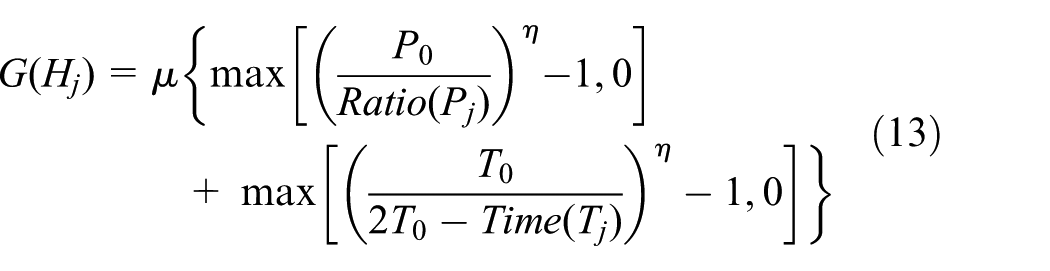
where
From equation (13), we can find that the ranges of
Crossover operator
In order to increase the local diversity of crossover chromosomes,

Mutation operator
Let the current best chromosome be

Otherwise, if the current chromosomes

In equation (16), the difference of
Migration operator
In order to greatly increase the exploration of the search space, we introduce the migration operation, in which chromosome is generated on the basis of the best chromosome


where
This migration operator can adjust the value of a gene properly within its bounds. If the value approaches the upper boundary, this operator can pull back it from the upper boundary. On the contrary, if it nears the lower boundary, the value will be increased.
Select operator
Select
The pseudo code of the proposed algorithm is shown in Algorithm 1. According to the algorithm, at first,

Implementation consideration
In this section, we have a discussion about the implementation of a dynamic quota-controlled routing protocol with GAPTO. Assume that all nodes know the network parameters, including the number of communities
Performance evaluation
In this section, we first analyze the effect of the parameters of GAPTO. Afterward, the proposed protocol is evaluated through both numerical computation and simulation. At last, the performance comparison of GAPTO with the other two algorithms is made through theoretical results.
Effect of the parameters of GAPTO
We now analyze the delivery cost of GAPTO affected by the migration probability

where
Figures 2 and 3 show the performance metrics in terms of the delivery cost versus migration probability
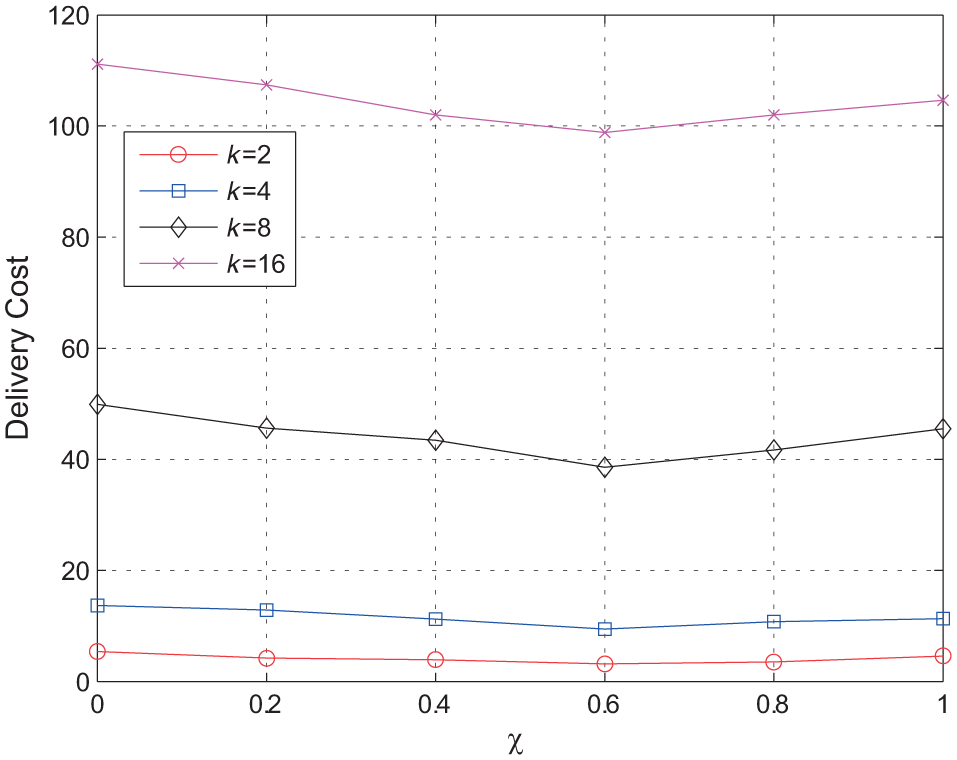
Delivery cost versus migration probability

Delivery cost versus penalty factor
It can be seen from Figure 3 that the delivery cost is the minimum when the penalty factor
Numerical and simulation evaluation
In order to validate the proposed protocol in section “Implementation consideration,” we evaluate our protocol via both numerical computation and extensive simulation by MATLAB
28
and the ONE simulator,
29
respectively. In the simulation, the whole terrain is divided into different regions to form different communities. Besides, by changing the velocity of nodes in different communities, we can obtain the different average contact rates
Simulation parameters.

Figures 4–6 plot the performance metrics of the proposed protocol obtained by the numerical computation and simulation. It can be seen that all the results of the numerical computation are consistent with those of the simulation very well.
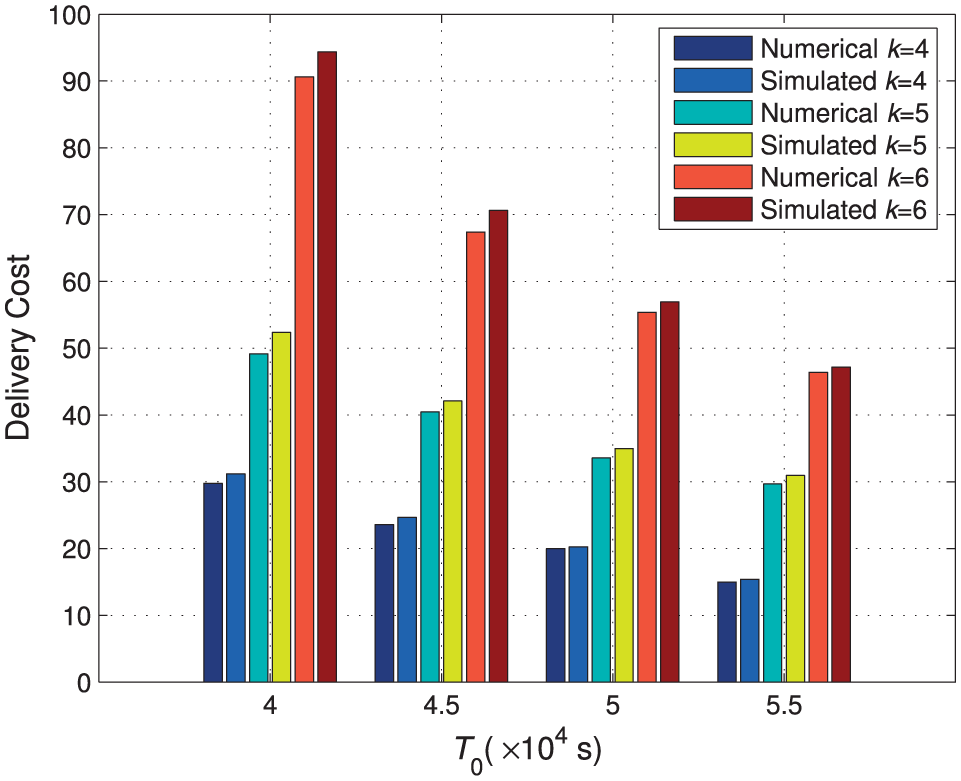
Delivery cost versus

Delivery probability versus

Delivery delay versus
Figure 4 shows the delivery cost versus the message TTL
Figures 5 and 6 show the delivery probability and delivery delay versus
Comparison with different algorithms
To evaluate the performance of GAPTO further, we compare GAPTO with the other two algorithms, proportional allocation algorithm (PAA) and random allocation algorithm (RAA), which are only different in the allocation algorithm for the delivery probability-limit vector
Under the condition of satisfying the constraints in equation (2), in PAA, the assigned values of
In RAA, the values of
Since the results of theory and simulation show good coherence in Figures 4–6, for convenience, the comparison is analyzed on the basis of numerical results by MATLAB. Let
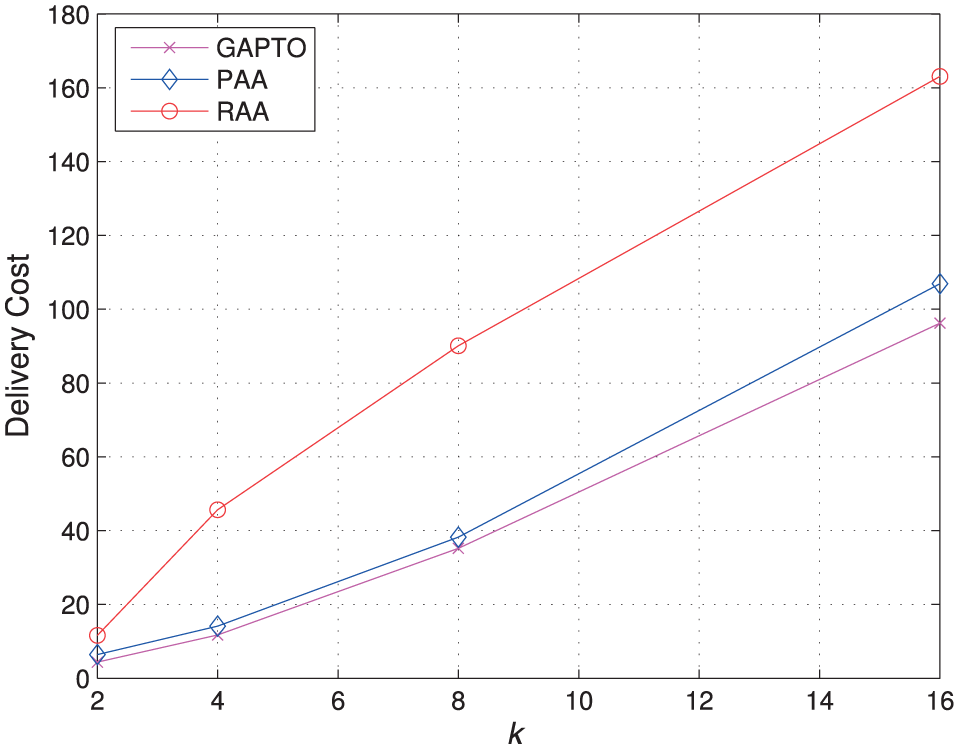
Delivery cost versus

Delivery delay versus
From Figure 7, it can be seen that GAPTO always achieves the minimum delivery cost, because GAPTO not only retains the advantages of traditional genetic method, but also has better convergence and higher search efficiency, which is commonly used to generate high-quality solutions to optimization problems. On the contrary, RAA is always the worst in these three algorithms, because the results of RAA have the characteristics of randomness. PAA can also achieve a good result since there is a little difference of delivery cost between PAA and GAPTO. However, the difference becomes obvious when
Figure 8 shows the delivery delay versus
Moreover, to present the advantages in cost efficiency of the dynamic to the static quota-controlled routings, we compare GAPTO for 2-period S&W protocol against GAPTO for the original S&W protocol, which are called GAPTO and GAPTO_static, respectively. The only difference between GAPTO and GAPTO_static is the expression of the minimum delivery cost according to our system model.
Figure 9 shows the delivery cost of the compared routing protocols. Clearly, the delivery cost of GAPTO is about 30% less than that of GAPTO_static. Thus, the cost efficiency of the dynamic quota-controlled routing is validated again. In addition, from Figure 10, we can see that the delivery cost of GAPTO is higher than that of GAPTO_static. This is because there usually exists a tradeoff between delivery cost and delay in DTNs. In this article, our focus is on minimizing the delivery cost and just limiting the delivery delay within the required TTL. Hence, the dynamic quota-controlled routing protocol is more cost efficient.

Delivery cost versus

Delivery delay versus
Conclusion
In this article, we present a network model in the multi-community DTNs and apply the dynamic quota-controlled routing scheme into the model. Based on this, we formulate a routing problem of minimizing the delivery cost that satisfies the required delivery probability under the given TTL of message as a nonlinear optimization problem. Then we propose GAPTO and a cost-efficient dynamic quota-controlled routing protocol, which is based on GAPTO. The results of both numerical computation and simulation demonstrate the cost efficiency improvement of the proposed protocol. In the future, we are going to extend the network model and study our protocol under different mobility scenarios and heterogeneous communities.
Footnotes
Handling Editor: Christos Anagnostopoulos
Declaration of conflicting interests
The author(s) declared no potential conflicts of interest with respect to the research, authorship, and/or publication of this article.
Funding
The author(s) disclosed receipt of the following financial support for the research, authorship, and/or publication of this article: This research was supported by the National Natural Science Foundation of China under Grant Nos 41571389 and 61373139, Open Research Fund from Key Laboratory of Computer Network and Information Integration (SEU), Ministry of Education, China, under Grant No. K93-9-2014-05B, and Scientific Research Foundation of NUPT under Grant No. NY214063.
