




Abstract
With the acceleration of the construction of smart city in China, the construction of a smart community that acts as the last mile of a smart city is highly valued. Development of smart community service integrated management platform is to utilize intelligent equipment and software platform, to build an information platform for information sharing, service integration, and resource optimization, and to ultimately realize intelligent management and innovative services within the community. In this article, we propose the overall framework and application system of the intelligent community integrated service platform, providing a strong theoretical basis for the construction of smart communities at this stage, and carry out detailed analysis and design of the underlying infrastructure, supporting platform and basic database of the platform.
Introduction
In academia, smart city is interpreted as using the latest information technology and decision analysis optimization technique to integrate human, goods, business, transportation, communications, energy, and other main elements, so as to make urban management, urban services, and urban operations more comprehensive, smoother, and more humane.1,2
From government services and decision-making to urban industrial planning and layout, the construction of a smart city is inseparable from big data, and big data will become the engine of smart city. On one hand, big data provide powerful data analysis and decision support in urban planning, which strengthens forward-looking and scientific city management;3–5 on the other hand, the management and service of the city are continuous, so there will be a lot of data accumulated, to precipitate the characteristics of many cities. Big data analysis can provide decision-making basis for the wisdom and refined management of the city, and it can provide new insights into smart city service systems.
From the perspective of urban development trends, smart city and smart community have gradually become a hot topic in government work and academic research. Existing studies have conducted in-depth studies on the development of smart city and communities from the perspectives of connotation, model, evaluation system, problem, and strategy analysis. Y He et al. 6 proposed an integrated framework that can enable dynamic orchestration of networking, caching, and computing resources to improve the performance of applications for smart cities. Then, they presented a novel big data deep reinforcement learning approach. Simulation results with different system parameters were presented to show the effectiveness of the proposed scheme. B Tang et al. 7 introduced a hierarchical distributed fog computing architecture to support the integration of massive number of infrastructure components and services in future smart cities, to perform data representation and feature extraction, to identify anomalous and hazardous events, and to offer optimal responses and controls. VA Memos et al. 8 proposed an efficient algorithm for media-based surveillance system (EAMSuS) in Internet of Things (IoT) network for smart city framework, which merged two algorithms introduced by other researchers for wireless sensor network (WSN) packet routing and security, while it reclaimed the new media compression standard, high-efficiency video coding. Experimental analysis showed the efficacy of their proposed scheme in terms of users’ privacy, media security, and sensor node memory requirements.
However, the existing research still has the following shortcomings.
There are differences in understanding the connotation of smart city and smart community.
Little research has been done on the development of intelligent community. In particular, there are great differences between community construction at home and abroad.
At present, most of the studies are qualitative analysis of intelligent community system design and architecture. However, the cost-effectiveness model of smart communities has not been quantitatively studied.
Therefore, on the basis of understanding the connotation and components of smart communities, it is necessary to analyze the application blueprint and cost-effectiveness of smart community service platform. In this article, we design a standardized intelligent community integrated service platform with good compatibility and information sharing, which can build a more convenient way of smart community life and facilitate community members to participate in self-management and community service.
Connotation and demand of smart community
Connotation of smart community
When the concept of smart community was first proposed, it was not planned and developed as a component of smart city. Later, along with the introduction and development of smart cities, smart city and smart community became a consistent core concept, that is, to take IoT technology as the core technology to build a comfortable and intelligent living environment in a new era. Cities can be divided into several communities to manage, so the smart community can naturally be regarded as the smallest component of smart city. 9
Since the construction of smart community in the context of smart cities is currently in its infancy, and people are at the stage of exploration for the planning and construction of smart communities, the system composition and function of the smart community have not yet formed a stable model at the current stage.
Based on general understanding, smart community is a new community form for the future, which is to utilize Internet technology to improve work and life experiences in many areas, including personal health, home care, hospitals, urban networks, and residential housing. In the construction process, we should give full play to the advantages of telecommunication industry, telecommunication infrastructure, and business, to create a good intellectual environment for community development, and thus form a new way of life, a new form of industrial development, and a new social management model of intelligent information filtering supported by big data storage and analysis. 10
First, the realization of smart community needs to establish an efficient information system, to effectively acquire and process information in terms of smart home, network communication, medical, property management, e-commerce, logistics, and so on. 11 By providing diversified life and work services for residents in the community with demand orientation, and creating a livable environment with high safety, convenience, and wide service for community residents, the smart community should be a high-tech and informative community facing the future. 12
We think that the smart community is a community that fundamentally improves the lifestyle of residents and the management mode of managers, which uses various modern high technologies to realize the advanced information of the community. It makes information everywhere and provides people with various convenience services, as a new, safe, convenient, and comfortable living space conforming to the concept of sustainable development.
Functional requirements
The functions of the smart community should satisfy all users participating in the smart community system, including community residents, property companies, relevant management departments, business enterprises, logistics companies, and community medical units. Here, we analyze the specific function requirements of the smart community from the perspective of those users.
Needs of community residents
Residents are the largest group of users in the smart community, as well as the main service objects of smart community, so the analysis of the needs of residents in the construction of smart communities is the key.
There are different types of residents in the community. In addition to some common needs, residents of different age groups, different living standards, or different physical characteristics may have different special needs. Common needs include efficient information management, sound residential property information service management, high security community public areas, fast food and beverage, daily department stores and agricultural products ordering services, efficient logistics services, barrier-free community communication services, and so on. For the elderly, their special needs include accurate monitoring of health condition, intimate companion service, visual talkback service, and so on. For young children, when their guardian is busy, they need daytime trusteeship, academic guidance, and interest class services.
Needs of property company
Property companies are the main providers of life services for community residents and are also an indispensable part for the orderly operation of the intelligent community. The primary responsibility of the property companies in the smart community is to manage and maintain, and their management and maintenance efficiency directly determines the living service experience of the residents.
The requirements of the property company are embodied as efficient resident information management, community property information management, community infrastructure information management, fast and effective community facility maintenance and community information release, reliable community security system, fully automatic water and electricity meter system, and automated parking lot management. In addition, they hope to provide residents with diverse community life services through digital and informational means.
Needs of government management department
Related government management departments mainly include community street offices, civil affairs bureau, and relevant management department of smart city. Their demand is to push news hot spots, government announcement, policy guidance, and service guide to community residents in a timely manner through electronic forms and guide the work of community service agencies such as neighborhood committees and property companies. By extending e-government to the community, government efficiency and service capacity will be improved.
Needs of business enterprise
Business enterprises hope to use the modern information technology to interact and communicate with residents in a timely manner, to collect the living needs of community residents, and then push business information to residents. With smart community application, business enterprises can adjust their business strategies based on residents’ needs, or implement online sales of goods, and ultimately achieve the purpose of improving service quality and work efficiency.
Needs of logistics company
Today, the construction of e-commerce platform has been effective. However, the reason for their rapid development is that there is a supporting logistics industry. In smart community, the demand of logistics companies is a unified and standardized express delivery, warehousing management with a certain capacity, and convenient express parcel status inquiry. They hope to provide a better logistics experience for community residents while improving the quality of their services.
Needs of community medical institution
As a basic medical security for community residents, community medical care has important strategic significance in China’s medical system, which can divert patient pressure to the hospital while meeting the basic medical needs of the residents. In smart community, in order to provide timely and intimate medical services to community residents. The requirements of community medical institution are to provide patients with appointment registration, health knowledge publicity, health file management, physical examination, and other services by intelligent information means. 13
We can see from the needs of the abovementioned six smart community participants that some needs are unilateral, while some others appear repeatedly between different participants. By organizing the needs of all participants, we summarize the seven application areas of the smart community, 14 including community property management, community smart home, community housekeeping service, community health care, community logistics service, community e-government, and community e-commerce, as shown in Figure 1.
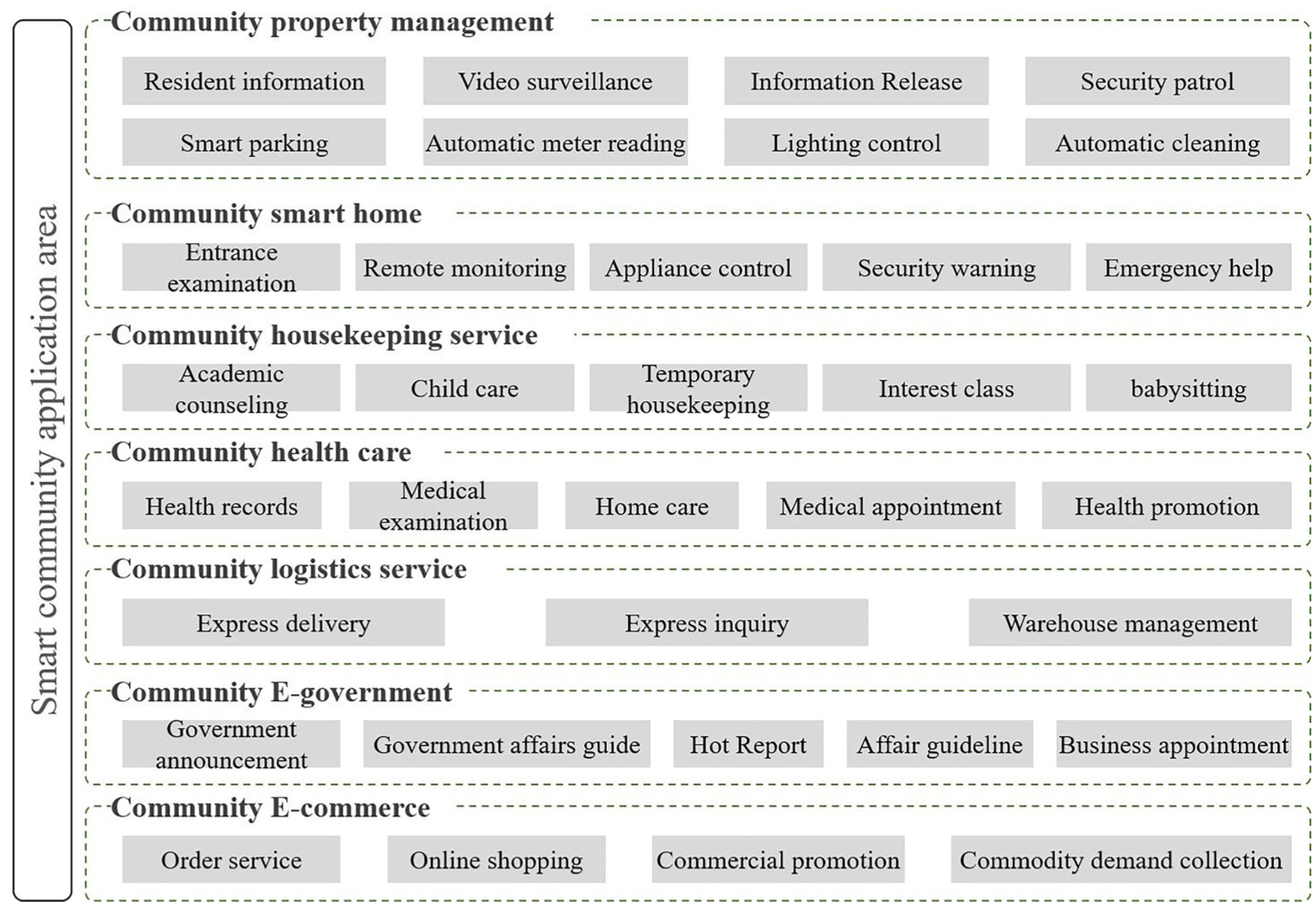
Application areas of the smart community.
Basic composition
According to the functions of the smart community, the construction of smart community requires not only individual function implementation but also realization of information flow between functions. Based on information processing logic within smart community, the basic composition of smart community can be divided into information collection unit, information transmission unit, information storage, exchange and processing unit, and information display unit.
The information collection unit acts as the nerve ending of the smart community, consisting of various active information acquisition equipment and passive information acquisition equipment. Active information acquisition equipment includes access control equipment, fire alarm, health monitoring equipment, water, and electricity detection equipment; passive information acquisition equipment mainly includes mobile phone, PC, and tablet. 15
Information transmission unit is the channel for intelligent community information flow, which not only provides information flow between various units within the smart community structure but also provides information flow channels for smart communities and the outside world. In general, information transmission unit is a variety of wired or wireless networks, such as local area network (LAN), Internet access network, and dedicated network.
The information storage, exchange, and processing unit are the warehouse for data management and processing in the smart community, that is, through data storage, to provide exchange space of data for each unit and filter and mine data using a database operating system, so as to provide support for intelligent applications in smart communities.
The information display unit is a variety of functions that are displayed to users through software at various terminals. Information display unit can intuitively display the achievements of the intelligent community.
As can be seen, some function terminals in the information display unit also have the function of information collection, so in the basic components of a smart community, the division of information collection unit and information display unit is not absolute.
Overall design of smart city community service integrated management platform
Overall framework
The overall framework of the smart community integrated service platform contains four parts as follows: infrastructure, support platform, application layer, and user layer. Infrastructures such as facility level, network layer, and perceptive layer are the foundation of this platform. It intelligently processes and integrates the important elements of people, places, things, feelings, events, and organizations in the community and then establishes the basic database. Then, with the database as the supporting layer, we build an intelligent community integrated management and service platform, including government service platform, public service platform and business service platform. 16 The above platform is the foundation of development, and we can build intelligent application systems with different forms and contents for different objects. Its functional system will cover applications in smart home service, smart community service, smart community management, energy management, and other fields, to achieve comprehensive services such as community administration, social public services, and commercial convenience services.
The overall framework of smart city community service integrated management platform is shown in Figure 2.

Basic composition of smart community.
The construction of smart community service platform aims to make full use of government public service resources, to integrate all kinds of management and services in a comprehensive and systematic way, with the help of various information platforms, so as to meet the increasingly diverse needs of community residents and promote the development of community service industrialization.
Logical architecture
Establishing a modern intelligent community is the development trend of property management, by combining the power of computers with modern management ideas. The functions of community intelligent property management system mainly include: customer service center, information release, video surveillance, unattended system, property management system, community card system, parking management system, electronic patrol system, visitor management system, perimeter defense system, and so on. Smart community integrated service platform is a large integrated platform, which is connected to all systems in the smart community. The logical architecture of smart community integrated service platform is shown in Figure 3.

Logical architecture of smart community integrated service platform.
Application blueprint
From the construction to the operation of the smart community, external resources such as advertising companies, media operators, health service centers, and public service centers are involved. To integrate these external resources into community business services through property management companies, community residents can use the smartphone, Pump Drive Assembly (PDA), information distribution terminal, or property customer service to grasp this information. Integrating external resources to smart community service platform requires not only innovative technology and products but also innovative service. The application blueprint of smart community integrated service platform is shown in Figure 4.
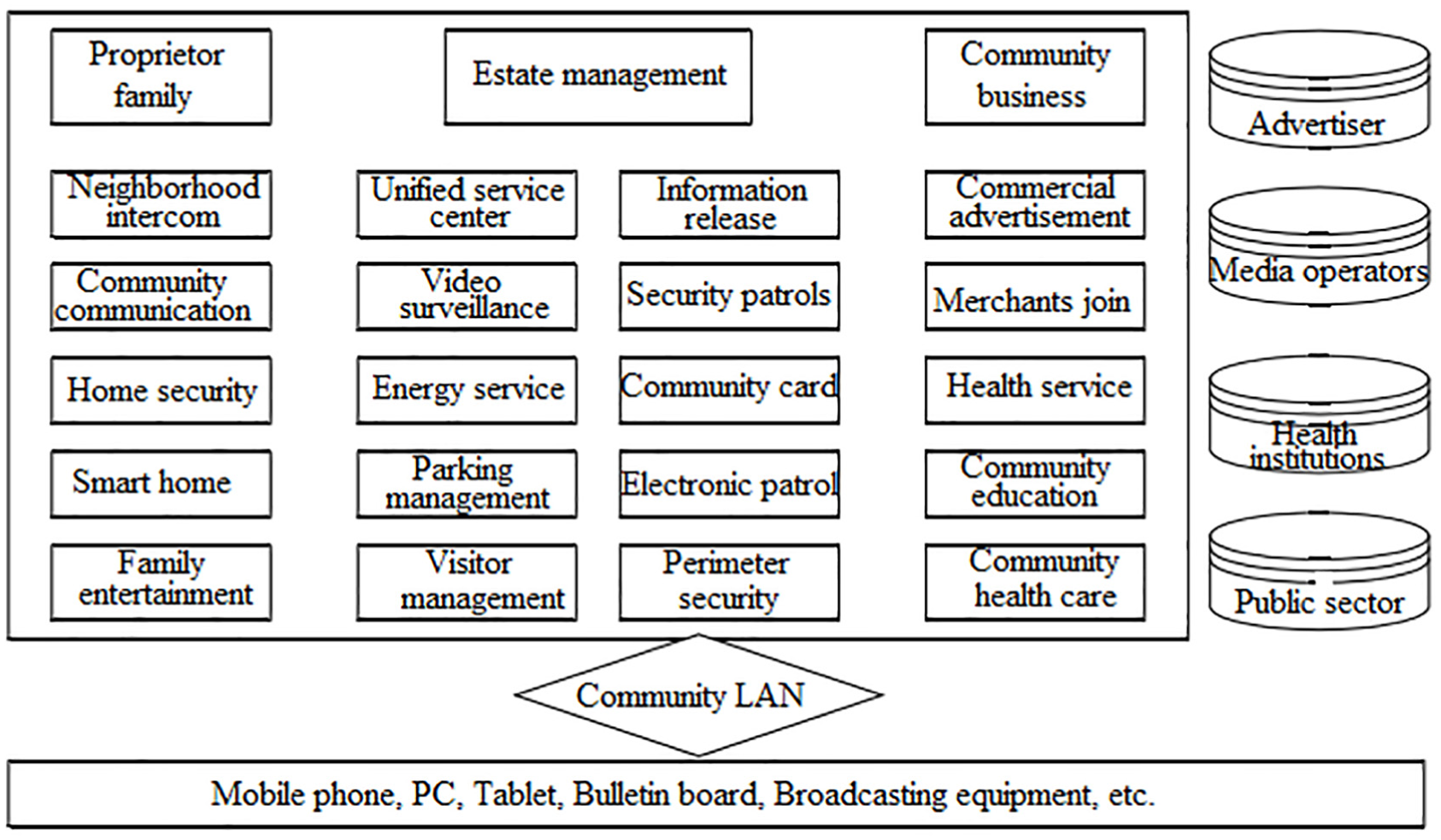
Application blueprint of smart community integrated service platform.
It can be seen from the application blueprint that the three core parts of the smart community are households, property management, and community business. The households are the services that the owners can enjoy at home, which is supported by the smart home system, including safe living environment, remote control of home equipment, as well as education and medical services without leaving home, while community business is mainly supported by intelligent community service system, which also provides communication service between community neighborhoods.
System topology
The communication link used in smart community integrated service platform is bidirectional, in which ZigBee device and radio frequency identification (RFID) reader are connected via universal asynchronous receiver/transmitter (UART). Taking the bottom-to-top transmission as an example, signals of small data devices such as the underlying RFID readers first pass through the ZigBee network and gateway and are sent to the top via a wired LAN then, while data from large data devices such as high-speed network cameras are sent to the top via wired LAN. In addition, there is an RFID reader directly connected to the background management system computer via serial port or USB, to realize the operation of registering RFID cards, and so on. The topology of smart community integrated service platform is shown in Figure 5.
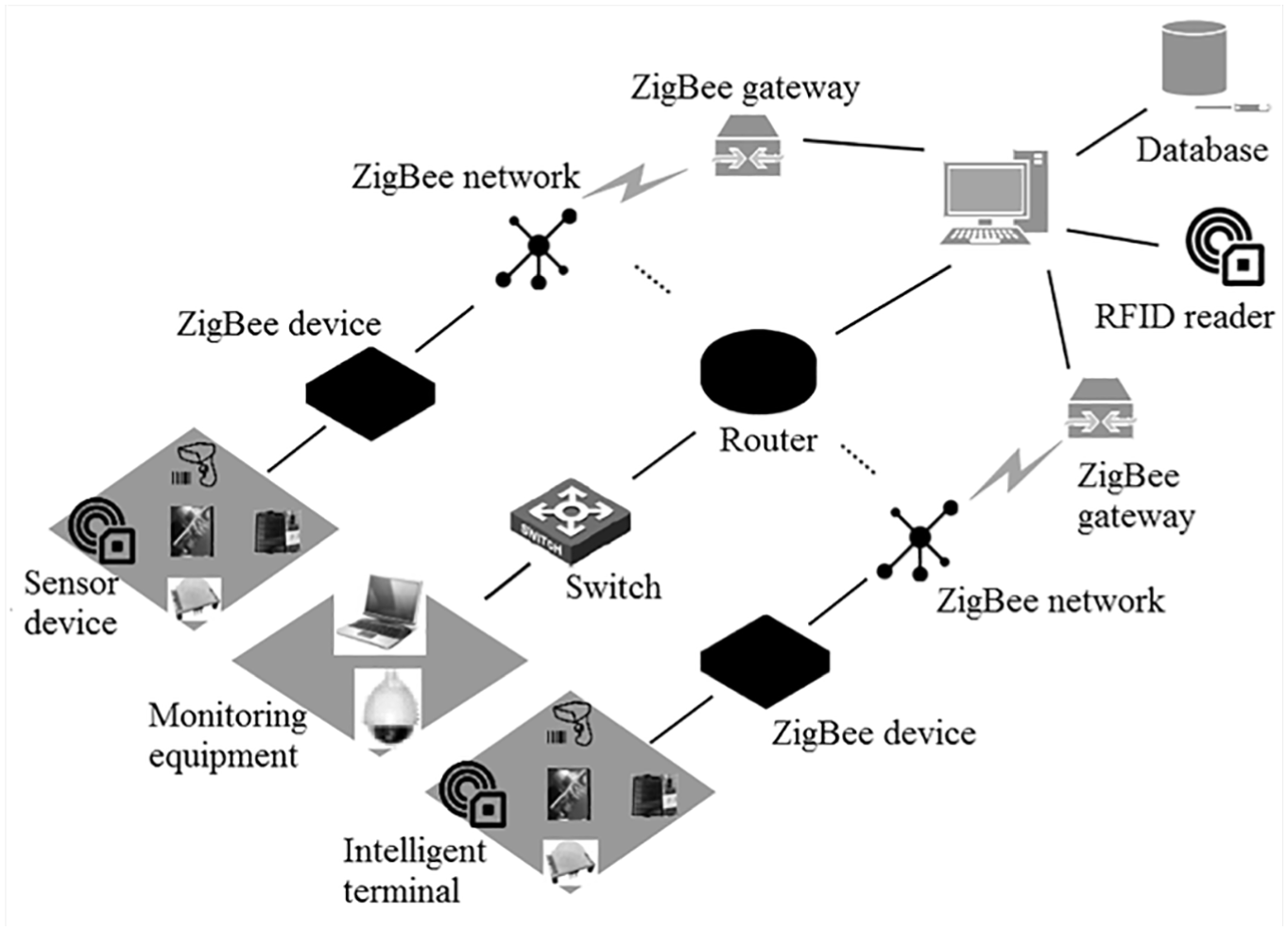
Topology of smart community integrated service platform.
This article will implement basic information management and intelligent access control with high-frequency RFID application systems, and ZigBee technology is applied in systems, such as illegal intrusion alarms, gas leak alarms, fire alarms, and house flooding alarms, and equipped with the appropriate equipment and software.
Article header information
All activities in the smart community can be described in two words as follows: application and service, and the corresponding application scenario is the management work of the property company and the living service of the community business. From the perspective of the application layer, the smart community service platform consists of smart home system, smart community service system, smart community management system, and integrated energy management system. Each system contains multiple subsystems, and the different subsystems are interrelated.
Smart home system
Smart home system is developed to meet all the intelligent needs of the community residents. This system can build communication between smart terminal and home equipment carried by residents through sensor network and realize automatic detection and control. For example, through home security subsystem, when gas leaks occur, the gas alarm controller will sense it, and then the gas alarm controller will immediately send relevant information to the district management center or the owner’s mobile terminal, so that security personnel can deal with accidents in time; remote monitoring system can detect all illegal people breaking into residential areas and ensure the safety of community residents; smart home appliance system is the most closely related part of the life of the residents, the owner can control the home appliances in any place with network access through the mobile terminal; and video intercom system can provide video and voice communication with family, property management, or visitors, just like face-to-face communication.
The composition of smart home system is shown in Figure 6.

Composition of smart home system.
Smart community service system
Smart community service system is also designed to serve the daily life of residents, but it has different priorities, that is, smart community service system focuses more on satisfying the residents’ service in community life, such as payment, complaints, repairs, and consumer inquiries. We advocate to provide a full range of community services through the smart card, so property management company sets up a community card operation center. The smart community service operation mode is shown in Figure 7.

Smart community service operation mode.
The operation mode of smart card system and smart community service is clearly described in Figure 7. Customers can make service requests in many ways and relate customer service requirements to specific services through community service operation centers.
Smart community management system
Smart community management system is mainly to facilitate the property company to carry out a full range of community management, which guarantees the entire operation of the smart community and also the focus of smart community to achieve efficient management and intelligent management.
Surveillance system
Surveillance system is a prerequisite for ensuring community safety. At some key points in the community, such as apartment entrance, main intersection, underground parking lot, equipment room, and other places, surveillance system is usually set up.
Parking management system
Parking management system is mainly to regulate the parking of community vehicles and to facilitate parking management charges. Due to the relatively fixed flow of personnel in community vehicles, the parking management system is relatively simple.
Visitor management system
Traditional visitor management relies on manual registration, but it is very difficult to find visitor information, so the visitor management system came into being. The system divides the access rights according to the type of visitors, and the visitor card is associated with the access control system. Massive data storage and data sharing can make visitor information available. In addition, register capture, hacker list settings, and automatic alerting are able to ensure safe and effective visitor management.
Integrated energy management system
Integrated energy management system realizes the collection of scattered data of various energy systems, as well as centralized management and supply and demand balance scheduling of energy. By building energy control center, it can perform real-time monitoring, calculation analysis, and processing of production energy. The energy management system collects and monitors the energy consumption of building lighting, water pumps, and air conditioners, aiming to improve energy utilization. The light-emitting diode (LED) light source has the characteristics of high luminous efficiency, low power consumption, long service life, strong safety, and reliability, so replacement of LED light source is conducive to the effective utilization of community energy resources.
In order to calculate the energy-saving benefits of replacing lamps, here we compare the costs of two typical lamps, as shown in Table 1.
Lamp cost comparison.

Then, we make electricity-saving benefit analysis of ordinary incandescent lamp, U-type energy-saving lamp, and LED lamp, as shown in Table 2.
Electricity-saving benefit analysis.

LED: light-emitting diode.
Finally, we make the comprehensive cost–benefit analysis of the three kinds of lamps, as shown in Table 3.
Comprehensive cost–benefit analysis.

LED: light-emitting diode.
As can be seen from the electricity-saving benefit analysis, every year, every LED lamp can save electricity by 79.2 yuan compared to ordinary incandescent lamps and 43.2 yuan compared to U-type energy-saving lamp. The energy-saving rates are 75.8% and 63%, respectively. From the comprehensive cost–benefit analysis, we can see that every LED lamp can save cost by 65.454 yuan compared to ordinary incandescent lamps and 38.96 yuan compared to U-type energy-saving lamp every year.
Energy efficiency analysis
At present, the energy-saving transformation is mainly the transformation of LED lighting energy-saving system, air-conditioning energy-saving system, and pump energy-saving system. At present, energy-saving retrofits usually adopt Electro Magnetic Compatibility (EMC) cooperation mode, that is, energy efficiency sharing model, in which the saving electricity costs in reimbursing equipment renovation costs, and when the contract expires, all energy savings are owned by the property company. Since the property company is a small profit industry, property companies basically do not have such large funds for system transformation. Therefore, through energy conservation, the economic burden of the property management company can be reduced, and it provides an economic basis for the property company to transform the smart community. The energy-saving renovation benefits of smart community are as follows.
LED lighting energy saving
Community public lighting mainly includes underground garage lighting, equipment room lighting, building lobby, aisle lighting, and courtyard lighting. The current LED lighting energy-saving system is already very mature, and we found that LED energy-saving effect is very ideal. However, the quality of LEDs on the market is uneven, affecting energy-saving effect, therefore, LED energy-saving effect is mainly affected by the quality of LED lights.
Pump energy saving
Energy-saving objects of water pumps in smart communities are mainly for domestic water pumps, because the fire pump start-up time is shorter, which usually starts only in emergencies and commissioning situations. The basic information of one community’s domestic pump equipment is given in Table 4.
Basic information of community’s domestic pump equipment.

Air-conditioning energy saving
Air-conditioning energy saving has the following advantages compared with lighting and pump energy-saving way: first, collaboration on the benefit sharing model of energy management under contract, customers do not need to invest, and after the contract expires, the property no longer enjoys a proportional share, and customers will enjoy ownership of energy-saving systems; second, the system is a complete refrigeration room group control solution, which can realize the full automation of the equipment room, energy-saving optimization control, and energy management trinity function; third, it can effectively support the operation and maintenance personnel and reduce the difficulty of operation and management of the freezer room; fourth, it can replace the workload of some operators and maintenance personnel, reducing the intensity of operation; fifth, optimization of equipment energy efficiency and reduction of operating energy consumption can be achieved; and finally, through remote monitoring, realize energy consumption monitoring and optimization control, bringing management visibility and control, so that it eliminates the asymmetry and loss of information to a certain extent.
Conclusion
The smart community has great potential for development in the future, and various intelligent applications will permeate every aspect of the life of residents. Enterprises and government organizations nearly cannot wait to connect the residents of the community to the big platform of the Internet. The construction of smart community integrated service platform is increasingly becoming an industry consensus. In this article, starting from the connotation and demand of smart community, we propose the overall framework and application system of the intelligent community integrated service platform, providing a strong theoretical basis for the construction of smart communities at this stage, and carry out detailed analysis and design of the underlying infrastructure, supporting platform and basic database of the platform. Based on this, we integrate community government services, public services, and business services together to construct four main applications in smart communities, including smart home system, smart community service system, smart community management system, and integrated energy management system, and then we deeply design multiple subsystems and their application modules.
Enterprise-led smart community construction will necessarily focus on the intelligent upgrade of community security, energy saving, construction of community operation service platform, home intelligence, and so on. The core goal of the smart community service system is to better promote property management and residential life, and its vision should be to create a good ecosystem between residents, real estate, property, and merchants. Building a smart community integrated service platform can break a series of problems in social public service and management, to create a multi-level, multi-faceted, intensive, intelligent management network, and build a quality convenience management and service mechanism, to achieve the sharing and integration of information resources.
Footnotes
Handling Editor: Marcin Wozniak
Declaration of conflicting interests
The author(s) declared no potential conflicts of interest with respect to the research, authorship, and/or publication of this article.
Funding
The author(s) disclosed receipt of the following financial support for the research, authorship, and/or publication of this article: This work was funded in part by the Baoding Philosophy and Social Science Planning Project number: 2017157.
