




Abstract
In smart cities, balanced energy usage is a classic scheduling target in decision-making of power systems. To handle multiple energy consumers, energy management is usually built based on game theory. Despite their effectiveness, they do not consider consumer preferences, which are however important in developing salient scheduling frameworks. For the first time, this work explores consumer preference–based social networking in computing-optimized schedules to facilitate the incorporation in energy management. We propose the consumer preference driven intelligent energy management technique for smart cities using game theoretic social tie. In our technique, social communities are constructed based on the preference of electricity usage. To support dynamic decisions in the consumer preference–induced game, community pricing strategy is adjusted during each time period through leveraging cooperative game theory. The simulation results demonstrate the effectiveness and efficiency of the proposed intelligent energy management technique.
Introduction
With the development of the technologies of Internet of things (IoT) in smart cities, smart grids have the capability of monitoring and controlling every consumer’s electric nodes.1,2 This has significant value for optimizing resource distributions, improving economic operations and enhancing the system’s security as well as intelligence. Compared with the traditional power networks, smart grids compromise efficiently the electric energy flow, the information flow, and the business flow. In fact, there are several advantages of IoT-based smart including (1) observation and prediction of breakdowns and the capability of self-repair; (2) resistance to disturbances and attacks; (3) flexible control through techniques, such as energy storage and intelligent arrangement; (4) exhibition of the power network status comprehensively and accurately to support operation management and (5) the ability to obtain the electricity price and energy load. 3 Exploiting IoT-based smart grids to optimize the energy performance of smart grid is becoming increasingly popular. 4
In a smart city, most of electricity consumption is used in civilian sectors. 5 However, there does not exist an efficient and intelligent system to schedule the electricity consumption among households, which results in the waste of billions of dollars. The key to optimize the cost of power generation by utility companies is to schedule intelligently the power consumption since power plants must satisfy the peak power consumption requirements by increasing the capacity of electricity generation or storing enough electricity. Therefore, efficient scheduling of electricity consumption can lead to an enormous economic benefit. Another benefit of efficient scheduling of electricity consumption is the reduction in cost for customers if the utility companies use price strategies to change consumers’ consumption plans, which are widely adopted in smart grids. 6 Thus, it is easy to attract consumers entering a smart grid. Therefore, efficient scheduling of electricity consumption is beneficial for both customers and power plants.
Some existing scheduling strategies were proposed to reduce the cost of electricity consumption. A scheduling strategy was proposed to minimize the peak load using an non-deterministic polynomial-time (NP)-hard problem, 6 which establishes that scheduling every individual’s strategy can reduce the peak load. In this scheme, each individual needs to be equipped with a demand response switch (DRS) to ensure the system can work, which causes additional complexity of the devices. Meanwhile, the system will cause communication overhead and large amounts of managerial costs. Testimonies show that demand response (DR) is an efficient method in electricity markets.7,8 However, aforementioned methods do not focus on how to schedule the intelligent price strategy. The scheme in Zhao and Tang 9 proposed a scheduling algorithm to maximize the consumer utility, but they ignore the fact that the goal of DR is to reduce the imbalance of electricity consumption. Recently, introducing social networks into smart grids is a proved novel way of reducing the power peak. Some researchers attempt to optimize electricity consumption plans by exploiting structural characteristics of social networks, but the proposed mechanisms cannot take advantage of the social network features and diversity among communities; thus, the improvement is limited. For example, the work in Conejo et al. 10 notes this problem and proposes a divide-and-conquer approach, which divides customers into several groups and finds the strategy in each group that minimizes the peak load. The strategies may not the best way to minimize the power load, but it can balance the overhead and the goal. However, it just uses the social network topology to reduce the peak load, which is more likely to use graphs instead of social networks. Although there are some existing scheduling schemes for smart grid, these works did not consider the underlying relationships and competitions of the consumers. Because the consumer nodes in smart grid have many characteristics such as self-organization, self-similarity, scale-freeness, and small-world networking, the intelligent cluster approach of the consumers usually has important impact of the electricity scheduling. In fact, different consumers have different electricity consumption preferences in smart grid. With the Internet-of-things (IoT) technologies, detailed preference of consumers can be obtained. Moreover, the preference of the consumers and their diversity impacts on the price strategy efficiency for consumers can be obtained, which provides very important features to perform intelligent scheduling for electricity consumption. However, the existing works did not exploit consumer preference and community diversity, which limits the performance of electricity consumption scheduling.
To address aforementioned open issues and find an optimal way to realize efficient scheduling in smart grids, we propose a consumer preference–enabled intelligent scheduling scheme based on game theoretic social tie. We exploit diverse characteristics of the consumer preference to construct the communities intelligently. Using these features to schedule different price strategies can significantly prevent customers from using electricity at the same time slot, thus the peak power problem can be optimized. In addition, to prevent high costs of management and address the fact that customers are reluctant to change their electricity consumption plans without any benefits, cooperative game theory–based DR technologies are adapted to create motivations for scheduling the customers’ electricity consumption strategies.
The contributions of this article are as follows. (1) We propose a social multi-community diversity approach that partitions customers into diversity communities according to their electricity consumption preference in smart grid. In each community, we schedule its price strategy based on the consumer preference. Customers have the right to choose the electricity consumption plan based on their lifestyle, price strategy, and the load in the community. Based on the dynamic communities, the electricity consumption is optimized intelligently. (2) After price strategies are proposed, we use cooperative game theory to address the optimum problem. Mixed strategy can lead consumers to schedule electricity consumption plans and receive better performance. (3) To avoid customers choosing the same price strategy and similar electricity consumption plans, which may cause higher peak load, we balance the communities’ size intelligently by adjusting price strategies. Meanwhile, the price strategy will also be changed in a single community to reduce the community peak load after each time period. Correspondingly, customers re-schedule and optimize their consumption plans in return based on game theory.
The rest of this article is organized as follows. Section “Related work” introduces the related work from previous research. Section “System description” describes the system description of the proposed approach. Section “Consumer preference-enabled scheduling price strategies based on social tie” presents the proposed social networking for scheduling the price strategies. Section “Game theoretic social community for power scheduling” describes the algorithm to optimize the performance using game theory. Section “Data set getting and processing for energy consumer profile” presents the data set of user profile of energy management task. Section “Simulation results” presents the design of the simulation and the simulation results. Section “Conclusion” concludes this article.
Related work
In the electricity consumption scheduling, peak power reduction is the most important issue. 11 There are three kinds of approaches to optimize the electricity consumption scheduling.
First, novel power grid technologies promote the efficient scheduling. In some recent works, model predictive control with synchronized electricity price is used to achieve the scheduling objective, where DR is one of the key technologies. These works focused on demand-side management (DSM), long-term market equilibrium, and smart loads, which provide a feasible way to perform the efficient scheduling. A smart power system with distributed users was proposed, in which the consumers request their energy demands to an energy provider and the energy provider dynamically updates the energy prices. 12 In the scheme, the peak-to-average ratio (PAR) is minimized by discharging the energy at high-demand periods and charging the consumers’ batteries at low-demand periods. A long-term market equilibrium scheme was proposed in smart grid with introducing DR provider in competition. 13 DSM is a set of measures to optimize the energy system at the side of consumption, which is overviewed in Palensky and Dietrich. 14 Moreover, the principle of price adjustment is studied, 15 which using uninterrupted power supply (UPS) units to share workload and raise electricity price on the peak load. Energy storage is another important point to optimize the scheduling. A control methodology was proposed to reduce peak demand for energy storage, which uses day-ahead historical demand data and demand forecasts. 16
Second, the features of consumers and appliances can be considered to improve the efficient scheduling. Customer engagement plans for scheduling were proposed in residential smart grids. 17 In this work, the effectiveness of customer engagement plans was studied, which clearly specifies the amount of intervention in customer’s load settings by the grid operator for peak load reduction. Some algorithms have been proposed to detect the community structure, which is helpful for constructing the communities for the nodes.18,19 Moreover, appliances are also useful to perform the electricity consumption scheduling. A set of appliance scheduling has been studied, 6 whose advantages are to implement the scheduling under a fixed delay requirement and a fixed peak demand constraint.
Third, efficient and feasible networking or mathematic approaches can be used to model the relationship of the nodes and promote the scheduling. Graph theory is one of the feasible approaches. The work in Cheng et al. 20 introduces the method of graph clustering–based scheduling for smart grid. In this scheme, a flexible and robust framework, co-regularized graph clustering (CGC) was proposed, which was based on non-negative matrix factorization (NMF). In addition, game theory is another crucial component to optimize the scheduling performance, which optimizes DSM, and price elasticity schemes has been proposed. For example, a power system with both distributed generators and customers is considered in Wang et al., 21 which is based on game theory. In the work, a distributed locational marginal pricing (DLMP)-based unified energy management system (uEMS) model was also proposed regarding increasing both stability of the distributed power system (DPS) and profit benefits for distributed generations (DGs). In addition, to consider the non-cooperative players and minimal communication, a distributed demand peak reduction was proposed in Collins and Middleton. 22
Different from existing scheduling schemes, the proposed intelligent energy management scheme overcomes the important limitations in these schemes. In fact, the consumer preference usually includes very important and useful information for the intelligent scheduling. This is because the consumer preference has impact on the usage time of the electricity, which is related to peak power. The existing works have not exploited the consumer preference diversity to optimize the scheduling, which has revolved in the proposed scheme.
To resolve aforementioned problem in existing works, there are two difficulties to introduce consumer preference into intelligent energy management in smart cities. First, the consumer preference will cause additional competitive and cooperative relations into the scheduling. It is necessary to propose a feasible model to describe formally this complex scenario. Second, the energy scheduling of smart cities is usually relative with price strategy. It is an important issue to balance the price and consumer preference. To address aforementioned challenges, this article introduces the consumer preference–based social networking model into the smart grid and proposes an intelligent scheduling with adaptive price strategy.
System description
The system model
In the proposed system, there are three planes including grid plane, social plane, and control plane. In grid plane, general capabilities, such as state monitor, vehicle-to-grid (V2G), renewable energy, and energy storage, can be realized.
In fact, consumer preference parameters are collected from the social plane to the control plane for the generation of the control strategies. Moreover, the grid plane implements the intelligent strategies from the social plane and control plane, thus the intelligent energy management can be realized.
In the social plane, consumers are organized based on social ties and the consumer communities are established. In the control plane, community and price strategy can be controlled and loaded, which provide dynamic control for the social plane. In fact, a central controller is established to schedule the price strategies. The central controller has the responsibility of summarizing every community size, which is the number of users who choose the specific price strategy. In addition to this, the central controller also has the capability to know each community load in the smart grid, which requires the functions of the energy source as proposing prices and receiving the desired aggregate load.
In the proposed scheme, when the central controller decides the new price strategies, users can choose new communities and re-schedule their electricity consumption plans.
Problem formulation
To simplify the problem and focus on the main aim, we ignore the production cost of the electricity and diversity among the utility companies. We assume there are
The profile of jobs.

We define the available time slots for user i by

Based on the above settings, we can observe the following hierarchical structure: job properties, jobs, users, and communities.
Let

The peak power

and

System flowchart
Figure 1 shows the process for how the system works. First, the controller sets the number of price strategies (or community number)

System model.
After a period of time, the central controller has the information of the size of the community and the summary of the electricity load. The central controller needs to re-schedule prices to reduce the peak load. To balance the size of the communities, the central controller should also adjust the prices. After these two steps of adjustment, the users can choose a different community to reduce their cost. New users can enter the system, and current users have the capability to quit the system.
Consumer preference–enabled scheduling price strategies based on social tie
In this section, we will mainly discuss how social networking is used in smart grid networks. According to the situation, we use price strategies to stimulate the users into changing their power consumption strategies and reducing the peak power. The main methods of scheduling price strategies are as follows.
Consumer preference–based social community
A property we will discuss that appears to be common to many networks including smart grid networks is the community structure, 23 which is also known as clustering. We can regard a smart grid as a social network, and it is easy to determine that such networks have communities in them. Within a community, connections between nodes are dense, while between communities, connections are much less dense. 23 The property of the community structure can be shown in Figure 2. Nodes with different colors represent different communities. Black lines describe links within a community, and gray lines describe links across communities. Nodes have more connections to each other when they are in the same community.

Payment of the electricity consumption.
Communities in a social network may describe groups with the same interest or background. 18 In the smart grid, communities represent groupings by electric energy consumption features. These features are based on the energy consumption time; thus, they describe the following three main phenomena:
Connections between nodes are dense in the same community. Therefore, users have the capability of contacting each other to learn related information.
Every community has its own energy consumption features, which more easily cause a higher peak power; thus, the central controller can take the advantage of this to determine price strategies and reduce peak power within a community.
Because of the differences between communities, the time of peak power may be different; hence, the central controller could only focus on individual communities.
Therefore, the central controller determines every community price strategy according to its features. The price strategy not only decreases the expense for the users but also leads users to change their consumption and reduce peak power. It is noted that users have the right to choose the price strategies; therefore, extreme price strategies are unacceptable in the system.
Balance community sizes
According to the related community theory, 24 the size between communities is obviously different. However, in the system, the size of a community is too large to simplify the complexity. Therefore, community sizes are to be balanced through price strategies.
Adjust price strategies
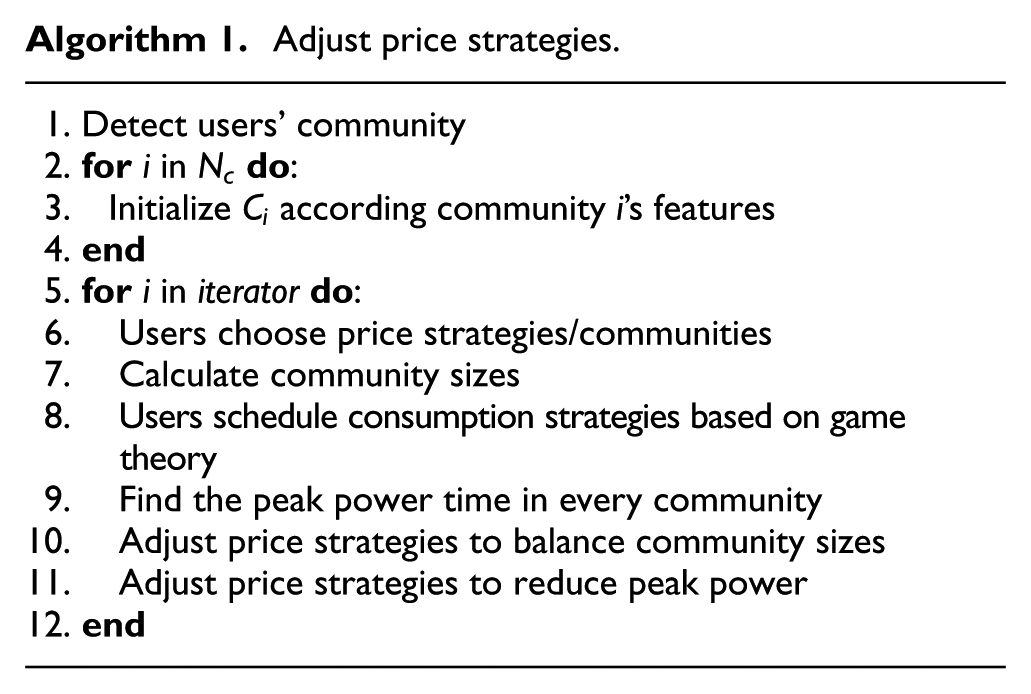
Algorithm 1 shows the method we use to adjust price strategies. The price strategies are adjusted based on the following two parameters: community size and peak power time slots.
Adjust price strategies.
At first, we need make some reasonable assumption throughout this article.
Assumption 1: for any community comm and any iteration itr, if

It means we need to increase the price of time slots
Assumption 2: the adjustment functions are strictly convex. For any community comm and any iteration itr, let

Then, we can get following formulation

A simple function that satisfy both Assumptions 1 and 2 is the quadratic function with

where

where

Game theoretic social community for power scheduling
In this section, we optimize the system performance using game theory. Game theory is “the study of mathematical models of conflict and cooperation between intelligent rational decision-makers.”19,25 It is mainly used in the field of economics to help people understand large collections of economic behavior. With the development of both game theory and computer science, game theory currently plays a significant role in computer science. Game theory offers a theoretical method to the field of distributed systems, such as smart grids.12,26
Modeling of electricity consumption
After the central controller proposes the price strategies and every family chooses one, the system still has the capability of reducing the peak power since families have the choice to arrange their consumption time when their price strategy has been chosen.
The game theory problem can be described by following equation

where G denotes the proposed game theory problem,

and U can be described by

Therefore, U manifests the peak power in the community, and the purpose of the system is to reduce U. For system, the aim is

For users, the aim is

Users in the same community can learn about the consumption information; thus, they know when the power reaches the maximum. The former power grid approach attempts to solve the optimum problem in the central controller, but it cannot be solved since the optimum method may conflict with the users’ goals. Therefore, it is much more advantageous to use a distributed approach. Individual consumers independently choose their energy consumption to minimize the peak power since higher peak power may cause the price to rise and increase their payments for the next time slot.
Mixed strategy
This problem can be regarded as a complete information static game. We consider the concept of the Nash equilibrium. For our system, the Nash equilibrium is defined as follow: 27
Definition 1: the pure strategy Nash equilibrium in every community j is a strategy profile

where
While in this situation, the Nash equilibrium does not exist or calculating
In contrast, the mixed strategy can describe the optimum problem well. Therefore, the problem is not choosing a strategy that can maximum the profits for users, but choosing the weight p to optimize the system. The weight
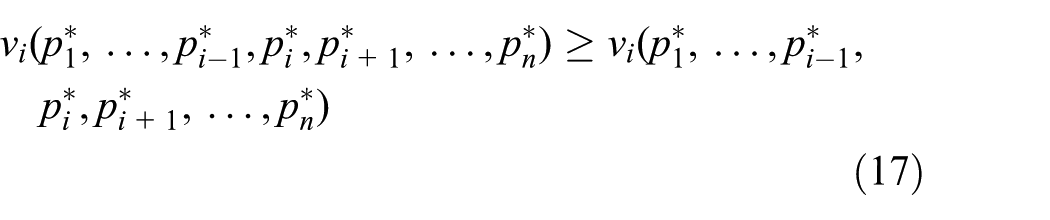
And, we update the Nash equilibrium definition as follows: 27
Definition 2: the mixed strategy Nash equilibrium in a game
and

Algorithm of electricity consumption scheduling
After generating the game theory model, we next propose a distributed energy consumption scheduling algorithm according to the game theory model. This algorithm aims to reduce the peak power after the central controller has set the price strategies and users have chosen the price strategies, also known as communities. The algorithm may not converge to the optimal strategy because the algorithm focuses the users into the same strategy, and users schedule the strategies independently. However, it decreases the time cost and the simulation results will show that the algorithm significantly reduces the peak power.
Algorithm 2 shows the solution to optimizing the approach. The value assignment is denoted as “←.”
Mixed game theory in community i.

We initialize
Data set getting and processing for energy consumer profile
In this section, the data set of user profile of task is presented. Since reasonable data sets are not available easily, we resort to simulated data according to Tang et al. 6 Each household (a unit or a user) has several of the same task types with different powers and other properties. The property diversity establishes the customer preferences and gives us the probability to achieve the goal through it. Our simulation results demonstrate that the approach we proposed reduces the peak load significantly by approximately 14%. Meanwhile, the system also decreases the customers’ expenses. Hence, it is a flexible and practical approach.
In this section, we present the design of the simulations in a smart grid. We describe the household electricity consumption simulator and job demand profile simulator first and then describe the simulation result.
To evaluate the performance of the system, we need a set of suitable data which are nearly to a real-life situation. Specifically, these data should not only reflect the electricity consumption in real life but also the consumption diversity among consumers. While the data for the household electricity consumption is not available through a general method. In The Reference Energy Disaggregation Data Set, 28 we obtained the data of six households. In addition, in Huang et al., 7 we obtained the profile of jobs in a household, which is statistically similar to the real world. For instance, they have similar probability distribution functions. While the design has some weaknesses, for example, it defined the average frequency, but does not limit the specific start time clearly. We updated the task information as the original task list.
We need a large amount of data for households. For each task in each household, we need to obtain its profile, including its name
We assume that the average powers

and

where

and

In the simulation, we assume

where
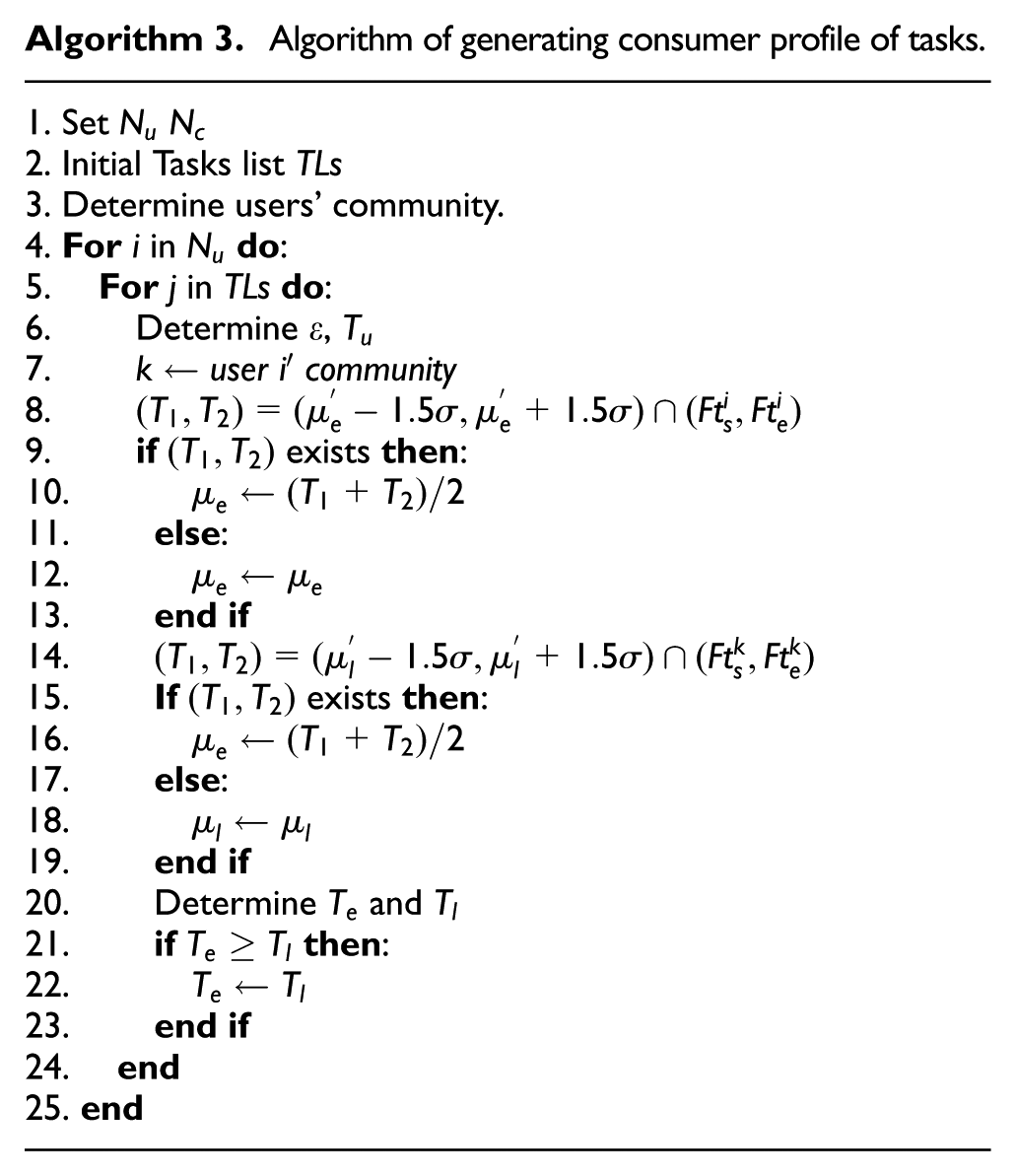
We assume that there are 1000 households entering into the system. In addition, we use the model proposed in Zhang et al. 29 to generate a social network of 1000 nodes and five communities. For every household, the community which the household belongs to is assigned first, its electricity consumption data are generated by Algorithm 3. The value exchange is denoted by “↔.” Therefore, every household has its own distinct characteristics. We simulate five days to observe the result.
Algorithm of generating consumer profile of tasks.
Because of the diversity among countries and regions, we do not choose a specific currency as the price unit. Moreover, we use
Simulation results
In this section, we will evaluate the system performance through several critical parameters, which are obtained from the simulation. In the simulation, without loss of generality, 5 days are taken as an example for observation:
Payment of the electricity consumption. The payment of the consumers is a very important issue for further evaluation, which can show the impact on benefits of consumers and sellers in smart grid.
The payment of the system under the price strategy changing is shown in Figure 2. The horizontal coordinates of Figure 2 is price scale and the horizontal coordinate is time. Compared with the first day payment, the payment in the fifth day has decreased by 1.2%. In other words, the payment of the whole system is nearly stable. This result makes sense since users benefit from the system, and sellers will not lose too much profit. Therefore, the proposed scheme is more likely to be accepted by all parties.
2. Impact on community size. To reduce the peak power, we need to diminish the diversity of the sizes. Therefore, it is necessary to evaluate the changing trend of the community size under optimized control strategy. The impacts on communities are shown in Figure 3. The communities 1, 2, 3, 4, and 5 denote consumers’ preferences are using electricity in the morning, noon, afternoon, evening, and midnight, respectively. Because the price strategy of every consumer is quite different, the community sizes are different at the first day without optimized control strategy based on game theoretic social tie. Especially, the size of community 4 is much larger than that of other communities, because most of the consumers prefer to use electricity in the evening. However, the sizes of the five communities change to closer. In other words, distribution of the electricity can be optimized based on the proposed scheme.
3. Electricity consumption comparisons. To compare the efficiency of the power peak reduction, the power of the proposed scheme and random walk scheme is evaluated.

Community size.
The peak power of random walk scheme is shown in Figure 4. Consumers choose the start time randomly, and they have no community; thus, the price strategies are not used. We can determine that the daily electricity consumption is similar. Figure 5 describes the result using game theoretic social tie. Some trends are found in the simulations. For instance, the peak power occurs every night. It makes sense for family members to usually stay up at night and use electric devices more frequently. Another example is that besides the peak power, there is another electricity peak time at noon, which is usually smaller than the peak power. It is similar to real life because people cook lunch at noon, but they do not use other electric devices as they do during the night. In addition, at midnight, people hardly use electric devices; thus, the electricity consumption is quite low.

Peak power of random walk scheme.

Peak power of proposed scheme.
We can easily observe that the performance of the proposed scheme is better than random walk scheme since the third day. In the first and second days, the peak power value is not very stable, because the initial price strategy setting is random and the consumers will join the community with low price. After optimization, the price strategy of the communities will be balanced. Therefore, the advantage of the proposed scheme is stable after optimization. The peak power value of the fifth day is taken as an example for comparison. The difference of the proposed scheme and random walk scheme is shown in Figure 6. Compared with the random walk, the proposed scheme has 10.9% increment in the peak power reduction. As aforementioned analysis, this is because that the consumer preference–enabled game theoretic price strategy has been optimized based on social tie. The underlying relations between the consumers have been used to balance the efficiency and price strategy, which has more fine-grained control than random walk approach.
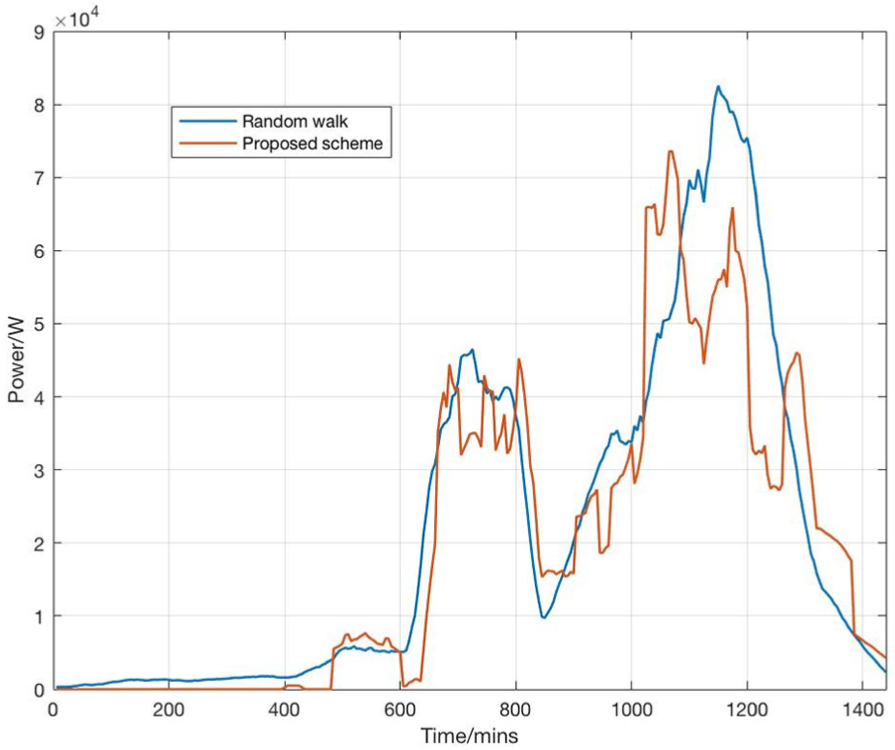
Comparisons of peak power.
Conclusion
In this article, we proposed an intelligent scheduling scheme, which reduces the peak power consumption and decreases payment for intelligent energy management for smart cities. The approach introduces consumer preference to construct the social communities. To improve the performance, cooperative game was used to model the complexly competitive and cooperative relations among the consumers, which is introduced by the consumer preference. The central controller schedules intelligently the price strategies. After the price strategies are proposed, game model helps the consumers schedule their electricity consumption plans. The electricity consumption plans that users choose also affects the peak power. Moreover, the DRS devices are not used because we give customers motivations to change their electricity consumption plans instead of forcing them to accept the given method. The simulation results demonstrate that the proposed intelligent scheduling approach reduces the peak load adaptively and significantly. The proposed scheme is applicable to improve the efficiency and reduce the cost of intelligent energy management in smart cities.
Footnotes
Handling Editor: Wenbing Zhao
Declaration of conflicting interests
The author(s) declared no potential conflicts of interest with respect to the research, authorship, and/or publication of this article.
Funding
The author(s) disclosed receipt of the following financial support for the research, authorship, and/or publication of this article: This work was supported by the Foundation of Zhejiang Education Committee, China, under grant KP22109H01.
