




Abstract
Wireless body area network is a type of wireless sensor network that enables efficient healthcare system. To minimize frequent sensor replacement due to resource restrictions, it is necessary to improve energy efficiency in wireless body area network. This article deals with energy efficiency and quality-of-service improvement together in novel wireless body area network architecture. A novel wireless body area network architecture is designed with dual sink nodes in order to minimize delay and energy consumption. A novel insistence-aware medium access control protocol which is aware of criticality of sensed data is presented in the proposed wireless body area network. Prior knowledge-based weighted routing algorithm is responsible to select optimal route for data transmission. In prior knowledge-based weighted routing, weight value is computed by considering significant metrics such as residual energy, link stability, distance, and delay in order to improve energy efficiency and quality of service in the network. Energy consumption is further minimized by incorporating graph-based sleep scheduling algorithm. In graph-based sleep scheduling, criticality of sensor node is also considered as major metric. In coordinator, split and map–based neural network classifier is involved to perform packet classification. After classification, packets are assigned to corresponding sink node according to packet type. Then, throughput and delay metrics are improved by frame aggregation process which is involved in sink node. Extensive simulation in OMNeT++ shows better performance in network lifetime, throughput, residual energy, dropped packets, and delay.
Keywords
Introduction
Wireless body area network (WBAN) is a typical sensor network which is specially designed for healthcare system.1–3 In WBAN, number of sensors, also referred as biosensors or body sensors, are deployed inside or over the human body in order to collect biomedical data. Major issues addressed in WBAN are dynamic link characteristics, high energy-efficiency requirement due to limited battery, and quality-of-service (QoS) requirement. 4 The next process followed by data collection is optimal route selection for data transmission. 5 The design challenges for WBAN routing protocols are as follows: data rate, security level, resource constraints, QoS, temperature rise, hop-count limit, and so on. In general, routing protocols presented in WBAN are felled under different categories such as QoS-aware routing, temperature-aware routing, cluster-based routing, postural movement–based routing, and cross-layered routing. 6 Dynamic routing algorithm (DRA) utilizes distance metric and estimated transmission energy for optimal route selection to enable energy and QoS efficiency in WBAN. 7 ZEQoS (A New Energy and QoS-Aware Routing Protocol for Communication of Sensor Devices in Healthcare System) method is another routing method which enables energy and QoS-aware routing using packet classification, hello protocol, routing services, and QoS-aware queuing module. 8 In WBAN, better QoS can be achieved by selecting best relay node with an assist of Nash equilibrium approach. 9
Medium access control (MAC) protocols are another solution for QoS and energy-efficient challenges in WBAN. 10 Usually, MAC protocols are categorized under event-driven protocols, query-driven protocols, and continuous delivery–based protocols based on type of data. Energy-efficient, multi-constrained, QoS-aware MAC (eMC-MAC) protocol is designed to improve QoS by considering traffic prioritization. 11 Furthermore, human energy harvesting MAC (HEH-BMAC) protocol which is a hybrid polling-based protocol is presented to ensure QoS improvement and energy efficiency conjointly. 12 In WBAN, a new MAC protocol in which time division multiple access (TDMA) is utilized is introduced to tackle energy efficiency and resource constraint issues. 13 Sleep scheduling is focused by some researchers to improve energy efficiency. For any network, large amount of energy is consumed in idle listening and overhearing. This problem can be resolved by optimal sleep–wake scheduling performed by optimization algorithms. 14 A channel-aware polling-based MAC (CPMAC) protocol minimizes energy consumption during idle listening by designing optimal sleep–wake up scheduling. 15 Here, channel sate is considered for scheduling, that is, nodes are waked up and transmitted only if the channel is strong enough. Generally, WBAN consists of biomedical data which are collected from different sensors with different critical levels. Thus, it is necessary to identify the type of data packet in order to improve QoS in the network. In priority-aware routing protocol, data packets are classified into emergency, delay-sensitive, and general monitoring. 16 Classification is performed based on bit rate, delay, and sampling rate required by data source. Data classification is not only involved in routing but also supports handover mechanism in WBAN. 17 Here, data are classified into general monitoring, delay-sensitive, and mandatory emergency packets. According to packet type, QoS requirements such as data rate, packet delivery ratio, point-to-point packet delay, and received signal strength indicator (RSSI) are guaranteed for data packets.
The major contributions of this article are listed as follows:
A novel WBAN architecture with dual sink nodes is designed to improve QoS and energy efficiency conjointly. The dual sink nodes are named as normal sink node (N-SN) which is responsible to aggregate normal data packets and emergency sink node (E-SN) which is responsible to aggregate emergency data packets.
The MAC protocol is improved by IA-MAC protocol in order to identify emergency level of data packet. The MAC format is modified without increase in overhead since emergency level of data is represented in binary values.
In data transmission, optimal route is selected by prior knowledge-based weighted routing (PWR) algorithm in which significant metrics are considered for weight value computation. Here, the routing overhead is minimized by considering prior knowledge of route selection.
Energy consumption is further minimized by enabling optimal sleep scheduling to sensor nodes. Sleep scheduling is supported by graph-based sleep scheduling (GSS) algorithm and performed by coordinator.
All incoming packets received by coordinator are classified into normal and emergency packets using split and map–based neural network (SMNN) classifier. Involvement of SMNN classifier is not only involved in classification but also contributes in delay minimization. In both SNs, frame aggregation mechanism is incorporated to further improve QoS.
The rest of this article is organized as follows: section “Related works” surveys the related works held on WBAN. In section “Problem definition,” we outline the problems presented in the previous works. Section “Proposed energy-aware QoS-guaranteed WBAN” details the proposed work with novel WBAN architecture and algorithms. In section “Performance evaluation,” we evaluate our proposed work in terms of performance metrics. Section “Conclusion” concludes our contributions.
Related works
This section surveys the previous research works held on WBAN in the perspective of QoS and energy efficiency. In this section, numerous significant approaches are surveyed and limitations of those approaches which tend to introduction of new algorithms in WBAN are provided.
Link-aware and energy-efficiency protocols for wireless body area network (LAEEBA) and cooperative-LAEEBA (Co-LAEEBA) were introduced for energy-efficient routing. 18 In both protocols, optimal path was selected. Here, cost function for each sensor node was determined by coordinator node based on distance and residual energy. This cost function contributed to decision-making in which each sensor made decision on being forwarder node. In addition, advanced nodes participated in transmission in order to implement Co-LAEEBA protocol. In both algorithms, forwarding decision made by the sensor node is not efficient, that is, if multiple sensor nodes made decision on not being forwarder, then transmission is not reliable in the network. Furthermore, Co-LAEEBA protocol requires additional advanced nodes with high energy which increases additional cost.
An energy-efficient routing protocol was introduced in WBAN to minimize power consumption and maximize stability. 19 Sensor node with higher residual energy, lower distance with sink node and other sensor nodes, was selected as optimal forwarder node for transmission. Furthermore, TDMA-based scheduling scheme was incorporated to minimize energy consumption. In this method, two sensor nodes were assigned for only critical data sensing. However, it is not sure that critical data are not always generated. Critical data also follow TDMA scheduling which increases delay for critical data transmission.
Ant colony optimization and breadth-first search strategies were combined for cluster-based energy-efficient routing. 20 Authors supposed that cluster-based routing protocol was attempted to improve network lifetime, energy efficiency, and load balancing. Here, data aggregation was a major responsibility for CH, and CH rotation was enabled in order to extend the network lifetime. TDMA-based scheduling algorithm was utilized to minimize energy consumption due to idle listening. Residual energy and hop count were major metrics considered in route selection. However, critical data transmission through CH and TDMA scheduling increases transmission delay for critical data.
Energy-efficient data transmission in WBAN was achieved by a quasi-sleep scheduling-based MAC protocol. 21 In this method, sensor hardware was modified so that it could support efficient critical data transmission. In this method, sensor nodes were deployed in tree topology to support level-based TDMA scheduling. The nodes presented in bottom levels were assigned with small number of time slots and number of time slots increased with increase in level of node in tree. According to the assigned time slots, nodes swing between sleep and transmission states simultaneously. By utilizing modified sensor hardware, coordinator was able to wake up all nodes for critical data transmission. Critical data transmission through tree topology increases transmission delay. Also, nodes presented in the higher level of the tree suffer from higher energy consumption due to simultaneous data forwarding.
TDMA-based MAC protocol was utilized to attain better QoS without increase in energy consumption in WBAN. 13 Here, the transmission order was dynamically changed with respect to channel status and application context of WBAN. In this method, the problem of collisions, idle listening, and overhearing were resolved by MAC scheduling. Sleep scheduling also involved in TDMA-based MAC protocol. A priority-based adaptive MAC (PA-MAC) protocol was involved in data transmission in WBAN. 22 In PA-MAC method, initially, traffic was classified into critical, on-demand, normal, and non-medical categories. Multiple channels were utilized such as beacon channel and data channel. Similarly, two different data transmission procedures were introduced for different transmission such as command message transmission and continuous message transmission. However, in both methods, critical message also follows TDMA scheduling which increases transmission delay.
To meet QoS requirements, two scheduling mechanisms such as inter-WBAN scheduling and aggregation (IWSA) and inter-WBAN scheduling (IWS) mechanisms were introduced. 23 These two mechanisms focused on enabling trade-off between delay and throughput. Thus, critical delay was considered as major metric in scheduling. Scheduler was responsible to compute critical delay for all packets and to schedule the packets in specific manner so that delay for delay-sensitive packets was minimized. Involvement of single metric is not efficient for scheduling process. The medical data generated by WBAN were classified into different categories in order to minimize power consumption. 24 In this approach, medical data were collected through single sensor deployed in WBAN. Then, collected data were classified into urgent, semi-urgent, and non-urgent packets. Data classification at sensor node increases overhead at sensor nodes. Similarly, this method is unable to handle multiple sensor nodes. Three different processes such as classification, scheduling, and vertical handover decision were involved in WBAN-based remote monitoring system. 25 Initially, packets were classified and then packets were scheduled by priority-weighted round-robin scheme. This method was attempted to minimize delay and maximize throughput in the network. Nonetheless, waiting time for critical data transmission increased due to ineffective scheduling.
Problem definition
An improved, stable, increased throughput multi-hop link-efficient (iM-SIMPLE) routing protocol was designed to support mobile sensor nodes in WBAN. 26 In this approach, TDMA scheduling algorithm was exploited to minimize energy consumption. Forwarder node selection was performed by considering distance metric and residual energy metric. In iM-SIMPLE protocol, involvement of limited metrics for forwarder selection increases the number of retransmissions which leads to higher energy consumption. This method is unable to differentiate critical packets in order to meet QoS for critical packets. Energy-efficient data transmission was enabled by reliable ad hoc on-demand distance vector (RelAODV) routing protocol. 27 Here, sensor nodes were allowed to follow two different modes such as relay mode and direct mode. On-sensor processing was exploited before data transmission to perform data classification. In this method, nodes in direct mode experience higher energy consumption since single-hop transmission consumes more energy. Enabling on-sensor processing is a major reason behind energy drop and overhead among sensor nodes.
Data scheduling and aggregation scheme was presented for IEEE 802.15.6- and IEEE 802.11.e-based WBAN. 28 Here, scheduling was performed based on critical delay which was computed as follows

where TLD was the tolerated latency delay and WD was the waiting delay. WD was expressed as follows

The packet arrival time was represented by Tarri at time t. Here, when the following condition is true, then arrived packet is dropped

This method drops packets regardless of the type of data which may serve critical message. Thus, in this method, packet drop decreases the overall network performance. In addition, critical packets are also encapsulated into single frame with normal packets which leads to higher transmission delay for critical packets.
Super-frame structure of IEEE 802.15.4-based MAC protocol was modified to support energy efficiency, delay efficiency, and through efficiency in WBAN. 29 The data packets were classified into normal and emergency data based on sensor node. Then, the packets were assigned with priority level by considering data type, packet size, and packet generation rate. Sleep control mechanism was supported by discrete-time, finite-state Markov model. Nonetheless, data classification based on sensor is not efficient. Here, high priority is assigned to packet with lower size which increases transmission delay for emergency data with higher packet size.
Thus, in WBAN, energy efficiency and QoS improvement are focused by many researchers but still convincing results are not obtained. Therefore, our major objectives in WBAN are as follows:
To maximize network lifetime;
To minimize energy consumption;
To improve QoS metrics such as throughput and delay.
Proposed energy-aware QoS-guaranteed WBAN
This section details the proposed energy-efficient and QoS-guaranteed WBAN with novel algorithms. Each significant algorithm involved in different processes such as routing, scheduling, and classification are detailed in this section.
Network overview
Energy-aware QoS-guaranteed WBAN (EQ-WBAN) architecture comprised “n” number of body sensor nodes (BSN), coordinator (CR), sink node (SN), and emergency sink node (E-SN). The overall architecture of EQ-WBAN is illustrated in Figure 1 and comprised the following entities:
BSN: These are sensor nodes especially designed to monitor human healthcare and widely utilized in WBAN and e-healthcare systems. Major responsibility of BSN is to sense the body conditions and to report the sensed data to sink node periodically. Electrocardiogram (ECG) sensor, electroencephalogram (EEG) sensor, motion sensor, temperature sensor, and so on are some of the examples for BSNs.
CR: Coordinator is a typical personal server which is enabled for patient in the network. The major responsibility of CR is to aggregate all sensed data from BSNs. Then, the aggregated patient’s vital health information is transmitted to sink node. In EQ-WBAN, CR is also responsible to classify the incoming packets into normal and emergency packets.
SN: SN is the destination of all biomedical data transmitted from BSNs. Through SN, all biomedical data are transferred to cloud monitoring server for further process such as disease diagnosis and recommendation generation. In EQ-WBAN, normal data and near-emergency data classified by CR are received by SN.
E-SN: Similar to SN, E-SN is responsible for receiving all emergency data from CR. Here, SN and E-SN perform frame aggregation in order to minimize transmission delay and energy consumption.

EQ-WBAN architecture.
In EQ-WBAN, IA-MAC is designed in order to determine the criticality of sensed data. In IA-MAC, the MAC header is modified to indicate the criticality level of data without increase in overhead. According to the criticality level, routing is enabled within single- and multi-hop. Here, PWR algorithm is incorporated in multi-hop routing in order to select optimal path for data transmission. In PWR algorithm, energy efficiency is a major constraint for route selection. Energy consumption is further minimized by employing GSS scheme–based sleep scheduling. In CR, SMNN classifier, which serves packet classification without time delay, is incorporated. Based on packet type, the packet is transmitted to SN or E-SN. Frame aggregation which minimizes transmission delay and maximizes throughput is enabled in both sink nodes. Each significant algorithm involved in EQ-WBAN is detailed in the below sections.
IA-MAC
In EQ-WBAN, MAC header format is modified with additional fields “data type and hop count.” In general, MAC frame is composed of fixed-length MAC header, variable-length frame body, and fixed-length frame check sequence (FCS). Here, the standard length of MAC header is 7 octets which comprise multiple sub-fields. MAC header includes frame control field with 4 octets length, recipient ID with 1 octet length, sender ID with 1 octet length, and BAN ID with 1 octet length. Here, we have utilized sender ID, recipient ID, and BAN ID bits to include additional fields. The modified IA-MAC header is depicted in Figure 2.
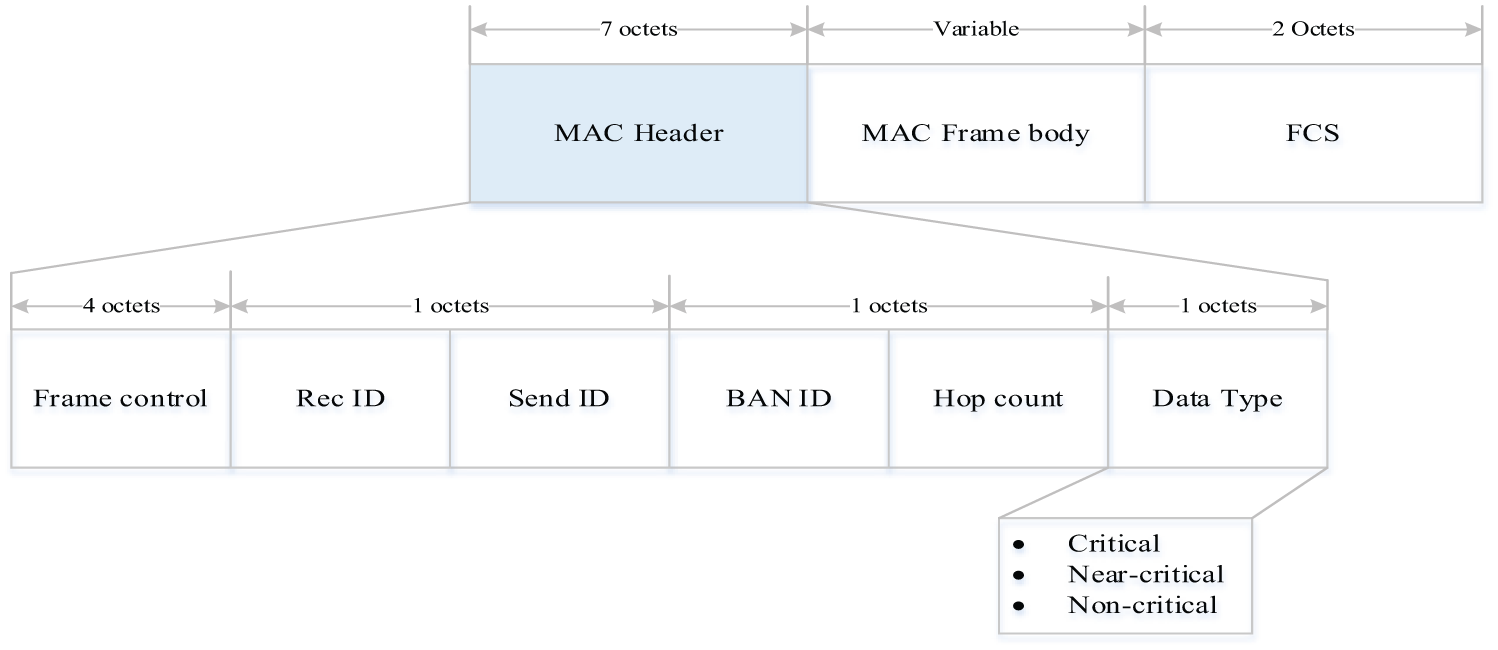
IA-MAC format.
As shown in the figure, IA-MAC header is included with data type and hop-count fields. Here, recipient ID represents the ID of destination which is probably CR. Send ID refers to the ID of BSN which is the source of the data. BAN ID indicates the ID of BAN in which the source node is presented. Rec ID and Send ID share 1 octet size, while BAN ID and hop count share 1 octet. Remaining 1 octet is assigned for data type field. In this field, data are represented as critical, near-critical, and non-critical. In order to minimize overhead, this field is represented in binary values as shown in Table 1.
Binary representation of data type field.

The data type is determined by BSN based on the criticality level of each sensor. In general, WBAN uses different BSNs for different purpose.
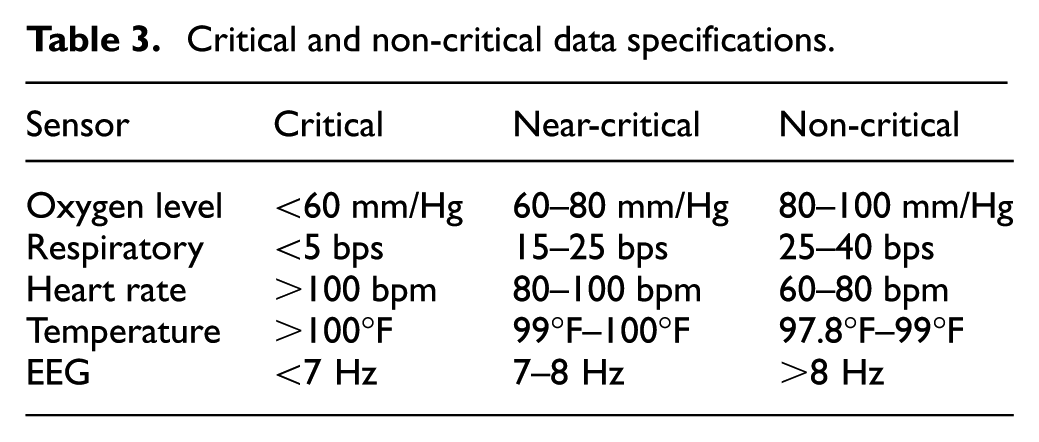
For instance, if sensed data from temperature sensor show above 99°, then this data is considered as critical data. Similarly, each BSN has critical, near-critical, and non-critical values. Then, data type field is assigned with optimal value based on the sensed data value. Thus, involvement of IA-MAC in EQ-WBAN allows BSN to determine the critical level of data. Based on the critical level of data, routing is performed in WBAN.
PWR-based routing
EQ-WBAN utilizes PWR algorithm to perform energy- and QoS-efficient routing. In PWR algorithm, both single- and multi-hop transmission are performed based on data type. The decision on single- or multi-hop transmission is made as follows

When single-hop transmission decision is made, then the data are transmitted to CR directly. It is worth mentioning that the single-hop communication decision is made only when data are critical. In WBAN, critical data must serve without any time delay since it holds data which has most impact on patient health. Thus, the data are transmitted within single hop in order to minimize transmission delay with the cost of little energy consumption. In multi-hop transmission, the next hop node is selected based on weight value which is determined by considering multiple significant metrics. In addition, the past experiences with neighbor node were also considered in PWR in order to increase throughput metric by enabling reliable transmission. The past experience is computed by number of packets successfully transmitted through the particular BSN. Each node maintains a past experience table to determine the past experience value for neighbor BSN. This table only updates the number of successful packets in order to minimize the space complexity and overhead. Then, weight value for each neighbor node is computed as follows

where
A BSN with high weight value is selected as optimal next hop node for transmission. In this manner, each BSN forwards the data packet to best next hop node. Involvement of multiple significant metrics minimizes transmission delay and energy consumption with increase in throughput. Here, a node with higher residual energy, link stability, past experience, signal strength, and lower delay, distance, and transmission power obtains higher weight value. Non-critical packets are transmitted as per this procedure. Here, the link stability between two nodes is computed as follows

The link stability between BSNi and BSNj is computed based on coverage range of BSNj(R) and distance between two nodes, dis(BSNi, BSNj). However, this method introduces transmission delay for near-critical packets which are to be served within time limit. This problem is resolved by considering hop count in near-critical data transmission. In EQ-WBAN, near-critical data transmission is supported by IA-MAC. Here, a predefined threshold value (Th) is considered for near-critical data transmission. All forwarder nodes which receive data packet increase the hop-count value in IA-MAC. When this value is equal to predefined threshold, then the packet is transmitted directly to CR. Thus including hop count as major metric for near-critical transmission minimizes the computational complexity as well as time consumption.
The overall process involved in PWR algorithm is detailed in Algorithm 1. In PWR, residual energy is considered as major metric in order to balance energy consumption, while other significant metrics contribute in minimizing energy consumption and providing QoS efficiency.

GSS-based scheduling
Energy consumption due to idle listening is a major problem in WBAN since it requires only periodic monitoring. To resolve this problem, EQ-WBAN employs GSS scheme–based sleep scheduling. In this scheme, BSNs are allowed to sleep during idle listening period. Duty cycle of BSN with M number of time slots is illustrated in Figure 3. Time slots are denoted as

Duty cycle of BSN.
Here, each BSN follows two states majorly such as sleep state and wake-up state. In wake-up state, the node performs sensing and transmitting. Furthermore, the transmission period is further utilized for direct communication and forwarding communication. Here, the direct communication is not always performed by node since it consumes more energy. Whenever emergency data are transmitted, direct communication is performed. However, sleep scheduling in WBAN should be aware of patient condition. A patient may have a heart disease who require continuous monitoring of heart. In such patient, data from ECG sensor may involve large number of critical and near-critical packets. Here, the ECG sensor requires being in sleep state for a small period of time.
Thus, GSS schedules the sleep and wake time for each BSN in an adaptive manner. Here, the sleep time slots are assigned based on number of critical, near-critical, and non-critical messages transmitted. The CR is responsible for assigning sleep–wake slots for each BSN. CR holds the details of packet type received from each BSN. Then, based on number of packets in each type, a weighted graph is constructed by CR. From the graph, the time slots for sleep and wake are assigned to each node. The weighted graph representation in GSS scheme is depicted in Figure 4. Here, weight value of BSN, n, with critical packet is denoted by NCP(n), with near-critical packet denoted by NNrCP(n) and non-critical packet denoted by NNCP(n). If the total number of critical and near-critical packets is higher than the number of non-critical packets for BSN, then that BSN is considered as critical BSN and assigned with minimum time slot for sleeping. Then, the BSN ID is broadcasted to all other nodes in order to prevent it from being forwarder.
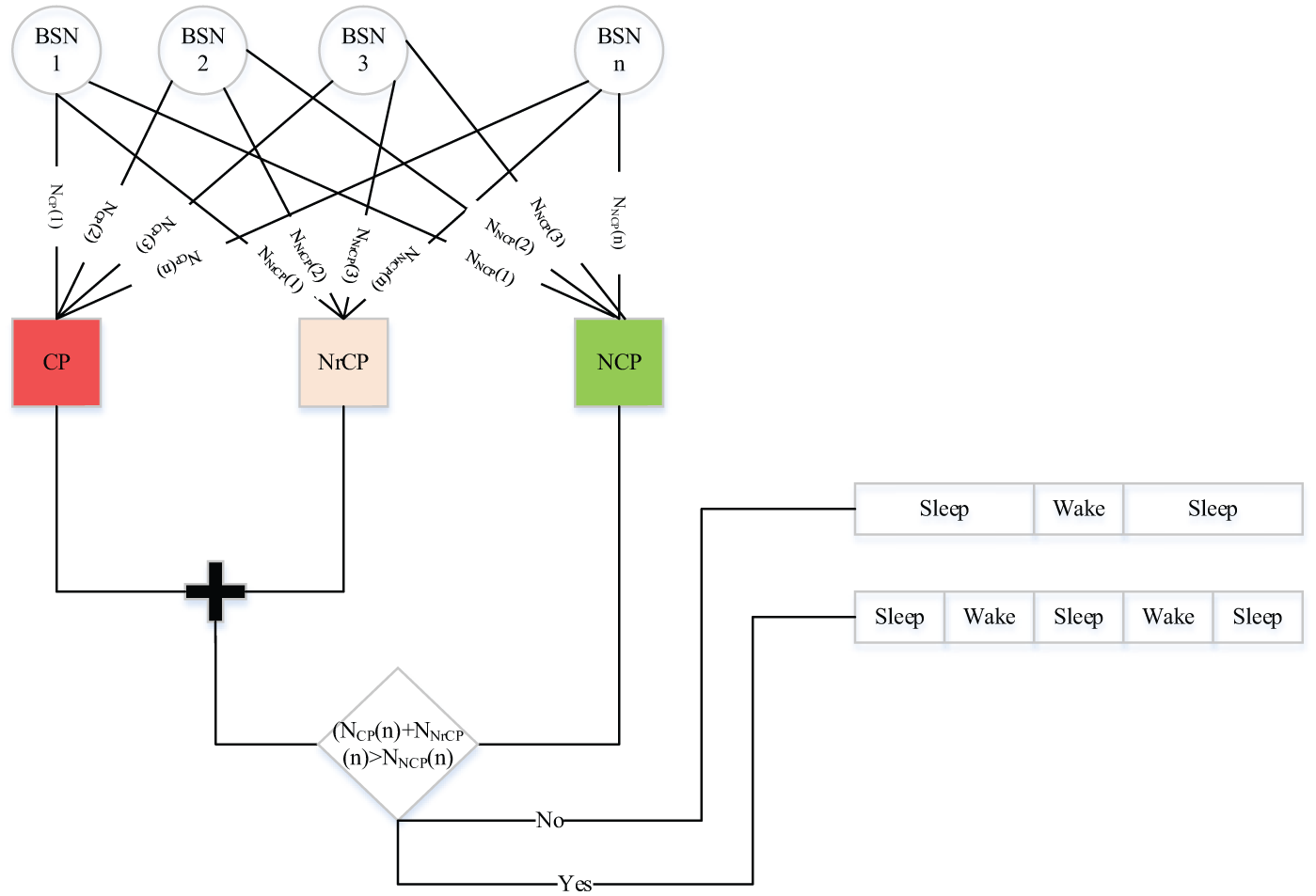
GSS scheme.
All BSNs follow the sleep scheduling provided by CR. A node with large number of critical packets is assigned with small period of sleep time. The question may arise, and then energy consumption of that node will be largely compared to other nodes. This problem is resolved by minimizing the involvement of particular node from being forwarder for other node transmission. At each scheduling period, CR broadcast BSN ID which has high weight value to other BSNs. Upon receiving that ID, other BSNs were unable to select a particular BSN as forwarder until another node ID is sent by CR. Thus, energy consumption for all BSNs is balanced by GSS scheme.
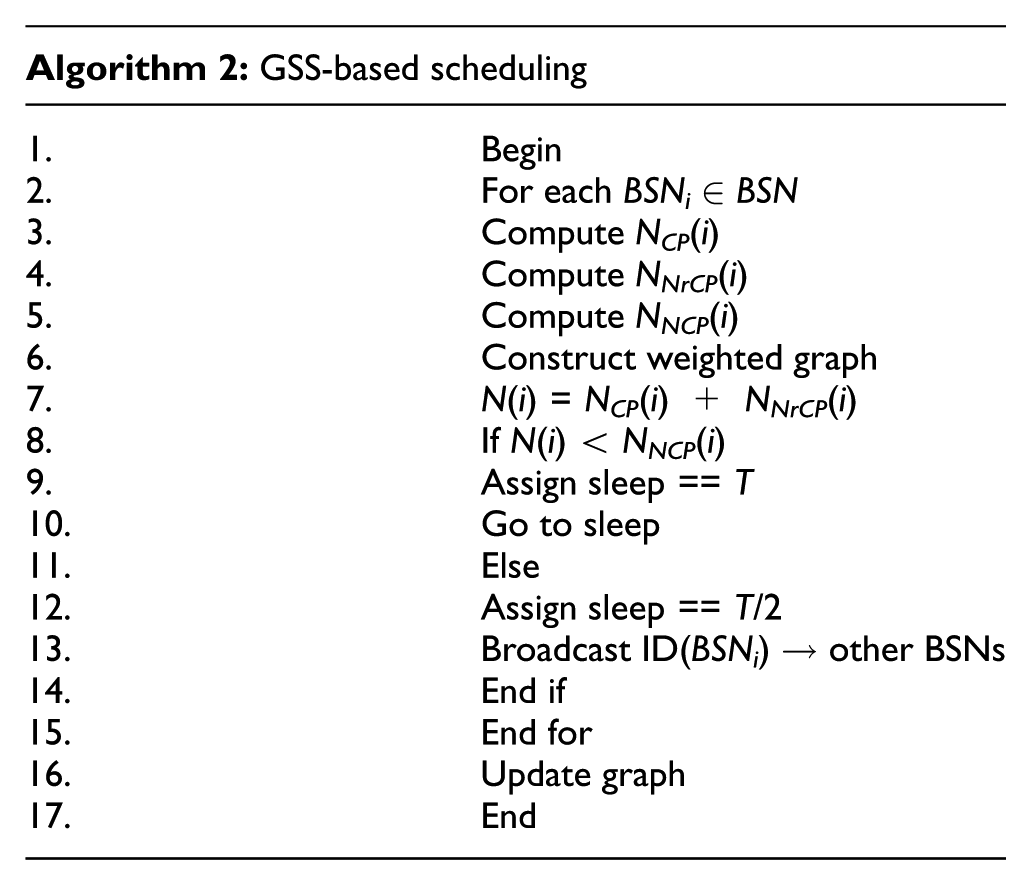
Algorithm 2 explains the scheduling process enabled by CR using GSS scheme. Here, criticality level of sensor node is also considered as significant metric which increases the overall network performance. GSS scheme also minimizes energy consumption among BSNs due to idle listening.
Packet classification by SMNN classifier
CR is responsible for receiving all types of data packets from all BSNs in the network. The aggregated packets are classified by CR into normal and emergency packets. The classification process is carried out by SMNN classifier which speeds up the classification process. In SMNN classifier, initially, incoming packets are divided and then mapped to corresponding class. The splitting and mapping processes are performed over neural network in order to minimize time consumption for classification. Packet size (PS), data type (DT), and time to live (TTL) are considered for classification. Initially, all packets are fed into input layer of neural network. Then, split and map phases are executed consequently on each packet. Here, split phase is responsible to spilt all three features from each packet. Then, in map phase, packets with similar features that satisfy particular conditions are mapped to same class. Involvement of neural network minimizes the time consumed for packet classification. The process of SMNN classifier is detailed in Figure 5. In SMNN classifier, split phase extracts all three features for classification. Then, in map phase, the optimal conditions are applied on each packet in order to assign packets to corresponding classes. Based on above conditions, packets are separated into two classes such as class 1 (emergency) and class 2 (normal). Packet classification plays a vital role in EQ-WBAN since CR assigns packets to corresponding sink node based on packet type.

Packet classification by SMNN classifier.
Here, the following steps are executed to classify the incoming packets in SMNN classifier.

Frame aggregation
Frame aggregation is a process of transmitting two or more frames in a single transmission. The main aim of frame aggregation process is to improve throughput by transmitting multiple frames through single transmission. Here, MAC service data unit (MSDU) aggregation scheme is utilized for frame aggregation. Frame aggregation process is performed on both SN and E-SN with the aim of improving throughput in EQ-WBAN. The aggregated MSDU frame consists of multiple SDUs. Source and destination address of each SDU is mapped to same transmitter and receiver address. However, this mapping process is not required in our work since all data packets have destination address which referred to monitoring server. Then, aggregated frame is transmitted to monitoring server for further diagnosis. The aggregated MSDU format is depicted in Figure 6.

Aggregated MSDU format.
The aggregated MSDU comprised the following fields: frame control, destination ID, address 1 address 2, address 3, sequence control (Seq ctrl), address 4, QoS control, high throughput (HT) control, aggregates-MSDU (A-MSDU), and frame check sequence (FCS). Then, aggregated MSDU frame is transmitted to server for further diagnosis. Involvement of frame aggregation process in EQ-WBAN enables high throughput efficiency with minimum delay.
Thus, involvement of IA-MAC protocol, energy- and QoS-efficient PWR routing algorithm, criticality-aware GSS scheduling scheme, delay-efficient packet classification, and throughput-efficient frame aggregation scheme in EQ-WBAN improves the overall performance of the network.
Performance evaluation
In this section, the performance of the proposed EQ-WBAN is evaluated in terms of performance metrics. This section comprised the following subsections: simulation environment and comparative analysis.
Simulation environment
EQ-WBAN network is implemented in OMNeT++ environment by utilizing C++ language. OMNeT++ is an extensible component-based framework specially designed to construct various networks. In our work, OMNeT++ is used since it highly supports graphical user interface which can be installed on Windows-7 operating system. In addition, OMNeT++ works well in implementing various communication protocols, routing protocols, optimization algorithms, sensor networks, and so on. It is a well-structured, highly modular tool which increases the application areas of OMNeT++. Thus, we have adapted OMNeT++ in the simulation of EQ-WBAN. The experiments are carried with four to five body sensors and single coordinator in simulation.
Table 2 lists out the significant parameters considered in EQ-WBAN implementation.
Simulation parameters.

In Table 3, the criticality level of different types of sensors is depicted. In our work, we have used oxygen-level sensor, respiratory sensor, heart rate sensor, and temperature sensor in order to collect biomedical data. For collected data, the criticality level is determined as per Table 3.
Critical and non-critical data specifications.
In Table 4, the obtained results for energy consumption during each process are depicted.
Obtained results for energy consumption.

The contention window (CW) for different data types such as critical, near-critical, and non-critical is set up as per Table 5. Here, critical data are provided with smallest CW duration, while non-critical message is provided with largest CW duration.
Contention window for different data types.

Comparative analysis
In this subsection, we evaluate our proposed EQ-WBAN in terms of performance metrics. Comparisons are made with previous works such as Ahmed et al., 18 Jing et al., 21 and Bradai et al. 28 based on energy consumption, network lifetime, dropped packets, throughput, and delay.
In Table 6, drawbacks existed in previous research work are discussed. These drawbacks have huge impact on performance metrics.
Drawbacks in previous works.

LAEEBA: link-aware and energy-efficiency protocols for wireless body area network; Co-LAEEBA: cooperative- LAEEBA; iM-SIMPLE: improved, stable, increased throughput multi-hop link-efficient protocol.
Effectiveness of energy consumption
Energy consumption in WBAN is defined as the total amount of energy consumed by the network to perform sensing, transmitting, and receiving. Energy consumption (EC) of network is expressed as follows

here, ETi represents energy consumed by “ith” BSN for transmission, ERi refers to energy consumed by “ith” BSN for data reception, and ESi represents energy consumed by “ith” BSN for sensing. Transmission energy is directly proportional to distance between source and destination.
In Figure 7, we compare the energy consumption in the proposed EQ-WBAN with Quasi-Sleep-Preempt-Supported (QS-PS) method. We can see that energy consumption in EQ-WBAN is significantly lower than QS-PS method. The reason behind higher energy consumption in QS-PS method is the involvement of tree topology which increases energy consumption of nodes presented in high level. However, EQ-WBAN resolves this problem by enabling efficient PWR-based routing and GSS-based sleep scheduling. Proposed EQ-WBAN method is relatively 40% efficient than previous work, that is, it minimizes 40% of energy consumption in the network. Even with the increase in simulation time, our proposed work consumes nearly 60 mJ, that is, to perform same task, the energy consumption will be same with the increase in simulation time.
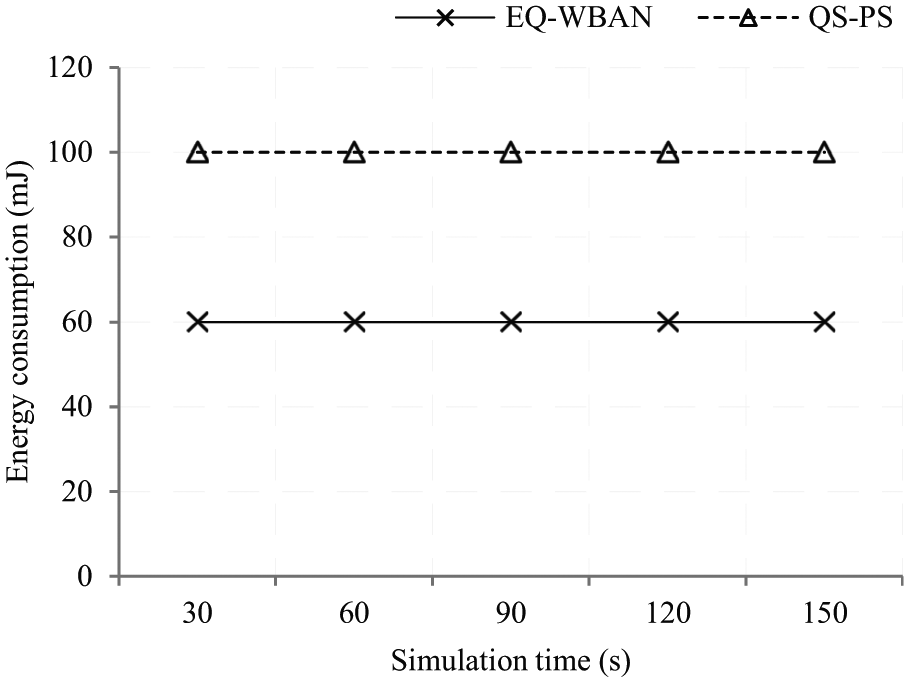
Analysis on energy consumption.
Effectiveness of network lifetime
Network lifetime is defined as the time span from the start of the network till the death of nodes in the network. In other words, network lifetime is the time duration in which the whole network is active, that is, all nodes are alive. It can be computed as follows

The network lifetime (NL) is computed in terms of constant continuous power consumption (PC), excepted wasted energy (E[W]), average sensor reporting rate (
In Figure 8, we analyze the network lifetime in the proposed EQ-WBAN with other existing woks. Here, the time taken for first node dead is considered as network lifetime. In M-attempt method, first node dies within 22 s, while in simple method, first node dies within 42 s. In iM-SIMPLE method, all nodes are alive for only 45 s which is relatively lower than EQ-WBAN. Since iM-SIMPLE method increases the number of retransmission due to inefficient route selection, node early dead occurs in iM-SIMPLE method. Proposed EQ-WBAN network survives for 98 s which is relatively higher than other existing works. Here, energy consumption is minimized by PWR algorithm and GSS scheme which improve network lifetime. In addition, optimal route selection also helps to minimize energy consumption which leads to lifetime maximization.

Analysis on network lifetime.
Effectiveness of dropped packets
In a network, packets are dropped whenever the status of the link is lower than the required level. Packet drop decision is taken by BSNs whenever it has lower energy than required level. Thus, analyzing the number of dropped packets represents the energy efficiency and QoS efficiency of the proposed work.
Comparative analysis on dropped packets is depicted in Figure 9. From the figure, we can see that EQ-WBAN method minimizes the number of packets dropped compared to Critical Data (CD) method. In EQ-WBAN method, nearly 10% of packets are dropped, while CD method drops 40% of packets in the network. However, in EQ-WBAN method, all critical packets are provided with required QoS and reliable transmission with the support of E-SN. But CD method drops packets without knowledge of packet type based on critical delay and waiting delay. Thus, the number of packet drops in CD method is higher than EQ-WBAN.
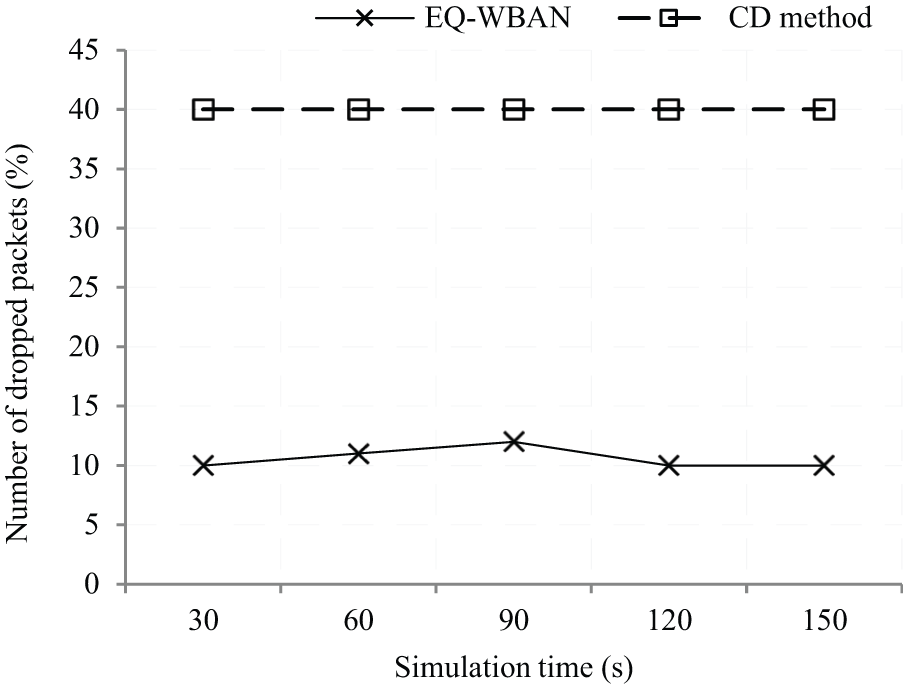
Analysis on dropped packets.
This analysis shows the efficiency of PWR algorithm involved in EQ-WBAN. A small amount of packet drop occurs due to involvement of GSS scheme; however, critical packets are not affected which improves the overall performance of the network.
Effectiveness of throughput
Throughput refers to the total number of packets transmitted to a specified destination in a particular period of time. It is also defined as the ratio between packet size and transmission time as follows

Throughput efficiency of the proposed EQ-WBAN method is depicted in Figure 10. Here, CD method attains lower throughput of around 35 kbps. From the analysis on dropped packets, we come to know that CD method drops large number of packets. This large number of packet dropping in CD method minimizes throughput efficiency. Similarly, Co-LAEEBA method provides throughput of around 60 kbps which is higher than CD method but relatively lower than EQ-WBAN method. Involvement of PWR-based routing algorithm supports to achieve throughput up to 82 kbps. In EQ-WBAN method, throughput increased with increase in simulation time since the number of packets reached destination increases over time.

Analysis on throughput.
Effectiveness of delay
The delay is defined as the finite time duration taken by a packet to reach its destination from the source node. Delay metric involves all possible delays during data transmission such as queuing delay, processing delay, propagation delay, and transmission delay. It can be expressed as

here, tr refers to the time taken by a node to receive packets, and ts represents the time taken to send the number of packets.
Figure 11 shows the delay efficiency of the proposed EQ-WBAN. Delay in QS-PS method is larger than other methods, which is nearly 20 ms higher than other works. Higher delay in QS-PS method is introduced due to involvement of tree topology, that is, the nodes presented in the lower level of trees take large amount of time to reach the destination. CD method attains 64 ms as an average delay which is slightly higher than EQ-WBAN method. However, 64 ms delay is also experienced by critical packets which are to be served within time. EQ-WBAN method minimizes average delay to 60 ms with the help of dual sink nodes, frame aggregation, and PWR routing.

Analysis on delay.
The overall analysis shows that EQ-WBAN achieves better results in energy consumption, network lifetime, dropped packets, throughput, and delay. Therefore, the proposed IA-MAC, PWR algorithm, GSS scheme, and SMNN classifier are efficient which improve the overall performance. The proposed work has major impact on QoS level in WBAN which emerges in real-world scenario. While applying our work in real-time cases, our work will achieve better results in QoS as well as energy efficiency.
Conclusion
In this article, an efficient EQ-WBAN architecture with dual sink nodes is designed to enhance QoS and energy efficiency in WBAN. QoS requirements for critical data transmission are achieved with the help of IA-MAC. Based on the criticality level of data, BSN performs route selection by utilizing PWR algorithm. PWR algorithm uses weight value which is computed with multiple significant metrics along with past experiences for optimal route selection. Energy consumption is further minimized by enabling GSS scheme–based sleep scheduling among BSNs. Here, criticality level of patient is also considered in order to improve network performance. Coordinator classifies all incoming packets into emergency and normal packets in order to transmit the packets to the corresponding sink node. Effective classification is performed by SMNN classifier in which packets are classified through split and map phases. Here, packet size, data type, and TTL are considered for classification. Frame aggregation process is initiated by both sink nodes with the aim of maximizing throughput metric in the network. Extensive simulation in OMNeT++ tool shows that proposed EQ-WBAN increases network lifetime and throughput, while decreasing energy consumption, delay, and dropped packets. In future, we have planned to improve security aspects of EQ-WBAN to defend against major attacks such as spoofing, eavesdropping, and jamming attacks.
Footnotes
Handling Editor: Joel Rodrigues
Declaration of conflicting interests
The author(s) declared no potential conflicts of interest with respect to the research, authorship, and/or publication of this article.
Funding
The author(s) received no financial support for the research, authorship, and/or publication of this article.