




Abstract
To reduce frequent sensor recharging and replacement due to resource constraint, it becomes imperative to increase the management of energy and network’s quality of service. To this end, this article provides a new wireless body sensor network architecture with two sink nodes and multiple energy management and quality-of-service algorithms. The first algorithm is the normal data avoidance algorithm that is responsible for decreasing the energy usage by avoiding the transmission of normal data. Duplicate data avoidance algorithm avoid transmitting duplicate data thus saving the bandwidth and battery life. Past knowledge-based weighted routing algorithm oversees taking the ideal direction to transmit information, hence improving quality of service. Furthermore, sleep scheduling is integrated to further improve the battery life. In addition, in our proposed model, linear programming which is based on mathematical models was used to model the network lifetime maximization and continuous data transmission minimization. Through simulation in Castalia-based OMNeT++ demonstrates that our proposed work outperforms the works of quasi-sleep-preempt-supported with regard to network lifetime and delay with 50% and 30% improvement, respectively, moreover, it improves the work of critical data with respect to packet drop and throughput with 30% and 75% improvement, respectively.
Keywords
Introduction
Proportion of senior citizens is considerably growing in industrialized countries and poor countries also. The disturbing growth in population of senior citizens is resulting to overburdening of medical facilities and rise in cost of healthcare. 1 The World Health Organization (WHO) forecasts that the people older 65 years will soon be larger than the number of kids less than 5 years old. 2
However, every year millions of individuals pass on yearly diseases, for example, Parkinson’s diseases, cardiovascular diseases, cancer, and diabetes. The most important challenge with these fatal ailments is that individuals realize the warning signs and have the illness diagnosed when it too late. However, scientists have showed that if these diseases are noticed in their initial stages, they can be prevented. A major solution is a sensor network consisting of wearable or in vivo sensors which are cheap and can detect diseases in their early stages, as a result leading to significant enhancements in life quality. This sensor network is referred to as wireless body sensor network (WBSN). 3
Nadeem et al. 4 proposed a protocol called SIMPLE that decreases the energy expenditure and enhances the network throughput. However, quality of service (QoS) was not considered despite its significant importance in WBSN.
Paper published in Ahmad et al., 5 which is an enhancement on Javaid et al., 6 was developed to improve the energy management and throughput whereas reducing the drop of the packets. The nodes were positioned by considering the nodes energy degree. Mix communication approach is considered whereby direct communication is employed for urgent data whereas multi-hop is employed for non-urgent ones. The method to separate non-critical and critical data (CD) was not discussed. CD can be sensitive, but there was no information on the consequences of sensitive data. Ahmed et al. 7 proposed an algorithm that evades interference among dissimilar wireless body area network (WBAN) in a hospital. On the contrary, routing data between the nodes were not giving due consideration. Moreover, energy consumption and QoS have been given little or no attention. Sagar et al. 8 proposed a technique that transmits only CD and ignores normal data in order to save energy; however, reliability of the channel and packet dropped is not considered. A reliability guaranteed WBAN structure that monitors the physiological parameters of an individual continuously for an extensive duration. A modified media access control (MAC) protocol is employed; however, significant energy saving is not achieved because of frequent transmission of all kinds of data.
To this end, we design our research objectives to achieve the following contributions:
A new WBAN architecture made up of twin nodes which improve both QoS and network lifetime (NL) of the network. The nodes are termed as high normal sink (HNS) and emergency sink (ES) which are responsible for gathering high normal data (HND) and emergency data (ED), respectively.
Enhanced-media access control (E-MAC) algorithm is developed to split the data into normal data (ND), HND, and ED packet. The E-MAC does not add complexity or overhead because emergency level of data is represented in 0s and 1s.
Normal data avoidance (NDA) algorithm which decreases the energy consumption by ignoring the transmission of ND.
To further decrease the energy consumption by developing a duplicate data avoidance (DDA) algorithm that avoids transmitting duplicate data.
Past knowledge-based weighted (PKW) routing protocol is in charge of selecting the optimal route for data transmission, hence improving QoS.
Sleep scheduling is integrated to further improve the battery life.
Provided mathematical models based on linear optimization for NL maximization, permanent transmission of data, and end-to-end delay minimization.
Related works
Some of the related studies proposed by researchers in the health monitoring area of WBAN are provided here. The focus will be on their contributions in terms of proposing different routing protocol to overcome different energy and QoS-constraints, for instance, throughput, delay, and packet drop. Data transmission technique for more than one WBSN fields was proposed with clustering method in Mu et al. 9
The main goal of the work was the enhancement of the QoS in the WBSN field. In order to archive that, an individual organizing adaptive grouping method was presented with more than one WBSNs. The drawback of the technique is the cluster formation that takes into account more than one body sensor networks (BSNs) and a one body area network (BAN) sensor uses regular method which additionally rises the energy depletion. A new BSN architecture with two sinks that enhances the QoS and extends the NL was presented. 10
The proposed work comprises of four protocols among which are Improved Medium Access Control Protocol (I-MAC) and PKW. Because of its importance, intensity is decided by the two sensor nodes and the sin. Shimly et al. 11 proposed a carrier sense multiple access with collision algorithm to remove the challenges in time division multiple access. In order to achieve that, the shortest path routing (SPR), which selects single path based on distance metric, and cooperative multi-path routing (CMR), which selects multiple paths based on back-off time, are utilized. However, this led to greater loss and depletion of energy. Also, the planning does not take into consideration the cruciality points of the data which is extremely needed in the wireless body area network environment. For optimum route choice, ant colony optimization (ACO) algorithm was introduced in wireless body area network. 12 The ACO locates an optimal route among the sender and the destination. It achieves energy improvement and weight stabilizing at the same time at every intermediary sensor. For the duration of route change, cluster head (CH) rotation was enabled to realize energy improvement. Nevertheless, the ACO has greater data communication lag. A routing protocol called Tripe-EEC chooses the ideal routes with great remaining energy, and the lowest possible temperature increase was proposed by Ullah et al. 13
The authors group the sick people’s information into four groups, namely, regular data, data on-demand, emergency information of small threshold result, and emergency information of great threshold result. Other algorithms were created for calculating cruciality of physiological parameters and sharing of dynamic and battery effective routes by eliminating dispute among them. They compared their work with advanced protocols in a realistic medical environment. However, in the route selection, they considered only one metric which is grossly insufficient and multiple hop increase delay in ED transmission. Crucial, urgency, and classified forwarding methods for effective communication of a patient’s important information to the sink were presented for mobility supported WBAN. 14 The data transmitting was achieved by predecessor-successor-node (PSN) technique. Even though the work efficiently utilizes energy, it proves inefficient for a real-time environment.
ORACE-Net is presented for the multi-BAN setting. 15 The technique calculates the value of the link between multiple BANs to opt for the ideal route for the sending of data. Although the link value metric enhances the data communication, it increases the delay due to multiple hops. Therefore, several factors must be considered in the multi-BAN setting. In addition, the measured metrics are inadequate to attain improved QoS and energy effectiveness.
QoS and energy management were the focus in these studies.16–19 The studies centered around lowering the power consumption, packet drop, and delay while improving the link quality and throughput. The downside for their achievement was the increase in complexity and cost of implementation. The literature20–32 proposed various protocols, techniques, and algorithms for energy utilization and QoS improvement; however, they fail to provide any mathematical models to this effect.
Mathematical modeling
Two linear programming mathematical models were discussed as follows: maximizing NL and minimizing continuous data transmission. The subsequent sections present more information.
Maximizing the NL
Energy models that were provided in the literature7,33,34 were used. We select these models since they are in accordance with the assumptions of our technique. Energy expenditure in sending and receiving per bit is provided in equations (1)–(4). Since the proposed method is parent centered, consequently, the two distinct node types are parent and normal. Parent or forwarded node is any node that has at least the highest amount of remaining energy and the shortest duration to destination otherwise known as sink. They are considered the nodes with the least cost. The key objective is NL maximization T, which is made as shown as follows. The objective function in equation (1) is the NL T, maximization. Equation (2) defines T as the summation of rounds during which the normal and parent nodes perform their functions prior to their energies Ei and Ep are diminished. Equation (3) calculates the received energy of the parent node. Ø stands for the data aggregation factor, N is the total number of nodes, l is the size of the packet, i is the normal node, and p represents the parent node. If the per bit sensing, processing, and transmission energy of normal nodes are characterized as









Then, equation (6) gives details about the per round energy consumption expenditure of the network. In constraint (7.1 and 7.2), the initial energy E0 must continually be larger than the current energies Ei and Ep because in every passage of time, the current energies decline. A node stops working when Ei and Ep ≤ ETX. Constraints in equation (7.3) consider sensing, processing, and transmission of data by normal node and ensures that these events respect their initial energy level (q = 1/T). They are only present at the parent node leading to decreasing and stabilizing of the energy expenditure. Equation (7.4) in contrast does not take into account Es and Ep which are only introduced in usual nodes. This also reduces and stabilizes the energy expenditure. Constraints in equations (7.5 and 7.6) guarantee flow conservation when data are routed from i to p and from p to s with their physical link abilities, Cip and Cps, respectively. Violation of these two constraints results to increased congestion which triggers increased delay and eventually to data being dropped. In order to retransmit the dropped packets, further energy is expended that results in diminished NL. Constraint in equations (7.7 and 7.8) indicates that the routing algorithm should be able to minimize the communication gap dip and dps to its lowest possible value dmin.
Continuous data transmission minimization
Constant data communication results to constant energy reduction. Constant transmission is tackled here and presented as shown as follows


The objective function in equation (8) intends to reduce the constant transmission (CT) of data from sending node s to parent node p. CT means the constant reduction in the node’s energy Ei when each data is sensed. Equation (9) gives information; in the initial part of equation (9), currently sensed data
Proposed Dual-sink Energy-efficient and QoS architecture for BSN
The entire architecture of the proposed Dual-sink Energy-efficient and QoS architecture for BSN (DEQ-BSN) is depicted in Figure 1 and its components are described as follows:
1. BASN: the body area sensor nodes (BASNs) are positioned around the body to monitor the vitals, route the sensed data, and send the data to the appropriate destination sensor node.
2. E-MAC protocol: it is created to divide the data into ND, HND, and ED packet. The E-MAC does not add complexity or overhead because emergency level of data is represented in 0s and 1s.
3. HNS: it oversees receiving HND from BASN.
4. ES: it oversees receiving ED from BASN.
5. NDA algorithm: it decreases the energy consumption by ignoring the transmission of ND, which is provided in Algorithm 1.
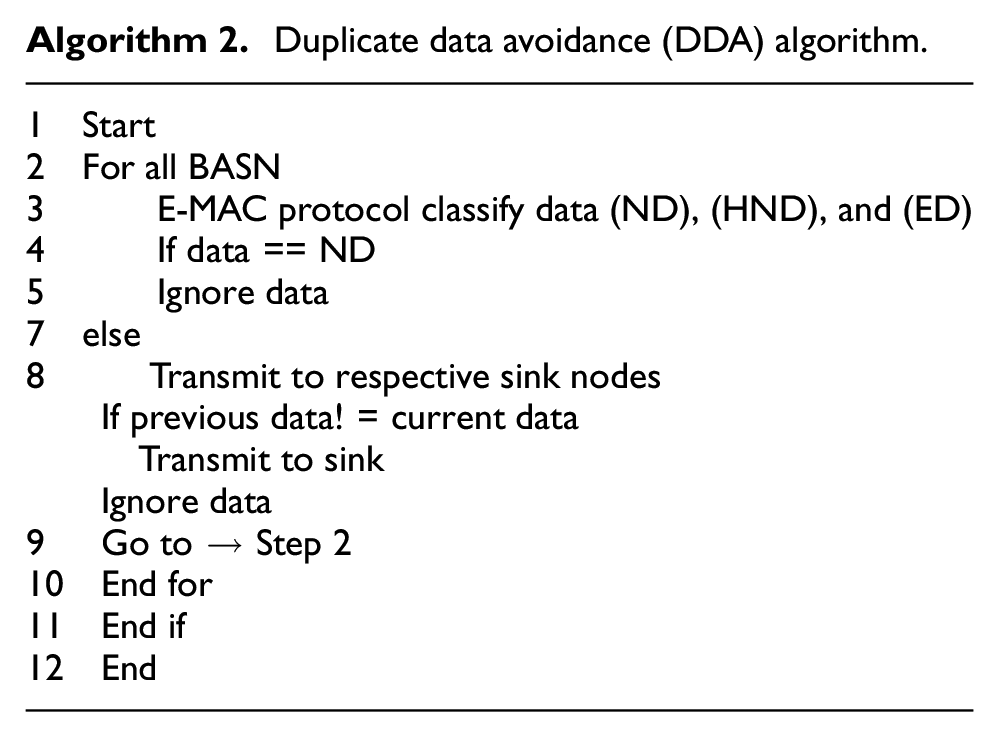
6. DDA algorithm: it is responsible for avoiding the transmission of duplicate data, which is shown in Algorithm 2.
7. sPKW algorithm: its role is for selecting the best possible path for data communication in case of HND, hence improving QoS and battery life. However, in the case of ED, the data are communicated promptly to the ES without delay. In a nutshell, PKW employs both single-hop and multi-hop communication. Single hop is enabled if the data are an ED such as shown in Table 1 while multi-hop communication is employed if the data are a HND as seen in Table 1.

DEQ-BSN architecture.
Normal data avoidance (NDA).

Duplicate data avoidance (DDA) algorithm.
Data type filed binary form.

ND: normal data; HN: high normal data; ED: emergency data; PKW: past knowledge-based weighted.
In PKW-multi-hop communication, the optimal next hop is chosen on the basis of weight value that is defined by considering some metrics and past knowledge of neighboring nodes. The past knowledge of neighboring nodes is the amount of packets successfully sent through the BASN. The weight value is computed as follows

where Wi is the weight value of node i, PKi is the past knowledge of neighboring nodes, REi is the residual energy, LSi is the link stability, Di is the delay in transmission to sink, and DSi is the distance to sink. Equation (11) shows how the weight value is computed. Table 2 shows the notations and meaning.
Important notations and meanings.
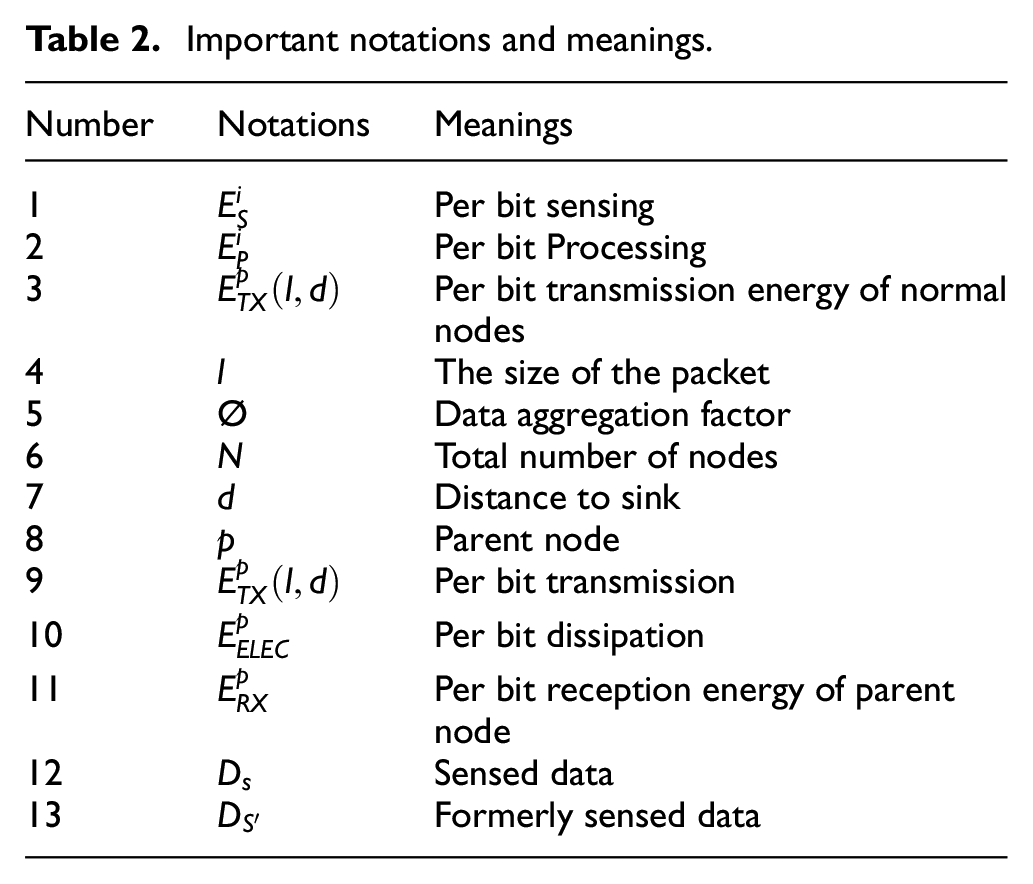
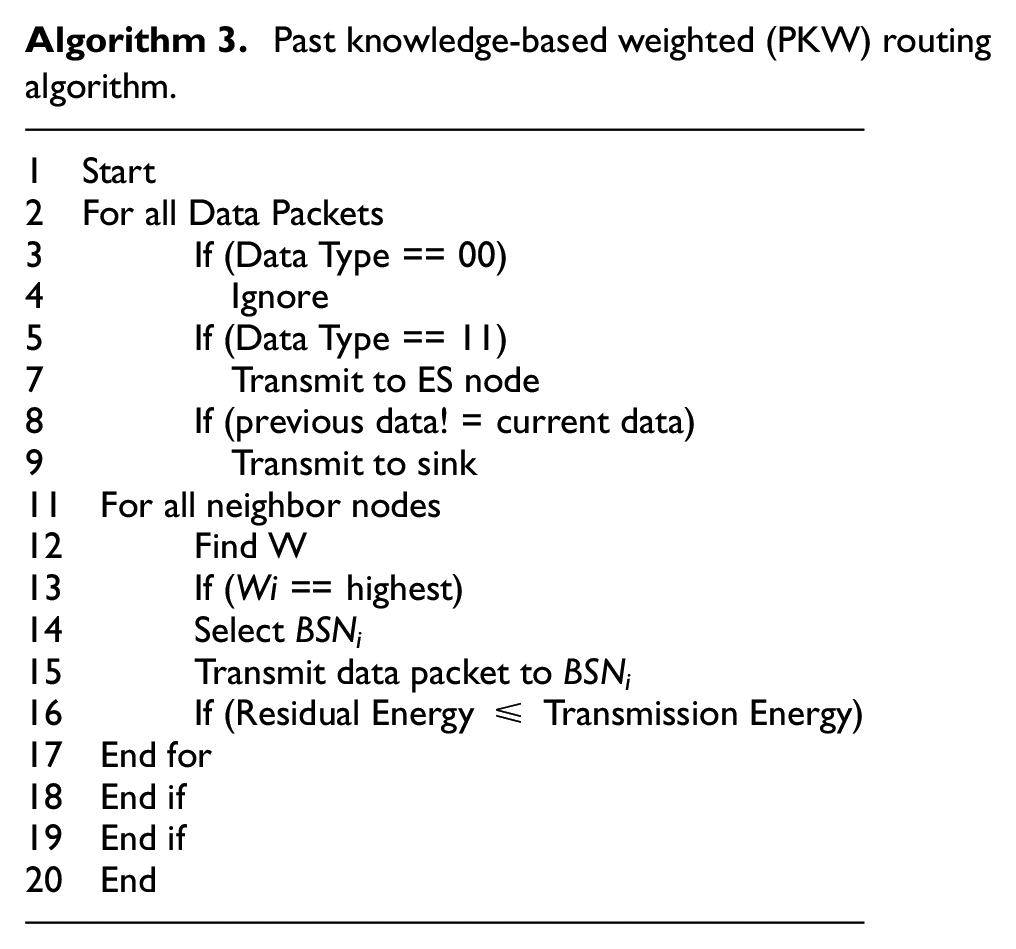
The sensor node with the greatest weight value is deemed as the optimal next hop for data transmission. By computing the weight value, throughput is maximized while delay, reliability, and energy consumption are minimized. The overall PKW algorithm can be seen in Algorithm 3.
Past knowledge-based weighted (PKW) routing algorithm.
The link stability can be computed as given in equation (12). For example, to find the link stability between BASNj and BASNi, the coverage range of BASNj is divided by distance between sensor node j to sensor node i

8. Sleep–wake duty cycle: it is responsible for reducing the idle listening and overhearing while increasing the NL and throughput. The sleep and wake up schedule are assigned according to the kind of information that is sensed by the sensor node. The flow chat of the whole operation is shown in Figure 2. First, SND represent the sensor node with n number of ND packets. SHND represent the sensor nodes with n number of HND packets, and SED represent the sensor nodes with n number of ED packets. On the condition that the sum of the number of ED packets and high normal packets is higher than the number of packets ND packets for a particular BSN, then that BSN is deemed as an emergency BSN and allotted with T/2 time slot. Subsequently, the BSN ID is broadcasted to all other nodes to stop it from becoming forwarder.

Sleep–wake duty cycle operations.
Simulation evaluation
This section analysis and evaluates the implementation of the proposed DEQ-BSN architecture pertaining to NL, throughput, delay, and packet drop performance metrics. The comparison is made with similar techniques such as Simple, iM-Simple, Energy-aware QoS-guaranteed WBAN (EQ-WBAN), Link aware and energy efficiency protocol for wireless body sensor network and cooperative (Co-LLEEBA), quasi-sleep-preempt-supported (QS-PS), and CD.
Simulation tool
The simulation environment used in this work is Castalia-based OMNET++ frameworks. The choice for OMNET++ was as a result of the analysis performs by Elias and Mehaoua 33 that shows OMNET++ is better than all similar simulators especially with respect to implementation of routing protocols. Table 3 shows simulation parameters.
Simulation values.

WBSN: wireless body sensor network; BSN: body sensor network; MAC: media access control.
Energy consumption
It is described to as the sum of the energy expended by nodes during different activities like sensing (ES), transmitting (ET), and receiving (ER) of data packets (Table 4).
Sensor node energy expended.

In Figure 3, the energy consumption of the proposed DEQ-BSN was compared with No Algorithm, QS-PS, and EQ-WBAN. It can be seen that our proposed DEQ-BSN significantly outperforms No-Algo, QS-PS, and EQ-WBAN by 60%, 50%, and 10%, respectively. The reason is that in No-Algo, whenever the data are sensed, it is transmitted without considering any algorithms, In the case of QS-PS, a complex tree topology is used which lead to an increase in energy consumption and finally, for EQ-WBAN, non-CD were transmitted, duplicate data were not considered, and coordinator was used which added complexity, delay, and increase in energy consumption. However, our proposed technique outperforms all the others due to the algorithms that were used.

Analysis on energy consumption.
NL
This is the time period in which all the nodes in the network are active. Hence, it is the time taken for the first node to die. It can be computed as shown in equation (13)

where PC is the constant power continuous power consumption, E [W] is the exempted waste,
In Figure 4, the NL of the proposed DEQ-BSN was compared with similar state-of-art algorithms. In No-Algo algorithm, its NL is only 8 s, this is because nodes are transmitting without following any algorithm. In iM-Simple, it achieved a lifetime of 60 s because of the inefficient selection of intermediate node. While in the case of EQ-WBAN, a better NL of 96 s was realized although lower than our algorithm. This is because complexity of CR and transmission of duplicate and non-CD. The proposed work achieves a much longer NL due to the implementation of NDA, DDA, PKW, and sleep–wake duty cycle algorithms.

Network lifetime.
Packet dropped
A sensor node drops packet whenever it residual energy is less than the required threshold to transmit a data packet. Figure 5 illustrates the number of packets dropped based on the implemented algorithm.

Packet dropped.
Our proposed algorithm drops the fewest number of packets due to the several techniques that make up our proposed Dual-sink Energy-efficient and QoS architecture for BSN (DEQ-BSN) especially the employment of dual-sink node. In CD algorithm, about 40% of packets are dropped. In addition, for Energy-aware QoS-guaranteed WBAN (EQ-WBAN), more packets are dropped than our algorithm because of their inefficient techniques that makes up their algorithm.
Transmission delay
It is the total time taken by the data packet to get to the sink node from the source. Delay is expressed in equation (14)

where tr is the time taken by a node to receive a data packet, and ts is the time taken to send number of packets to the next node.
Figure 6 shows the delay experienced by the proposed algorithm and similar ones. QS-PS incurred about 80 ms delay as a result of the complex tree topology used in the algorithm. In the case of CD, a delay of about 62 ms was obtained regardless of the criticality of data packet. While EQ-BAN achieved less delay compared to the other two, it failed to match the delay is DEQ-WBAN because of the use of CR which coordinates all of the EQ-BAN techniques, hence causing delay. The proposed DEQ-BAN outperforms all the similar algorithms because of its dual architecture, multiple algorithms, and lack of CR.

Delay.
Network throughput
It is the total amount of packets sent to actual target in specific time duration. It is additionally described as packet size divided by transmission times as shown in equation (15)

Figure 7 shows the throughput comparison of DEQ-BSN and similar works. It is evident from the figure that our algorithm achieves higher throughput. No-Algo has the lowest throughput because it depletes it energy fast; hence, it is unable to transmit any data to the sink node. CD achieves better network throughput compared to No-Algo; it throughput is significantly lower than the rest because of the large number of packet losses. Even though EQ-WBAN attained a throughput of around 75 kbps, our proposed technique outperforms it due to its limited packet drop.

Throughput.
The above findings demonstrate that the proposed DEQ-BSN substantially surpasses similar algorithms in delay, NL, energy consumption, packet drop, and throughput. Hence, it can be concluded that our dual-sink architecture with E-MAC protocol, NDA, DDA, PKW, and sleep–wake up duty cycle is efficient enough to increase the total performance of the network. This proves that if our work is applied in real-time scenario, it will attain similar results.
Conclusion
This article has presented a dual-sink WBAN architecture with energy-efficient and QoS routing protocols. The aim of the dual-sink node is to ensure that each type of node reach its appropriate sink without delay in separating the data packets. Five different algorithms were presented which increase the network lifetime and the QoS of the network. The first algorithm is the NDA that ignores the transmission of ND. Next is the DDA that avoids the transmission of duplicate data. Then, PKW algorithm is used for selecting the optimal route for data transmission, hence improving QoS. Sleep scheduling is incorporated to help improve the battery life. Next, linear programming–based mathematical model was designed to model the network lifetime maximization and continuous data transmission minimization. Exhaustive simulation in OMNeT++ tool demonstrates that the proposed work surpasses similar state-of-the-art research with regard to network lifetime, throughput, energy consumption, delay, and dropped packets. As a future work, we intend to add energy harvesting and security to further increase the overall performance and defend the network against major attacks.
Footnotes
Handling Editor: Benny Lo
Declaration of conflicting interests
The author(s) declared no potential conflicts of interest with respect to the research, authorship, and/or publication of this article.
Funding
The author(s) received no financial support for the research, authorship, and/or publication of this article.
